Developmental Dysplasia of the Hip
by
Dr. Mostafa El-Sebai Hammad
Definition and terminology
• First CDH, Now DDH
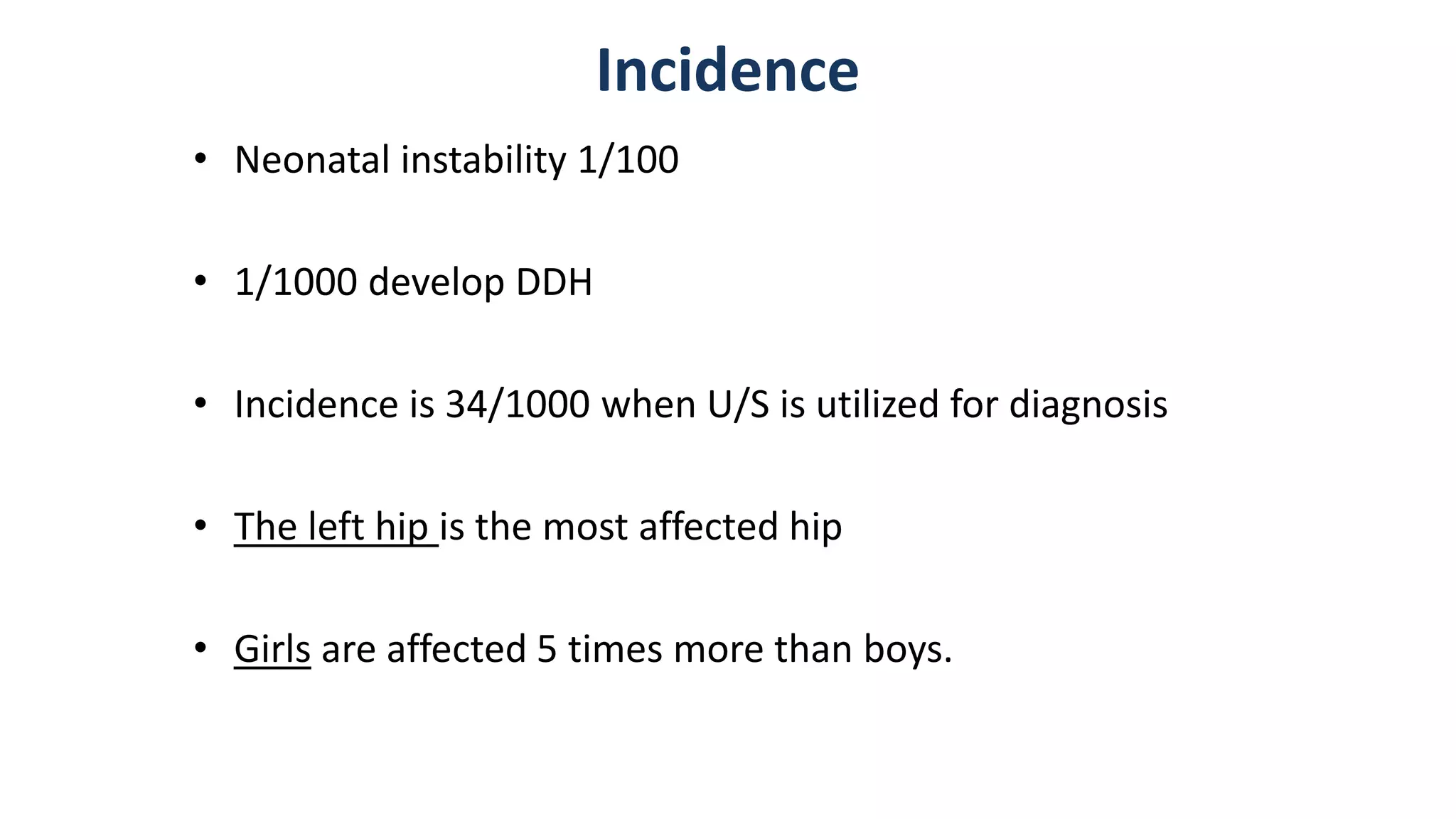
• Klisic 1989: Congenital dislocation of the hip, a bief report):
proposed “Developmental displacement of the hip”
as not all cases are present at birth and that some
cases can develop later-on
• Modern diagnostic imaging allowed more
understanding of the more subtle forms of
Dysplasia, Instability, Subluxation or
So it is now Developmental dysplasia of the hip
Incidence
• Neonatal instability 1/100
• 1/1000 develop DDH
• Incidence is 34/1000 when U/S is utilized for diagnosis
• The left hip is the most affected hip
• Girls are affected 5 times more than boys.
Aetiology
Polygenic
Hormonal: Estrogen ; relaxin
• Maternal relaxin hormone produce ligamentous
laxity that is necessary for the expansion of the
maternal pelvis,
• cross the placenta and induce laxity in the infant.
This effect is much stronger in female than in male
children.
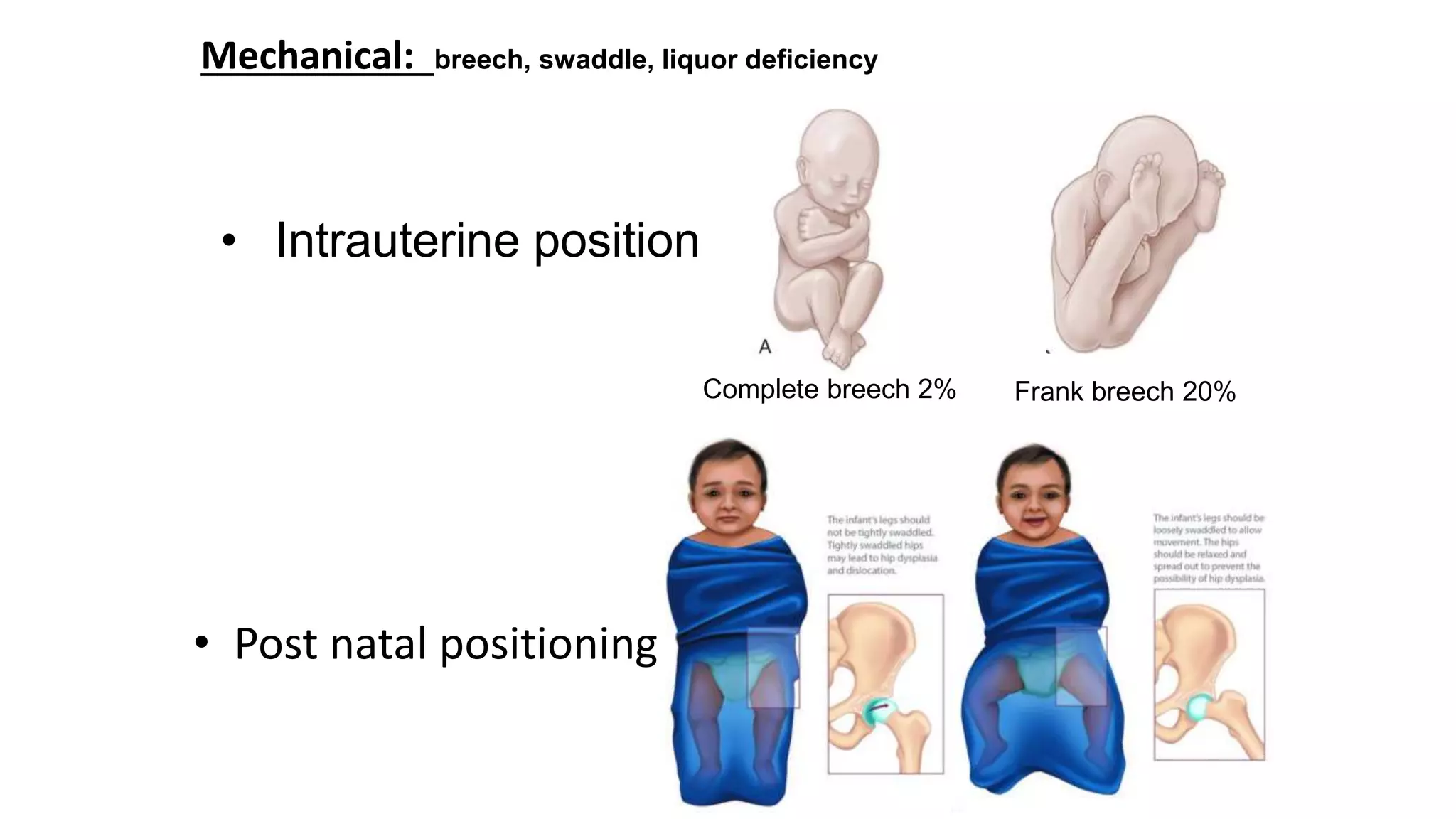
• Post natal positioning
Complete breech 2% Frank breech 20%
Mechanical: breech, swaddle, liquor deficiency
• Intrauterine position
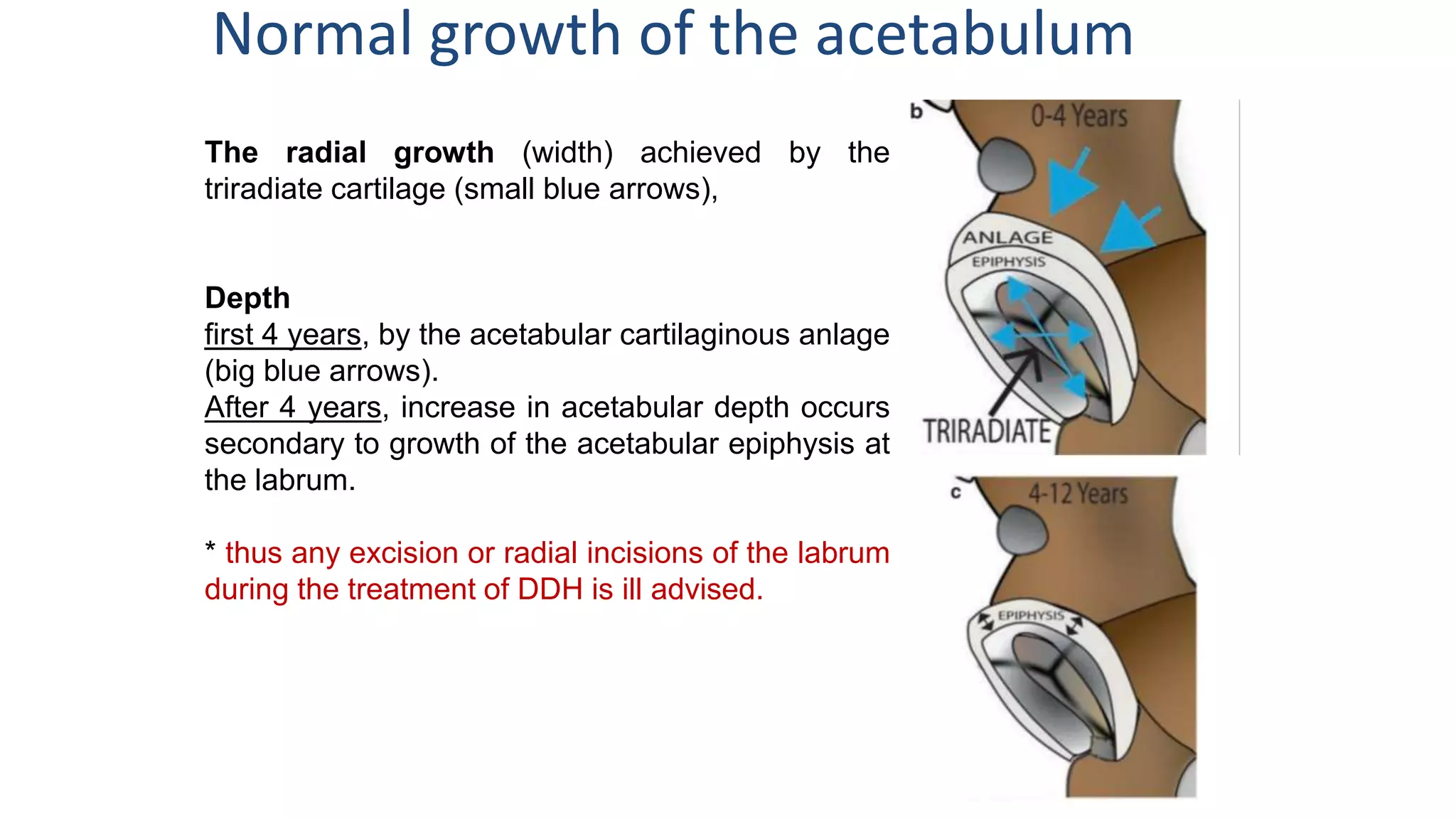
The radial growth (width) achieved by the
triradiate cartilage (small blue arrows),
Depth
first 4 years, by the acetabular cartilaginous anlage
(big blue arrows).
After 4 years, increase in acetabular depth occurs
secondary to growth of the acetabular epiphysis at
the labrum.
* thus any excision or radial incisions of the labrum
during the treatment of DDH is ill advised.
Normal growth of the acetabulum
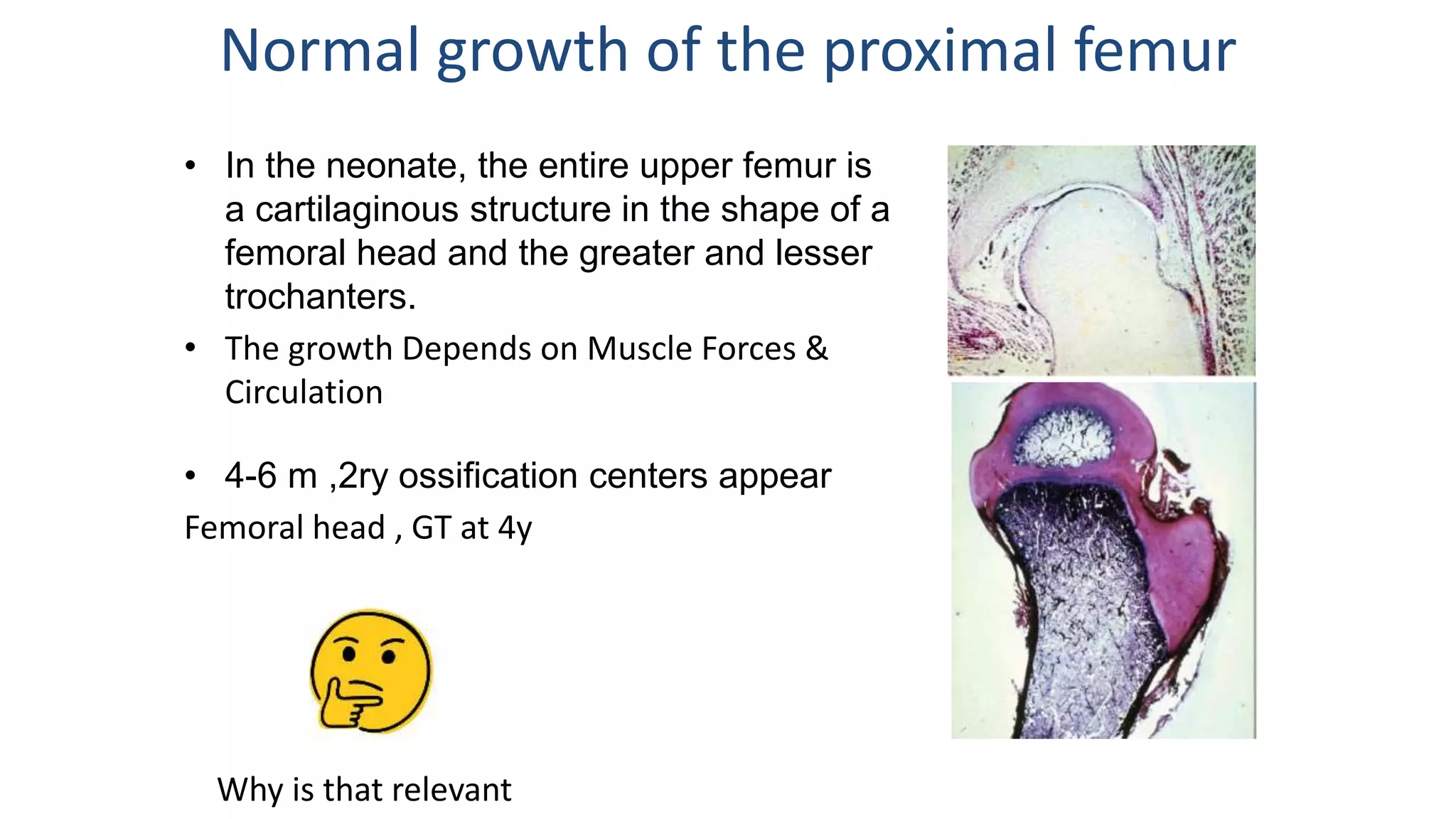
Normal growth of the proximal femur
• In the neonate, the entire upper femur is
a cartilaginous structure in the shape of a
femoral head and the greater and lesser
trochanters.
• The growth Depends on Muscle Forces &
Circulation
• 4-6 m ,2ry ossification centers appear
Femoral head , GT at 4y
Why is that relevant
Abnormal anatomy
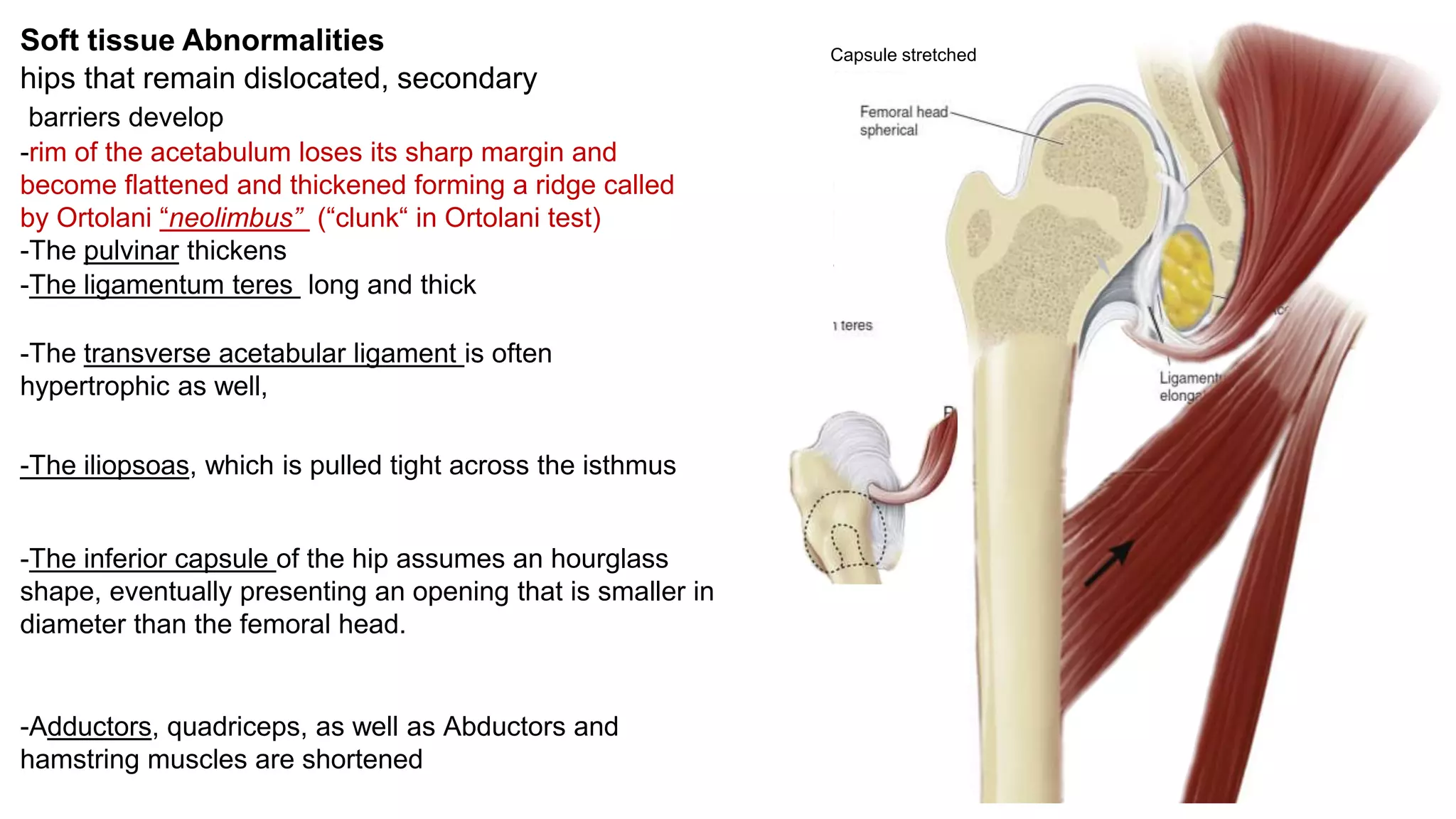
Soft tissue Abnormalities
hips that remain dislocated, secondary
barriers develop
-rim of the acetabulum loses its sharp margin and
become flattened and thickened forming a ridge called
by Ortolani “neolimbus” (“clunk“ in Ortolani test)
-The pulvinar thickens
-The ligamentum teres long and thick
-The transverse acetabular ligament is often
hypertrophic as well,
Capsule stretched
-Adductors, quadriceps, as well as Abductors and
hamstring muscles are shortened
-The inferior capsule of the hip assumes an hourglass
shape, eventually presenting an opening that is smaller in
diameter than the femoral head.
-The iliopsoas, which is pulled tight across the isthmus
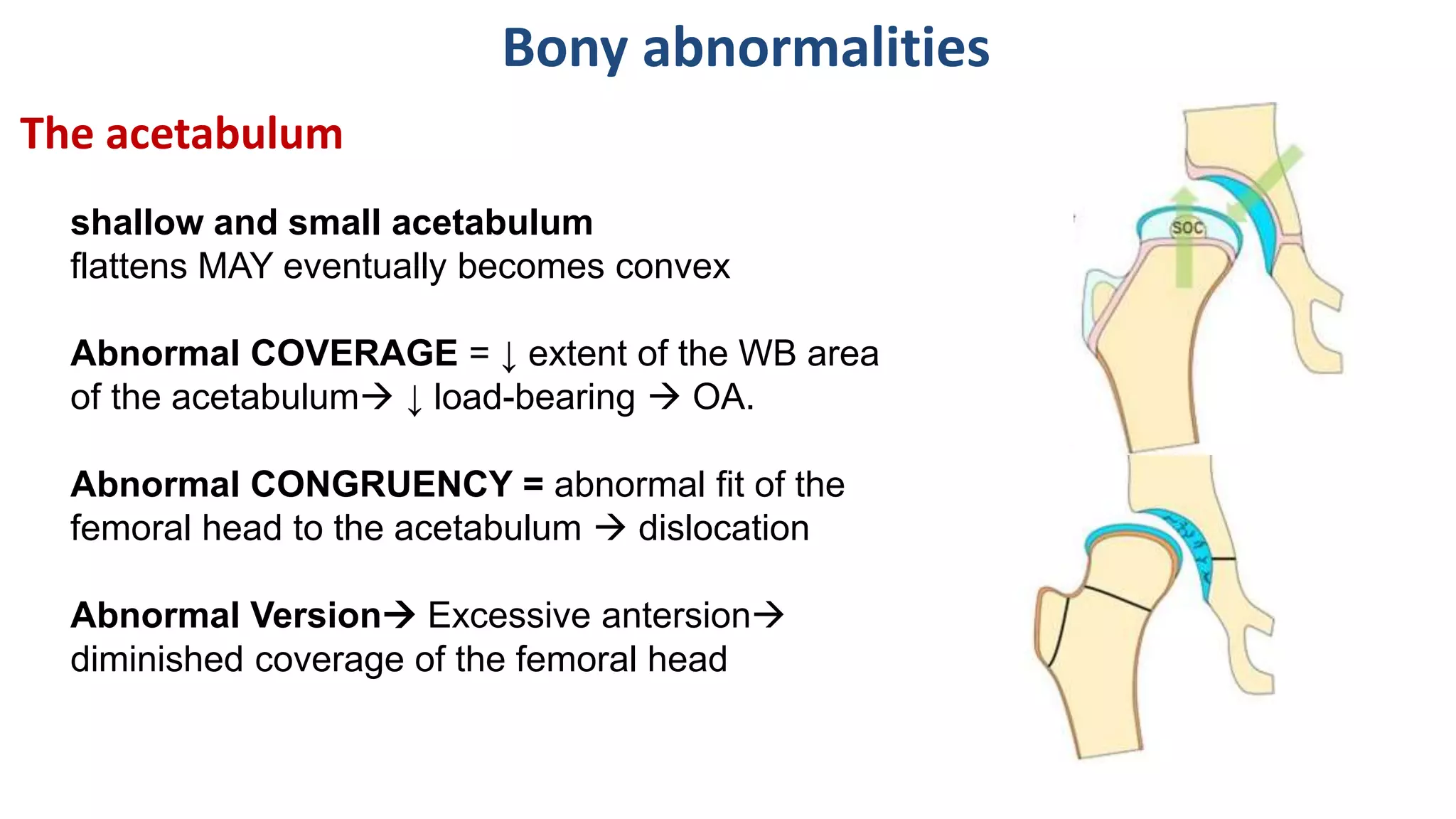
shallow and small acetabulum
flattens MAY eventually becomes convex
Abnormal COVERAGE = ↓ extent of the WB area
of the acetabulum ↓ load-bearing  OA.
Abnormal CONGRUENCY = abnormal fit of the
femoral head to the acetabulum  dislocation
Abnormal Version Excessive antersion
diminished coverage of the femoral head
The acetabulum
Bony abnormalities
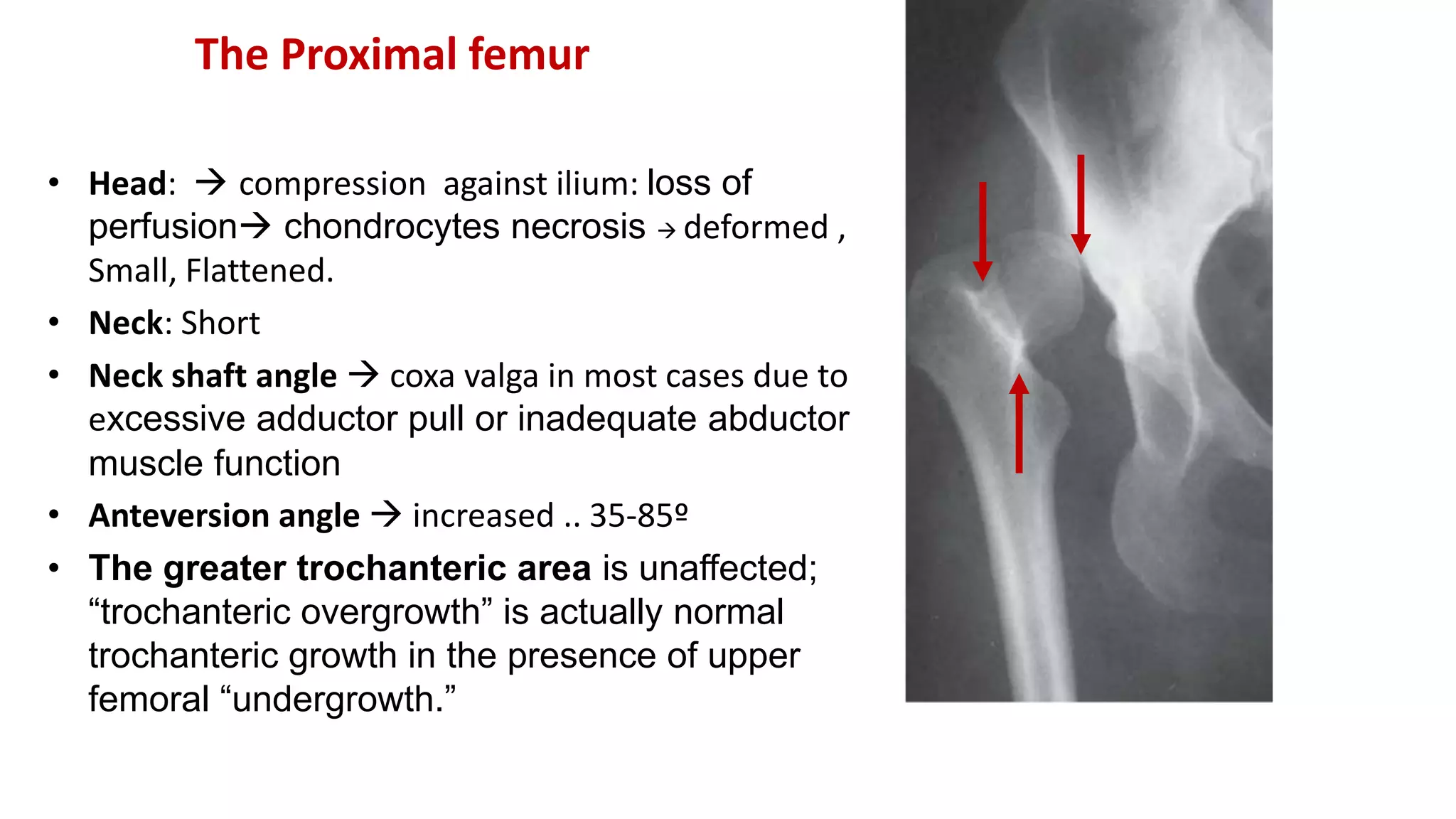
• Head:  compression against ilium: loss of
perfusion chondrocytes necrosis  deformed ,
Small, Flattened.
• Neck: Short
• Neck shaft angle  coxa valga in most cases due to
excessive adductor pull or inadequate abductor
muscle function
• Anteversion angle  increased .. 35-85º
• The greater trochanteric area is unaffected;
“trochanteric overgrowth” is actually normal
trochanteric growth in the presence of upper
femoral “undergrowth.”
The Proximal femur
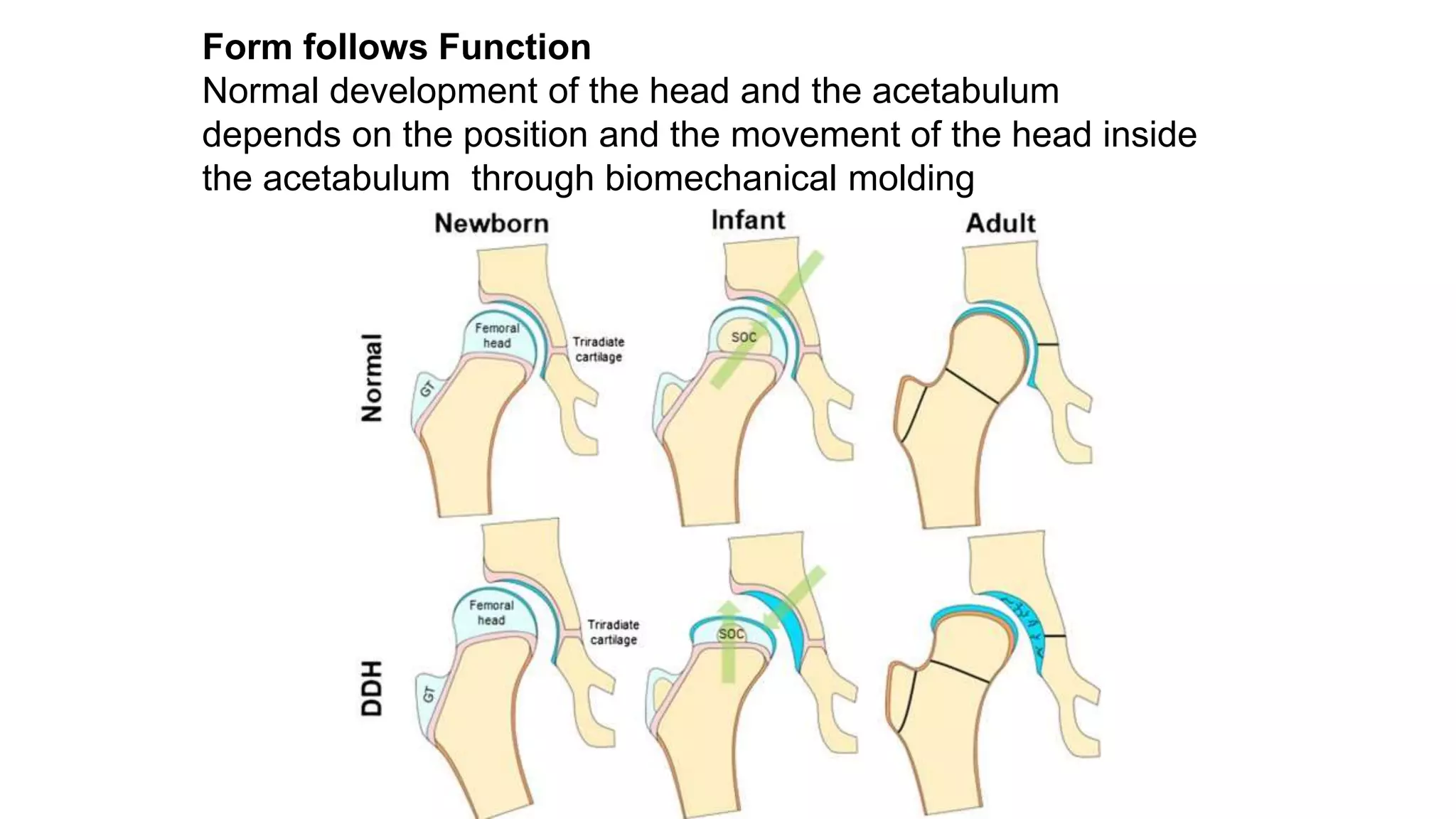
Form follows Function
Normal development of the head and the acetabulum
depends on the position and the movement of the head inside
the acetabulum through biomechanical molding
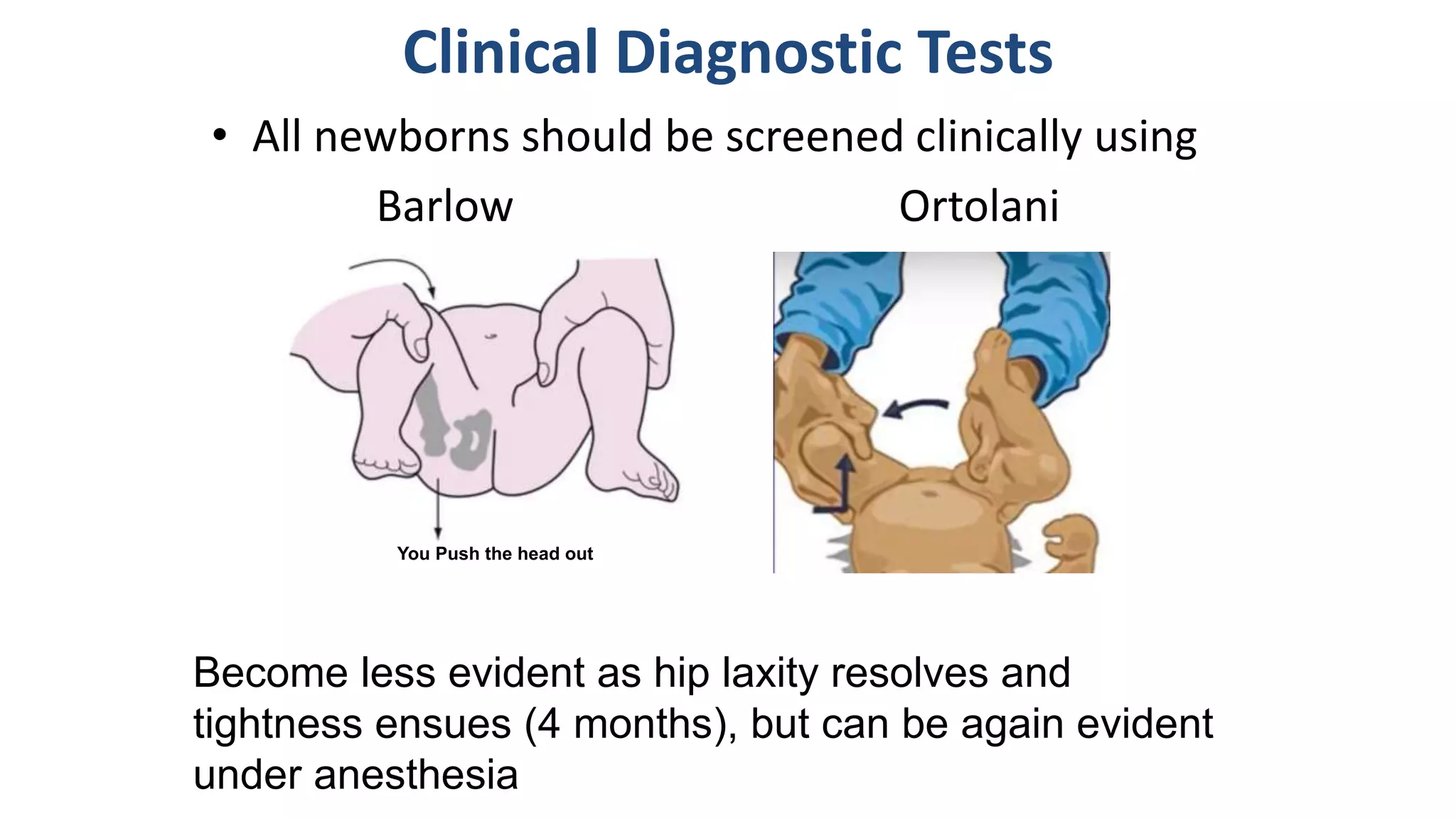
Clinical Diagnostic Tests
• All newborns should be screened clinically using
Barlow Ortolani
Become less evident as hip laxity resolves and
tightness ensues (4 months), but can be again evident
under anesthesia
You Push the head out
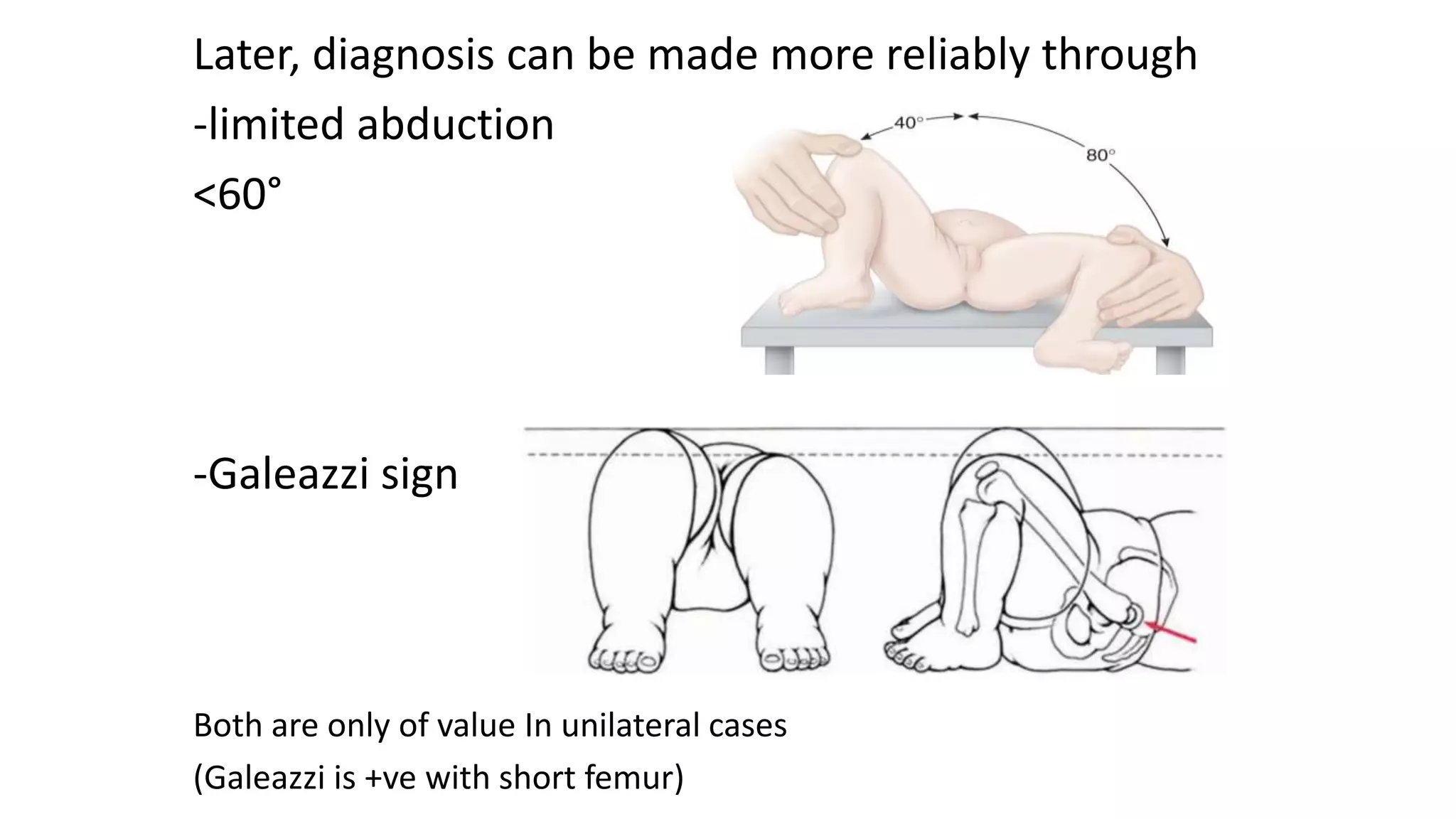
Later, diagnosis can be made more reliably through
-limited abduction
<60°
-Galeazzi sign
Both are only of value In unilateral cases
(Galeazzi is +ve with short femur)
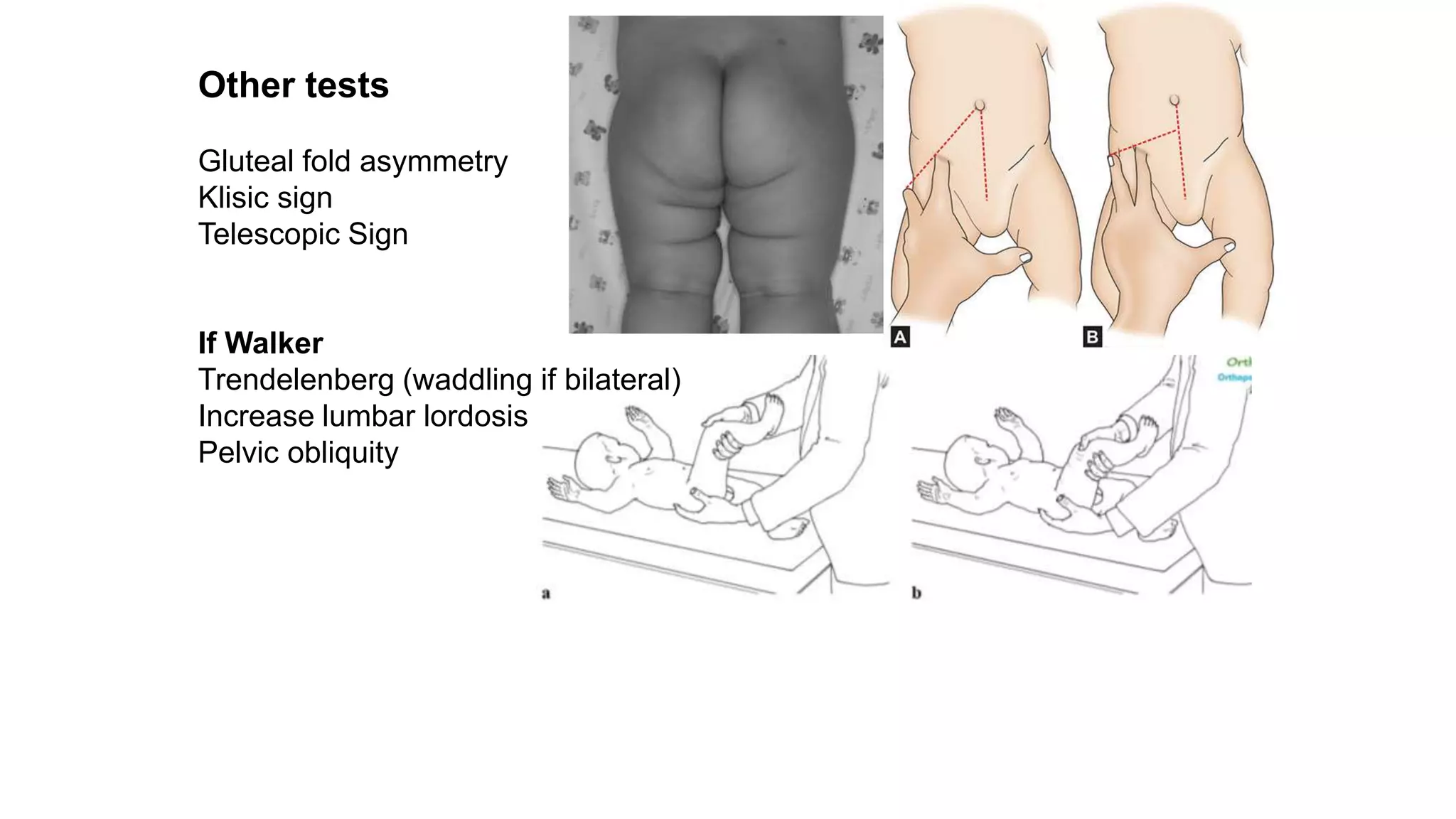
Other tests
Gluteal fold asymmetry
Klisic sign
Telescopic Sign
If Walker
Trendelenberg (waddling if bilateral)
Increase lumbar lordosis
Pelvic obliquity
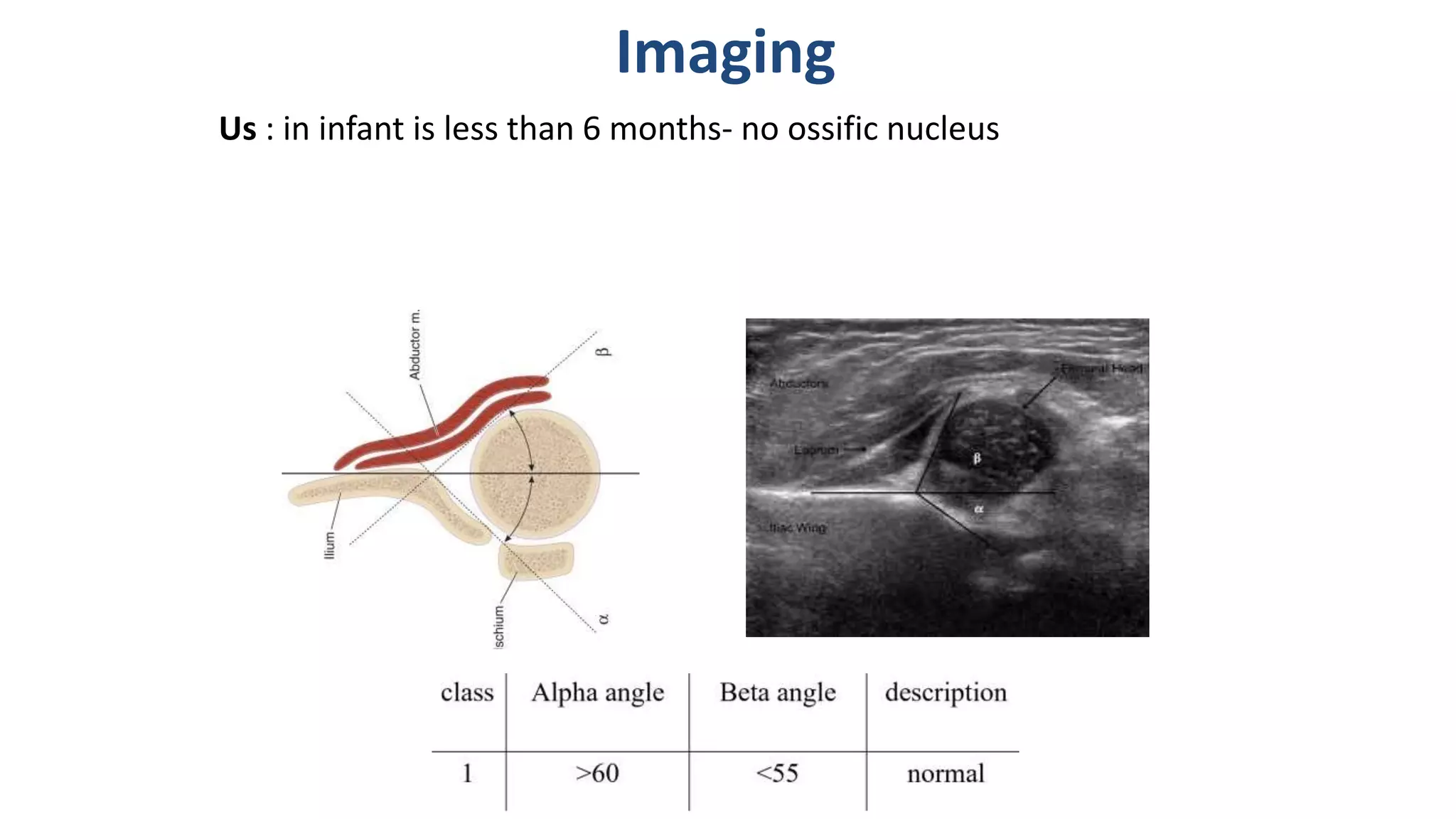
Imaging
Us : in infant is less than 6 months- no ossific nucleus
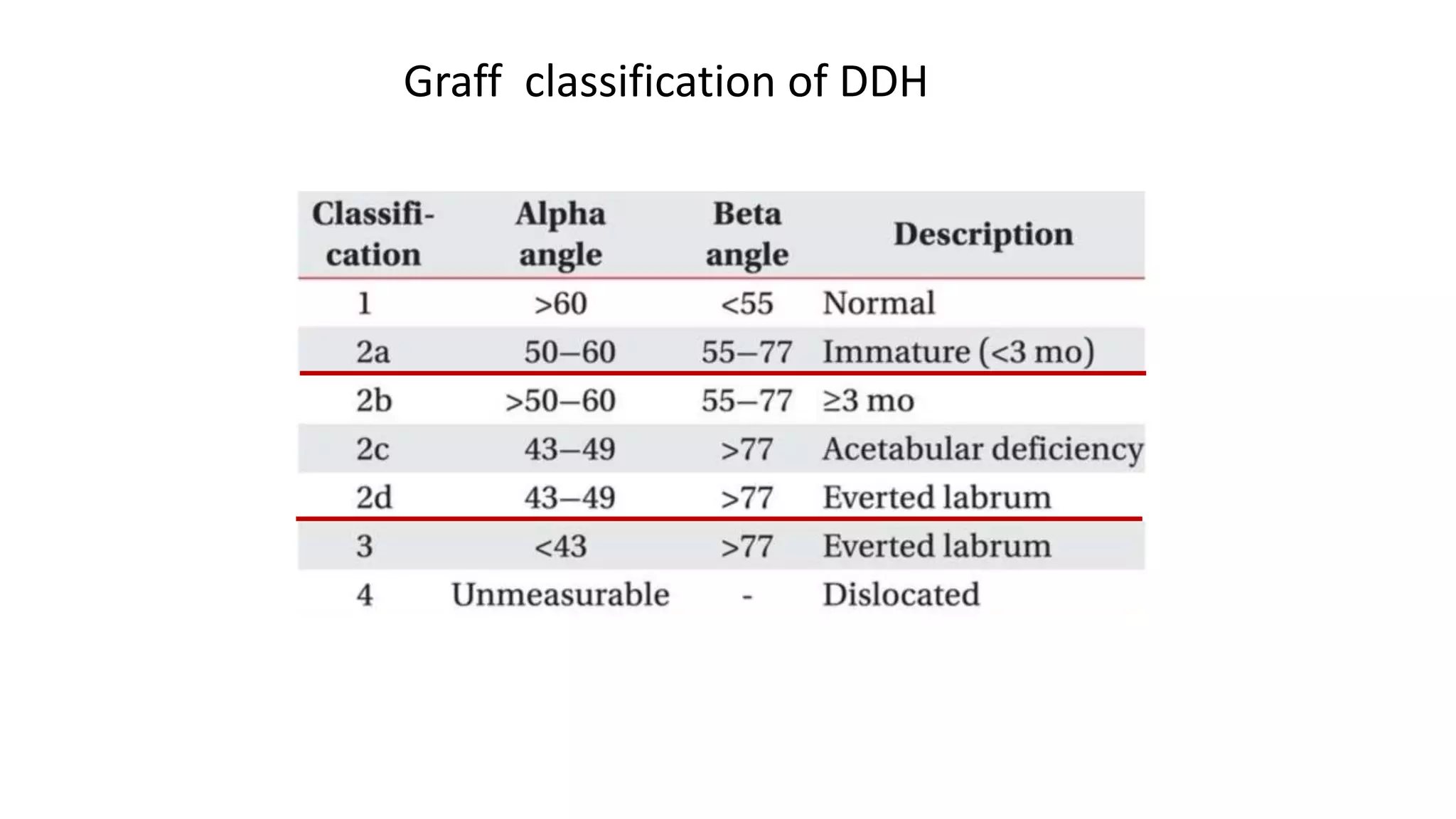
Graff classification of DDH
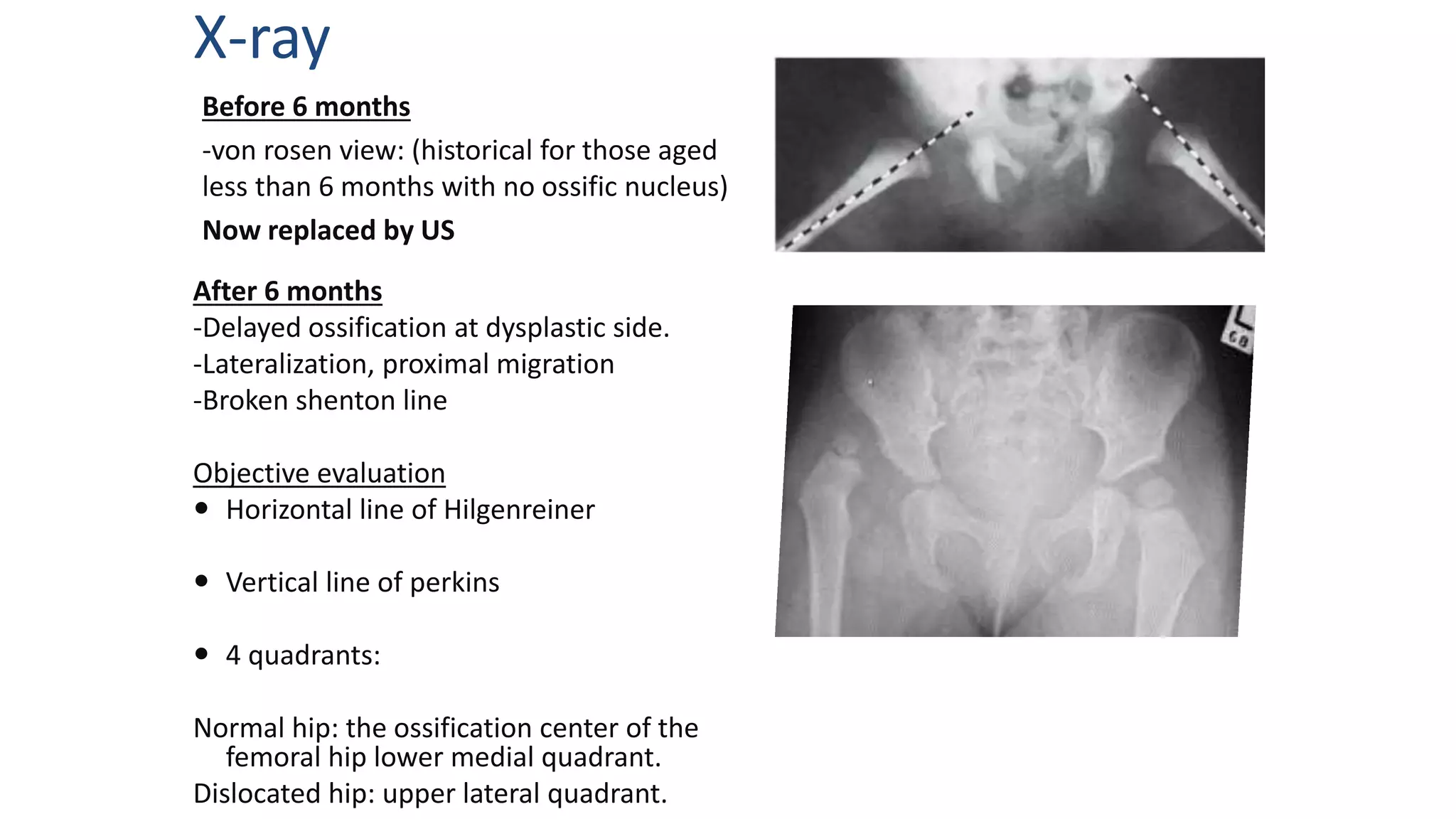
X-ray
After 6 months
-Delayed ossification at dysplastic side.
-Lateralization, proximal migration
-Broken shenton line
Objective evaluation
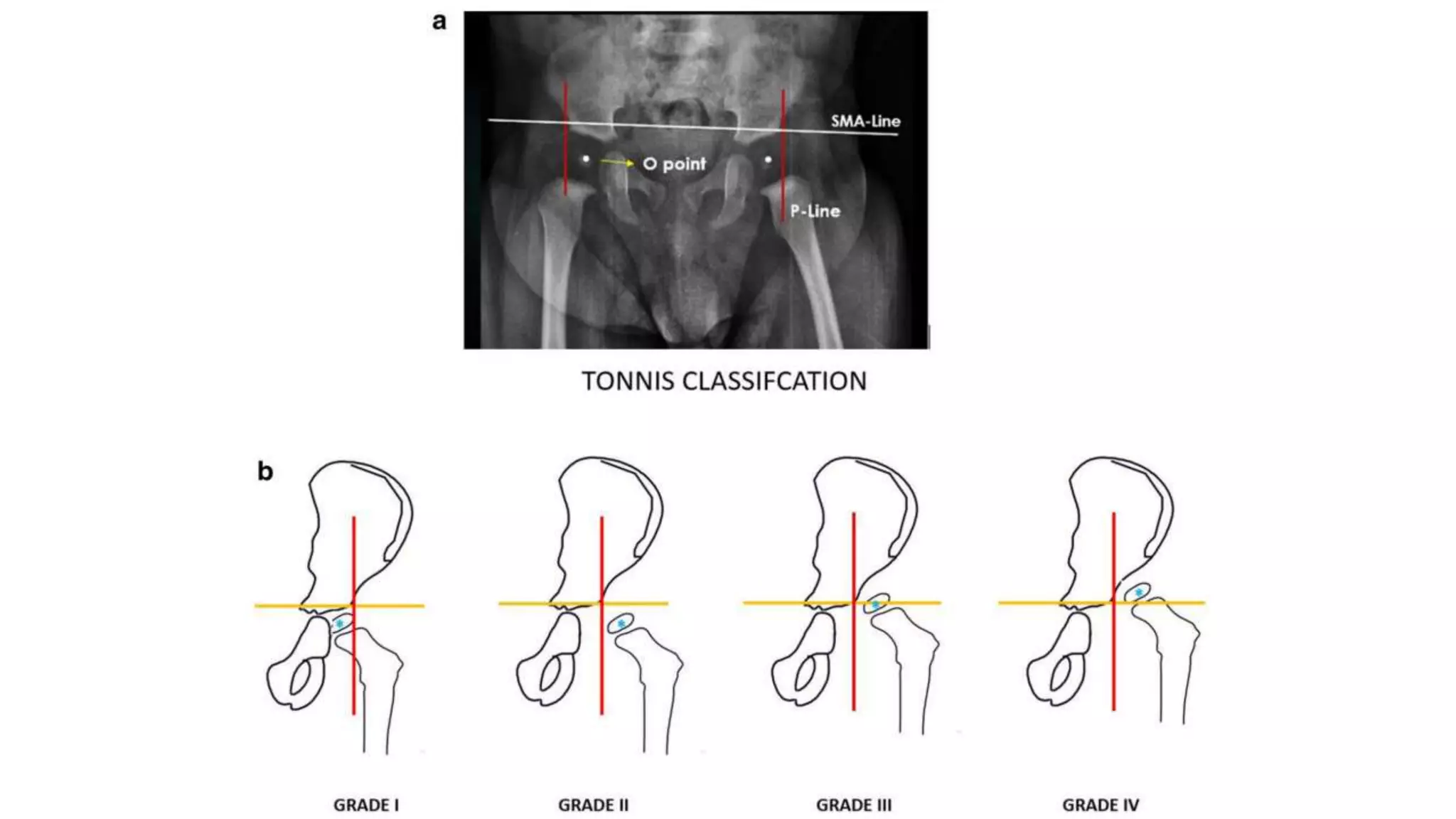
 Horizontal line of Hilgenreiner
 Vertical line of perkins
 4 quadrants:
Normal hip: the ossification center of the
femoral hip lower medial quadrant.
Dislocated hip: upper lateral quadrant.
Before 6 months
-von rosen view: (historical for those aged
less than 6 months with no ossific nucleus)
Now replaced by US
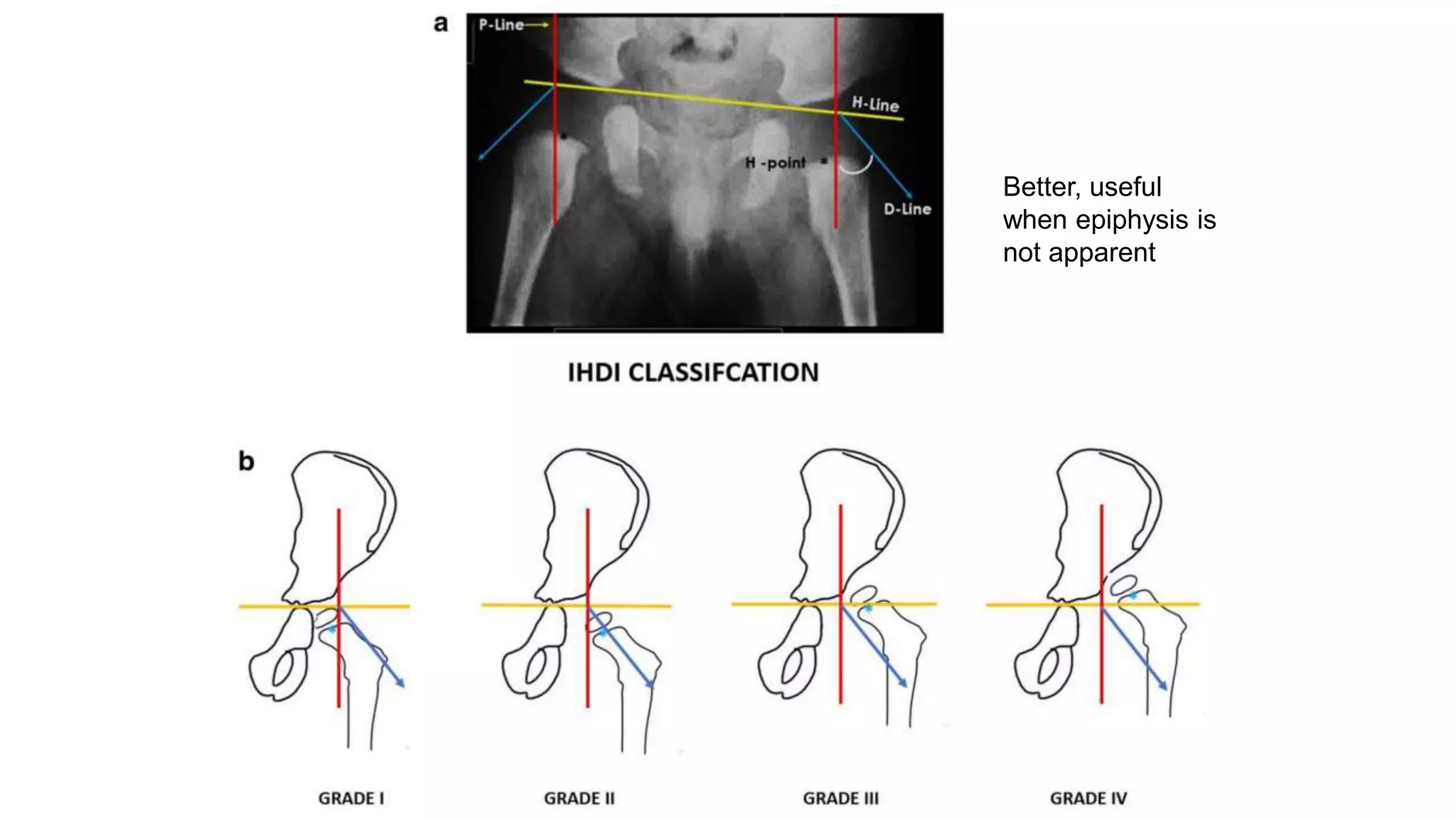
Better, useful
when epiphysis is
not apparent
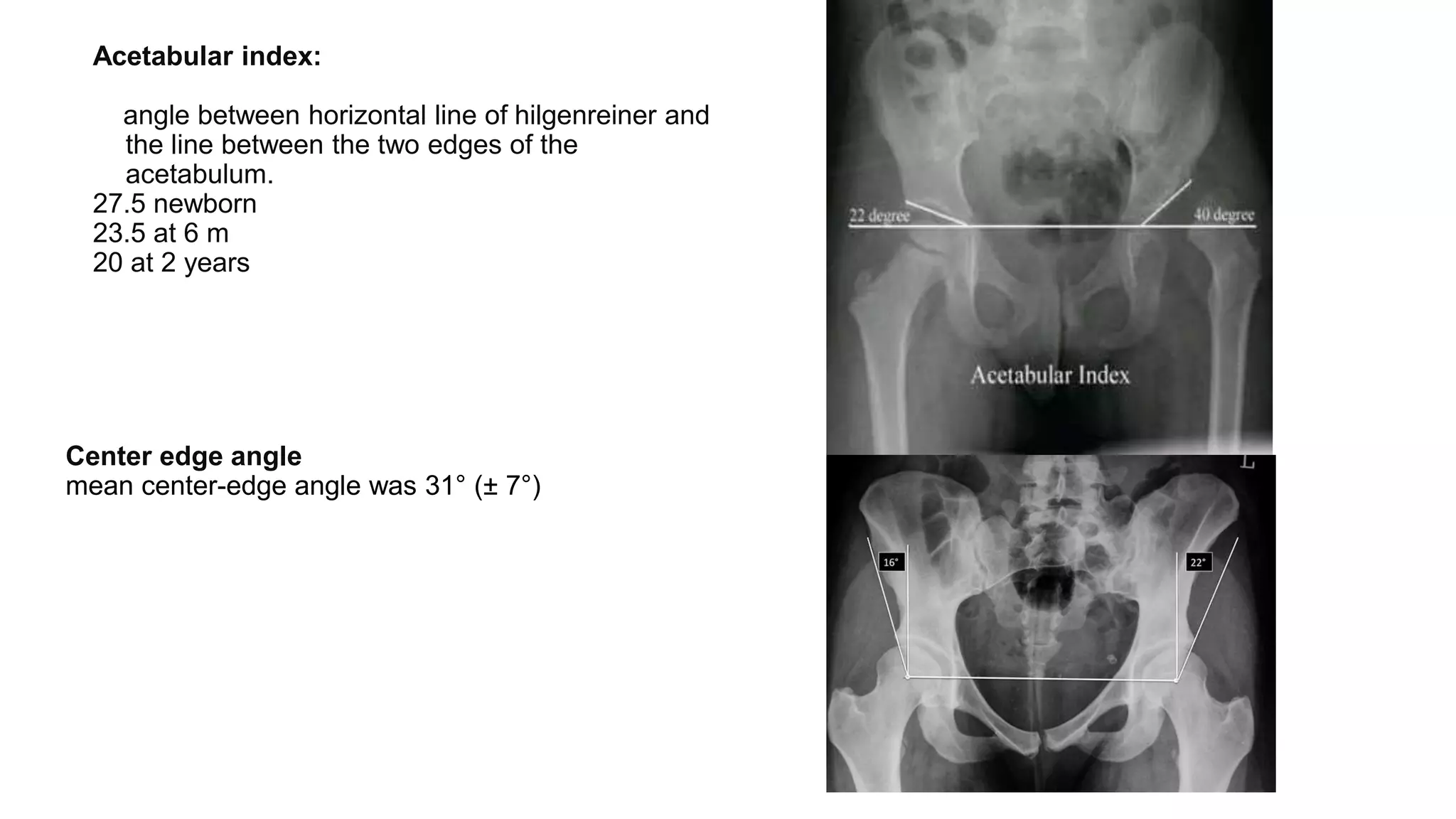
Acetabular index:
angle between horizontal line of hilgenreiner and
the line between the two edges of the
acetabulum.
27.5 newborn
23.5 at 6 m
20 at 2 years
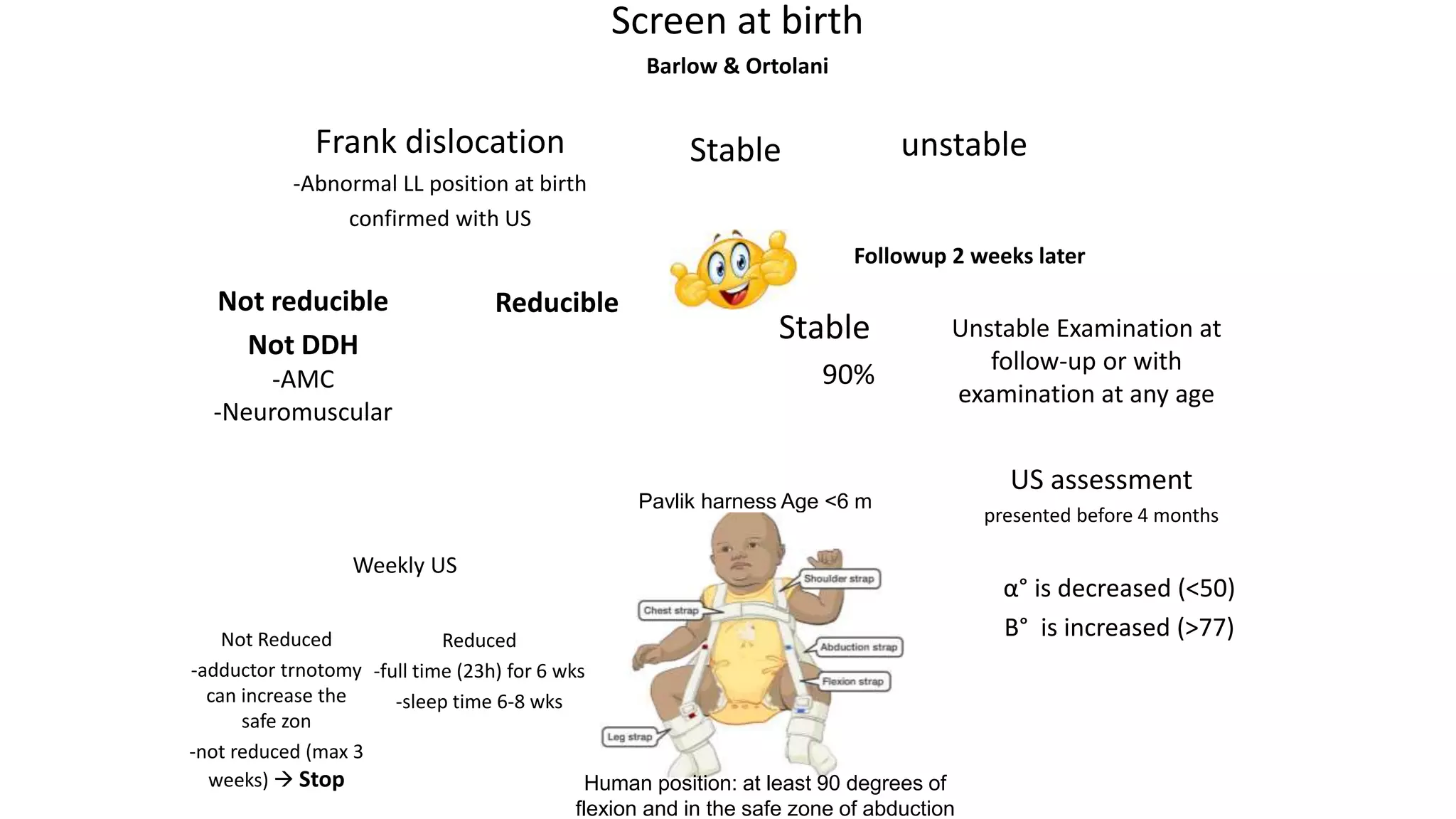
Center edge angle
mean center-edge angle was 31° (± 7°)
Management
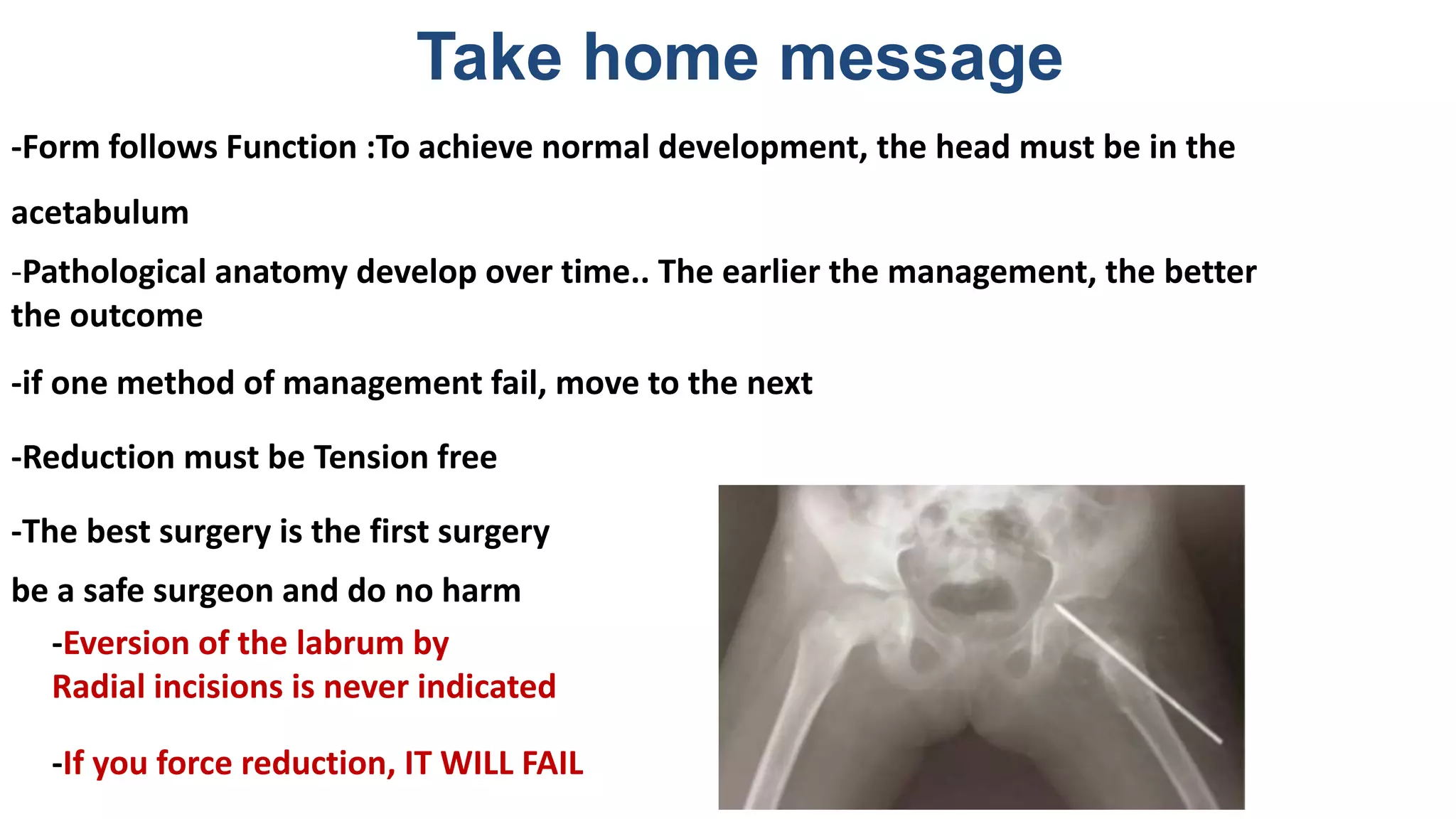
Screen at birth
Barlow & Ortolani
unstable
Stable
Followup 2 weeks later
Stable
90%
Unstable Examination at
follow-up or with
examination at any age
US assessment
presented before 4 months
α° is decreased (<50)
Β° is increased (>77)
Pavlik harness Age <6 m
Frank dislocation
-Abnormal LL position at birth
confirmed with US
Not reducible
Not DDH
-AMC
-Neuromuscular
Weekly US
Reduced
-full time (23h) for 6 wks
-sleep time 6-8 wks
Not Reduced
-adductor trnotomy
can increase the
safe zon
-not reduced (max 3
weeks)  Stop
Reducible
Human position: at least 90 degrees of
flexion and in the safe zone of abduction
Failed Pavlik or
Presented after 6 months
6-12 months
-Adductor tenotomy
-Closed reduction in safe position
(Arthrography if less than 6 m)
-Spica casting in human position
(3 months)
> 1 year (1.5 yrs!)
Success
CT or MRI for follow-up
Failed
Medial approach (Experts only)
-less blood loss -no disturbance of anatomy
-addresses all obstacles,
but can’t do capsulorrhaphy
not suitable for high dislocation
Risk of vacular injury
-Adductor tnotomy
Open reduction through Ant approach
-Capsullorrhaphy
-pelvic osteotomy (Sandiego)
-Femoral osteotomy (derotation,
shortening, V rarely varus)
whatever is needed to achieve
concentric reduction without tension
-Spica cast in slight flexion, 40-60
abduction, minimal to no int rotation
-Form follows Function :To achieve normal development, the head must be in the
acetabulum
-Pathological anatomy develop over time.. The earlier the management, the better
the outcome
-if one method of management fail, move to the next
-Reduction must be Tension free
-The best surgery is the first surgery
be a safe surgeon and do no harm
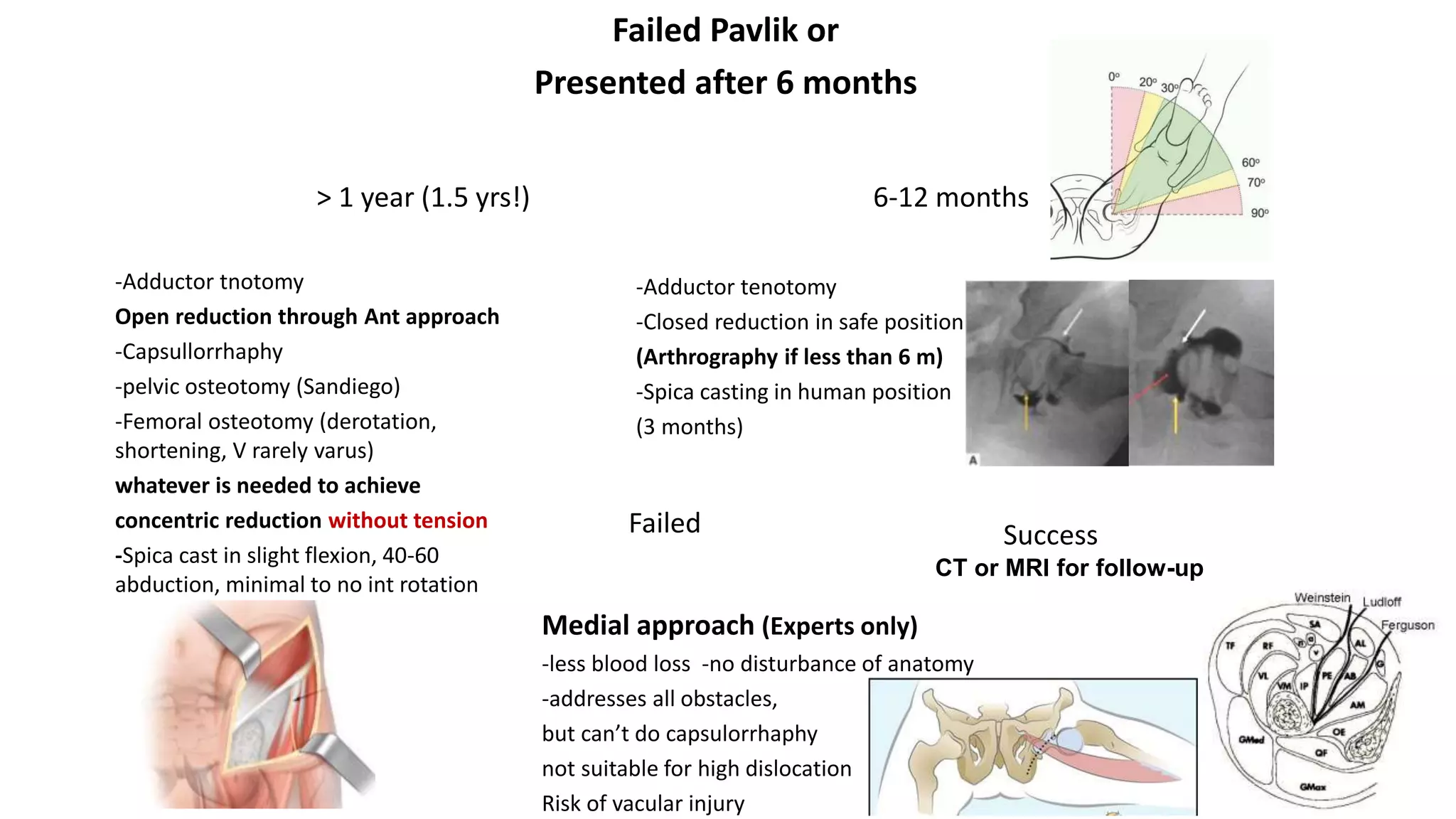
-Eversion of the labrum by
Radial incisions is never indicated
-If you force reduction, IT WILL FAIL
Take home message

DDH introduction and algorithm.pptx

  • 1.
    Developmental Dysplasia ofthe Hip by Dr. Mostafa El-Sebai Hammad
  • 2.
    Definition and terminology •First CDH, Now DDH • Klisic 1989: Congenital dislocation of the hip, a bief report): proposed “Developmental displacement of the hip” as not all cases are present at birth and that some cases can develop later-on • Modern diagnostic imaging allowed more understanding of the more subtle forms of Dysplasia, Instability, Subluxation or So it is now Developmental dysplasia of the hip
  • 3.
    Incidence • Neonatal instability1/100 • 1/1000 develop DDH • Incidence is 34/1000 when U/S is utilized for diagnosis • The left hip is the most affected hip • Girls are affected 5 times more than boys.
  • 4.
    Aetiology Polygenic Hormonal: Estrogen ;relaxin • Maternal relaxin hormone produce ligamentous laxity that is necessary for the expansion of the maternal pelvis, • cross the placenta and induce laxity in the infant. This effect is much stronger in female than in male children.
  • 5.
    • Post natalpositioning Complete breech 2% Frank breech 20% Mechanical: breech, swaddle, liquor deficiency • Intrauterine position
  • 6.
    The radial growth(width) achieved by the triradiate cartilage (small blue arrows), Depth first 4 years, by the acetabular cartilaginous anlage (big blue arrows). After 4 years, increase in acetabular depth occurs secondary to growth of the acetabular epiphysis at the labrum. * thus any excision or radial incisions of the labrum during the treatment of DDH is ill advised. Normal growth of the acetabulum
  • 7.
    Normal growth ofthe proximal femur • In the neonate, the entire upper femur is a cartilaginous structure in the shape of a femoral head and the greater and lesser trochanters. • The growth Depends on Muscle Forces & Circulation • 4-6 m ,2ry ossification centers appear Femoral head , GT at 4y Why is that relevant
  • 8.
  • 9.
    Soft tissue Abnormalities hipsthat remain dislocated, secondary barriers develop -rim of the acetabulum loses its sharp margin and become flattened and thickened forming a ridge called by Ortolani “neolimbus” (“clunk“ in Ortolani test) -The pulvinar thickens -The ligamentum teres long and thick -The transverse acetabular ligament is often hypertrophic as well, Capsule stretched -Adductors, quadriceps, as well as Abductors and hamstring muscles are shortened -The inferior capsule of the hip assumes an hourglass shape, eventually presenting an opening that is smaller in diameter than the femoral head. -The iliopsoas, which is pulled tight across the isthmus
  • 10.
    shallow and smallacetabulum flattens MAY eventually becomes convex Abnormal COVERAGE = ↓ extent of the WB area of the acetabulum ↓ load-bearing  OA. Abnormal CONGRUENCY = abnormal fit of the femoral head to the acetabulum  dislocation Abnormal Version Excessive antersion diminished coverage of the femoral head The acetabulum Bony abnormalities
  • 11.
    • Head: compression against ilium: loss of perfusion chondrocytes necrosis  deformed , Small, Flattened. • Neck: Short • Neck shaft angle  coxa valga in most cases due to excessive adductor pull or inadequate abductor muscle function • Anteversion angle  increased .. 35-85º • The greater trochanteric area is unaffected; “trochanteric overgrowth” is actually normal trochanteric growth in the presence of upper femoral “undergrowth.” The Proximal femur
  • 12.
    Form follows Function Normaldevelopment of the head and the acetabulum depends on the position and the movement of the head inside the acetabulum through biomechanical molding
  • 13.
    Clinical Diagnostic Tests •All newborns should be screened clinically using Barlow Ortolani Become less evident as hip laxity resolves and tightness ensues (4 months), but can be again evident under anesthesia You Push the head out
  • 14.
    Later, diagnosis canbe made more reliably through -limited abduction <60° -Galeazzi sign Both are only of value In unilateral cases (Galeazzi is +ve with short femur)
  • 15.
    Other tests Gluteal foldasymmetry Klisic sign Telescopic Sign If Walker Trendelenberg (waddling if bilateral) Increase lumbar lordosis Pelvic obliquity
  • 16.
    Imaging Us : ininfant is less than 6 months- no ossific nucleus
  • 17.
  • 18.
    X-ray After 6 months -Delayedossification at dysplastic side. -Lateralization, proximal migration -Broken shenton line Objective evaluation  Horizontal line of Hilgenreiner  Vertical line of perkins  4 quadrants: Normal hip: the ossification center of the femoral hip lower medial quadrant. Dislocated hip: upper lateral quadrant. Before 6 months -von rosen view: (historical for those aged less than 6 months with no ossific nucleus) Now replaced by US
  • 20.
  • 21.
    Acetabular index: angle betweenhorizontal line of hilgenreiner and the line between the two edges of the acetabulum. 27.5 newborn 23.5 at 6 m 20 at 2 years Center edge angle mean center-edge angle was 31° (± 7°)
  • 22.
  • 23.
    Screen at birth Barlow& Ortolani unstable Stable Followup 2 weeks later Stable 90% Unstable Examination at follow-up or with examination at any age US assessment presented before 4 months α° is decreased (<50) Β° is increased (>77) Pavlik harness Age <6 m Frank dislocation -Abnormal LL position at birth confirmed with US Not reducible Not DDH -AMC -Neuromuscular Weekly US Reduced -full time (23h) for 6 wks -sleep time 6-8 wks Not Reduced -adductor trnotomy can increase the safe zon -not reduced (max 3 weeks)  Stop Reducible Human position: at least 90 degrees of flexion and in the safe zone of abduction
  • 24.
    Failed Pavlik or Presentedafter 6 months 6-12 months -Adductor tenotomy -Closed reduction in safe position (Arthrography if less than 6 m) -Spica casting in human position (3 months) > 1 year (1.5 yrs!) Success CT or MRI for follow-up Failed Medial approach (Experts only) -less blood loss -no disturbance of anatomy -addresses all obstacles, but can’t do capsulorrhaphy not suitable for high dislocation Risk of vacular injury -Adductor tnotomy Open reduction through Ant approach -Capsullorrhaphy -pelvic osteotomy (Sandiego) -Femoral osteotomy (derotation, shortening, V rarely varus) whatever is needed to achieve concentric reduction without tension -Spica cast in slight flexion, 40-60 abduction, minimal to no int rotation
  • 26.
    -Form follows Function:To achieve normal development, the head must be in the acetabulum -Pathological anatomy develop over time.. The earlier the management, the better the outcome -if one method of management fail, move to the next -Reduction must be Tension free -The best surgery is the first surgery be a safe surgeon and do no harm -Eversion of the labrum by Radial incisions is never indicated -If you force reduction, IT WILL FAIL Take home message

Editor's Notes

  • #3 Dysplasia generally: the abnormal development of tissue  Hip Dysplasia: abnormality in the size, shape, orientation, or organization of the femoral head, acetabulum, or both. Acetabular dysplasia: an immature, shallow acetabulum and can result in subluxation or dislocation of the femoral head term dysplasia refers to a radiographic finding of increased obliquity and the loss of the concavity of the acetabulum, with an intact Shenton line
  • #4 Barlow found 1 hip in 60 that he examined to exhibit his instability sign; 60% normalized within 1 week, and 88% were corrected within 2 months without treatment
  • #8 appositional growth on the surfaces of the upper femur and epiphyseal growth at the juncture of the cartilaginous upper femur and the femoral shaft.256 In the normal femur, an ossification center appears in the center of the femoral head between the fourth and seventh months of postnatal life. This center grows until physeal closure during late adolescence
  • #10 -neolimbus: cartilage ridge within the superolateral aspect of the acetabulum that forms as a reaction to femoral head pressure in the dysplastic hip -This is distinct from the limbus, which is a hypertrophic labrum with fibrous overgrowth.