CONGENITAL CHEST WALL
ANOMALIES
Dr Tarek Mohsen MD, FRCS
Prof. of Cardiothoracic Surgery
Cairo University Hospitals
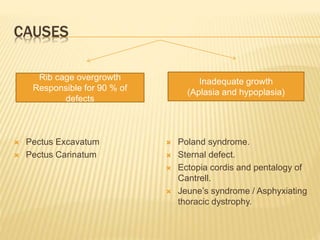
CAUSES
 Pectus Excavatum
 Pectus Carinatum
 Poland syndrome.
 Sternal defect.
 Ectopia cordis and pentalogy of
Cantrell.
 Jeune’s syndrome / Asphyxiating
thoracic dystrophy.
Rib cage overgrowth
Responsible for 90 % of
defects
Inadequate growth
(Aplasia and hypoplasia)
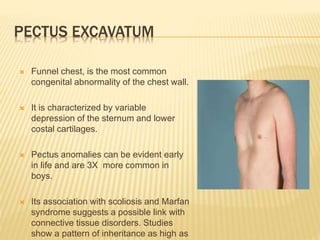
PECTUS EXCAVATUM
 Funnel chest, is the most common
congenital abnormality of the chest wall.
 It is characterized by variable
depression of the sternum and lower
costal cartilages.
 Pectus anomalies can be evident early
in life and are 3X more common in
boys.
 Its association with scoliosis and Marfan
syndrome suggests a possible link with
connective tissue disorders. Studies
show a pattern of inheritance as high as
CLINICAL PRESENTATION AND INVESTIGATIONS
 C/O: Asymptomatic in most cases but limited physical activity in severe
depression.
 Examination: Asymmetrical sternal depression starting from the second
costal cartilage. Associated heart defects in 1.5 % and Marfan syndrome
in 15 % of cases.
 Investigations
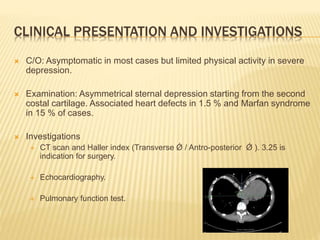
 CT scan and Haller index (Transverse Ǿ / Antro-posterior Ǿ ). 3.25 is
indication for surgery.
 Echocardiography.
 Pulmonary function test.
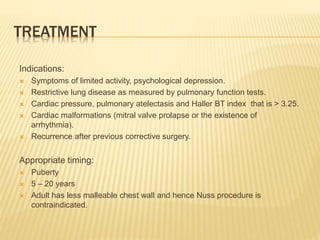
TREATMENT
Indications:
 Symptoms of limited activity, psychological depression.
 Restrictive lung disease as measured by pulmonary function tests.
 Cardiac pressure, pulmonary atelectasis and Haller BT index that is > 3.25.
 Cardiac malformations (mitral valve prolapse or the existence of
arrhythmia).
 Recurrence after previous corrective surgery.
Appropriate timing:
 Puberty
 5 – 20 years
 Adult has less malleable chest wall and hence Nuss procedure is
contraindicated.
TYPES OF CORRECTIVE INTERVENTION
 TRANSVERSE STERNAL OSTEOTOMY WITH
SUBPERICHONDRIAL COSTAL CARTILAGE RESECTION
(MODIFIED RAVITCH PROCEDURE).
 MINIMALLY INVASIVE REPAIR (NUSS PROCEDURE).
 MAGNETIC MINI MOVER PROCEDURE.
 THE VACUUM BELL.
MODIFIED RAVITCH PROCEDURE
 A transverse incision is made in the anterior chest below the nipple line corresponding with
the future inframammary fold.
 Skin flaps are then elevated to expose the body of the sternum and affected costal
cartilages. Up to the level of sterno-manubrial joint.
 After optimal exposure, the pectoralis muscles are dissected off the cartilages and
elevated bilaterally to the level of the costochondral joints.
 The perichondrium corresponding with the affected costal cartilages is opened sharply.
The cartilages of the 3rd, 4th, and 5th ribs are exposed, grasped, and divided sharply from
their insertion into the sternum. Laterally, a 1-cm rim of cartilage is left in continuation to
the adjacent rib for further growth plate development.
 The next step is the correction of the sternal angulation, which is achieved by performing a
transverse osteotomy and by removing a wedge of bone at the anterior surface of the
sternum. This is then re-approximated with heavy sutures
 A closed drainage system is left in place, the pectoral muscle flaps are re-approximated in
the midline, and the skin is closed in layers.
MINIMAL INVASIVE NUSS PROCEDURE
 Minimal invasive procedure utilizing
videoscope, a pectus bar removed after 2-3
years.
 The main complication after Ravitch is
recurrence, the Nuss procedure is more
painful, wound infection, pneumothorax and
overcorrection are among the complications.
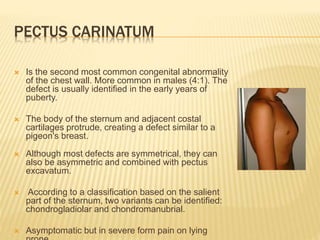
PECTUS CARINATUM
 Is the second most common congenital abnormality
of the chest wall. More common in males (4:1). The
defect is usually identified in the early years of
puberty.
 The body of the sternum and adjacent costal
cartilages protrude, creating a defect similar to a
pigeon's breast.
 Although most defects are symmetrical, they can
also be asymmetric and combined with pectus
excavatum.
 According to a classification based on the salient
part of the sternum, two variants can be identified:
chondrogladiolar and chondromanubrial.
 Asymptomatic but in severe form pain on lying
TREATMENT
NON OPERATIVE OPERATIVE
 A brace that provides
anteroposterior compression
results in progressive remodeling
of the chest.
 The brace must be worn 14 hours
a day for at least 2 years.
 Surgical correction is often
reserved for those who fail
conservative management or in
noncompliant patient
 Modified Ravitch with
multiple ostiotomies in
combinded anomalies.
 Minimal invasive
subcutaneous C shaped
bar.
POLAND’S SYNDROME
 Poland's syndrome is a rare congenital anomaly in which
there are varying degrees of hypoplasia or aplasia of the
thoracic wall components.
 It occurs in ~1 in 30,000 live births and is rarely bilateral.
 The only consistent anomaly in this syndrome is the
underdevelopment or absence of the pectoralis muscles.
 Associated anomalies of the rib cage are present in up to
60% of cases, including hypoplasia or aplasia of the ribs and
their cartilages.
 Other deformities include amastia, athelia, bradydactyly or
syndactyly, and occasionally hypoplasia of the subclavian
vessels.
CLINICAL PRESENTATION AND TREATMENT
 Hypoplasia of the pectoral muscles rarely causes functional limitation in the ipsilateral
extremity, perhaps due to compensation by other muscle groups.
 Costochondral defects and absence of ribs can result in disfiguring anomalies. In
addition, women may have amastia, athelia, or ectopia of the nipple.
 The surgical treatment of Poland's syndrome is largely cosmetic and is
individualized according to the anomalies present.
 The concavity of the chest wall at the site of the defective pectoral muscle can be
filled with muscle flaps or implants.
 In women with amastia, reconstruction should be performed when full development of
the normal contralateral breast is completed.
 Techniques for repairing the costochondral anomalies in Poland's syndrome are
adaptations to the Ravitch technique. When multiple ribs are hypoplastic or absent,
contralateral costal grafts can be used.
 Wedge osteotomies are performed as needed to correct the abnormal curvature or
rotations in the sternum.
STERNAL DEFECTS
 Sternal defects are divided into four
categories based on tissue coverage of the
heart:
(1) Sternal cleft or bifid sternum,
(2) Thoracic ectopia cordis,
(3) Cervical ectopia cordis, and
(4) Thoracoabdominal ectopia cordis
TYPES OF STERNAL CLEFT
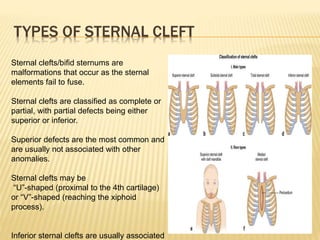
Sternal clefts/bifid sternums are
malformations that occur as the sternal
elements fail to fuse.
Sternal clefts are classified as complete or
partial, with partial defects being either
superior or inferior.
Superior defects are the most common and
are usually not associated with other
anomalies.
Sternal clefts may be
“U”-shaped (proximal to the 4th cartilage)
or “V”-shaped (reaching the xiphoid
process).
Inferior sternal clefts are usually associated
CLINICAL PRESENTATION AND INVESTIGATIONS
 Patients with sternal clefts may present as a spectrum from
asymptomatic to recurrent respiratory infections and may
have a dramatic appearance when the child cries or coughs.
 Surgery is advocated in even asymptomatic patients to
protect the heart, relief parental anxiety, and decrease
respiratory infections.
 Perioperative evaluation should include an echocardiogram,
chest radiographs, and 3D CT scan to completely evaluate
the bony abnormality.
 If there are concerns for vascular anomalies, then a contrast
CT scan is justified.
TREATMENT
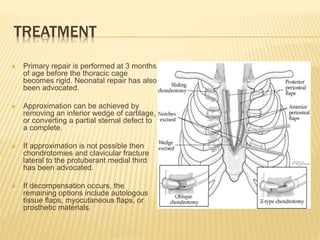
 Primary repair is performed at 3 months
of age before the thoracic cage
becomes rigid. Neonatal repair has also
been advocated.
 Approximation can be achieved by
removing an inferior wedge of cartilage,
or converting a partial sternal defect to
a complete.
 If approximation is not possible then
chondrotomies and clavicular fracture
lateral to the protuberant medial third
has been advocated.
 If decompensation occurs, the
remaining options include autologous
tissue flaps, myocutaneous flaps, or
prosthetic materials.
ECTOPIA CORDIS AND PENTALOGY OF CANTRELL
Cantrell, Haller, and Ravitch in 1958 described a syndrome consisting of five
embryologic defects:
(1) Ectopia cordis,
(2) Deficiency of the anterior diaphragm,
(3) Supraumbilical abdominal wall defect,
(4) Defect in lower sternum, and
(5) Congenital intracardiac anomalies.
Other anomalies such as cleft palate and clubfeet were also described with
the syndrome.
CLINICAL PRESENTATION
 More than half the cases of Cantrell's pentalogy present with the
complete syndrome.
 Ectopia cordis is present in 63% of cases and is called cervical, thoracic,
or thoracoabdominal depending on the area of cardiac evisceration.
 The most common intracardiac anomalies associated with the
syndrome include (VSD) , (ASD) and tetralogy of Fallot.
 The diagnosis can be made in the first trimester of pregnancy by
ultrasonography.
 Recently, MRI has been used to delineate the anatomic details of the
pentalogy.
TREATMENT
 When the diagnosis is made early in pregnancy, the physician should
counsel the parents about the high mortality associated with the
syndrome. Termination of pregnancy may be an option.
 There are several methods for correcting the different components of the
syndrome. The main objective is to cover the eviscerated heart with
skin, muscle flap, or synthetic material, without returning the heart to the
thoracic cavity . This is because these patients usually have reduced
thoracic capacity.
 In a later surgery, the osseous defect should be corrected. With the
advent of pediatric cardiovascular surgery, the mortality of patients with
intracardiac defects has been reduced substantially.
 Patients with the worst prognosis are those who present with complex
heart defects and those with cervical or thoracic ectopia cordis.
JEUNE’S SYNDROME / ASPHYXIATING
THORACIC DYSTROPHY
 A rare autosomal recessive disorder. It was first described
by Jeune in 1955 in a pair of siblings with severely narrow
thoraces.
 A genetic locus has been identified on chromosome 15q13
as well as in the IFT80 gene encoding intraflagellar proteins
in a subset of patients.
 Prenatal diagnosis are polyhydramnios, abnormal small
thorax, short limbs and unidentifiable fetal respiratory
movements.
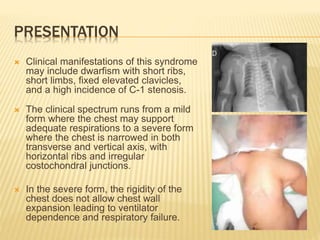
PRESENTATION
 Clinical manifestations of this syndrome
may include dwarfism with short ribs,
short limbs, fixed elevated clavicles,
and a high incidence of C-1 stenosis.
 The clinical spectrum runs from a mild
form where the chest may support
adequate respirations to a severe form
where the chest is narrowed in both
transverse and vertical axis, with
horizontal ribs and irregular
costochondral junctions.
 In the severe form, the rigidity of the
chest does not allow chest wall
expansion leading to ventilator
dependence and respiratory failure.
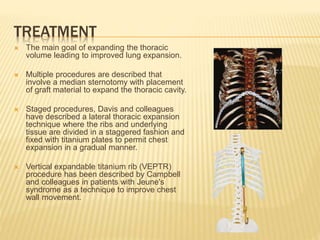
TREATMENT
 The main goal of expanding the thoracic
volume leading to improved lung expansion.
 Multiple procedures are described that
involve a median sternotomy with placement
of graft material to expand the thoracic cavity.
 Staged procedures, Davis and colleagues
have described a lateral thoracic expansion
technique where the ribs and underlying
tissue are divided in a staggered fashion and
fixed with titanium plates to permit chest
expansion in a gradual manner.
 Vertical expandable titanium rib (VEPTR)
procedure has been described by Campbell
and colleagues in patients with Jeune's
syndrome as a technique to improve chest
wall movement.
THANK YOU
JOIN MY CHANNEL AT YOUTUBE
CARDIOTHORACIC MASTER CLASS AND
SUBSCRIBE FOR MORE TOPICS

Congenital chest wall anomalies

  • 1.
    CONGENITAL CHEST WALL ANOMALIES DrTarek Mohsen MD, FRCS Prof. of Cardiothoracic Surgery Cairo University Hospitals
  • 2.
    CAUSES  Pectus Excavatum Pectus Carinatum  Poland syndrome.  Sternal defect.  Ectopia cordis and pentalogy of Cantrell.  Jeune’s syndrome / Asphyxiating thoracic dystrophy. Rib cage overgrowth Responsible for 90 % of defects Inadequate growth (Aplasia and hypoplasia)
  • 3.
    PECTUS EXCAVATUM  Funnelchest, is the most common congenital abnormality of the chest wall.  It is characterized by variable depression of the sternum and lower costal cartilages.  Pectus anomalies can be evident early in life and are 3X more common in boys.  Its association with scoliosis and Marfan syndrome suggests a possible link with connective tissue disorders. Studies show a pattern of inheritance as high as
  • 4.
    CLINICAL PRESENTATION ANDINVESTIGATIONS  C/O: Asymptomatic in most cases but limited physical activity in severe depression.  Examination: Asymmetrical sternal depression starting from the second costal cartilage. Associated heart defects in 1.5 % and Marfan syndrome in 15 % of cases.  Investigations  CT scan and Haller index (Transverse Ǿ / Antro-posterior Ǿ ). 3.25 is indication for surgery.  Echocardiography.  Pulmonary function test.
  • 5.
    TREATMENT Indications:  Symptoms oflimited activity, psychological depression.  Restrictive lung disease as measured by pulmonary function tests.  Cardiac pressure, pulmonary atelectasis and Haller BT index that is > 3.25.  Cardiac malformations (mitral valve prolapse or the existence of arrhythmia).  Recurrence after previous corrective surgery. Appropriate timing:  Puberty  5 – 20 years  Adult has less malleable chest wall and hence Nuss procedure is contraindicated.
  • 6.
    TYPES OF CORRECTIVEINTERVENTION  TRANSVERSE STERNAL OSTEOTOMY WITH SUBPERICHONDRIAL COSTAL CARTILAGE RESECTION (MODIFIED RAVITCH PROCEDURE).  MINIMALLY INVASIVE REPAIR (NUSS PROCEDURE).  MAGNETIC MINI MOVER PROCEDURE.  THE VACUUM BELL.
  • 7.
    MODIFIED RAVITCH PROCEDURE A transverse incision is made in the anterior chest below the nipple line corresponding with the future inframammary fold.  Skin flaps are then elevated to expose the body of the sternum and affected costal cartilages. Up to the level of sterno-manubrial joint.  After optimal exposure, the pectoralis muscles are dissected off the cartilages and elevated bilaterally to the level of the costochondral joints.  The perichondrium corresponding with the affected costal cartilages is opened sharply. The cartilages of the 3rd, 4th, and 5th ribs are exposed, grasped, and divided sharply from their insertion into the sternum. Laterally, a 1-cm rim of cartilage is left in continuation to the adjacent rib for further growth plate development.  The next step is the correction of the sternal angulation, which is achieved by performing a transverse osteotomy and by removing a wedge of bone at the anterior surface of the sternum. This is then re-approximated with heavy sutures  A closed drainage system is left in place, the pectoral muscle flaps are re-approximated in the midline, and the skin is closed in layers.
  • 8.
    MINIMAL INVASIVE NUSSPROCEDURE  Minimal invasive procedure utilizing videoscope, a pectus bar removed after 2-3 years.  The main complication after Ravitch is recurrence, the Nuss procedure is more painful, wound infection, pneumothorax and overcorrection are among the complications.
  • 9.
    PECTUS CARINATUM  Isthe second most common congenital abnormality of the chest wall. More common in males (4:1). The defect is usually identified in the early years of puberty.  The body of the sternum and adjacent costal cartilages protrude, creating a defect similar to a pigeon's breast.  Although most defects are symmetrical, they can also be asymmetric and combined with pectus excavatum.  According to a classification based on the salient part of the sternum, two variants can be identified: chondrogladiolar and chondromanubrial.  Asymptomatic but in severe form pain on lying
  • 10.
    TREATMENT NON OPERATIVE OPERATIVE A brace that provides anteroposterior compression results in progressive remodeling of the chest.  The brace must be worn 14 hours a day for at least 2 years.  Surgical correction is often reserved for those who fail conservative management or in noncompliant patient  Modified Ravitch with multiple ostiotomies in combinded anomalies.  Minimal invasive subcutaneous C shaped bar.
  • 11.
    POLAND’S SYNDROME  Poland'ssyndrome is a rare congenital anomaly in which there are varying degrees of hypoplasia or aplasia of the thoracic wall components.  It occurs in ~1 in 30,000 live births and is rarely bilateral.  The only consistent anomaly in this syndrome is the underdevelopment or absence of the pectoralis muscles.  Associated anomalies of the rib cage are present in up to 60% of cases, including hypoplasia or aplasia of the ribs and their cartilages.  Other deformities include amastia, athelia, bradydactyly or syndactyly, and occasionally hypoplasia of the subclavian vessels.
  • 12.
    CLINICAL PRESENTATION ANDTREATMENT  Hypoplasia of the pectoral muscles rarely causes functional limitation in the ipsilateral extremity, perhaps due to compensation by other muscle groups.  Costochondral defects and absence of ribs can result in disfiguring anomalies. In addition, women may have amastia, athelia, or ectopia of the nipple.  The surgical treatment of Poland's syndrome is largely cosmetic and is individualized according to the anomalies present.  The concavity of the chest wall at the site of the defective pectoral muscle can be filled with muscle flaps or implants.  In women with amastia, reconstruction should be performed when full development of the normal contralateral breast is completed.  Techniques for repairing the costochondral anomalies in Poland's syndrome are adaptations to the Ravitch technique. When multiple ribs are hypoplastic or absent, contralateral costal grafts can be used.  Wedge osteotomies are performed as needed to correct the abnormal curvature or rotations in the sternum.
  • 13.
    STERNAL DEFECTS  Sternaldefects are divided into four categories based on tissue coverage of the heart: (1) Sternal cleft or bifid sternum, (2) Thoracic ectopia cordis, (3) Cervical ectopia cordis, and (4) Thoracoabdominal ectopia cordis
  • 14.
    TYPES OF STERNALCLEFT Sternal clefts/bifid sternums are malformations that occur as the sternal elements fail to fuse. Sternal clefts are classified as complete or partial, with partial defects being either superior or inferior. Superior defects are the most common and are usually not associated with other anomalies. Sternal clefts may be “U”-shaped (proximal to the 4th cartilage) or “V”-shaped (reaching the xiphoid process). Inferior sternal clefts are usually associated
  • 15.
    CLINICAL PRESENTATION ANDINVESTIGATIONS  Patients with sternal clefts may present as a spectrum from asymptomatic to recurrent respiratory infections and may have a dramatic appearance when the child cries or coughs.  Surgery is advocated in even asymptomatic patients to protect the heart, relief parental anxiety, and decrease respiratory infections.  Perioperative evaluation should include an echocardiogram, chest radiographs, and 3D CT scan to completely evaluate the bony abnormality.  If there are concerns for vascular anomalies, then a contrast CT scan is justified.
  • 16.
    TREATMENT  Primary repairis performed at 3 months of age before the thoracic cage becomes rigid. Neonatal repair has also been advocated.  Approximation can be achieved by removing an inferior wedge of cartilage, or converting a partial sternal defect to a complete.  If approximation is not possible then chondrotomies and clavicular fracture lateral to the protuberant medial third has been advocated.  If decompensation occurs, the remaining options include autologous tissue flaps, myocutaneous flaps, or prosthetic materials.
  • 17.
    ECTOPIA CORDIS ANDPENTALOGY OF CANTRELL Cantrell, Haller, and Ravitch in 1958 described a syndrome consisting of five embryologic defects: (1) Ectopia cordis, (2) Deficiency of the anterior diaphragm, (3) Supraumbilical abdominal wall defect, (4) Defect in lower sternum, and (5) Congenital intracardiac anomalies. Other anomalies such as cleft palate and clubfeet were also described with the syndrome.
  • 18.
    CLINICAL PRESENTATION  Morethan half the cases of Cantrell's pentalogy present with the complete syndrome.  Ectopia cordis is present in 63% of cases and is called cervical, thoracic, or thoracoabdominal depending on the area of cardiac evisceration.  The most common intracardiac anomalies associated with the syndrome include (VSD) , (ASD) and tetralogy of Fallot.  The diagnosis can be made in the first trimester of pregnancy by ultrasonography.  Recently, MRI has been used to delineate the anatomic details of the pentalogy.
  • 19.
    TREATMENT  When thediagnosis is made early in pregnancy, the physician should counsel the parents about the high mortality associated with the syndrome. Termination of pregnancy may be an option.  There are several methods for correcting the different components of the syndrome. The main objective is to cover the eviscerated heart with skin, muscle flap, or synthetic material, without returning the heart to the thoracic cavity . This is because these patients usually have reduced thoracic capacity.  In a later surgery, the osseous defect should be corrected. With the advent of pediatric cardiovascular surgery, the mortality of patients with intracardiac defects has been reduced substantially.  Patients with the worst prognosis are those who present with complex heart defects and those with cervical or thoracic ectopia cordis.
  • 20.
    JEUNE’S SYNDROME /ASPHYXIATING THORACIC DYSTROPHY  A rare autosomal recessive disorder. It was first described by Jeune in 1955 in a pair of siblings with severely narrow thoraces.  A genetic locus has been identified on chromosome 15q13 as well as in the IFT80 gene encoding intraflagellar proteins in a subset of patients.  Prenatal diagnosis are polyhydramnios, abnormal small thorax, short limbs and unidentifiable fetal respiratory movements.
  • 21.
    PRESENTATION  Clinical manifestationsof this syndrome may include dwarfism with short ribs, short limbs, fixed elevated clavicles, and a high incidence of C-1 stenosis.  The clinical spectrum runs from a mild form where the chest may support adequate respirations to a severe form where the chest is narrowed in both transverse and vertical axis, with horizontal ribs and irregular costochondral junctions.  In the severe form, the rigidity of the chest does not allow chest wall expansion leading to ventilator dependence and respiratory failure.
  • 22.
    TREATMENT  The maingoal of expanding the thoracic volume leading to improved lung expansion.  Multiple procedures are described that involve a median sternotomy with placement of graft material to expand the thoracic cavity.  Staged procedures, Davis and colleagues have described a lateral thoracic expansion technique where the ribs and underlying tissue are divided in a staggered fashion and fixed with titanium plates to permit chest expansion in a gradual manner.  Vertical expandable titanium rib (VEPTR) procedure has been described by Campbell and colleagues in patients with Jeune's syndrome as a technique to improve chest wall movement.
  • 23.
    THANK YOU JOIN MYCHANNEL AT YOUTUBE CARDIOTHORACIC MASTER CLASS AND SUBSCRIBE FOR MORE TOPICS