SIRIM QAS International
Bahrain Branch Office
Presented by: Basori Hj Selamat
30th March 2017
Conformity Assessment
Facilitates Trades
Development
Presentation Outline
• Challenges of trades
• Quality Infrastructure
• Conformity Assessment
• Mutual Recognition Agreements
• Benefits of Conformity Assessment
• Value of Certification
• Customers’ confidence that their need and
expectations will be met.
• non-acceptance of conformity mark,
certificates of conformity and test reports
• costly multiple re-testing and/or certification
• non-acceptance of foreign standards and
conformity assessment results
Challenges of trades
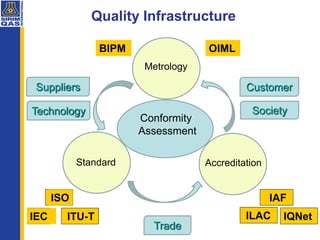
Metrology
Conformity
Assessment
Standard Accreditation
Quality Infrastructure
ISO
ITU-TIEC
IAF
ILAC
Trade
Technology Society
BIPM OIML
IQNet
Suppliers Customer
What is Conformity Assessment ?
‘demonstration that specified requirements
relating to a product , process, system,
person or body are fulfilled’
Specified requirements may be stated in
normative documents such as regulations,
standards and technical specifications
ISO 17000:2004
‘any procedure used, directly or indirect, to
determine that relevant requirements in
technical regulations or standards are fulfilled’
Annex 1 WTO/TBT Agreement
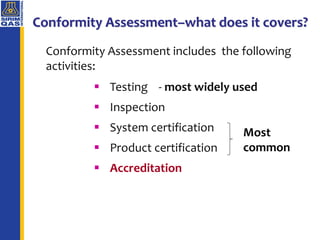
Conformity Assessment–what does it covers?
Conformity Assessment includes the following
activities:
 Testing - most widely used
 Inspection
 System certification
 Product certification
 Accreditation
Most
common
What is a standard ?
• A document approved by a recognized body
that provides, for common and repeated use,
rules, guidelines or characteristics for
products and their related processes or
production methods,
• Compliance is not mandatory unless
requested by authorities
• Often used as specified requirements since
they represent a broad consensus of what is
wanted in a given situation.
What is a technical regulation ?
A document which lays down product characteristics
or their related process or production methods,
including administrative provisions, with which
compliance is mandatory.
It may also cover terminology, symbols, packaging,
marking or labeling requirements as they apply to a
product, process or production method.
WTO/TBT Agreement
• metrology is the technology or science of measurement.
• availability of a national measurement system to ensure
that measurements are made with appropriate accuracy
and reliability and can be related to other
measurements made domestically or internationally.
• Subdivided into
a. scientific metrology (highest level of
measurement standards),
b. legal metrology (ensure the correctness of
measurements that affect the transparency of
trade, law enforcement, health and safety)
c. industrial metrology (satisfactory functioning of
measurement instruments used in industry)
What is Metrology ?
Who will benefit
Conformity
Assessment
beneficiaries
clients of
certification ,
inspection
bodies, test labs
customers of
organizations
whose products,
processes or
services are
certified;
governmental
authorities;
non-
governmental
organizations;
consumers and
other members
of the public.
Principles of Conformity Assessment
Selection
Determination
Review and
attestation
Information and
selected items
Information on
fulfilment of specified
requirements
fulfilment of specified
requirements
demonstrated
Surveillance
needed
Need to fulfilment of specified requirements
Yes
No
END
Selection
Involves planning and preparation activities to collect
or produce all information and input needed for
subsequent determination activities.
May be a large number of identical items: on-going
production, continuous process or system, or
numerous locations - consideration needs to be
given to sampling or sample selection.
A single individual product may be the object of
conformity assessment - even in such cases,
sampling may be necessary to select a part that is
representative of the whole.
Determination
Undertaken to develop complete information regarding
fulfillment of specified requirements.
Typical determination activities are :
• auditing
• inspection
• testing
There are other determination activities with no specific
name or designation.
Output is combination of information created through
determination activity and input to determination
function - structured to facilitate review and attestation.
Review and attestation
Review - final stage of checking before taking
decision that the object of conformity assessment
has been reliably demonstrated to fulfill the specified
requirements.
Attestation results in a “statement” in a form that most
readily reaches all potential users; could be in the
form of a :
• “certificate”
• “license”
• “statement of conformity.”
Note: Attestation issue of a statement, based on
a decision following review, that fulfilment of
specified requirements has been demonstrated
Basic conformity assessment process
Object Test Attestation
Declaration
(1st. Party)
Contract
(2nd Party)
Certificate
(3rd. Party)
+
Requirements
(Technical Regulations
and/or Standards)
Accreditation
Peer assessment
Specified
requirements
fulfilled
Standard,
Technical
regulation
and
requirements
Conformity Assessment Bodies and
Standards
Laboratories
ISO/IEC 17025 -
requirements for
competence of labs
(Testing and Calibration)
Inspection bodies
ISO/IEC 17020 –
requirements for
inspection of various
items etc
Certification bodies
ISO/IEC 17021 – for certification of
Management Systems,
ISO/IEC 17065 - for products, processes
or services
ISO/IEC 17024 - for persons
Management system is set of interrelated or
interacting elements of an organization to establish
policies and objectives and processes to achieve
those objectives
Management system includes among others:
ISO 9001 Quality
ISO 14001 Environment
ISO 50001 Energy efficiency,
ISO 55001 Assets
ISO 27001 Information security
ISO 22000 Food safety,.
Management System Certification
• An independent demonstration that the
organization’s management system
a) conforms to specified requirements,
b) capable of consistently achieving its stated policy
and objectives, and
c) effectively and efficiently implemented
• Motivation to the organization’s employees
• Provides the organization with marketing
opportunities to potential customers
• Serves as a foundation for facilitating the
organization in the international trade
Management System Certification
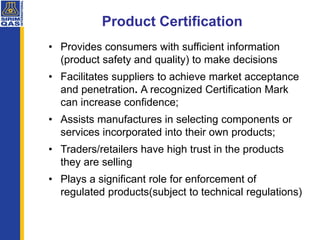
• Provides consumers with sufficient information
(product safety and quality) to make decisions
• Facilitates suppliers to achieve market acceptance
and penetration. A recognized Certification Mark
can increase confidence;
• Assists manufactures in selecting components or
services incorporated into their own products;
• Traders/retailers have high trust in the products
they are selling
• Plays a significant role for enforcement of
regulated products(subject to technical regulations)
Product Certification
• Type testing : full tests of a sample product
against standard and/or regulation;
• Factory assessment of the quality system;
• Followed up by testing of samples taken from
factory and/or the open market;
• Factory surveillance assessment and/or
confirmatory testing;
• Market surveillance.
Product Certification
Selection of type of product certification scheme
• Refer to ISO/IEC 17067 for guidance
• Consideration on the level of risk of products or
services to consumers
• Low risk product- may choose a once-off type test;
• Medium risk product – may use batch certification
• High risk product - may use a scheme which has type
testing, management system with regular product
testing from the factory and/or from the market.
Product Certification
• Recognizes the competence of individuals to
perform specific tasks.
• Person competence is not based on academic
qualification alone.
• A person can be well qualified but may be
incompetent
• Typically assessment is based on individuals
ability to apply knowledge and skills to achieve
intended results.
Certification of Persons
• Provides a consistent framework and set of
requirements to allow recognition of competence
• Provides employers with confidence in their
certified employees and clearly identifies the
competencies required for different categories of
professions and jobs
• Competencies can be up graded and maintained
as technologies change
• Allows for mobility of certified persons
Certification of Persons
• Provides objective evidence that an inspected
item/material meets the specified requirements
and needs of a customer (purchaser,
manufacturer or regulator).
• Heavily relies on professional judgment of an
inspector whose competence is crucial to make a
right decision.
Inspection
Inspection
• Many plants and installations use inspection to
ensure that equipment and plant facilities continue
to operate safely and correctly.
• Usually performed on site and allow for the clients
to be informed immediately.
• Conducted before shipping or confirmation with the
order to prevent shipment of wrong items/materials.
• Commonly used prior shipment of building
materials and heavy machineries.
Testing and Calibration
• Testing is the determination of a product’s
characteristics against the requirements of the
standard or specification
• testing depends on the support of competent
calibration
• calibration is also a foundation for confidence in
various industries where decisions are based on
measurement
• accreditation to ISO/IEC 17025 - compliance to
the generic standard requirements and also to any
field specific requirements for the laboratories
• the scope is supported by the specific test
methods the laboratory uses for testing and
specific measurements; and associated
uncertainty for calibration laboratories.
• the scope allows the laboratory to identify
competent people to do the work within their
scope of activity.
• the scope allows the customers to identify a
suitable laboratory for their purposes and
have confidence in the tests and
measurements made by the laboratory.
Testing and Calibration
Accreditation
• third-party attestation related to a conformity
assessment body conveying formal
demonstration of its competence to carry out
specific assessment tasks
• Customer’s confidence in competence,
integrity and impartiality of accredited
conformity assessment bodies
• the accreditation function cannot be carried
out by an organization that also provides
conformity assessment services
Demands for
accreditation
System/Product/
Service
Producer
Consumer
Local/Regions/
International +
Government
Requirements
Market
Certification Inspection Testing
body body laboratory
Accreditation
Conformity assessment
Conformity Assessment - Accreditation
Accreditation
International Accreditation
In response to Standards Code negotiations
• If countries are expected to accept foreign test
data, they must be able to have confidence in
the competence of foreign laboratories
• Accreditation offers a good solution
• The concept of mutual recognition between
accreditation bodies was initiated
Mutual Recognition Agreements (MRA’s)
• Internationally traded goods and services are
subject to repeated conformity assessment controls
• Mainly because of lack of confidence by consumers
of conformity assessment in one country in the
competence of conformity assessment bodies in
another country
• Confidence achieved through cross-border
cooperation among conformity assessment bodies
and accreditation bodies - formalized in MRA’s.
Accreditation of Certification Bodies
• International Accreditation Forum (IAF)
• Pacific Accreditation Cooperation (PAC)
Accreditation of Labs. And Insp. Bodies
• International Laboratory Accreditation
Cooperation (ILAC)
• Asia Pacific Laboratory Accreditation
Cooperation (APLAC)
Mutual Recognition Agreements (MRA’s)
International Accreditation Forum (IAF)
• Established in 1992 as an informal co-operation and
incorporated in the US in 1998
• Objectives: achieve and maintain confidence in the
accreditation programmes operated by its members
• Links with ILAC, international standardization
bodies and trade organizations
• IAF Multilateral Recognition Arrangement (MLA) in
the areas of Management system & Product
certification with the objective of “certified once,
accepted everywhere.”
International Accreditation Forum (IAF)
• Admission to the MLA after stringent evaluation of
operations by a peer evaluation team to evaluate
compliance with international standards (ISO/IEC 17011)
and IAF requirements
• IAF MLA signatories:
IAF QMS MLA 3 regional accreditation groups
and 54 ABs
IAF EMS MLA 3 regional accreditation groups
and 50 ABs
IAF Product MLA 3 regional accreditation groups
and 51 Abs
Aims and objectives of ILAC
• International forum for the development of
laboratory accreditation practices and procedures
• Harmonisation of accreditation procedures and
practices – to remove technical barriers to trade
• Advice and assistance to countries developing
their own laboratory accreditation systems
• facilitating trade by promotion of the acceptance
of accredited test and calibration results
• product tested once, accepted everywhere
Recognition/acceptance
Acceptance of certificates can be strengthened:
At National Level
Across borders
National Accreditation
+
Mutual Recognition
between Accreditors
Mutual Recognition
between Conformity
Assessment Bodies
Accreditation
Mark of conformity
• indicates that an object of conformity assessment
(product, process, person, system or body) is in
conformity with specified requirements
• can be on products (product certification), license,
certificates and publications materials
• convey useful information about a product, or
indicate particular characteristics of a product
such as its safety, quality, performance, reliability
or impact on the environment.
- ISO/IEC 17030
38
Voluntary
Sectors
Regulated
Sectors
Conformity Assessment Model
(Source:Building trust – The Conformity Assessment Toolbox, 2010 )
Benefits of Conformity Assessment
• For Business
• Greater acceptance of products and services -
greater market access
• Avoid high costs associated with multiple
certifications and testing
• Reduces time to market new products and services.
• Minimize wastage of material and non-conforming
products during production.
• Gain access to the growing number of tenders
which specify accredited certification
• For Society
• Enhance confidence in products and services,
despite complex global marketplace
• Protected from procuring sub standard products
and services in the markets
• Minimises product failures or recalls from the
marketplace
• Preservation of environment
Benefits of Conformity Assessment
• For Government
• Facilitator of an international trade
• Increase international cooperation
• An efficient tools for enforcement / monitoring
• An effective mechanism to enhance public
awareness on the compliance to regulation
Benefits of Conformity Assessment
• Accredited Conformity Assessment Bodies must
have procedures in place to handle, record and
report:
• Certified products that are found to be failure against
standard or technical regulation
• Misuse of a certification mark
• Actions to be taken
• Product containment
• Public advisories
• Product recall
• Revocation of certificates of conformity & use of marks
When a certified product failed?
Drivers for Seeking Certification
(Source: IAF survey report - published 2012)
The main driver for seeking certification is internal business
improvement (47%), customer requirement (32%), and to meet
regulatory requirements (13%).
The value of certification
83% of respondents agreed and strongly agreed that
certification had added value to their organisation.
(Source: IAF survey report - published 2012)
The value of certification
79% of respondents confirmed that certification helped to
meet the requirements of regulators.
(Source: IAF survey report - published 2012)
Achieving accreditation is not an option.
Without accreditation, certificates issued by
a CAB in a developing economy have very
little chance of being accepted in developed
markets
Conformity Assessment is a catalyst for
improving the quality of products/services,
competitiveness and access to global
market.
Conformity Assessment is proven to be an
effective mechanism to ensure that public
interest requirements, such as health, safety
and environmental, are being met.
Conclusion
Thank You
SIRIM QAS International Sdn Bhd
Block 8, Persiaran Dato' Menteri
Section 2,
40700 Shah Alam, MALAYSIA
Mobile: +60196688417
Email: hjselamat@Hotmail.com

Conformity assessment

  • 1.
    SIRIM QAS International BahrainBranch Office Presented by: Basori Hj Selamat 30th March 2017 Conformity Assessment Facilitates Trades Development
  • 2.
    Presentation Outline • Challengesof trades • Quality Infrastructure • Conformity Assessment • Mutual Recognition Agreements • Benefits of Conformity Assessment • Value of Certification
  • 3.
    • Customers’ confidencethat their need and expectations will be met. • non-acceptance of conformity mark, certificates of conformity and test reports • costly multiple re-testing and/or certification • non-acceptance of foreign standards and conformity assessment results Challenges of trades
  • 4.
  • 5.
    What is ConformityAssessment ? ‘demonstration that specified requirements relating to a product , process, system, person or body are fulfilled’ Specified requirements may be stated in normative documents such as regulations, standards and technical specifications ISO 17000:2004 ‘any procedure used, directly or indirect, to determine that relevant requirements in technical regulations or standards are fulfilled’ Annex 1 WTO/TBT Agreement
  • 6.
    Conformity Assessment–what doesit covers? Conformity Assessment includes the following activities:  Testing - most widely used  Inspection  System certification  Product certification  Accreditation Most common
  • 7.
    What is astandard ? • A document approved by a recognized body that provides, for common and repeated use, rules, guidelines or characteristics for products and their related processes or production methods, • Compliance is not mandatory unless requested by authorities • Often used as specified requirements since they represent a broad consensus of what is wanted in a given situation.
  • 8.
    What is atechnical regulation ? A document which lays down product characteristics or their related process or production methods, including administrative provisions, with which compliance is mandatory. It may also cover terminology, symbols, packaging, marking or labeling requirements as they apply to a product, process or production method. WTO/TBT Agreement
  • 9.
    • metrology isthe technology or science of measurement. • availability of a national measurement system to ensure that measurements are made with appropriate accuracy and reliability and can be related to other measurements made domestically or internationally. • Subdivided into a. scientific metrology (highest level of measurement standards), b. legal metrology (ensure the correctness of measurements that affect the transparency of trade, law enforcement, health and safety) c. industrial metrology (satisfactory functioning of measurement instruments used in industry) What is Metrology ?
  • 10.
    Who will benefit Conformity Assessment beneficiaries clientsof certification , inspection bodies, test labs customers of organizations whose products, processes or services are certified; governmental authorities; non- governmental organizations; consumers and other members of the public.
  • 11.
    Principles of ConformityAssessment Selection Determination Review and attestation Information and selected items Information on fulfilment of specified requirements fulfilment of specified requirements demonstrated Surveillance needed Need to fulfilment of specified requirements Yes No END
  • 12.
    Selection Involves planning andpreparation activities to collect or produce all information and input needed for subsequent determination activities. May be a large number of identical items: on-going production, continuous process or system, or numerous locations - consideration needs to be given to sampling or sample selection. A single individual product may be the object of conformity assessment - even in such cases, sampling may be necessary to select a part that is representative of the whole.
  • 13.
    Determination Undertaken to developcomplete information regarding fulfillment of specified requirements. Typical determination activities are : • auditing • inspection • testing There are other determination activities with no specific name or designation. Output is combination of information created through determination activity and input to determination function - structured to facilitate review and attestation.
  • 14.
    Review and attestation Review- final stage of checking before taking decision that the object of conformity assessment has been reliably demonstrated to fulfill the specified requirements. Attestation results in a “statement” in a form that most readily reaches all potential users; could be in the form of a : • “certificate” • “license” • “statement of conformity.” Note: Attestation issue of a statement, based on a decision following review, that fulfilment of specified requirements has been demonstrated
  • 15.
    Basic conformity assessmentprocess Object Test Attestation Declaration (1st. Party) Contract (2nd Party) Certificate (3rd. Party) + Requirements (Technical Regulations and/or Standards) Accreditation Peer assessment Specified requirements fulfilled Standard, Technical regulation and requirements
  • 16.
    Conformity Assessment Bodiesand Standards Laboratories ISO/IEC 17025 - requirements for competence of labs (Testing and Calibration) Inspection bodies ISO/IEC 17020 – requirements for inspection of various items etc Certification bodies ISO/IEC 17021 – for certification of Management Systems, ISO/IEC 17065 - for products, processes or services ISO/IEC 17024 - for persons
  • 17.
    Management system isset of interrelated or interacting elements of an organization to establish policies and objectives and processes to achieve those objectives Management system includes among others: ISO 9001 Quality ISO 14001 Environment ISO 50001 Energy efficiency, ISO 55001 Assets ISO 27001 Information security ISO 22000 Food safety,. Management System Certification
  • 18.
    • An independentdemonstration that the organization’s management system a) conforms to specified requirements, b) capable of consistently achieving its stated policy and objectives, and c) effectively and efficiently implemented • Motivation to the organization’s employees • Provides the organization with marketing opportunities to potential customers • Serves as a foundation for facilitating the organization in the international trade Management System Certification
  • 19.
    • Provides consumerswith sufficient information (product safety and quality) to make decisions • Facilitates suppliers to achieve market acceptance and penetration. A recognized Certification Mark can increase confidence; • Assists manufactures in selecting components or services incorporated into their own products; • Traders/retailers have high trust in the products they are selling • Plays a significant role for enforcement of regulated products(subject to technical regulations) Product Certification
  • 20.
    • Type testing: full tests of a sample product against standard and/or regulation; • Factory assessment of the quality system; • Followed up by testing of samples taken from factory and/or the open market; • Factory surveillance assessment and/or confirmatory testing; • Market surveillance. Product Certification
  • 21.
    Selection of typeof product certification scheme • Refer to ISO/IEC 17067 for guidance • Consideration on the level of risk of products or services to consumers • Low risk product- may choose a once-off type test; • Medium risk product – may use batch certification • High risk product - may use a scheme which has type testing, management system with regular product testing from the factory and/or from the market. Product Certification
  • 22.
    • Recognizes thecompetence of individuals to perform specific tasks. • Person competence is not based on academic qualification alone. • A person can be well qualified but may be incompetent • Typically assessment is based on individuals ability to apply knowledge and skills to achieve intended results. Certification of Persons
  • 23.
    • Provides aconsistent framework and set of requirements to allow recognition of competence • Provides employers with confidence in their certified employees and clearly identifies the competencies required for different categories of professions and jobs • Competencies can be up graded and maintained as technologies change • Allows for mobility of certified persons Certification of Persons
  • 24.
    • Provides objectiveevidence that an inspected item/material meets the specified requirements and needs of a customer (purchaser, manufacturer or regulator). • Heavily relies on professional judgment of an inspector whose competence is crucial to make a right decision. Inspection
  • 25.
    Inspection • Many plantsand installations use inspection to ensure that equipment and plant facilities continue to operate safely and correctly. • Usually performed on site and allow for the clients to be informed immediately. • Conducted before shipping or confirmation with the order to prevent shipment of wrong items/materials. • Commonly used prior shipment of building materials and heavy machineries.
  • 26.
    Testing and Calibration •Testing is the determination of a product’s characteristics against the requirements of the standard or specification • testing depends on the support of competent calibration • calibration is also a foundation for confidence in various industries where decisions are based on measurement • accreditation to ISO/IEC 17025 - compliance to the generic standard requirements and also to any field specific requirements for the laboratories
  • 27.
    • the scopeis supported by the specific test methods the laboratory uses for testing and specific measurements; and associated uncertainty for calibration laboratories. • the scope allows the laboratory to identify competent people to do the work within their scope of activity. • the scope allows the customers to identify a suitable laboratory for their purposes and have confidence in the tests and measurements made by the laboratory. Testing and Calibration
  • 28.
    Accreditation • third-party attestationrelated to a conformity assessment body conveying formal demonstration of its competence to carry out specific assessment tasks • Customer’s confidence in competence, integrity and impartiality of accredited conformity assessment bodies • the accreditation function cannot be carried out by an organization that also provides conformity assessment services
  • 29.
    Demands for accreditation System/Product/ Service Producer Consumer Local/Regions/ International + Government Requirements Market CertificationInspection Testing body body laboratory Accreditation Conformity assessment Conformity Assessment - Accreditation Accreditation
  • 30.
    International Accreditation In responseto Standards Code negotiations • If countries are expected to accept foreign test data, they must be able to have confidence in the competence of foreign laboratories • Accreditation offers a good solution • The concept of mutual recognition between accreditation bodies was initiated
  • 31.
    Mutual Recognition Agreements(MRA’s) • Internationally traded goods and services are subject to repeated conformity assessment controls • Mainly because of lack of confidence by consumers of conformity assessment in one country in the competence of conformity assessment bodies in another country • Confidence achieved through cross-border cooperation among conformity assessment bodies and accreditation bodies - formalized in MRA’s.
  • 32.
    Accreditation of CertificationBodies • International Accreditation Forum (IAF) • Pacific Accreditation Cooperation (PAC) Accreditation of Labs. And Insp. Bodies • International Laboratory Accreditation Cooperation (ILAC) • Asia Pacific Laboratory Accreditation Cooperation (APLAC) Mutual Recognition Agreements (MRA’s)
  • 33.
    International Accreditation Forum(IAF) • Established in 1992 as an informal co-operation and incorporated in the US in 1998 • Objectives: achieve and maintain confidence in the accreditation programmes operated by its members • Links with ILAC, international standardization bodies and trade organizations • IAF Multilateral Recognition Arrangement (MLA) in the areas of Management system & Product certification with the objective of “certified once, accepted everywhere.”
  • 34.
    International Accreditation Forum(IAF) • Admission to the MLA after stringent evaluation of operations by a peer evaluation team to evaluate compliance with international standards (ISO/IEC 17011) and IAF requirements • IAF MLA signatories: IAF QMS MLA 3 regional accreditation groups and 54 ABs IAF EMS MLA 3 regional accreditation groups and 50 ABs IAF Product MLA 3 regional accreditation groups and 51 Abs
  • 35.
    Aims and objectivesof ILAC • International forum for the development of laboratory accreditation practices and procedures • Harmonisation of accreditation procedures and practices – to remove technical barriers to trade • Advice and assistance to countries developing their own laboratory accreditation systems • facilitating trade by promotion of the acceptance of accredited test and calibration results • product tested once, accepted everywhere
  • 36.
    Recognition/acceptance Acceptance of certificatescan be strengthened: At National Level Across borders National Accreditation + Mutual Recognition between Accreditors Mutual Recognition between Conformity Assessment Bodies Accreditation
  • 37.
    Mark of conformity •indicates that an object of conformity assessment (product, process, person, system or body) is in conformity with specified requirements • can be on products (product certification), license, certificates and publications materials • convey useful information about a product, or indicate particular characteristics of a product such as its safety, quality, performance, reliability or impact on the environment. - ISO/IEC 17030
  • 38.
  • 39.
    Benefits of ConformityAssessment • For Business • Greater acceptance of products and services - greater market access • Avoid high costs associated with multiple certifications and testing • Reduces time to market new products and services. • Minimize wastage of material and non-conforming products during production. • Gain access to the growing number of tenders which specify accredited certification
  • 40.
    • For Society •Enhance confidence in products and services, despite complex global marketplace • Protected from procuring sub standard products and services in the markets • Minimises product failures or recalls from the marketplace • Preservation of environment Benefits of Conformity Assessment
  • 41.
    • For Government •Facilitator of an international trade • Increase international cooperation • An efficient tools for enforcement / monitoring • An effective mechanism to enhance public awareness on the compliance to regulation Benefits of Conformity Assessment
  • 42.
    • Accredited ConformityAssessment Bodies must have procedures in place to handle, record and report: • Certified products that are found to be failure against standard or technical regulation • Misuse of a certification mark • Actions to be taken • Product containment • Public advisories • Product recall • Revocation of certificates of conformity & use of marks When a certified product failed?
  • 43.
    Drivers for SeekingCertification (Source: IAF survey report - published 2012) The main driver for seeking certification is internal business improvement (47%), customer requirement (32%), and to meet regulatory requirements (13%).
  • 44.
    The value ofcertification 83% of respondents agreed and strongly agreed that certification had added value to their organisation. (Source: IAF survey report - published 2012)
  • 45.
    The value ofcertification 79% of respondents confirmed that certification helped to meet the requirements of regulators. (Source: IAF survey report - published 2012)
  • 46.
    Achieving accreditation isnot an option. Without accreditation, certificates issued by a CAB in a developing economy have very little chance of being accepted in developed markets Conformity Assessment is a catalyst for improving the quality of products/services, competitiveness and access to global market. Conformity Assessment is proven to be an effective mechanism to ensure that public interest requirements, such as health, safety and environmental, are being met. Conclusion
  • 47.
    Thank You SIRIM QASInternational Sdn Bhd Block 8, Persiaran Dato' Menteri Section 2, 40700 Shah Alam, MALAYSIA Mobile: +60196688417 Email: hjselamat@Hotmail.com