ISO
Not acronym – Greek word called
isos means equal
International organization for
standardization
• Established in 1942 in Geneva, Switzerland
• It is an association of national standard bodies
of more than 150 countries.
• It is a specialized agency.
• Aim of ISO is create coordination and
unification of international standards.
• It employs – technical committee, sub
committee, working group
ISO involves quality system
• How – method/process
• Who – responsibilities/authorities
• When – records/eveidence
• Where – identification/traceability
Quality Systems
• System is well understood/ effective
• Product/service actually do satisfy customer
• Emphasis is placed on problem-prevention
rather than problem detection after
concurrence.
QS
• ISO does not lend its name to advertisements
and not registration business.
• But create and publish international standard
facilities.
• International exchange of G&S
ISO 9000
• Business dealings
• Product
• Material process
• Quality management
• Customer satisfaction
ISO 14000
• Environmental management requirements
• Control pollution
• Minimize effect
objectives
• Consistent dissemination of information
• Improve employee involvement
• Improve house keeping
• Improve decision making
• Improve customer satisfaction
• Improve safe working
• Reduce customer complaints
• Reduced inspection efforts
• Reduce quality cost
• Global market
• Control operation
• Standardized organization
Kept ready for ISO 9000 std
• Technical report
• Handbook
• Web based document on quality management
/ assurance
Responsible for developing ISO 9000
std
• Technical and sub committee
• expert
Classifications
• ISO 8402:1986 – vocabulary – gives the
definition of various terms (such as quality,
reliability, grade, inspection)
• ISO 9001: 1987 – Design, Development,
Production, Installation and Servicing (gives
model right from designing to customer
service such as: TV, cooler, pump fitters,
fridge, laptop)
Classifications
• ISO 9002: 1987 – production to installation ex:
road construction, bridge, dam and civil
structure
• ISO 9003:1987 – final inspection and testing –
after manufacturing ex: all consumer items,
petroleum, FMCG
• ISO 9004 : 1987 – guidelines for QM (quality
culture)
Classifications
• ISO 10011 – 1990 – guidelines for auditing QS
• ISO 10011 – 1991- role of
auditors/responsibilities/executing /reporting
• ISO 10011-1992 – evaluating/ qualification
• ISO 10011 1993 – establishment of audit
function
Elements
• Management responsibility
• Quality systems
• Contract review
• Design control
• Documentation
• Purchasing
• Purchaser or customer supplied product
• Product identification/traceability
• Process control
• Inspection & testing
Elements
• IMTE – inspection, measuring & test equipment
• Inspection and test status
• Control of non conforming products review
• Correction and preventive action
• Handling, storage, packaging, preservation and delivery
• Control of quality records
• Internal quality audit
• Training
• Servicing
• Statistical techniques
Implementation of QS
• Top mgt. commitment
• Appoint expert
• Create awareness
• Form team
• Training
• Time schedule
• Select element owners
• Review the present system
Implementation of QS
• Write the documents
• Install the new system
• Internal audit
• Management review
• Pre assessment
• Award of ISO 9000 certificate
Documentation of QS
• It is evidence or for reference
• Benefits are – clarity, systematic, consistency,
involvement
• Required document – policy / manual – rules and
regulation (what)
• Procedure – methods (who when where)
• Work instructions – manufacturing process (how)
• Records / formats - forms
Auditing
• It is carried out to see if QS is effective
• Features – who – auditor well versed and
qualified
• What – product, process, system, service
• How – information gathering activity not
police kind of activity
• Where – internal and external purpose.
Types of audit
• First party – internal audit
• Second party – another organization (on
supplier by customer)
• Third party – by independent organization (on
supplier for accreditation)
Objectives
• Determine conformity & non – conformity
• Meet requirement
• Meet objectives
• Evaluate one’s own org. quality
• Recognize by third party
Stages
• Audit planning – schedule, appoint auditor,
notification to auditee, prepare checklist (list
of questions to be asked in audit)
• Audit performance – meeting, inspection
• Audit reporting – summary of findings,
corrective action requirement
• Audit follow up – time period
ISO 14000
• After success of ISO 9000 another std for EM
came in 1992 i.e ISO 14000
• It covers – Env. Mgt, Systems
• Env. Auditing
• Env. Performance evaluation
• Life cycle assessment
• Env. Aspects in product std.
Why ISO 14000
• To encourage cleaner, safer, healthier world
for all
• To compete
• To start in other countries
• To make the customer to think that they
safeguard the people
• Own practices to be free pollution country –
to be uniform ISO 14000 developed.
ISO 14000 series
• Organization Evaluation standard
• ISO 14001 – EMS Specification – Elements to
get registration certificate
• ISO 14004 – EMS Guidelines Principles –
• ISO 14010 – EA Principles – Int/Ext Auditing
• ISO 14011 – Guidelines EA – plan
• ISO 14012 – EA Qualification – personal
attributes and skills
ISO 14000 series
• ISO 14031 – EPA Guidelines – monitoring and
measurings
• Product Evaluation Standard
• ISO 14064 – Env Aspects in product standard –
develop product standard
• ISO 14020:2000 – label and declaration – envl.
Basic principles for all environmental labeling
– goal used in label
ISO 14000 series
• ISO 14021 – L & D (terms and conditions) –
accurate, verifiable not deceptive
• ISO 14022 – L &D – symbol
• ISO 14023 – L & D – guidelines
• ISO 14024 – L & D – labeling or seal
• ISO 14040 – LCA – application and limitation -
principles
• ISO 14041 - LCA - review - goal
• ISO 14042 – LCA – impact
• ISO LCA - improvement
Terminology
• Environment –flora and fauna
• Envl aspect – water wastage, air emission
• Envl. Impact – negative or positive
• Envl. Objective – org. policy to safe & control
the env.
• Envl. Target – in no: or % of objectives like
reduce 2% -3% carbon
Requirement of ISO 14000
• General requirement
• Environmental policy
• Environmental Aspects
• Legal aspects
• Objectives and target
• Environmental management programme
• Structure and responsibilty
• Training, awareness and competency
• Communication
Requirement of ISO 14000
• EMS document
• Document control
• Operation control
• Emergency preparaedness and response
• Monitor and measurement
• Non – conformance
• Records
• EMS audit
• Mgt. review
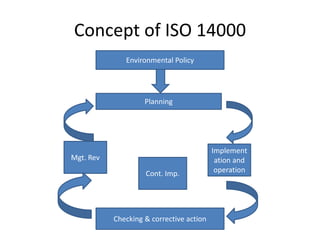
Concept of ISO 14000
Environmental Policy
Cont. Imp.
Mgt. Rev
Implement
ation and
operation
Checking & corrective action
Planning
Benefits
• Global - no trade barrier
• Organizational – customer, employee, investor
TS 16949
• Automotive Industry
• It is an technical specification aiming to the
development of a quality management system
that provides for continual improvement
emphasizing defects prevention & the
reduction in variation and waste in the supply
chain.
• It is based on ISO 9001 published in Mar 2002
as TS 16949
Type of standard
• ISO 9000 & ISO 14000 industry – QM & EMS
• AS 9100 – Aerospace Industry
• TL 9000 – Tele Communication Industry
• TS 16949 – Automotive Industry
• Prepared by International Automotive task
force and the technical committee
• Chrysler (quality Assurance Manual)
• Ford Motor (QS std)
• GM (Target for excellence)
• TS 16949 applies to the design/development
production and installation and servicing of
automotive related products.
• Validity for 3 years
Content of specification
• QMS – General requirement, control of
documents
• Responsibility of the management
• Management resource
• Product realization (production)
• Measurement, Analysis and Improvement
• Customer requirement
process
• Business oriented process
• Customer oriented process
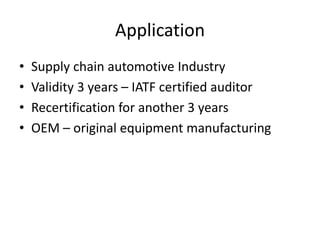
Application
• Supply chain automotive Industry
• Validity 3 years – IATF certified auditor
• Recertification for another 3 years
• OEM – original equipment manufacturing
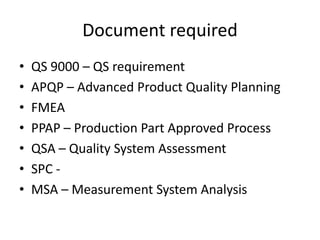
Document required
• QS 9000 – QS requirement
• APQP – Advanced Product Quality Planning
• FMEA
• PPAP – Production Part Approved Process
• QSA – Quality System Assessment
• SPC -
• MSA – Measurement System Analysis
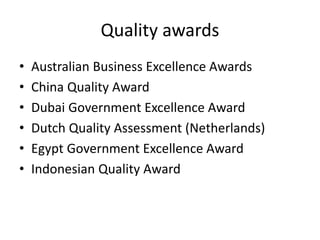
Quality awards
• Australian Business Excellence Awards
• China Quality Award
• Dubai Government Excellence Award
• Dutch Quality Assessment (Netherlands)
• Egypt Government Excellence Award
• Indonesian Quality Award
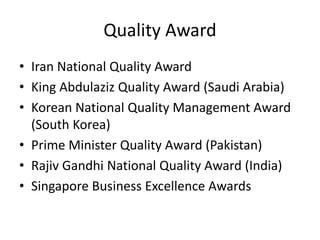
Quality Award
• Iran National Quality Award
• King Abdulaziz Quality Award (Saudi Arabia)
• Korean National Quality Management Award
(South Korea)
• Prime Minister Quality Award (Pakistan)
• Rajiv Gandhi National Quality Award (India)
• Singapore Business Excellence Awards

TQM unit 5 QUALITY SYSTEM

  • 1.
    ISO Not acronym –Greek word called isos means equal
  • 2.
    International organization for standardization •Established in 1942 in Geneva, Switzerland • It is an association of national standard bodies of more than 150 countries. • It is a specialized agency. • Aim of ISO is create coordination and unification of international standards. • It employs – technical committee, sub committee, working group
  • 3.
    ISO involves qualitysystem • How – method/process • Who – responsibilities/authorities • When – records/eveidence • Where – identification/traceability
  • 4.
    Quality Systems • Systemis well understood/ effective • Product/service actually do satisfy customer • Emphasis is placed on problem-prevention rather than problem detection after concurrence.
  • 5.
    QS • ISO doesnot lend its name to advertisements and not registration business. • But create and publish international standard facilities. • International exchange of G&S
  • 6.
    ISO 9000 • Businessdealings • Product • Material process • Quality management • Customer satisfaction
  • 7.
    ISO 14000 • Environmentalmanagement requirements • Control pollution • Minimize effect
  • 8.
    objectives • Consistent disseminationof information • Improve employee involvement • Improve house keeping • Improve decision making • Improve customer satisfaction • Improve safe working • Reduce customer complaints • Reduced inspection efforts • Reduce quality cost • Global market • Control operation • Standardized organization
  • 9.
    Kept ready forISO 9000 std • Technical report • Handbook • Web based document on quality management / assurance
  • 10.
    Responsible for developingISO 9000 std • Technical and sub committee • expert
  • 11.
    Classifications • ISO 8402:1986– vocabulary – gives the definition of various terms (such as quality, reliability, grade, inspection) • ISO 9001: 1987 – Design, Development, Production, Installation and Servicing (gives model right from designing to customer service such as: TV, cooler, pump fitters, fridge, laptop)
  • 12.
    Classifications • ISO 9002:1987 – production to installation ex: road construction, bridge, dam and civil structure • ISO 9003:1987 – final inspection and testing – after manufacturing ex: all consumer items, petroleum, FMCG • ISO 9004 : 1987 – guidelines for QM (quality culture)
  • 13.
    Classifications • ISO 10011– 1990 – guidelines for auditing QS • ISO 10011 – 1991- role of auditors/responsibilities/executing /reporting • ISO 10011-1992 – evaluating/ qualification • ISO 10011 1993 – establishment of audit function
  • 14.
    Elements • Management responsibility •Quality systems • Contract review • Design control • Documentation • Purchasing • Purchaser or customer supplied product • Product identification/traceability • Process control • Inspection & testing
  • 15.
    Elements • IMTE –inspection, measuring & test equipment • Inspection and test status • Control of non conforming products review • Correction and preventive action • Handling, storage, packaging, preservation and delivery • Control of quality records • Internal quality audit • Training • Servicing • Statistical techniques
  • 16.
    Implementation of QS •Top mgt. commitment • Appoint expert • Create awareness • Form team • Training • Time schedule • Select element owners • Review the present system
  • 17.
    Implementation of QS •Write the documents • Install the new system • Internal audit • Management review • Pre assessment • Award of ISO 9000 certificate
  • 18.
    Documentation of QS •It is evidence or for reference • Benefits are – clarity, systematic, consistency, involvement • Required document – policy / manual – rules and regulation (what) • Procedure – methods (who when where) • Work instructions – manufacturing process (how) • Records / formats - forms
  • 19.
    Auditing • It iscarried out to see if QS is effective • Features – who – auditor well versed and qualified • What – product, process, system, service • How – information gathering activity not police kind of activity • Where – internal and external purpose.
  • 20.
    Types of audit •First party – internal audit • Second party – another organization (on supplier by customer) • Third party – by independent organization (on supplier for accreditation)
  • 21.
    Objectives • Determine conformity& non – conformity • Meet requirement • Meet objectives • Evaluate one’s own org. quality • Recognize by third party
  • 22.
    Stages • Audit planning– schedule, appoint auditor, notification to auditee, prepare checklist (list of questions to be asked in audit) • Audit performance – meeting, inspection • Audit reporting – summary of findings, corrective action requirement • Audit follow up – time period
  • 23.
    ISO 14000 • Aftersuccess of ISO 9000 another std for EM came in 1992 i.e ISO 14000 • It covers – Env. Mgt, Systems • Env. Auditing • Env. Performance evaluation • Life cycle assessment • Env. Aspects in product std.
  • 24.
    Why ISO 14000 •To encourage cleaner, safer, healthier world for all • To compete • To start in other countries • To make the customer to think that they safeguard the people • Own practices to be free pollution country – to be uniform ISO 14000 developed.
  • 25.
    ISO 14000 series •Organization Evaluation standard • ISO 14001 – EMS Specification – Elements to get registration certificate • ISO 14004 – EMS Guidelines Principles – • ISO 14010 – EA Principles – Int/Ext Auditing • ISO 14011 – Guidelines EA – plan • ISO 14012 – EA Qualification – personal attributes and skills
  • 26.
    ISO 14000 series •ISO 14031 – EPA Guidelines – monitoring and measurings • Product Evaluation Standard • ISO 14064 – Env Aspects in product standard – develop product standard • ISO 14020:2000 – label and declaration – envl. Basic principles for all environmental labeling – goal used in label
  • 27.
    ISO 14000 series •ISO 14021 – L & D (terms and conditions) – accurate, verifiable not deceptive • ISO 14022 – L &D – symbol • ISO 14023 – L & D – guidelines • ISO 14024 – L & D – labeling or seal • ISO 14040 – LCA – application and limitation - principles • ISO 14041 - LCA - review - goal • ISO 14042 – LCA – impact • ISO LCA - improvement
  • 28.
    Terminology • Environment –floraand fauna • Envl aspect – water wastage, air emission • Envl. Impact – negative or positive • Envl. Objective – org. policy to safe & control the env. • Envl. Target – in no: or % of objectives like reduce 2% -3% carbon
  • 29.
    Requirement of ISO14000 • General requirement • Environmental policy • Environmental Aspects • Legal aspects • Objectives and target • Environmental management programme • Structure and responsibilty • Training, awareness and competency • Communication
  • 30.
    Requirement of ISO14000 • EMS document • Document control • Operation control • Emergency preparaedness and response • Monitor and measurement • Non – conformance • Records • EMS audit • Mgt. review
  • 31.
    Concept of ISO14000 Environmental Policy Cont. Imp. Mgt. Rev Implement ation and operation Checking & corrective action Planning
  • 32.
    Benefits • Global -no trade barrier • Organizational – customer, employee, investor
  • 33.
    TS 16949 • AutomotiveIndustry • It is an technical specification aiming to the development of a quality management system that provides for continual improvement emphasizing defects prevention & the reduction in variation and waste in the supply chain. • It is based on ISO 9001 published in Mar 2002 as TS 16949
  • 34.
    Type of standard •ISO 9000 & ISO 14000 industry – QM & EMS • AS 9100 – Aerospace Industry • TL 9000 – Tele Communication Industry • TS 16949 – Automotive Industry
  • 35.
    • Prepared byInternational Automotive task force and the technical committee • Chrysler (quality Assurance Manual) • Ford Motor (QS std) • GM (Target for excellence)
  • 36.
    • TS 16949applies to the design/development production and installation and servicing of automotive related products. • Validity for 3 years
  • 37.
    Content of specification •QMS – General requirement, control of documents • Responsibility of the management • Management resource • Product realization (production) • Measurement, Analysis and Improvement • Customer requirement
  • 38.
    process • Business orientedprocess • Customer oriented process
  • 39.
    Application • Supply chainautomotive Industry • Validity 3 years – IATF certified auditor • Recertification for another 3 years • OEM – original equipment manufacturing
  • 40.
    Document required • QS9000 – QS requirement • APQP – Advanced Product Quality Planning • FMEA • PPAP – Production Part Approved Process • QSA – Quality System Assessment • SPC - • MSA – Measurement System Analysis
  • 41.
    Quality awards • AustralianBusiness Excellence Awards • China Quality Award • Dubai Government Excellence Award • Dutch Quality Assessment (Netherlands) • Egypt Government Excellence Award • Indonesian Quality Award
  • 42.
    Quality Award • IranNational Quality Award • King Abdulaziz Quality Award (Saudi Arabia) • Korean National Quality Management Award (South Korea) • Prime Minister Quality Award (Pakistan) • Rajiv Gandhi National Quality Award (India) • Singapore Business Excellence Awards