By Arundathie Abeysinghe
Journalist/Lecturer
International Aviation Academy
Arundathie Abeysinghe

SriLankan Airlines
1
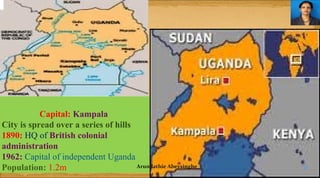
Capital: Kampala
City is spread over a series of hills
1890: HQ of British colonial
administration
1962: Capital of independent Uganda
Arundathie Abeysinghe
Population: 1.2m

2
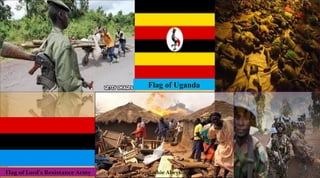
Flag of Uganda

Flag of Lord’s Resistance Army

Arundathie Abeysinghe

3
 In 1800s, Boganda had a lot of power and it was ruled by King or

Kabaka
 Boganda was one of the richest and most sophisticated
kingdoms in Africa
 Up to 1890, British Colonial rule
 In 1962, Uganda gained independence from the British
 In 1966, leader of the ruling party – Uganda People’s Congress,
Milton Obote drafted a new Constitution for the country
 In 1971, Idi Amin toppled Obote’s government
Arundathie Abeysinghe

4
In 1986, due to the Civil War about a million people were

dead and about 600,000 were injured
The economy was virtually bankrupt
People wanted a change and they supported a new party
called the National Resistance Movement (NRM)
NRM seized power
In 2002, Museveni became the President
Arundathie Abeysinghe

5
Surge of rebel groups in response to government
Support from Khartoum, Sudan
In 2005, LRA established a base in Congo
In 1999, rebel units withdrew to bases in Sudan
In 2004, ongoing troubles in the north of the country
Children were kidnapped and forced to join rebels
The Government tried to disarm the Karimojong but they

wanted guns to defend their cattle from Kenyans and from
LRA rebels
Arundathie Abeysinghe

6
 30,000 children have been abducted and recruited to LRA by

brainwashing them
 30,000 people have been killed in direct action with the LRA
 About 100,000 died due to direct and indirect actions of the LRA
 Thousands have been maimed physically - lips, ears, mouths and
limbs being cut off since they were considered as traitors
 About 2 million people were displaced either voluntarily or
through government action into camps where life was simply hell
on earth
 Countless children died in combat
Arundathie Abeysinghe

7
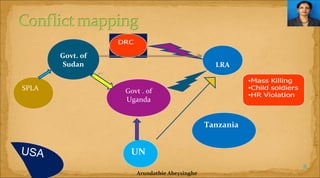
Govt. of
Sudan
SPLA

LRA
Govt . of
Uganda

Tanzania

USA

UN
Arundathie Abeysinghe

8
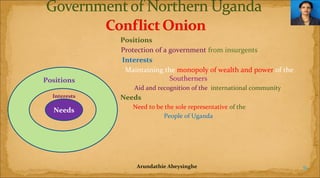
Positions
Interests

Needs
P

Positions
Protection of a government from insurgents
Interests
Maintaining the monopoly of wealth and power of the
Southerners
Aid and recognition of the international community

Needs
Need to be the sole representative of the
People of Uganda

Arundathie Abeysinghe

9
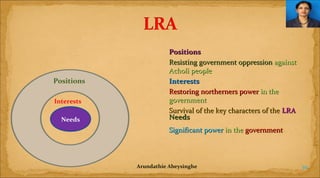
Positions
Interests
Needs

Positions
Resisting government oppression against
Acholi people
Interests
Restoring northerners power in the
government
Survival of the key characters of the LRA
Needs
Significant power in the government

Arundathie Abeysinghe

10
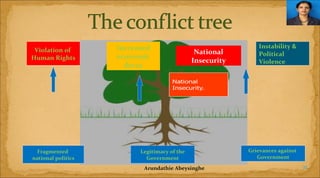
Violation of
Human Rights

Fragmented
national politics

Increased
economic
decay

National
Insecurity

Legitimacy of the
Government
Arundathie Abeysinghe

Instability &
Political
Violence

Grievances against
Government

11
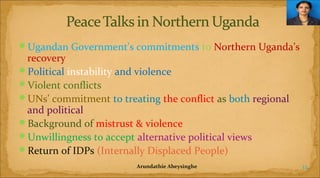
Ugandan Government's commitments to Northern Uganda’s

recovery
Political instability and violence
Violent conflicts
UNs’ commitment to treating the conflict as both regional
and political
Background of mistrust & violence
Unwillingness to accept alternative political views
Return of IDPs (Internally Displaced People)
Arundathie Abeysinghe

12
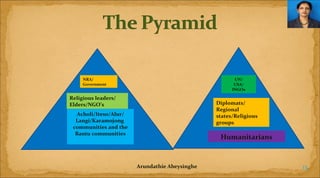
NRA/

UN/
USA/
INGOs

Government

Religious leaders/
Elders/NGO’s

Diplomats/
Regional
states/Religious
groups

Acholi/Iteso/Alur/
Langi/Karamojong
communities and the
Bantu communities

Humanitarians

Arundathie Abeysinghe

13
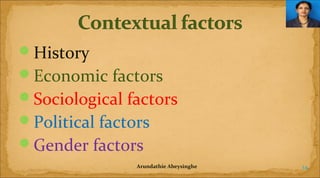
History
Economic factors
Sociological factors
Political factors
Gender factors
Arundathie Abeysinghe

14
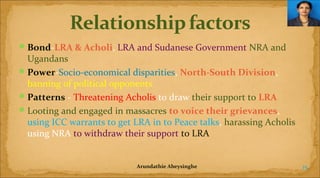
 Bond-LRA & Acholi, LRA and Sudanese Government NRA and

Ugandans
 Power-Socio-economical disparities, North-South Division,
banning of political opponents
 Patterns - Threatening Acholis to draw their support to LRA
 Looting and engaged in massacres to voice their grievances,
using ICC warrants to get LRA in to Peace talks, harassing Acholis
using NRA to withdraw their support to LRA

Arundathie Abeysinghe

15
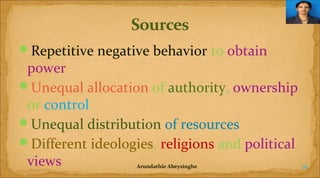
Repetitive negative behavior to obtain

power
Unequal allocation of authority, ownership
or control
Unequal distribution of resources
Different ideologies, religions and political
views
Arundathie Abeysinghe

16
Imbalanced economic development
Division of socio-economic and political

powers

Lack of a multi-party political system
Arundathie Abeysinghe

17
Primary - LRA, NRA, Acholi Tribe
Secondary - Southern Ugandans, Sudanese

Governments, South Sudanese
Government, DRC,
Tertiary - UN, USA and International
Community
Arundathie Abeysinghe

18
• LRA
• Fear of government power
• Hatred towards government, felt cheated by the
government
• Government of Uganda - Superiority over
northerners, vengeance, not willing for a political
solution, skeptical of international proposals
Arundathie Abeysinghe

19
Government of Uganda
Using military attacks instead of a political solution,
killing/massacres, curtailing freedom of expression and
association in the name of “the war against terrorism”
Supporting monopoly of power and wealth of southerners
Discrimination of Acholi

Arundathie Abeysinghe

20
LRA
Killing, attacking the villages,
abduction of children, ensuring
survival of the key characters of the
LRA
Arundathie Abeysinghe

21
 Conflict Management - Betty Bigombe Peace Talks (1993-1994),

Juba Peace Talks – (2006-2008) - Ceasefire, Cessation of hostilities
 Conflict Resolution - Discuss grievances, needs, IDP’s problem,
issuing of ICC (International Criminal Court) warrants
 Conflict Transformation - “Peace, Recovery and Development
Plan for North Uganda”
 Setting up of special courts linking National Justice and Traditional
Mechanism, Agreement on DDR, agreeing to request a deferral of
arrest warrants under several conditions

Arundathie Abeysinghe

22
Local efforts to dialogue between Museveni and the

LRA have consistently failed
In early 2000, President Museveni signed a blanket
amnesty
At the same time, the U.S listed the LRA on its list
of terrorist organizations
Museveni and the government diverted funds from
ministries to the military
Arundathie Abeysinghe

23
 Put pressure on LRA Leadership to re-enter

Peace Negotiations
 Government should promote equal treatment
for all tribes and expand the development
projects to northern and eastern areas as well
 Encourage UN Peace Keepers to force Sudanese
Government to stop helping LRA
 Introduce national propaganda to end the
North-South Division in Uganda
Arundathie Abeysinghe

24
Military Solution – Post-Conflict resolutions
Major Rehabilitation Projects
IDPs
Child Soldiers
Rape Victims
War Victims
Former LRA Carder
 Find a Permanent Solution to the Root Causes to
Prevent re-emergence






Arundathie Abeysinghe

25
1500 - Bito dynasties of Buganda, Bunyoro and Ankole

founded by Nilotic-speaking immigrants from present-day
southeastern Sudan
1700 - Buganda begins to expand at the expense of Bunyoro
1800 - Buganda controls territory bordering Lake Victoria
from the Victoria Nile to the Kagera River
Arundathie Abeysinghe

26
1840s - Muslim traders from the Indian Ocean coast

exchange firearms, cloth and beads for the ivory and slaves
of Buganda
1862 - British explorer John Hanning Speke becomes the first
European to visit Buganda
1875 - Bugandan King Mutesa I allows Christian missionaries
to enter his realm

Arundathie Abeysinghe

27
1877 - Members of the British Missionary Society

arrive in Buganda
1879 - Members of the French Roman Catholic
White Fathers arrive
1890 - Britain and Germany sign treaty giving Britain
rights to what was to become Uganda

Arundathie Abeysinghe

28
1892 - Imperial British East Africa Company agent Frederick

Lugard extends the company's control to southern Uganda
and helps the Protestant missionaries to prevail over their
Catholic counterparts in Buganda
1894 - Uganda becomes a British protectorate
1900 - Britain signs agreement with Buganda giving it
autonomy and turning it into a constitutional monarchy
controlled mainly by Protestant chiefs
Arundathie Abeysinghe

29
1902 - Eastern province of Uganda

transferred to Kenya
1904 - Commercial cultivation of cotton
begins
1921 - Uganda given a legislative council, but
its first African member not admitted till 1945
Arundathie Abeysinghe

30
1958 - Uganda given internal self-government
1962 - Uganda becomes independent with Milton Obote as

prime minister
1963 - Uganda becomes a republic with Buganda's King
Mutesa as president
1966 - Milton Obote ends Buganda's autonomy and
promotes himself to the presidency
1967 - New constitution vests considerable power in the
president
Arundathie Abeysinghe

31
1971 - Milton Obote toppled in coup led by Army chief Idi

Amin
1972 - Amin orders Asians who were not Ugandan citizens
- around 60,000 people - to leave the country
1972-73 - Uganda engages in border clashes with
Tanzania
1976 - Idi Amin declares himself president for life and
claims parts of Kenya
1978 - Uganda invades Tanzania with a view to annexing
Kagera region
Arundathie Abeysinghe

32
1979 - Tanzania invades Uganda, unifying the various anti-

Amin forces under the Uganda National Liberation Front and
forcing Amin to flee the country; Yusufu Lule installed as
president -quickly replaced by Godfrey Binaisa
1980 - Binaisa overthrown by the army
Milton Obote becomes president after elections
1985 - Obote deposed in military coup - replaced by Tito
Okello
1986 - National Resistance Army rebels take Kampala and
install Yoweri Museveni as president
Arundathie Abeysinghe

33
1993 - Museveni restores traditional kings, but without

political power
1995 - New constitution legalizes political parties but
maintains the ban on political activity
1996 - Museveni returned to office in Uganda's first direct
presidential election
1997 - Ugandan troops help depose Mobutu Sese Seko of
Zaire - replaced by Laurent Kabila
1998 - Ugandan troops intervene in the Democratic
Republic of Congo to overthrow Kabila
Arundathie Abeysinghe

34
2002 March - Sudan, Uganda sign agreement aimed at

containing Ugandan rebel group - Lord's Resistance Army (LRA)
2002 October - Army evacuates more than 400,000
civilians caught up in fight against LRA’s brutal attacks on
villages
2002 December - Peace deal signed with Uganda National
Rescue Front (UNRF) after more than 5 years of negotiations
2003 May - Uganda pulls out troops from eastern DR Congo
Over 10,000 DR Congo civilians seek asylum in Uganda
2004 February - LRA rebels slaughter more than 200IDPs
Arundathie Abeysinghe
35
2004 December - Government and LRA rebels hold face-to-

face talks - no breakthrough to end the insurgency
2005 April - Uganda rejects accusations made by DR Congo
at the International Court in The Hague
Multi-party politics
2005 July - Parliament approves a constitutional
amendment which scraps presidential term limits
Voters in a referendum back a return to multi-party
politics
Arundathie Abeysinghe

36
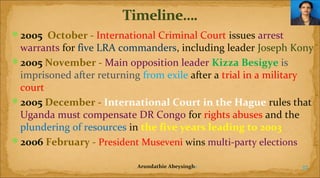
2005  October - International Criminal Court issues arrest

warrants for five LRA commanders, including leader Joseph Kony
2005 November - Main opposition leader Kizza Besigye is
imprisoned after returning from exile after a trial in a military
court
2005 December - International Court in the Hague rules that
Uganda must compensate DR Congo for rights abuses and the
plundering of resources in the five years leading to 2003
2006 February - President Museveni wins multi-party elections
Arundathie Abeysinghe

37
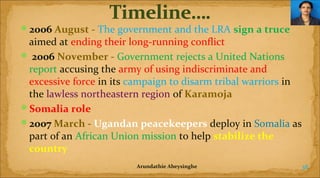
2006 August - The government and the LRA sign a truce 

aimed at ending their long-running conflict
 2006 November - Government rejects a United Nations
report accusing the army of using indiscriminate and
excessive force in its campaign to disarm tribal warriors in
the lawless northeastern region of Karamoja
Somalia role
2007 March - Ugandan peacekeepers deploy in Somalia as
part of an African Union mission to help stabilize the 
country
Arundathie Abeysinghe

38
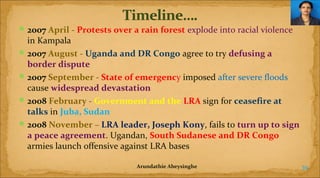
 2007 April - Protests over a rain forest explode into racial violence

in Kampala
 2007 August - Uganda and DR Congo agree to try defusing a 
border dispute
 2007 September - State of emergency imposed after severe floods
cause widespread devastation
 2008 February - Government and the LRA sign for ceasefire at 
talks in Juba, Sudan
 2008 November – LRA leader, Joseph Kony, fails to turn up to sign 
a peace agreement. Ugandan, South Sudanese and DR Congo 
armies launch offensive against LRA bases
Arundathie Abeysinghe

39
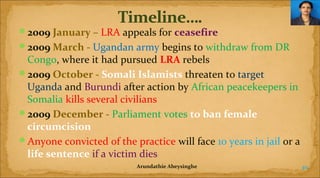
2009 January – LRA appeals for ceasefire
2009 March - Ugandan army begins to withdraw from DR

Congo, where it had pursued LRA rebels
2009 October - Somali Islamists threaten to target
Uganda and Burundi after action by African peacekeepers in
Somalia kills several civilians
2009 December - Parliament votes to ban female 
circumcision
Anyone convicted of the practice will face 10 years in jail or a
life sentence if a victim dies
Arundathie Abeysinghe

40
2010 January - President Museveni distances himself from

the anti-homosexuality Bill
2010 June - Public prosecutor opens corruption 
investigation against Vice-President Gilbert Bukenya,
Foreign Minister Sam Kutesa and several other ministers 
and officials over the alleged theft of $25m
2010 June-August - Operation Rwenzori against ADFNALU rebels striving for an Islamic state in Uganda
prompts 90,000 to flee in North Kivu province of
neighboring DR Congo
Arundathie Abeysinghe

41
2010 July - Two bomb attacks on people watching World 

Cup finals at a restaurant and a rugby club in Kampala kill
at least 74 people
Somali Islamist group Al-Shabab says it was behind the
blasts
2010 August - National Resistance Movement primary
elections for parliamentary and local candidates suspended 
amid irregularities, violence
Arundathie Abeysinghe

42
2010 October - UN report into killing of Hutus in DR

Congo between 1993 and 2003
2010 October - Constitutional Court quashes treason
charges against opposition leader Kizza Besigye
2011 February - Museveni wins his fourth presidential 
election
2011 April - Kizza Besigye arrested several times over
''walk-to-work'' protests against rising prices
2011 July - US deploys special forces personnel to help
Uganda combat LRA rebels
Arundathie Abeysinghe

43
2011 September - Court orders release of LRA commander

Thomas Kwoyelo
2012 May - Ugandan Army captures senior LRA 
commander Caesar Achellam in a clash in the Central
African Republic
Tens of thousands of refugees cross into Uganda, fleeing 
fighting in DR Congo
2012 July - UN accuses Uganda of sending troops into DR
Congo to fight alongside the M23 rebel movement, a charge 
Uganda denies
Arundathie Abeysinghe
44
2012 November - Uganda announces its intention to withdraw

from UN-backed international peacekeeping missions
2013 February - Eleven countries, including Uganda, sign a
UN-mediated agreement pledging not to interfere in DR Congo
2013 March - Uganda is grouped among the worst offenders in 
the illegal ivory trade at a meeting of CITES, the body 
regulating wildlife trade
2013 May - Government temporarily shuts two newspapers
after they published a letter suggesting President
Museveni was grooming his son for power
 

Arundathie Abeysinghe

45
Thank you!
Arundathie Abeysinghe

46

Conflict in North Uganda

  • 1.
    By Arundathie Abeysinghe Journalist/Lecturer InternationalAviation Academy Arundathie Abeysinghe SriLankan Airlines 1
  • 2.
    Capital: Kampala City isspread over a series of hills 1890: HQ of British colonial administration 1962: Capital of independent Uganda Arundathie Abeysinghe Population: 1.2m 2
  • 3.
    Flag of Uganda Flagof Lord’s Resistance Army Arundathie Abeysinghe 3
  • 4.
     In 1800s,Boganda had a lot of power and it was ruled by King or Kabaka  Boganda was one of the richest and most sophisticated kingdoms in Africa  Up to 1890, British Colonial rule  In 1962, Uganda gained independence from the British  In 1966, leader of the ruling party – Uganda People’s Congress, Milton Obote drafted a new Constitution for the country  In 1971, Idi Amin toppled Obote’s government Arundathie Abeysinghe 4
  • 5.
    In 1986, dueto the Civil War about a million people were dead and about 600,000 were injured The economy was virtually bankrupt People wanted a change and they supported a new party called the National Resistance Movement (NRM) NRM seized power In 2002, Museveni became the President Arundathie Abeysinghe 5
  • 6.
    Surge of rebelgroups in response to government Support from Khartoum, Sudan In 2005, LRA established a base in Congo In 1999, rebel units withdrew to bases in Sudan In 2004, ongoing troubles in the north of the country Children were kidnapped and forced to join rebels The Government tried to disarm the Karimojong but they wanted guns to defend their cattle from Kenyans and from LRA rebels Arundathie Abeysinghe 6
  • 7.
     30,000 childrenhave been abducted and recruited to LRA by brainwashing them  30,000 people have been killed in direct action with the LRA  About 100,000 died due to direct and indirect actions of the LRA  Thousands have been maimed physically - lips, ears, mouths and limbs being cut off since they were considered as traitors  About 2 million people were displaced either voluntarily or through government action into camps where life was simply hell on earth  Countless children died in combat Arundathie Abeysinghe 7
  • 8.
    Govt. of Sudan SPLA LRA Govt .of Uganda Tanzania USA UN Arundathie Abeysinghe 8
  • 9.
    Positions Interests Needs P Positions Protection of agovernment from insurgents Interests Maintaining the monopoly of wealth and power of the Southerners Aid and recognition of the international community Needs Need to be the sole representative of the People of Uganda Arundathie Abeysinghe 9
  • 10.
    Positions Interests Needs Positions Resisting government oppressionagainst Acholi people Interests Restoring northerners power in the government Survival of the key characters of the LRA Needs Significant power in the government Arundathie Abeysinghe 10
  • 11.
    Violation of Human Rights Fragmented nationalpolitics Increased economic decay National Insecurity Legitimacy of the Government Arundathie Abeysinghe Instability & Political Violence Grievances against Government 11
  • 12.
    Ugandan Government's commitmentsto Northern Uganda’s recovery Political instability and violence Violent conflicts UNs’ commitment to treating the conflict as both regional and political Background of mistrust & violence Unwillingness to accept alternative political views Return of IDPs (Internally Displaced People) Arundathie Abeysinghe 12
  • 13.
  • 14.
    History Economic factors Sociological factors Politicalfactors Gender factors Arundathie Abeysinghe 14
  • 15.
     Bond-LRA &Acholi, LRA and Sudanese Government NRA and Ugandans  Power-Socio-economical disparities, North-South Division, banning of political opponents  Patterns - Threatening Acholis to draw their support to LRA  Looting and engaged in massacres to voice their grievances, using ICC warrants to get LRA in to Peace talks, harassing Acholis using NRA to withdraw their support to LRA Arundathie Abeysinghe 15
  • 16.
    Repetitive negative behaviorto obtain power Unequal allocation of authority, ownership or control Unequal distribution of resources Different ideologies, religions and political views Arundathie Abeysinghe 16
  • 17.
    Imbalanced economic development Divisionof socio-economic and political powers Lack of a multi-party political system Arundathie Abeysinghe 17
  • 18.
    Primary - LRA,NRA, Acholi Tribe Secondary - Southern Ugandans, Sudanese Governments, South Sudanese Government, DRC, Tertiary - UN, USA and International Community Arundathie Abeysinghe 18
  • 19.
    • LRA • Fearof government power • Hatred towards government, felt cheated by the government • Government of Uganda - Superiority over northerners, vengeance, not willing for a political solution, skeptical of international proposals Arundathie Abeysinghe 19
  • 20.
    Government of Uganda Usingmilitary attacks instead of a political solution, killing/massacres, curtailing freedom of expression and association in the name of “the war against terrorism” Supporting monopoly of power and wealth of southerners Discrimination of Acholi Arundathie Abeysinghe 20
  • 21.
    LRA Killing, attacking thevillages, abduction of children, ensuring survival of the key characters of the LRA Arundathie Abeysinghe 21
  • 22.
     Conflict Management- Betty Bigombe Peace Talks (1993-1994), Juba Peace Talks – (2006-2008) - Ceasefire, Cessation of hostilities  Conflict Resolution - Discuss grievances, needs, IDP’s problem, issuing of ICC (International Criminal Court) warrants  Conflict Transformation - “Peace, Recovery and Development Plan for North Uganda”  Setting up of special courts linking National Justice and Traditional Mechanism, Agreement on DDR, agreeing to request a deferral of arrest warrants under several conditions Arundathie Abeysinghe 22
  • 23.
    Local efforts todialogue between Museveni and the LRA have consistently failed In early 2000, President Museveni signed a blanket amnesty At the same time, the U.S listed the LRA on its list of terrorist organizations Museveni and the government diverted funds from ministries to the military Arundathie Abeysinghe 23
  • 24.
     Put pressureon LRA Leadership to re-enter Peace Negotiations  Government should promote equal treatment for all tribes and expand the development projects to northern and eastern areas as well  Encourage UN Peace Keepers to force Sudanese Government to stop helping LRA  Introduce national propaganda to end the North-South Division in Uganda Arundathie Abeysinghe 24
  • 25.
    Military Solution –Post-Conflict resolutions Major Rehabilitation Projects IDPs Child Soldiers Rape Victims War Victims Former LRA Carder  Find a Permanent Solution to the Root Causes to Prevent re-emergence      Arundathie Abeysinghe 25
  • 26.
    1500 - Bitodynasties of Buganda, Bunyoro and Ankole founded by Nilotic-speaking immigrants from present-day southeastern Sudan 1700 - Buganda begins to expand at the expense of Bunyoro 1800 - Buganda controls territory bordering Lake Victoria from the Victoria Nile to the Kagera River Arundathie Abeysinghe 26
  • 27.
    1840s - Muslimtraders from the Indian Ocean coast exchange firearms, cloth and beads for the ivory and slaves of Buganda 1862 - British explorer John Hanning Speke becomes the first European to visit Buganda 1875 - Bugandan King Mutesa I allows Christian missionaries to enter his realm Arundathie Abeysinghe 27
  • 28.
    1877 - Membersof the British Missionary Society arrive in Buganda 1879 - Members of the French Roman Catholic White Fathers arrive 1890 - Britain and Germany sign treaty giving Britain rights to what was to become Uganda Arundathie Abeysinghe 28
  • 29.
    1892 - ImperialBritish East Africa Company agent Frederick Lugard extends the company's control to southern Uganda and helps the Protestant missionaries to prevail over their Catholic counterparts in Buganda 1894 - Uganda becomes a British protectorate 1900 - Britain signs agreement with Buganda giving it autonomy and turning it into a constitutional monarchy controlled mainly by Protestant chiefs Arundathie Abeysinghe 29
  • 30.
    1902 - Easternprovince of Uganda transferred to Kenya 1904 - Commercial cultivation of cotton begins 1921 - Uganda given a legislative council, but its first African member not admitted till 1945 Arundathie Abeysinghe 30
  • 31.
    1958 - Ugandagiven internal self-government 1962 - Uganda becomes independent with Milton Obote as prime minister 1963 - Uganda becomes a republic with Buganda's King Mutesa as president 1966 - Milton Obote ends Buganda's autonomy and promotes himself to the presidency 1967 - New constitution vests considerable power in the president Arundathie Abeysinghe 31
  • 32.
    1971 - MiltonObote toppled in coup led by Army chief Idi Amin 1972 - Amin orders Asians who were not Ugandan citizens - around 60,000 people - to leave the country 1972-73 - Uganda engages in border clashes with Tanzania 1976 - Idi Amin declares himself president for life and claims parts of Kenya 1978 - Uganda invades Tanzania with a view to annexing Kagera region Arundathie Abeysinghe 32
  • 33.
    1979 - Tanzaniainvades Uganda, unifying the various anti- Amin forces under the Uganda National Liberation Front and forcing Amin to flee the country; Yusufu Lule installed as president -quickly replaced by Godfrey Binaisa 1980 - Binaisa overthrown by the army Milton Obote becomes president after elections 1985 - Obote deposed in military coup - replaced by Tito Okello 1986 - National Resistance Army rebels take Kampala and install Yoweri Museveni as president Arundathie Abeysinghe 33
  • 34.
    1993 - Musevenirestores traditional kings, but without political power 1995 - New constitution legalizes political parties but maintains the ban on political activity 1996 - Museveni returned to office in Uganda's first direct presidential election 1997 - Ugandan troops help depose Mobutu Sese Seko of Zaire - replaced by Laurent Kabila 1998 - Ugandan troops intervene in the Democratic Republic of Congo to overthrow Kabila Arundathie Abeysinghe 34
  • 35.
    2002 March -Sudan, Uganda sign agreement aimed at containing Ugandan rebel group - Lord's Resistance Army (LRA) 2002 October - Army evacuates more than 400,000 civilians caught up in fight against LRA’s brutal attacks on villages 2002 December - Peace deal signed with Uganda National Rescue Front (UNRF) after more than 5 years of negotiations 2003 May - Uganda pulls out troops from eastern DR Congo Over 10,000 DR Congo civilians seek asylum in Uganda 2004 February - LRA rebels slaughter more than 200IDPs Arundathie Abeysinghe 35
  • 36.
    2004 December -Government and LRA rebels hold face-to- face talks - no breakthrough to end the insurgency 2005 April - Uganda rejects accusations made by DR Congo at the International Court in The Hague Multi-party politics 2005 July - Parliament approves a constitutional amendment which scraps presidential term limits Voters in a referendum back a return to multi-party politics Arundathie Abeysinghe 36
  • 37.
    2005  October - International CriminalCourt issues arrest warrants for five LRA commanders, including leader Joseph Kony 2005 November - Main opposition leader Kizza Besigye is imprisoned after returning from exile after a trial in a military court 2005 December - International Court in the Hague rules that Uganda must compensate DR Congo for rights abuses and the plundering of resources in the five years leading to 2003 2006 February - President Museveni wins multi-party elections Arundathie Abeysinghe 37
  • 38.
    2006 August - The governmentand the LRA sign a truce  aimed at ending their long-running conflict  2006 November - Government rejects a United Nations report accusing the army of using indiscriminate and excessive force in its campaign to disarm tribal warriors in the lawless northeastern region of Karamoja Somalia role 2007 March - Ugandan peacekeepers deploy in Somalia as part of an African Union mission to help stabilize the  country Arundathie Abeysinghe 38
  • 39.
     2007 April - Protests over a rain forestexplode into racial violence in Kampala  2007 August - Uganda and DR Congo agree to try defusing a  border dispute  2007 September - State of emergency imposed after severe floods cause widespread devastation  2008 February - Government and the LRA sign for ceasefire at  talks in Juba, Sudan  2008 November – LRA leader, Joseph Kony, fails to turn up to sign  a peace agreement. Ugandan, South Sudanese and DR Congo  armies launch offensive against LRA bases Arundathie Abeysinghe 39
  • 40.
    2009 January – LRA appealsfor ceasefire 2009 March - Ugandan army begins to withdraw from DR Congo, where it had pursued LRA rebels 2009 October - Somali Islamists threaten to target Uganda and Burundi after action by African peacekeepers in Somalia kills several civilians 2009 December - Parliament votes to ban female  circumcision Anyone convicted of the practice will face 10 years in jail or a life sentence if a victim dies Arundathie Abeysinghe 40
  • 41.
    2010 January - President Musevenidistances himself from the anti-homosexuality Bill 2010 June - Public prosecutor opens corruption  investigation against Vice-President Gilbert Bukenya, Foreign Minister Sam Kutesa and several other ministers  and officials over the alleged theft of $25m 2010 June-August - Operation Rwenzori against ADFNALU rebels striving for an Islamic state in Uganda prompts 90,000 to flee in North Kivu province of neighboring DR Congo Arundathie Abeysinghe 41
  • 42.
    2010 July - Two bomb attackson people watching World  Cup finals at a restaurant and a rugby club in Kampala kill at least 74 people Somali Islamist group Al-Shabab says it was behind the blasts 2010 August - National Resistance Movement primary elections for parliamentary and local candidates suspended  amid irregularities, violence Arundathie Abeysinghe 42
  • 43.
    2010 October - UN reportinto killing of Hutus in DR Congo between 1993 and 2003 2010 October - Constitutional Court quashes treason charges against opposition leader Kizza Besigye 2011 February - Museveni wins his fourth presidential  election 2011 April - Kizza Besigye arrested several times over ''walk-to-work'' protests against rising prices 2011 July - US deploys special forces personnel to help Uganda combat LRA rebels Arundathie Abeysinghe 43
  • 44.
    2011 September - Court orders releaseof LRA commander Thomas Kwoyelo 2012 May - Ugandan Army captures senior LRA  commander Caesar Achellam in a clash in the Central African Republic Tens of thousands of refugees cross into Uganda, fleeing  fighting in DR Congo 2012 July - UN accuses Uganda of sending troops into DR Congo to fight alongside the M23 rebel movement, a charge  Uganda denies Arundathie Abeysinghe 44
  • 45.
    2012 November - Uganda announcesits intention to withdraw from UN-backed international peacekeeping missions 2013 February - Eleven countries, including Uganda, sign a UN-mediated agreement pledging not to interfere in DR Congo 2013 March - Uganda is grouped among the worst offenders in  the illegal ivory trade at a meeting of CITES, the body  regulating wildlife trade 2013 May - Government temporarily shuts two newspapers after they published a letter suggesting President Museveni was grooming his son for power   Arundathie Abeysinghe 45
  • 46.

Editor's Notes