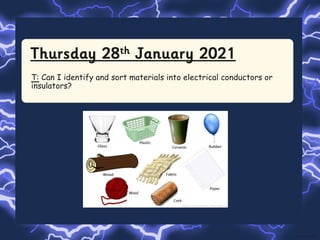
Thursday 28th January 2021
T: Can I identify and sort materials into electrical conductors or
insulators?
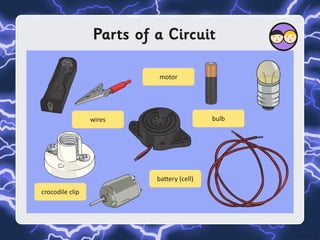
Parts of a Circuit
bulb
battery (cell)
crocodile clip
wires
motor
Conductors and Insulators
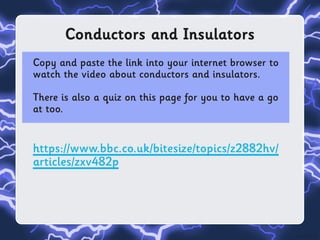
Copy and paste the link into your internet browser to
watch the video about conductors and insulators.
There is also a quiz on this page for you to have a go
at too.
https://www.bbc.co.uk/bitesize/topics/z2882hv/
articles/zxv482p
Insulators and Conductors
• The protons and neutrons are attracted to
each other as a result of the strong
nuclear force, and they form the nucleus.
• The electrons are attracted to protons, but
this attraction is not as strong as the strong
nuclear force which makes the protons
and neutrons stick together
.
• Instead, the attraction means that the
electrons orbit the protons in the nucleus.
• The electrons cannot move freely in
these materials and therefore no electric
current can be produced.
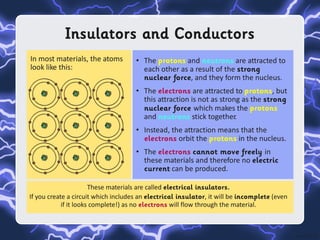
In most materials, the atoms
look like this:
These materials are called electrical insulators.
If you create a circuit which includes an electrical insulator, it will be incomplete (even
if it looks complete!) as no electrons will flow through the material.
Insulators and Conductors
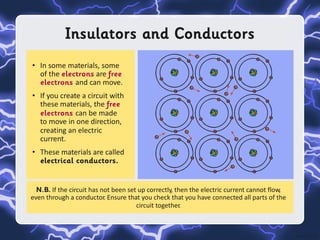
• In some materials, some
of the electrons are free
electrons and can move.
• If you create a circuit with
these materials, the free
electrons can be made
to move in one direction,
creating an electric
current.
• These materials are called
electrical conductors.
N.B. If the circuit has not been set up correctly, then the electric current cannot flow,
even through a conductor
. Ensure that you check that you have connected all parts of the
circuit together
.
Today’s activity
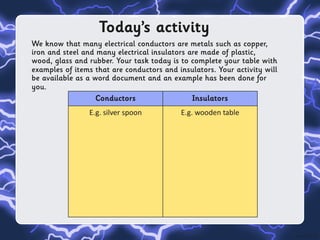
Conductors Insulators
E.g. silver spoon E.g. wooden table
We know that many electrical conductors are metals such as copper,
iron and steel and many electrical insulators are made of plastic,
wood, glass and rubber. Your task today is to complete your table with
examples of items that are conductors and insulators. Your activity will
be available as a word document and an example has been done for
you.

Conductors and Insulators PowerPoint.pdf

  • 2.
    Thursday 28th January2021 T: Can I identify and sort materials into electrical conductors or insulators?
  • 3.
    Parts of aCircuit bulb battery (cell) crocodile clip wires motor
  • 4.
    Conductors and Insulators Copyand paste the link into your internet browser to watch the video about conductors and insulators. There is also a quiz on this page for you to have a go at too. https://www.bbc.co.uk/bitesize/topics/z2882hv/ articles/zxv482p
  • 5.
    Insulators and Conductors •The protons and neutrons are attracted to each other as a result of the strong nuclear force, and they form the nucleus. • The electrons are attracted to protons, but this attraction is not as strong as the strong nuclear force which makes the protons and neutrons stick together . • Instead, the attraction means that the electrons orbit the protons in the nucleus. • The electrons cannot move freely in these materials and therefore no electric current can be produced. In most materials, the atoms look like this: These materials are called electrical insulators. If you create a circuit which includes an electrical insulator, it will be incomplete (even if it looks complete!) as no electrons will flow through the material.
  • 6.
    Insulators and Conductors •In some materials, some of the electrons are free electrons and can move. • If you create a circuit with these materials, the free electrons can be made to move in one direction, creating an electric current. • These materials are called electrical conductors. N.B. If the circuit has not been set up correctly, then the electric current cannot flow, even through a conductor . Ensure that you check that you have connected all parts of the circuit together .
  • 7.
    Today’s activity Conductors Insulators E.g.silver spoon E.g. wooden table We know that many electrical conductors are metals such as copper, iron and steel and many electrical insulators are made of plastic, wood, glass and rubber. Your task today is to complete your table with examples of items that are conductors and insulators. Your activity will be available as a word document and an example has been done for you.