Human Reproductive
System
Science 5 2nd Quarter Week 1 Day 1 - 2
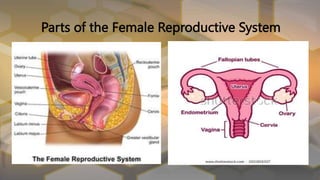
Parts of the Female Reproductive System
Objectives:
•Identify the parts of the female reproductive
system.
•Describe function of each parts of the female
reproductive system.
S5LT-IIa-1
Review: Group activity
•Assemble the following organs
according to its right order.
• Note: Distribute the pieces of organs to assemble.
This is a time pressure activity.
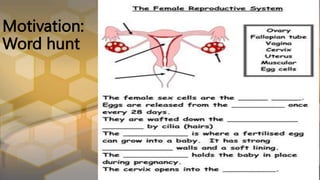
Motivation:
Word hunt
Group Activity
•See Activity Sheet provided
at Grade 5 LMs
•Group
reporting/presentation
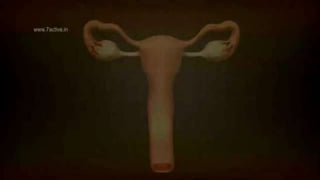
Video clip
presentation
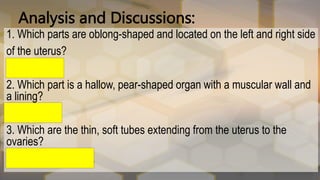
Analysis and Discussions:
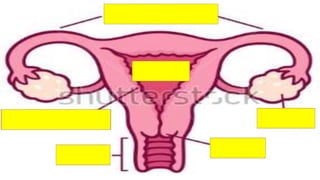
1. Which parts are oblong-shaped and located on the left and right side
of the uterus?
•OVARIES
2. Which part is a hallow, pear-shaped organ with a muscular wall and
a lining?
UTERUS
3. Which are the thin, soft tubes extending from the uterus to the
ovaries?
•FALLOPIAN TUBE
4. What part is located in the lower portion of the uterus that opens into
the vagina?
CERVIX
5. Which part is the outside passage way of the baby?
VAGINA
Developing mastery of the lesson
•Describing the parts of the female
reproductive system and their
functions.
Application:
•Parts of female
reproductive system and
their functions.
OVARIES - a female reproductive organ in which ova or eggs are
produced, present in humans and other vertebrates as a pair.
FALLOPIAN TUBES - either of a pair of tubes along which eggs travel
from the ovaries to the uterus.
UTERUS - This bag is like an inverted pear, held in place by
ligaments and muscle. It has very soft lining, which holds the
fertilized egg and nurtures it till it is a fully developed baby.
VAGINA - the muscular tube leading from the external genitals to the
cervix of the uterus in women and most female mammals.
CERVIX - is a ring of muscle located at the lower third portion of the
uterus. It forms a barrier between the uterus and the 'V'. Until birth, the
baby is held in place by the cervix. During birth, the cervix expands
and the baby passes through it.
•Why do you think it is
important to use the right
terms in referring to the
female reproductive parts?
Generalization:
•What are the parts of the
human female reproductive
system?
Evaluation:
Directions: Read each item carefully. Choose the letter of the correct
answer.
1. What are the female reproductive organs?
A. egg cells B. ovaries C. sperms D. testes
2. Why is the vagina called the birth canal?
A. It is pyramid in shape. C. It is where the urine passes
B. It receives the sperm D. The new born baby passes out from
it.
3. Which is not a part of the female reproductive system?
A. cervix B. epididymis C. fallopian tube D. uterus
4. Which best describe the ovaries?
A. oblong-shaped and located on the left and right side of the
uterus
B. the outside passage way of the baby
C. located in lower portion of the uterus that opens into the
vagina
D. hallow, pear-shaped organ with a muscular wall and a lining
5. What do ovaries produce?
A. sperm cells B. egg cells C. zygote D. fertilized egg
Assignment:
•Create a three-dimensional foldable
graphic organizer that will contain
important concepts about the female
reproductive system using colored
paper, coloring materials, marker
and scissors.
Human Reproductive System week 1 day 1-2.pptx

Human Reproductive System week 1 day 1-2.pptx

  • 1.
    Human Reproductive System Science 52nd Quarter Week 1 Day 1 - 2
  • 2.
    Parts of theFemale Reproductive System
  • 3.
    Objectives: •Identify the partsof the female reproductive system. •Describe function of each parts of the female reproductive system. S5LT-IIa-1
  • 4.
    Review: Group activity •Assemblethe following organs according to its right order. • Note: Distribute the pieces of organs to assemble. This is a time pressure activity.
  • 5.
  • 6.
    Group Activity •See ActivitySheet provided at Grade 5 LMs
  • 7.
  • 8.
  • 10.
    Analysis and Discussions: 1.Which parts are oblong-shaped and located on the left and right side of the uterus? •OVARIES 2. Which part is a hallow, pear-shaped organ with a muscular wall and a lining? UTERUS 3. Which are the thin, soft tubes extending from the uterus to the ovaries? •FALLOPIAN TUBE
  • 11.
    4. What partis located in the lower portion of the uterus that opens into the vagina? CERVIX 5. Which part is the outside passage way of the baby? VAGINA
  • 12.
    Developing mastery ofthe lesson •Describing the parts of the female reproductive system and their functions.
  • 14.
  • 15.
    OVARIES - afemale reproductive organ in which ova or eggs are produced, present in humans and other vertebrates as a pair. FALLOPIAN TUBES - either of a pair of tubes along which eggs travel from the ovaries to the uterus. UTERUS - This bag is like an inverted pear, held in place by ligaments and muscle. It has very soft lining, which holds the fertilized egg and nurtures it till it is a fully developed baby.
  • 16.
    VAGINA - themuscular tube leading from the external genitals to the cervix of the uterus in women and most female mammals. CERVIX - is a ring of muscle located at the lower third portion of the uterus. It forms a barrier between the uterus and the 'V'. Until birth, the baby is held in place by the cervix. During birth, the cervix expands and the baby passes through it.
  • 17.
    •Why do youthink it is important to use the right terms in referring to the female reproductive parts?
  • 18.
    Generalization: •What are theparts of the human female reproductive system?
  • 19.
    Evaluation: Directions: Read eachitem carefully. Choose the letter of the correct answer. 1. What are the female reproductive organs? A. egg cells B. ovaries C. sperms D. testes 2. Why is the vagina called the birth canal? A. It is pyramid in shape. C. It is where the urine passes B. It receives the sperm D. The new born baby passes out from it. 3. Which is not a part of the female reproductive system? A. cervix B. epididymis C. fallopian tube D. uterus
  • 20.
    4. Which bestdescribe the ovaries? A. oblong-shaped and located on the left and right side of the uterus B. the outside passage way of the baby C. located in lower portion of the uterus that opens into the vagina D. hallow, pear-shaped organ with a muscular wall and a lining 5. What do ovaries produce? A. sperm cells B. egg cells C. zygote D. fertilized egg
  • 21.
    Assignment: •Create a three-dimensionalfoldable graphic organizer that will contain important concepts about the female reproductive system using colored paper, coloring materials, marker and scissors.