Early Childhood Education
Inclusion of Children with Special Needs
Meeting the Needs of Children and Families - Part One
ECEP 233
Section 062
For: Lisa McCaie-Watters
From: Yanjiao Deng
Due Date: April 2, 2013
Conduct Disorder
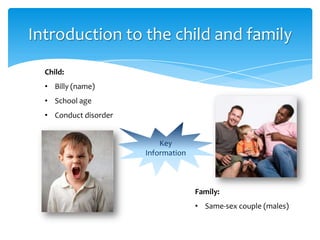
Hi, my name is Billy. I am a school age children, and I am
living with my Fathers. When I am at school, I do not
know what’s happen with myself. All my teachers are
feeling very frustrated with me in the program. One
day, my Fathers had a meeting with the teacher, and
they told her that I had been diagnosed with Conduct
Disorder.
Video Time:
http://www.youtube.com/watch?v=g58qUHEq6fU
Contents
Introduction to the child and family ……………………………………………………… 4
Introduction to the individual special need ………………………………………………7
Meeting the needs in the child care center …………………………………………… 18
Overview of referred agencies/resources ……………………………………………….. 21
References …………………………………………………………………………………23
Introduction to the child and family
Child:
• Billy (name)
• School age
• Conduct disorder
Family:
• Same-sex couple (males)
Key
Information
Introduction to the child and family
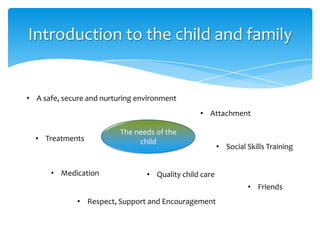
• Attachment
The needs of the
child
• Medication
• Treatments
• Quality child care
• A safe, secure and nurturing environment
• Social Skills Training
• Respect, Support and Encouragement
• Friends
Introduction to the child and family
Training and Therapy:
• Parent Management Training
• Parenting skills Training
• Family Therapy
Research and Observation:
• Get accurate information
about conduct disorder from
libraries, Internet, hotlines, or
other sources
• Pay careful attention to the
signs, try to understand the
underlying reasons/causes
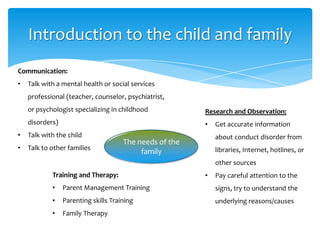
Communication:
• Talk with a mental health or social services
professional (teacher, counselor, psychiatrist,
or psychologist specializing in childhood
disorders)
• Talk with the child
• Talk to other families
The needs of the
family
Introduction to the individual special
need – Conduct Disorder
1. Definition
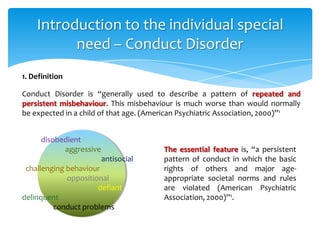
Conduct Disorder is “generally used to describe a pattern of repeated and
persistent misbehaviour. This misbehaviour is much worse than would normally
be expected in a child of that age. (American Psychiatric Association, 2000)”1
disobedient
aggressive
antisocial
challenging behaviour
oppositional
defiant
delinquent
conduct problems
The essential feature is, “a persistent
pattern of conduct in which the basic
rights of others and major age-
appropriate societal norms and rules
are violated (American Psychiatric
Association, 2000)”1.
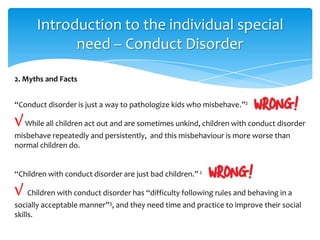
“Conduct disorder is just a way to pathologize kids who misbehave.”2
√While all children act out and are sometimes unkind, children with conduct disorder
misbehave repeatedly and persistently, and this misbehaviour is more worse than
normal children do.
“Children with conduct disorder are just bad children.”2
√ Children with conduct disorder has “difficulty following rules and behaving in a
socially acceptable manner”3, and they need time and practice to improve their social
skills.
Introduction to the individual special
need – Conduct Disorder
2. Myths and Facts
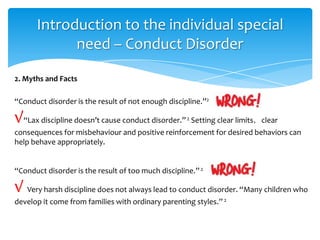
“Conduct disorder is the result of not enough discipline.”2
√“Lax discipline doesn’t cause conduct disorder.”2 Setting clear limits,clear
consequences for misbehaviour and positive reinforcement for desired behaviors can
help behave appropriately.
“Conduct disorder is the result of too much discipline.”2
√ Very harsh discipline does not always lead to conduct disorder. “Many children who
develop it come from families with ordinary parenting styles.”2
2. Myths and Facts
Introduction to the individual special
need – Conduct Disorder
“Parents want their children on medicine so they'll be docile.”2
√“Medication isn't a treatment recommended for conduct disorder, but it may be
helpful when kids also have other disorders, such as depression, ADHD, or post-
traumatic stress disorder. ”2
2. Myths and Facts
Introduction to the individual special
need – Conduct Disorder
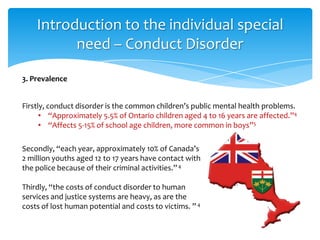
Firstly, conduct disorder is the common children’s public mental health problems.
• “Approximately 5.5% of Ontario children aged 4 to 16 years are affected.”4
• “Affects 5-15% of school age children, more common in boys”5
3. Prevalence
Introduction to the individual special
need – Conduct Disorder
Secondly, “each year, approximately 10% of Canada’s
2 million youths aged 12 to 17 years have contact with
the police because of their criminal activities.”4
Thirdly, “the costs of conduct disorder to human
services and justice systems are heavy, as are the
costs of lost human potential and costs to victims. ” 4
4. Signs and Symptoms
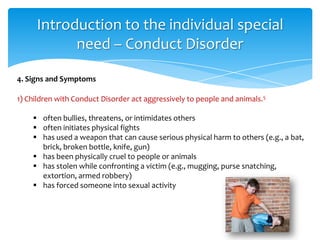
1) Children with Conduct Disorder act aggressively to people and animals.5
 often bullies, threatens, or intimidates others
 often initiates physical fights
 has used a weapon that can cause serious physical harm to others (e.g., a bat,
brick, broken bottle, knife, gun)
 has been physically cruel to people or animals
 has stolen while confronting a victim (e.g., mugging, purse snatching,
extortion, armed robbery)
 has forced someone into sexual activity
Introduction to the individual special
need – Conduct Disorder
2) Destruction of property5 :
 has deliberately engaged in fire setting with the intention of causing harm
 has deliberately destroyed others’ property (other than by fire setting)
3) Deceitfulness or theft5 :
 has broken into someone’s house, building, or car
 often lies to obtain goods or favours or to avoid obligations (i.e., “cons”
others)
 has stolen items of nontrivial value without confronting a victim (e.g.,
shoplifting, forgery)
Introduction to the individual special
need – Conduct Disorder
4. Signs and Symptoms
Conduct
Disorder
4) Serious violation of rules5 :
 often stays out at night starting before age 13 years
 has run away from home overnight at least twice (or once without returning
for a lengthy period)
 is often truant from school starting before age 13 years
4. Signs and Symptoms
Introduction to the individual special
need – Conduct Disorder
the presence of any three (or more) of
the above criteria in the past 12 months,
with at least one criterion present in the
past 6 months
Research shows that “no specific cause of conduct disorder has been identified”6.
The following are the possibly factors that may contribute to the development of
conduct disorder:
1) Child Factors
 Genetics
“It is likely that biochemical underpinnings and genetic vulnerabilities interact with
environmental forces and individual characteristics to cause conduct disorders.”7
 Brain damage
Many conduct disordered children have learning problems, and this would leads to
poor language skills, social skills and etc.
 Failure in school
 Traumatic life experiences
Introduction to the individual special
need – Conduct Disorder
5. Causal Factors
Introduction to the individual special
need – Conduct Disorder
2) Parenting Factors
 Poor parenting skills
“There is a strong correlation between children diagnosed with conduct disorder
and poor parenting practices.”8
 Mental health problems in parents
 Child abuse
3) Environmental Factors
 “Social disadvantage, homelessness, low socio-economic status, poverty,
overcrowding and social isolation are broader factors that predispose children
to conduct disorder (Hausman & Hammen,1993; American Academy of Child
and Adolescent Psychiatry, 1997; Carr, 1999).” 9
5. Causal Factors
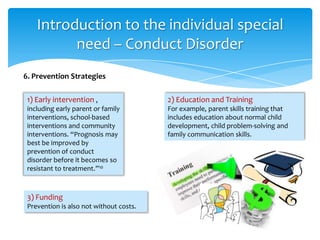
1) Early intervention ,
including early parent or family
interventions, school-based
interventions and community
interventions. “Prognosis may
best be improved by
prevention of conduct
disorder before it becomes so
resistant to treatment.”10
Introduction to the individual special
need – Conduct Disorder
6. Prevention Strategies
2) Education and Training
For example, parent skills training that
includes education about normal child
development, child problem-solving and
family communication skills.
3) Funding
Prevention is also not without costs.
Meeting the needs in the child care center
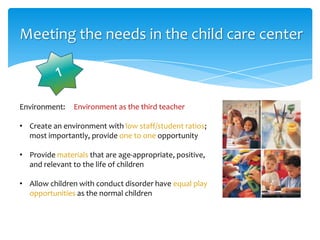
Environment: Environment as the third teacher
• Create an environment with low staff/student ratios;
most importantly, provide one to one opportunity
• Provide materials that are age-appropriate, positive,
and relevant to the life of children
• Allow children with conduct disorder have equal play
opportunities as the normal children
Meeting the needs in the child care center
Teaching Strategies:
• Have an appropriate level curriculum for the child with Conduct Disorder, or
make a individual program plan for the child
• Praise the child with Conduct Disorder sincerely
• Remain calm and respond the child with Conduct Disorder with respect
• Maximize the performance of children with conduct disorder through the use of
cues, prompting, chaining and shaping etc.
• Systematically teach social skills - anger management, conflict resolution
strategies and an appropriate manner. For example, scripted stories can be used
to help all children understand social interactions, expectations and social cue.
• Structure activities so the student with conduct disorder is not always left out or
the last one picked
• Establish clear and fair classroom rules
• Teach other children how to work with children with conduct disorder
Meeting the needs in the child care center
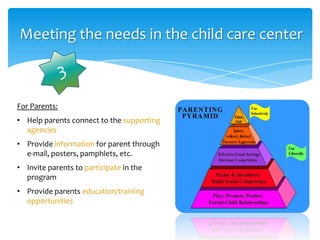
For Parents:
• Help parents connect to the supporting
agencies
• Provide information for parent through
e-mail, posters, pamphlets, etc.
• Invite parents to participate in the
program
• Provide parents education/training
opportunities
1. Canadian Mental Health Association, Ontario
http://www.ontario.cmha.ca/index.asp
Overview of referred agencies/resources
The Canadian Mental Health Association, Ontario works to improve services and support
for people with mental illnesses and their families, and to promote mental health for all
Ontarians.
Parents can:
 Get more information about Conduct
Disorder
 Find services and supports through the
website
 Access to education and training
programs
……
Overview of referred agencies/resources
http://acposb.on.ca/practice/intervention.html
2. The Association of Chief Psychologists
with Ontario School Boards
A voluntary professional organization dedicated to the promotion and development of
psychological services in schools in the best interests of the students, parents and the
school community
Parents can:
 Get more information about Conduct
Disorder
 Find services and supports through the
website
……
3. Conduct Disorder Services Guidelines:
https://www.msd.govt.nz/documents/about-msd-and-our-work/publications-
resources/service-guidelines/conduct-disorder-services-guidelines.pdf
References
1. http://www.rcpsych.ac.uk/files/samplechapter/80_3.pdf
2. http://www.childmind.org/en/myths-about-conduct-disorder/
3. http://www.thirdage.com/hc/c/what-is-conduct-disorder
4. http://ww1.cpa-apc.org/French_Site/publications/CJP/supplements/october1999/sup2-oct.pdf
5. Lisa, Handout – Children with Behavioural & Social/Emontional Disorders
6. http://www.thirdage.com/hc/c/conduct-disorder-causes
7. http://www.aacap.org/cs/root/publication_store/your_child_conduct_disorders
8. http://www.minddisorders.com/Br-Del/Conduct-disorder.html#ixzz2P8yaIgve
9. http://www.rcpsych.ac.uk/files/samplechapter/80_3.pdf
10. http://www.minddisorders.com/Br-Del/Conduct-disorder.html
References
Pictures:
http://2.bp.blogspot.com/_-
gI8fEeRlS0/TSMU5QnnRfI/AAAAAAAAAOc/Gt2ezKqSMlA/s1600/tantrum.jpg
http://ecnp.i-site.nl/Matters/number1/images/child.jpg
http://www.examiner.com/images/blog/wysiwyg/image/same_sex_parents_kid.jpg
http://www.wholistic.net.au/uploads/1/1/0/2/11029337/4024038.jpg
http://www.anh-usa.org/wp-content/uploads/2010/09/wrong.jpg
http://img.mynetdiary.com.s3.amazonaws.com/blog/facts-about-obesity-there-is-so-much.jpeg
http://upload.wikimedia.org/wikipedia/commons/d/db/Ontario-flag-contour.png
http://www.prostate.net/wp-content/uploads/2012/06/causes-of-peyronies-disease.png
http://www.vced.org.au/assets/images/G0902557.gif
http://blog.kace.com/wp-content/uploads/2013/03/training-program.jpg
http://blogs-images.forbes.com/steveodland/files/2012/02/37e32-costs-stack-up.jpg
http://www.beingforthebenefit.com/wp-content/uploads/2010/09/talking-heads.jpg
http://www.conestogac.on.ca/ece/images/daycare_collage.jpg
https://www.ocps.net/cs/ese/support/ei/PublishingImages/ParentingPyramidLarge.gif
http://rollercoasterkid.files.wordpress.com/2008/07/bp-wordle.jpg
http://www.child-behavior-guide.com/images/behavior-disorders-01.png
Conduct disorder

Conduct disorder

  • 1.
    Early Childhood Education Inclusionof Children with Special Needs Meeting the Needs of Children and Families - Part One ECEP 233 Section 062 For: Lisa McCaie-Watters From: Yanjiao Deng Due Date: April 2, 2013
  • 2.
    Conduct Disorder Hi, myname is Billy. I am a school age children, and I am living with my Fathers. When I am at school, I do not know what’s happen with myself. All my teachers are feeling very frustrated with me in the program. One day, my Fathers had a meeting with the teacher, and they told her that I had been diagnosed with Conduct Disorder. Video Time: http://www.youtube.com/watch?v=g58qUHEq6fU
  • 3.
    Contents Introduction to thechild and family ……………………………………………………… 4 Introduction to the individual special need ………………………………………………7 Meeting the needs in the child care center …………………………………………… 18 Overview of referred agencies/resources ……………………………………………….. 21 References …………………………………………………………………………………23
  • 4.
    Introduction to thechild and family Child: • Billy (name) • School age • Conduct disorder Family: • Same-sex couple (males) Key Information
  • 5.
    Introduction to thechild and family • Attachment The needs of the child • Medication • Treatments • Quality child care • A safe, secure and nurturing environment • Social Skills Training • Respect, Support and Encouragement • Friends
  • 6.
    Introduction to thechild and family Training and Therapy: • Parent Management Training • Parenting skills Training • Family Therapy Research and Observation: • Get accurate information about conduct disorder from libraries, Internet, hotlines, or other sources • Pay careful attention to the signs, try to understand the underlying reasons/causes Communication: • Talk with a mental health or social services professional (teacher, counselor, psychiatrist, or psychologist specializing in childhood disorders) • Talk with the child • Talk to other families The needs of the family
  • 7.
    Introduction to theindividual special need – Conduct Disorder 1. Definition Conduct Disorder is “generally used to describe a pattern of repeated and persistent misbehaviour. This misbehaviour is much worse than would normally be expected in a child of that age. (American Psychiatric Association, 2000)”1 disobedient aggressive antisocial challenging behaviour oppositional defiant delinquent conduct problems The essential feature is, “a persistent pattern of conduct in which the basic rights of others and major age- appropriate societal norms and rules are violated (American Psychiatric Association, 2000)”1.
  • 8.
    “Conduct disorder isjust a way to pathologize kids who misbehave.”2 √While all children act out and are sometimes unkind, children with conduct disorder misbehave repeatedly and persistently, and this misbehaviour is more worse than normal children do. “Children with conduct disorder are just bad children.”2 √ Children with conduct disorder has “difficulty following rules and behaving in a socially acceptable manner”3, and they need time and practice to improve their social skills. Introduction to the individual special need – Conduct Disorder 2. Myths and Facts
  • 9.
    “Conduct disorder isthe result of not enough discipline.”2 √“Lax discipline doesn’t cause conduct disorder.”2 Setting clear limits,clear consequences for misbehaviour and positive reinforcement for desired behaviors can help behave appropriately. “Conduct disorder is the result of too much discipline.”2 √ Very harsh discipline does not always lead to conduct disorder. “Many children who develop it come from families with ordinary parenting styles.”2 2. Myths and Facts Introduction to the individual special need – Conduct Disorder
  • 10.
    “Parents want theirchildren on medicine so they'll be docile.”2 √“Medication isn't a treatment recommended for conduct disorder, but it may be helpful when kids also have other disorders, such as depression, ADHD, or post- traumatic stress disorder. ”2 2. Myths and Facts Introduction to the individual special need – Conduct Disorder
  • 11.
    Firstly, conduct disorderis the common children’s public mental health problems. • “Approximately 5.5% of Ontario children aged 4 to 16 years are affected.”4 • “Affects 5-15% of school age children, more common in boys”5 3. Prevalence Introduction to the individual special need – Conduct Disorder Secondly, “each year, approximately 10% of Canada’s 2 million youths aged 12 to 17 years have contact with the police because of their criminal activities.”4 Thirdly, “the costs of conduct disorder to human services and justice systems are heavy, as are the costs of lost human potential and costs to victims. ” 4
  • 12.
    4. Signs andSymptoms 1) Children with Conduct Disorder act aggressively to people and animals.5  often bullies, threatens, or intimidates others  often initiates physical fights  has used a weapon that can cause serious physical harm to others (e.g., a bat, brick, broken bottle, knife, gun)  has been physically cruel to people or animals  has stolen while confronting a victim (e.g., mugging, purse snatching, extortion, armed robbery)  has forced someone into sexual activity Introduction to the individual special need – Conduct Disorder
  • 13.
    2) Destruction ofproperty5 :  has deliberately engaged in fire setting with the intention of causing harm  has deliberately destroyed others’ property (other than by fire setting) 3) Deceitfulness or theft5 :  has broken into someone’s house, building, or car  often lies to obtain goods or favours or to avoid obligations (i.e., “cons” others)  has stolen items of nontrivial value without confronting a victim (e.g., shoplifting, forgery) Introduction to the individual special need – Conduct Disorder 4. Signs and Symptoms
  • 14.
    Conduct Disorder 4) Serious violationof rules5 :  often stays out at night starting before age 13 years  has run away from home overnight at least twice (or once without returning for a lengthy period)  is often truant from school starting before age 13 years 4. Signs and Symptoms Introduction to the individual special need – Conduct Disorder the presence of any three (or more) of the above criteria in the past 12 months, with at least one criterion present in the past 6 months
  • 15.
    Research shows that“no specific cause of conduct disorder has been identified”6. The following are the possibly factors that may contribute to the development of conduct disorder: 1) Child Factors  Genetics “It is likely that biochemical underpinnings and genetic vulnerabilities interact with environmental forces and individual characteristics to cause conduct disorders.”7  Brain damage Many conduct disordered children have learning problems, and this would leads to poor language skills, social skills and etc.  Failure in school  Traumatic life experiences Introduction to the individual special need – Conduct Disorder 5. Causal Factors
  • 16.
    Introduction to theindividual special need – Conduct Disorder 2) Parenting Factors  Poor parenting skills “There is a strong correlation between children diagnosed with conduct disorder and poor parenting practices.”8  Mental health problems in parents  Child abuse 3) Environmental Factors  “Social disadvantage, homelessness, low socio-economic status, poverty, overcrowding and social isolation are broader factors that predispose children to conduct disorder (Hausman & Hammen,1993; American Academy of Child and Adolescent Psychiatry, 1997; Carr, 1999).” 9 5. Causal Factors
  • 17.
    1) Early intervention, including early parent or family interventions, school-based interventions and community interventions. “Prognosis may best be improved by prevention of conduct disorder before it becomes so resistant to treatment.”10 Introduction to the individual special need – Conduct Disorder 6. Prevention Strategies 2) Education and Training For example, parent skills training that includes education about normal child development, child problem-solving and family communication skills. 3) Funding Prevention is also not without costs.
  • 18.
    Meeting the needsin the child care center Environment: Environment as the third teacher • Create an environment with low staff/student ratios; most importantly, provide one to one opportunity • Provide materials that are age-appropriate, positive, and relevant to the life of children • Allow children with conduct disorder have equal play opportunities as the normal children
  • 19.
    Meeting the needsin the child care center Teaching Strategies: • Have an appropriate level curriculum for the child with Conduct Disorder, or make a individual program plan for the child • Praise the child with Conduct Disorder sincerely • Remain calm and respond the child with Conduct Disorder with respect • Maximize the performance of children with conduct disorder through the use of cues, prompting, chaining and shaping etc. • Systematically teach social skills - anger management, conflict resolution strategies and an appropriate manner. For example, scripted stories can be used to help all children understand social interactions, expectations and social cue. • Structure activities so the student with conduct disorder is not always left out or the last one picked • Establish clear and fair classroom rules • Teach other children how to work with children with conduct disorder
  • 20.
    Meeting the needsin the child care center For Parents: • Help parents connect to the supporting agencies • Provide information for parent through e-mail, posters, pamphlets, etc. • Invite parents to participate in the program • Provide parents education/training opportunities
  • 21.
    1. Canadian MentalHealth Association, Ontario http://www.ontario.cmha.ca/index.asp Overview of referred agencies/resources The Canadian Mental Health Association, Ontario works to improve services and support for people with mental illnesses and their families, and to promote mental health for all Ontarians. Parents can:  Get more information about Conduct Disorder  Find services and supports through the website  Access to education and training programs ……
  • 22.
    Overview of referredagencies/resources http://acposb.on.ca/practice/intervention.html 2. The Association of Chief Psychologists with Ontario School Boards A voluntary professional organization dedicated to the promotion and development of psychological services in schools in the best interests of the students, parents and the school community Parents can:  Get more information about Conduct Disorder  Find services and supports through the website …… 3. Conduct Disorder Services Guidelines: https://www.msd.govt.nz/documents/about-msd-and-our-work/publications- resources/service-guidelines/conduct-disorder-services-guidelines.pdf
  • 23.
    References 1. http://www.rcpsych.ac.uk/files/samplechapter/80_3.pdf 2. http://www.childmind.org/en/myths-about-conduct-disorder/ 3.http://www.thirdage.com/hc/c/what-is-conduct-disorder 4. http://ww1.cpa-apc.org/French_Site/publications/CJP/supplements/october1999/sup2-oct.pdf 5. Lisa, Handout – Children with Behavioural & Social/Emontional Disorders 6. http://www.thirdage.com/hc/c/conduct-disorder-causes 7. http://www.aacap.org/cs/root/publication_store/your_child_conduct_disorders 8. http://www.minddisorders.com/Br-Del/Conduct-disorder.html#ixzz2P8yaIgve 9. http://www.rcpsych.ac.uk/files/samplechapter/80_3.pdf 10. http://www.minddisorders.com/Br-Del/Conduct-disorder.html
  • 24.
    References Pictures: http://2.bp.blogspot.com/_- gI8fEeRlS0/TSMU5QnnRfI/AAAAAAAAAOc/Gt2ezKqSMlA/s1600/tantrum.jpg http://ecnp.i-site.nl/Matters/number1/images/child.jpg http://www.examiner.com/images/blog/wysiwyg/image/same_sex_parents_kid.jpg http://www.wholistic.net.au/uploads/1/1/0/2/11029337/4024038.jpg http://www.anh-usa.org/wp-content/uploads/2010/09/wrong.jpg http://img.mynetdiary.com.s3.amazonaws.com/blog/facts-about-obesity-there-is-so-much.jpeg http://upload.wikimedia.org/wikipedia/commons/d/db/Ontario-flag-contour.png http://www.prostate.net/wp-content/uploads/2012/06/causes-of-peyronies-disease.png http://www.vced.org.au/assets/images/G0902557.gif http://blog.kace.com/wp-content/uploads/2013/03/training-program.jpg http://blogs-images.forbes.com/steveodland/files/2012/02/37e32-costs-stack-up.jpg http://www.beingforthebenefit.com/wp-content/uploads/2010/09/talking-heads.jpg http://www.conestogac.on.ca/ece/images/daycare_collage.jpg https://www.ocps.net/cs/ese/support/ei/PublishingImages/ParentingPyramidLarge.gif http://rollercoasterkid.files.wordpress.com/2008/07/bp-wordle.jpg http://www.child-behavior-guide.com/images/behavior-disorders-01.png