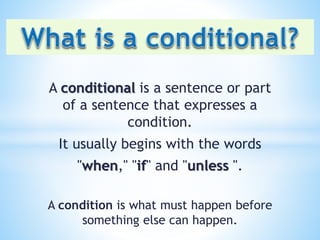
A conditional is a sentence or part
of a sentence that expresses a
condition.
It usually begins with the words
"when," "if" and "unless ".
A condition is what must happen before
something else can happen.
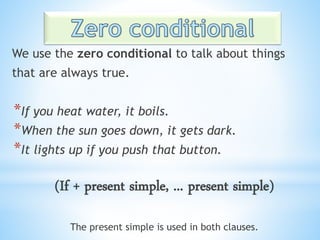
We use the zero conditional to talk about things
that are always true.
*If you heat water, it boils.
*When the sun goes down, it gets dark.
*It lights up if you push that button.
(If + present simple, ... present simple)
The present simple is used in both clauses.
We use the first conditional when we talk about real and possible situations.
*I’ll go shopping on the way home if I have time.
*If it’s a nice day tomorrow, we’ll go to the beach.
*If it rains tomorrow, we'll go to the cinema.
If + Simple Present, + Will + Infinitive
OR
Will + If + Simple Present
In first conditional sentences, the structure is usually if + present simple and will +
infinitive. It’s not important which clause comes first.
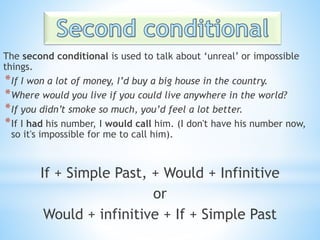
The second conditional is used to talk about ‘unreal’ or impossible
things.
*If I won a lot of money, I’d buy a big house in the country.
*Where would you live if you could live anywhere in the world?
*If you didn’t smoke so much, you’d feel a lot better.
*If I had his number, I would call him. (I don't have his number now,
so it's impossible for me to call him).
If + Simple Past, + Would + Infinitive
or
Would + infinitive + If + Simple Past

Conditionals

  • 1.
    A conditional isa sentence or part of a sentence that expresses a condition. It usually begins with the words "when," "if" and "unless ". A condition is what must happen before something else can happen.
  • 2.
    We use thezero conditional to talk about things that are always true. *If you heat water, it boils. *When the sun goes down, it gets dark. *It lights up if you push that button. (If + present simple, ... present simple) The present simple is used in both clauses.
  • 3.
    We use thefirst conditional when we talk about real and possible situations. *I’ll go shopping on the way home if I have time. *If it’s a nice day tomorrow, we’ll go to the beach. *If it rains tomorrow, we'll go to the cinema. If + Simple Present, + Will + Infinitive OR Will + If + Simple Present In first conditional sentences, the structure is usually if + present simple and will + infinitive. It’s not important which clause comes first.
  • 4.
    The second conditionalis used to talk about ‘unreal’ or impossible things. *If I won a lot of money, I’d buy a big house in the country. *Where would you live if you could live anywhere in the world? *If you didn’t smoke so much, you’d feel a lot better. *If I had his number, I would call him. (I don't have his number now, so it's impossible for me to call him). If + Simple Past, + Would + Infinitive or Would + infinitive + If + Simple Past