CONDITIONALS
Zero, first, second and third
Zero conditional
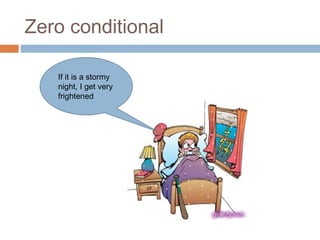
If it is a stormy
night, I get very
frightened
ZERO CONDITIONAL
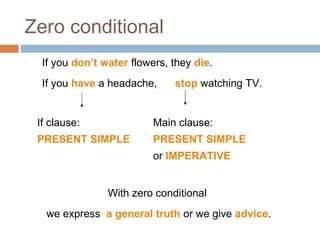
If you don’t water flowers, they die.
If you have a headache, stop watching TV.
With zero conditional
we express a general truth or we give advice.
If clause:
PRESENT SIMPLE
Main clause:
PRESENT SIMPLE
or IMPERATIVE
Zero conditional
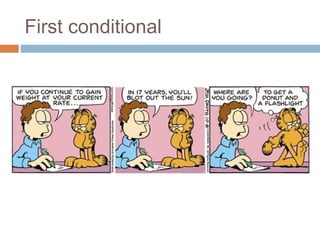
First conditional
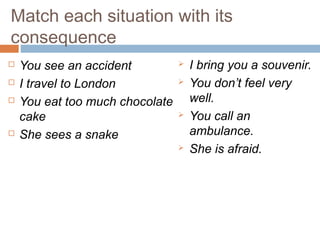
Match each situation with its
consequence
 You see an accident
 I travel to London
 You eat too much chocolate
cake
 She sees a snake
 I bring you a souvenir.
 You don’t feel very
well.
 You call an
ambulance.
 She is afraid.
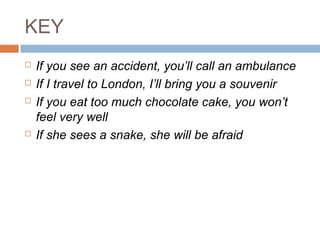
KEY
 If you see an accident, you’ll call an ambulance
 If I travel to London, I’ll bring you a souvenir
 If you eat too much chocolate cake, you won’t
feel very well
 If she sees a snake, she will be afraid
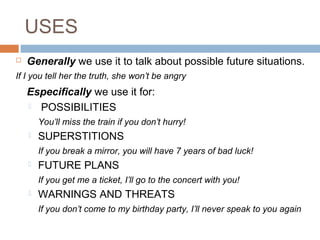
USES
 Generally we use it to talk about possible future situations.
If I you tell her the truth, she won’t be angry
Especifically we use it for:
 POSSIBILITIES
You’ll miss the train if you don’t hurry!
 SUPERSTITIONS
If you break a mirror, you will have 7 years of bad luck!
 FUTURE PLANS
If you get me a ticket, I’ll go to the concert with you!
 WARNINGS AND THREATS
If you don’t come to my birthday party, I’ll never speak to you again
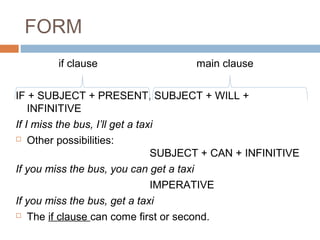
FORM
if clause main clause
IF + SUBJECT + PRESENT, SUBJECT + WILL +
INFINITIVE
If I miss the bus, I’ll get a taxi
 Other possibilities:
SUBJECT + CAN + INFINITIVE
If you miss the bus, you can get a taxi
IMPERATIVE
If you miss the bus, get a taxi
 The if clause can come first or second.
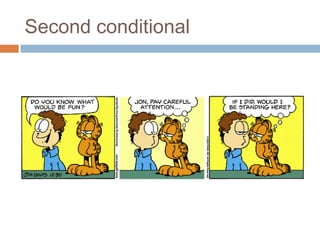
Second conditional
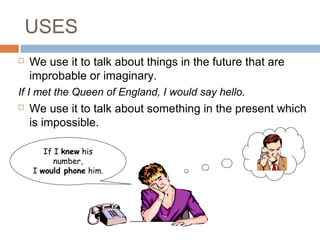
USES
 We use it to talk about things in the future that are
improbable or imaginary.
If I met the Queen of England, I would say hello.
 We use it to talk about something in the present which
is impossible.
If I knew his
number,
I would phone him.
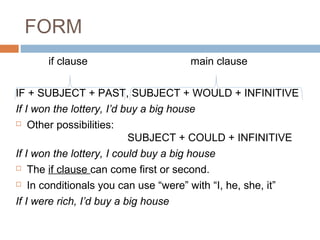
FORM
if clause main clause
IF + SUBJECT + PAST, SUBJECT + WOULD + INFINITIVE
If I won the lottery, I’d buy a big house
 Other possibilities:
SUBJECT + COULD + INFINITIVE
If I won the lottery, I could buy a big house
 The if clause can come first or second.
 In conditionals you can use “were” with “I, he, she, it”
If I were rich, I’d buy a big house
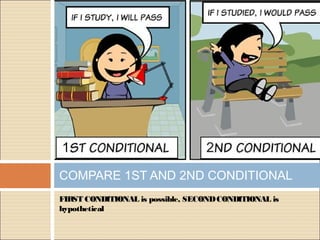
FIRST CONDITIONAL is possible, SECONDCONDITIONAL is
hypothetical
COMPARE 1ST AND 2ND CONDITIONAL
THIRD CONDITIONAL
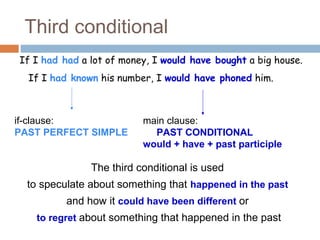
If I had had a lot of money, I would have bought a big house.
If I had known his number, I would have phoned him.
if-clause:
PAST PERFECT SIMPLE
main clause:
PAST CONDITIONAL
would + have + past participle
The third conditional is used
to speculate about something that happened in the past
and how it could have been different or
to regret about something that happened in the past
Third conditional
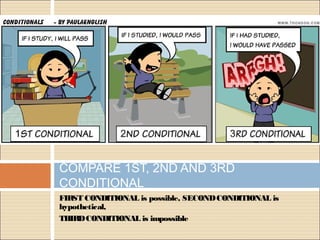
FIRST CONDITIONAL is possible, SECONDCONDITIONAL is
hypothetical,
THIRDCONDITIONAL is impossible
COMPARE 1ST, 2ND AND 3RD
CONDITIONAL

Conditionals definite

  • 1.
  • 2.
    Zero conditional If itis a stormy night, I get very frightened
  • 3.
    ZERO CONDITIONAL If youdon’t water flowers, they die. If you have a headache, stop watching TV. With zero conditional we express a general truth or we give advice. If clause: PRESENT SIMPLE Main clause: PRESENT SIMPLE or IMPERATIVE Zero conditional
  • 4.
  • 5.
    Match each situationwith its consequence  You see an accident  I travel to London  You eat too much chocolate cake  She sees a snake  I bring you a souvenir.  You don’t feel very well.  You call an ambulance.  She is afraid.
  • 6.
    KEY  If yousee an accident, you’ll call an ambulance  If I travel to London, I’ll bring you a souvenir  If you eat too much chocolate cake, you won’t feel very well  If she sees a snake, she will be afraid
  • 7.
    USES  Generally weuse it to talk about possible future situations. If I you tell her the truth, she won’t be angry Especifically we use it for:  POSSIBILITIES You’ll miss the train if you don’t hurry!  SUPERSTITIONS If you break a mirror, you will have 7 years of bad luck!  FUTURE PLANS If you get me a ticket, I’ll go to the concert with you!  WARNINGS AND THREATS If you don’t come to my birthday party, I’ll never speak to you again
  • 8.
    FORM if clause mainclause IF + SUBJECT + PRESENT, SUBJECT + WILL + INFINITIVE If I miss the bus, I’ll get a taxi  Other possibilities: SUBJECT + CAN + INFINITIVE If you miss the bus, you can get a taxi IMPERATIVE If you miss the bus, get a taxi  The if clause can come first or second.
  • 9.
  • 10.
    USES  We useit to talk about things in the future that are improbable or imaginary. If I met the Queen of England, I would say hello.  We use it to talk about something in the present which is impossible. If I knew his number, I would phone him.
  • 11.
    FORM if clause mainclause IF + SUBJECT + PAST, SUBJECT + WOULD + INFINITIVE If I won the lottery, I’d buy a big house  Other possibilities: SUBJECT + COULD + INFINITIVE If I won the lottery, I could buy a big house  The if clause can come first or second.  In conditionals you can use “were” with “I, he, she, it” If I were rich, I’d buy a big house
  • 12.
    FIRST CONDITIONAL ispossible, SECONDCONDITIONAL is hypothetical COMPARE 1ST AND 2ND CONDITIONAL
  • 13.
    THIRD CONDITIONAL If Ihad had a lot of money, I would have bought a big house. If I had known his number, I would have phoned him. if-clause: PAST PERFECT SIMPLE main clause: PAST CONDITIONAL would + have + past participle The third conditional is used to speculate about something that happened in the past and how it could have been different or to regret about something that happened in the past Third conditional
  • 14.
    FIRST CONDITIONAL ispossible, SECONDCONDITIONAL is hypothetical, THIRDCONDITIONAL is impossible COMPARE 1ST, 2ND AND 3RD CONDITIONAL