CONDITIONAL SENTENCES
Type I : Real Conditional
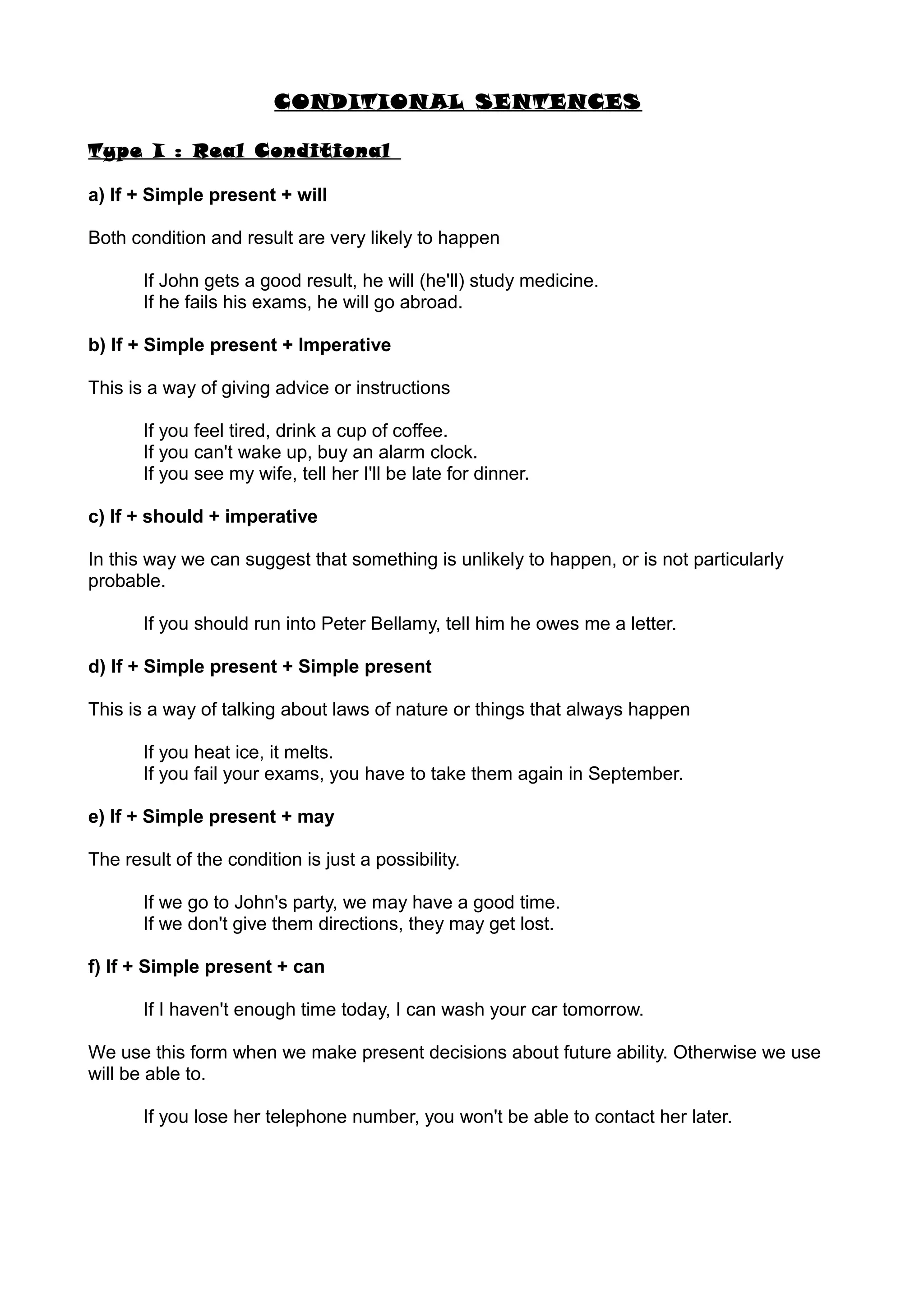
a) If + Simple present + will
Both condition and result are very likely to happen
If John gets a good result, he will (he'll) study medicine.
If he fails his exams, he will go abroad.
b) If + Simple present + Imperative
This is a way of giving advice or instructions
If you feel tired, drink a cup of coffee.
If you can't wake up, buy an alarm clock.
If you see my wife, tell her I'll be late for dinner.
c) If + should + imperative
In this way we can suggest that something is unlikely to happen, or is not particularly
probable.
If you should run into Peter Bellamy, tell him he owes me a letter.
d) If + Simple present + Simple present
This is a way of talking about laws of nature or things that always happen
If you heat ice, it melts.
If you fail your exams, you have to take them again in September.
e) If + Simple present + may
The result of the condition is just a possibility.
If we go to John's party, we may have a good time.
If we don't give them directions, they may get lost.
f) If + Simple present + can
If I haven't enough time today, I can wash your car tomorrow.
We use this form when we make present decisions about future ability. Otherwise we use
will be able to.
If you lose her telephone number, you won't be able to contact her later.
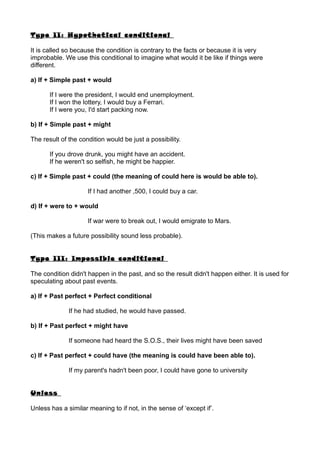
Type II: Hypothetical conditional
It is called so because the condition is contrary to the facts or because it is very
improbable. We use this conditional to imagine what would it be like if things were
different.
a) If + Simple past + would
If I were the president, I would end unemployment.
If I won the lottery, I would buy a Ferrari.
If I were you, I'd start packing now.
b) If + Simple past + might
The result of the condition would be just a possibility.
If you drove drunk, you might have an accident.
If he weren't so selfish, he might be happier.
c) If + Simple past + could (the meaning of could here is would be able to).
If I had another ,500, I could buy a car.
d) If + were to + would
If war were to break out, I would emigrate to Mars.
(This makes a future possibility sound less probable).
Type III: Impossible conditional
The condition didn't happen in the past, and so the result didn't happen either. It is used for
speculating about past events.
a) If + Past perfect + Perfect conditional
If he had studied, he would have passed.
b) If + Past perfect + might have
If someone had heard the S.O.S., their lives might have been saved
c) If + Past perfect + could have (the meaning is could have been able to).
If my parent's hadn't been poor, I could have gone to university
Unless
Unless has a similar meaning to if not, in the sense of ‘except if’.
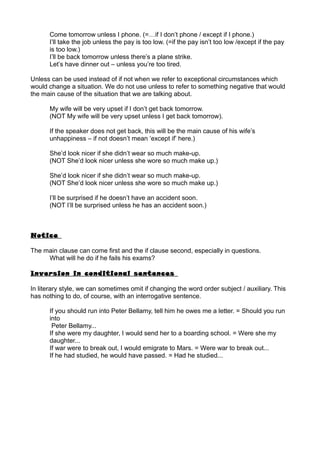
Come tomorrow unless I phone. (=…if I don’t phone / except if I phone.)
I’ll take the job unless the pay is too low. (=if the pay isn’t too low /except if the pay
is too low.)
I’ll be back tomorrow unless there’s a plane strike.
Let’s have dinner out – unless you’re too tired.
Unless can be used instead of if not when we refer to exceptional circumstances which
would change a situation. We do not use unless to refer to something negative that would
the main cause of the situation that we are talking about.
My wife will be very upset if I don’t get back tomorrow.
(NOT My wife will be very upset unless I get back tomorrow).
If the speaker does not get back, this will be the main cause of his wife’s
unhappiness – if not doesn’t mean ‘except if’ here.)
She’d look nicer if she didn’t wear so much make-up.
(NOT She’d look nicer unless she wore so much make up.)
She’d look nicer if she didn’t wear so much make-up.
(NOT She’d look nicer unless she wore so much make up.)
I’ll be surprised if he doesn’t have an accident soon.
(NOT I’ll be surprised unless he has an accident soon.)
Notice
The main clause can come first and the if clause second, especially in questions.
What will he do if he fails his exams?
Inversion in conditional sentences
In literary style, we can sometimes omit if changing the word order subject / auxiliary. This
has nothing to do, of course, with an interrogative sentence.
If you should run into Peter Bellamy, tell him he owes me a letter. = Should you run
into
Peter Bellamy...
If she were my daughter, I would send her to a boarding school. = Were she my
daughter...
If war were to break out, I would emigrate to Mars. = Were war to break out...
If he had studied, he would have passed. = Had he studied...

Conditionals

  • 1.
    CONDITIONAL SENTENCES Type I: Real Conditional a) If + Simple present + will Both condition and result are very likely to happen If John gets a good result, he will (he'll) study medicine. If he fails his exams, he will go abroad. b) If + Simple present + Imperative This is a way of giving advice or instructions If you feel tired, drink a cup of coffee. If you can't wake up, buy an alarm clock. If you see my wife, tell her I'll be late for dinner. c) If + should + imperative In this way we can suggest that something is unlikely to happen, or is not particularly probable. If you should run into Peter Bellamy, tell him he owes me a letter. d) If + Simple present + Simple present This is a way of talking about laws of nature or things that always happen If you heat ice, it melts. If you fail your exams, you have to take them again in September. e) If + Simple present + may The result of the condition is just a possibility. If we go to John's party, we may have a good time. If we don't give them directions, they may get lost. f) If + Simple present + can If I haven't enough time today, I can wash your car tomorrow. We use this form when we make present decisions about future ability. Otherwise we use will be able to. If you lose her telephone number, you won't be able to contact her later.
  • 2.
    Type II: Hypotheticalconditional It is called so because the condition is contrary to the facts or because it is very improbable. We use this conditional to imagine what would it be like if things were different. a) If + Simple past + would If I were the president, I would end unemployment. If I won the lottery, I would buy a Ferrari. If I were you, I'd start packing now. b) If + Simple past + might The result of the condition would be just a possibility. If you drove drunk, you might have an accident. If he weren't so selfish, he might be happier. c) If + Simple past + could (the meaning of could here is would be able to). If I had another ,500, I could buy a car. d) If + were to + would If war were to break out, I would emigrate to Mars. (This makes a future possibility sound less probable). Type III: Impossible conditional The condition didn't happen in the past, and so the result didn't happen either. It is used for speculating about past events. a) If + Past perfect + Perfect conditional If he had studied, he would have passed. b) If + Past perfect + might have If someone had heard the S.O.S., their lives might have been saved c) If + Past perfect + could have (the meaning is could have been able to). If my parent's hadn't been poor, I could have gone to university Unless Unless has a similar meaning to if not, in the sense of ‘except if’.
  • 3.
    Come tomorrow unlessI phone. (=…if I don’t phone / except if I phone.) I’ll take the job unless the pay is too low. (=if the pay isn’t too low /except if the pay is too low.) I’ll be back tomorrow unless there’s a plane strike. Let’s have dinner out – unless you’re too tired. Unless can be used instead of if not when we refer to exceptional circumstances which would change a situation. We do not use unless to refer to something negative that would the main cause of the situation that we are talking about. My wife will be very upset if I don’t get back tomorrow. (NOT My wife will be very upset unless I get back tomorrow). If the speaker does not get back, this will be the main cause of his wife’s unhappiness – if not doesn’t mean ‘except if’ here.) She’d look nicer if she didn’t wear so much make-up. (NOT She’d look nicer unless she wore so much make up.) She’d look nicer if she didn’t wear so much make-up. (NOT She’d look nicer unless she wore so much make up.) I’ll be surprised if he doesn’t have an accident soon. (NOT I’ll be surprised unless he has an accident soon.) Notice The main clause can come first and the if clause second, especially in questions. What will he do if he fails his exams? Inversion in conditional sentences In literary style, we can sometimes omit if changing the word order subject / auxiliary. This has nothing to do, of course, with an interrogative sentence. If you should run into Peter Bellamy, tell him he owes me a letter. = Should you run into Peter Bellamy... If she were my daughter, I would send her to a boarding school. = Were she my daughter... If war were to break out, I would emigrate to Mars. = Were war to break out... If he had studied, he would have passed. = Had he studied...