Conditional SentencesConditional Sentences
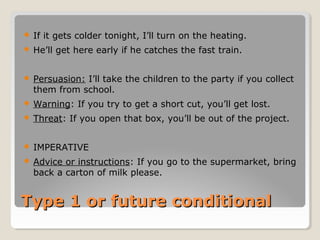
Type 1 orType 1 or futurefuture conditionalconditional
 If it gets colder tonight, I’ll turn on the heating.
 He’ll get here early if he catches the fast train.
 Persuasion: I’ll take the children to the party if you collect
them from school.
 Warning: If you try to get a short cut, you’ll get lost.
 Threat: If you open that box, you’ll be out of the project.
 IMPERATIVE
 Advice or instructions: If you go to the supermarket, bring
back a carton of milk please.
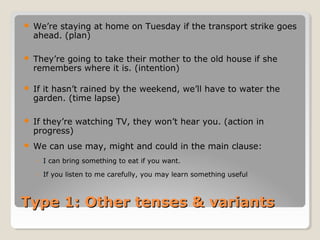
Type 1: Other tenses & variantsType 1: Other tenses & variants
 We’re staying at home on Tuesday if the transport strike goes
ahead. (plan)
 They’re going to take their mother to the old house if she
remembers where it is. (intention)
 If it hasn’t rained by the weekend, we’ll have to water the
garden. (time lapse)
 If they’re watching TV, they won’t hear you. (action in
progress)
 We can use may, might and could in the main clause:
◦ I can bring something to eat if you want.
◦ If you listen to me carefully, you may learn something useful
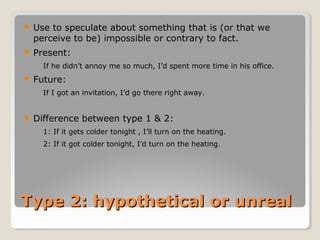
Type 2: hypothetical or unrealType 2: hypothetical or unreal
 Use to speculate about something that is (or that we
perceive to be) impossible or contrary to fact.
 Present:
◦ If he didn’t annoy me so much, I’d spent more time in his office.
 Future:
◦ If I got an invitation, I’d go there right away.
 Difference between type 1 & 2:
◦ 1: If it gets colder tonight , I’ll turn on the heating.
◦ 2: If it got colder tonight, I’d turn on the heating.
Type 2: Other tenses & variantsType 2: Other tenses & variants
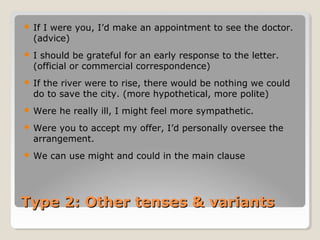
 If I were you, I’d make an appointment to see the doctor.
(advice)
 I should be grateful for an early response to the letter.
(official or commercial correspondence)
 If the river were to rise, there would be nothing we could
do to save the city. (more hypothetical, more polite)
 Were he really ill, I might feel more sympathetic.
 Were you to accept my offer, I’d personally oversee the
arrangement.
 We can use might and could in the main clause
Type 3: past eventsType 3: past events
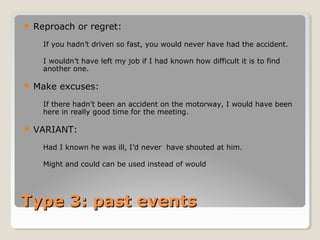
 Reproach or regret:
◦ If you hadn’t driven so fast, you would never have had the accident.
◦ I wouldn’t have left my job if I had known how difficult it is to find
another one.
 Make excuses:
◦ If there hadn’t been an accident on the motorway, I would have been
here in really good time for the meeting.
 VARIANT:
◦ Had I known he was ill, I’d never have shouted at him.
◦ Might and could can be used instead of would
Zero conditional sentencesZero conditional sentences
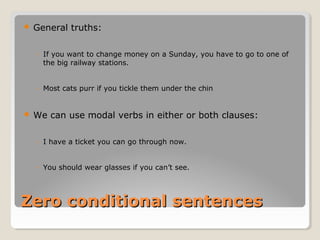
 General truths:
◦ If you want to change money on a Sunday, you have to go to one of
the big railway stations.
◦ Most cats purr if you tickle them under the chin
 We can use modal verbs in either or both clauses:
◦ I have a ticket you can go through now.
◦ You should wear glasses if you can’t see.
Mixed conditional sentencesMixed conditional sentences
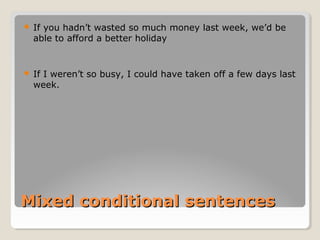
 If you hadn’t wasted so much money last week, we’d be
able to afford a better holiday
 If I weren’t so busy, I could have taken off a few days last
week.
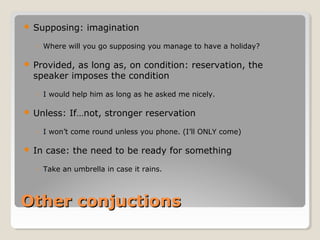
Other conjuctionsOther conjuctions
 Supposing: imagination
◦ Where will you go supposing you manage to have a holiday?
 Provided, as long as, on condition: reservation, the
speaker imposes the condition
◦ I would help him as long as he asked me nicely.
 Unless: If…not, stronger reservation
◦ I won’t come round unless you phone. (I’ll ONLY come)
 In case: the need to be ready for something
◦ Take an umbrella in case it rains.
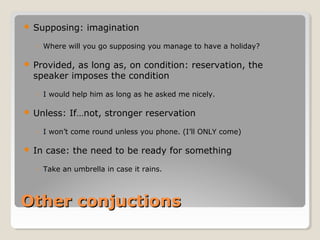
Other conjuctionsOther conjuctions
 Supposing: imagination
◦ Where will you go supposing you manage to have a holiday?
 Provided, as long as, on condition: reservation, the
speaker imposes the condition
◦ I would help him as long as he asked me nicely.
 Unless: If…not, stronger reservation
◦ I won’t come round unless you phone. (I’ll ONLY come)
 In case: the need to be ready for something
◦ Take an umbrella in case it rains.

Conditionals

  • 1.
  • 2.
    Type 1 orType1 or futurefuture conditionalconditional  If it gets colder tonight, I’ll turn on the heating.  He’ll get here early if he catches the fast train.  Persuasion: I’ll take the children to the party if you collect them from school.  Warning: If you try to get a short cut, you’ll get lost.  Threat: If you open that box, you’ll be out of the project.  IMPERATIVE  Advice or instructions: If you go to the supermarket, bring back a carton of milk please.
  • 3.
    Type 1: Othertenses & variantsType 1: Other tenses & variants  We’re staying at home on Tuesday if the transport strike goes ahead. (plan)  They’re going to take their mother to the old house if she remembers where it is. (intention)  If it hasn’t rained by the weekend, we’ll have to water the garden. (time lapse)  If they’re watching TV, they won’t hear you. (action in progress)  We can use may, might and could in the main clause: ◦ I can bring something to eat if you want. ◦ If you listen to me carefully, you may learn something useful
  • 4.
    Type 2: hypotheticalor unrealType 2: hypothetical or unreal  Use to speculate about something that is (or that we perceive to be) impossible or contrary to fact.  Present: ◦ If he didn’t annoy me so much, I’d spent more time in his office.  Future: ◦ If I got an invitation, I’d go there right away.  Difference between type 1 & 2: ◦ 1: If it gets colder tonight , I’ll turn on the heating. ◦ 2: If it got colder tonight, I’d turn on the heating.
  • 5.
    Type 2: Othertenses & variantsType 2: Other tenses & variants  If I were you, I’d make an appointment to see the doctor. (advice)  I should be grateful for an early response to the letter. (official or commercial correspondence)  If the river were to rise, there would be nothing we could do to save the city. (more hypothetical, more polite)  Were he really ill, I might feel more sympathetic.  Were you to accept my offer, I’d personally oversee the arrangement.  We can use might and could in the main clause
  • 6.
    Type 3: pasteventsType 3: past events  Reproach or regret: ◦ If you hadn’t driven so fast, you would never have had the accident. ◦ I wouldn’t have left my job if I had known how difficult it is to find another one.  Make excuses: ◦ If there hadn’t been an accident on the motorway, I would have been here in really good time for the meeting.  VARIANT: ◦ Had I known he was ill, I’d never have shouted at him. ◦ Might and could can be used instead of would
  • 7.
    Zero conditional sentencesZeroconditional sentences  General truths: ◦ If you want to change money on a Sunday, you have to go to one of the big railway stations. ◦ Most cats purr if you tickle them under the chin  We can use modal verbs in either or both clauses: ◦ I have a ticket you can go through now. ◦ You should wear glasses if you can’t see.
  • 8.
    Mixed conditional sentencesMixedconditional sentences  If you hadn’t wasted so much money last week, we’d be able to afford a better holiday  If I weren’t so busy, I could have taken off a few days last week.
  • 9.
    Other conjuctionsOther conjuctions Supposing: imagination ◦ Where will you go supposing you manage to have a holiday?  Provided, as long as, on condition: reservation, the speaker imposes the condition ◦ I would help him as long as he asked me nicely.  Unless: If…not, stronger reservation ◦ I won’t come round unless you phone. (I’ll ONLY come)  In case: the need to be ready for something ◦ Take an umbrella in case it rains.
  • 10.
    Other conjuctionsOther conjuctions Supposing: imagination ◦ Where will you go supposing you manage to have a holiday?  Provided, as long as, on condition: reservation, the speaker imposes the condition ◦ I would help him as long as he asked me nicely.  Unless: If…not, stronger reservation ◦ I won’t come round unless you phone. (I’ll ONLY come)  In case: the need to be ready for something ◦ Take an umbrella in case it rains.