
IES El Señor de Bembibre
©English Dpt.
M
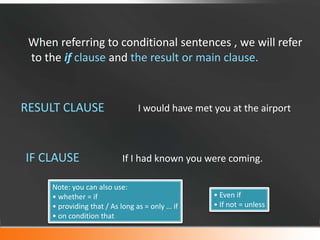
When referring to conditional sentences , we will refer
to the if clause and the result or main clause.

RESULT CLAUSE

IF CLAUSE

I would have met you at the airport

If I had known you were coming.

Note: you can also use:
• whether = if
• providing that / As long as = only … if
• on condition that

• Even if
• If not = unless
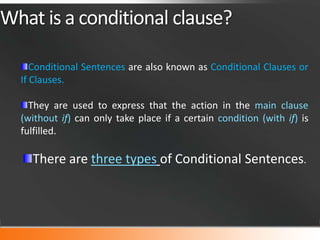
What is a conditional clause?
Conditional Sentences are also known as Conditional Clauses or
If Clauses.
They are used to express that the action in the main clause
(without if) can only take place if a certain condition (with if) is
fulfilled.

There are three types of Conditional Sentences.
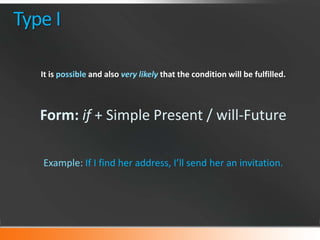
Type I
It is possible and also very likely that the condition will be fulfilled.

Form: if + Simple Present / will-Future
Example: If I find her address, I’ll send her an invitation.
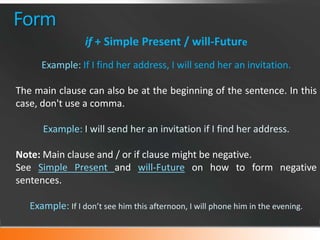
Form
if + Simple Present / will-Future
Example: If I find her address, I will send her an invitation.
The main clause can also be at the beginning of the sentence. In this
case, don't use a comma.
Example: I will send her an invitation if I find her address.
Note: Main clause and / or if clause might be negative.
See Simple Present and will-Future on how to form negative
sentences.
Example: If I don’t see him this afternoon, I will phone him in the evening.
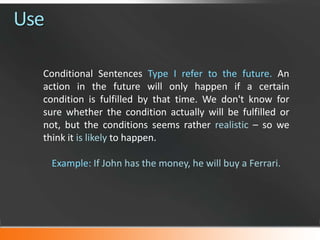
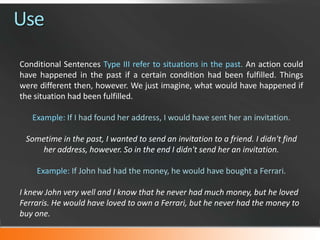
Use
Conditional Sentences Type I refer to the future. An
action in the future will only happen if a certain
condition is fulfilled by that time. We don't know for
sure whether the condition actually will be fulfilled or
not, but the conditions seems rather realistic – so we
think it is likely to happen.
Example: If John has the money, he will buy a Ferrari.
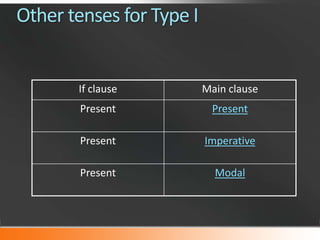
Other tenses for Type I

If clause

Main clause

Present

Present

Present

Imperative

Present

Modal
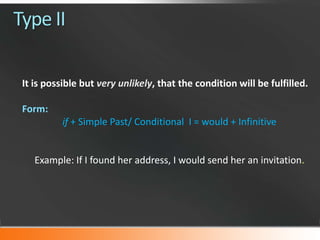
Type II
It is possible but very unlikely, that the condition will be fulfilled.
Form:

if + Simple Past/ Conditional I = would + Infinitive

Example: If I found her address, I would send her an invitation.
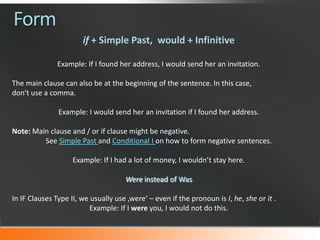
Form
if + Simple Past, would + Infinitive
Example: If I found her address, I would send her an invitation.
The main clause can also be at the beginning of the sentence. In this case,
don't use a comma.
Example: I would send her an invitation if I found her address.
Note: Main clause and / or if clause might be negative.
See Simple Past and Conditional I on how to form negative sentences.
Example: If I had a lot of money, I wouldn’t stay here.
Were instead of Was
In IF Clauses Type II, we usually use ‚were‘ – even if the pronoun is I, he, she or it .
Example: If I were you, I would not do this.
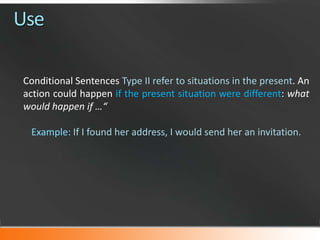
Use
Conditional Sentences Type II refer to situations in the present. An
action could happen if the present situation were different: what
would happen if …“
Example: If I found her address, I would send her an invitation.
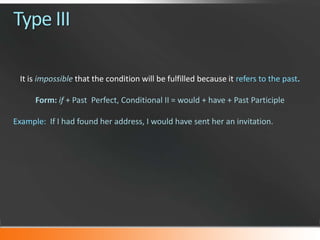
Type III
It is impossible that the condition will be fulfilled because it refers to the past.
Form: if + Past Perfect, Conditional II = would + have + Past Participle

Example: If I had found her address, I would have sent her an invitation.
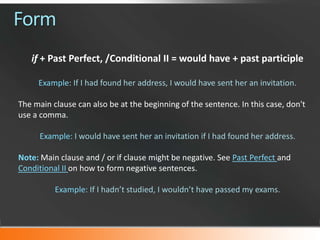
Form
if + Past Perfect, /Conditional II = would have + past participle
Example: If I had found her address, I would have sent her an invitation.
The main clause can also be at the beginning of the sentence. In this case, don't
use a comma.
Example: I would have sent her an invitation if I had found her address.
Note: Main clause and / or if clause might be negative. See Past Perfect and
Conditional II on how to form negative sentences.
Example: If I hadn’t studied, I wouldn’t have passed my exams.
Use
Conditional Sentences Type III refer to situations in the past. An action could
have happened in the past if a certain condition had been fulfilled. Things
were different then, however. We just imagine, what would have happened if
the situation had been fulfilled.
Example: If I had found her address, I would have sent her an invitation.
Sometime in the past, I wanted to send an invitation to a friend. I didn't find
her address, however. So in the end I didn't send her an invitation.
Example: If John had had the money, he would have bought a Ferrari.
I knew John very well and I know that he never had much money, but he loved
Ferraris. He would have loved to own a Ferrari, but he never had the money to
buy one.
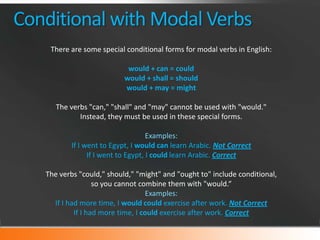
Conditional with Modal Verbs
There are some special conditional forms for modal verbs in English:
would + can = could
would + shall = should
would + may = might
The verbs "can," "shall" and "may" cannot be used with "would."
Instead, they must be used in these special forms.
Examples:
If I went to Egypt, I would can learn Arabic. Not Correct
If I went to Egypt, I could learn Arabic. Correct
The verbs "could," should," "might" and "ought to" include conditional,
so you cannot combine them with "would.“
Examples:
If I had more time, I would could exercise after work. Not Correct
If I had more time, I could exercise after work. Correct
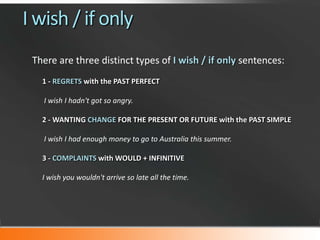
I wish / if only
There are three distinct types of I wish / if only sentences:
1 - REGRETS with the PAST PERFECT
I wish I hadn't got so angry.
2 - WANTING CHANGE FOR THE PRESENT OR FUTURE with the PAST SIMPLE
I wish I had enough money to go to Australia this summer.
3 - COMPLAINTS with WOULD + INFINITIVE
I wish you wouldn't arrive so late all the time.
Let’s do some exercises!
Open your notebook and go for it!
Hope you’ll have both
enjoyed and learnt
If you like it, say thank you;
if you don’t, you should keep quiet.

Do you want to listen to a song?
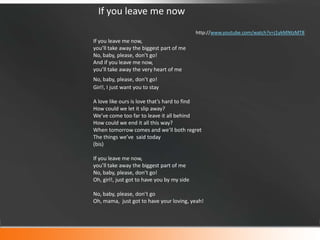
If you leave me now
http://www.youtube.com/watch?v=j1ykMNtzMT8

If you leave me now,
you’ll take away the biggest part of me
No, baby, please, don’t go!
And if you leave me now,
you’ll take away the very heart of me
No, baby, please, don’t go!
Girl!, I just want you to stay
A love like ours is love that’s hard to find
How could we let it slip away?
We’ve come too far to leave it all behind
How could we end it all this way?
When tomorrow comes and we’ll both regret
The things we’ve said today
(bis)
If you leave me now,
you’ll take away the biggest part of me
No, baby, please, don’t go!
Oh, girl!, just got to have you by my side
No, baby, please, don’t go
Oh, mama, just got to have your loving, yeah!
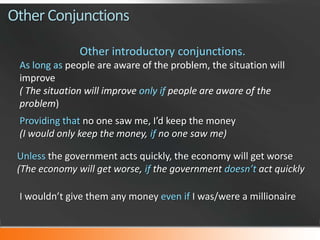
Other Conjunctions
Other introductory conjunctions.
As long as people are aware of the problem, the situation will
improve
( The situation will improve only if people are aware of the
problem)
Providing that no one saw me, I’d keep the money
(I would only keep the money, if no one saw me)
Unless the government acts quickly, the economy will get worse
(The economy will get worse, if the government doesn’t act quickly
I wouldn’t give them any money even if I was/were a millionaire
That’s all folks!

Conditional Sentences

  • 1.
    IES El Señorde Bembibre ©English Dpt. M
  • 2.
    When referring toconditional sentences , we will refer to the if clause and the result or main clause. RESULT CLAUSE IF CLAUSE I would have met you at the airport If I had known you were coming. Note: you can also use: • whether = if • providing that / As long as = only … if • on condition that • Even if • If not = unless
  • 3.
    What is aconditional clause? Conditional Sentences are also known as Conditional Clauses or If Clauses. They are used to express that the action in the main clause (without if) can only take place if a certain condition (with if) is fulfilled. There are three types of Conditional Sentences.
  • 4.
    Type I It ispossible and also very likely that the condition will be fulfilled. Form: if + Simple Present / will-Future Example: If I find her address, I’ll send her an invitation.
  • 5.
    Form if + SimplePresent / will-Future Example: If I find her address, I will send her an invitation. The main clause can also be at the beginning of the sentence. In this case, don't use a comma. Example: I will send her an invitation if I find her address. Note: Main clause and / or if clause might be negative. See Simple Present and will-Future on how to form negative sentences. Example: If I don’t see him this afternoon, I will phone him in the evening.
  • 6.
    Use Conditional Sentences TypeI refer to the future. An action in the future will only happen if a certain condition is fulfilled by that time. We don't know for sure whether the condition actually will be fulfilled or not, but the conditions seems rather realistic – so we think it is likely to happen. Example: If John has the money, he will buy a Ferrari.
  • 7.
    Other tenses forType I If clause Main clause Present Present Present Imperative Present Modal
  • 8.
    Type II It ispossible but very unlikely, that the condition will be fulfilled. Form: if + Simple Past/ Conditional I = would + Infinitive Example: If I found her address, I would send her an invitation.
  • 9.
    Form if + SimplePast, would + Infinitive Example: If I found her address, I would send her an invitation. The main clause can also be at the beginning of the sentence. In this case, don't use a comma. Example: I would send her an invitation if I found her address. Note: Main clause and / or if clause might be negative. See Simple Past and Conditional I on how to form negative sentences. Example: If I had a lot of money, I wouldn’t stay here. Were instead of Was In IF Clauses Type II, we usually use ‚were‘ – even if the pronoun is I, he, she or it . Example: If I were you, I would not do this.
  • 10.
    Use Conditional Sentences TypeII refer to situations in the present. An action could happen if the present situation were different: what would happen if …“ Example: If I found her address, I would send her an invitation.
  • 11.
    Type III It isimpossible that the condition will be fulfilled because it refers to the past. Form: if + Past Perfect, Conditional II = would + have + Past Participle Example: If I had found her address, I would have sent her an invitation.
  • 12.
    Form if + PastPerfect, /Conditional II = would have + past participle Example: If I had found her address, I would have sent her an invitation. The main clause can also be at the beginning of the sentence. In this case, don't use a comma. Example: I would have sent her an invitation if I had found her address. Note: Main clause and / or if clause might be negative. See Past Perfect and Conditional II on how to form negative sentences. Example: If I hadn’t studied, I wouldn’t have passed my exams.
  • 13.
    Use Conditional Sentences TypeIII refer to situations in the past. An action could have happened in the past if a certain condition had been fulfilled. Things were different then, however. We just imagine, what would have happened if the situation had been fulfilled. Example: If I had found her address, I would have sent her an invitation. Sometime in the past, I wanted to send an invitation to a friend. I didn't find her address, however. So in the end I didn't send her an invitation. Example: If John had had the money, he would have bought a Ferrari. I knew John very well and I know that he never had much money, but he loved Ferraris. He would have loved to own a Ferrari, but he never had the money to buy one.
  • 14.
    Conditional with ModalVerbs There are some special conditional forms for modal verbs in English: would + can = could would + shall = should would + may = might The verbs "can," "shall" and "may" cannot be used with "would." Instead, they must be used in these special forms. Examples: If I went to Egypt, I would can learn Arabic. Not Correct If I went to Egypt, I could learn Arabic. Correct The verbs "could," should," "might" and "ought to" include conditional, so you cannot combine them with "would.“ Examples: If I had more time, I would could exercise after work. Not Correct If I had more time, I could exercise after work. Correct
  • 15.
    I wish /if only There are three distinct types of I wish / if only sentences: 1 - REGRETS with the PAST PERFECT I wish I hadn't got so angry. 2 - WANTING CHANGE FOR THE PRESENT OR FUTURE with the PAST SIMPLE I wish I had enough money to go to Australia this summer. 3 - COMPLAINTS with WOULD + INFINITIVE I wish you wouldn't arrive so late all the time.
  • 16.
    Let’s do someexercises! Open your notebook and go for it!
  • 17.
    Hope you’ll haveboth enjoyed and learnt If you like it, say thank you; if you don’t, you should keep quiet. Do you want to listen to a song?
  • 18.
    If you leaveme now http://www.youtube.com/watch?v=j1ykMNtzMT8 If you leave me now, you’ll take away the biggest part of me No, baby, please, don’t go! And if you leave me now, you’ll take away the very heart of me No, baby, please, don’t go! Girl!, I just want you to stay A love like ours is love that’s hard to find How could we let it slip away? We’ve come too far to leave it all behind How could we end it all this way? When tomorrow comes and we’ll both regret The things we’ve said today (bis) If you leave me now, you’ll take away the biggest part of me No, baby, please, don’t go! Oh, girl!, just got to have you by my side No, baby, please, don’t go Oh, mama, just got to have your loving, yeah!
  • 19.
    Other Conjunctions Other introductoryconjunctions. As long as people are aware of the problem, the situation will improve ( The situation will improve only if people are aware of the problem) Providing that no one saw me, I’d keep the money (I would only keep the money, if no one saw me) Unless the government acts quickly, the economy will get worse (The economy will get worse, if the government doesn’t act quickly I wouldn’t give them any money even if I was/were a millionaire
  • 20.