Elsa Maximiano
          2012
Conditional
 Sentences


              Elsa Maximiano
                        2012
Conditional
 Sentences


  Type 2      Elsa Maximiano
                        2012
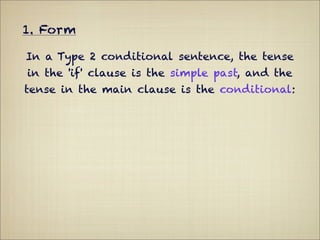
1. Form

In a Type 2 conditional sentence, the tense
in the 'if' clause is the simple past, and the
tense in the main clause is the conditional:
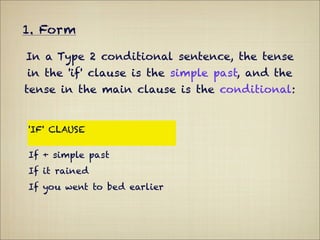
1. Form

In a Type 2 conditional sentence, the tense
in the 'if' clause is the simple past, and the
tense in the main clause is the conditional:


'IF' CLAUSE                  MAIN CLAUSE

If + simple past             Conditional
If it rained                 you would get wet.
If you went to bed earlier   you wouldn't be so
                             tired.
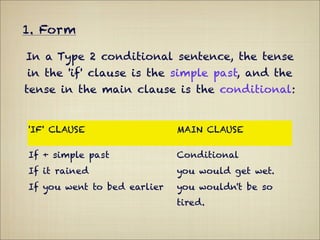
1. Form

In a Type 2 conditional sentence, the tense
in the 'if' clause is the simple past, and the
tense in the main clause is the conditional:


'IF' CLAUSE                  MAIN CLAUSE

If + simple past             Conditional
If it rained                 you would get wet.
If you went to bed earlier   you wouldn't be so
                             tired.
Conditional - form
Conditional - form
The present conditional of any verb is composed
of two parts:
Conditional - form
The present conditional of any verb is composed
of two parts:
  1. the modal auxiliary would;
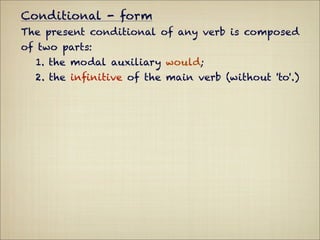
Conditional - form
The present conditional of any verb is composed
of two parts:
  1. the modal auxiliary would;
  2. the infinitive of the main verb (without 'to'.)
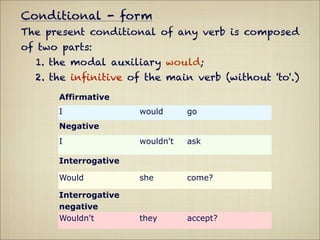
Conditional - form
The present conditional of any verb is composed
of two parts:
  1. the modal auxiliary would;
  2. the infinitive of the main verb (without 'to'.)
      Affirmative
      I               would      go
      Negative
      I               wouldn't   ask

      Interrogative

      Would           she        come?

      Interrogative
      negative
      Wouldn't        they       accept?
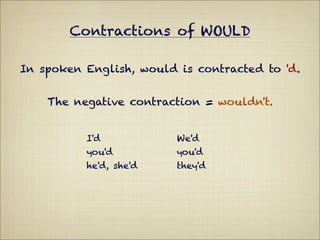
Contractions of WOULD

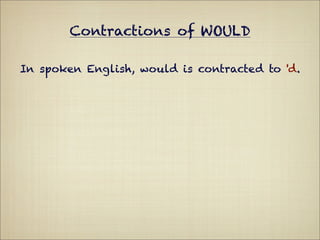
In spoken English, would is contracted to 'd.
Contractions of WOULD

In spoken English, would is contracted to 'd.


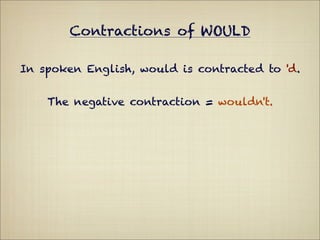
    The negative contraction = wouldn't.
Contractions of WOULD

In spoken English, would is contracted to 'd.


    The negative contraction = wouldn't.


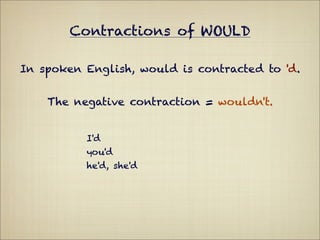
          I'd            We'd
          you'd          you'd
          he'd, she'd    they'd
Contractions of WOULD

In spoken English, would is contracted to 'd.


    The negative contraction = wouldn't.


          I'd            We'd
          you'd          you'd
          he'd, she'd    they'd
2. Function
2. Function


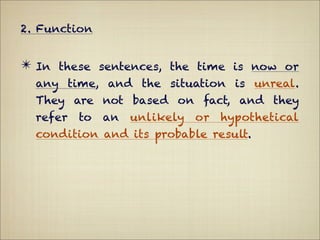
✴ In these sentences, the time is now or
  any time, and the situation is unreal.
  They are not based on fact, and they
  refer   to   an   unlikely   or   hypothetical
  condition and its probable result.
2. Function


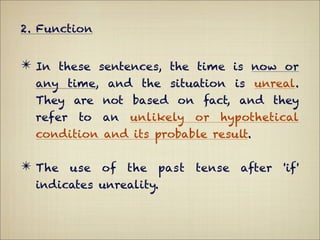
✴ In these sentences, the time is now or
  any time, and the situation is unreal.
  They are not based on fact, and they
  refer   to   an   unlikely   or   hypothetical
  condition and its probable result.

✴ The use of the past tense after 'if'
  indicates unreality.
We   can     nearly   always   add   a   phrase
starting with "but", that expresses the real
situation:
We    can    nearly   always   add   a   phrase
starting with "but", that expresses the real
situation:


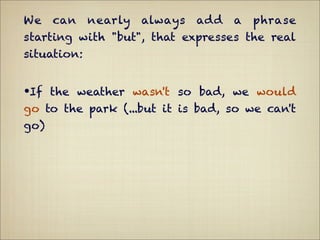
•If the weather wasn't so bad, we would
go to the park (...but it is bad, so we can't
go)
We   can     nearly   always   add   a   phrase
starting with "but", that expresses the real
situation:


•If the weather wasn't so bad, we would
go to the park (...but it is bad, so we can't
go)
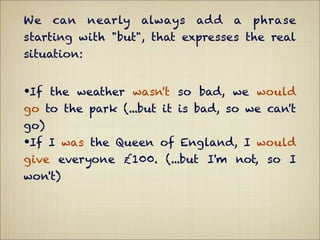
•If I was the Queen of England, I would
give everyone £100. (...but I'm not, so I
won't)
Examples of use:
Examples of use:

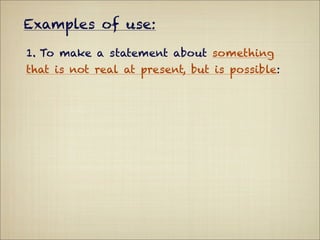
1. To make a statement about something
that is not real at present, but is possible:
Examples of use:

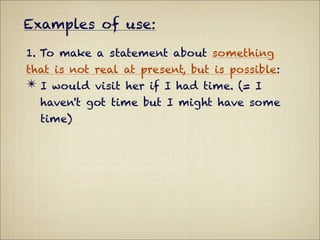
1. To make a statement about something
that is not real at present, but is possible:
✴ I would visit her if I had time. (= I
  haven't got time but I might have some
  time)
Examples of use:

1. To make a statement about something
that is not real at present, but is possible:
✴ I would visit her if I had time. (= I
  haven't got time but I might have some
  time)


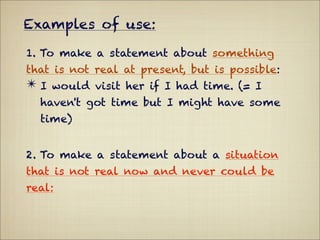
2. To make a statement about a situation
that is not real now and never could be
real:
Examples of use:

1. To make a statement about something
that is not real at present, but is possible:
✴ I would visit her if I had time. (= I
  haven't got time but I might have some
  time)


2. To make a statement about a situation
that is not real now and never could be
real:
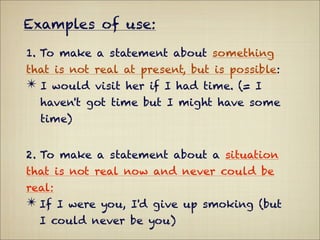
✴ If I were you, I'd give up smoking (but
  I could never be you)
Examples:


            Elsa Maximiano
                      2012
Examples:

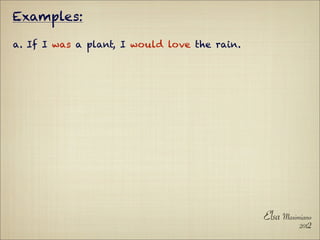
a. If I was a plant, I would love the rain.


                                              Elsa Maximiano
                                                        2012
Examples:

a. If I was a plant, I would love the rain.
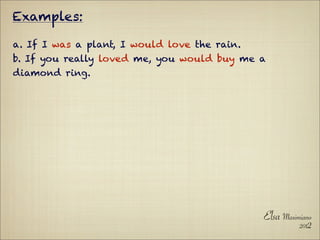
b. If you really loved me, you would buy me a
diamond ring.


                                              Elsa Maximiano
                                                        2012
Examples:

a. If I was a plant, I would love the rain.
b. If you really loved me, you would buy me a
diamond ring.
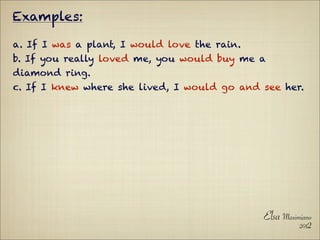
c. If I knew where she lived, I would go and see her.


                                              Elsa Maximiano
                                                        2012
Examples:

a. If I was a plant, I would love the rain.
b. If you really loved me, you would buy me a
diamond ring.
c. If I knew where she lived, I would go and see her.
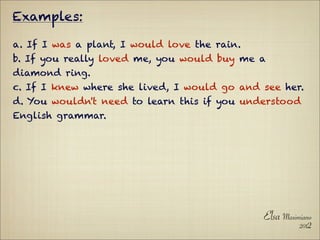
d. You wouldn't need to learn this if you understood
English grammar.


                                              Elsa Maximiano
                                                        2012
Examples:

a. If I was a plant, I would love the rain.
b. If you really loved me, you would buy me a
diamond ring.
c. If I knew where she lived, I would go and see her.
d. You wouldn't need to learn this if you understood
English grammar.
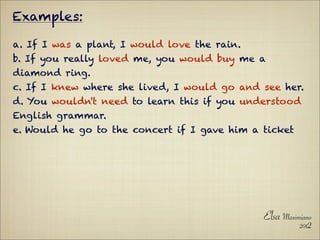
e. Would he go to the concert if I gave him a ticket


                                              Elsa Maximiano
                                                        2012
Examples:

a. If I was a plant, I would love the rain.
b. If you really loved me, you would buy me a
diamond ring.
c. If I knew where she lived, I would go and see her.
d. You wouldn't need to learn this if you understood
English grammar.
e. Would he go to the concert if I gave him a ticket
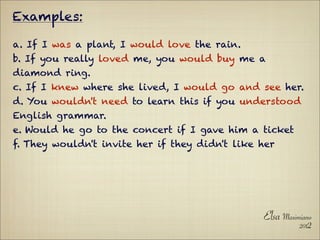
f. They wouldn't invite her if they didn't like her


                                                Elsa Maximiano
                                                          2012
Examples:

a. If I was a plant, I would love the rain.
b. If you really loved me, you would buy me a
diamond ring.
c. If I knew where she lived, I would go and see her.
d. You wouldn't need to learn this if you understood
English grammar.
e. Would he go to the concert if I gave him a ticket
f. They wouldn't invite her if they didn't like her
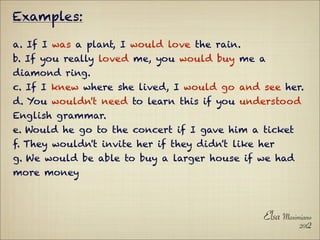
g. We would be able to buy a larger house if we had
more money


                                                Elsa Maximiano
                                                          2012
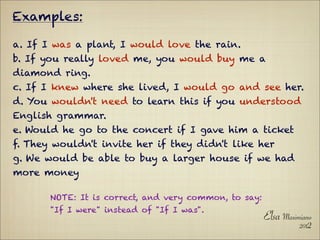
Examples:

a. If I was a plant, I would love the rain.
b. If you really loved me, you would buy me a
diamond ring.
c. If I knew where she lived, I would go and see her.
d. You wouldn't need to learn this if you understood
English grammar.
e. Would he go to the concert if I gave him a ticket
f. They wouldn't invite her if they didn't like her
g. We would be able to buy a larger house if we had
more money

       NOTE: It is correct, and very common, to say:
       "If I were" instead of "If I was".
                                                       Elsa Maximiano
                                                                 2012

Conditional type2

  • 1.
  • 2.
    Conditional Sentences Elsa Maximiano 2012
  • 3.
    Conditional Sentences Type 2 Elsa Maximiano 2012
  • 5.
    1. Form In aType 2 conditional sentence, the tense in the 'if' clause is the simple past, and the tense in the main clause is the conditional:
  • 6.
    1. Form In aType 2 conditional sentence, the tense in the 'if' clause is the simple past, and the tense in the main clause is the conditional: 'IF' CLAUSE MAIN CLAUSE If + simple past Conditional If it rained you would get wet. If you went to bed earlier you wouldn't be so tired.
  • 7.
    1. Form In aType 2 conditional sentence, the tense in the 'if' clause is the simple past, and the tense in the main clause is the conditional: 'IF' CLAUSE MAIN CLAUSE If + simple past Conditional If it rained you would get wet. If you went to bed earlier you wouldn't be so tired.
  • 9.
  • 10.
    Conditional - form Thepresent conditional of any verb is composed of two parts:
  • 11.
    Conditional - form Thepresent conditional of any verb is composed of two parts: 1. the modal auxiliary would;
  • 12.
    Conditional - form Thepresent conditional of any verb is composed of two parts: 1. the modal auxiliary would; 2. the infinitive of the main verb (without 'to'.)
  • 13.
    Conditional - form Thepresent conditional of any verb is composed of two parts: 1. the modal auxiliary would; 2. the infinitive of the main verb (without 'to'.) Affirmative I would go Negative I wouldn't ask Interrogative Would she come? Interrogative negative Wouldn't they accept?
  • 15.
  • 16.
    Contractions of WOULD Inspoken English, would is contracted to 'd.
  • 17.
    Contractions of WOULD Inspoken English, would is contracted to 'd. The negative contraction = wouldn't.
  • 18.
    Contractions of WOULD Inspoken English, would is contracted to 'd. The negative contraction = wouldn't. I'd We'd you'd you'd he'd, she'd they'd
  • 19.
    Contractions of WOULD Inspoken English, would is contracted to 'd. The negative contraction = wouldn't. I'd We'd you'd you'd he'd, she'd they'd
  • 21.
  • 22.
    2. Function ✴ Inthese sentences, the time is now or any time, and the situation is unreal. They are not based on fact, and they refer to an unlikely or hypothetical condition and its probable result.
  • 23.
    2. Function ✴ Inthese sentences, the time is now or any time, and the situation is unreal. They are not based on fact, and they refer to an unlikely or hypothetical condition and its probable result. ✴ The use of the past tense after 'if' indicates unreality.
  • 25.
    We can nearly always add a phrase starting with "but", that expresses the real situation:
  • 26.
    We can nearly always add a phrase starting with "but", that expresses the real situation: •If the weather wasn't so bad, we would go to the park (...but it is bad, so we can't go)
  • 27.
    We can nearly always add a phrase starting with "but", that expresses the real situation: •If the weather wasn't so bad, we would go to the park (...but it is bad, so we can't go) •If I was the Queen of England, I would give everyone £100. (...but I'm not, so I won't)
  • 28.
  • 29.
    Examples of use: 1.To make a statement about something that is not real at present, but is possible:
  • 30.
    Examples of use: 1.To make a statement about something that is not real at present, but is possible: ✴ I would visit her if I had time. (= I haven't got time but I might have some time)
  • 31.
    Examples of use: 1.To make a statement about something that is not real at present, but is possible: ✴ I would visit her if I had time. (= I haven't got time but I might have some time) 2. To make a statement about a situation that is not real now and never could be real:
  • 32.
    Examples of use: 1.To make a statement about something that is not real at present, but is possible: ✴ I would visit her if I had time. (= I haven't got time but I might have some time) 2. To make a statement about a situation that is not real now and never could be real: ✴ If I were you, I'd give up smoking (but I could never be you)
  • 33.
    Examples: Elsa Maximiano 2012
  • 34.
    Examples: a. If Iwas a plant, I would love the rain. Elsa Maximiano 2012
  • 35.
    Examples: a. If Iwas a plant, I would love the rain. b. If you really loved me, you would buy me a diamond ring. Elsa Maximiano 2012
  • 36.
    Examples: a. If Iwas a plant, I would love the rain. b. If you really loved me, you would buy me a diamond ring. c. If I knew where she lived, I would go and see her. Elsa Maximiano 2012
  • 37.
    Examples: a. If Iwas a plant, I would love the rain. b. If you really loved me, you would buy me a diamond ring. c. If I knew where she lived, I would go and see her. d. You wouldn't need to learn this if you understood English grammar. Elsa Maximiano 2012
  • 38.
    Examples: a. If Iwas a plant, I would love the rain. b. If you really loved me, you would buy me a diamond ring. c. If I knew where she lived, I would go and see her. d. You wouldn't need to learn this if you understood English grammar. e. Would he go to the concert if I gave him a ticket Elsa Maximiano 2012
  • 39.
    Examples: a. If Iwas a plant, I would love the rain. b. If you really loved me, you would buy me a diamond ring. c. If I knew where she lived, I would go and see her. d. You wouldn't need to learn this if you understood English grammar. e. Would he go to the concert if I gave him a ticket f. They wouldn't invite her if they didn't like her Elsa Maximiano 2012
  • 40.
    Examples: a. If Iwas a plant, I would love the rain. b. If you really loved me, you would buy me a diamond ring. c. If I knew where she lived, I would go and see her. d. You wouldn't need to learn this if you understood English grammar. e. Would he go to the concert if I gave him a ticket f. They wouldn't invite her if they didn't like her g. We would be able to buy a larger house if we had more money Elsa Maximiano 2012
  • 41.
    Examples: a. If Iwas a plant, I would love the rain. b. If you really loved me, you would buy me a diamond ring. c. If I knew where she lived, I would go and see her. d. You wouldn't need to learn this if you understood English grammar. e. Would he go to the concert if I gave him a ticket f. They wouldn't invite her if they didn't like her g. We would be able to buy a larger house if we had more money NOTE: It is correct, and very common, to say: "If I were" instead of "If I was". Elsa Maximiano 2012