• Understand theconcept of conditional
sentences.
• Explore the different types of conditional
sentences.
• Learn about the structure and formation
of conditional sentences.
• Identify common usage patterns and
examples.
Learning Objectives
3.
What are ConditionalSentences?
Conditional sentences express hypothetical
or unreal situations and the consequences
that would occur under certain conditions.
They describe the result of something that
might happen (in the present or future) or
might have happened but didn’t (in the past)
6.
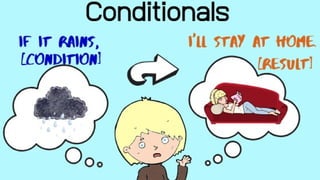
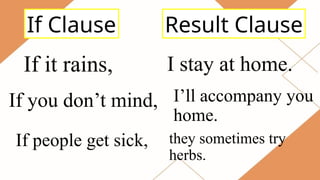
If it rains,
IfClause Result Clause
If you don’t mind,
If people get sick,
I stay at home.
I’ll accompany you
home.
they sometimes try
herbs.
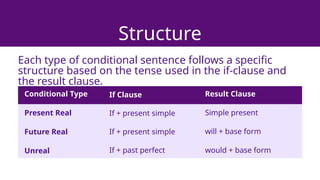
Structure
Each type ofconditional sentence follows a specific
structure based on the tense used in the if-clause and
the result clause.
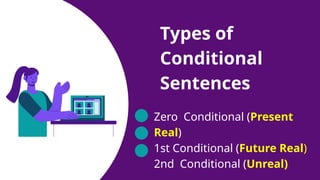
Conditional Type If Clause Result Clause
Present Real
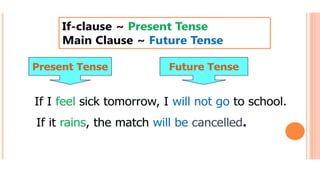
Future Real
Unreal
If + present simple
If + present simple
If + past perfect
Simple present
will + base form
would + base form
14.
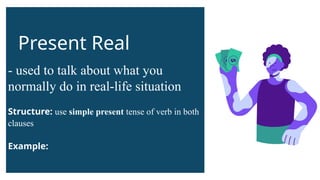
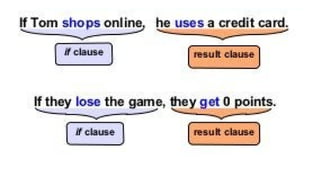
Present Real
- usedto talk about what you
normally do in real-life situation
Structure: use simple present tense of verb in both
clauses
Example:
16.
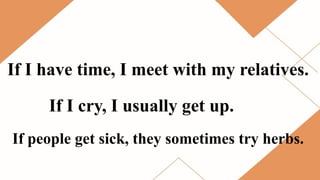
If I havetime, I meet with my relatives.
If I cry, I usually get up.
If people get sick, they sometimes try herbs.
17.
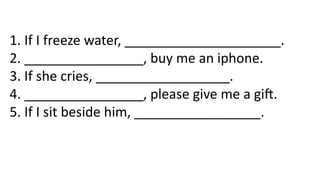
1. If Ifreeze water, _____________________.
2. ________________, buy me an iphone.
3. If she cries, __________________.
4. ________________, please give me a gift.
5. If I sit beside him, _________________.
18.
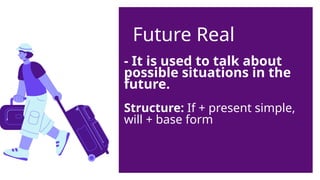
Future Real
- Itis used to talk about
possible situations in the
future.
Structure: If + present simple,
will + base form
20.
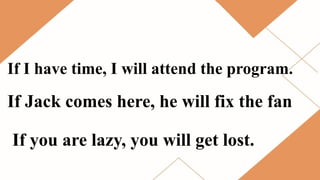
If I havetime, I will attend the program.
If Jack comes here, he will fix the fan
If you are lazy, you will get lost.
27.
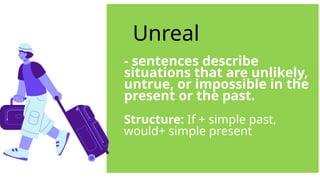
Unreal
- sentences describe
situationsthat are unlikely,
untrue, or impossible in the
present or the past.
Structure: If + simple past,
would+ simple present
28.
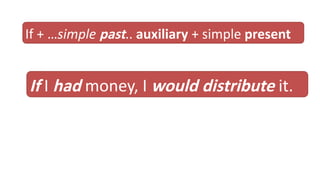
If + …simplepast.. auxiliary + simple present
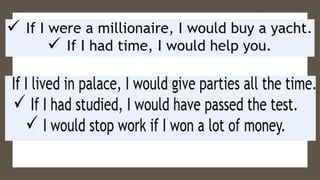
If I had money, I would distribute it.
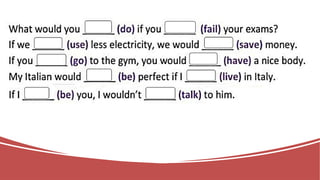
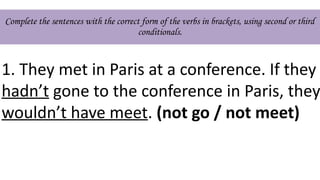
Complete the sentenceswith the correct form of the verbs in brackets, using second or third
conditionals.
1. They met in Paris at a conference. If they
hadn’t gone to the conference in Paris, they
wouldn’t have meet. (not go / not meet)
44.
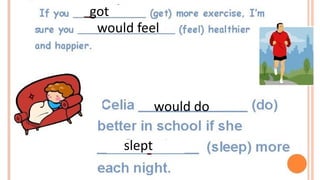
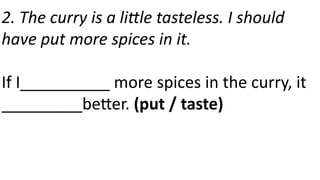
2. The curryis a little tasteless. I should
have put more spices in it.
If I__________ more spices in the curry, it
_________better. (put / taste)
45.
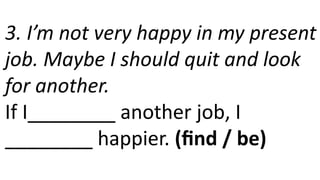
3. I’m notvery happy in my present
job. Maybe I should quit and look
for another.
If I________ another job, I
________ happier. (find / be)
46.
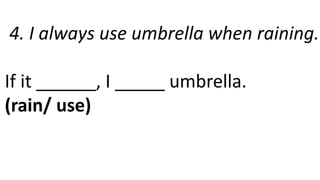
4. I alwaysuse umbrella when raining.
If it ______, I _____ umbrella.
(rain/ use)
47.
5. Don’t swimin that river; there
might be crocodiles.
If I _____ you, I _______in that
river as there might be crocodiles.
(be / not swim)
48.
6. Laura fellin love with Tom. She
left Liam.
Laura _____ Liam if she ______ in
love with Tom. (not leave / not
fall)
49.
7. In awedding, a girl who catches the
bride’s flower is said to be the next
bride.
If a girl _________ the bride's
flowers, she _____ the next to
marry.
50.
8. She doesn’thave enough money
to buy a new car.
She____ a new car if she ___ afford
one. (buy / can)
51.
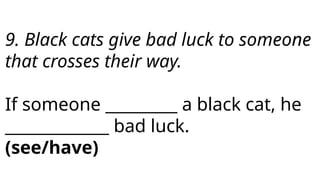
9. Black catsgive bad luck to someone
that crosses their way.
If someone _________ a black cat, he
_____________ bad luck.
(see/have)
52.
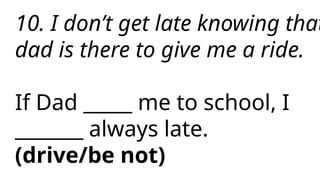
10. I don’tget late knowing that
dad is there to give me a ride.
If Dad _____ me to school, I
_______ always late.
(drive/be not)
Editor's Notes
#16 If you freeze water, it turns into ice.
If Alice comes here, she meets me.
If Albert has leisure time, he goes to the library
If you have the responsibility, perform it properly.
If you are going to Alana’s place, please give this gift to her.