University Of Engineering And Technology Peshawar, Pakistan
CE-125
Concrete Technology
Instructed By: Dr Khan Shahzada
Presented By: Asmar-Ud-Din
Semester: 2nd
Department Of: Civil Engineering
Registration No: 19PWCIV5272
DEFINATION:
“Concrete is the most common construction material which is the
composition of binding material i.e. cement or lime, aggregates( fine and
course), and water. In concrete mixture the water and binding materials
mix with each other to form paste which on solidification binds the fine
and course aggregates.”
The word concrete is of Latin origin and Roman were first to use this
word based on Hydraulic cement, which is the material that hardens
under water.
CONCRETE
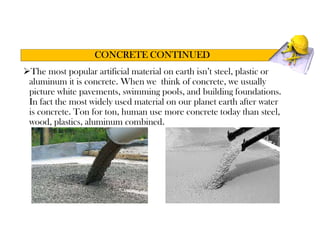
The most popular artificial material on earth isn’t steel, plastic or
aluminum it is concrete. When we think of concrete, we usually
picture white pavements, swimming pools, and building foundations.
In fact the most widely used material on our planet earth after water
is concrete. Ton for ton, human use more concrete today than steel,
wood, plastics, aluminum combined.
CONCRETE CONTINUED
CONSTITUENTS OF CONCRETE:
Main constituents of concrete are
Cement
Fine and coarse aggregates
Water
 Sometime apart from the above constituents Admixtures are also
added to the mixture
CONCRETE CONTINUED
COMPOSITION OF CONSTITUENTS:
Typical composition of constituents of concrete by volume are
Cement 7-15%
Water 14-21%
Aggregates (fine and coarse) 60-80%
Admixtures may or may not be added to the concrete
CONCRETE CONTINUED
PROPERTIES OF CONCRETE:
A good Concrete should be
Strong
Durable
Hard
Impervious (water proofing)
Fire resistant
Economical
CONCRETE CONTINUED
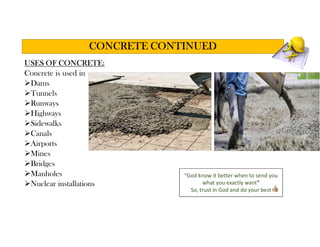
USES OF CONCRETE:
Concrete is used in
Dams
Tunnels
Runways
Highways
Sidewalks
Canals
Airports
Mines
Bridges
Manholes
Nuclear installations
CONCRETE CONTINUED
“God know it better when to send you
what you exactly want”
So, trust in God and do your best
STEEL VERSUS CONCRETE:
In USA concrete consumption is 5 times by the weight of steel
In other countries the concrete consumption is 10 times by the weight
of steel
In Pakistan the concrete consumption is more than 100 times by the
weight of steel
More than 1ton/year/person of concrete is used and no such
tremendous material is consumed by humans except water
CONCRETE CONTINUED
DEFINATION:
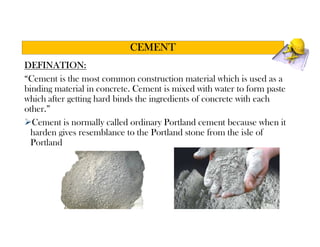
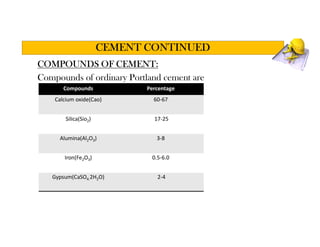
“Cement is the most common construction material which is used as a
binding material in concrete. Cement is mixed with water to form paste
which after getting hard binds the ingredients of concrete with each
other.”
Cement is normally called ordinary Portland cement because when it
harden gives resemblance to the Portland stone from the isle of
Portland
CEMENT
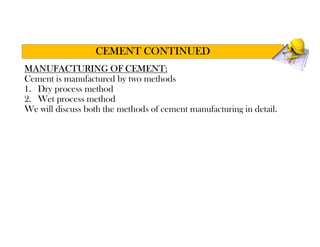
COMPOUNDS OF CEMENT:
Compounds of ordinary Portland cement are
CEMENT CONTINUED
Compounds Percentage
Calcium oxide(Cao) 60-67
Silica(Sio2) 17-25
Alumina(Al2O3) 3-8
Iron(Fe2O3) 0.5-6.0
Gypsum(CaSO4.2H2O) 2-4
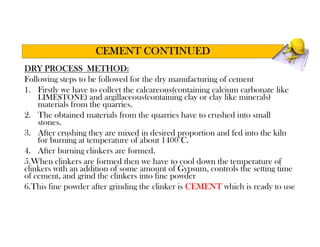
MANUFACTURING OF CEMENT:
Cement is manufactured by two methods
1. Dry process method
2. Wet process method
We will discuss both the methods of cement manufacturing in detail.
CEMENT CONTINUED
DRY PROCESS METHOD:
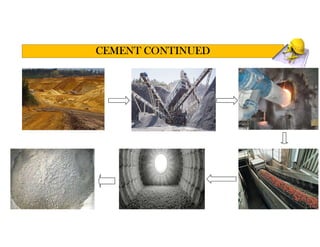
Following steps to be followed for the dry manufacturing of cement
1. Firstly we have to collect the calcareous(containing calcium carbonate like
LIMESTONE) and argillaceous(containing clay or clay like minerals)
materials from the quarries.
2. The obtained materials from the quarries have to crushed into small
stones.
3. After crushing they are mixed in desired proportion and fed into the kiln
for burning at temperature of about 1400°C.
4. After burning clinkers are formed.
5.When clinkers are formed then we have to cool down the temperature of
clinkers with an addition of some amount of Gypsum, controls the setting time
of cement, and grind the clinkers into fine powder
6.This fine powder after grinding the clinker is CEMENT which is ready to use
CEMENT CONTINUED
CEMENT CONTINUED
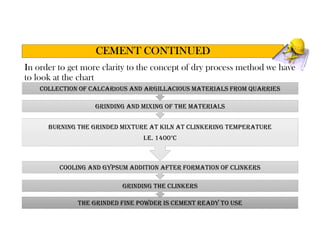
In order to get more clarity to the concept of dry process method we have
to look at the chart
THE GRINDED FINE POWDER IS CEMENT READY TO USE
GRINDING THE CLINKERS
COOLING AND GYPSUM ADDITION AFTER FORMATION OF CLINKERS
BURNING THE GRINDED MIXTURE AT KILN AT CLINKERING TEMPERATURE
I.E. 1400°C
GRINDING AND MIXING OF THE MATERIALS
COLLECTION OF CALCARIOUS AND ARGILLACIOUS MATERIALS FROM QUARRIES
CEMENT CONTINUED
WET PROCESS METHOD:
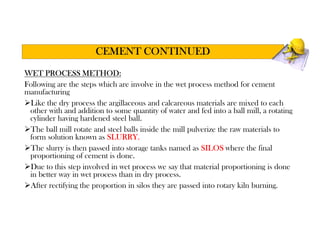
Following are the steps which are involve in the wet process method for cement
manufacturing
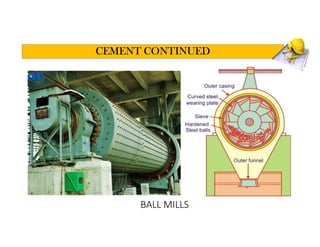
Like the dry process the argillaceous and calcareous materials are mixed to each
other with and addition to some quantity of water and fed into a ball mill, a rotating
cylinder having hardened steel ball.
The ball mill rotate and steel balls inside the mill pulverize the raw materials to
form solution known as SLURRY.
The slurry is then passed into storage tanks named as SILOS where the final
proportioning of cement is done.
Due to this step involved in wet process we say that material proportioning is done
in better way in wet process than in dry process.
After rectifying the proportion in silos they are passed into rotary kiln burning.
CEMENT CONTINUED
BALL MILLS
CEMENT CONTINUED
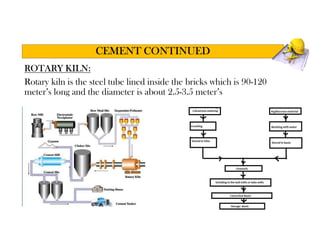
ROTARY KILN:
Rotary kiln is the steel tube lined inside the bricks which is 90-120
meter’s long and the diameter is about 2.5-3.5 meter’s
CEMENT CONTINUED
Slurry on passing the kiln loss all the moisture and form lumps or
nodules.
The nodules are then passed into rising temperature zone and finally
burnt at higher temperature of about 1400°C.
On this burning temperature they form clinkers.
Finally the grinding of the clinkers result into cement
CEMENT CONTINUED
SETTING TIME OF CEMENT:
Two important setting time of cement are
Initial setting time
Final setting time
We will discuss both in detail
CEMENT CONTINUED
INITIAL SETTING TIME OF CEMENT:
“The time after mixing of water with cement at which cement paste,
concrete or mortar can no longer be properly mixed, finished or
compacted is known as initial setting time.”
OR
“The time elapsed between the moment when water is added to the
cement to the time when it starts losing its plasticity.”
Experimentally we can say that initial setting time is the time elapsed
between the moment when water is added to the cement to the time
when vicat plunger penetrates up to 5mm from the bottom.
CEMENT CONTINUED
FINAL SETTING TIME:
“The time at which the cement, mortar or concrete gain sufficient
strength and hardness.”
OR
“The time elapsed between the moment when water is added to the
cement to the time when it completely lost its plasticity.”
Experimentally we can say that final setting time is the time elapsed
between the moment when water is added to the cement to the time
when circular attachment fails to make an impression
CEMENT CONTINUED
CEMENT CONTINUED
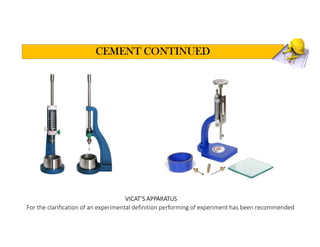
VICAT’S APPARATUS
For the clarification of an experimental definition performing of experiment has been recommended
HYDRATION OF CEMENT:
“When water reacts with cement the reaction is called hydration of
cement”.
The hydration reaction of cement is an exothermic.
The amount of heat evolved in joules per gram of cement upon
complete hydration at a given temperature is called heat of hydration
CEMENT CONTINUED
TYPES OF CEMENT:
On the basis of the materials used in manufacturing of cement we have
different types of cement for different purposes.
Here we have to discuss each type in detail with its uses
Ordinary Portland cement(OPC)
Rapid hardening Portland cement(R.H.C)
Low heat Portland cement
CEMENT CONTINUED
1. ORDINARY PORTLAND CEMENT(OPC)(Type-I):
OPC is the most common type of cement used in construction work.
This is general type of cement and should be used in areas of
construction where no special properties of cement are required. OPC is
not to be used in areas of construction with an exposure to sulphate.
2. RAPID HARDENING PORTLAND CEMENT(Type-III):
Rapid hardening Portland cement is also called high early strength
cement because it produce strength early as compare to OPC. The early
strength development is due to high contents of C3S , sometimes
increases up to 70%, and also due to very fine grinding of the clinkers
during manufacturing of cement in plant.
CEMENT CONTINUED
USES:
As it is clear that main property of rapid hardening cement is that it
gain strength early, therefore it will be used in areas of construction
where early strength is required for further construction.
When framework have to remove early for reuse then we use rapid
hardening Portland cement in that area.
It is used in cold areas because of its high heat generation due to
reaction where it helps to prevent frost damages.
Due to high heat generation it should not be used in construction of
massive structure because it create cracks.
CEMENT CONTINUED
3. LOW HEAT PORTLAND CEMENT (Type-IV):
As we know that due to higher contents of C3S the rapid hardening
Portland cement gain early strength.
Due to the low contents of C3S the generation of heat is low and that’s
why the strength development will get late also but the ultimate strength is
not affected.
Low heat Portland cement was first used by United Stats in large gravity
dams.
CEMENT CONTINUED
POZZOLONA:
Pozzolona is siliceous or siliceous and argillaceous material which itself
don’t have any cementatious properties. But in finely divided form and in
presence of moisture at normal temperature reacts with calcium
hydroxide to form compounds having cementacious properties.
e.g. Fly ash, Silica fume and Rice husk ash.
CEMENT CONTINUED
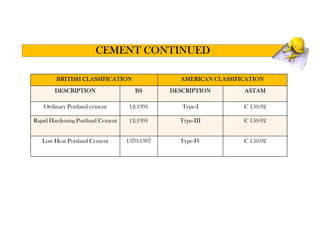
BRITISH CLASSIFICATION AMERICAN CLASSIFICATION
DESCRIPTION BS DESCRIPTION ASTAM
Ordinary Portland cement 12:1991 Type-I C 150-92
Rapid Hardening Portland Cement 12:1991 Type-III C 150-92
Low Heat Portland Cement 1370:1997 Type-IV C 150-92
CEMENT CONTINUED
Concrete Technology By Asmar

Concrete Technology By Asmar

  • 3.
    University Of EngineeringAnd Technology Peshawar, Pakistan CE-125 Concrete Technology Instructed By: Dr Khan Shahzada Presented By: Asmar-Ud-Din Semester: 2nd Department Of: Civil Engineering Registration No: 19PWCIV5272
  • 4.
    DEFINATION: “Concrete is themost common construction material which is the composition of binding material i.e. cement or lime, aggregates( fine and course), and water. In concrete mixture the water and binding materials mix with each other to form paste which on solidification binds the fine and course aggregates.” The word concrete is of Latin origin and Roman were first to use this word based on Hydraulic cement, which is the material that hardens under water. CONCRETE
  • 5.
    The most popularartificial material on earth isn’t steel, plastic or aluminum it is concrete. When we think of concrete, we usually picture white pavements, swimming pools, and building foundations. In fact the most widely used material on our planet earth after water is concrete. Ton for ton, human use more concrete today than steel, wood, plastics, aluminum combined. CONCRETE CONTINUED
  • 6.
    CONSTITUENTS OF CONCRETE: Mainconstituents of concrete are Cement Fine and coarse aggregates Water  Sometime apart from the above constituents Admixtures are also added to the mixture CONCRETE CONTINUED
  • 7.
    COMPOSITION OF CONSTITUENTS: Typicalcomposition of constituents of concrete by volume are Cement 7-15% Water 14-21% Aggregates (fine and coarse) 60-80% Admixtures may or may not be added to the concrete CONCRETE CONTINUED
  • 8.
    PROPERTIES OF CONCRETE: Agood Concrete should be Strong Durable Hard Impervious (water proofing) Fire resistant Economical CONCRETE CONTINUED
  • 9.
    USES OF CONCRETE: Concreteis used in Dams Tunnels Runways Highways Sidewalks Canals Airports Mines Bridges Manholes Nuclear installations CONCRETE CONTINUED “God know it better when to send you what you exactly want” So, trust in God and do your best
  • 10.
    STEEL VERSUS CONCRETE: InUSA concrete consumption is 5 times by the weight of steel In other countries the concrete consumption is 10 times by the weight of steel In Pakistan the concrete consumption is more than 100 times by the weight of steel More than 1ton/year/person of concrete is used and no such tremendous material is consumed by humans except water CONCRETE CONTINUED
  • 11.
    DEFINATION: “Cement is themost common construction material which is used as a binding material in concrete. Cement is mixed with water to form paste which after getting hard binds the ingredients of concrete with each other.” Cement is normally called ordinary Portland cement because when it harden gives resemblance to the Portland stone from the isle of Portland CEMENT
  • 12.
    COMPOUNDS OF CEMENT: Compoundsof ordinary Portland cement are CEMENT CONTINUED Compounds Percentage Calcium oxide(Cao) 60-67 Silica(Sio2) 17-25 Alumina(Al2O3) 3-8 Iron(Fe2O3) 0.5-6.0 Gypsum(CaSO4.2H2O) 2-4
  • 13.
    MANUFACTURING OF CEMENT: Cementis manufactured by two methods 1. Dry process method 2. Wet process method We will discuss both the methods of cement manufacturing in detail. CEMENT CONTINUED
  • 14.
    DRY PROCESS METHOD: Followingsteps to be followed for the dry manufacturing of cement 1. Firstly we have to collect the calcareous(containing calcium carbonate like LIMESTONE) and argillaceous(containing clay or clay like minerals) materials from the quarries. 2. The obtained materials from the quarries have to crushed into small stones. 3. After crushing they are mixed in desired proportion and fed into the kiln for burning at temperature of about 1400°C. 4. After burning clinkers are formed. 5.When clinkers are formed then we have to cool down the temperature of clinkers with an addition of some amount of Gypsum, controls the setting time of cement, and grind the clinkers into fine powder 6.This fine powder after grinding the clinker is CEMENT which is ready to use CEMENT CONTINUED
  • 15.
    CEMENT CONTINUED In orderto get more clarity to the concept of dry process method we have to look at the chart THE GRINDED FINE POWDER IS CEMENT READY TO USE GRINDING THE CLINKERS COOLING AND GYPSUM ADDITION AFTER FORMATION OF CLINKERS BURNING THE GRINDED MIXTURE AT KILN AT CLINKERING TEMPERATURE I.E. 1400°C GRINDING AND MIXING OF THE MATERIALS COLLECTION OF CALCARIOUS AND ARGILLACIOUS MATERIALS FROM QUARRIES
  • 16.
  • 17.
    WET PROCESS METHOD: Followingare the steps which are involve in the wet process method for cement manufacturing Like the dry process the argillaceous and calcareous materials are mixed to each other with and addition to some quantity of water and fed into a ball mill, a rotating cylinder having hardened steel ball. The ball mill rotate and steel balls inside the mill pulverize the raw materials to form solution known as SLURRY. The slurry is then passed into storage tanks named as SILOS where the final proportioning of cement is done. Due to this step involved in wet process we say that material proportioning is done in better way in wet process than in dry process. After rectifying the proportion in silos they are passed into rotary kiln burning. CEMENT CONTINUED
  • 18.
  • 19.
    ROTARY KILN: Rotary kilnis the steel tube lined inside the bricks which is 90-120 meter’s long and the diameter is about 2.5-3.5 meter’s CEMENT CONTINUED
  • 20.
    Slurry on passingthe kiln loss all the moisture and form lumps or nodules. The nodules are then passed into rising temperature zone and finally burnt at higher temperature of about 1400°C. On this burning temperature they form clinkers. Finally the grinding of the clinkers result into cement CEMENT CONTINUED
  • 21.
    SETTING TIME OFCEMENT: Two important setting time of cement are Initial setting time Final setting time We will discuss both in detail CEMENT CONTINUED
  • 22.
    INITIAL SETTING TIMEOF CEMENT: “The time after mixing of water with cement at which cement paste, concrete or mortar can no longer be properly mixed, finished or compacted is known as initial setting time.” OR “The time elapsed between the moment when water is added to the cement to the time when it starts losing its plasticity.” Experimentally we can say that initial setting time is the time elapsed between the moment when water is added to the cement to the time when vicat plunger penetrates up to 5mm from the bottom. CEMENT CONTINUED
  • 23.
    FINAL SETTING TIME: “Thetime at which the cement, mortar or concrete gain sufficient strength and hardness.” OR “The time elapsed between the moment when water is added to the cement to the time when it completely lost its plasticity.” Experimentally we can say that final setting time is the time elapsed between the moment when water is added to the cement to the time when circular attachment fails to make an impression CEMENT CONTINUED
  • 24.
    CEMENT CONTINUED VICAT’S APPARATUS Forthe clarification of an experimental definition performing of experiment has been recommended
  • 25.
    HYDRATION OF CEMENT: “Whenwater reacts with cement the reaction is called hydration of cement”. The hydration reaction of cement is an exothermic. The amount of heat evolved in joules per gram of cement upon complete hydration at a given temperature is called heat of hydration CEMENT CONTINUED
  • 26.
    TYPES OF CEMENT: Onthe basis of the materials used in manufacturing of cement we have different types of cement for different purposes. Here we have to discuss each type in detail with its uses Ordinary Portland cement(OPC) Rapid hardening Portland cement(R.H.C) Low heat Portland cement CEMENT CONTINUED
  • 27.
    1. ORDINARY PORTLANDCEMENT(OPC)(Type-I): OPC is the most common type of cement used in construction work. This is general type of cement and should be used in areas of construction where no special properties of cement are required. OPC is not to be used in areas of construction with an exposure to sulphate. 2. RAPID HARDENING PORTLAND CEMENT(Type-III): Rapid hardening Portland cement is also called high early strength cement because it produce strength early as compare to OPC. The early strength development is due to high contents of C3S , sometimes increases up to 70%, and also due to very fine grinding of the clinkers during manufacturing of cement in plant. CEMENT CONTINUED
  • 28.
    USES: As it isclear that main property of rapid hardening cement is that it gain strength early, therefore it will be used in areas of construction where early strength is required for further construction. When framework have to remove early for reuse then we use rapid hardening Portland cement in that area. It is used in cold areas because of its high heat generation due to reaction where it helps to prevent frost damages. Due to high heat generation it should not be used in construction of massive structure because it create cracks. CEMENT CONTINUED
  • 29.
    3. LOW HEATPORTLAND CEMENT (Type-IV): As we know that due to higher contents of C3S the rapid hardening Portland cement gain early strength. Due to the low contents of C3S the generation of heat is low and that’s why the strength development will get late also but the ultimate strength is not affected. Low heat Portland cement was first used by United Stats in large gravity dams. CEMENT CONTINUED
  • 30.
    POZZOLONA: Pozzolona is siliceousor siliceous and argillaceous material which itself don’t have any cementatious properties. But in finely divided form and in presence of moisture at normal temperature reacts with calcium hydroxide to form compounds having cementacious properties. e.g. Fly ash, Silica fume and Rice husk ash. CEMENT CONTINUED
  • 31.
    BRITISH CLASSIFICATION AMERICANCLASSIFICATION DESCRIPTION BS DESCRIPTION ASTAM Ordinary Portland cement 12:1991 Type-I C 150-92 Rapid Hardening Portland Cement 12:1991 Type-III C 150-92 Low Heat Portland Cement 1370:1997 Type-IV C 150-92 CEMENT CONTINUED