Completed under guidance of :
Dr. M.P.S. CHAUHAN
By :
AMRITESH
KUMAR
I.D. : 130514
CIVIL 3rd
year
CC- Concrete Cloth
BS EN – British Standards
DIN – German Institute of Standardization.
ISO – International Organization for Standardization
OPC – Open Platform Communications ( a series of
standards and specifications for industrial
telecommunication)
CBR – static puncture test
ASTM – American Society for Testing Materials.
There is a increasing demand for construction and
construction materials worldwide, for that
concrete is the most extensively used material in
construction.
Concrete is being used for so many purposes in
many different adverse conditions.
There are many advantages of concrete but there is
one drawback – concrete is not flexible when it is
hardened.
To overcome this drawback , a new construction
material evolved as “CONCRETE CLOTH”
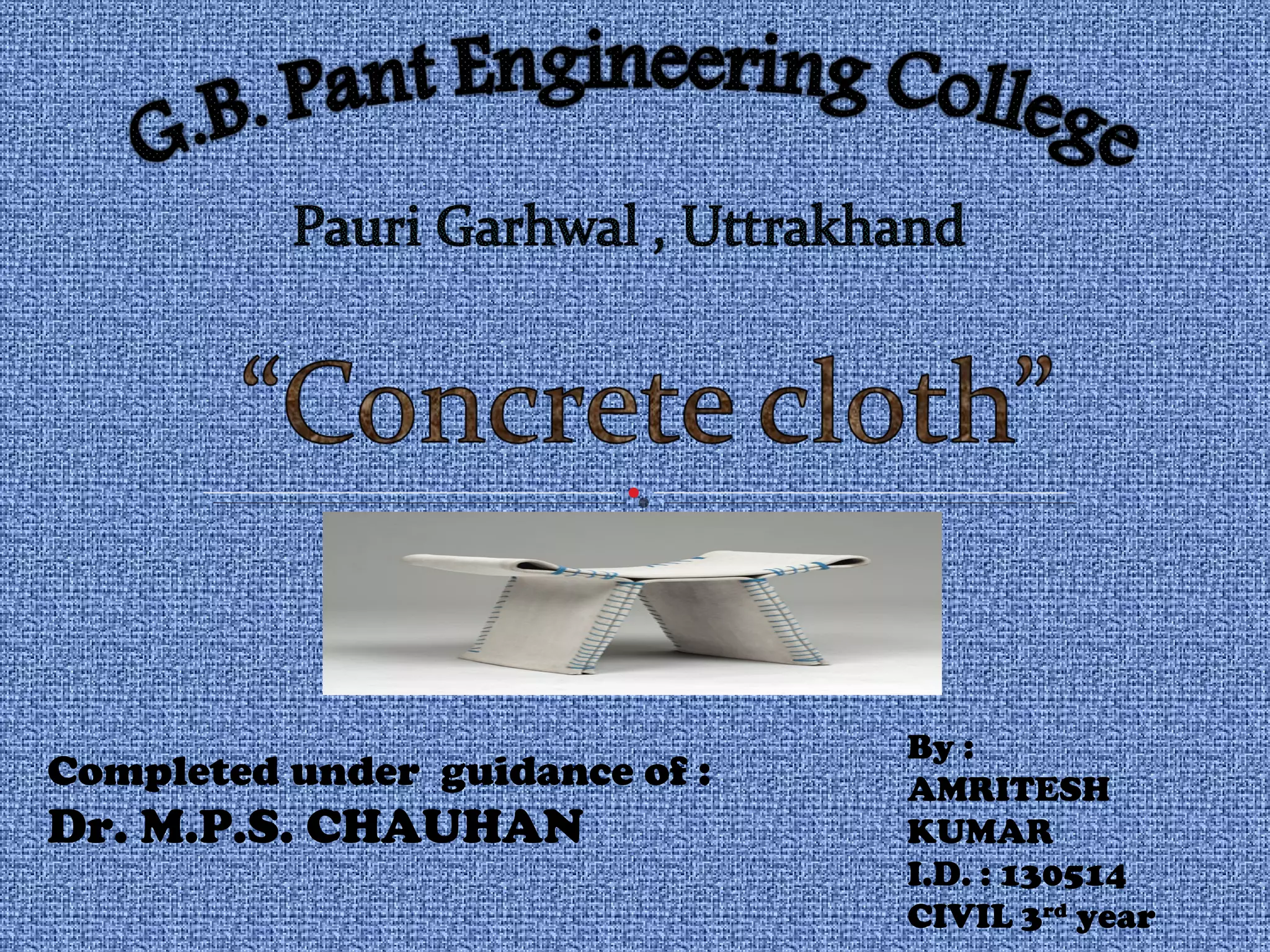
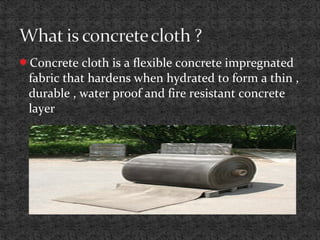
Concrete cloth is a flexible concrete impregnated
fabric that hardens when hydrated to form a thin ,
durable , water proof and fire resistant concrete
layer
Milliken Infrastructure solutions, LLC(also known as
MIS) manufactures concrete cloth under the license
from “Concrete Canvas Ltd” .it is marketed as concrete
canvas.
Their specially designed, highly specialised machinery
is used to permeate a custom cement blend with other
additives that transform into a 3D synthetic fibre
matrix with a PVC (polymerised vinyl chloride , a
synthetic resin) coating on one surface.
Concrete cloth is for sale outside the US and Canada.
There are installations in 15 US states and 3 Canadian
provinces.
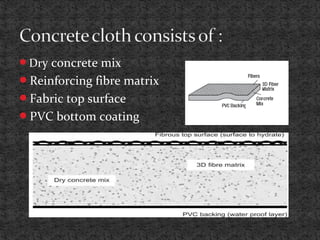
Dry concrete mix
Reinforcing fibre matrix
Fabric top surface
PVC bottom coating
Conctrete cloth can be used:
The product called concrete cloth was developed by a
British engineering company called “Concrete
canvas”.
It was the result of a competition run by British
Cement Association under entry of Rapidly
Deployable Emergency shelter .
The British army saw potential uses of this new
material and started using concrete cloth as a
method of reinforcing sandbag defences. This
solution reduces degradation of sandbag walls in
harsh environment such as Afghanistan .
In January 2008 , a small quantity was used on the
frontline in Afghanistan to validate its performance.
As a result of these trials, the US Ministry of Defence
had awarded concrete canvas a contract to supply
5500 m² (6600 yd²) to the frontline .
Concrete cloth – material of the year 2009
Strength : very high early strength is the fundamental
characteristic of cc.
Compression testing based on ASTM C473 – 07
-10 day compression failure stress = 40Mpa
- 10 day compressive young’s modulus = 1500Mpa
Bending tests based on BS EN 12467:2004
- 10 day bending failure stress = 3.4Mpa
- 10 day bending young’s modulus = 180Mpa
Abrasion Resistance (ASTM C1353-8)
- CC lost 60% less weight than marble over 1000 cycles.
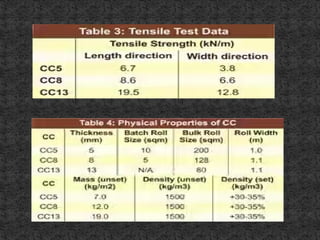
Tensile test
Abrasion resistance (DIN 52108)
- similar to twice that of OPC Max 0.10 gm/cm²
CBR puncture resistance EN ISO 12236:2007 (CCB &
CC13 only)
- minimum push through force = 2.69kN
- maximum Deflection at peak = 38mm
Resistance to imposed loads on vehicle traffic areas
EN 1991-1-1-:2002 (CCB & CC13 only)
- category G compliant
- Gross weight of 2 axle vehicle 30 to 160kN
- Uniformly distributed load not exceeding 5kN/sq m
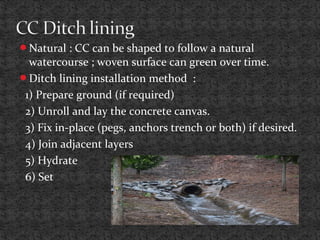
Natural : CC can be shaped to follow a natural
watercourse ; woven surface can green over time.
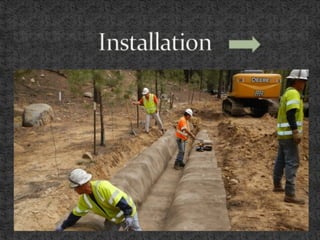
Ditch lining installation method :
1) Prepare ground (if required)
2) Unroll and lay the concrete canvas.
3) Fix in-place (pegs, anchors trench or both) if desired.
4) Join adjacent layers
5) Hydrate
6) Set
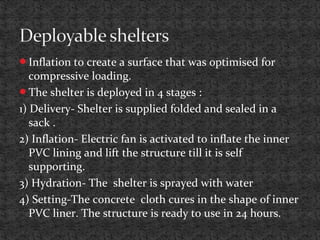
Inflation to create a surface that was optimised for
compressive loading.
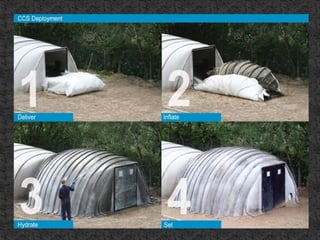
The shelter is deployed in 4 stages :
1) Delivery- Shelter is supplied folded and sealed in a
sack .
2) Inflation- Electric fan is activated to inflate the inner
PVC lining and lift the structure till it is self
supporting.
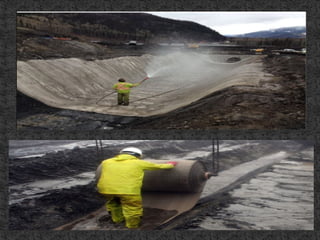
3) Hydration- The shelter is sprayed with water
4) Setting-The concrete cloth cures in the shape of inner
PVC liner. The structure is ready to use in 24 hours.
CC can be hydrated using saline water or non saline
water .
The minimum ratio of water to cc is 1:2 by weight.
CC can not be over hydrated so an excess in
recommended .
Recommended methods
-Immersion : Immerse cc in water for a minimum of 90
seconds
- spraying : Spray the dry CC with water until it is
saturated .
*Re-spray CC again after 1 hour if
~Installing CC5
~Installing CC on a steep or vertical surface
~Installing in warm climates.
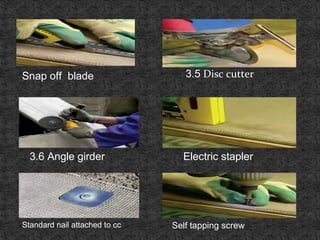
A snap off type disposable blade is the most suitable
tool for cutting CC before it is hydrated or set .
When cutting dry CC , a 20mm allowance should be
left from the cut edge due to lost fill.
This could be avoided by wetting the CC prior to
cutting .
CC can also be cut using handheld self sharpening
powered disc cutters.
Cutting set CC : Set CC can be cut as with
conventional concrete , with angle grinders ,
construction disc cutters or quality tile cutters.
CC Mechanical fixing : There are large number of
mechanical fixings that are suitable for use with concrete
canvas. Some of these fixings can be used in conjunction
with the non-mechanical joining methods described later
in this to improve the mechanical strength or water
proofing properties of joints.
Staples : Wide range of manual , electrical or gas powered
staplers are suitable for attaching CC to soft substrates
such as wooden boarding for building cladding.
commercially available hand staplers are suitable for
fixing 2 layers of CC together where a small amount of
compression force is required.
Nails : Standard nails can be used to attach CC.
Alternatively , a power tool such as the Hill nail
gun ,provide a quick and effective method of securing
CC to hard surfaces such as concrete or rock. This
may be appropriate where CC is being used to
recondition an existing concrete surface. It is
important to ensure that the nail is used with at least
a 15mm washer to ensure the head does not penetrate
through the surface of the canvas.
Screws : Self tapping screws provide a quick and
readily available means of attaching CC to substrate
or to itself. Typically applications include sandbag
reinforcement or covering existing wooden or steel
structure.
Snap off blade 3.5 Disc cutter
3.6 Angle girder Electric stapler
Standard nail attached to cc Self tapping screw
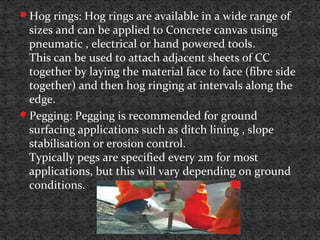
Hog rings: Hog rings are available in a wide range of
sizes and can be applied to Concrete canvas using
pneumatic , electrical or hand powered tools.
This can be used to attach adjacent sheets of CC
together by laying the material face to face (fibre side
together) and then hog ringing at intervals along the
edge.
Pegging: Pegging is recommended for ground
surfacing applications such as ditch lining , slope
stabilisation or erosion control.
Typically pegs are specified every 2m for most
applications, but this will vary depending on ground
conditions.
The fibre surface of CC can be easily painted once set,
using standard exterior masonry paint.
Alternatively Concrete Canvas Ltd. recommend a
range of copolymer concrete surface treatments
which can provide a coloured uniform finish and
hydrophobic protection against staining and organic
growth.
Fire resistant paints have also been shown to be
effective when thermal performance is critical.
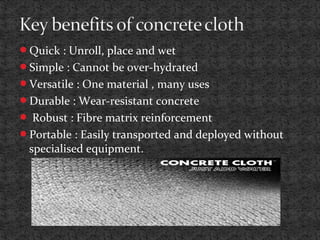
Quick : Unroll, place and wet
Simple : Cannot be over-hydrated
Versatile : One material , many uses
Durable : Wear-resistant concrete
 Robust : Fibre matrix reinforcement
Portable : Easily transported and deployed without
specialised equipment.
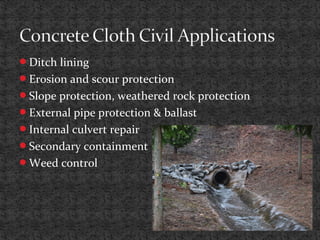
Ditch lining
Erosion and scour protection
Slope protection, weathered rock protection
External pipe protection & ballast
Internal culvert repair
Secondary containment
Weed control
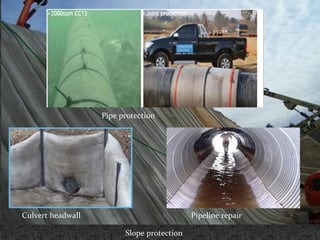
Slope protection
Pipe protection
Culvert headwall Pipeline repair
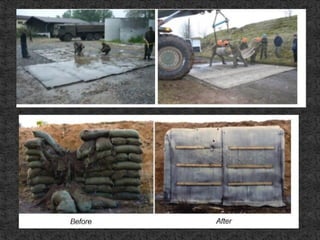
Force protection
Structure upgrades
Helipad construction / dust suppression
Expedient resurfacing
Ditch / Tank lining
Slope protection
CC cannot be over hydrated
Do not jet high pressure directly onto the cc as this
may wash a channel in the material.
CC has a working of 1-2 hours after hydration .So do
not move it once it has begun to set.
Working time will be reduced in hot climates.
If cc is fully saturated , the set may be delayed and
strength reduced.
Concrete cloth is a boo to construction and
management.
Concrete cloth may well seem like two words that
should not be together , but more and more often,
they do and this amazing fabric innovation is altering
and improving the landscape of construction and
other important industries.
It changes the way we think about concrete.
Concrete cloth

Concrete cloth

  • 1.
    Completed under guidanceof : Dr. M.P.S. CHAUHAN By : AMRITESH KUMAR I.D. : 130514 CIVIL 3rd year
  • 2.
    CC- Concrete Cloth BSEN – British Standards DIN – German Institute of Standardization. ISO – International Organization for Standardization OPC – Open Platform Communications ( a series of standards and specifications for industrial telecommunication) CBR – static puncture test ASTM – American Society for Testing Materials.
  • 3.
    There is aincreasing demand for construction and construction materials worldwide, for that concrete is the most extensively used material in construction. Concrete is being used for so many purposes in many different adverse conditions. There are many advantages of concrete but there is one drawback – concrete is not flexible when it is hardened. To overcome this drawback , a new construction material evolved as “CONCRETE CLOTH”
  • 4.
    Concrete cloth isa flexible concrete impregnated fabric that hardens when hydrated to form a thin , durable , water proof and fire resistant concrete layer
  • 5.
    Milliken Infrastructure solutions,LLC(also known as MIS) manufactures concrete cloth under the license from “Concrete Canvas Ltd” .it is marketed as concrete canvas. Their specially designed, highly specialised machinery is used to permeate a custom cement blend with other additives that transform into a 3D synthetic fibre matrix with a PVC (polymerised vinyl chloride , a synthetic resin) coating on one surface. Concrete cloth is for sale outside the US and Canada. There are installations in 15 US states and 3 Canadian provinces.
  • 6.
    Dry concrete mix Reinforcingfibre matrix Fabric top surface PVC bottom coating
  • 7.
  • 8.
    The product calledconcrete cloth was developed by a British engineering company called “Concrete canvas”. It was the result of a competition run by British Cement Association under entry of Rapidly Deployable Emergency shelter . The British army saw potential uses of this new material and started using concrete cloth as a method of reinforcing sandbag defences. This solution reduces degradation of sandbag walls in harsh environment such as Afghanistan .
  • 9.
    In January 2008, a small quantity was used on the frontline in Afghanistan to validate its performance. As a result of these trials, the US Ministry of Defence had awarded concrete canvas a contract to supply 5500 m² (6600 yd²) to the frontline . Concrete cloth – material of the year 2009
  • 10.
    Strength : veryhigh early strength is the fundamental characteristic of cc. Compression testing based on ASTM C473 – 07 -10 day compression failure stress = 40Mpa - 10 day compressive young’s modulus = 1500Mpa Bending tests based on BS EN 12467:2004 - 10 day bending failure stress = 3.4Mpa - 10 day bending young’s modulus = 180Mpa Abrasion Resistance (ASTM C1353-8) - CC lost 60% less weight than marble over 1000 cycles.
  • 11.
    Tensile test Abrasion resistance(DIN 52108) - similar to twice that of OPC Max 0.10 gm/cm² CBR puncture resistance EN ISO 12236:2007 (CCB & CC13 only) - minimum push through force = 2.69kN - maximum Deflection at peak = 38mm Resistance to imposed loads on vehicle traffic areas EN 1991-1-1-:2002 (CCB & CC13 only) - category G compliant - Gross weight of 2 axle vehicle 30 to 160kN - Uniformly distributed load not exceeding 5kN/sq m
  • 14.
    Natural : CCcan be shaped to follow a natural watercourse ; woven surface can green over time. Ditch lining installation method : 1) Prepare ground (if required) 2) Unroll and lay the concrete canvas. 3) Fix in-place (pegs, anchors trench or both) if desired. 4) Join adjacent layers 5) Hydrate 6) Set
  • 15.
    Inflation to createa surface that was optimised for compressive loading. The shelter is deployed in 4 stages : 1) Delivery- Shelter is supplied folded and sealed in a sack . 2) Inflation- Electric fan is activated to inflate the inner PVC lining and lift the structure till it is self supporting. 3) Hydration- The shelter is sprayed with water 4) Setting-The concrete cloth cures in the shape of inner PVC liner. The structure is ready to use in 24 hours.
  • 17.
    CC can behydrated using saline water or non saline water . The minimum ratio of water to cc is 1:2 by weight. CC can not be over hydrated so an excess in recommended . Recommended methods -Immersion : Immerse cc in water for a minimum of 90 seconds - spraying : Spray the dry CC with water until it is saturated . *Re-spray CC again after 1 hour if ~Installing CC5 ~Installing CC on a steep or vertical surface ~Installing in warm climates.
  • 19.
    A snap offtype disposable blade is the most suitable tool for cutting CC before it is hydrated or set . When cutting dry CC , a 20mm allowance should be left from the cut edge due to lost fill. This could be avoided by wetting the CC prior to cutting . CC can also be cut using handheld self sharpening powered disc cutters. Cutting set CC : Set CC can be cut as with conventional concrete , with angle grinders , construction disc cutters or quality tile cutters.
  • 20.
    CC Mechanical fixing: There are large number of mechanical fixings that are suitable for use with concrete canvas. Some of these fixings can be used in conjunction with the non-mechanical joining methods described later in this to improve the mechanical strength or water proofing properties of joints. Staples : Wide range of manual , electrical or gas powered staplers are suitable for attaching CC to soft substrates such as wooden boarding for building cladding. commercially available hand staplers are suitable for fixing 2 layers of CC together where a small amount of compression force is required.
  • 21.
    Nails : Standardnails can be used to attach CC. Alternatively , a power tool such as the Hill nail gun ,provide a quick and effective method of securing CC to hard surfaces such as concrete or rock. This may be appropriate where CC is being used to recondition an existing concrete surface. It is important to ensure that the nail is used with at least a 15mm washer to ensure the head does not penetrate through the surface of the canvas. Screws : Self tapping screws provide a quick and readily available means of attaching CC to substrate or to itself. Typically applications include sandbag reinforcement or covering existing wooden or steel structure.
  • 22.
    Snap off blade3.5 Disc cutter 3.6 Angle girder Electric stapler Standard nail attached to cc Self tapping screw
  • 23.
    Hog rings: Hogrings are available in a wide range of sizes and can be applied to Concrete canvas using pneumatic , electrical or hand powered tools. This can be used to attach adjacent sheets of CC together by laying the material face to face (fibre side together) and then hog ringing at intervals along the edge. Pegging: Pegging is recommended for ground surfacing applications such as ditch lining , slope stabilisation or erosion control. Typically pegs are specified every 2m for most applications, but this will vary depending on ground conditions.
  • 24.
    The fibre surfaceof CC can be easily painted once set, using standard exterior masonry paint. Alternatively Concrete Canvas Ltd. recommend a range of copolymer concrete surface treatments which can provide a coloured uniform finish and hydrophobic protection against staining and organic growth. Fire resistant paints have also been shown to be effective when thermal performance is critical.
  • 25.
    Quick : Unroll,place and wet Simple : Cannot be over-hydrated Versatile : One material , many uses Durable : Wear-resistant concrete  Robust : Fibre matrix reinforcement Portable : Easily transported and deployed without specialised equipment.
  • 26.
    Ditch lining Erosion andscour protection Slope protection, weathered rock protection External pipe protection & ballast Internal culvert repair Secondary containment Weed control
  • 27.
  • 28.
    Force protection Structure upgrades Helipadconstruction / dust suppression Expedient resurfacing Ditch / Tank lining Slope protection
  • 30.
    CC cannot beover hydrated Do not jet high pressure directly onto the cc as this may wash a channel in the material. CC has a working of 1-2 hours after hydration .So do not move it once it has begun to set. Working time will be reduced in hot climates. If cc is fully saturated , the set may be delayed and strength reduced.
  • 31.
    Concrete cloth isa boo to construction and management. Concrete cloth may well seem like two words that should not be together , but more and more often, they do and this amazing fabric innovation is altering and improving the landscape of construction and other important industries. It changes the way we think about concrete.