CONCRETECONCRETE
BASICSBASICS
A Guide to Concrete PracticeA Guide to Concrete Practice
Prepared by Eng AbdelrahmanPrepared by Eng Abdelrahman
ZayedZayed
Concrete Expert OrascomciConcrete Expert Orascomci
December 2013 GEMDecember 2013 GEM
December 17December 17thth
20132013
22
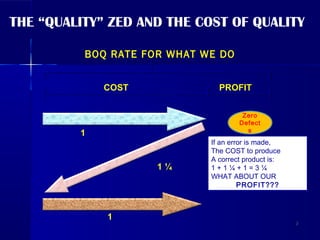
THE “QUALITY” ZED AND THE COST OF QUALITY
BOQ RATE FOR WHAT WE DO
COST PROFIT
Zero
Defect
s
If an error is made,
The COST to produce
A correct product is:
1 + 1 ¼ + 1 = 3 ¼
WHAT ABOUT OUR
PROFIT???
1
1
1 ¼
Concrete MaterialsConcrete Materials
33
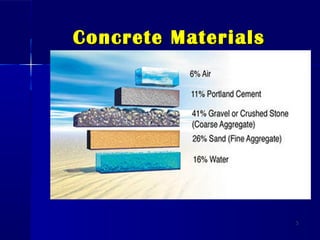
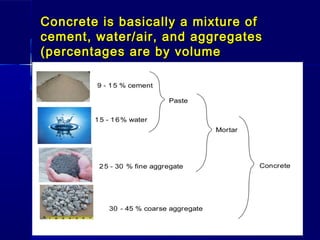
Concrete is basically a mixture ofConcrete is basically a mixture of
cement, water/air, and aggregatescement, water/air, and aggregates
(percentages are by volume(percentages are by volume
Concrete MaterialsConcrete Materials
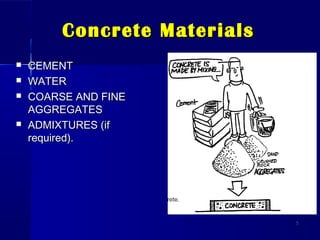
 CEMENTCEMENT
 WATERWATER
 COARSE AND FINECOARSE AND FINE
AGGREGATESAGGREGATES
 ADMIXTURES (ifADMIXTURES (if
required).required).
55
Concrete MaterialsConcrete Materials
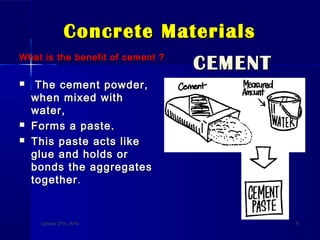
What is the benefit of cement ?What is the benefit of cement ?
 The cement powder,The cement powder,
when mixed withwhen mixed with
water,water,
 Forms a paste.Forms a paste.
 This paste acts likeThis paste acts like
glue and holds orglue and holds or
bonds the aggregatesbonds the aggregates
togethertogether..
CEMENTCEMENT
October 27th, 2010October 27th, 2010 66
Concrete MaterialsConcrete Materials
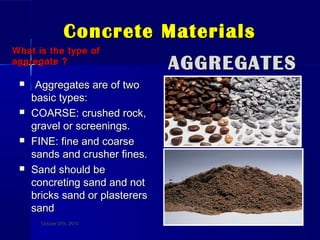
What is the type ofWhat is the type of
aggregate ?aggregate ?
 Aggregates are of twoAggregates are of two
basic types:basic types:
 COARSE: crushed rock,COARSE: crushed rock,
gravel or screenings.gravel or screenings.
 FINE: fine and coarseFINE: fine and coarse
sands and crusher fines.sands and crusher fines.
 Sand should beSand should be
concreting sand and notconcreting sand and not
bricks sand or plasterersbricks sand or plasterers
sandsand
AGGREGATESAGGREGATES
October 27th, 2010October 27th, 2010 77
Concrete MaterialsConcrete Materials
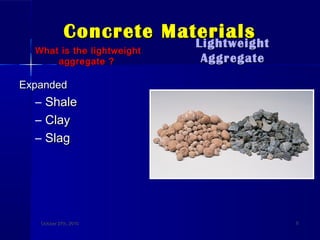
What is the lightweightWhat is the lightweight
aggregate ?aggregate ?
ExpandedExpanded
– ShaleShale
– ClayClay
– SlagSlag
LightweightLightweight
AggregateAggregate
October 27th, 2010October 27th, 2010 88
Concrete MaterialsConcrete Materials
What is the Quality ofWhat is the Quality of
aggregate ?aggregate ?
 Aggregates should be :Aggregates should be : STRONGSTRONG andand
HARDHARD A stronger, harder aggregateA stronger, harder aggregate
will give a stronger finalwill give a stronger final
 concrete. Never use a crumble orconcrete. Never use a crumble or
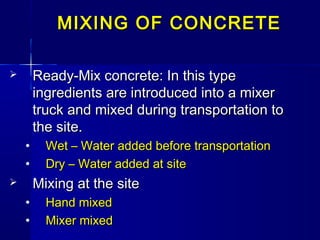
flakey rock like sandstone.flakey rock like sandstone.
 DURABLE to stand up to wear andDURABLE to stand up to wear and
tear and weathering.tear and weathering.
 CHEMICALLY INACTIVE so theCHEMICALLY INACTIVE so the
aggregates don’t react with theaggregates don’t react with the
cement.cement.
 CLEAN Dirt or clay sticking to theCLEAN Dirt or clay sticking to the
aggregates will weaken the bondaggregates will weaken the bond
between paste and aggregates.between paste and aggregates.
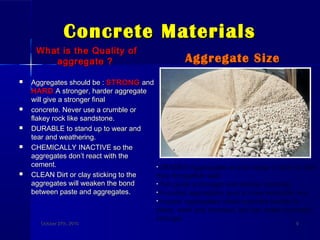
Aggregate SizeAggregate Size
October 27th, 2010October 27th, 2010 99
•GRADED Aggregates should range in size so that
they fit together well.
•This gives a stronger and denser concrete.
•Rounded aggregates give a more workable mix.
•Angular aggregates make concrete harder to
place, work and compact, but can make concrete
stronger.
Concrete MaterialsConcrete Materials
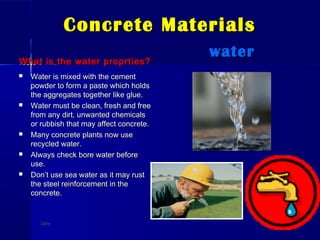
What is the water proprties?What is the water proprties?
 Water is mixed with the cementWater is mixed with the cement
powder to form a paste which holdspowder to form a paste which holds
the aggregates together like glue.the aggregates together like glue.
 Water must be clean, fresh and freeWater must be clean, fresh and free
from any dirt, unwanted chemicalsfrom any dirt, unwanted chemicals
or rubbish that may affect concrete.or rubbish that may affect concrete.
 Many concrete plants now useMany concrete plants now use
recycled water.recycled water.
 Always check bore water beforeAlways check bore water before
use.use.
 Don’t use sea water as it may rustDon’t use sea water as it may rust
the steel reinforcement in thethe steel reinforcement in the
concrete.concrete.
waterwater
DateDate 1010
Concrete MaterialsConcrete Materials
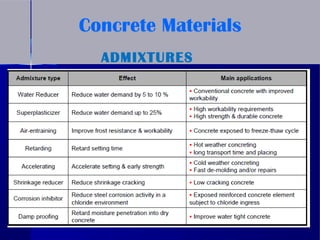
ADMIXTURE TYPEDADMIXTURE TYPED
 Air-entraining admixturesAir-entraining admixtures
 Water-reducing admixturesWater-reducing admixtures
 PlasticizersPlasticizers
 Accelerating admixturesAccelerating admixtures
 Retarding admixturesRetarding admixtures
 Hydration-control admixturesHydration-control admixtures
 Corrosion inhibitorsCorrosion inhibitors
 Shrinkage reducersShrinkage reducers
 ASR inhibitorsASR inhibitors
 Coloring admixturesColoring admixtures
 Miscellaneous admixturesMiscellaneous admixtures
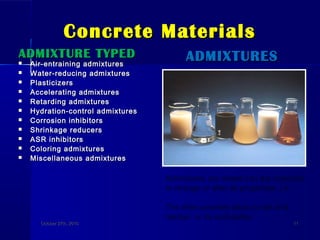
ADMIXTURESADMIXTURES
October 27th, 2010October 27th, 2010 1111
Admixtures are mixed into the concrete
to change or alter its properties, i.e.
The time concrete takes to set and
harden, or its workability.
Concrete MaterialsConcrete Materials
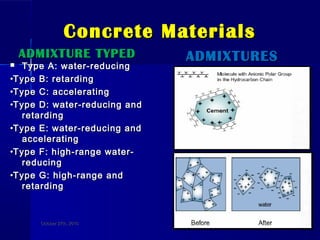
ADMIXTURE TYPEDADMIXTURE TYPED
 Type A: water-reducingType A: water-reducing
••Type B: retardingType B: retarding
••Type C: acceleratingType C: accelerating
••Type D: water-reducing andType D: water-reducing and
retardingretarding
••Type E: water-reducing andType E: water-reducing and
acceleratingaccelerating
••Type F: high-range water-Type F: high-range water-
reducingreducing
••Type G: high-range andType G: high-range and
retardingretarding
ADMIXTURESADMIXTURES
October 27th, 2010October 27th, 2010 1212
October 27th, 2010October 27th, 2010 1313
Concrete Materials
ADMIXTURES
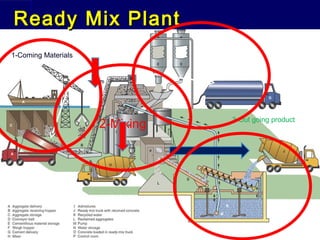
Ready Mix PlantReady Mix Plant
1-Coming Materials
2-Mixing 3-Out going product
Concrete PropertiesConcrete Properties
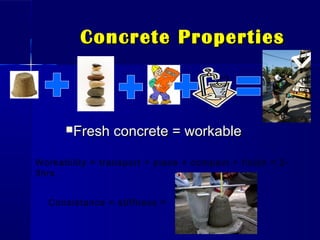
Fresh concrete = workableFresh concrete = workable
Workability = transport + place + compact + finish = 2-
3hrs
Consistance = stiffness =
Concrete PropertiesConcrete Properties
DateDate 1616
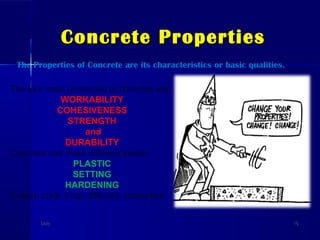
The Properties of Concrete are its characteristics or basic qualities.
The four main properties of concrete are:
WORKABILITY
COHESIVENESS
STRENGTH
and
DURABILITY
Concrete has three different states:
PLASTIC
SETTING
HARDENING
In each state it has different properties.
Concrete STATESConcrete STATES
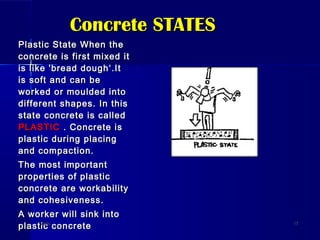
Plastic State When thePlastic State When the
concrete is first mixed itconcrete is first mixed it
is like 'bread dough‘.Itis like 'bread dough‘.It
is soft and can beis soft and can be
worked or moulded intoworked or moulded into
different shapes. In thisdifferent shapes. In this
state concrete is calledstate concrete is called
PLASTICPLASTIC . Concrete is. Concrete is
plastic during placingplastic during placing
and compaction.and compaction.
The most importantThe most important
properties of plasticproperties of plastic
concrete are workabilityconcrete are workability
and cohesiveness.and cohesiveness.
A worker will sink intoA worker will sink into
plastic concreteplastic concreteDateDate 1717
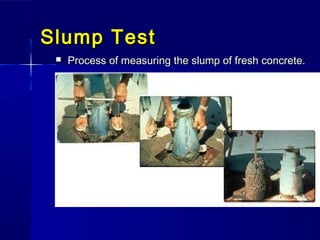
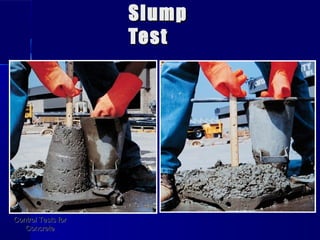
Slump TestSlump Test
 Process of measuring the slump of fresh concrete.Process of measuring the slump of fresh concrete.
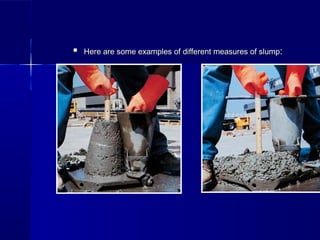
 Here are some examples of different measures of slumpHere are some examples of different measures of slump::
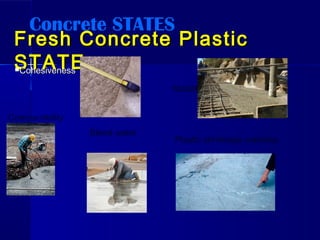
Fresh Concrete PlasticFresh Concrete Plastic
STATESTATECohesivenessCohesiveness
Mobility
Compactibility
Bleed water
Plastic shrinkage cracking
Concrete STATES
Concrete STATESConcrete STATES
What is the SettingWhat is the Setting
State?State? Setting StateSetting State
DateDate 2121
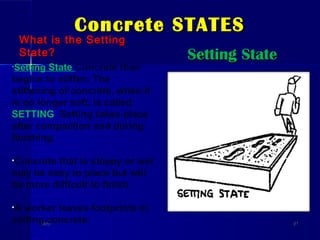
•Setting State Concrete then
begins to stiffen. The
stiffening of concrete, when it
is no longer soft, is called
SETTING. Setting takes place
after compaction and during
finishing.
•Concrete that is sloppy or wet
may be easy to place but will
be more difficult to finish.
•A worker leaves footprints in
setting concrete.
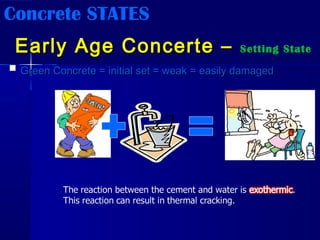
Early Age Concerte –Early Age Concerte – Setting StateSetting State
 Green Concrete = initial set = weak = easily damagedGreen Concrete = initial set = weak = easily damaged
Concrete STATES
Concrete STATESConcrete STATES
What is the hardeningWhat is the hardening
State?State?
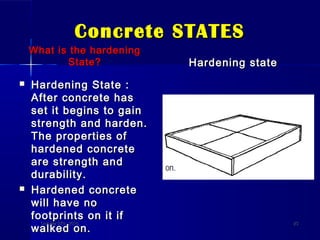
 Hardening State :Hardening State :
After concrete hasAfter concrete has
set it begins to gainset it begins to gain
strength and harden.strength and harden.
The properties ofThe properties of
hardened concretehardened concrete
are strength andare strength and
durability.durability.
 Hardened concreteHardened concrete
will have nowill have no
footprints on it iffootprints on it if
walked on.walked on.
Hardening stateHardening state
October 27th, 2010October 27th, 2010 2323
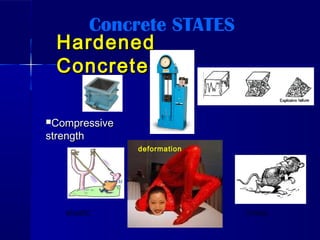
HardenedHardened
ConcreteConcrete
CompressiveCompressive
strengthstrength
deformation
elastic creep
Concrete STATES
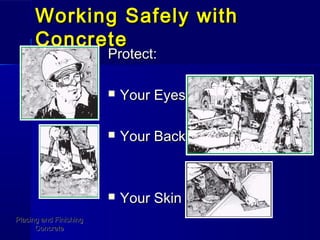
Working Safely withWorking Safely with
ConcreteConcrete
Protect:Protect:
 Your EyesYour Eyes
 Your BackYour Back
 Your SkinYour Skin
Placing and FinishingPlacing and Finishing
ConcreteConcrete
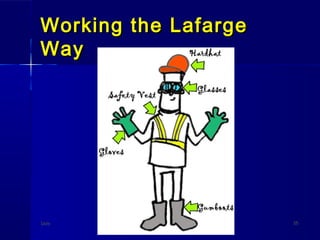
Working the LafargeWorking the Lafarge
WayWay
DateDate 2626
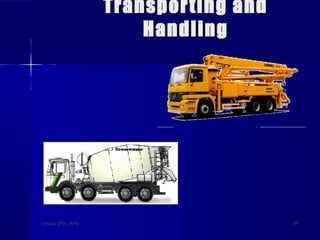
Transporting andTransporting and
HandlingHandling
October 27th, 2010October 27th, 2010 2727
PlanningPlanning
vs
Weather conditionsWeather conditions
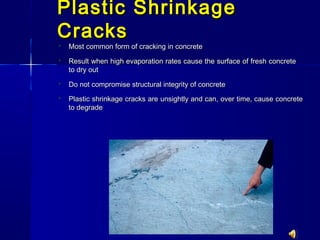
Plastic ShrinkagePlastic Shrinkage
CracksCracks
 Most common form of cracking in concreteMost common form of cracking in concrete
 Result when high evaporation rates cause the surface of fresh concreteResult when high evaporation rates cause the surface of fresh concrete
to dry outto dry out
 Do not compromise structural integrity of concreteDo not compromise structural integrity of concrete
 Plastic shrinkage cracks are unsightly and can, over time, cause concretePlastic shrinkage cracks are unsightly and can, over time, cause concrete
to degradeto degrade
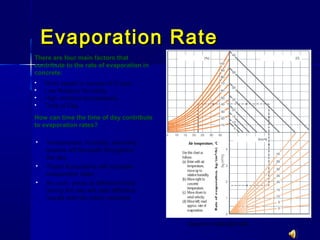
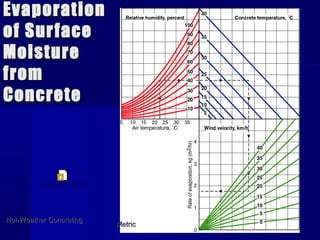
Evaporation RateEvaporation Rate
 Wind speed in excess of 5 mph
 Low Relative Humidity
 High ambient temperature
 Time of Day
Annex D. CSA A23.1-09
There are four main factors that
contribute to the rate of evaporation in
concrete:
How can time the time of day contribute
to evaporation rates?
 Temperature, humidity, and wind
speeds will fluctuate throughout
the day
 These fluctuations will increase
evaporation rates
 As such, pours at different times
during the day will yield different
results with the same concrete
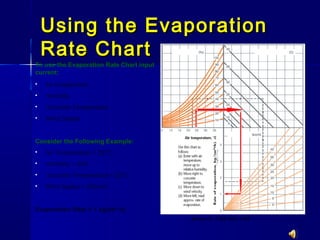
Using the EvaporationUsing the Evaporation
Rate ChartRate Chart
Annex D. CSA A23.1-09
 Air temperature
 Humidity
 Concrete Temperature
 Wind Speed
Consider the Following Example:
 Air Temperature = 25°C
 Humidity = 40%
 Concrete Temperature = 25°C
 Wind Speed = 25km/h
Evaporation Rate = 1 kg/(m2
·h)
To use the Evaporation Rate Chart input
current:
EvaporationEvaporation
of Surfaceof Surface
MoistureMoisture
fromfrom
ConcreteConcrete
Hot-Weather ConcretingHot-Weather Concreting
MetricMetric
Curing Program mitric.mht
SlumpSlump
TestTest
Control Tests forControl Tests for
ConcreteConcrete
Frequency of Testing —Frequency of Testing —
SlumpSlump
 First batch of concrete each dayFirst batch of concrete each day
 Whenever the consistency ofWhenever the consistency of
concrete appears to varyconcrete appears to vary
 Whenever strength-test cylindersWhenever strength-test cylinders
are made at jobsiteare made at jobsite
Control Tests forControl Tests for
ConcreteConcrete
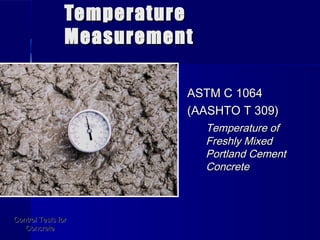
TemperatureTemperature
MeasurementMeasurement
ASTM C 1064ASTM C 1064
(AASHTO T 309)(AASHTO T 309)
Temperature ofTemperature of
Freshly MixedFreshly Mixed
Portland CementPortland Cement
ConcreteConcrete
Control Tests forControl Tests for
ConcreteConcrete
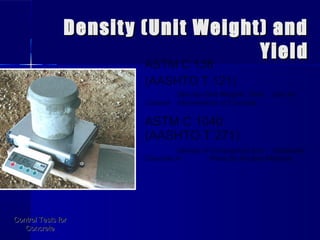
Density (Unit Weight) andDensity (Unit Weight) and
YieldYield
Control Tests forControl Tests for
ConcreteConcrete
ASTM C 138
(AASHTO T 121)
Density (Unit Weight), Yield, and Air
Content (Gravimetric) of Concrete
ASTM C 1040
(AASHTO T 271)
Density of Unhardened and Hardened
Concrete in Place By Nuclear Methods
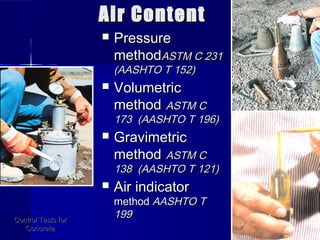
Air ContentAir Content
 PressurePressure
methodmethodASTM C 231ASTM C 231
(AASHTO T 152)(AASHTO T 152)
 VolumetricVolumetric
methodmethod ASTM CASTM C
173 (AASHTO T 196)173 (AASHTO T 196)
 GravimetricGravimetric
methodmethod ASTM CASTM C
138 (AASHTO T 121)138 (AASHTO T 121)
 Air indicatorAir indicator
methodmethod AASHTO TAASHTO T
199199Control Tests forControl Tests for
ConcreteConcrete
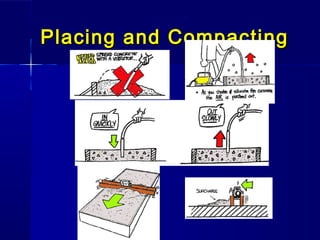
Placing and CompactingPlacing and Compacting
CONSOLIDATINGCONSOLIDATING
CONCRETECONCRETE
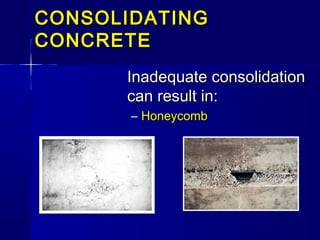
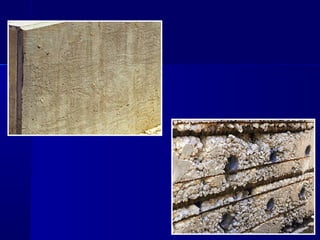
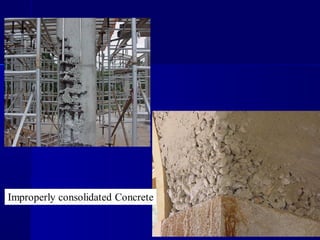
Inadequate consolidationInadequate consolidation
can result in:can result in:
– HoneycombHoneycomb
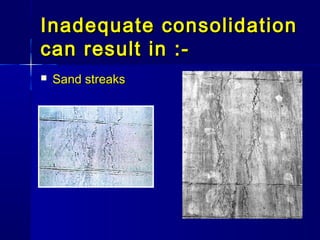
Inadequate consolidationInadequate consolidation
can result in :-can result in :-
 Sand streaksSand streaks
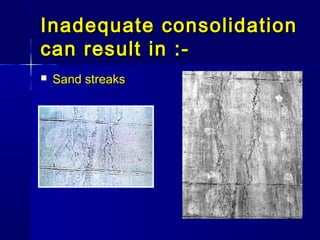
Inadequate consolidationInadequate consolidation
can result in :-can result in :-
 Sand streaksSand streaks
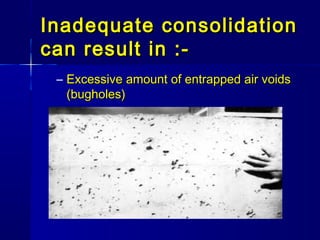
Inadequate consolidationInadequate consolidation
can result in :-can result in :-
– Excessive amount of entrapped air voidsExcessive amount of entrapped air voids
(bugholes)(bugholes)
Inadequate consolidationInadequate consolidation
can result in :-can result in :-
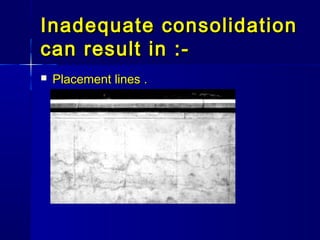
 Placement linesPlacement lines ..
Inadequate consolidationInadequate consolidation
can result in :-can result in :-
 Placement lines are dark lines on thePlacement lines are dark lines on the
formed surface at the boundaryformed surface at the boundary
between adjacent batches of concrete.between adjacent batches of concrete.
Generally, they indicate that the vibratorGenerally, they indicate that the vibrator
was not lowered far enough to penetratewas not lowered far enough to penetrate
the layer below the one being vibrated.the layer below the one being vibrated.
Inadequate consolidationInadequate consolidation
can result in :-can result in :-
 Cold jointsCold joints ——Delays in concreting can result in coldDelays in concreting can result in cold
joints. To avoid cold joints, placing should bejoints. To avoid cold joints, placing should be
resumedsubstantially before the time of initial set. Forresumedsubstantially before the time of initial set. For
unusually long delays during concreting, the concreteunusually long delays during concreting, the concrete
should be kept live by periodically revibrating it. Concreteshould be kept live by periodically revibrating it. Concrete
should be vibrated at approximately 15 minute intervals orshould be vibrated at approximately 15 minute intervals or
less, depending upon job conditions. Concrete should notless, depending upon job conditions. Concrete should not
be over vibrated to the point of causing segregation.be over vibrated to the point of causing segregation.
Furthermore, should the concrete approach time of initialFurthermore, should the concrete approach time of initial
setting, vibration should be discontinued and the concretesetting, vibration should be discontinued and the concrete
should be allowed to harden. A cold joint will result, andshould be allowed to harden. A cold joint will result, and
suitable surface preparation measures should be appliedsuitable surface preparation measures should be applied....
VIBRATION OFVIBRATION OF
CONCRETECONCRETE
 The process of compacting concreteThe process of compacting concrete
consists essentially of the elimination ofconsists essentially of the elimination of
entrapped air. This can be achieved by:entrapped air. This can be achieved by:
– Tamping or rodding the concreteTamping or rodding the concrete
– Use of vibratorsUse of vibrators
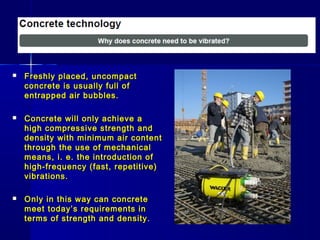
 Freshly placed, uncompactFreshly placed, uncompact
concrete is usually full ofconcrete is usually full of
entrapped air bubbles.entrapped air bubbles.
 Concrete will only achieve aConcrete will only achieve a
high compressive strength andhigh compressive strength and
density with minimum air contentdensity with minimum air content
through the use of mechanicalthrough the use of mechanical
means, i. e. the introduction ofmeans, i. e. the introduction of
high-frequency (fast, repetitive)high-frequency (fast, repetitive)
vibrations.vibrations.
 Only in this way can concreteOnly in this way can concrete
meet today’s requirements inmeet today’s requirements in
terms of strength and densityterms of strength and density ..
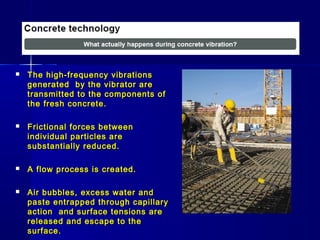
 The high-frequency vibrationsThe high-frequency vibrations
generated by the vibrator aregenerated by the vibrator are
transmitted to the components oftransmitted to the components of
the fresh concrete.the fresh concrete.
 Frictional forces betweenFrictional forces between
individual particles areindividual particles are
substantially reduced.substantially reduced.
 A flow process is created.A flow process is created.
 Air bubbles, excess water andAir bubbles, excess water and
paste entrapped through capillarypaste entrapped through capillary
action and surface tensions areaction and surface tensions are
released and escape to thereleased and escape to the
surface.surface.
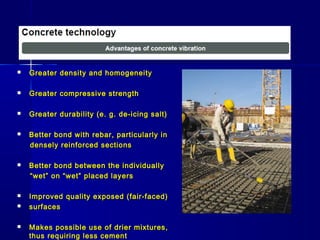
 Greater density and homogeneityGreater density and homogeneity
 Greater compressive strengthGreater compressive strength
 Greater durability (e. g. de-icing salt)Greater durability (e. g. de-icing salt)
 Better bond with rebar, particularly inBetter bond with rebar, particularly in
densely reinforced sectionsdensely reinforced sections
 Better bond between the individuallyBetter bond between the individually
““wet” on “wet” placed layerswet” on “wet” placed layers
 Improved quality exposed (fair-faced)Improved quality exposed (fair-faced)
 surfacessurfaces
 Makes possible use of drier mixtures,Makes possible use of drier mixtures,
thus requiring less cementthus requiring less cement
VIBRATORSVIBRATORS
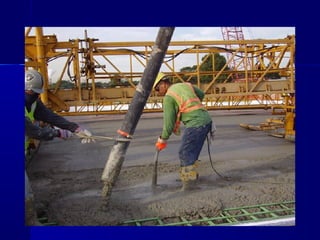
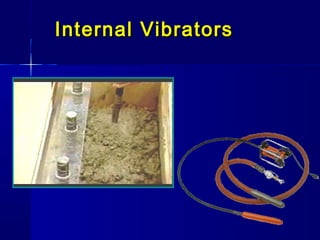
 Internal vibratorInternal vibrator:: The poker is immersedThe poker is immersed
into concrete to compact it. The poker isinto concrete to compact it. The poker is
easily removed from point to point.easily removed from point to point.
 External vibrators:External vibrators: External vibratorsExternal vibrators
clamp direct to the formwork requiringclamp direct to the formwork requiring
strong, rigid formsstrong, rigid forms..
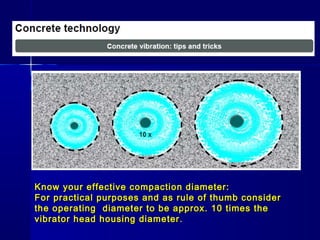
Know your effective compaction diameter:Know your effective compaction diameter:
For practical purposes and as rule of thumb considerFor practical purposes and as rule of thumb consider
the operating diameter to be approx. 10 times thethe operating diameter to be approx. 10 times the
vibrator head housing diametervibrator head housing diameter ..
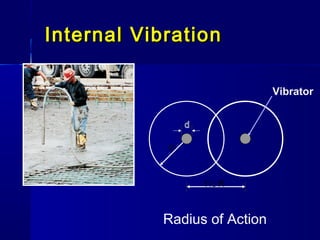
Internal VibrationInternal Vibration
Radius of Action
R
1½ R
Vibrator
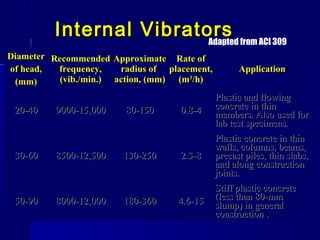
Internal VibratorsInternal Vibrators
DiameterDiameter
of head,of head,
(m(mmm))
RecommendedRecommended
frequency,frequency,
((vibvib././minmin.).)
ApproximateApproximate
radius ofradius of
action,action, ((mmmm))
Rate ofRate of
placement,placement,
((mm33
/h/h))
ApplicationApplication
20-4020-40 9000-15,0009000-15,000 80-15080-150 0.8-40.8-4
Plastic and flowingPlastic and flowing
concrete in thinconcrete in thin
members. Also used formembers. Also used for
lab test specimens.lab test specimens.
30-6030-60 8500-12,5008500-12,500 130-250130-250 2.3-82.3-8
Plastic concrete in thinPlastic concrete in thin
walls, columns, beams,walls, columns, beams,
precast piles, thin slabs,precast piles, thin slabs,
and along constructionand along construction
joints.joints.
50-9050-90 8000-12,0008000-12,000 180-360180-360 4.6-154.6-15
Stiff plastic concreteStiff plastic concrete
(less than 80-mm(less than 80-mm
slump) in generalslump) in general
construction .construction .
Adapted from ACI 309
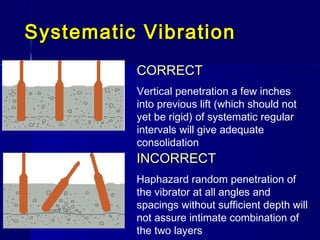
Systematic VibrationSystematic Vibration
CORRECTCORRECT
Vertical penetration a few inches
into previous lift (which should not
yet be rigid) of systematic regular
intervals will give adequate
consolidation
INCORRECTINCORRECT
Haphazard random penetration of
the vibrator at all angles and
spacings without sufficient depth will
not assure intimate combination of
the two layers
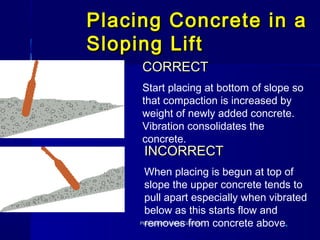
Placing Concrete in aPlacing Concrete in a
Sloping LiftSloping Lift
Placing and Finishing ConcretePlacing and Finishing Concrete
CORRECTCORRECT
Start placing at bottom of slope so
that compaction is increased by
weight of newly added concrete.
Vibration consolidates the
concrete.
INCORRECTINCORRECT
When placing is begun at top of
slope the upper concrete tends to
pull apart especially when vibrated
below as this starts flow and
removes from concrete above.
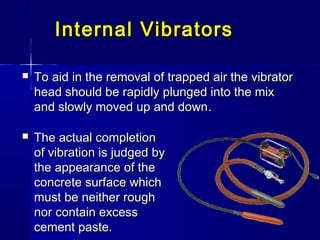
 To aid in the removal of trapped air the vibratorTo aid in the removal of trapped air the vibrator
head should be rapidly plunged into the mixhead should be rapidly plunged into the mix
and slowly moved up and downand slowly moved up and down..
Internal VibratorsInternal Vibrators
 The actual completionThe actual completion
of vibration is judged byof vibration is judged by
the appearance of thethe appearance of the
concrete surface whichconcrete surface which
must be neither roughmust be neither rough
nor contain excessnor contain excess
cement paste.cement paste.
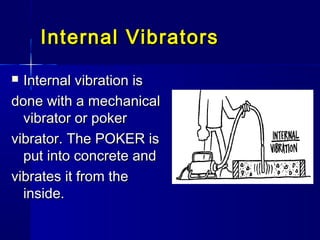
Internal VibratorsInternal Vibrators
 Internal vibration isInternal vibration is
done with a mechanicaldone with a mechanical
vibrator or pokervibrator or poker
vibrator. The POKER isvibrator. The POKER is
put into concrete andput into concrete and
vibrates it from thevibrates it from the
inside.inside.
Internal VibratorsInternal Vibrators
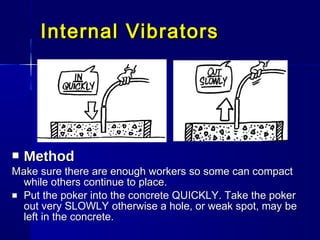
 MethodMethod
Make sure there are enough workers so some can compactMake sure there are enough workers so some can compact
while others continue to place.while others continue to place.
 Put the poker into the concrete QUICKLY. Take the pokerPut the poker into the concrete QUICKLY. Take the poker
out very SLOWLY otherwise a hole, or weak spot, may beout very SLOWLY otherwise a hole, or weak spot, may be
left in the concrete.left in the concrete.
Internal VibratorsInternal Vibrators
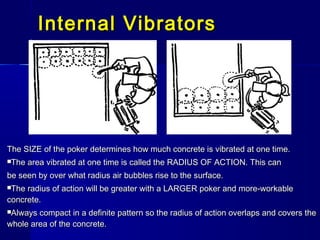
The SIZE of the poker determines how much concrete is vibrated at one time.The SIZE of the poker determines how much concrete is vibrated at one time.
The area vibrated at one time is called the RADIUS OF ACTION. This canThe area vibrated at one time is called the RADIUS OF ACTION. This can
be seen by over what radius air bubbles rise to the surface.be seen by over what radius air bubbles rise to the surface.
The radius of action will be greater with a LARGER poker and more-workableThe radius of action will be greater with a LARGER poker and more-workable
concrete.concrete.
Always compact in a definite pattern so the radius of action overlaps and covers theAlways compact in a definite pattern so the radius of action overlaps and covers the
whole area of the concrete.whole area of the concrete.
Internal VibratorsInternal Vibrators
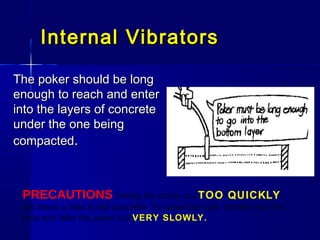
The poker should be longThe poker should be long
enough to reach and enterenough to reach and enter
into the layers of concreteinto the layers of concrete
under the one beingunder the one being
compactedcompacted..
PRECAUTIONS Taking the poker out TOO QUICKLY
will leave a hole in the concrete. To close the hole, vibrate near the
hole and take the poker out VERY SLOWLY.
Internal VibratorsInternal Vibrators
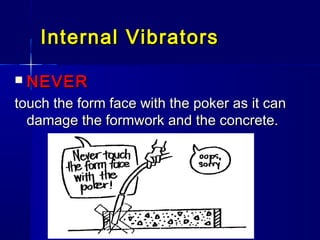
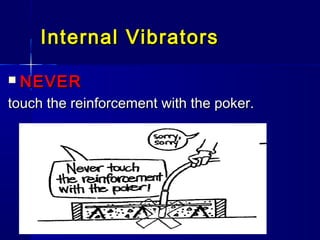
 NEVERNEVER
touch the form face with the poker as it cantouch the form face with the poker as it can
damage the formwork and the concrete.damage the formwork and the concrete.
Internal VibratorsInternal Vibrators
 NEVERNEVER
touch the reinforcement with the poker.touch the reinforcement with the poker.
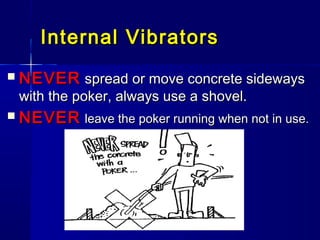
Internal VibratorsInternal Vibrators
 NEVERNEVER spread or move concrete sidewaysspread or move concrete sideways
with the poker, always use a shovel.with the poker, always use a shovel.
 NEVERNEVER leave the poker running when not in use.leave the poker running when not in use.
Internal VibratorsInternal Vibrators
 HOW LONG TO COMPACTHOW LONG TO COMPACT ForFor
concrete of average workability (ie slump ofconcrete of average workability (ie slump of
80 mm)80 mm)
with a poker size between 25–75 mm,with a poker size between 25–75 mm,
concrete should usually be vibrated forconcrete should usually be vibrated for
betweenbetween
5 and 15 seconds.5 and 15 seconds.
 It is worse toIt is worse to UNDER-VIBRATEUNDER-VIBRATE than tothan to
OVER-VIBRATEOVER-VIBRATE concrete.concrete.
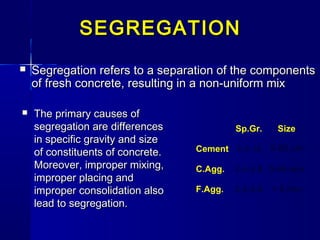
 SegregationSegregation refers to a separation of the componentsrefers to a separation of the components
of fresh concrete, resulting in a non-uniform mixof fresh concrete, resulting in a non-uniform mix
  Sp.Gr. Size
Cement 3-3.15 5-80 µm
C.Agg. 2.4-2.8 5-40 mm
F.Agg. 2.4-2.8 < 5 mm
SEGREGATIONSEGREGATION
 The primary causes ofThe primary causes of
segregation are differencessegregation are differences
in specific gravity and sizein specific gravity and size
of constituents of concrete.of constituents of concrete.
Moreover, improper mixing,Moreover, improper mixing,
improper placing andimproper placing and
improper consolidation alsoimproper consolidation also
lead to segregation.lead to segregation.
Some of the factors affecting segregation:Some of the factors affecting segregation:
– Larger maximum particle size (25mm) andLarger maximum particle size (25mm) and
proportion of the larger particles.proportion of the larger particles.
– High specific gravity of coarse aggregate.High specific gravity of coarse aggregate.
– Decrease in the amount of fine particles.Decrease in the amount of fine particles.
– Particle shape and texture.Particle shape and texture.
– Water/cement ratio.Water/cement ratio.
SEGREGATIONSEGREGATION
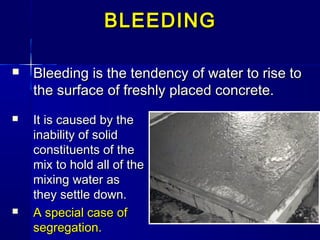
 Bleeding is the tendency of water to rise toBleeding is the tendency of water to rise to
the surface of freshly placed concrete.the surface of freshly placed concrete.
BLEEDINGBLEEDING
 It is caused by theIt is caused by the
inability of solidinability of solid
constituents of theconstituents of the
mix to hold all of themix to hold all of the
mixing water asmixing water as
they settle down.they settle down.
 A special case ofA special case of
segregation.segregation.
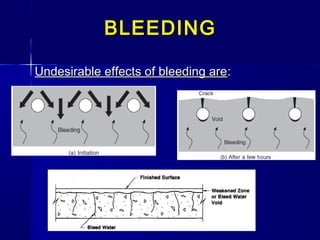
Undesirable effects of bleeding areUndesirable effects of bleeding are::
BLEEDINGBLEEDING
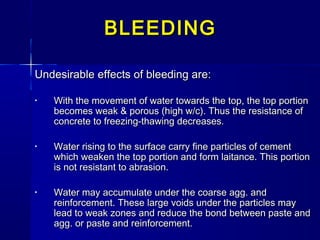
Undesirable effects of bleeding are:Undesirable effects of bleeding are:
• With the movement of water towards the top, the top portionWith the movement of water towards the top, the top portion
becomes weak & porous (high w/c). Thus the resistance ofbecomes weak & porous (high w/c). Thus the resistance of
concrete to freezing-thawing decreases.concrete to freezing-thawing decreases.
• Water rising to the surface carry fine particles of cementWater rising to the surface carry fine particles of cement
which weaken the top portion and form laitance. This portionwhich weaken the top portion and form laitance. This portion
is not resistant to abrasion.is not resistant to abrasion.
• Water may accumulate under the coarse agg. andWater may accumulate under the coarse agg. and
reinforcement. These large voids under the particles mayreinforcement. These large voids under the particles may
lead to weak zones and reduce the bond between paste andlead to weak zones and reduce the bond between paste and
agg. or paste and reinforcement.agg. or paste and reinforcement.
BLEEDINGBLEEDING
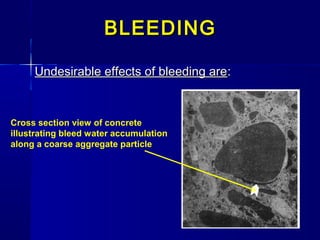
Undesirable effects of bleeding areUndesirable effects of bleeding are::
BLEEDINGBLEEDING
Cross section view of concrete
illustrating bleed water accumulation
along a coarse aggregate particle.
BLEEDINGBLEEDING
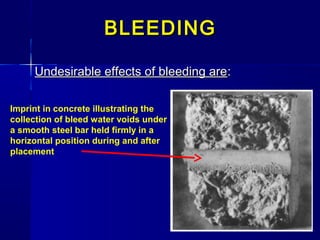
Undesirable effects of bleeding areUndesirable effects of bleeding are::
Imprint in concrete illustrating the
collection of bleed water voids under
a smooth steel bar held firmly in a
horizontal position during and after
placement
The tendency of concrete to bleedingThe tendency of concrete to bleeding
depends largely on properties ofdepends largely on properties of cement.cement.
It is decreased by:It is decreased by:
 Increasing the fineness of cementIncreasing the fineness of cement
 Increasing the rate of hydration (CIncreasing the rate of hydration (C33S, CS, C33A andA and
alkalies)alkalies)
 Adding pozzolansAdding pozzolans
 Reducing water contentReducing water content
 Use more cement if paste content is low.Use more cement if paste content is low.
BLEEDINGBLEEDING
In general, the bleeding tendencies of concrete can beIn general, the bleeding tendencies of concrete can be
reduced significantly by the following actions. Everyreduced significantly by the following actions. Every
reasonable effort should be made to take such measuresreasonable effort should be made to take such measures
when bleeding is a problem :-when bleeding is a problem :-
1. Correct any aggregate gradation deficiency problem1. Correct any aggregate gradation deficiency problem
where materials of the required size gradations arewhere materials of the required size gradations are
economically available. The use of gap-graded aggregateseconomically available. The use of gap-graded aggregates
results in increased bleeding. Ideally, combined gradation ofresults in increased bleeding. Ideally, combined gradation of
all aggregates should yield a percent retained on each sieveall aggregates should yield a percent retained on each sieve
below the largest and above the No. 100 (150 μm) ofbelow the largest and above the No. 100 (150 μm) of
somewhere between 8 and 18%. The most commonsomewhere between 8 and 18%. The most common
deficiency is in the 3/8 in., No. 4, 8, or 16 (9.5, 4.75, 2.36, ordeficiency is in the 3/8 in., No. 4, 8, or 16 (9.5, 4.75, 2.36, or
1.18 mm) sieve sizes.1.18 mm) sieve sizes.
BLEEDINGBLEEDING
 2- Increase the amount of fine aggregate passing the No.2- Increase the amount of fine aggregate passing the No.
50,100, and 200 (300, 150, and 75 μm) sieves to near the50,100, and 200 (300, 150, and 75 μm) sieves to near the
maximum allowable amount. More water (and possiblymaximum allowable amount. More water (and possibly
more cement) may be needed due to more paste beingmore cement) may be needed due to more paste being
required; more shrinkage could result.required; more shrinkage could result.
3 -Avoid admixtures that augment bleeding.3 -Avoid admixtures that augment bleeding.
4 - Use concrete approaching the highest as-placed4 - Use concrete approaching the highest as-placed
temperature permitted by the contract documents. (Note:temperature permitted by the contract documents. (Note:
Except for bleeding, there are benefits to be derived fromExcept for bleeding, there are benefits to be derived from
placing concrete at the lowest permissible temperature.)placing concrete at the lowest permissible temperature.)
5- Use dewatering techniques5- Use dewatering techniques
BLEEDINGBLEEDING
MIXING OF CONCRETEMIXING OF CONCRETE
 The aim of mixing is to blend all of theThe aim of mixing is to blend all of the
ingredients of the concrete to form aingredients of the concrete to form a
uniform mass and to coat the surface ofuniform mass and to coat the surface of
aggregates with cement paste.aggregates with cement paste.
MIXING OF CONCRETEMIXING OF CONCRETE
 Ready-Mix concrete: In this typeReady-Mix concrete: In this type
ingredients are introduced into a mixeringredients are introduced into a mixer
truck and mixed during transportation totruck and mixed during transportation to
the site.the site.
• Wet – Water added before transportationWet – Water added before transportation
• Dry – Water added at siteDry – Water added at site
 Mixing at the siteMixing at the site
• Hand mixedHand mixed
• Mixer mixedMixer mixed
Placing and CompactingPlacing and Compacting
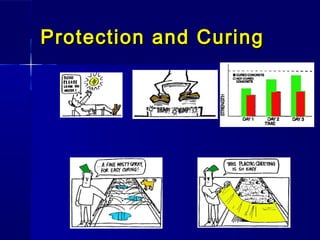
Protection and CuringProtection and Curing
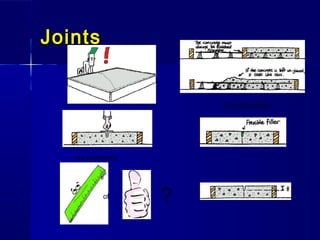
JointsJoints
construction
of
?
movement
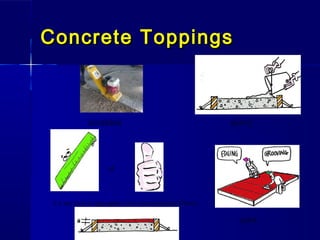
Concrete ToppingsConcrete Toppings
of
4 x top size of aggregate (min recommended 50mm)
scrabble slurry
joint

Concrete basicss for gem

  • 1.
    CONCRETECONCRETE BASICSBASICS A Guide toConcrete PracticeA Guide to Concrete Practice Prepared by Eng AbdelrahmanPrepared by Eng Abdelrahman ZayedZayed Concrete Expert OrascomciConcrete Expert Orascomci December 2013 GEMDecember 2013 GEM December 17December 17thth 20132013
  • 2.
    22 THE “QUALITY” ZEDAND THE COST OF QUALITY BOQ RATE FOR WHAT WE DO COST PROFIT Zero Defect s If an error is made, The COST to produce A correct product is: 1 + 1 ¼ + 1 = 3 ¼ WHAT ABOUT OUR PROFIT??? 1 1 1 ¼
  • 3.
  • 4.
    Concrete is basicallya mixture ofConcrete is basically a mixture of cement, water/air, and aggregatescement, water/air, and aggregates (percentages are by volume(percentages are by volume
  • 5.
    Concrete MaterialsConcrete Materials CEMENTCEMENT  WATERWATER  COARSE AND FINECOARSE AND FINE AGGREGATESAGGREGATES  ADMIXTURES (ifADMIXTURES (if required).required). 55
  • 6.
    Concrete MaterialsConcrete Materials Whatis the benefit of cement ?What is the benefit of cement ?  The cement powder,The cement powder, when mixed withwhen mixed with water,water,  Forms a paste.Forms a paste.  This paste acts likeThis paste acts like glue and holds orglue and holds or bonds the aggregatesbonds the aggregates togethertogether.. CEMENTCEMENT October 27th, 2010October 27th, 2010 66
  • 7.
    Concrete MaterialsConcrete Materials Whatis the type ofWhat is the type of aggregate ?aggregate ?  Aggregates are of twoAggregates are of two basic types:basic types:  COARSE: crushed rock,COARSE: crushed rock, gravel or screenings.gravel or screenings.  FINE: fine and coarseFINE: fine and coarse sands and crusher fines.sands and crusher fines.  Sand should beSand should be concreting sand and notconcreting sand and not bricks sand or plasterersbricks sand or plasterers sandsand AGGREGATESAGGREGATES October 27th, 2010October 27th, 2010 77
  • 8.
    Concrete MaterialsConcrete Materials Whatis the lightweightWhat is the lightweight aggregate ?aggregate ? ExpandedExpanded – ShaleShale – ClayClay – SlagSlag LightweightLightweight AggregateAggregate October 27th, 2010October 27th, 2010 88
  • 9.
    Concrete MaterialsConcrete Materials Whatis the Quality ofWhat is the Quality of aggregate ?aggregate ?  Aggregates should be :Aggregates should be : STRONGSTRONG andand HARDHARD A stronger, harder aggregateA stronger, harder aggregate will give a stronger finalwill give a stronger final  concrete. Never use a crumble orconcrete. Never use a crumble or flakey rock like sandstone.flakey rock like sandstone.  DURABLE to stand up to wear andDURABLE to stand up to wear and tear and weathering.tear and weathering.  CHEMICALLY INACTIVE so theCHEMICALLY INACTIVE so the aggregates don’t react with theaggregates don’t react with the cement.cement.  CLEAN Dirt or clay sticking to theCLEAN Dirt or clay sticking to the aggregates will weaken the bondaggregates will weaken the bond between paste and aggregates.between paste and aggregates. Aggregate SizeAggregate Size October 27th, 2010October 27th, 2010 99 •GRADED Aggregates should range in size so that they fit together well. •This gives a stronger and denser concrete. •Rounded aggregates give a more workable mix. •Angular aggregates make concrete harder to place, work and compact, but can make concrete stronger.
  • 10.
    Concrete MaterialsConcrete Materials Whatis the water proprties?What is the water proprties?  Water is mixed with the cementWater is mixed with the cement powder to form a paste which holdspowder to form a paste which holds the aggregates together like glue.the aggregates together like glue.  Water must be clean, fresh and freeWater must be clean, fresh and free from any dirt, unwanted chemicalsfrom any dirt, unwanted chemicals or rubbish that may affect concrete.or rubbish that may affect concrete.  Many concrete plants now useMany concrete plants now use recycled water.recycled water.  Always check bore water beforeAlways check bore water before use.use.  Don’t use sea water as it may rustDon’t use sea water as it may rust the steel reinforcement in thethe steel reinforcement in the concrete.concrete. waterwater DateDate 1010
  • 11.
    Concrete MaterialsConcrete Materials ADMIXTURETYPEDADMIXTURE TYPED  Air-entraining admixturesAir-entraining admixtures  Water-reducing admixturesWater-reducing admixtures  PlasticizersPlasticizers  Accelerating admixturesAccelerating admixtures  Retarding admixturesRetarding admixtures  Hydration-control admixturesHydration-control admixtures  Corrosion inhibitorsCorrosion inhibitors  Shrinkage reducersShrinkage reducers  ASR inhibitorsASR inhibitors  Coloring admixturesColoring admixtures  Miscellaneous admixturesMiscellaneous admixtures ADMIXTURESADMIXTURES October 27th, 2010October 27th, 2010 1111 Admixtures are mixed into the concrete to change or alter its properties, i.e. The time concrete takes to set and harden, or its workability.
  • 12.
    Concrete MaterialsConcrete Materials ADMIXTURETYPEDADMIXTURE TYPED  Type A: water-reducingType A: water-reducing ••Type B: retardingType B: retarding ••Type C: acceleratingType C: accelerating ••Type D: water-reducing andType D: water-reducing and retardingretarding ••Type E: water-reducing andType E: water-reducing and acceleratingaccelerating ••Type F: high-range water-Type F: high-range water- reducingreducing ••Type G: high-range andType G: high-range and retardingretarding ADMIXTURESADMIXTURES October 27th, 2010October 27th, 2010 1212
  • 13.
    October 27th, 2010October27th, 2010 1313 Concrete Materials ADMIXTURES
  • 14.
    Ready Mix PlantReadyMix Plant 1-Coming Materials 2-Mixing 3-Out going product
  • 15.
    Concrete PropertiesConcrete Properties Freshconcrete = workableFresh concrete = workable Workability = transport + place + compact + finish = 2- 3hrs Consistance = stiffness =
  • 16.
    Concrete PropertiesConcrete Properties DateDate1616 The Properties of Concrete are its characteristics or basic qualities. The four main properties of concrete are: WORKABILITY COHESIVENESS STRENGTH and DURABILITY Concrete has three different states: PLASTIC SETTING HARDENING In each state it has different properties.
  • 17.
    Concrete STATESConcrete STATES PlasticState When thePlastic State When the concrete is first mixed itconcrete is first mixed it is like 'bread dough‘.Itis like 'bread dough‘.It is soft and can beis soft and can be worked or moulded intoworked or moulded into different shapes. In thisdifferent shapes. In this state concrete is calledstate concrete is called PLASTICPLASTIC . Concrete is. Concrete is plastic during placingplastic during placing and compaction.and compaction. The most importantThe most important properties of plasticproperties of plastic concrete are workabilityconcrete are workability and cohesiveness.and cohesiveness. A worker will sink intoA worker will sink into plastic concreteplastic concreteDateDate 1717
  • 18.
    Slump TestSlump Test Process of measuring the slump of fresh concrete.Process of measuring the slump of fresh concrete.
  • 19.
     Here aresome examples of different measures of slumpHere are some examples of different measures of slump::
  • 20.
    Fresh Concrete PlasticFreshConcrete Plastic STATESTATECohesivenessCohesiveness Mobility Compactibility Bleed water Plastic shrinkage cracking Concrete STATES
  • 21.
    Concrete STATESConcrete STATES Whatis the SettingWhat is the Setting State?State? Setting StateSetting State DateDate 2121 •Setting State Concrete then begins to stiffen. The stiffening of concrete, when it is no longer soft, is called SETTING. Setting takes place after compaction and during finishing. •Concrete that is sloppy or wet may be easy to place but will be more difficult to finish. •A worker leaves footprints in setting concrete.
  • 22.
    Early Age Concerte–Early Age Concerte – Setting StateSetting State  Green Concrete = initial set = weak = easily damagedGreen Concrete = initial set = weak = easily damaged Concrete STATES
  • 23.
    Concrete STATESConcrete STATES Whatis the hardeningWhat is the hardening State?State?  Hardening State :Hardening State : After concrete hasAfter concrete has set it begins to gainset it begins to gain strength and harden.strength and harden. The properties ofThe properties of hardened concretehardened concrete are strength andare strength and durability.durability.  Hardened concreteHardened concrete will have nowill have no footprints on it iffootprints on it if walked on.walked on. Hardening stateHardening state October 27th, 2010October 27th, 2010 2323
  • 24.
  • 25.
    Working Safely withWorkingSafely with ConcreteConcrete Protect:Protect:  Your EyesYour Eyes  Your BackYour Back  Your SkinYour Skin Placing and FinishingPlacing and Finishing ConcreteConcrete
  • 26.
    Working the LafargeWorkingthe Lafarge WayWay DateDate 2626
  • 27.
  • 28.
  • 29.
  • 30.
    Plastic ShrinkagePlastic Shrinkage CracksCracks Most common form of cracking in concreteMost common form of cracking in concrete  Result when high evaporation rates cause the surface of fresh concreteResult when high evaporation rates cause the surface of fresh concrete to dry outto dry out  Do not compromise structural integrity of concreteDo not compromise structural integrity of concrete  Plastic shrinkage cracks are unsightly and can, over time, cause concretePlastic shrinkage cracks are unsightly and can, over time, cause concrete to degradeto degrade
  • 31.
    Evaporation RateEvaporation Rate Wind speed in excess of 5 mph  Low Relative Humidity  High ambient temperature  Time of Day Annex D. CSA A23.1-09 There are four main factors that contribute to the rate of evaporation in concrete: How can time the time of day contribute to evaporation rates?  Temperature, humidity, and wind speeds will fluctuate throughout the day  These fluctuations will increase evaporation rates  As such, pours at different times during the day will yield different results with the same concrete
  • 32.
    Using the EvaporationUsingthe Evaporation Rate ChartRate Chart Annex D. CSA A23.1-09  Air temperature  Humidity  Concrete Temperature  Wind Speed Consider the Following Example:  Air Temperature = 25°C  Humidity = 40%  Concrete Temperature = 25°C  Wind Speed = 25km/h Evaporation Rate = 1 kg/(m2 ·h) To use the Evaporation Rate Chart input current:
  • 33.
    EvaporationEvaporation of Surfaceof Surface MoistureMoisture fromfrom ConcreteConcrete Hot-WeatherConcretingHot-Weather Concreting MetricMetric Curing Program mitric.mht
  • 34.
  • 35.
    Frequency of Testing—Frequency of Testing — SlumpSlump  First batch of concrete each dayFirst batch of concrete each day  Whenever the consistency ofWhenever the consistency of concrete appears to varyconcrete appears to vary  Whenever strength-test cylindersWhenever strength-test cylinders are made at jobsiteare made at jobsite Control Tests forControl Tests for ConcreteConcrete
  • 36.
    TemperatureTemperature MeasurementMeasurement ASTM C 1064ASTMC 1064 (AASHTO T 309)(AASHTO T 309) Temperature ofTemperature of Freshly MixedFreshly Mixed Portland CementPortland Cement ConcreteConcrete Control Tests forControl Tests for ConcreteConcrete
  • 37.
    Density (Unit Weight)andDensity (Unit Weight) and YieldYield Control Tests forControl Tests for ConcreteConcrete ASTM C 138 (AASHTO T 121) Density (Unit Weight), Yield, and Air Content (Gravimetric) of Concrete ASTM C 1040 (AASHTO T 271) Density of Unhardened and Hardened Concrete in Place By Nuclear Methods
  • 38.
    Air ContentAir Content PressurePressure methodmethodASTM C 231ASTM C 231 (AASHTO T 152)(AASHTO T 152)  VolumetricVolumetric methodmethod ASTM CASTM C 173 (AASHTO T 196)173 (AASHTO T 196)  GravimetricGravimetric methodmethod ASTM CASTM C 138 (AASHTO T 121)138 (AASHTO T 121)  Air indicatorAir indicator methodmethod AASHTO TAASHTO T 199199Control Tests forControl Tests for ConcreteConcrete
  • 39.
  • 40.
  • 41.
    Inadequate consolidationInadequate consolidation canresult in :-can result in :-  Sand streaksSand streaks
  • 42.
    Inadequate consolidationInadequate consolidation canresult in :-can result in :-  Sand streaksSand streaks
  • 43.
    Inadequate consolidationInadequate consolidation canresult in :-can result in :- – Excessive amount of entrapped air voidsExcessive amount of entrapped air voids (bugholes)(bugholes)
  • 44.
    Inadequate consolidationInadequate consolidation canresult in :-can result in :-  Placement linesPlacement lines ..
  • 45.
    Inadequate consolidationInadequate consolidation canresult in :-can result in :-  Placement lines are dark lines on thePlacement lines are dark lines on the formed surface at the boundaryformed surface at the boundary between adjacent batches of concrete.between adjacent batches of concrete. Generally, they indicate that the vibratorGenerally, they indicate that the vibrator was not lowered far enough to penetratewas not lowered far enough to penetrate the layer below the one being vibrated.the layer below the one being vibrated.
  • 46.
    Inadequate consolidationInadequate consolidation canresult in :-can result in :-  Cold jointsCold joints ——Delays in concreting can result in coldDelays in concreting can result in cold joints. To avoid cold joints, placing should bejoints. To avoid cold joints, placing should be resumedsubstantially before the time of initial set. Forresumedsubstantially before the time of initial set. For unusually long delays during concreting, the concreteunusually long delays during concreting, the concrete should be kept live by periodically revibrating it. Concreteshould be kept live by periodically revibrating it. Concrete should be vibrated at approximately 15 minute intervals orshould be vibrated at approximately 15 minute intervals or less, depending upon job conditions. Concrete should notless, depending upon job conditions. Concrete should not be over vibrated to the point of causing segregation.be over vibrated to the point of causing segregation. Furthermore, should the concrete approach time of initialFurthermore, should the concrete approach time of initial setting, vibration should be discontinued and the concretesetting, vibration should be discontinued and the concrete should be allowed to harden. A cold joint will result, andshould be allowed to harden. A cold joint will result, and suitable surface preparation measures should be appliedsuitable surface preparation measures should be applied....
  • 47.
    VIBRATION OFVIBRATION OF CONCRETECONCRETE The process of compacting concreteThe process of compacting concrete consists essentially of the elimination ofconsists essentially of the elimination of entrapped air. This can be achieved by:entrapped air. This can be achieved by: – Tamping or rodding the concreteTamping or rodding the concrete – Use of vibratorsUse of vibrators
  • 49.
     Freshly placed,uncompactFreshly placed, uncompact concrete is usually full ofconcrete is usually full of entrapped air bubbles.entrapped air bubbles.  Concrete will only achieve aConcrete will only achieve a high compressive strength andhigh compressive strength and density with minimum air contentdensity with minimum air content through the use of mechanicalthrough the use of mechanical means, i. e. the introduction ofmeans, i. e. the introduction of high-frequency (fast, repetitive)high-frequency (fast, repetitive) vibrations.vibrations.  Only in this way can concreteOnly in this way can concrete meet today’s requirements inmeet today’s requirements in terms of strength and densityterms of strength and density ..
  • 51.
     The high-frequencyvibrationsThe high-frequency vibrations generated by the vibrator aregenerated by the vibrator are transmitted to the components oftransmitted to the components of the fresh concrete.the fresh concrete.  Frictional forces betweenFrictional forces between individual particles areindividual particles are substantially reduced.substantially reduced.  A flow process is created.A flow process is created.  Air bubbles, excess water andAir bubbles, excess water and paste entrapped through capillarypaste entrapped through capillary action and surface tensions areaction and surface tensions are released and escape to thereleased and escape to the surface.surface.
  • 52.
     Greater densityand homogeneityGreater density and homogeneity  Greater compressive strengthGreater compressive strength  Greater durability (e. g. de-icing salt)Greater durability (e. g. de-icing salt)  Better bond with rebar, particularly inBetter bond with rebar, particularly in densely reinforced sectionsdensely reinforced sections  Better bond between the individuallyBetter bond between the individually ““wet” on “wet” placed layerswet” on “wet” placed layers  Improved quality exposed (fair-faced)Improved quality exposed (fair-faced)  surfacessurfaces  Makes possible use of drier mixtures,Makes possible use of drier mixtures, thus requiring less cementthus requiring less cement
  • 53.
    VIBRATORSVIBRATORS  Internal vibratorInternalvibrator:: The poker is immersedThe poker is immersed into concrete to compact it. The poker isinto concrete to compact it. The poker is easily removed from point to point.easily removed from point to point.  External vibrators:External vibrators: External vibratorsExternal vibrators clamp direct to the formwork requiringclamp direct to the formwork requiring strong, rigid formsstrong, rigid forms..
  • 54.
    Know your effectivecompaction diameter:Know your effective compaction diameter: For practical purposes and as rule of thumb considerFor practical purposes and as rule of thumb consider the operating diameter to be approx. 10 times thethe operating diameter to be approx. 10 times the vibrator head housing diametervibrator head housing diameter ..
  • 55.
  • 56.
    Internal VibratorsInternal Vibrators DiameterDiameter ofhead,of head, (m(mmm)) RecommendedRecommended frequency,frequency, ((vibvib././minmin.).) ApproximateApproximate radius ofradius of action,action, ((mmmm)) Rate ofRate of placement,placement, ((mm33 /h/h)) ApplicationApplication 20-4020-40 9000-15,0009000-15,000 80-15080-150 0.8-40.8-4 Plastic and flowingPlastic and flowing concrete in thinconcrete in thin members. Also used formembers. Also used for lab test specimens.lab test specimens. 30-6030-60 8500-12,5008500-12,500 130-250130-250 2.3-82.3-8 Plastic concrete in thinPlastic concrete in thin walls, columns, beams,walls, columns, beams, precast piles, thin slabs,precast piles, thin slabs, and along constructionand along construction joints.joints. 50-9050-90 8000-12,0008000-12,000 180-360180-360 4.6-154.6-15 Stiff plastic concreteStiff plastic concrete (less than 80-mm(less than 80-mm slump) in generalslump) in general construction .construction . Adapted from ACI 309
  • 57.
    Systematic VibrationSystematic Vibration CORRECTCORRECT Verticalpenetration a few inches into previous lift (which should not yet be rigid) of systematic regular intervals will give adequate consolidation INCORRECTINCORRECT Haphazard random penetration of the vibrator at all angles and spacings without sufficient depth will not assure intimate combination of the two layers
  • 58.
    Placing Concrete inaPlacing Concrete in a Sloping LiftSloping Lift Placing and Finishing ConcretePlacing and Finishing Concrete CORRECTCORRECT Start placing at bottom of slope so that compaction is increased by weight of newly added concrete. Vibration consolidates the concrete. INCORRECTINCORRECT When placing is begun at top of slope the upper concrete tends to pull apart especially when vibrated below as this starts flow and removes from concrete above.
  • 59.
     To aidin the removal of trapped air the vibratorTo aid in the removal of trapped air the vibrator head should be rapidly plunged into the mixhead should be rapidly plunged into the mix and slowly moved up and downand slowly moved up and down.. Internal VibratorsInternal Vibrators  The actual completionThe actual completion of vibration is judged byof vibration is judged by the appearance of thethe appearance of the concrete surface whichconcrete surface which must be neither roughmust be neither rough nor contain excessnor contain excess cement paste.cement paste.
  • 60.
  • 61.
    Internal VibratorsInternal Vibrators Internal vibration isInternal vibration is done with a mechanicaldone with a mechanical vibrator or pokervibrator or poker vibrator. The POKER isvibrator. The POKER is put into concrete andput into concrete and vibrates it from thevibrates it from the inside.inside.
  • 62.
    Internal VibratorsInternal Vibrators MethodMethod Make sure there are enough workers so some can compactMake sure there are enough workers so some can compact while others continue to place.while others continue to place.  Put the poker into the concrete QUICKLY. Take the pokerPut the poker into the concrete QUICKLY. Take the poker out very SLOWLY otherwise a hole, or weak spot, may beout very SLOWLY otherwise a hole, or weak spot, may be left in the concrete.left in the concrete.
  • 63.
    Internal VibratorsInternal Vibrators TheSIZE of the poker determines how much concrete is vibrated at one time.The SIZE of the poker determines how much concrete is vibrated at one time. The area vibrated at one time is called the RADIUS OF ACTION. This canThe area vibrated at one time is called the RADIUS OF ACTION. This can be seen by over what radius air bubbles rise to the surface.be seen by over what radius air bubbles rise to the surface. The radius of action will be greater with a LARGER poker and more-workableThe radius of action will be greater with a LARGER poker and more-workable concrete.concrete. Always compact in a definite pattern so the radius of action overlaps and covers theAlways compact in a definite pattern so the radius of action overlaps and covers the whole area of the concrete.whole area of the concrete.
  • 64.
    Internal VibratorsInternal Vibrators Thepoker should be longThe poker should be long enough to reach and enterenough to reach and enter into the layers of concreteinto the layers of concrete under the one beingunder the one being compactedcompacted.. PRECAUTIONS Taking the poker out TOO QUICKLY will leave a hole in the concrete. To close the hole, vibrate near the hole and take the poker out VERY SLOWLY.
  • 65.
    Internal VibratorsInternal Vibrators NEVERNEVER touch the form face with the poker as it cantouch the form face with the poker as it can damage the formwork and the concrete.damage the formwork and the concrete.
  • 66.
    Internal VibratorsInternal Vibrators NEVERNEVER touch the reinforcement with the poker.touch the reinforcement with the poker.
  • 67.
    Internal VibratorsInternal Vibrators NEVERNEVER spread or move concrete sidewaysspread or move concrete sideways with the poker, always use a shovel.with the poker, always use a shovel.  NEVERNEVER leave the poker running when not in use.leave the poker running when not in use.
  • 68.
    Internal VibratorsInternal Vibrators HOW LONG TO COMPACTHOW LONG TO COMPACT ForFor concrete of average workability (ie slump ofconcrete of average workability (ie slump of 80 mm)80 mm) with a poker size between 25–75 mm,with a poker size between 25–75 mm, concrete should usually be vibrated forconcrete should usually be vibrated for betweenbetween 5 and 15 seconds.5 and 15 seconds.  It is worse toIt is worse to UNDER-VIBRATEUNDER-VIBRATE than tothan to OVER-VIBRATEOVER-VIBRATE concrete.concrete.
  • 69.
     SegregationSegregation refersto a separation of the componentsrefers to a separation of the components of fresh concrete, resulting in a non-uniform mixof fresh concrete, resulting in a non-uniform mix   Sp.Gr. Size Cement 3-3.15 5-80 µm C.Agg. 2.4-2.8 5-40 mm F.Agg. 2.4-2.8 < 5 mm SEGREGATIONSEGREGATION  The primary causes ofThe primary causes of segregation are differencessegregation are differences in specific gravity and sizein specific gravity and size of constituents of concrete.of constituents of concrete. Moreover, improper mixing,Moreover, improper mixing, improper placing andimproper placing and improper consolidation alsoimproper consolidation also lead to segregation.lead to segregation.
  • 72.
    Some of thefactors affecting segregation:Some of the factors affecting segregation: – Larger maximum particle size (25mm) andLarger maximum particle size (25mm) and proportion of the larger particles.proportion of the larger particles. – High specific gravity of coarse aggregate.High specific gravity of coarse aggregate. – Decrease in the amount of fine particles.Decrease in the amount of fine particles. – Particle shape and texture.Particle shape and texture. – Water/cement ratio.Water/cement ratio. SEGREGATIONSEGREGATION
  • 73.
     Bleeding isthe tendency of water to rise toBleeding is the tendency of water to rise to the surface of freshly placed concrete.the surface of freshly placed concrete. BLEEDINGBLEEDING  It is caused by theIt is caused by the inability of solidinability of solid constituents of theconstituents of the mix to hold all of themix to hold all of the mixing water asmixing water as they settle down.they settle down.  A special case ofA special case of segregation.segregation.
  • 74.
    Undesirable effects ofbleeding areUndesirable effects of bleeding are:: BLEEDINGBLEEDING
  • 75.
    Undesirable effects ofbleeding are:Undesirable effects of bleeding are: • With the movement of water towards the top, the top portionWith the movement of water towards the top, the top portion becomes weak & porous (high w/c). Thus the resistance ofbecomes weak & porous (high w/c). Thus the resistance of concrete to freezing-thawing decreases.concrete to freezing-thawing decreases. • Water rising to the surface carry fine particles of cementWater rising to the surface carry fine particles of cement which weaken the top portion and form laitance. This portionwhich weaken the top portion and form laitance. This portion is not resistant to abrasion.is not resistant to abrasion. • Water may accumulate under the coarse agg. andWater may accumulate under the coarse agg. and reinforcement. These large voids under the particles mayreinforcement. These large voids under the particles may lead to weak zones and reduce the bond between paste andlead to weak zones and reduce the bond between paste and agg. or paste and reinforcement.agg. or paste and reinforcement. BLEEDINGBLEEDING
  • 76.
    Undesirable effects ofbleeding areUndesirable effects of bleeding are:: BLEEDINGBLEEDING Cross section view of concrete illustrating bleed water accumulation along a coarse aggregate particle.
  • 77.
    BLEEDINGBLEEDING Undesirable effects ofbleeding areUndesirable effects of bleeding are:: Imprint in concrete illustrating the collection of bleed water voids under a smooth steel bar held firmly in a horizontal position during and after placement
  • 78.
    The tendency ofconcrete to bleedingThe tendency of concrete to bleeding depends largely on properties ofdepends largely on properties of cement.cement. It is decreased by:It is decreased by:  Increasing the fineness of cementIncreasing the fineness of cement  Increasing the rate of hydration (CIncreasing the rate of hydration (C33S, CS, C33A andA and alkalies)alkalies)  Adding pozzolansAdding pozzolans  Reducing water contentReducing water content  Use more cement if paste content is low.Use more cement if paste content is low. BLEEDINGBLEEDING
  • 79.
    In general, thebleeding tendencies of concrete can beIn general, the bleeding tendencies of concrete can be reduced significantly by the following actions. Everyreduced significantly by the following actions. Every reasonable effort should be made to take such measuresreasonable effort should be made to take such measures when bleeding is a problem :-when bleeding is a problem :- 1. Correct any aggregate gradation deficiency problem1. Correct any aggregate gradation deficiency problem where materials of the required size gradations arewhere materials of the required size gradations are economically available. The use of gap-graded aggregateseconomically available. The use of gap-graded aggregates results in increased bleeding. Ideally, combined gradation ofresults in increased bleeding. Ideally, combined gradation of all aggregates should yield a percent retained on each sieveall aggregates should yield a percent retained on each sieve below the largest and above the No. 100 (150 μm) ofbelow the largest and above the No. 100 (150 μm) of somewhere between 8 and 18%. The most commonsomewhere between 8 and 18%. The most common deficiency is in the 3/8 in., No. 4, 8, or 16 (9.5, 4.75, 2.36, ordeficiency is in the 3/8 in., No. 4, 8, or 16 (9.5, 4.75, 2.36, or 1.18 mm) sieve sizes.1.18 mm) sieve sizes. BLEEDINGBLEEDING
  • 80.
     2- Increasethe amount of fine aggregate passing the No.2- Increase the amount of fine aggregate passing the No. 50,100, and 200 (300, 150, and 75 μm) sieves to near the50,100, and 200 (300, 150, and 75 μm) sieves to near the maximum allowable amount. More water (and possiblymaximum allowable amount. More water (and possibly more cement) may be needed due to more paste beingmore cement) may be needed due to more paste being required; more shrinkage could result.required; more shrinkage could result. 3 -Avoid admixtures that augment bleeding.3 -Avoid admixtures that augment bleeding. 4 - Use concrete approaching the highest as-placed4 - Use concrete approaching the highest as-placed temperature permitted by the contract documents. (Note:temperature permitted by the contract documents. (Note: Except for bleeding, there are benefits to be derived fromExcept for bleeding, there are benefits to be derived from placing concrete at the lowest permissible temperature.)placing concrete at the lowest permissible temperature.) 5- Use dewatering techniques5- Use dewatering techniques BLEEDINGBLEEDING
  • 81.
    MIXING OF CONCRETEMIXINGOF CONCRETE  The aim of mixing is to blend all of theThe aim of mixing is to blend all of the ingredients of the concrete to form aingredients of the concrete to form a uniform mass and to coat the surface ofuniform mass and to coat the surface of aggregates with cement paste.aggregates with cement paste.
  • 82.
    MIXING OF CONCRETEMIXINGOF CONCRETE  Ready-Mix concrete: In this typeReady-Mix concrete: In this type ingredients are introduced into a mixeringredients are introduced into a mixer truck and mixed during transportation totruck and mixed during transportation to the site.the site. • Wet – Water added before transportationWet – Water added before transportation • Dry – Water added at siteDry – Water added at site  Mixing at the siteMixing at the site • Hand mixedHand mixed • Mixer mixedMixer mixed
  • 83.
  • 84.
  • 85.
  • 86.
    Concrete ToppingsConcrete Toppings of 4x top size of aggregate (min recommended 50mm) scrabble slurry joint

Editor's Notes

  • #15 Fig. 10-5. Schematic of a ready mix plant.
  • #31 One of the most common forms of cracking that can occur in concrete is plastic shrinkage cracking. Plastic shrinkage cracks appear on the surface of fresh concrete and result when high evaporation rates cause the surface of the concrete to dry out before it has gained enough strength to resist cracking. As the concrete shrinks from loss of water, the resulting tension pulls and tears the surface of the concrete apart - forming plastic shrinkage cracks. These cracks can penetrate up to mid depth in a slab and are of varying lengths spaced anywhere from a few centimeters to 3m apart. While plastic shrinkage cracks do not compromise the overall structural integrity of the concrete, they are unsightly and can, over time, cause the concrete to degrade further from exposure to the elements.
  • #32 There are four main factors that contribute to the rate of evaporation in concrete: wind speed, humidity, temperature, and the time of day. As the chart on the left demonstrates the slightest variance in any of the first three factors can greatly increase the rate of evaporation. Low humidity, high wind speeds, and high temperatures all work in conjunction to draw moisture out of freshly laid concrete. So how can the time of day contribute to evaporation rates? Temperature, humidity, and wind speeds will fluctuate throughout the day. These fluctuations will increase evaporation rates and as such pours at different times during the day will yield very different results with the same concrete. As a part of the sales team, it is your responsibility to pay attention or draw attention to these factors in your area so that you can better serve your customers.
  • #33 The Evaporation Rate Chart located in Annex D. CSA A23.1-09 is a useful tool designed to help you determine the evaporation rates for your area. By simply inputting the current air temperature, humidity, concrete temperature, and wind speed you can help customers by determining what the evaporation rates are at that time and recommend measures that they can take to protect their concrete. Consider the following example: If the current air temperature is 25 C° with 40% humidity, and the concrete’s temperature is 25 C° with a wind speed of 25 km/h, then the evaporation rate for your area at that time of day is 1 kg/(m2•h). CSA standards recognize that anything above 0.5 kg/(m2•h) is extreme. When evaporation rates are high, proper curing practices combined with the use of polypropylene fibers will help protect concrete from plastic shrinkage cracks.
  • #34 To use these charts: 1. Enter with air temperature, move up to relative humidity. 2. Move right to concrete temperature. 3. Move down to wind velocity. 4. Move left: read approximate rate of evaporation. Fig. 13-8. Effect of concrete and air temperatures, relative humidity, and wind velocity on rate of evaporation of surface moisture from concrete. Wind speed is the average horizontal air or wind speed in km/h (mph) measured at 500 mm (20 in.) above the evaporating surface. Air temperature and relative humidity should be measured at a level approximately 1.2 to 1.8 m (4 to 6 ft) above the evaporating surface and on the windward side shielded from the sun’s rays (Menzel 1954).
  • #35 Fig. 16-2. Slump test for consistency of concrete. Left figure illustrates a lower slump, right figure a higher slump. (69786, 69787)
  • #37 Fig. 16-3. A thermometer is used to take the temperature of fresh concrete. (69885A) Thermometer accuracy ±0.5 °C (±1 °F) Remain in sample minimum of 2 minutes 75-mm (3-in.) minimum of concrete surrounding the sensing portion Complete test within 5 minutes after obtaining the sample.
  • #38 Fig. 16-4. Fresh concrete is measured in a container of known volume to determine density (unit weight). (69785) Scale must be sensitive to 0.3% of anticipated mass of sample and container Size of container varies according to the size of the aggregate, the 7-L (25-ft3) air meter container for up tp 25-mm (1-in.) nominal max. size aggregate: 14-L (0.5 ft3) container for aggregates up to 50 mm (2-in.) Container should be calibrated at least annually (ASTM C 1077)
  • #39 (left) Fig. 16-5. Pressure-type meter for determining air content. (69766) (top right) Fig. 16-6. Volumetric air meter. (69886) (bottom right) Air indicator. (2515)
  • #41 Fig. 11-9. Honeycomb and rock pockets are the results of inadequate consolidation. (50207) Bottom: Sand streaks
  • #56 Fig. 11-11. Internal vibrators are commonly used to consolidate concrete in walls, columns, beams, and slabs. (69970) Schematic: Radius of action ( R) of a vibrator is about three to five times the vibrator diameter (d). A Vibrator should be inserted about 1 ½ times the radius of action to consolidate concrete properly. The operator will be able to see the radius of action in the concrete.
  • #57 Table 11-1. Range of Characteristics, Performance, and Applications of Internal Vibrators. Generally, extremely dry or very stiff concrete does not respond well to internal vibrators. While vibrator is operating in concrete. Distance over which concrete is fully consolidated. Assumes the insertion spacing is 11¼2 times the radius of action, and that vibrator operates two-thirds of time concrete is being placed. These ranges reflect not only the capability of the vibrator but also differences in workability of the mix, degree of deaeration desired, and other conditions experienced in construction.