Pharmacotherapeutics
Presented by
Miss Diksha Diwakar
Sahu Onkar Saran School of
Pharmacy
IFTM University, Moradabad
Introduction of pharmacotherapeutics
It is applied science(Applied science is a discipline that is used to apply existing
scientific knowledge to develop more practical applications).
Pharmacotherapeutics (PT) is the application of pharmacological information together
with the knowledge of the disease for its prevention, mitigation, or cure.
Pharmacotherapy is included as drug therapy to treat the disease after surgical,
radiation, or physical therapy.
In the modern day, different types of chemical constituted medicine or available which
show the effect (may be positive or negative), to correct this problem (according to the
demand or patient need) Pharmacotherapeutics play a major role in the Indian system of
medicine.
Pharmacotherapeutics
Pharmacology
• Provide scientific data about drugs
• How they act, where they act
• Formulations in which they are
available
• Routes and doses, frequency, duration
• Adverse effects
• How to use them safely
Therapeutics
• It is concerned with the prevention and
cure of disease or relief of symptoms
with drug therapy and non-drug
measures.
Etiopathogenesis-The cause and subsequent development of an abnormal condition of
a disease
Clinical manifestation- A clinical manifestation is the physical result of some type of
illness or infection
Non-pharmacological management of disease- Non-pharmacological therapies (non-
medication treatments): Referring to therapies that do not involve drugs
Pharmacological management of disease- therapies that involve drug
Principles of Pharmacotherapeutics
1. Establish a goal for therapy
2. Every ill does not require a pill
3. Prescribe rationally and not fashionably
4. Integrate drug information with relevant knowledge from other subjects.
5. Safe prescribing all the times
6. Problems can arise at any stage: Beware of them
7. Adopt strategies to maximize adherence.
8. Keep your drug knowledge current.
9. Know your patient well: Avoid prescribing cascade(Prescribing cascade is
defined as the situation in which a first drug administered to a patient causes
adverse event signs and symptoms, that are misinterpreted as a new condition,
resulting in a new medication being prescribed.)
Objective of Pharmacotherapeutics
The main objectives of Pharmacotherapy study as follows:
1. Provide complete pathophysiology of selected disease states and the
rationale for drug therapy.
2. The therapeutic approach to management of these diseases.
3. The importance of preparation of individualised therapeutic plans based on
diagnosis.
4. Needs to identify the patient-specific parameters relevant in initiating drug
therapy, and monitoring therapy (including alternatives, time course of
clinical and laboratory indices of therapeutic response and adverse effects.)
5. Minimize adverse effect.
Scope of Pharmacotherapeutics
Pharmacotherapeutics provides the knowledge and skills required for the quality use of medicine.
• Pharmacotherapeutics covers the pathophysiology and therapeutics of disease. This will enable us to understand the
pathophysiology of the disease and its management.
• Selection of the most appropriate drug, dose, dosage form and duration of action and route of administration depends
on the particular disease, its state, and patient condition.
• Pharmacokinetic and pharmacodynamics of drugs alter with the disease state and patient condition and concurrently
administered drugs.
• The change in the ADME of the drug will result in a change in the bioavailibilty of the drugs which can modify the
effect of drugs and may result in adverse effects of the drug.
• After complete study of pharmacotherapeutics, an individual has an extensive understanding of how the
pharmacokinetics and pharmacodynamics can be correlated with treatment and disease and how drugs can interact
with each other and this will be helpful to him to select best individual therapy
Rational use of Medicine
RUM is an important, vital, and caretaker aspect/subject included in the pharmacodynamics because- Body mechanism
of persons varies individually (obese, thin, male-female, age of the person, etc.) due to the involvement of RUM we
decide that- the correct medicine for the correct individual at the correct time for correct diseases.
According to WHO- “The rational use of drugs requires the patient to receive medication appropriate to their clinical
needs, in doses that meet their own individual requirements for an adequate period of time and at the lowest cost to them
and their community”.
Factors responsible for the RUM
A. Arises during manufacturing procedures— It is the initial step/factor responsible for the RUM because during the
manufacturing drug quantity and measure are the important aspects regarding the drug formulation, it is avoided by the
involvement of-
1. Correct platform
2. Correct equipment
3. Correct procedure
B. Arise due to the individual— The body physiology of an individual varies from person to person so chemical
requirement also varies person to person for treating any disease. It depends on the different factors-
1. Body structure.
2. Sex of person.
3. Age of person.
4. Prior disease history.
5. Drug contraindication and allergy.
C. Environmental effects— Environmental condition also varies place to place so, they also act as the factor-
6. Seasonal variation.
7. Any pandemic.
8. Any mutations.
Irrational use of medicines
Irrational use of medicines is a major problem worldwide. WHO estimates that more than half of all medicines are
prescribed, dispensed, or sold inappropriately, and that half of all patients fail to take them correctly.
Irrational use of drugs means, the use of medicines in an improper manner and improper formulation it involves as-
1. By selection of wrong medicine.
2. By selection of wrong doses.
3. By selection of the wrong person.
4. By selection of wrong time
Reason for Irrational use of medicines
The use of too many medicines prescribed per patient (polypharmacy); often, these result in cross-reactions between
different drugs prescribed.
• Inappropriate prescription of antimicrobials, often in inadequate dosage, for nonbacterial infections.
• Over-prescription of injections when oral formulations would be more appropriate.
• Failure to prescribe in accordance with clinical guidelines: Wrong choice of drugs, inadequate dosages, incorrect
frequency of administration of a drug, improper duration of therapy, or failure to observe drug contraindications.
• Choice of more expensive drugs when less expensive drugs would be equally or more effective.
• Prescription of drugs that have no use, only for their placebo effect or for impressing the patient, or for vested interests
in the prescribed drugs.
• Inadequate consulting time and dispensing time along with poor communication of information regarding drugs to a
patient in a verbal or written form leading to incorrect use by patients is of great public health concern too. Worldwide,
more than 50% of all medicines are prescribed, dispensed, or sold inappropriately, while 50% of patients fail to take
them correctly.
• Inappropriate self-medication of prescription-only medicines.
Impact for Irrational use of medicines
• Ineffective treatment leading to serious morbidity and mortality.
• Iatrogenic diseases: It is defined as a disease induced by a drug prescribed by a physician, or after a medical or surgical
procedure
• Inappropriate use and overuse of medicines leading to high out-of-pocket payments by patients. This results in patient
harm in terms of adverse drug reactions and impoverishment of the patient.
• Inappropriate use and overuse in the public sector facility, where the government pays the bills, leads to wastage of
meager resources, and a shift of funds away from necessary expenditures to unnecessary areas.
• Increasing antimicrobial resistance:
▪ Inappropriate use of antimicrobials is leading to increased antimicrobial resistance.
▪ Antimicrobial resistance (AMR) is one of the most serious public health problems globally resulting in prolonged
illness and hospitalization, mortality, and higher costs.
Common examples of irrational prescribing seen in day to day include the use of :
Drugs when no drug therapy is indicated, e.g., antibiotics for viral upper respiratory infections
• wrong drug for a specific condition requiring drug therapy, e.g. an antibiotic in childhood viral diarrheas
requiring ORS • drugs with doubtful/unproven efficacy, e.g. antimotility agents in acute infective diarrhea
• correct drugs but incorrect administration, dosages, or duration, e.g., use of IV metronidazole when an oral
formulation would be appropriate
• unnecessarily expensive drugs, e.g., a third generation, broad-spectrum antimicrobial when a first-line,
narrow spectrum, an agent would suffice
• multivitamins and ‘tonics’ and so forth.
Evidence based medicine
Evidence based medicine, as it follows, is the conscientious, explicit, and judicious use of current best
evidence in making decisions about individual patients.
• Therefore, EBM’s praxis encompasses two components: a combination of medical expertise with the best
available external clinical evidence from systematic research.
• according to EBM’s concept, medical treatment decisions must be based on the best available evidence.
• The expertise and experience of the clinical who understands the disease are crucial in determining whether
the external evidence applies to the patient and whether it should be integrated in the therapeutic plan.
• Best research evidence may come from basic medical sciences, but more often it arises from patient-
centered clinical research.
Essential medicine
According to WHO, Essential medicines are those that satisfy the priority healthcare needs of the
population.
• They are selected on the basis of disease prevalence, evidence of efficacy, safety, and comparative cost-
effectiveness. • Essential medicines are intended to be available in functioning health systems at all times in
adequate amounts, in the appropriate dosage forms, with assured quality, and at a price the individual and the
community can afford.
• Which medicines are regarded as essential remains the responsibility of states within a national framework
WHO model List of Essential Medicines
The WHO model List of Essential Medicines is a list of essential medicines created by the World Health Organization
(WHO) which serves as a guide for the development of national and institutional Essential Medicine Lists (EML).
• It is updated and revised every 2 years by the WHO Expert Committee on Selection and Use of Medicines.
• The list was first published in 1977.
• Since 2007, a separate list for children up to 12 years (WHO Model List of Essential Medicines for Children) is being
brought out. e.g. ibuprofen 200 mg/5 mL , pcm 125 mg/ml or suppositories 100mg tablet 100 mg or 250mg
• Initially in 1977, the WHO EML had 204 molecules and the current is the 20th list (2017) which has 433 medicines,
including 25 fixed dose drug combinations (FDCs).
• India produced its National Essential Drugs List in 1996, and has revised it in 2011, and now in 2015 with the title
“National List of Essential Medicines”. The latest list includes 376 medicines, of which 20 are FDCs.
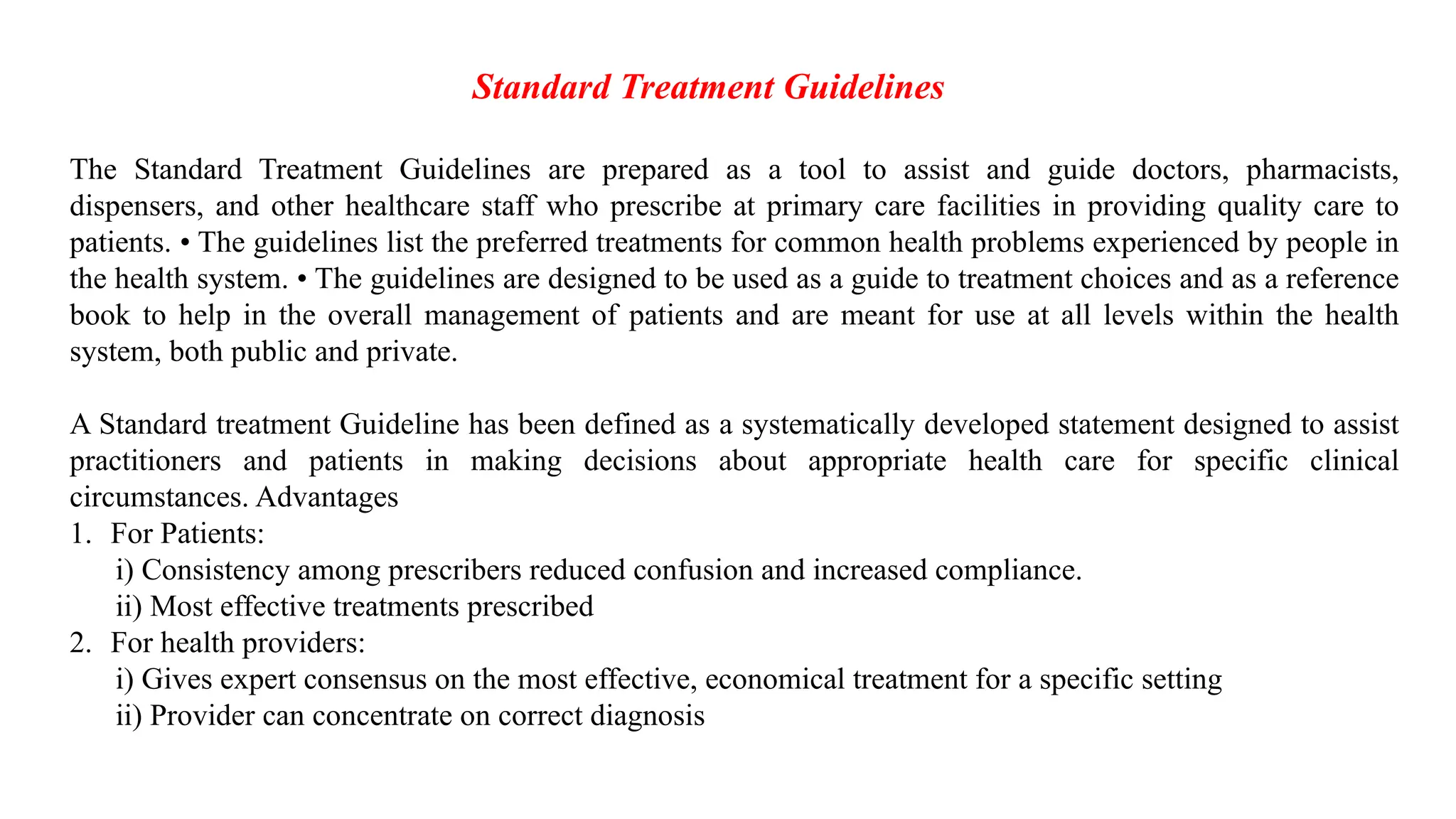
Standard Treatment Guidelines
The Standard Treatment Guidelines are prepared as a tool to assist and guide doctors, pharmacists,
dispensers, and other healthcare staff who prescribe at primary care facilities in providing quality care to
patients. • The guidelines list the preferred treatments for common health problems experienced by people in
the health system. • The guidelines are designed to be used as a guide to treatment choices and as a reference
book to help in the overall management of patients and are meant for use at all levels within the health
system, both public and private.
A Standard treatment Guideline has been defined as a systematically developed statement designed to assist
practitioners and patients in making decisions about appropriate health care for specific clinical
circumstances. Advantages
1. For Patients:
i) Consistency among prescribers reduced confusion and increased compliance.
ii) Most effective treatments prescribed
2. For health providers:
i) Gives expert consensus on the most effective, economical treatment for a specific setting
ii) Provider can concentrate on correct diagnosis
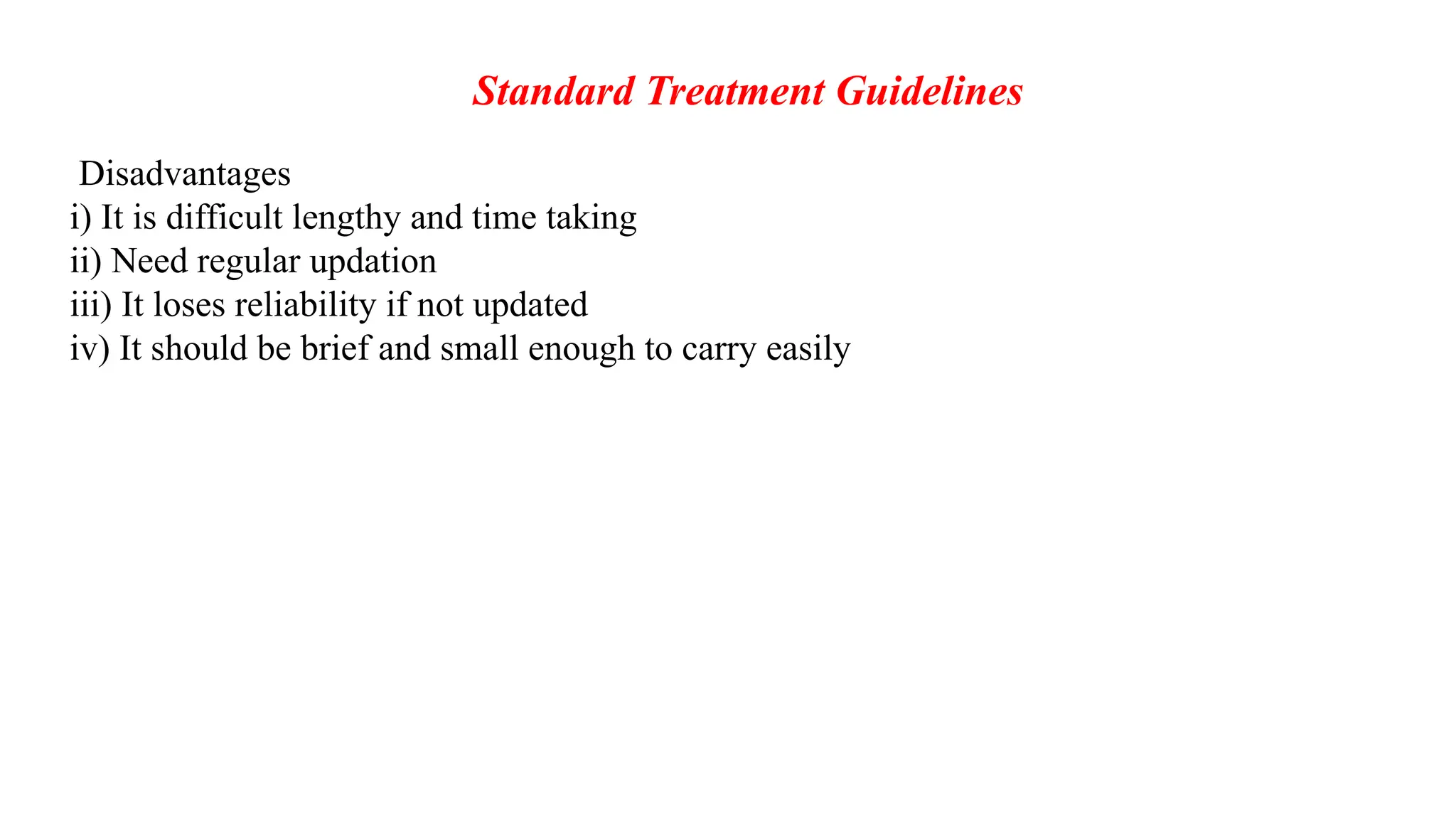
Standard Treatment Guidelines
Disadvantages
i) It is difficult lengthy and time taking
ii) Need regular updation
iii) It loses reliability if not updated
iv) It should be brief and small enough to carry easily
REFERENCES
• Verma BK ,Pant NC, Ojha A. Pharmacotherapeutics. 1st edition. Meerut: Sarthak
publication; 2022.
• https://www.who.int/activities/promoting-rational-use-of- medicines#:~:text=Irrational
%20use%20of%20medicines%20is,fail%20to%20take%2 0them%20correctly
Thank you

Pharmacotherapeutics notes unit 1 ppt.pptx

  • 1.
    Pharmacotherapeutics Presented by Miss DikshaDiwakar Sahu Onkar Saran School of Pharmacy IFTM University, Moradabad Introduction of pharmacotherapeutics
  • 2.
    It is appliedscience(Applied science is a discipline that is used to apply existing scientific knowledge to develop more practical applications). Pharmacotherapeutics (PT) is the application of pharmacological information together with the knowledge of the disease for its prevention, mitigation, or cure. Pharmacotherapy is included as drug therapy to treat the disease after surgical, radiation, or physical therapy. In the modern day, different types of chemical constituted medicine or available which show the effect (may be positive or negative), to correct this problem (according to the demand or patient need) Pharmacotherapeutics play a major role in the Indian system of medicine. Pharmacotherapeutics
  • 3.
    Pharmacotherapeutics Pharmacology • Provide scientificdata about drugs • How they act, where they act • Formulations in which they are available • Routes and doses, frequency, duration • Adverse effects • How to use them safely Therapeutics • It is concerned with the prevention and cure of disease or relief of symptoms with drug therapy and non-drug measures.
  • 4.
    Etiopathogenesis-The cause andsubsequent development of an abnormal condition of a disease Clinical manifestation- A clinical manifestation is the physical result of some type of illness or infection Non-pharmacological management of disease- Non-pharmacological therapies (non- medication treatments): Referring to therapies that do not involve drugs Pharmacological management of disease- therapies that involve drug
  • 5.
    Principles of Pharmacotherapeutics 1.Establish a goal for therapy 2. Every ill does not require a pill 3. Prescribe rationally and not fashionably 4. Integrate drug information with relevant knowledge from other subjects. 5. Safe prescribing all the times 6. Problems can arise at any stage: Beware of them 7. Adopt strategies to maximize adherence. 8. Keep your drug knowledge current. 9. Know your patient well: Avoid prescribing cascade(Prescribing cascade is defined as the situation in which a first drug administered to a patient causes adverse event signs and symptoms, that are misinterpreted as a new condition, resulting in a new medication being prescribed.)
  • 6.
    Objective of Pharmacotherapeutics Themain objectives of Pharmacotherapy study as follows: 1. Provide complete pathophysiology of selected disease states and the rationale for drug therapy. 2. The therapeutic approach to management of these diseases. 3. The importance of preparation of individualised therapeutic plans based on diagnosis. 4. Needs to identify the patient-specific parameters relevant in initiating drug therapy, and monitoring therapy (including alternatives, time course of clinical and laboratory indices of therapeutic response and adverse effects.) 5. Minimize adverse effect.
  • 7.
    Scope of Pharmacotherapeutics Pharmacotherapeuticsprovides the knowledge and skills required for the quality use of medicine. • Pharmacotherapeutics covers the pathophysiology and therapeutics of disease. This will enable us to understand the pathophysiology of the disease and its management. • Selection of the most appropriate drug, dose, dosage form and duration of action and route of administration depends on the particular disease, its state, and patient condition. • Pharmacokinetic and pharmacodynamics of drugs alter with the disease state and patient condition and concurrently administered drugs. • The change in the ADME of the drug will result in a change in the bioavailibilty of the drugs which can modify the effect of drugs and may result in adverse effects of the drug. • After complete study of pharmacotherapeutics, an individual has an extensive understanding of how the pharmacokinetics and pharmacodynamics can be correlated with treatment and disease and how drugs can interact with each other and this will be helpful to him to select best individual therapy
  • 8.
    Rational use ofMedicine RUM is an important, vital, and caretaker aspect/subject included in the pharmacodynamics because- Body mechanism of persons varies individually (obese, thin, male-female, age of the person, etc.) due to the involvement of RUM we decide that- the correct medicine for the correct individual at the correct time for correct diseases. According to WHO- “The rational use of drugs requires the patient to receive medication appropriate to their clinical needs, in doses that meet their own individual requirements for an adequate period of time and at the lowest cost to them and their community”. Factors responsible for the RUM A. Arises during manufacturing procedures— It is the initial step/factor responsible for the RUM because during the manufacturing drug quantity and measure are the important aspects regarding the drug formulation, it is avoided by the involvement of- 1. Correct platform 2. Correct equipment 3. Correct procedure
  • 9.
    B. Arise dueto the individual— The body physiology of an individual varies from person to person so chemical requirement also varies person to person for treating any disease. It depends on the different factors- 1. Body structure. 2. Sex of person. 3. Age of person. 4. Prior disease history. 5. Drug contraindication and allergy. C. Environmental effects— Environmental condition also varies place to place so, they also act as the factor- 6. Seasonal variation. 7. Any pandemic. 8. Any mutations.
  • 10.
    Irrational use ofmedicines Irrational use of medicines is a major problem worldwide. WHO estimates that more than half of all medicines are prescribed, dispensed, or sold inappropriately, and that half of all patients fail to take them correctly. Irrational use of drugs means, the use of medicines in an improper manner and improper formulation it involves as- 1. By selection of wrong medicine. 2. By selection of wrong doses. 3. By selection of the wrong person. 4. By selection of wrong time
  • 11.
    Reason for Irrationaluse of medicines The use of too many medicines prescribed per patient (polypharmacy); often, these result in cross-reactions between different drugs prescribed. • Inappropriate prescription of antimicrobials, often in inadequate dosage, for nonbacterial infections. • Over-prescription of injections when oral formulations would be more appropriate. • Failure to prescribe in accordance with clinical guidelines: Wrong choice of drugs, inadequate dosages, incorrect frequency of administration of a drug, improper duration of therapy, or failure to observe drug contraindications. • Choice of more expensive drugs when less expensive drugs would be equally or more effective. • Prescription of drugs that have no use, only for their placebo effect or for impressing the patient, or for vested interests in the prescribed drugs. • Inadequate consulting time and dispensing time along with poor communication of information regarding drugs to a patient in a verbal or written form leading to incorrect use by patients is of great public health concern too. Worldwide, more than 50% of all medicines are prescribed, dispensed, or sold inappropriately, while 50% of patients fail to take them correctly. • Inappropriate self-medication of prescription-only medicines.
  • 12.
    Impact for Irrationaluse of medicines • Ineffective treatment leading to serious morbidity and mortality. • Iatrogenic diseases: It is defined as a disease induced by a drug prescribed by a physician, or after a medical or surgical procedure • Inappropriate use and overuse of medicines leading to high out-of-pocket payments by patients. This results in patient harm in terms of adverse drug reactions and impoverishment of the patient. • Inappropriate use and overuse in the public sector facility, where the government pays the bills, leads to wastage of meager resources, and a shift of funds away from necessary expenditures to unnecessary areas. • Increasing antimicrobial resistance: ▪ Inappropriate use of antimicrobials is leading to increased antimicrobial resistance. ▪ Antimicrobial resistance (AMR) is one of the most serious public health problems globally resulting in prolonged illness and hospitalization, mortality, and higher costs.
  • 13.
    Common examples ofirrational prescribing seen in day to day include the use of : Drugs when no drug therapy is indicated, e.g., antibiotics for viral upper respiratory infections • wrong drug for a specific condition requiring drug therapy, e.g. an antibiotic in childhood viral diarrheas requiring ORS • drugs with doubtful/unproven efficacy, e.g. antimotility agents in acute infective diarrhea • correct drugs but incorrect administration, dosages, or duration, e.g., use of IV metronidazole when an oral formulation would be appropriate • unnecessarily expensive drugs, e.g., a third generation, broad-spectrum antimicrobial when a first-line, narrow spectrum, an agent would suffice • multivitamins and ‘tonics’ and so forth.
  • 14.
    Evidence based medicine Evidencebased medicine, as it follows, is the conscientious, explicit, and judicious use of current best evidence in making decisions about individual patients. • Therefore, EBM’s praxis encompasses two components: a combination of medical expertise with the best available external clinical evidence from systematic research. • according to EBM’s concept, medical treatment decisions must be based on the best available evidence. • The expertise and experience of the clinical who understands the disease are crucial in determining whether the external evidence applies to the patient and whether it should be integrated in the therapeutic plan. • Best research evidence may come from basic medical sciences, but more often it arises from patient- centered clinical research.
  • 15.
    Essential medicine According toWHO, Essential medicines are those that satisfy the priority healthcare needs of the population. • They are selected on the basis of disease prevalence, evidence of efficacy, safety, and comparative cost- effectiveness. • Essential medicines are intended to be available in functioning health systems at all times in adequate amounts, in the appropriate dosage forms, with assured quality, and at a price the individual and the community can afford. • Which medicines are regarded as essential remains the responsibility of states within a national framework
  • 16.
    WHO model Listof Essential Medicines The WHO model List of Essential Medicines is a list of essential medicines created by the World Health Organization (WHO) which serves as a guide for the development of national and institutional Essential Medicine Lists (EML). • It is updated and revised every 2 years by the WHO Expert Committee on Selection and Use of Medicines. • The list was first published in 1977. • Since 2007, a separate list for children up to 12 years (WHO Model List of Essential Medicines for Children) is being brought out. e.g. ibuprofen 200 mg/5 mL , pcm 125 mg/ml or suppositories 100mg tablet 100 mg or 250mg • Initially in 1977, the WHO EML had 204 molecules and the current is the 20th list (2017) which has 433 medicines, including 25 fixed dose drug combinations (FDCs). • India produced its National Essential Drugs List in 1996, and has revised it in 2011, and now in 2015 with the title “National List of Essential Medicines”. The latest list includes 376 medicines, of which 20 are FDCs.
  • 17.
    Standard Treatment Guidelines TheStandard Treatment Guidelines are prepared as a tool to assist and guide doctors, pharmacists, dispensers, and other healthcare staff who prescribe at primary care facilities in providing quality care to patients. • The guidelines list the preferred treatments for common health problems experienced by people in the health system. • The guidelines are designed to be used as a guide to treatment choices and as a reference book to help in the overall management of patients and are meant for use at all levels within the health system, both public and private. A Standard treatment Guideline has been defined as a systematically developed statement designed to assist practitioners and patients in making decisions about appropriate health care for specific clinical circumstances. Advantages 1. For Patients: i) Consistency among prescribers reduced confusion and increased compliance. ii) Most effective treatments prescribed 2. For health providers: i) Gives expert consensus on the most effective, economical treatment for a specific setting ii) Provider can concentrate on correct diagnosis
  • 18.
    Standard Treatment Guidelines Disadvantages i)It is difficult lengthy and time taking ii) Need regular updation iii) It loses reliability if not updated iv) It should be brief and small enough to carry easily
  • 19.
    REFERENCES • Verma BK,Pant NC, Ojha A. Pharmacotherapeutics. 1st edition. Meerut: Sarthak publication; 2022. • https://www.who.int/activities/promoting-rational-use-of- medicines#:~:text=Irrational %20use%20of%20medicines%20is,fail%20to%20take%2 0them%20correctly
  • 20.

Editor's Notes

  • #1 Introduction to human body
  • #2 It is applied science(Applied science is a discipline that is used to apply existing scientific knowledge to develop more practical applications)
  • #5 Principles of Pharmacotherapeutics
  • #6 Principles of Pharmacotherapeutics
  • #7 Principles of Pharmacotherapeutics
  • #8 Principles of Pharmacotherapeutics
  • #10 Principles of Pharmacotherapeutics
  • #11 Principles of Pharmacotherapeutics
  • #12 Principles of Pharmacotherapeutics
  • #13 Principles of Pharmacotherapeutics
  • #14 Principles of Pharmacotherapeutics
  • #15 Principles of Pharmacotherapeutics
  • #16 Principles of Pharmacotherapeutics
  • #17 Principles of Pharmacotherapeutics
  • #18 Principles of Pharmacotherapeutics
  • #19 Principles of Pharmacotherapeutics
  • #20 Thank you