CONCEPT OF
TEACHING
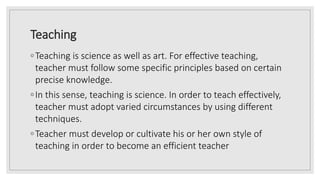
Teaching
◦Teaching is science as well as art. For effective teaching,
teacher must follow some specific principles based on certain
precise knowledge.
◦In this sense, teaching is science. In order to teach effectively,
teacher must adopt varied circumstances by using different
techniques.
◦Teacher must develop or cultivate his or her own style of
teaching in order to become an efficient teacher
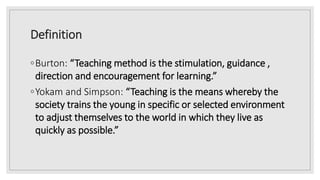
Definition
◦Burton: “Teaching method is the stimulation, guidance ,
direction and encouragement for learning.”
◦Yokam and Simpson: “Teaching is the means whereby the
society trains the young in specific or selected environment
to adjust themselves to the world in which they live as
quickly as possible.”
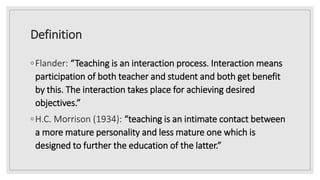
Definition
◦Flander: “Teaching is an interaction process. Interaction means
participation of both teacher and student and both get benefit
by this. The interaction takes place for achieving desired
objectives.”
◦H.C. Morrison (1934): “teaching is an intimate contact between
a more mature personality and less mature one which is
designed to further the education of the latter.”
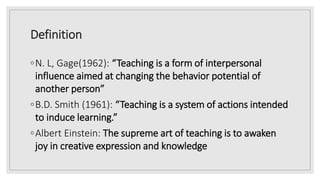
Definition
◦N. L, Gage(1962): “Teaching is a form of interpersonal
influence aimed at changing the behavior potential of
another person”
◦B.D. Smith (1961): “Teaching is a system of actions intended
to induce learning.”
◦Albert Einstein: The supreme art of teaching is to awaken
joy in creative expression and knowledge
Objective of Teaching
◦Aims at developing love for work
◦Inculcates the desire to do work with maximum efficiency
which one is capable of
◦Develop the capacity of clear thinking
◦Provides adequate opportunities for participation
Characteristics of Teaching
◦Teaching is an interactive process
◦Teaching is both formal and informal
◦Teaching is Art, Craft as well Science
◦Teaching is not one sided
◦Teaching is not an independent activity
◦Teaching is a planned activity
Characteristics of Teaching
◦Teaching is diagnostic and remedial
◦Teaching is dominated by communication skills
◦Good teaching is democratic
◦Teaching causes motivation
◦Teaching is professional in character
Objective of Teaching
◦Expand students' interest
◦Provide opportunities to pupils to apply practically the
knowledge and skills
◦They should adapt to the 3A’s age, ability, and aptitude of
the student.
◦Eagerness of the inspectorates
◦General support of the profession
Objective of Teaching
◦Teamwork and a sense of security
◦Mastery of the subject matter
◦Provision for a good library and teaching learning material
◦Role of teacher training institutes
◦Cooperation of the parents.
FUNCTIONS OF TEACHING
Diagnostic
◦Entering behavior of the student
◦Initial potential of the student
◦Educational Objectives
◦Content, instructional material &environment
◦His own potentials and capabilities
Prescriptive
◦Selecting appropriate contents and organizing them into
proper sequence.
◦Selecting proper teaching techniques, strategies and
feedback devices in view of the individual difference
among the students.
◦Seeking essential cooperation from the students for a
purposeful interaction.
Evaluative
◦Realization of the stipulated objectives.
◦Various evaluation devices in the form of tests, observations,
interviews, rating scales, inventories and unstructured
projective techniques are help in exercising evaluative
functions.
◦Failure in the realization of the objectives is essentially a failure
in the prescriptive or diagnostic functions.
◦Students are more active.
The other general functions of teaching are:
◦Creating learning situations.
◦Motivating the child to learn.
◦Diagnosing learning problems.
◦Making curricular material.
◦Explain and inform.
◦Initiation, Direction and Administration.
METHODS OF TEACHING
Inspirational Method
◦based on high activity on the part of the teacher e.g.
simulation and microteaching
Expository Methods
◦cognitive emphasis is high while student activity and
emphasis on experience is low e.g. lecture method
Natural Learning Method
◦learning takes place in a natural way e.g. field trip
Individualized Method
◦main emphasis is for each learner to earn at his own
place e.g. programmed instruction, self study, case
method, and computer-oriented instruction.
Group Method
◦e.g. project method, socialized classroom method
Encounter Method
◦providing experience through confrontation or
through encounter effective of change in basic
behavioral pattern and developing new ways of
looking at thing e.g. role play, simulation.
Discovery method
◦these methods are high on all dimensions like
learner activity, experience, and experimentation by
learner and cognitive understanding e.g. problem-
solving technique.
Qualities of Good Teaching
◦Good teaching recognizes individual difference
◦Good teaching is cause to learn
◦Good teaching provide opportunities for activity
◦Good teaching involves in guiding and learning
◦Good teaching is kindly and sympathetic
Qualities of Good Teaching
◦Good teaching reduces distance between teacher and
learner
◦Good teaching is flexible
◦Good teaching incorporate cooperativeness and
suggestiveness
Qualities of Good Teaching
◦Good teaching is democratic
◦Good teaching provide desirable and selective
information
◦Good teaching helps the client to adjust himself in
the environment
Qualities of Good Teaching
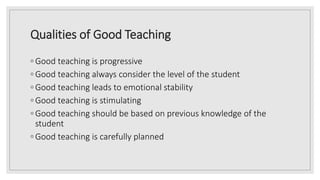
◦ Good teaching is progressive
◦ Good teaching always consider the level of the student
◦ Good teaching leads to emotional stability
◦ Good teaching is stimulating
◦ Good teaching should be based on previous knowledge of the
student
◦ Good teaching is carefully planned
Qualities of Good Teaching
◦Good teaching is stimulating
◦Good teaching should be based on previous
knowledge of the student
◦Good teaching is carefully planned
QUALITIES OF A GOOD
TEACHER
Friendliness and Congeniality
◦The most important characteristic of a good teacher
can have is to be friendly and congenial with his
students. It is a plus if his students can share their
problems with him, without being afraid or hesitant.
A Good Personality
◦A good teacher has a very good personality
◦Students always get attracted to teachers with good
personality which leads to better communication,
understanding, and ultimately good results.
◦Everyone can have a good, decent, likable, and presentable
personality. Just dress sensibly well, smell good, and be a
little gentle and kind.
Deep Knowledge and a Great Education
◦Another important characteristic of a good teacher is his
knowledge and own education. There is a saying that 'a
teacher is only as good as his knowledge is.' After all, he
is doing a teacher's job, which is to teach.
◦If he himself lacks in the knowledge of a certain subject
that he teaches, he is never going to make a name for
himself.
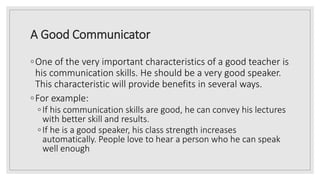
A Good Communicator
◦One of the very important characteristics of a good teacher is
his communication skills. He should be a very good speaker.
This characteristic will provide benefits in several ways.
◦For example:
◦If his communication skills are good, he can convey his lectures
with better skill and results.
◦If he is a good speaker, his class strength increases
automatically. People love to hear a person who he can speak
well enough
A Good Listener
◦Apart from being a good communicator, a good teacher
should also have the characteristic of being an even better
listener.
◦"If speaking is silver; then listening is gold."
◦A good listener will always have many friends and fans.
◦And when a good teacher develops this patience quality in
him, he starts to become a great teacher.
A Good Sense of Humor
◦So, a good teacher is the one who can keep up with
his sense of humor, and with his strong
communication skills and personality, can also
maintain the discipline of the class.
Kindness
◦The last but obviously one of the most important
characteristics to have in his box of qualities: he
should be a gentle, kind, chivalrous, and benevolent
person. Students should love him, and when they do
love him, they idolize him.
Conclusion
◦Teaching is an interaction process. Interaction means
participation of both teacher and student and both are
benefit by this.
◦The interaction takes place for achieving desired objective.
◦Teaching is an intimate contact between teacher and
student. In this process of education, teacher helps in
developing in the student’s personality by this intimate
contact.
Concept of Teaching.pptx

Concept of Teaching.pptx

  • 1.
  • 2.
    Teaching ◦Teaching is scienceas well as art. For effective teaching, teacher must follow some specific principles based on certain precise knowledge. ◦In this sense, teaching is science. In order to teach effectively, teacher must adopt varied circumstances by using different techniques. ◦Teacher must develop or cultivate his or her own style of teaching in order to become an efficient teacher
  • 3.
    Definition ◦Burton: “Teaching methodis the stimulation, guidance , direction and encouragement for learning.” ◦Yokam and Simpson: “Teaching is the means whereby the society trains the young in specific or selected environment to adjust themselves to the world in which they live as quickly as possible.”
  • 4.
    Definition ◦Flander: “Teaching isan interaction process. Interaction means participation of both teacher and student and both get benefit by this. The interaction takes place for achieving desired objectives.” ◦H.C. Morrison (1934): “teaching is an intimate contact between a more mature personality and less mature one which is designed to further the education of the latter.”
  • 5.
    Definition ◦N. L, Gage(1962):“Teaching is a form of interpersonal influence aimed at changing the behavior potential of another person” ◦B.D. Smith (1961): “Teaching is a system of actions intended to induce learning.” ◦Albert Einstein: The supreme art of teaching is to awaken joy in creative expression and knowledge
  • 6.
    Objective of Teaching ◦Aimsat developing love for work ◦Inculcates the desire to do work with maximum efficiency which one is capable of ◦Develop the capacity of clear thinking ◦Provides adequate opportunities for participation
  • 7.
    Characteristics of Teaching ◦Teachingis an interactive process ◦Teaching is both formal and informal ◦Teaching is Art, Craft as well Science ◦Teaching is not one sided ◦Teaching is not an independent activity ◦Teaching is a planned activity
  • 8.
    Characteristics of Teaching ◦Teachingis diagnostic and remedial ◦Teaching is dominated by communication skills ◦Good teaching is democratic ◦Teaching causes motivation ◦Teaching is professional in character
  • 9.
    Objective of Teaching ◦Expandstudents' interest ◦Provide opportunities to pupils to apply practically the knowledge and skills ◦They should adapt to the 3A’s age, ability, and aptitude of the student. ◦Eagerness of the inspectorates ◦General support of the profession
  • 10.
    Objective of Teaching ◦Teamworkand a sense of security ◦Mastery of the subject matter ◦Provision for a good library and teaching learning material ◦Role of teacher training institutes ◦Cooperation of the parents.
  • 11.
  • 12.
    Diagnostic ◦Entering behavior ofthe student ◦Initial potential of the student ◦Educational Objectives ◦Content, instructional material &environment ◦His own potentials and capabilities
  • 13.
    Prescriptive ◦Selecting appropriate contentsand organizing them into proper sequence. ◦Selecting proper teaching techniques, strategies and feedback devices in view of the individual difference among the students. ◦Seeking essential cooperation from the students for a purposeful interaction.
  • 14.
    Evaluative ◦Realization of thestipulated objectives. ◦Various evaluation devices in the form of tests, observations, interviews, rating scales, inventories and unstructured projective techniques are help in exercising evaluative functions. ◦Failure in the realization of the objectives is essentially a failure in the prescriptive or diagnostic functions. ◦Students are more active.
  • 15.
    The other generalfunctions of teaching are: ◦Creating learning situations. ◦Motivating the child to learn. ◦Diagnosing learning problems. ◦Making curricular material. ◦Explain and inform. ◦Initiation, Direction and Administration.
  • 16.
  • 17.
    Inspirational Method ◦based onhigh activity on the part of the teacher e.g. simulation and microteaching
  • 18.
    Expository Methods ◦cognitive emphasisis high while student activity and emphasis on experience is low e.g. lecture method
  • 19.
    Natural Learning Method ◦learningtakes place in a natural way e.g. field trip
  • 20.
    Individualized Method ◦main emphasisis for each learner to earn at his own place e.g. programmed instruction, self study, case method, and computer-oriented instruction.
  • 21.
    Group Method ◦e.g. projectmethod, socialized classroom method
  • 22.
    Encounter Method ◦providing experiencethrough confrontation or through encounter effective of change in basic behavioral pattern and developing new ways of looking at thing e.g. role play, simulation.
  • 23.
    Discovery method ◦these methodsare high on all dimensions like learner activity, experience, and experimentation by learner and cognitive understanding e.g. problem- solving technique.
  • 24.
    Qualities of GoodTeaching ◦Good teaching recognizes individual difference ◦Good teaching is cause to learn ◦Good teaching provide opportunities for activity ◦Good teaching involves in guiding and learning ◦Good teaching is kindly and sympathetic
  • 25.
    Qualities of GoodTeaching ◦Good teaching reduces distance between teacher and learner ◦Good teaching is flexible ◦Good teaching incorporate cooperativeness and suggestiveness
  • 26.
    Qualities of GoodTeaching ◦Good teaching is democratic ◦Good teaching provide desirable and selective information ◦Good teaching helps the client to adjust himself in the environment
  • 27.
    Qualities of GoodTeaching ◦ Good teaching is progressive ◦ Good teaching always consider the level of the student ◦ Good teaching leads to emotional stability ◦ Good teaching is stimulating ◦ Good teaching should be based on previous knowledge of the student ◦ Good teaching is carefully planned
  • 28.
    Qualities of GoodTeaching ◦Good teaching is stimulating ◦Good teaching should be based on previous knowledge of the student ◦Good teaching is carefully planned
  • 29.
    QUALITIES OF AGOOD TEACHER
  • 30.
    Friendliness and Congeniality ◦Themost important characteristic of a good teacher can have is to be friendly and congenial with his students. It is a plus if his students can share their problems with him, without being afraid or hesitant.
  • 31.
    A Good Personality ◦Agood teacher has a very good personality ◦Students always get attracted to teachers with good personality which leads to better communication, understanding, and ultimately good results. ◦Everyone can have a good, decent, likable, and presentable personality. Just dress sensibly well, smell good, and be a little gentle and kind.
  • 32.
    Deep Knowledge anda Great Education ◦Another important characteristic of a good teacher is his knowledge and own education. There is a saying that 'a teacher is only as good as his knowledge is.' After all, he is doing a teacher's job, which is to teach. ◦If he himself lacks in the knowledge of a certain subject that he teaches, he is never going to make a name for himself.
  • 33.
    A Good Communicator ◦Oneof the very important characteristics of a good teacher is his communication skills. He should be a very good speaker. This characteristic will provide benefits in several ways. ◦For example: ◦If his communication skills are good, he can convey his lectures with better skill and results. ◦If he is a good speaker, his class strength increases automatically. People love to hear a person who he can speak well enough
  • 34.
    A Good Listener ◦Apartfrom being a good communicator, a good teacher should also have the characteristic of being an even better listener. ◦"If speaking is silver; then listening is gold." ◦A good listener will always have many friends and fans. ◦And when a good teacher develops this patience quality in him, he starts to become a great teacher.
  • 35.
    A Good Senseof Humor ◦So, a good teacher is the one who can keep up with his sense of humor, and with his strong communication skills and personality, can also maintain the discipline of the class.
  • 36.
    Kindness ◦The last butobviously one of the most important characteristics to have in his box of qualities: he should be a gentle, kind, chivalrous, and benevolent person. Students should love him, and when they do love him, they idolize him.
  • 37.
    Conclusion ◦Teaching is aninteraction process. Interaction means participation of both teacher and student and both are benefit by this. ◦The interaction takes place for achieving desired objective. ◦Teaching is an intimate contact between teacher and student. In this process of education, teacher helps in developing in the student’s personality by this intimate contact.