Examples of Some Key Language Functions
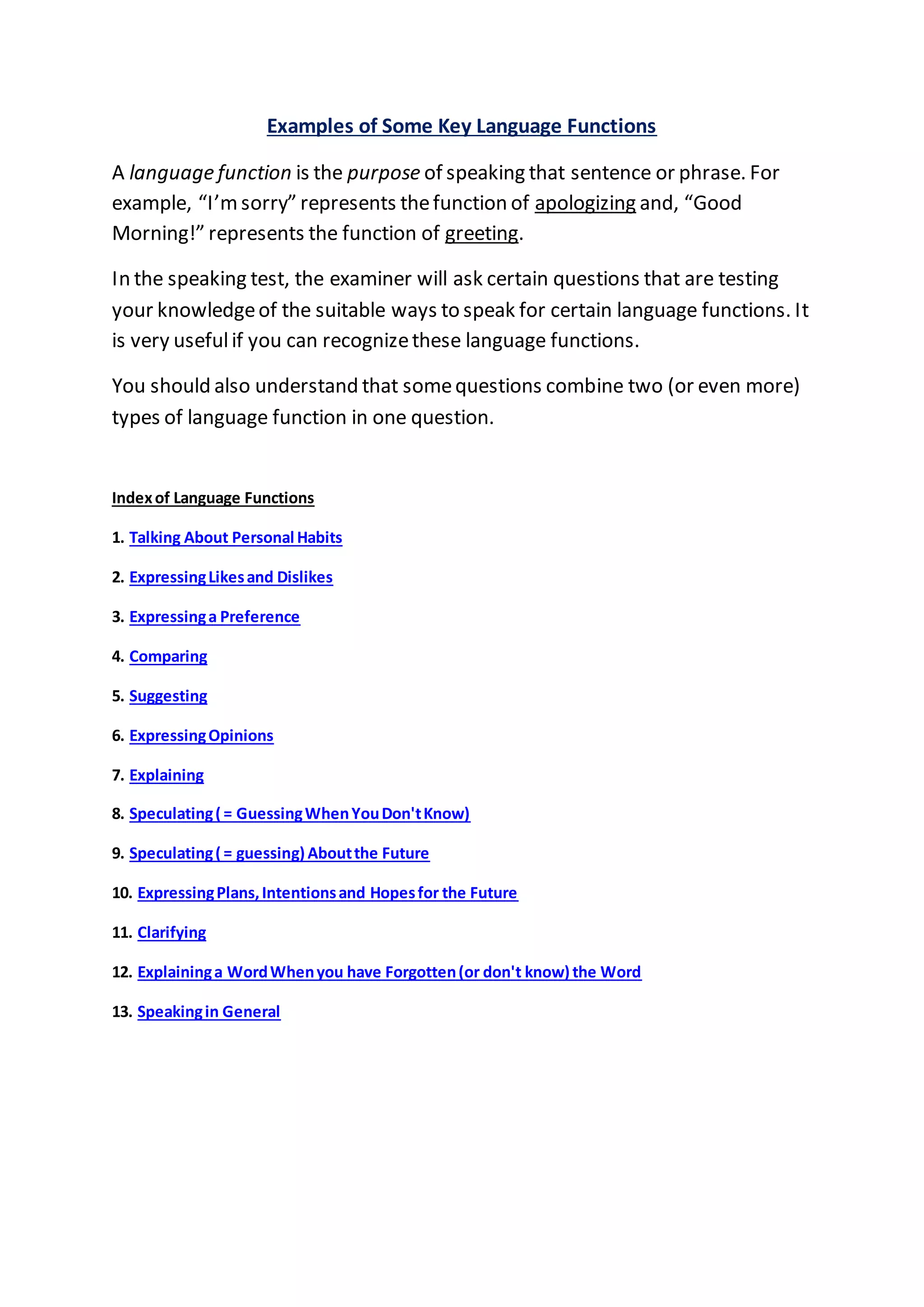
A language function is the purpose of speaking that sentence or phrase. For
example, “I’msorry” represents thefunction of apologizing and, “Good
Morning!” represents the function of greeting.
In the speaking test, the examiner will ask certain questions that are testing
your knowledgeof the suitable ways to speak for certain language functions. It
is very usefulif you can recognizethese language functions.
You should also understand that somequestions combine two (or even more)
types of language function in one question.
Indexof Language Functions
1. Talking About Personal Habits
2. ExpressingLikesand Dislikes
3. Expressinga Preference
4. Comparing
5. Suggesting
6. ExpressingOpinions
7. Explaining
8. Speculating( = GuessingWhenYouDon'tKnow)
9. Speculating( = guessing) Aboutthe Future
10. ExpressingPlans,Intentionsand Hopesfor the Future
11. Clarifying
12. Explaininga WordWhenyou have Forgotten(or don't know) the Word
13. Speakingin General
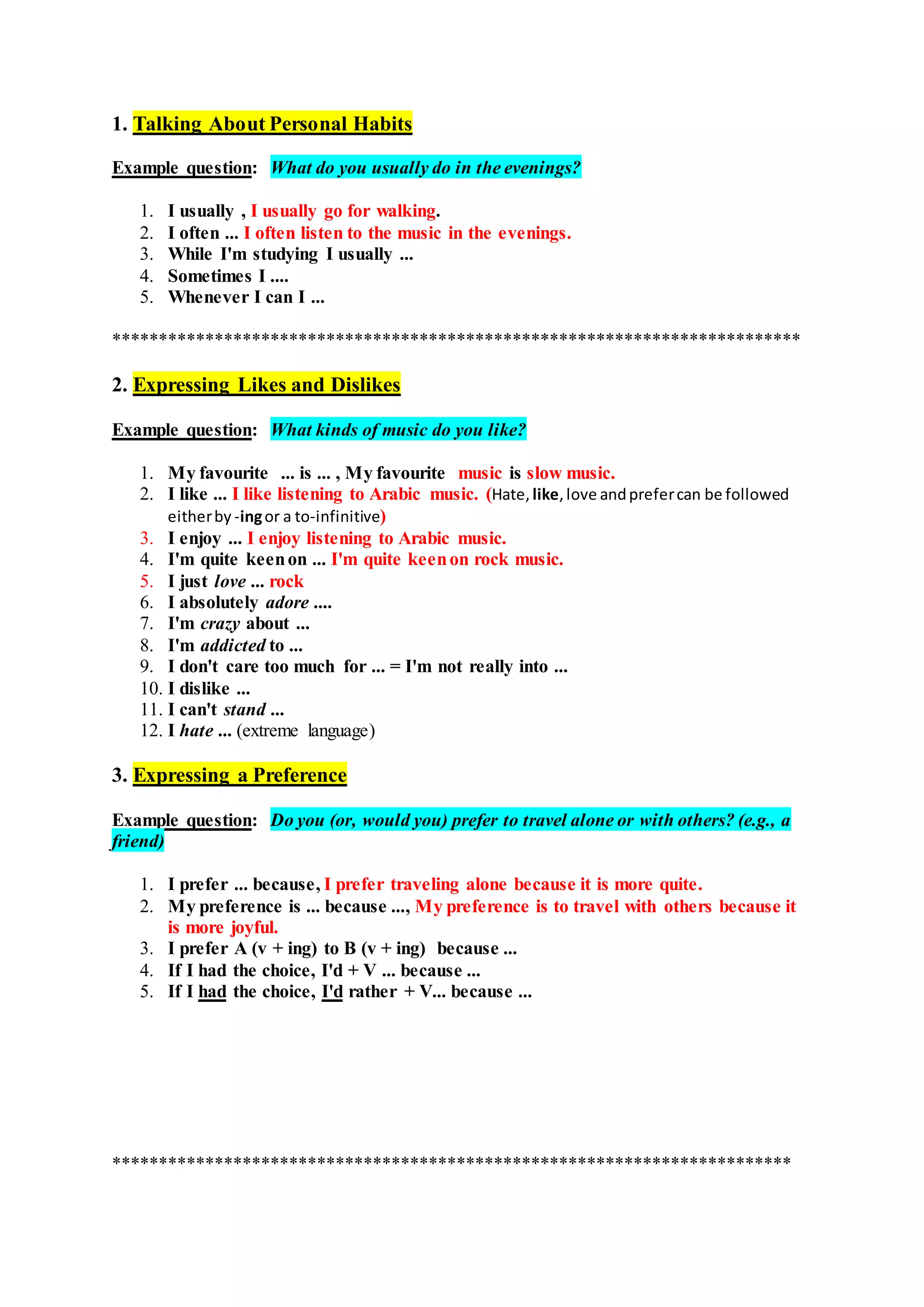
1. Talking About Personal Habits
Example question: What do you usually do in the evenings?
1. I usually , I usually go for walking.
2. I often ... I often listen to the music in the evenings.
3. While I'm studying I usually ...
4. Sometimes I ....
5. Whenever I can I ...
**************************************************************************
2. Expressing Likes and Dislikes
Example question: What kinds of music do you like?
1. My favourite ... is ... , My favourite music is slow music.
2. I like ... I like listening to Arabic music. (Hate, like,love andprefercan be followed
eitherby -ingor a to-infinitive)
3. I enjoy ... I enjoy listening to Arabic music.
4. I'm quite keenon ... I'm quite keenon rock music.
5. I just love ... rock
6. I absolutely adore ....
7. I'm crazy about ...
8. I'm addicted to ...
9. I don't care too much for ... = I'm not really into ...
10. I dislike ...
11. I can't stand ...
12. I hate ... (extreme language)
3. Expressing a Preference
Example question: Do you (or, would you) prefer to travel alone or with others? (e.g., a
friend)
1. I prefer ... because, I prefer traveling alone because it is more quite.
2. My preference is ... because ..., My preference is to travel with others because it
is more joyful.
3. I prefer A (v + ing) to B (v + ing) because ...
4. If I had the choice, I'd + V ... because ...
5. If I had the choice, I'd rather + V... because ...
*************************************************************************
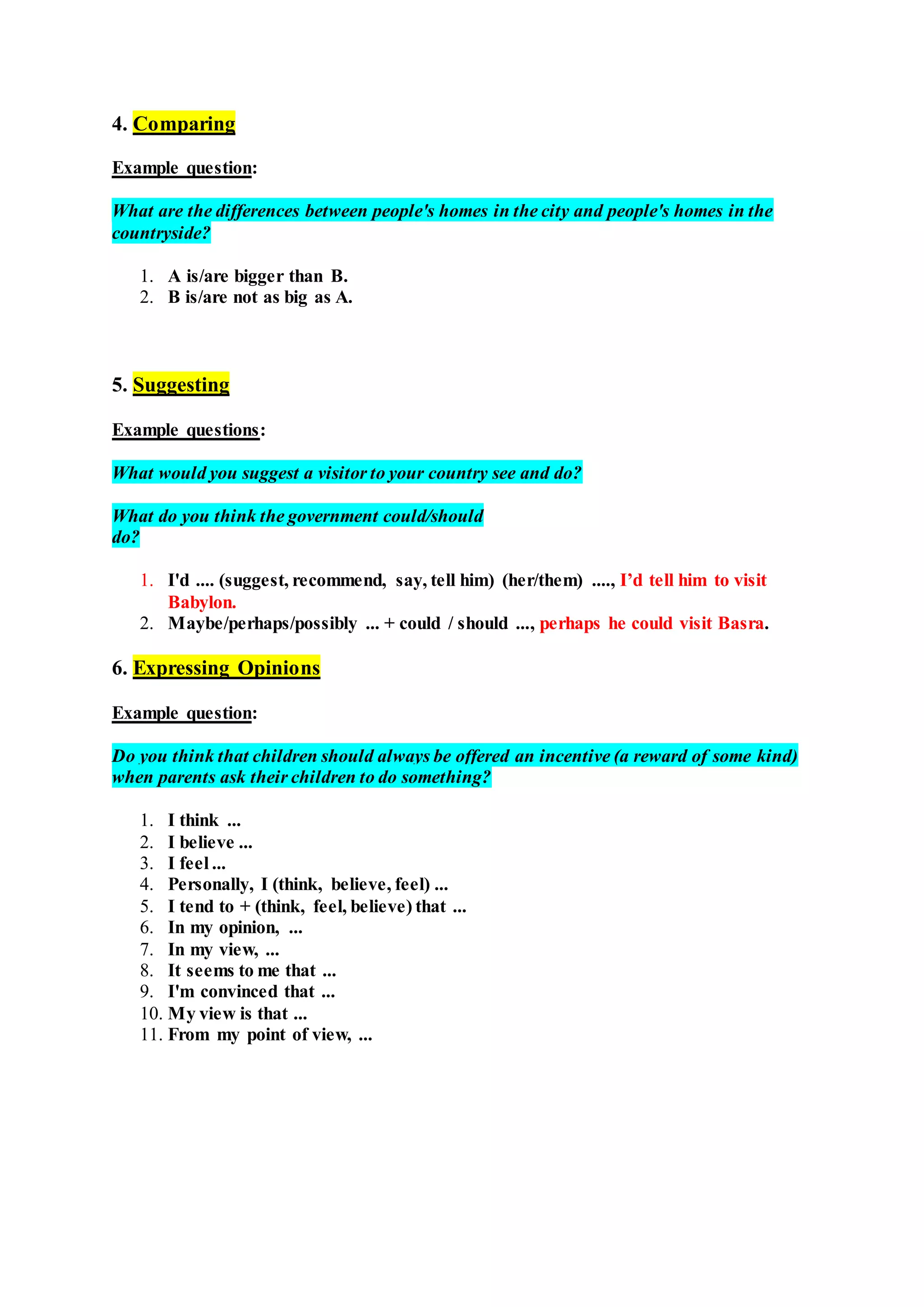
4. Comparing
Example question:
What are the differences between people's homes in the city and people's homes in the
countryside?
1. A is/are bigger than B.
2. B is/are not as big as A.
5. Suggesting
Example questions:
What would you suggest a visitor to your country see and do?
What do you think the government could/should
do?
1. I'd .... (suggest, recommend, say, tell him) (her/them) ...., I’d tell him to visit
Babylon.
2. Maybe/perhaps/possibly ... + could / should ..., perhaps he could visit Basra.
6. Expressing Opinions
Example question:
Do you think that children should always be offered an incentive (a reward of some kind)
when parents ask their children to do something?
1. I think ...
2. I believe ...
3. I feel ...
4. Personally, I (think, believe, feel) ...
5. I tend to + (think, feel, believe) that ...
6. In my opinion, ...
7. In my view, ...
8. It seems to me that ...
9. I'm convinced that ...
10. My view is that ...
11. From my point of view, ...
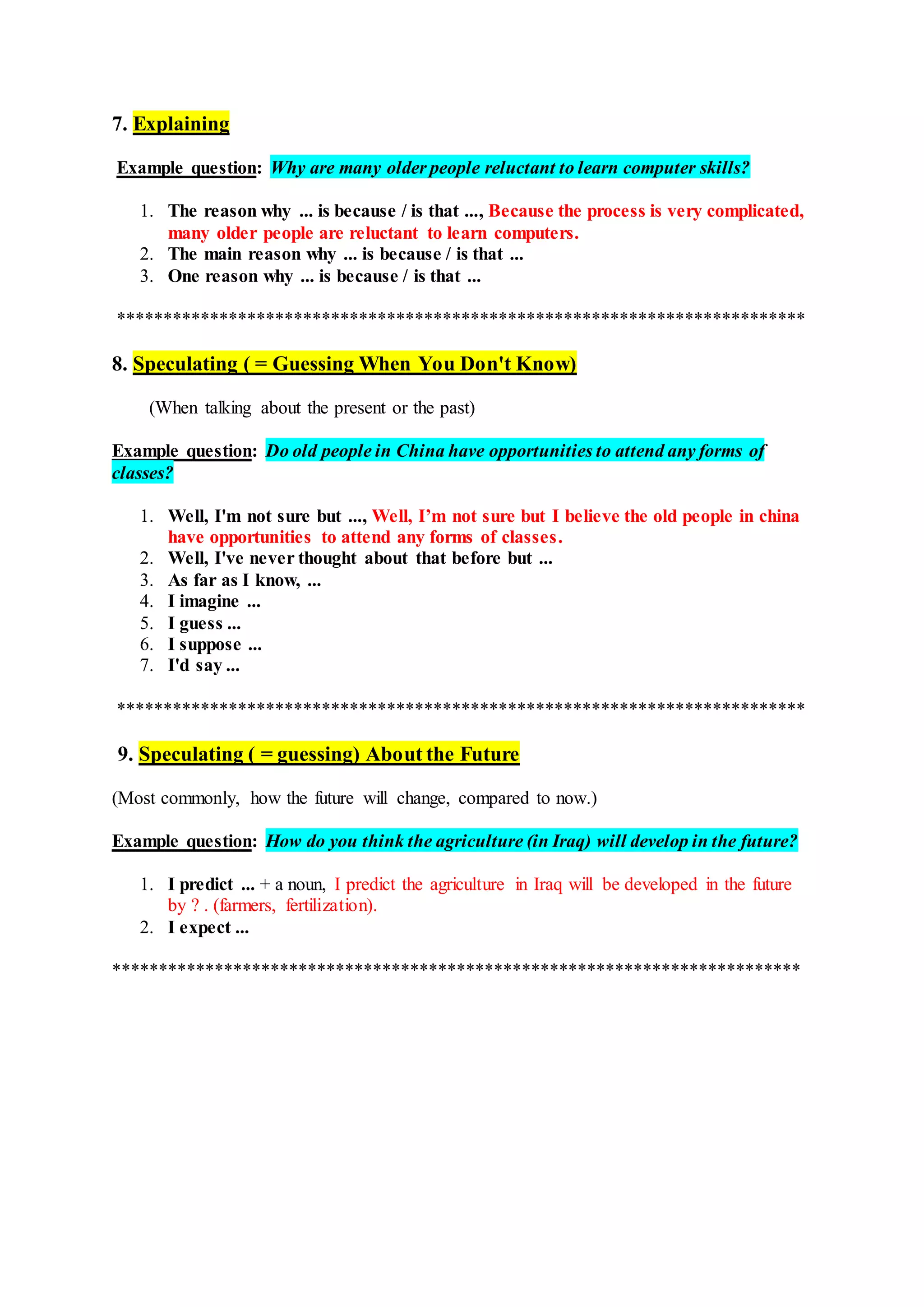
7. Explaining
Example question: Why are many older people reluctant to learn computer skills?
1. The reason why ... is because / is that ..., Because the process is very complicated,
many older people are reluctant to learn computers.
2. The main reason why ... is because / is that ...
3. One reason why ... is because / is that ...
**************************************************************************
8. Speculating ( = Guessing When You Don't Know)
(When talking about the present or the past)
Example question: Do old people in China have opportunities to attend any forms of
classes?
1. Well, I'm not sure but ..., Well, I’m not sure but I believe the old people in china
have opportunities to attend any forms of classes.
2. Well, I've never thought about that before but ...
3. As far as I know, ...
4. I imagine ...
5. I guess ...
6. I suppose ...
7. I'd say ...
**************************************************************************
9. Speculating ( = guessing) About the Future
(Most commonly, how the future will change, compared to now.)
Example question: How do you think the agriculture (in Iraq) will develop in the future?
1. I predict ... + a noun, I predict the agriculture in Iraq will be developed in the future
by ? . (farmers, fertilization).
2. I expect ...
**************************************************************************
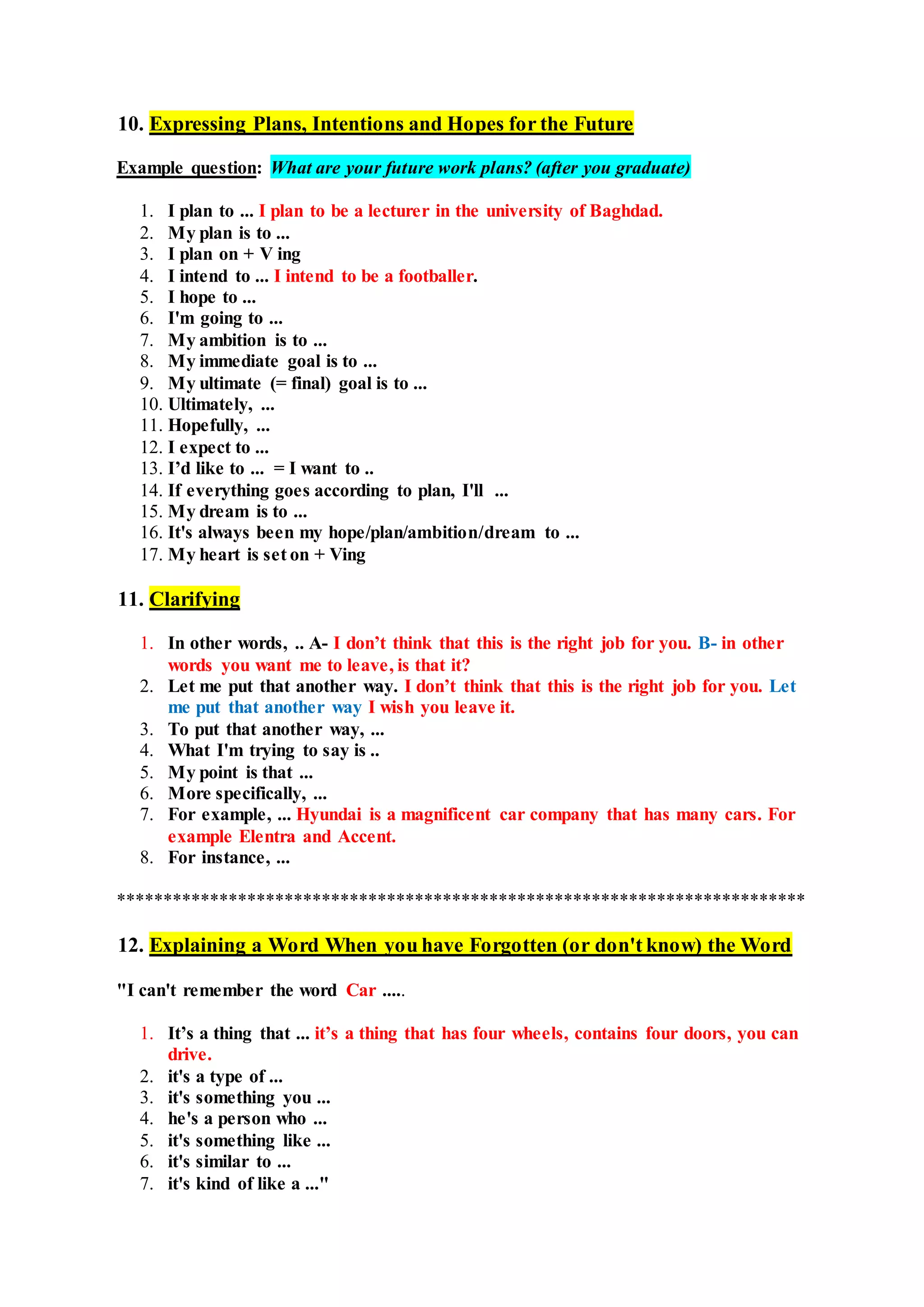
10. Expressing Plans, Intentions and Hopes for the Future
Example question: What are your future work plans? (after you graduate)
1. I plan to ... I plan to be a lecturer in the university of Baghdad.
2. My plan is to ...
3. I plan on + V ing
4. I intend to ... I intend to be a footballer.
5. I hope to ...
6. I'm going to ...
7. My ambition is to ...
8. My immediate goal is to ...
9. My ultimate (= final) goal is to ...
10. Ultimately, ...
11. Hopefully, ...
12. I expect to ...
13. I’d like to ... = I want to ..
14. If everything goes according to plan, I'll ...
15. My dream is to ...
16. It's always been my hope/plan/ambition/dream to ...
17. My heart is set on + Ving
11. Clarifying
1. In other words, .. A- I don’t think that this is the right job for you. B- in other
words you want me to leave, is that it?
2. Let me put that another way. I don’t think that this is the right job for you. Let
me put that another way I wish you leave it.
3. To put that another way, ...
4. What I'm trying to say is ..
5. My point is that ...
6. More specifically, ...
7. For example, ... Hyundai is a magnificent car company that has many cars. For
example Elentra and Accent.
8. For instance, ...
**************************************************************************
12. Explaining a Word When you have Forgotten (or don't know) the Word
"I can't remember the word Car .....
1. It’s a thing that ... it’s a thing that has four wheels, contains four doors, you can
drive.
2. it's a type of ...
3. it's something you ...
4. he's a person who ...
5. it's something like ...
6. it's similar to ...
7. it's kind of like a ..."
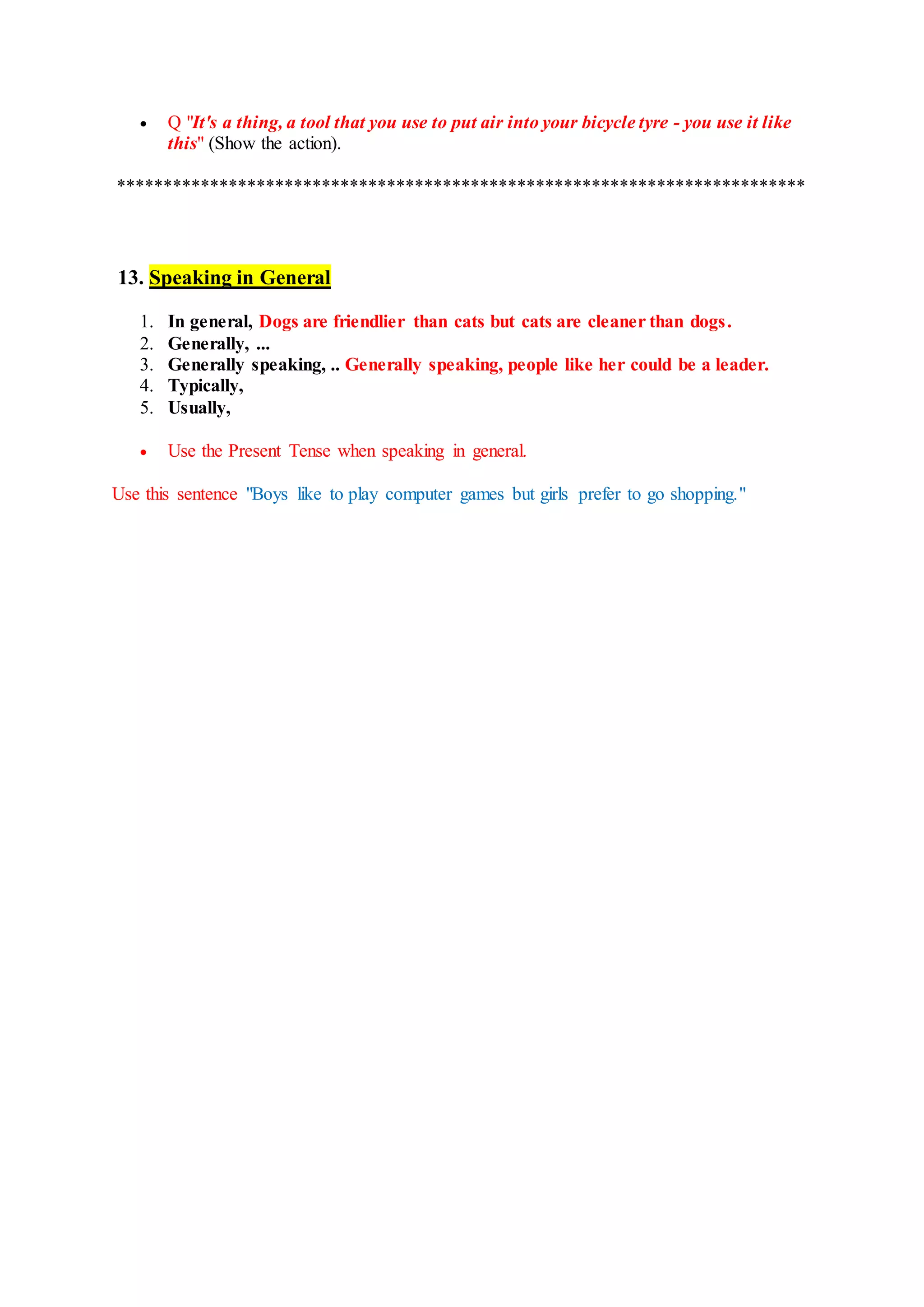
 Q "It's a thing, a tool that you use to put air into your bicycle tyre - you use it like
this" (Show the action).
**************************************************************************
13. Speaking in General
1. In general, Dogs are friendlier than cats but cats are cleaner than dogs.
2. Generally, ...
3. Generally speaking, .. Generally speaking, people like her could be a leader.
4. Typically,
5. Usually,
 Use the Present Tense when speaking in general.
Use this sentence "Boys like to play computer games but girls prefer to go shopping."

Language function 1

  • 1.
    Examples of SomeKey Language Functions A language function is the purpose of speaking that sentence or phrase. For example, “I’msorry” represents thefunction of apologizing and, “Good Morning!” represents the function of greeting. In the speaking test, the examiner will ask certain questions that are testing your knowledgeof the suitable ways to speak for certain language functions. It is very usefulif you can recognizethese language functions. You should also understand that somequestions combine two (or even more) types of language function in one question. Indexof Language Functions 1. Talking About Personal Habits 2. ExpressingLikesand Dislikes 3. Expressinga Preference 4. Comparing 5. Suggesting 6. ExpressingOpinions 7. Explaining 8. Speculating( = GuessingWhenYouDon'tKnow) 9. Speculating( = guessing) Aboutthe Future 10. ExpressingPlans,Intentionsand Hopesfor the Future 11. Clarifying 12. Explaininga WordWhenyou have Forgotten(or don't know) the Word 13. Speakingin General
  • 2.
    1. Talking AboutPersonal Habits Example question: What do you usually do in the evenings? 1. I usually , I usually go for walking. 2. I often ... I often listen to the music in the evenings. 3. While I'm studying I usually ... 4. Sometimes I .... 5. Whenever I can I ... ************************************************************************** 2. Expressing Likes and Dislikes Example question: What kinds of music do you like? 1. My favourite ... is ... , My favourite music is slow music. 2. I like ... I like listening to Arabic music. (Hate, like,love andprefercan be followed eitherby -ingor a to-infinitive) 3. I enjoy ... I enjoy listening to Arabic music. 4. I'm quite keenon ... I'm quite keenon rock music. 5. I just love ... rock 6. I absolutely adore .... 7. I'm crazy about ... 8. I'm addicted to ... 9. I don't care too much for ... = I'm not really into ... 10. I dislike ... 11. I can't stand ... 12. I hate ... (extreme language) 3. Expressing a Preference Example question: Do you (or, would you) prefer to travel alone or with others? (e.g., a friend) 1. I prefer ... because, I prefer traveling alone because it is more quite. 2. My preference is ... because ..., My preference is to travel with others because it is more joyful. 3. I prefer A (v + ing) to B (v + ing) because ... 4. If I had the choice, I'd + V ... because ... 5. If I had the choice, I'd rather + V... because ... *************************************************************************
  • 3.
    4. Comparing Example question: Whatare the differences between people's homes in the city and people's homes in the countryside? 1. A is/are bigger than B. 2. B is/are not as big as A. 5. Suggesting Example questions: What would you suggest a visitor to your country see and do? What do you think the government could/should do? 1. I'd .... (suggest, recommend, say, tell him) (her/them) ...., I’d tell him to visit Babylon. 2. Maybe/perhaps/possibly ... + could / should ..., perhaps he could visit Basra. 6. Expressing Opinions Example question: Do you think that children should always be offered an incentive (a reward of some kind) when parents ask their children to do something? 1. I think ... 2. I believe ... 3. I feel ... 4. Personally, I (think, believe, feel) ... 5. I tend to + (think, feel, believe) that ... 6. In my opinion, ... 7. In my view, ... 8. It seems to me that ... 9. I'm convinced that ... 10. My view is that ... 11. From my point of view, ...
  • 4.
    7. Explaining Example question:Why are many older people reluctant to learn computer skills? 1. The reason why ... is because / is that ..., Because the process is very complicated, many older people are reluctant to learn computers. 2. The main reason why ... is because / is that ... 3. One reason why ... is because / is that ... ************************************************************************** 8. Speculating ( = Guessing When You Don't Know) (When talking about the present or the past) Example question: Do old people in China have opportunities to attend any forms of classes? 1. Well, I'm not sure but ..., Well, I’m not sure but I believe the old people in china have opportunities to attend any forms of classes. 2. Well, I've never thought about that before but ... 3. As far as I know, ... 4. I imagine ... 5. I guess ... 6. I suppose ... 7. I'd say ... ************************************************************************** 9. Speculating ( = guessing) About the Future (Most commonly, how the future will change, compared to now.) Example question: How do you think the agriculture (in Iraq) will develop in the future? 1. I predict ... + a noun, I predict the agriculture in Iraq will be developed in the future by ? . (farmers, fertilization). 2. I expect ... **************************************************************************
  • 5.
    10. Expressing Plans,Intentions and Hopes for the Future Example question: What are your future work plans? (after you graduate) 1. I plan to ... I plan to be a lecturer in the university of Baghdad. 2. My plan is to ... 3. I plan on + V ing 4. I intend to ... I intend to be a footballer. 5. I hope to ... 6. I'm going to ... 7. My ambition is to ... 8. My immediate goal is to ... 9. My ultimate (= final) goal is to ... 10. Ultimately, ... 11. Hopefully, ... 12. I expect to ... 13. I’d like to ... = I want to .. 14. If everything goes according to plan, I'll ... 15. My dream is to ... 16. It's always been my hope/plan/ambition/dream to ... 17. My heart is set on + Ving 11. Clarifying 1. In other words, .. A- I don’t think that this is the right job for you. B- in other words you want me to leave, is that it? 2. Let me put that another way. I don’t think that this is the right job for you. Let me put that another way I wish you leave it. 3. To put that another way, ... 4. What I'm trying to say is .. 5. My point is that ... 6. More specifically, ... 7. For example, ... Hyundai is a magnificent car company that has many cars. For example Elentra and Accent. 8. For instance, ... ************************************************************************** 12. Explaining a Word When you have Forgotten (or don't know) the Word "I can't remember the word Car ..... 1. It’s a thing that ... it’s a thing that has four wheels, contains four doors, you can drive. 2. it's a type of ... 3. it's something you ... 4. he's a person who ... 5. it's something like ... 6. it's similar to ... 7. it's kind of like a ..."
  • 6.
     Q "It'sa thing, a tool that you use to put air into your bicycle tyre - you use it like this" (Show the action). ************************************************************************** 13. Speaking in General 1. In general, Dogs are friendlier than cats but cats are cleaner than dogs. 2. Generally, ... 3. Generally speaking, .. Generally speaking, people like her could be a leader. 4. Typically, 5. Usually,  Use the Present Tense when speaking in general. Use this sentence "Boys like to play computer games but girls prefer to go shopping."