Error Correction
Can you remember these terms? Authentic material Extension activity Productive skills Receptive skills Aims / stage aim Assumptions Controlled practice Elicit Free practice TTT / STT PPP
Authentic material  Written or spoken texts which a first language speaker might read or listen to.  They may be taken from newspapers, radio etc.  The language in the texts is not adapted or made easier for learners or the language learning process.
Assumptions  When teachers think about what they believe their learners will or will not know or how they will behave in a particular lesson.  For example, a teacher plans to teach the present simple using the context of jobs and daily routines.  The teacher may make the assumption that learners will know basic job vocabulary and so knows s/he will not need to spend time in the lesson presenting these words.
Elicit (verb)  When a teacher thinks that some learners will know a piece of language or other information, s/he asks targeted questions or gives clues to get, or prompt learners to give the target language or information rather than simply providing it to the class her/himself.
TTT and STT TTT and STT: Teacher Talking Time. The trend in ESL/EFL pedagogy has been to limit the amount of time that the teacher is talking and increase STT (Student Talking Time). TTT is often associated with a teacher-centered classroom and STT with a student-centered classroom. However, there are some problems with the view that student talking is good for students. For one, communication should be meaningful. Two, at the lowest levels, students may not be able to communicate effectively with each other. Three students may teach or reinforce each other's bad habits or incorrect expressions and grammar. Four, students will lack pragmatic competence in English and will not be able to pick it up from each other. A lot of research has shown that language is for the most part input driven. That is students learn most when they are being given sufficient comprehensible input .
Spoken errors correction Discuss these questions in groups: Make some notes! Are errors a good thing or a bad thing? Why do sts. make errors? – 3 reasons 3 different ways to correct spoken errors
Are errors a good thing? They show learning No errors = probably no input of new language Who needs more correction: strong or weak students?
Why do students make errors? Language interference (L1) They haven’t learnt sth. yet (error) They confuse 2 similar things Not enough mental power (attention) ‘ Slips’
I goed to a movie last week Over-generalization Form or meaning?
I have ever been to Shanghai last year Form or meaning?
I saw a movie about a big sheep  …It’s name is Titanic pronunciation
In a shopping roleplay: S1:Can I help you? S2: Yes. Give me an MP4 player! S1: Certainly. Here you are. S2: Thank you Is it ‘right’ or ‘wrong’?  Appropriacy
Ways to correct spoken errors Think about, for example: A student is telling a story (fluency activity) Students are repeating sentences or making substitutions (a drill) Students answer comprehension questions
Is it a ‘fluency’ or ‘accuracy’ activity? You probably can’t do both at the same time
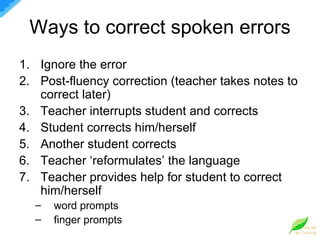
Ways to correct spoken errors Ignore the error Post-fluency correction (teacher takes notes to correct later) Teacher interrupts student and corrects Student corrects him/herself Another student corrects Teacher ‘reformulates’ the language Teacher provides help for student to correct him/herself word prompts finger prompts
Spoken error correction
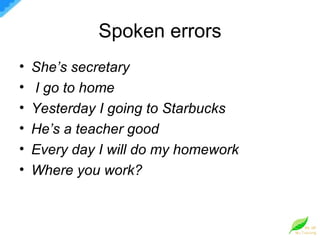
Spoken errors She’s secretary I go to home Yesterday I going to Starbucks He’s a teacher good  Every day I will do my homework Where you work?
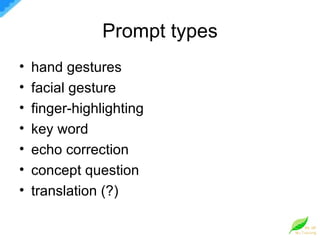
Prompt types hand gestures facial gesture finger-highlighting key word echo correction concept question translation (?)
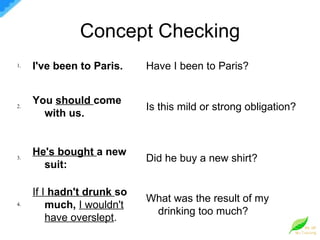
Concept Checking 1. I've been to Paris. Have I been to Paris? 2. You  should  come with us. Is this mild or strong obligation? 3. He's bought  a new suit: Did he buy a new shirt? 4. If I  hadn't drunk  so much,   I wouldn't have overslept . What was the result of my drinking too much?
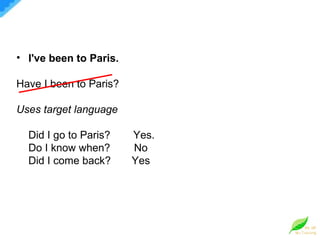
I've been to Paris.   Have I been to Paris? Uses target language Did I go to Paris?   Yes. Do I know when?  No Did I come back?  Yes
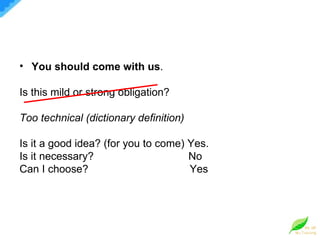
You should come with us . Is this mild or strong obligation?  Too   technical (dictionary definition) Is it a good idea? (for you to come) Yes.  Is it necessary?   No Can I choose?  Yes
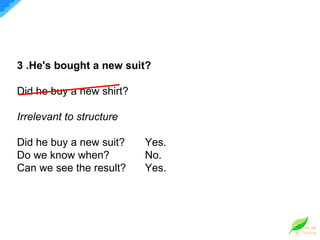
3 .He's bought a new suit? Did he buy a new shirt? Irrelevant to structure Did he buy a new suit? Yes. Do we know when? No. Can we see the result? Yes.
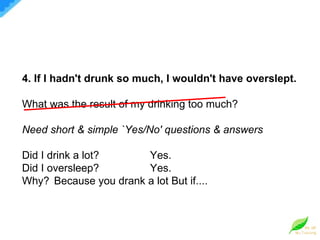
4. If I hadn't drunk so much, I wouldn't have overslept. What was the result of my drinking too much? Need short & simple `Yes/No' questions & answers Did I drink a lot? Yes. Did I oversleep? Yes. Why? Because you drank a lot But if....
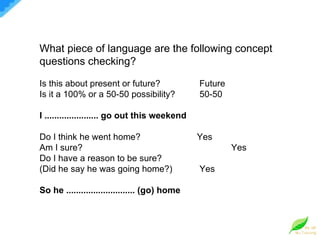
What piece of language are the following concept questions checking? Is this about present or future?   Future Is it a 100% or a 50-50 possibility? 50-50 I ...................... go out this weekend Do I think he went home?   Yes  Am I sure?   Yes  Do I have a reason to be sure? (Did he say he was going home?) Yes So he ............................ (go) home
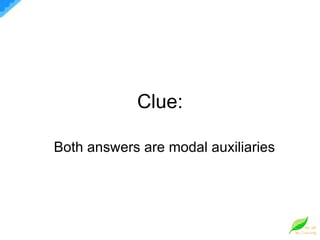
Clue: Both answers are modal auxiliaries
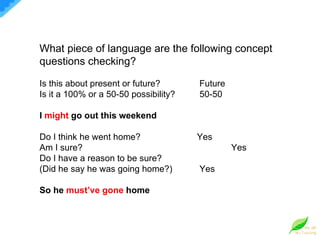
What piece of language are the following concept questions checking? Is this about present or future?   Future Is it a 100% or a 50-50 possibility? 50-50 I  might  go out this weekend Do I think he went home?   Yes  Am I sure?   Yes  Do I have a reason to be sure? (Did he say he was going home?) Yes So he  must’ve gone  home
Work in pairs. Can you think of CCQs to check the meaning?  I  managed to  climb the mountain I  used to  smoke I   was crossing  the road when the accident happened sensible  (not sensitive) e.g. She's a sensible girl
Workshop: Chain drill Take a card Read the card and decide what the error is Don’t write on the card! Read aloud your card to your partner He/her must listen, then use a prompt to get you to self correct Pass your card on
Do you like marking sts’ written work? How is correcting written English different from correcting spoken English?
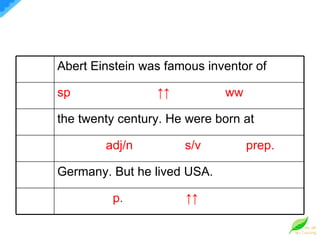
Abert Einstein was famous inventor of the twenty century. He were born at Germany. But he lived USA. Can you find the mistakes. How can we correct it? Correcting writing
Abert Einstein was famous inventor of  sp  ↑↑  ww the twenty century. He were born at adj/n  s/v  prep. Germany. But he lived USA. p.  ↑↑
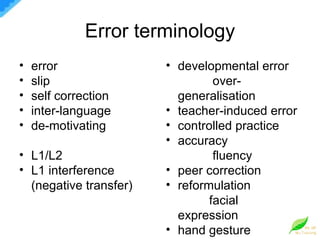
Error terminology error  slip  self correction  inter-language de-motivating  L1/L2 L1 interference  (negative transfer)  developmental error  over-generalisation teacher-induced error controlled practice  accuracy  fluency peer correction reformulation  facial expression  hand gesture
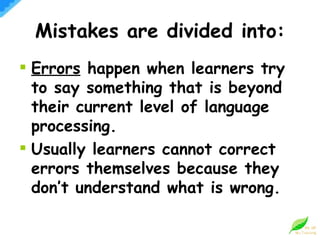
Mistakes are divided into: Errors  happen when learners try to say something that is beyond their current level of language processing. Usually learners cannot correct errors themselves because they don’t understand what is wrong.
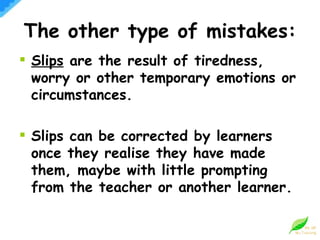
The other type of mistakes: Slips  are the result of tiredness, worry or other temporary emotions or circumstances. Slips can be corrected by learners once they realise they have made them, maybe with little prompting from the teacher or another learner.
Key concepts We need to think hard about whether, when and how to correct learners. In fluency activities it is better not to pay attention to learners’ errors— ignore   them—so that the learners have an opportunity to develop their confidence and fluency, and to experiment with language.
First reason why L2 learners make mistakes Interference or transfer :  influence from learners’ first language (L1) or their mother tongue Learners may use sound patterns, lexis or grammatical structures from their own language in English.
Developmental error : Learners are unconsciously working out and organising language but this process is not yet complete. Overgeneralisation  = when learners wrongly apply a rule for one item of the language to another item Second reason why L2 learners make mistakes
Errors are part of learners’  interlanguage   (the learners’ own version of the 2 nd  language which they speak as they learn). Interlanguage is not fixed because learners unconsciously process, i.e. analyse and reorganise it.
More key concepts Errors which prevent communication are more important than those which do not. Different learners may need to be corrected or not depending on their stages of learning, learning styles and level of confidence.
Ways of helping learners To expose them to lots of language that is just beyond their level, through reading and listening To give them opportunities to focus on the form of language To give them time to use language to communicate and interact and see if they can do so successfully

Tk terrorcorrection

  • 1.
  • 2.
    Can you rememberthese terms? Authentic material Extension activity Productive skills Receptive skills Aims / stage aim Assumptions Controlled practice Elicit Free practice TTT / STT PPP
  • 3.
    Authentic material Written or spoken texts which a first language speaker might read or listen to. They may be taken from newspapers, radio etc. The language in the texts is not adapted or made easier for learners or the language learning process.
  • 4.
    Assumptions Whenteachers think about what they believe their learners will or will not know or how they will behave in a particular lesson. For example, a teacher plans to teach the present simple using the context of jobs and daily routines. The teacher may make the assumption that learners will know basic job vocabulary and so knows s/he will not need to spend time in the lesson presenting these words.
  • 5.
    Elicit (verb) When a teacher thinks that some learners will know a piece of language or other information, s/he asks targeted questions or gives clues to get, or prompt learners to give the target language or information rather than simply providing it to the class her/himself.
  • 6.
    TTT and STTTTT and STT: Teacher Talking Time. The trend in ESL/EFL pedagogy has been to limit the amount of time that the teacher is talking and increase STT (Student Talking Time). TTT is often associated with a teacher-centered classroom and STT with a student-centered classroom. However, there are some problems with the view that student talking is good for students. For one, communication should be meaningful. Two, at the lowest levels, students may not be able to communicate effectively with each other. Three students may teach or reinforce each other's bad habits or incorrect expressions and grammar. Four, students will lack pragmatic competence in English and will not be able to pick it up from each other. A lot of research has shown that language is for the most part input driven. That is students learn most when they are being given sufficient comprehensible input .
  • 7.
    Spoken errors correctionDiscuss these questions in groups: Make some notes! Are errors a good thing or a bad thing? Why do sts. make errors? – 3 reasons 3 different ways to correct spoken errors
  • 8.
    Are errors agood thing? They show learning No errors = probably no input of new language Who needs more correction: strong or weak students?
  • 9.
    Why do studentsmake errors? Language interference (L1) They haven’t learnt sth. yet (error) They confuse 2 similar things Not enough mental power (attention) ‘ Slips’
  • 10.
    I goed toa movie last week Over-generalization Form or meaning?
  • 11.
    I have everbeen to Shanghai last year Form or meaning?
  • 12.
    I saw amovie about a big sheep …It’s name is Titanic pronunciation
  • 13.
    In a shoppingroleplay: S1:Can I help you? S2: Yes. Give me an MP4 player! S1: Certainly. Here you are. S2: Thank you Is it ‘right’ or ‘wrong’? Appropriacy
  • 14.
    Ways to correctspoken errors Think about, for example: A student is telling a story (fluency activity) Students are repeating sentences or making substitutions (a drill) Students answer comprehension questions
  • 15.
    Is it a‘fluency’ or ‘accuracy’ activity? You probably can’t do both at the same time
  • 16.
    Ways to correctspoken errors Ignore the error Post-fluency correction (teacher takes notes to correct later) Teacher interrupts student and corrects Student corrects him/herself Another student corrects Teacher ‘reformulates’ the language Teacher provides help for student to correct him/herself word prompts finger prompts
  • 17.
  • 18.
    Spoken errors She’ssecretary I go to home Yesterday I going to Starbucks He’s a teacher good Every day I will do my homework Where you work?
  • 19.
    Prompt types handgestures facial gesture finger-highlighting key word echo correction concept question translation (?)
  • 20.
    Concept Checking 1.I've been to Paris. Have I been to Paris? 2. You should come with us. Is this mild or strong obligation? 3. He's bought a new suit: Did he buy a new shirt? 4. If I hadn't drunk so much, I wouldn't have overslept . What was the result of my drinking too much?
  • 21.
    I've been toParis. Have I been to Paris? Uses target language Did I go to Paris? Yes. Do I know when? No Did I come back? Yes
  • 22.
    You should comewith us . Is this mild or strong obligation? Too technical (dictionary definition) Is it a good idea? (for you to come) Yes. Is it necessary? No Can I choose? Yes
  • 23.
    3 .He's boughta new suit? Did he buy a new shirt? Irrelevant to structure Did he buy a new suit? Yes. Do we know when? No. Can we see the result? Yes.
  • 24.
    4. If Ihadn't drunk so much, I wouldn't have overslept. What was the result of my drinking too much? Need short & simple `Yes/No' questions & answers Did I drink a lot? Yes. Did I oversleep? Yes. Why? Because you drank a lot But if....
  • 25.
    What piece oflanguage are the following concept questions checking? Is this about present or future? Future Is it a 100% or a 50-50 possibility? 50-50 I ...................... go out this weekend Do I think he went home? Yes Am I sure? Yes Do I have a reason to be sure? (Did he say he was going home?) Yes So he ............................ (go) home
  • 26.
    Clue: Both answersare modal auxiliaries
  • 27.
    What piece oflanguage are the following concept questions checking? Is this about present or future? Future Is it a 100% or a 50-50 possibility? 50-50 I might go out this weekend Do I think he went home? Yes Am I sure? Yes Do I have a reason to be sure? (Did he say he was going home?) Yes So he must’ve gone home
  • 28.
    Work in pairs.Can you think of CCQs to check the meaning? I managed to climb the mountain I used to smoke I was crossing the road when the accident happened sensible (not sensitive) e.g. She's a sensible girl
  • 29.
    Workshop: Chain drillTake a card Read the card and decide what the error is Don’t write on the card! Read aloud your card to your partner He/her must listen, then use a prompt to get you to self correct Pass your card on
  • 30.
    Do you likemarking sts’ written work? How is correcting written English different from correcting spoken English?
  • 31.
    Abert Einstein wasfamous inventor of the twenty century. He were born at Germany. But he lived USA. Can you find the mistakes. How can we correct it? Correcting writing
  • 32.
    Abert Einstein wasfamous inventor of sp ↑↑ ww the twenty century. He were born at adj/n s/v prep. Germany. But he lived USA. p. ↑↑
  • 33.
    Error terminology error slip self correction inter-language de-motivating L1/L2 L1 interference (negative transfer) developmental error over-generalisation teacher-induced error controlled practice accuracy fluency peer correction reformulation facial expression hand gesture
  • 34.
    Mistakes are dividedinto: Errors happen when learners try to say something that is beyond their current level of language processing. Usually learners cannot correct errors themselves because they don’t understand what is wrong.
  • 35.
    The other typeof mistakes: Slips are the result of tiredness, worry or other temporary emotions or circumstances. Slips can be corrected by learners once they realise they have made them, maybe with little prompting from the teacher or another learner.
  • 36.
    Key concepts Weneed to think hard about whether, when and how to correct learners. In fluency activities it is better not to pay attention to learners’ errors— ignore them—so that the learners have an opportunity to develop their confidence and fluency, and to experiment with language.
  • 37.
    First reason whyL2 learners make mistakes Interference or transfer : influence from learners’ first language (L1) or their mother tongue Learners may use sound patterns, lexis or grammatical structures from their own language in English.
  • 38.
    Developmental error :Learners are unconsciously working out and organising language but this process is not yet complete. Overgeneralisation = when learners wrongly apply a rule for one item of the language to another item Second reason why L2 learners make mistakes
  • 39.
    Errors are partof learners’ interlanguage (the learners’ own version of the 2 nd language which they speak as they learn). Interlanguage is not fixed because learners unconsciously process, i.e. analyse and reorganise it.
  • 40.
    More key conceptsErrors which prevent communication are more important than those which do not. Different learners may need to be corrected or not depending on their stages of learning, learning styles and level of confidence.
  • 41.
    Ways of helpinglearners To expose them to lots of language that is just beyond their level, through reading and listening To give them opportunities to focus on the form of language To give them time to use language to communicate and interact and see if they can do so successfully