Computing in
English Education
Oliver Quinlan
nesta.org.uk
oliverquinlan.com
@oliverquinlanCC BY NC
celesterc
England
(C) Google Maps
(C) Google Maps
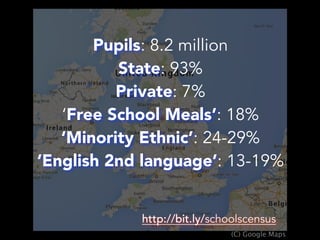
Pupils: 8.2 million
State: 93%
Private: 7%
‘Free School Meals’: 18%
‘Minority Ethnic’: 24-29%
‘English 2nd language’: 13-19%
http://bit.ly/schoolscensus
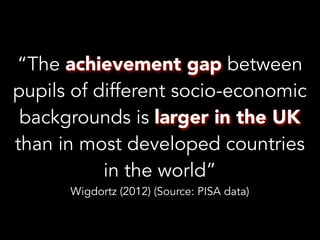
“The achievement gap between
pupils of different socio-economic
backgrounds is larger in the UK
than in most developed countries
in the world”
Wigdortz (2012) (Source: PISA data)
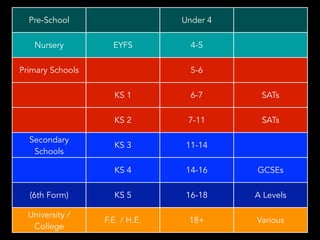
Pre-School Under 4
Nursery EYFS 4-5
Primary Schools 5-6
KS 1 6-7 SATs
KS 2 7-11 SATs
Secondary
Schools
KS 3 11-14
KS 4 14-16 GCSEs
(6th Form) KS 5 16-18 A Levels
University /
College
F.E. / H.E. 18+ Various
History
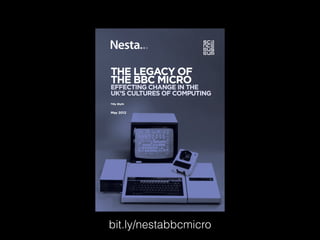
bit.ly/nestabbcmicro
CC BY SA Gisela Giardino
theguardian (2011), Eric Schmidt’s McTaggart Lecture- Full text. Available at:
http://www.guardian.co.uk/media/interactive/2011/aug/26/eric-schmidt-
mactaggart-lecture-full-text (Accessed 25th September 2012)
“You invented computers in
both concept and practice [...]
Yet today, none of the world's
leading exponents in these
fields are from the UK.”
Nesta ‘NextGen’ Report
NESTA
“Shut down or restart?”
The Royal Society
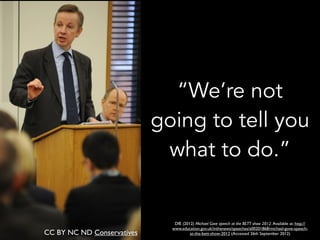
“We’re not
going to tell you
what to do.”
CC BY NC ND Conservatives
DfE (2012) Michael Gove speech at the BETT show 2012. Available at: http://
www.education.gov.uk/inthenews/speeches/a00201868/michael-gove-speech-
at-the-bett-show-2012 (Accessed 26th September 2012)
Computing
S E P T E M B E R 2 0 1 4 :
The Curriculum
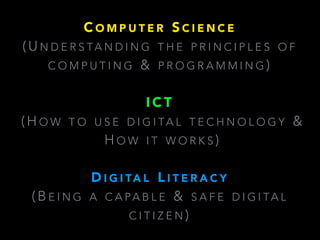
C O M P U T E R S C I E N C E
( U N D E R S TA N D I N G T H E P R I N C I P L E S O F
C O M P U T I N G & P R O G R A M M I N G )
I C T
( H O W T O U S E D I G I TA L T E C H N O L O G Y &
H O W I T W O R K S )
D I G I TA L L I T E R A C Y
( B E I N G A C A PA B L E & S A F E D I G I TA L
C I T I Z E N )
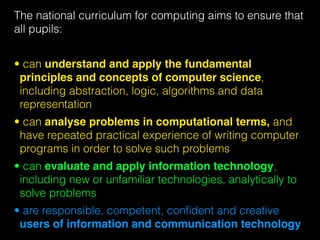
The national curriculum for computing aims to ensure that
all pupils:
• can understand and apply the fundamental
principles and concepts of computer science,
including abstraction, logic, algorithms and data
representation
• can analyse problems in computational terms, and
have repeated practical experience of writing computer
programs in order to solve such problems
• can evaluate and apply information technology,
including new or unfamiliar technologies, analytically to
solve problems
• are responsible, competent, confident and creative
users of information and communication technology
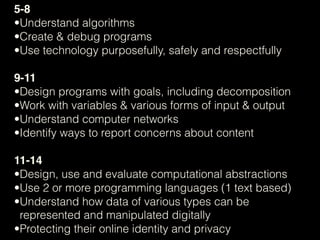
5-8
•Understand algorithms
•Create & debug programs
•Use technology purposefully, safely and respectfully
9-11
•Design programs with goals, including decomposition
•Work with variables & various forms of input & output
•Understand computer networks
•Identify ways to report concerns about content
11-14
•Design, use and evaluate computational abstractions
•Use 2 or more programming languages (1 text based)
•Understand how data of various types can be
represented and manipulated digitally
•Protecting their online identity and privacy
The English National Curriculum for Computing
https://www.gov.uk/government/publications/national-
curriculum-in-england-computing-programmes-of-study/
national-curriculum-in-england-computing-programmes-
of-study
bit.ly/computingengland
Successes
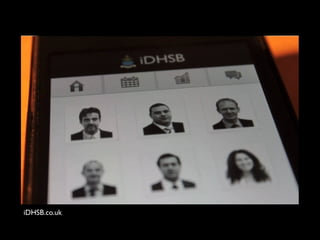
iDHSB.co.uk
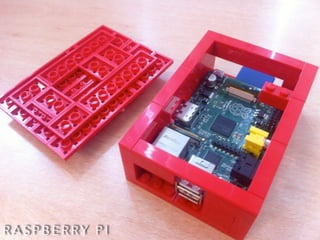
R A S P B E R RY P I
computingatschool.org.uk
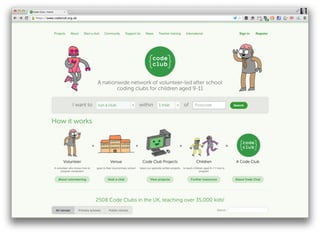
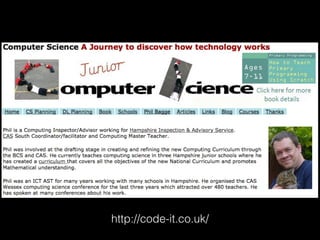
http://code-it.co.uk/
Challenges
Why it matters
bit.ly/digitalmakers
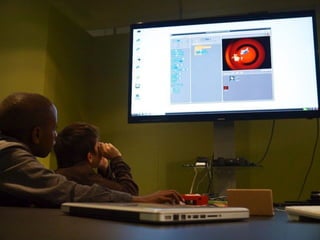
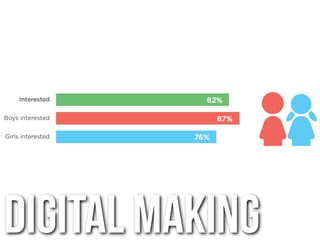
Digital Making
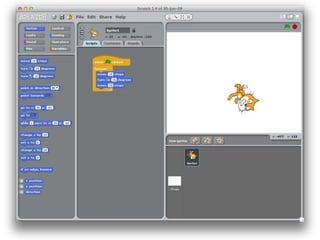
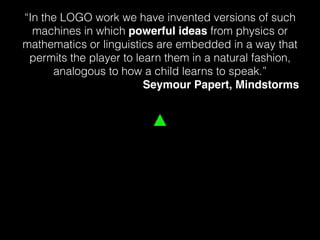
“In the LOGO work we have invented versions of such
machines in which powerful ideas from physics or
mathematics or linguistics are embedded in a way that
permits the player to learn them in a natural fashion,
analogous to how a child learns to speak.”
Seymour Papert, Mindstorms
Certain ideas can be used as tools to think with over a
lifetime.
One learns to enjoy and to respect the power of powerful
ideas. One learns that the most powerful idea of all is the
idea of powerful ideas.
Seymour Papert, Mindstorms
slideshare.com/oliverquinlan
Oliver Quinlan
nesta.org.uk
oliverquinlan.com
@oliverquinlan

Computing in English Education #ind15

  • 1.
    Computing in English Education OliverQuinlan nesta.org.uk oliverquinlan.com @oliverquinlanCC BY NC celesterc
  • 2.
  • 3.
  • 4.
    (C) Google Maps Pupils:8.2 million State: 93% Private: 7% ‘Free School Meals’: 18% ‘Minority Ethnic’: 24-29% ‘English 2nd language’: 13-19% http://bit.ly/schoolscensus
  • 5.
    “The achievement gapbetween pupils of different socio-economic backgrounds is larger in the UK than in most developed countries in the world” Wigdortz (2012) (Source: PISA data)
  • 6.
    Pre-School Under 4 NurseryEYFS 4-5 Primary Schools 5-6 KS 1 6-7 SATs KS 2 7-11 SATs Secondary Schools KS 3 11-14 KS 4 14-16 GCSEs (6th Form) KS 5 16-18 A Levels University / College F.E. / H.E. 18+ Various
  • 7.
  • 8.
  • 9.
    CC BY SAGisela Giardino theguardian (2011), Eric Schmidt’s McTaggart Lecture- Full text. Available at: http://www.guardian.co.uk/media/interactive/2011/aug/26/eric-schmidt- mactaggart-lecture-full-text (Accessed 25th September 2012) “You invented computers in both concept and practice [...] Yet today, none of the world's leading exponents in these fields are from the UK.”
  • 10.
    Nesta ‘NextGen’ Report NESTA “Shutdown or restart?” The Royal Society
  • 11.
    “We’re not going totell you what to do.” CC BY NC ND Conservatives DfE (2012) Michael Gove speech at the BETT show 2012. Available at: http:// www.education.gov.uk/inthenews/speeches/a00201868/michael-gove-speech- at-the-bett-show-2012 (Accessed 26th September 2012)
  • 12.
    Computing S E PT E M B E R 2 0 1 4 :
  • 13.
  • 14.
    C O MP U T E R S C I E N C E ( U N D E R S TA N D I N G T H E P R I N C I P L E S O F C O M P U T I N G & P R O G R A M M I N G ) I C T ( H O W T O U S E D I G I TA L T E C H N O L O G Y & H O W I T W O R K S ) D I G I TA L L I T E R A C Y ( B E I N G A C A PA B L E & S A F E D I G I TA L C I T I Z E N )
  • 15.
    The national curriculumfor computing aims to ensure that all pupils: • can understand and apply the fundamental principles and concepts of computer science, including abstraction, logic, algorithms and data representation • can analyse problems in computational terms, and have repeated practical experience of writing computer programs in order to solve such problems • can evaluate and apply information technology, including new or unfamiliar technologies, analytically to solve problems • are responsible, competent, confident and creative users of information and communication technology
  • 16.
    5-8 •Understand algorithms •Create &debug programs •Use technology purposefully, safely and respectfully 9-11 •Design programs with goals, including decomposition •Work with variables & various forms of input & output •Understand computer networks •Identify ways to report concerns about content 11-14 •Design, use and evaluate computational abstractions •Use 2 or more programming languages (1 text based) •Understand how data of various types can be represented and manipulated digitally •Protecting their online identity and privacy
  • 17.
    The English NationalCurriculum for Computing https://www.gov.uk/government/publications/national- curriculum-in-england-computing-programmes-of-study/ national-curriculum-in-england-computing-programmes- of-study bit.ly/computingengland
  • 18.
  • 24.
  • 25.
    R A SP B E R RY P I
  • 26.
  • 27.
  • 28.
  • 30.
  • 33.
  • 34.
  • 36.
    “In the LOGOwork we have invented versions of such machines in which powerful ideas from physics or mathematics or linguistics are embedded in a way that permits the player to learn them in a natural fashion, analogous to how a child learns to speak.” Seymour Papert, Mindstorms
  • 37.
    Certain ideas canbe used as tools to think with over a lifetime. One learns to enjoy and to respect the power of powerful ideas. One learns that the most powerful idea of all is the idea of powerful ideas. Seymour Papert, Mindstorms
  • 38.