There are many types of computers categorized by size and processing power. Desktops are designed for individual use and have a tower, keyboard, mouse and monitor. Laptops are portable with integrated components and run on batteries. Netbooks are smaller laptops with less power. Tablets use touchscreens and apps. Mobile devices include phones and can access the internet, apps, cameras and more. Servers store network files and data. Mainframes process large amounts of data for thousands simultaneously. Supercomputers perform quadrillions of calculations and are used for research. Wearable computers integrate technology into watches and clothing. Embedded computers are single-chip systems installed in devices. Future computers may be more integrated with glasses and highly engineered materials.
Introduction
There aremany different types of
computers available today.
They are categorized into different types
depending on their size and processing
power,
What are the categories?
3.
Desktop / PC
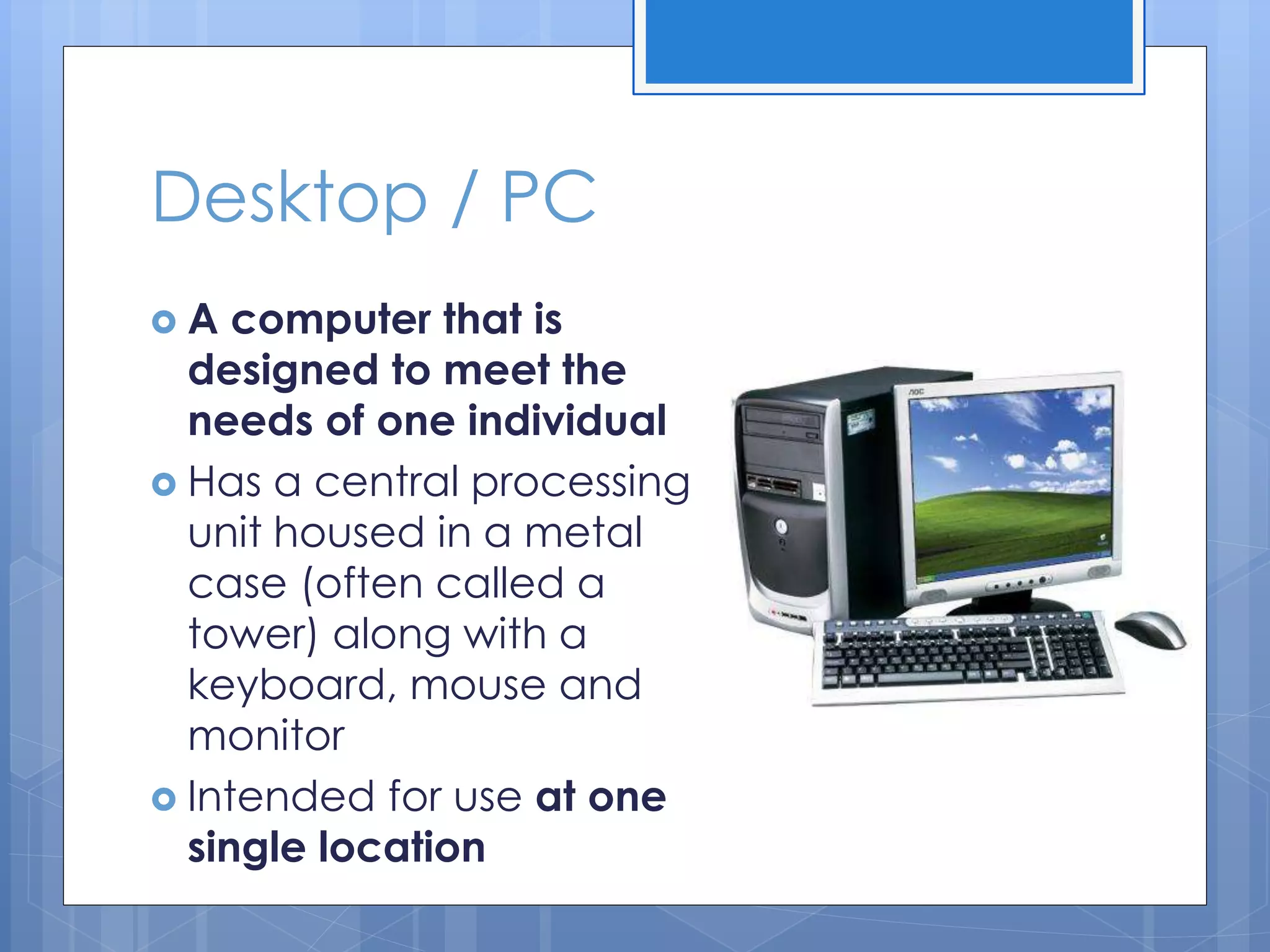
A computer that is
designed to meet the
needs of one individual
Has a central processing
unit housed in a metal
case (often called a
tower) along with a
keyboard, mouse and
monitor
Intended for use at one
single location
4.
Desktops are usedfor:
Desktops are used for running applications
(full scale, complex software) including:
Office Software—Word processing,
spreadsheets, presentations, and databases
Engineering designing software—CAD/CAM
and other designing software for homes,
kitchens, airplanes and more…
Photo and Video editing
Music—creating, playing and storing
Internet—Entertainment and information
5.
Advantages and Disadvantages
Easy to upgrade
Vast range of
software available
Easy to mix and
match; customize to
meet your needs.
Can be used
continually for long
periods of time
Not easily portable
Requires large
amount of desk
space
Needs a fan to
prevent overheating
Must be plugged in
to power outlet
6.
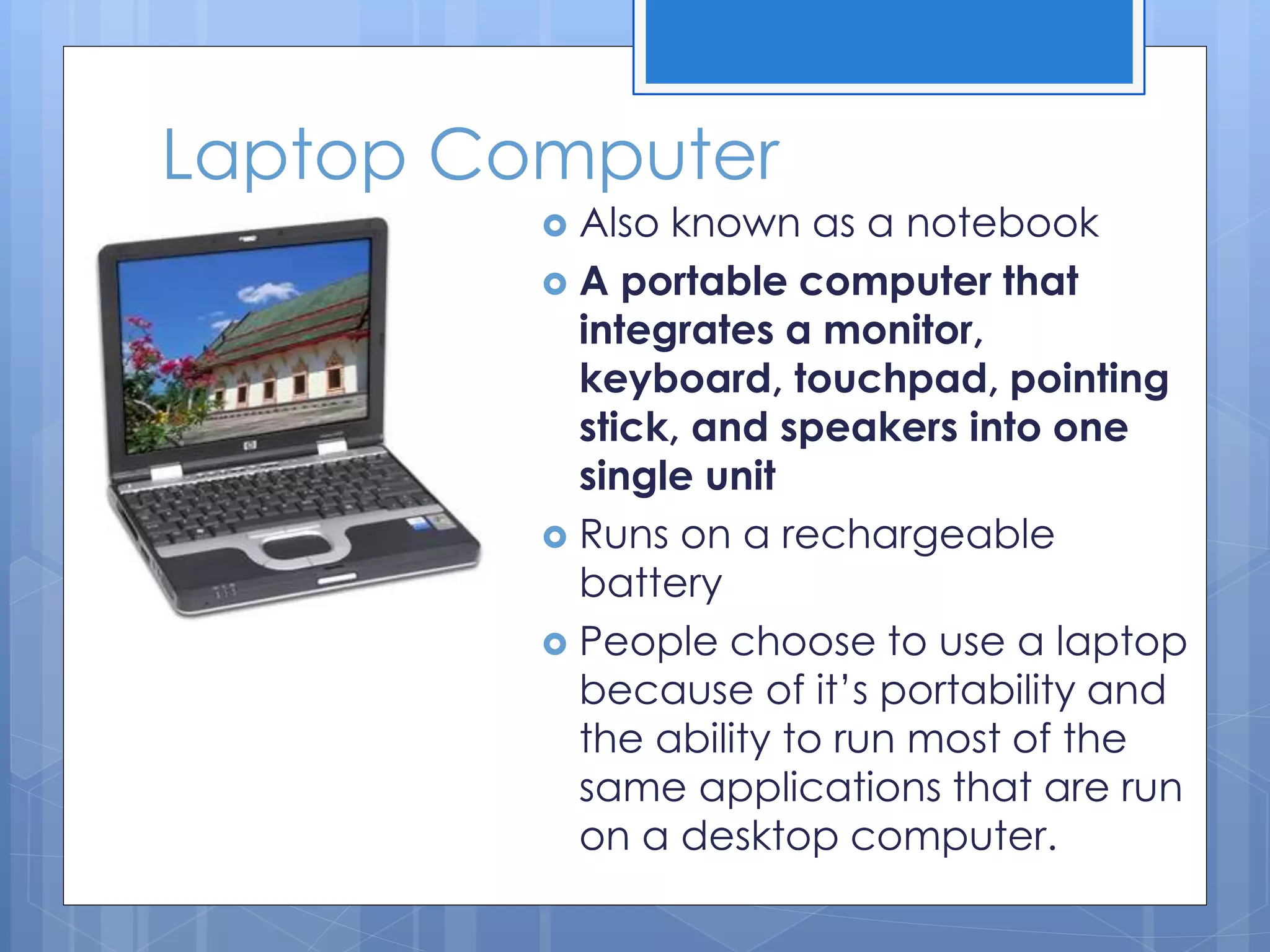
Laptop Computer
Alsoknown as a notebook
A portable computer that
integrates a monitor,
keyboard, touchpad, pointing
stick, and speakers into one
single unit
Runs on a rechargeable
battery
People choose to use a laptop
because of it’s portability and
the ability to run most of the
same applications that are run
on a desktop computer.
7.
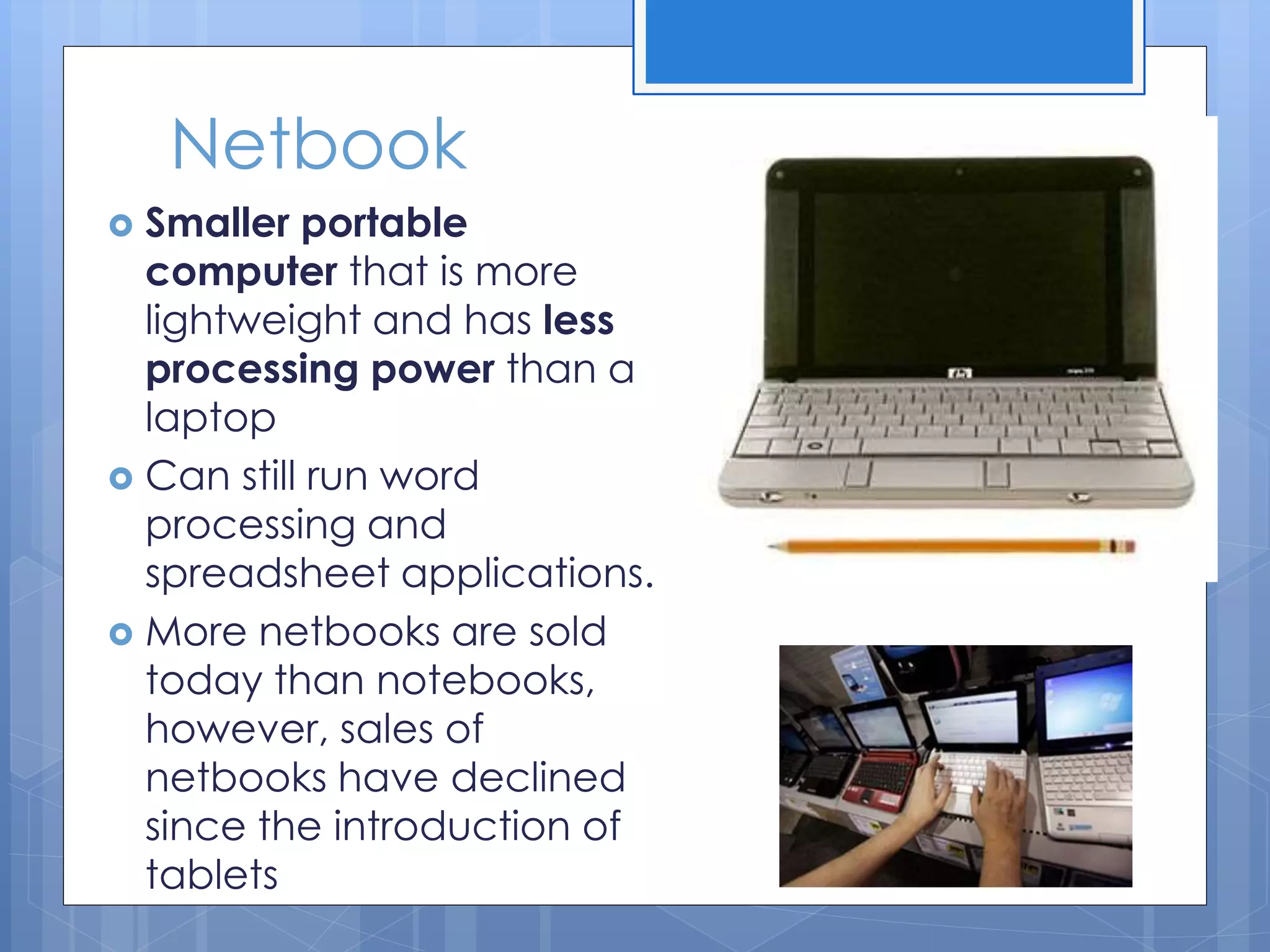
Netbook
Smaller portable
computerthat is more
lightweight and has less
processing power than a
laptop
Can still run word
processing and
spreadsheet applications.
More netbooks are sold
today than notebooks,
however, sales of
netbooks have declined
since the introduction of
tablets
8.
Advantages and Disadvantages
ofNotebooks and Netbooks
Portable
Lightweight
Runs on a
rechargeable
battery
Runs the same
software as a
Desktop PC
More expensive than
a comparable PC
Easily damaged if
dropped
Difficult to repair/
upgrade
9.
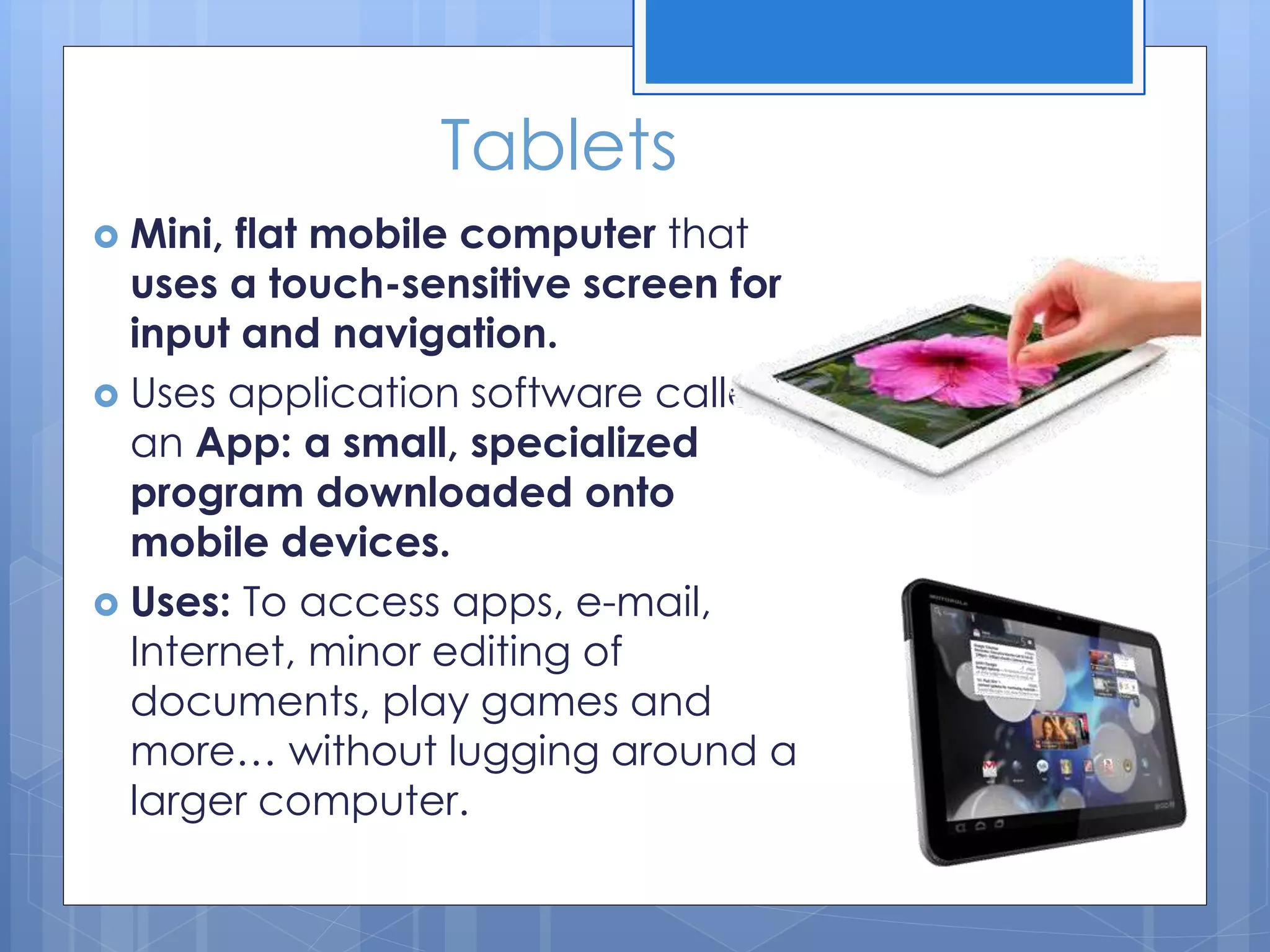
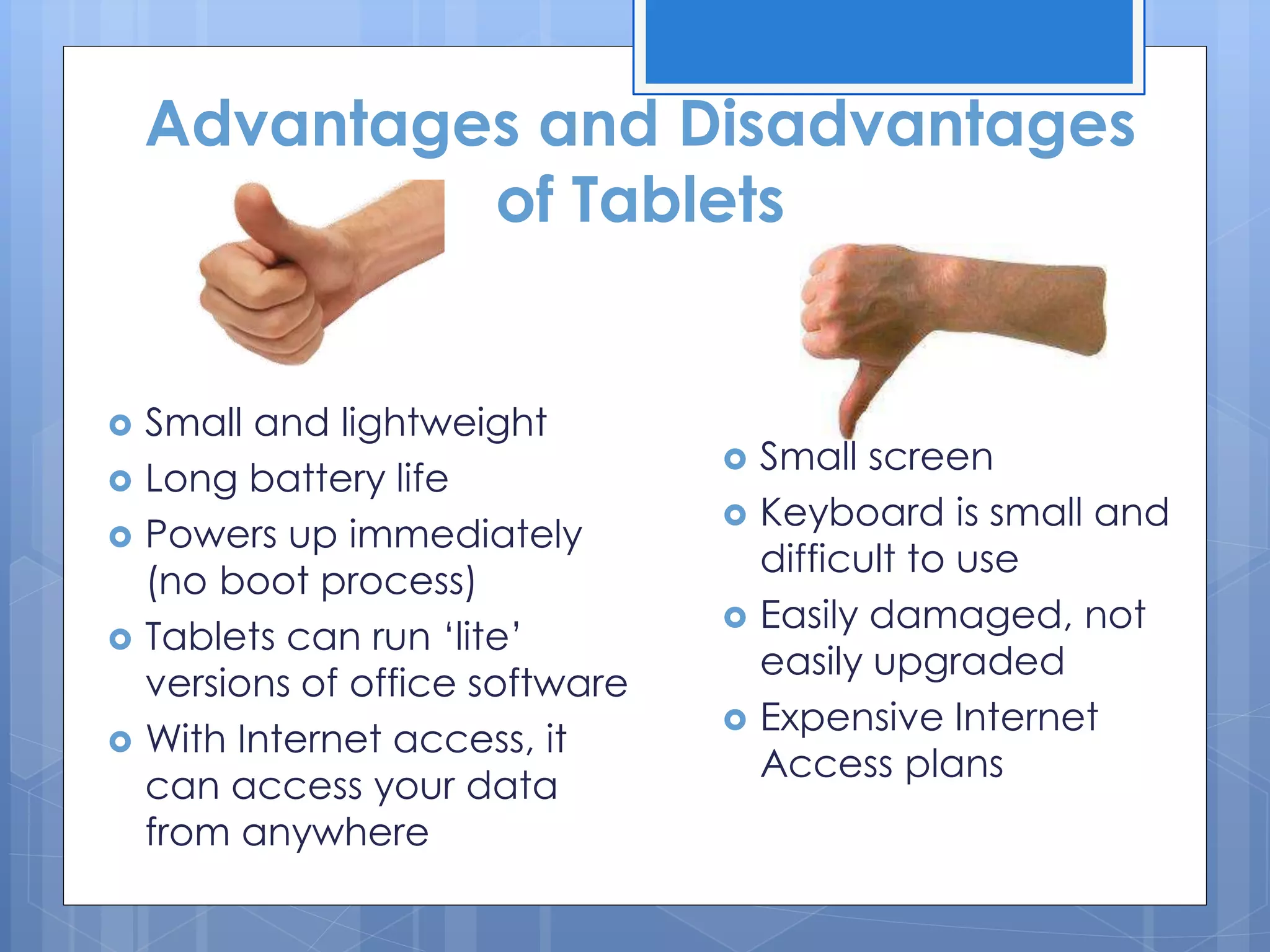
Tablets
Mini, flatmobile computer that
uses a touch-sensitive screen for
input and navigation.
Uses application software called
an App: a small, specialized
program downloaded onto
mobile devices.
Uses: To access apps, e-mail,
Internet, minor editing of
documents, play games and
more… without lugging around a
larger computer.
10.
Advantages and Disadvantages
ofTablets
Small and lightweight
Long battery life
Powers up immediately
(no boot process)
Tablets can run ‘lite’
versions of office software
With Internet access, it
can access your data
from anywhere
Small screen
Keyboard is small and
difficult to use
Easily damaged, not
easily upgraded
Expensive Internet
Access plans
11.
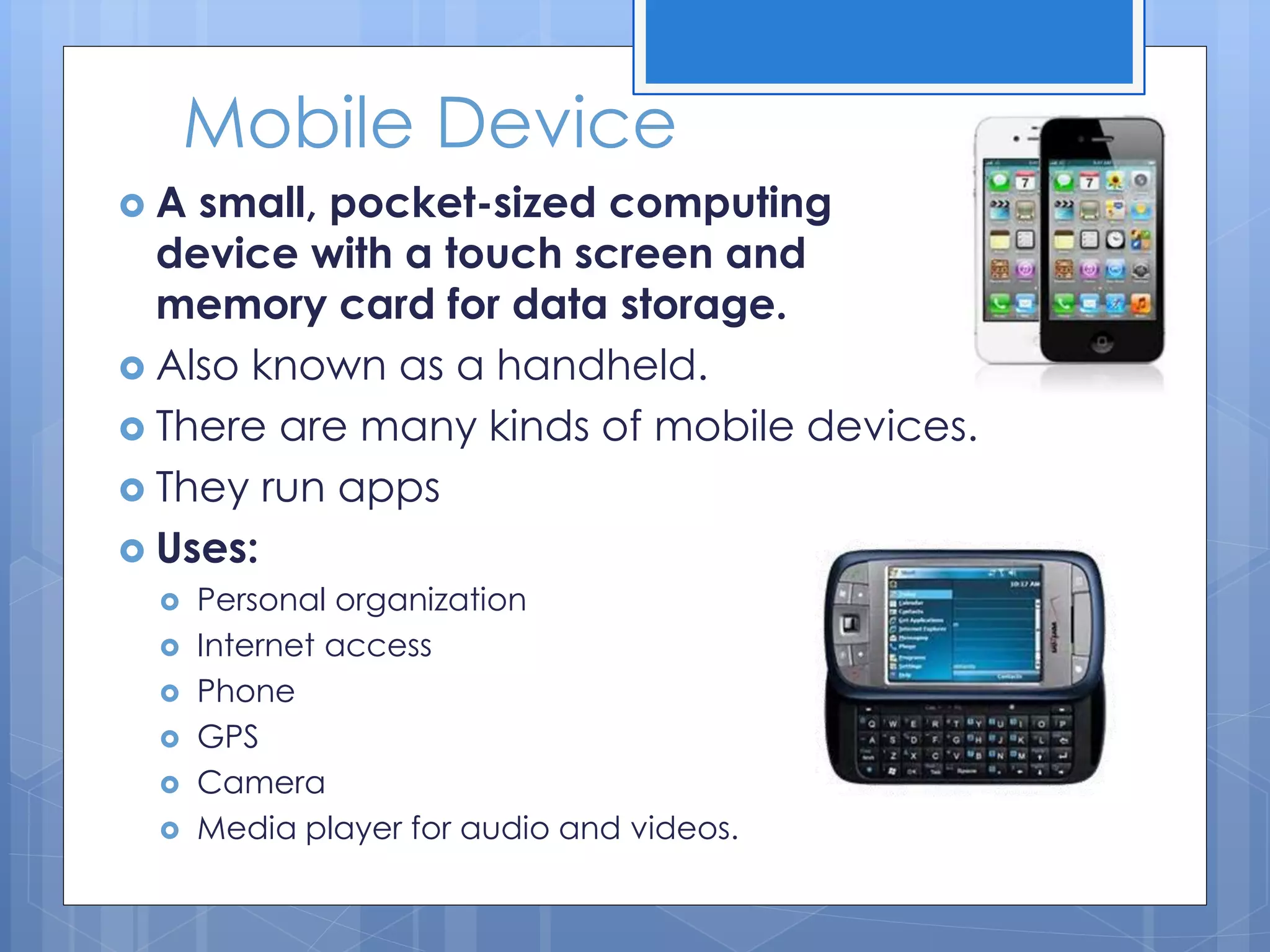
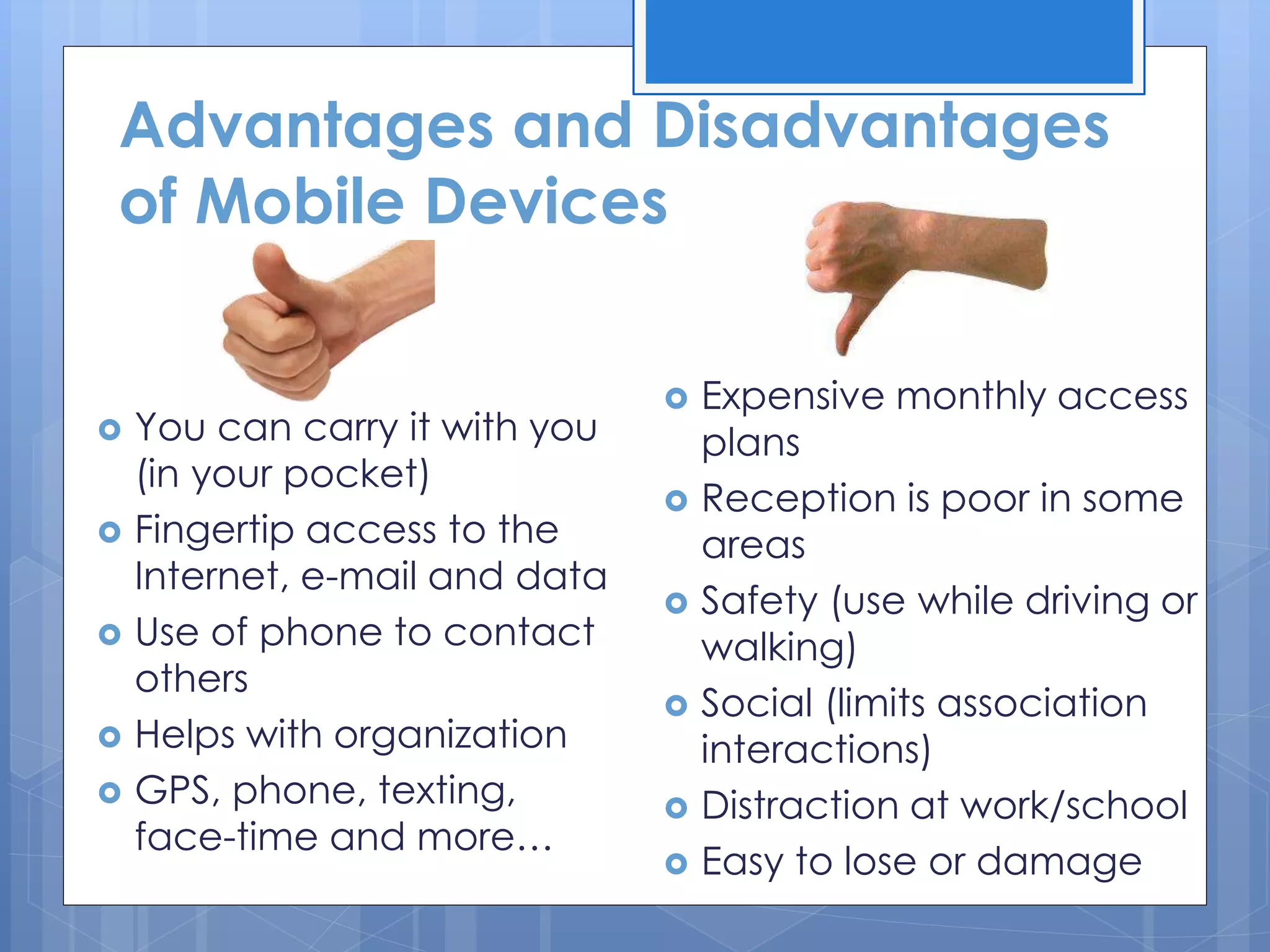
Mobile Device
Asmall, pocket-sized computing
device with a touch screen and
memory card for data storage.
Also known as a handheld.
There are many kinds of mobile devices.
They run apps
Uses:
Personal organization
Internet access
Phone
GPS
Camera
Media player for audio and videos.
12.
Advantages and Disadvantages
ofMobile Devices
You can carry it with you
(in your pocket)
Fingertip access to the
Internet, e-mail and data
Use of phone to contact
others
Helps with organization
GPS, phone, texting,
face-time and more…
Expensive monthly access
plans
Reception is poor in some
areas
Safety (use while driving or
walking)
Social (limits association
interactions)
Distraction at work/school
Easy to lose or damage
13.
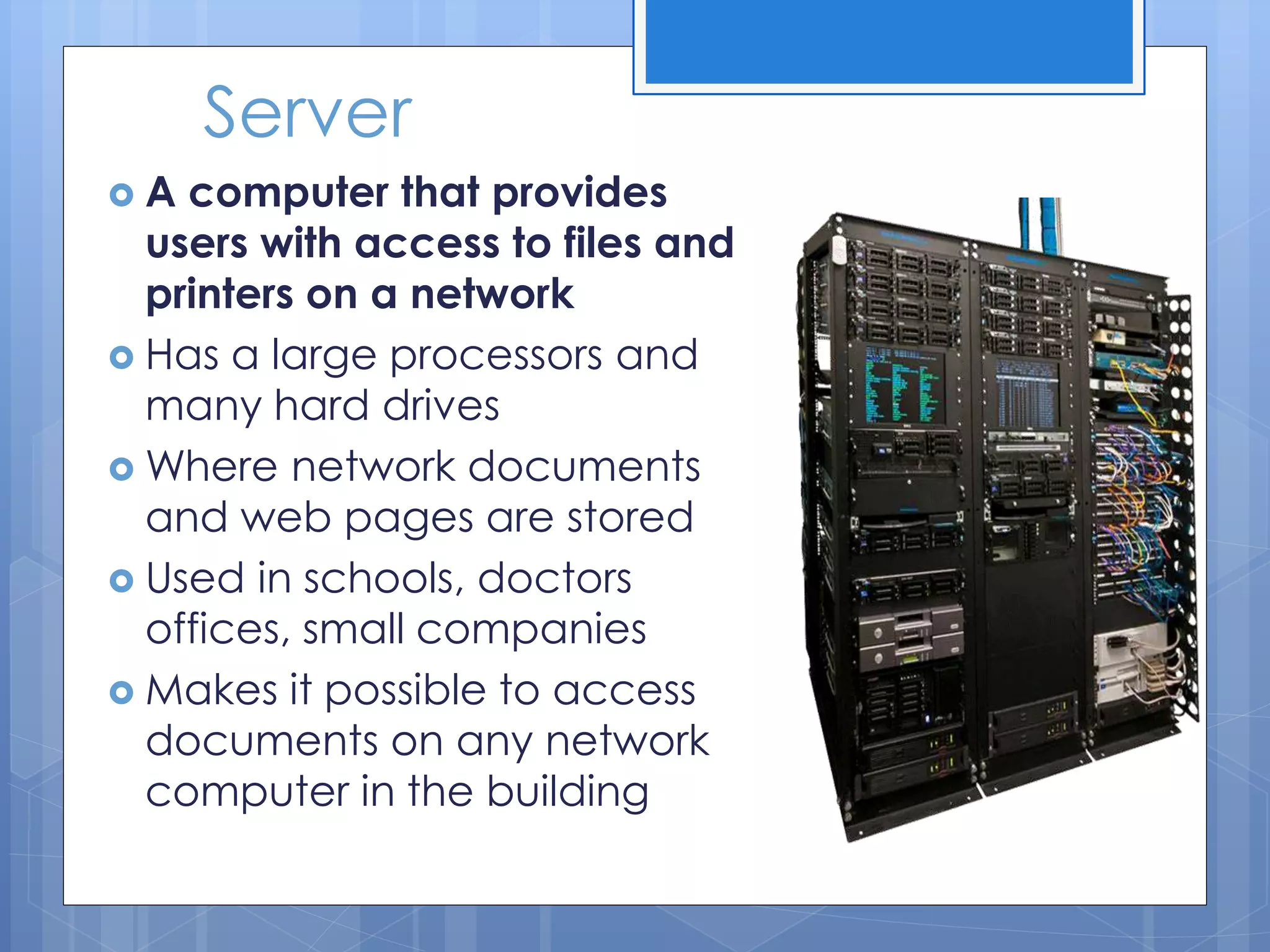
Server
A computerthat provides
users with access to files and
printers on a network
Has a large processors and
many hard drives
Where network documents
and web pages are stored
Used in schools, doctors
offices, small companies
Makes it possible to access
documents on any network
computer in the building
14.
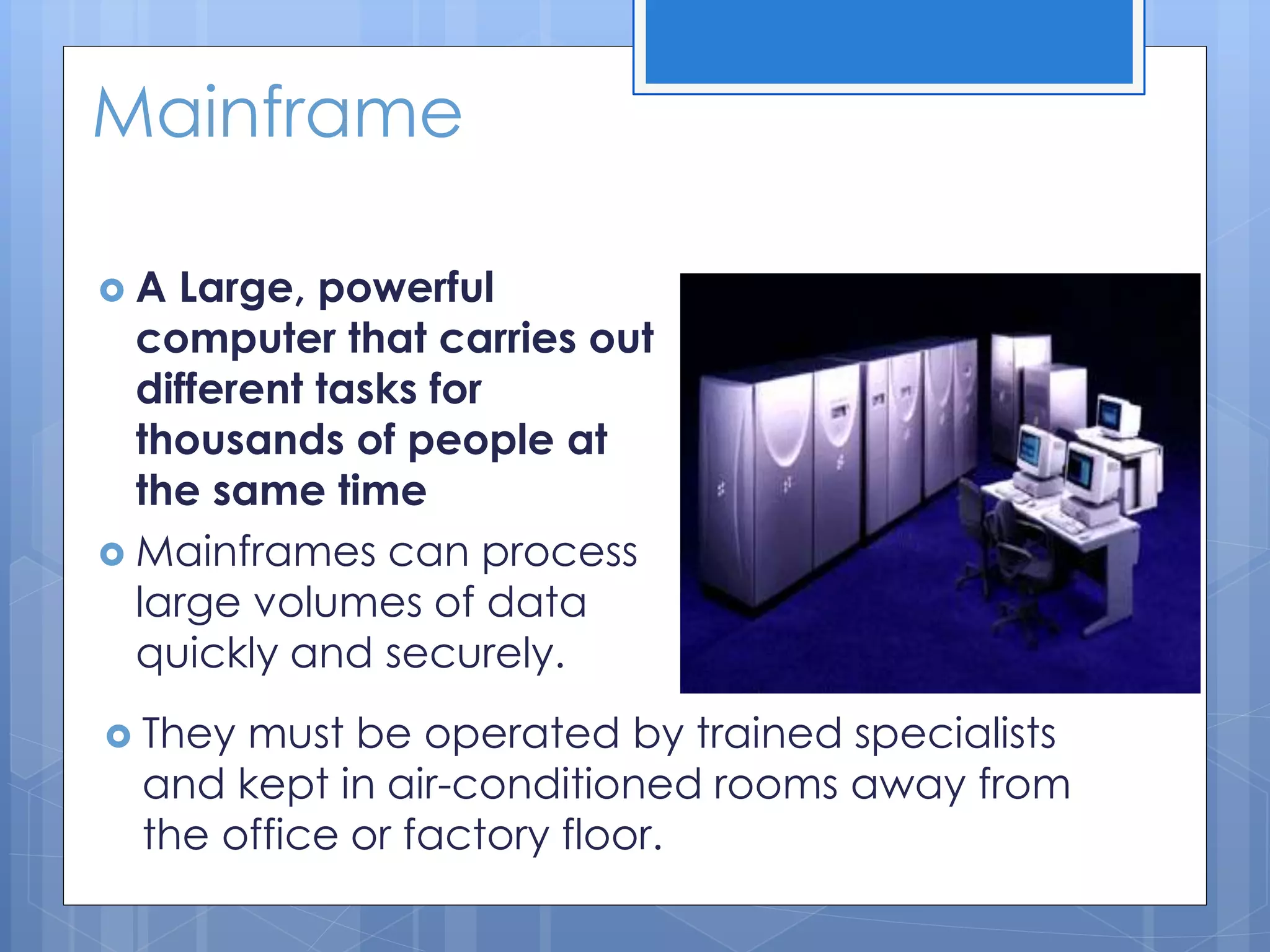
Mainframe
A Large,powerful
computer that carries out
different tasks for
thousands of people at
the same time
Mainframes can process
large volumes of data
quickly and securely.
They must be operated by trained specialists
and kept in air-conditioned rooms away from
the office or factory floor.
15.
Mainframes are usedfor:
Utility Companies (Gas and Electricity
suppliers)--for billing
Banks –for managing your accounts
Insurance Companies—managing
policies
Airlines—reservations and ticket
processing
Police—crime detection
16.
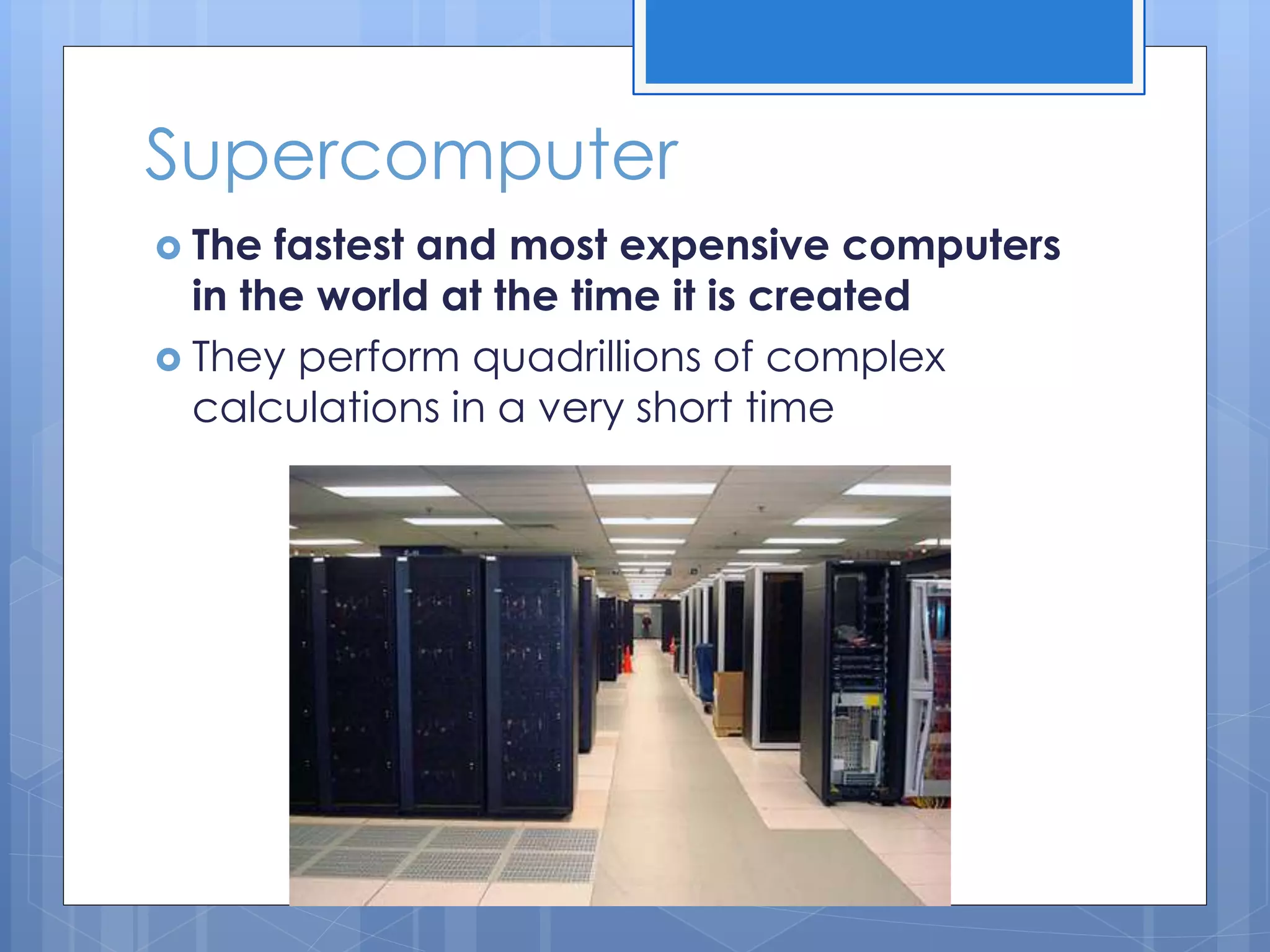
Supercomputer
The fastestand most expensive computers
in the world at the time it is created
They perform quadrillions of complex
calculations in a very short time
17.
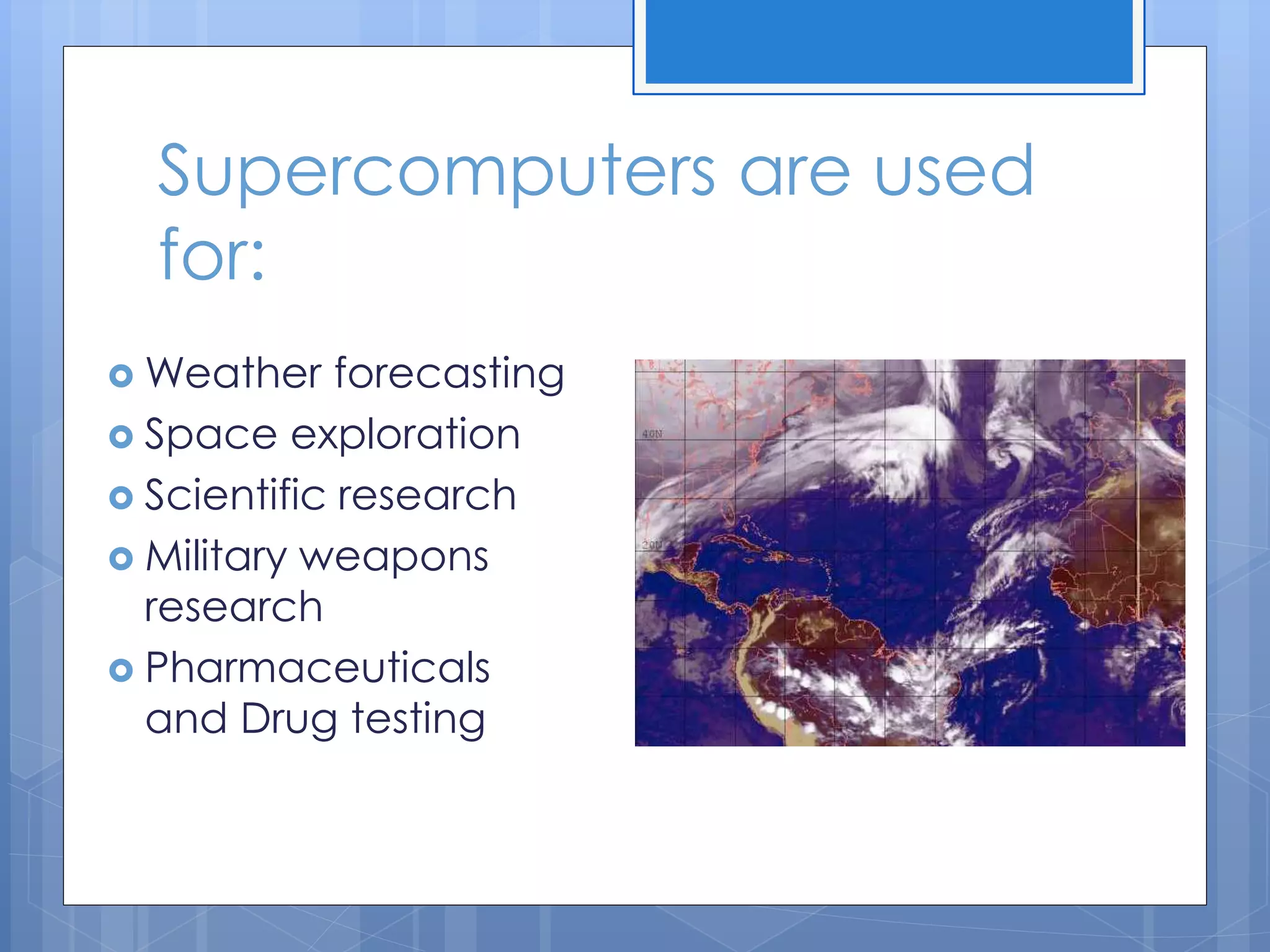
Supercomputers are used
for:
Weather forecasting
Space exploration
Scientific research
Military weapons
research
Pharmaceuticals
and Drug testing
18.
Supercomputers continued…
Generatelots of heat;
air-conditioning required
Miles of cables connect
the computer to
peripherals
Requires its own
electricity generator
Need special filters
installed to keep the
atmosphere free of dust
particles
Can tackle huge real
world calculations
that would be too
time consuming to
be completed by an
individual or any
other type of
computer
Speed and accuracy
of calculations
19.
Supercomputers
Click below towatch a video about supercomputers. Please keep in mind that the list of top 10
supercomputers in the world constantly changes as new supercomputers are created and older
supercomputers are updated.
20.
So how fastis a Petaflop?
This short 2 minute video explains!
21.
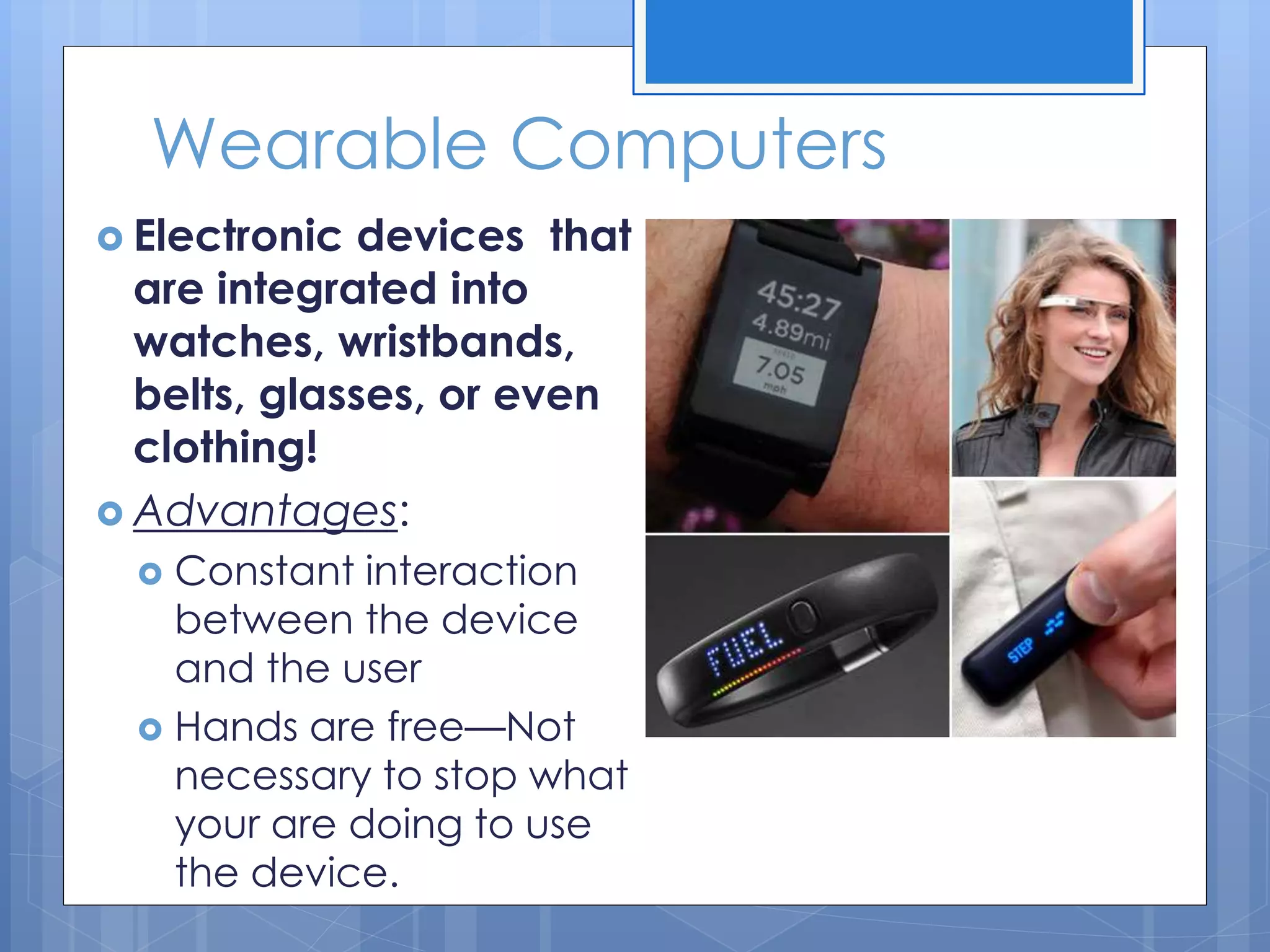
Wearable Computers
Electronicdevices that
are integrated into
watches, wristbands,
belts, glasses, or even
clothing!
Advantages:
Constant interaction
between the device
and the user
Hands are free—Not
necessary to stop what
your are doing to use
the device.
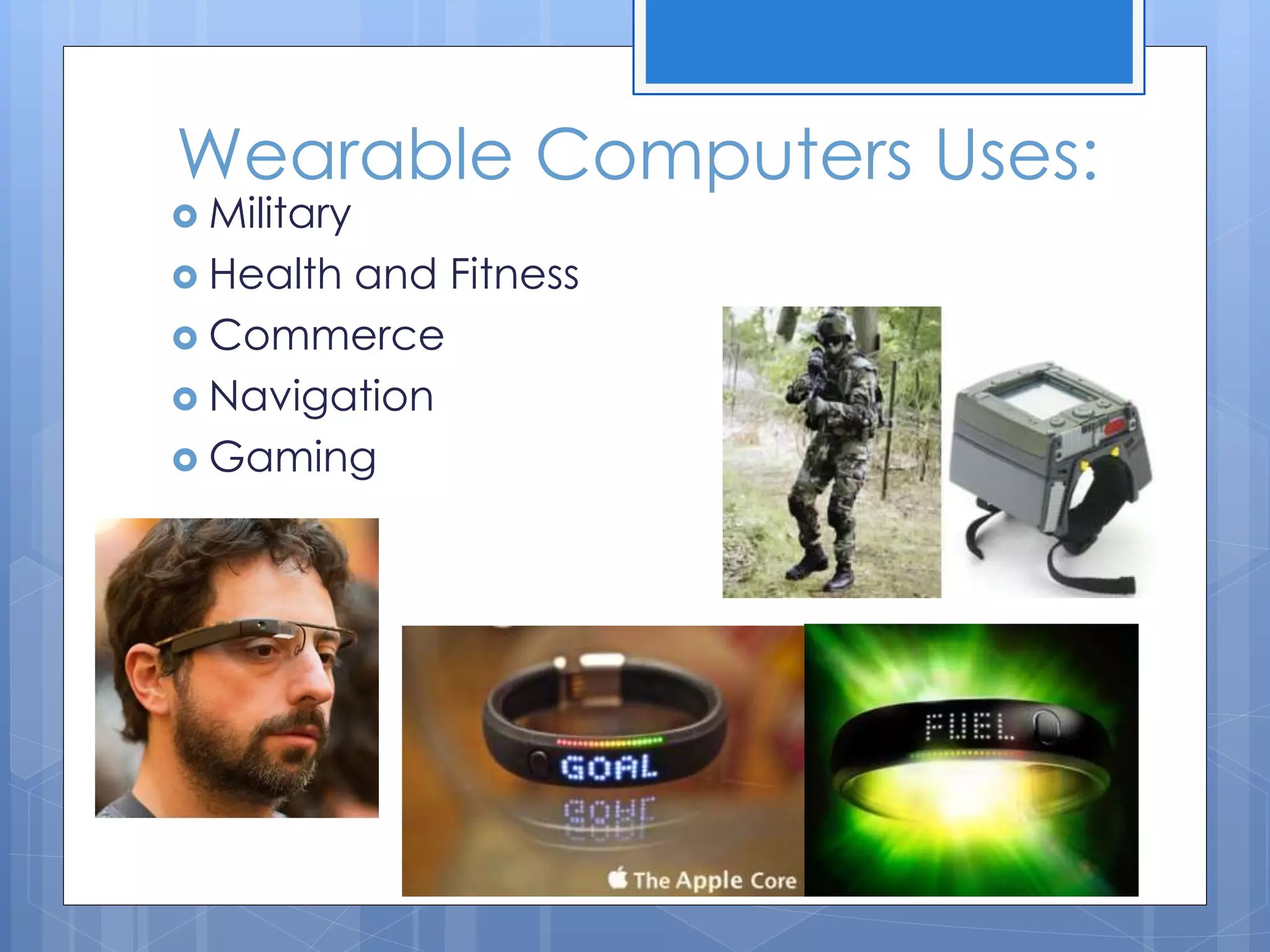
#23 Military
Military demands are similar to consumer demand: low power, lightweight, high performance, and long battery life. Small handheld wearable computers enable a soldier to free one or both hands, which means a more alert soldier than one sitting at a laptop.
A large push is under way to improve video capability on wearable displays to better take advantage of sensor fusion and provide situational awareness not only to battlefield commanders, but also down to individual soldiers.
An example of this is sending images taken from unmanned-aerial-vehicle surveillance directly to the wearable devices in special-operations units and reconnaissance forces. This approach would let them see what the UAV sees.
http://www.militaryaerospace.com/articles/print/volume-16/issue-11/features/technology-focus/wearable-computers-and-the-military-the-smaller-the-better.html
Wearable Computer capabilities
“Imagine video games that happen in real space. Or glasses that remind you of your colleague’s name that you really should know. Or paying for a coffee at Starbucks with your watch instead of your phone. Wearables will transform our lives in numerous ways, trivial and substantial, that we are just starting to imagine.”
The above is quoted from the NY Times technology blog located at http://bits.blogs.nytimes.com/2012/04/17/wearable-computers-are-the-next-platform-wars-report-says/
It is an outstanding article about wearables and the future.
Health and Fitness
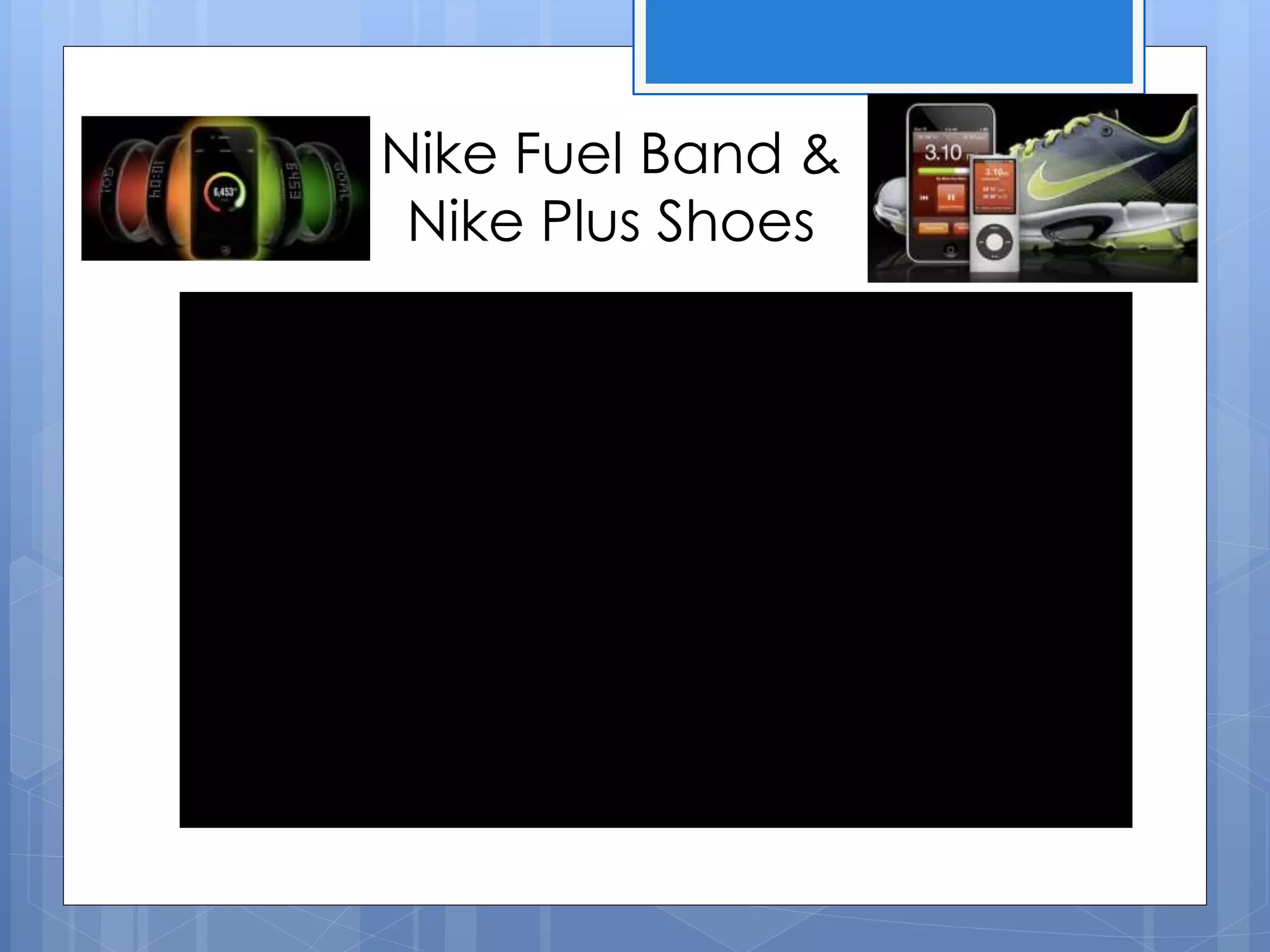
Link to a super article about the Nike FuelBand, a wearable fitness computer
http://www.zdnet.com/blog/apple/nike-fuelband-the-wearable-fitness-computer/12813


![Types of computers[6999]](https://cdn.slidesharecdn.com/ss_thumbnails/typesofcomputers6999-201007141446-thumbnail.jpg?width=640&height=640&fit=bounds)


