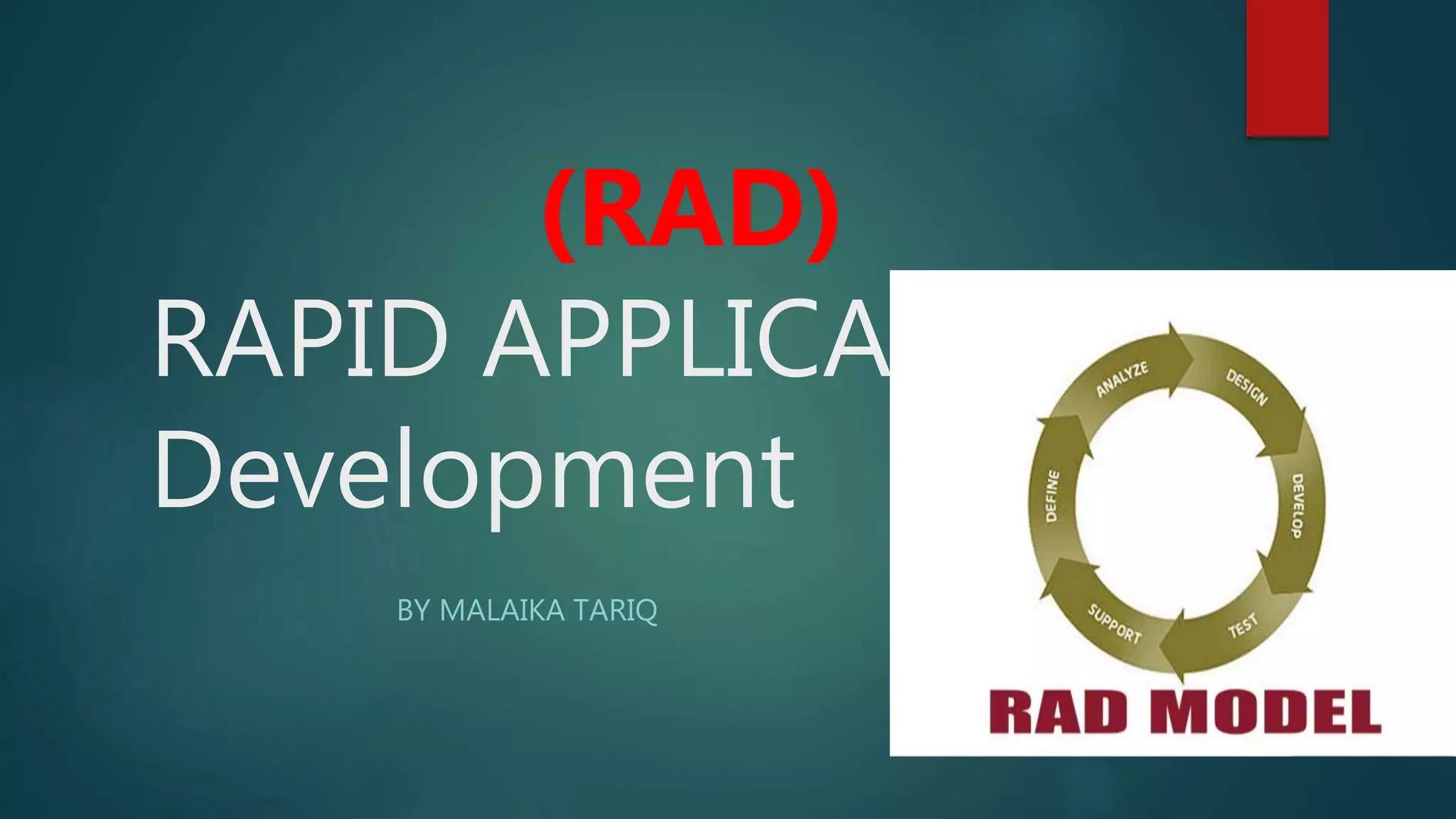
(RAD)
RAPID APPLICATION
Development
BY MALAIKA TARIQ
DEFINATION:
 Abbreviation of Rapid Application Design
 It is an adoption of water fall model
 It was developed by IBM in 1980’s
 It aims at developing a software in a short span of time
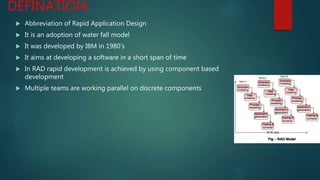
 In RAD rapid development is achieved by using component based
development
 Multiple teams are working parallel on discrete components
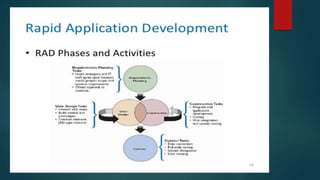
Phases of RAD
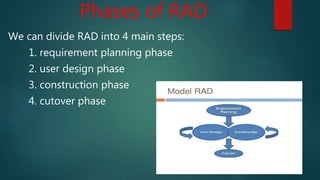
We can divide RAD into 4 main steps:
1. requirement planning phase
2. user design phase
3. construction phase
4. cutover phase
Requirement planning phase
 Users ,managers and It staff members discuss on business needs.
 They discuss on system requirements.
 They also discuss project scope.
 Decides how to generate the software and what it will do.
 It ends when the tram agrees on the key issues and obtain
management authorization to continue.
User design phase
 It is also called modeling phase.
 It is a continuous interactive process.
 During this phase ,user interact with software model and develop
model and prototypes that represents all system processes , inputs ,
and output.
 Allow us to understand and modify the system.
 JAD (Joint Application Development) type system for
interaction…..collaborative interaction.
 Approve a working model of system.
Construction phase
 Focuses on program and application development task.
 User continue to participate and suggest changes and
improvements.
 Tasks are
* Programming and application development
* Coding
* Unit integration.
* System testing.
Cutover phase
 It is the final task.
 Resembles the final task in SDLC Implementation phase.
 Its tasks are…….
*data conversion.
*full scale testing.
*system changes as old and new system run
parallel until old system is phased out and
new system is approved.
*user training.
 In this phase new system is built and delivered.
RAD Strength
 Reduce time development.
 Greater customer satisfaction.
 Faster delivery time.
 Improved and better quality.
 Continuous customer involvement.
RAD Weaknesses
 Requires highly skilled and well trained developers.
 Require sufficient human resource to create the right
number of RAD Team.
 Developers and customers must be committed to
rapid-fire activities in an abbreviated time frame.
 Don’t use if technical risks are high.
Object Oriented System
Analysis
(OOSA)
 Another type of system development method.
 It is a method that is applied for finding the needs analysis and
affect the subsequent phases.
 Creates entities called objects and then establish relation ship
between the objects.
 For example in case of the need analysis of point of sale system ,
each item to be sold is an entity
 Each item is defined as an object and each object is assigned
attributes.
 In this case attributes could be price , color , size , or any other
characteristic.
 Next relationships are established between the objects
 For example the item must be moved to inventory once it comes
into store and must be moved out when sold.
 At the time of sale the sale associate perform the sale
transaction
 In this way relationships are established and model is
created
 Help best to break up the project into smaller pieces
and assigned to different teams.
 The developing teams may use conventional
programming tools or other tools such as JAVA.
Computers

Computers

  • 1.
  • 2.
    DEFINATION:  Abbreviation ofRapid Application Design  It is an adoption of water fall model  It was developed by IBM in 1980’s  It aims at developing a software in a short span of time  In RAD rapid development is achieved by using component based development  Multiple teams are working parallel on discrete components
  • 3.
    Phases of RAD Wecan divide RAD into 4 main steps: 1. requirement planning phase 2. user design phase 3. construction phase 4. cutover phase
  • 4.
    Requirement planning phase Users ,managers and It staff members discuss on business needs.  They discuss on system requirements.  They also discuss project scope.  Decides how to generate the software and what it will do.  It ends when the tram agrees on the key issues and obtain management authorization to continue.
  • 5.
    User design phase It is also called modeling phase.  It is a continuous interactive process.  During this phase ,user interact with software model and develop model and prototypes that represents all system processes , inputs , and output.  Allow us to understand and modify the system.  JAD (Joint Application Development) type system for interaction…..collaborative interaction.  Approve a working model of system.
  • 6.
    Construction phase  Focuseson program and application development task.  User continue to participate and suggest changes and improvements.  Tasks are * Programming and application development * Coding * Unit integration. * System testing.
  • 7.
    Cutover phase  Itis the final task.  Resembles the final task in SDLC Implementation phase.  Its tasks are……. *data conversion. *full scale testing. *system changes as old and new system run parallel until old system is phased out and new system is approved. *user training.  In this phase new system is built and delivered.
  • 9.
    RAD Strength  Reducetime development.  Greater customer satisfaction.  Faster delivery time.  Improved and better quality.  Continuous customer involvement.
  • 10.
    RAD Weaknesses  Requireshighly skilled and well trained developers.  Require sufficient human resource to create the right number of RAD Team.  Developers and customers must be committed to rapid-fire activities in an abbreviated time frame.  Don’t use if technical risks are high.
  • 11.
  • 12.
     Another typeof system development method.  It is a method that is applied for finding the needs analysis and affect the subsequent phases.  Creates entities called objects and then establish relation ship between the objects.  For example in case of the need analysis of point of sale system , each item to be sold is an entity  Each item is defined as an object and each object is assigned attributes.  In this case attributes could be price , color , size , or any other characteristic.  Next relationships are established between the objects  For example the item must be moved to inventory once it comes into store and must be moved out when sold.
  • 13.
     At thetime of sale the sale associate perform the sale transaction  In this way relationships are established and model is created  Help best to break up the project into smaller pieces and assigned to different teams.  The developing teams may use conventional programming tools or other tools such as JAVA.