
What is V model
When to use V model
Pictorial Description
Phases of V-Model
Merits
Demerits
 V- model means Verification and Validation model.
 V-Shaped life cycle is a sequential path of execution of
processes.
 Each phase must be completed before the next phase
starts.
 Testing of the product is planned in parallel with a
corresponding phase of development.
 The V-shaped model should be used for small to medium
sized projects where requirements are clearly defined and
fixed.
 The V-Shaped model should be chosen when sample
technical resources are available with needed technical
expertise.
There are two phases
 Verification Phase
 Validation Phase
 Requirements Analysis:
the first step in the verification process, the requirements of
the system are collected by analyzing the needs of the user.
 System design:
In this phase system engineers analyze and understand the
business of the proposed system by studying the user
requirements document.
 Architecture design
The baseline in selecting the architecture is that it should
realize all which typically consists of the list of modules, brief
functionality of each module, their interface
relationships, dependencies, database tables, architecture
diagrams, technology details etc. The integration testing
design is carried out in the particular phase.
 Module design
The module design phase can also be referred to as
low-level design. The designed system is broken up
into smaller units or modules and each of them is
explained so that the programmer can start coding
directly. The low level design document or program
specifications will contain a detailed functional logic of
the module, in pseudo-code:
 database tables, with all elements, including their type
and size
 all interface details with complete API references
 all dependency issues
 error message listings
 complete input and outputs for a module.
 This is at the bottom of the V-Shape model. Module
design is converted into code by developers.
 Unit testing
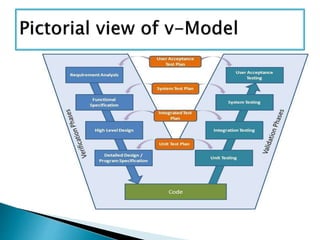
In the V-Model, Unit Test Plans (UTPs) are developed during
module design phase. These UTPs are executed to eliminate
bugs at code level or unit level. A unit is the smallest entity
which can independently exist, e.g. a program module. Unit
testing verifies that the smallest entity can function correctly
when isolated from the rest of the codes/units.
 Integration testing
Integration Test Plans are developed during the
Architectural Design Phase. These tests verify that units
created and tested independently can coexist and
communicate among themselves.
 System testing
System Tests Plans are developed during System Design
Phase. Unlike Unit and Integration Test Plans, System
Test Plans are composed by client's business team.
System Test ensures that expectations from application
developed are met.
 User acceptance testing
User Acceptance Test (UAT) Plans are developed during
the Requirements Analysis phase. Test Plans are
composed by business users. UAT is performed in a
user environment that resembles the production
environment, using realistic data.
 Simple and easy to use.
 Testing activities like planning, test
designing happens well before coding.
 This saves a lot of time. Hence higher chance of
success over the waterfall model.
 Proactive defect tracking – that is defects are found at
early stage.
 Avoids the downward flow of the defects.
 Works well for small projects where requirements are
easily understood.
 Very rigid and least flexible.
 Software is developed during the implementation
phase, so no early prototypes of the software are
produced.
 If any changes happen in midway, then the test
documents along with requirement documents has to
be updated.
V model Over view (Software Engineering)

V model Over view (Software Engineering)

  • 2.
    What is Vmodel When to use V model Pictorial Description Phases of V-Model Merits Demerits
  • 3.
     V- modelmeans Verification and Validation model.  V-Shaped life cycle is a sequential path of execution of processes.  Each phase must be completed before the next phase starts.  Testing of the product is planned in parallel with a corresponding phase of development.
  • 4.
     The V-shapedmodel should be used for small to medium sized projects where requirements are clearly defined and fixed.  The V-Shaped model should be chosen when sample technical resources are available with needed technical expertise.
  • 5.
    There are twophases  Verification Phase  Validation Phase
  • 7.
     Requirements Analysis: thefirst step in the verification process, the requirements of the system are collected by analyzing the needs of the user.  System design: In this phase system engineers analyze and understand the business of the proposed system by studying the user requirements document.
  • 8.
     Architecture design Thebaseline in selecting the architecture is that it should realize all which typically consists of the list of modules, brief functionality of each module, their interface relationships, dependencies, database tables, architecture diagrams, technology details etc. The integration testing design is carried out in the particular phase.
  • 9.
     Module design Themodule design phase can also be referred to as low-level design. The designed system is broken up into smaller units or modules and each of them is explained so that the programmer can start coding directly. The low level design document or program specifications will contain a detailed functional logic of the module, in pseudo-code:  database tables, with all elements, including their type and size  all interface details with complete API references  all dependency issues  error message listings  complete input and outputs for a module.
  • 10.
     This isat the bottom of the V-Shape model. Module design is converted into code by developers.
  • 11.
     Unit testing Inthe V-Model, Unit Test Plans (UTPs) are developed during module design phase. These UTPs are executed to eliminate bugs at code level or unit level. A unit is the smallest entity which can independently exist, e.g. a program module. Unit testing verifies that the smallest entity can function correctly when isolated from the rest of the codes/units.
  • 12.
     Integration testing IntegrationTest Plans are developed during the Architectural Design Phase. These tests verify that units created and tested independently can coexist and communicate among themselves.  System testing System Tests Plans are developed during System Design Phase. Unlike Unit and Integration Test Plans, System Test Plans are composed by client's business team. System Test ensures that expectations from application developed are met.
  • 13.
     User acceptancetesting User Acceptance Test (UAT) Plans are developed during the Requirements Analysis phase. Test Plans are composed by business users. UAT is performed in a user environment that resembles the production environment, using realistic data.
  • 14.
     Simple andeasy to use.  Testing activities like planning, test designing happens well before coding.  This saves a lot of time. Hence higher chance of success over the waterfall model.  Proactive defect tracking – that is defects are found at early stage.  Avoids the downward flow of the defects.  Works well for small projects where requirements are easily understood.
  • 15.
     Very rigidand least flexible.  Software is developed during the implementation phase, so no early prototypes of the software are produced.  If any changes happen in midway, then the test documents along with requirement documents has to be updated.