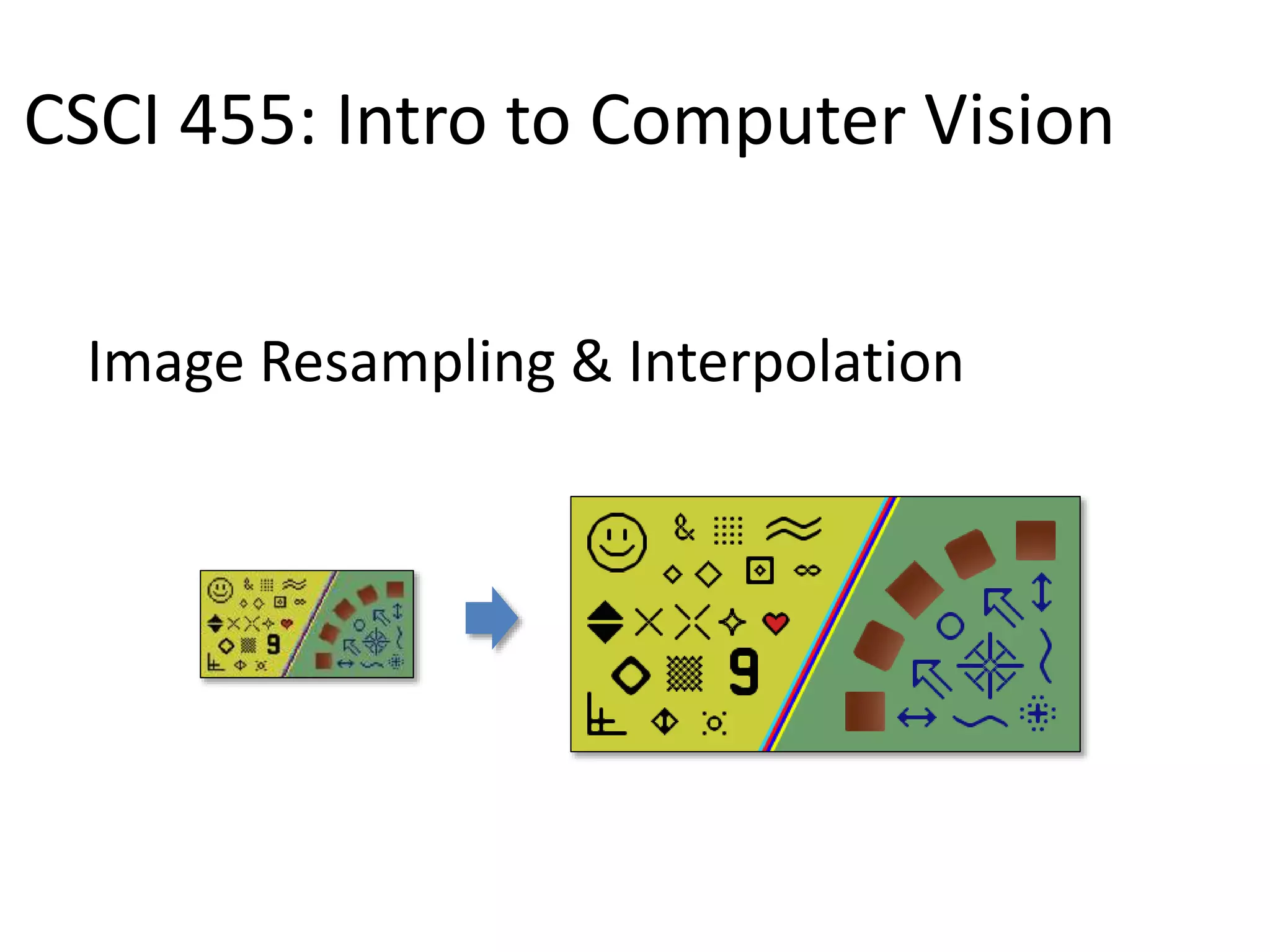
Image Resampling & Interpolation
CSCI 455: Intro to Computer Vision
Acknowledgement
Many of the following slides are modified from the
excellent class notes of similar courses offered in
other schools by Prof Yung-Yu Chuang, Fredo
Durand, Alexei Efros, William Freeman, James Hays,
Svetlana Lazebnik, Andrej Karpathy, Fei-Fei Li,
Srinivasa Narasimhan, Silvio Savarese, Steve Seitz,
Richard Szeliski, Noah Snavely and Li Zhang. The
instructor is extremely thankful to the researchers
for making their notes available online. Please feel
free to use and modify any of the slides, but
acknowledge the original sources where
appropriate.
Image Scaling
This image is too big to fit on the
screen. How can we generate a
half-sized version?
Source: S. Seitz
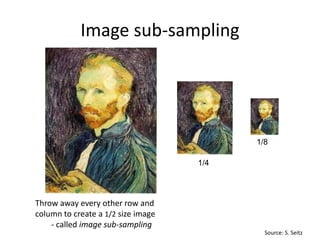
Image sub-sampling
Throw away every other row and
column to create a 1/2 size image
- called image sub-sampling
1/4
1/8
Source: S. Seitz
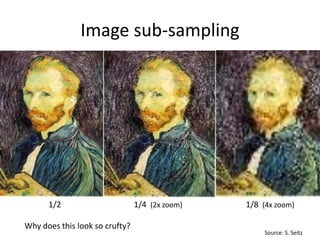
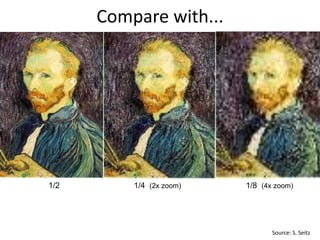
Image sub-sampling
1/4 (2x zoom) 1/8 (4x zoom)
Why does this look so crufty?
1/2
Source: S. Seitz
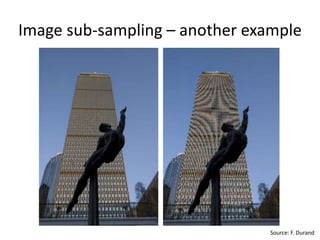
Image sub-sampling – another example
Source: F. Durand
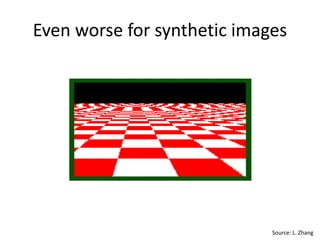
Even worse for synthetic images
Source: L. Zhang
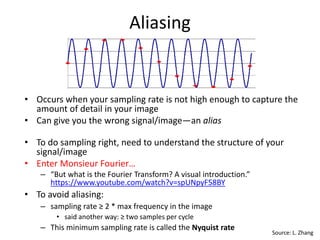
Aliasing
• Occurs when your sampling rate is not high enough to capture the
amount of detail in your image
• Can give you the wrong signal/image—an alias
• To do sampling right, need to understand the structure of your
signal/image
• Enter Monsieur Fourier…
– “But what is the Fourier Transform? A visual introduction.”
https://www.youtube.com/watch?v=spUNpyF58BY
• To avoid aliasing:
– sampling rate ≥ 2 * max frequency in the image
• said another way: ≥ two samples per cycle
– This minimum sampling rate is called the Nyquist rate
Source: L. Zhang
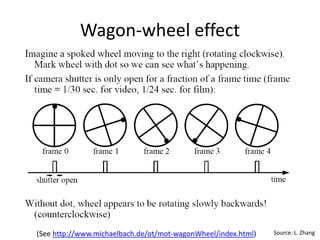
Wagon-wheel effect
(See http://www.michaelbach.de/ot/mot-wagonWheel/index.html) Source: L. Zhang
Wagon-wheel effect
https://en.wikipedia.org/wiki/Wagon-wheel_effect
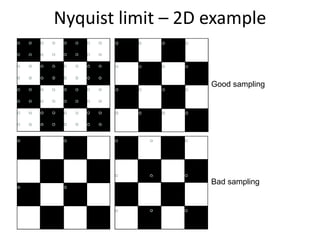
Nyquist limit – 2D example
Good sampling
Bad sampling
Aliasing
• When downsampling by a factor of two
– Original image has frequencies that are too high
• How can we fix this?
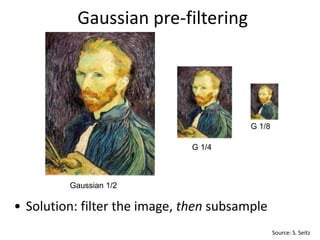
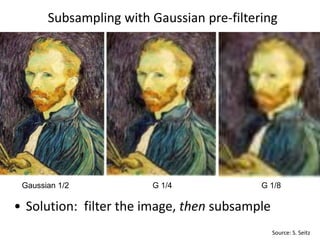
Gaussian pre-filtering
G 1/4
G 1/8
Gaussian 1/2
• Solution: filter the image, then subsample
Source: S. Seitz
Subsampling with Gaussian pre-filtering
G 1/4 G 1/8Gaussian 1/2
• Solution: filter the image, then subsample
Source: S. Seitz
Compare with...
1/4 (2x zoom) 1/8 (4x zoom)1/2
Source: S. Seitz
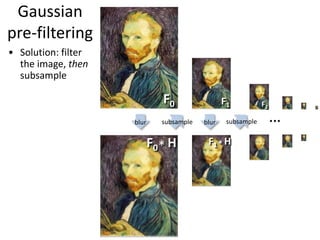
Gaussian
pre-filtering
• Solution: filter
the image, then
subsample
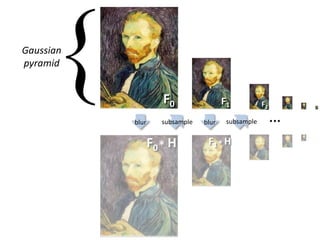
blur
F0 H*
subsample blur subsample …
F1
F1 H*
F2
F0
blur
F0 H*
subsample blur subsample …
F1
F1 H*
F2
F0
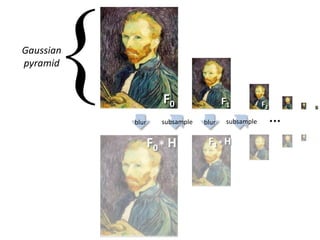
Gaussian
pyramid
blur
F0 H*
subsample blur subsample …
F1
F1 H*
F2
F0
Gaussian
pyramid
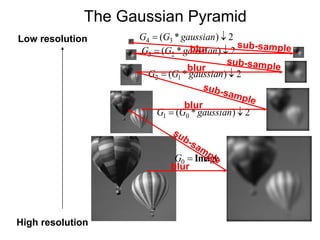
2)*( 23  gaussianGG
1G
The Gaussian Pyramid
High resolution
Low resolution
Image0G
2)*( 01  gaussianGG
2)*( 12  gaussianGG
2)*( 34  gaussianGG
blur
blur
blur
blur
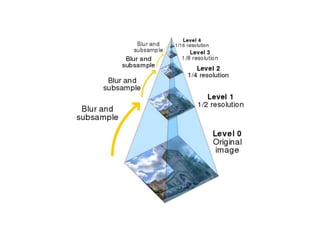
Gaussian pyramids
[Burt and Adelson, 1983]
• In computer graphics, a mip map [Williams, 1983]
• A precursor to wavelet transform
Gaussian Pyramids have all sorts of applications in computer vision
Source: S. Seitz
Gaussian pyramids
[Burt and Adelson, 1983]
• How much space does a Gaussian pyramid take compared to the
original image?
Source: S. Seitz
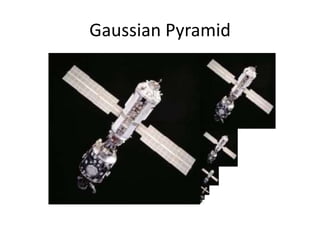
Gaussian Pyramid
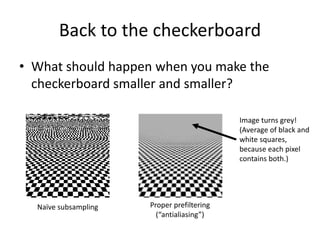
Back to the checkerboard
• What should happen when you make the
checkerboard smaller and smaller?
Naïve subsampling Proper prefiltering
(“antialiasing”)
Image turns grey!
(Average of black and
white squares,
because each pixel
contains both.)
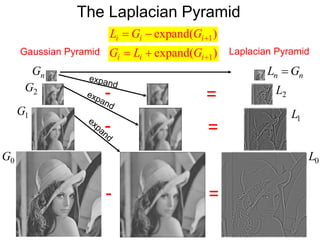
Gaussian Pyramid Laplacian Pyramid
The Laplacian Pyramid
0G
1G
2G
nG
- =
0L
- =
1L
- = 2L
nn GL 
)expand( 1 iii GGL
)expand( 1 iii GLG
Questions?
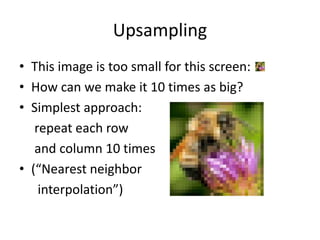
Upsampling
• This image is too small for this screen:
• How can we make it 10 times as big?
• Simplest approach:
repeat each row
and column 10 times
• (“Nearest neighbor
interpolation”)
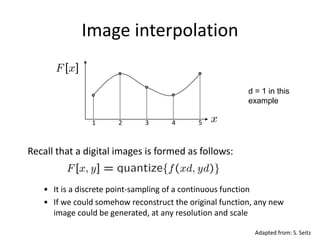
Image interpolation
Recall that a digital images is formed as follows:
• It is a discrete point-sampling of a continuous function
• If we could somehow reconstruct the original function, any new
image could be generated, at any resolution and scale
1 2 3 4 5
Adapted from: S. Seitz
d = 1 in this
example
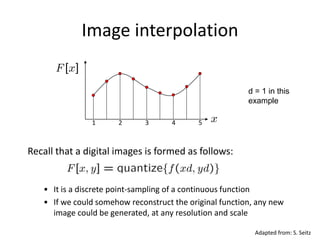
Image interpolation
1 2 3 4 5
d = 1 in this
example
Recall that a digital images is formed as follows:
• It is a discrete point-sampling of a continuous function
• If we could somehow reconstruct the original function, any new
image could be generated, at any resolution and scale
Adapted from: S. Seitz
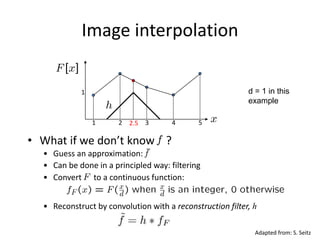
Image interpolation
1 2 3 4 52.5
1
• Convert to a continuous function:
• Reconstruct by convolution with a reconstruction filter, h
• What if we don’t know ?
• Guess an approximation:
• Can be done in a principled way: filtering
d = 1 in this
example
Adapted from: S. Seitz
Image interpolation
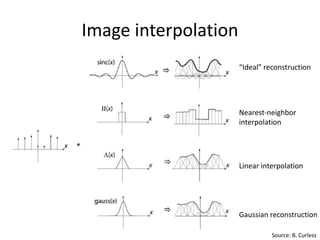
“Ideal” reconstruction
Nearest-neighbor
interpolation
Linear interpolation
Gaussian reconstruction
Source: B. Curless
Reconstruction filters
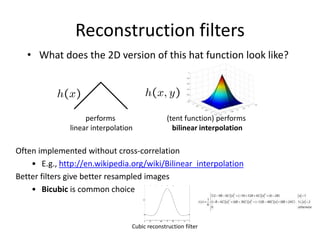
• What does the 2D version of this hat function look like?
Often implemented without cross-correlation
• E.g., http://en.wikipedia.org/wiki/Bilinear_interpolation
Better filters give better resampled images
• Bicubic is common choice
performs
linear interpolation
(tent function) performs
bilinear interpolation
Cubic reconstruction filter
Image interpolation
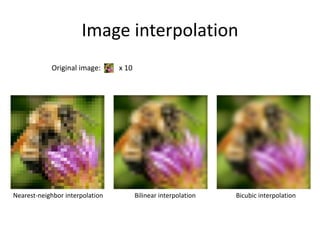
Nearest-neighbor interpolation Bilinear interpolation Bicubic interpolation
Original image: x 10
Image interpolation
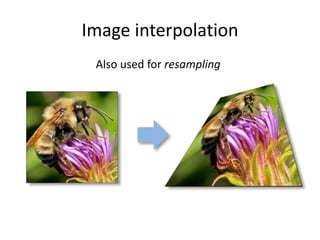
Also used for resampling
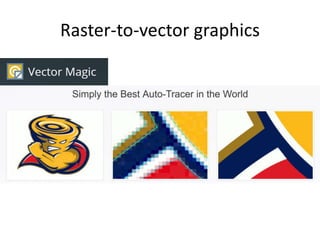
Raster-to-vector graphics
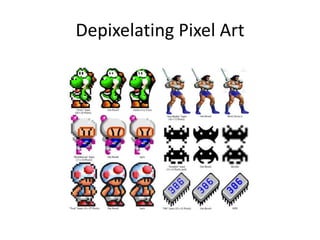
Depixelating Pixel Art
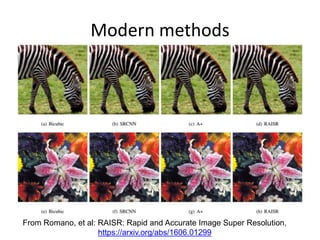
Modern methods
From Romano, et al: RAISR: Rapid and Accurate Image Super Resolution,
https://arxiv.org/abs/1606.01299
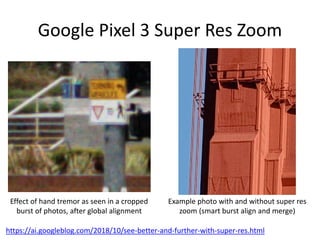
Super-resolution with multiple images
• Can do better upsampling if you have multiple
images of the scene taken with small
(subpixel) shifts
• Some cellphone cameras (like the Google Pixel
line) capture a burst of photos
• Can we use that burst for upsampling?
Google Pixel 3 Super Res Zoom
Effect of hand tremor as seen in a cropped
burst of photos, after global alignment
https://ai.googleblog.com/2018/10/see-better-and-further-with-super-res.html
Example photo with and without super res
zoom (smart burst align and merge)
Questions?

Computer Vision resample

  • 1.
    Image Resampling &Interpolation CSCI 455: Intro to Computer Vision
  • 2.
    Acknowledgement Many of thefollowing slides are modified from the excellent class notes of similar courses offered in other schools by Prof Yung-Yu Chuang, Fredo Durand, Alexei Efros, William Freeman, James Hays, Svetlana Lazebnik, Andrej Karpathy, Fei-Fei Li, Srinivasa Narasimhan, Silvio Savarese, Steve Seitz, Richard Szeliski, Noah Snavely and Li Zhang. The instructor is extremely thankful to the researchers for making their notes available online. Please feel free to use and modify any of the slides, but acknowledge the original sources where appropriate.
  • 3.
    Image Scaling This imageis too big to fit on the screen. How can we generate a half-sized version? Source: S. Seitz
  • 4.
    Image sub-sampling Throw awayevery other row and column to create a 1/2 size image - called image sub-sampling 1/4 1/8 Source: S. Seitz
  • 5.
    Image sub-sampling 1/4 (2xzoom) 1/8 (4x zoom) Why does this look so crufty? 1/2 Source: S. Seitz
  • 6.
    Image sub-sampling –another example Source: F. Durand
  • 7.
    Even worse forsynthetic images Source: L. Zhang
  • 8.
    Aliasing • Occurs whenyour sampling rate is not high enough to capture the amount of detail in your image • Can give you the wrong signal/image—an alias • To do sampling right, need to understand the structure of your signal/image • Enter Monsieur Fourier… – “But what is the Fourier Transform? A visual introduction.” https://www.youtube.com/watch?v=spUNpyF58BY • To avoid aliasing: – sampling rate ≥ 2 * max frequency in the image • said another way: ≥ two samples per cycle – This minimum sampling rate is called the Nyquist rate Source: L. Zhang
  • 9.
  • 10.
  • 11.
    Nyquist limit –2D example Good sampling Bad sampling
  • 12.
    Aliasing • When downsamplingby a factor of two – Original image has frequencies that are too high • How can we fix this?
  • 13.
    Gaussian pre-filtering G 1/4 G1/8 Gaussian 1/2 • Solution: filter the image, then subsample Source: S. Seitz
  • 14.
    Subsampling with Gaussianpre-filtering G 1/4 G 1/8Gaussian 1/2 • Solution: filter the image, then subsample Source: S. Seitz
  • 15.
    Compare with... 1/4 (2xzoom) 1/8 (4x zoom)1/2 Source: S. Seitz
  • 16.
    Gaussian pre-filtering • Solution: filter theimage, then subsample blur F0 H* subsample blur subsample … F1 F1 H* F2 F0
  • 17.
    blur F0 H* subsample blursubsample … F1 F1 H* F2 F0 Gaussian pyramid
  • 18.
    blur F0 H* subsample blursubsample … F1 F1 H* F2 F0 Gaussian pyramid
  • 19.
    2)*( 23 gaussianGG 1G The Gaussian Pyramid High resolution Low resolution Image0G 2)*( 01  gaussianGG 2)*( 12  gaussianGG 2)*( 34  gaussianGG blur blur blur blur
  • 21.
    Gaussian pyramids [Burt andAdelson, 1983] • In computer graphics, a mip map [Williams, 1983] • A precursor to wavelet transform Gaussian Pyramids have all sorts of applications in computer vision Source: S. Seitz
  • 22.
    Gaussian pyramids [Burt andAdelson, 1983] • How much space does a Gaussian pyramid take compared to the original image? Source: S. Seitz
  • 23.
  • 24.
    Back to thecheckerboard • What should happen when you make the checkerboard smaller and smaller? Naïve subsampling Proper prefiltering (“antialiasing”) Image turns grey! (Average of black and white squares, because each pixel contains both.)
  • 25.
    Gaussian Pyramid LaplacianPyramid The Laplacian Pyramid 0G 1G 2G nG - = 0L - = 1L - = 2L nn GL  )expand( 1 iii GGL )expand( 1 iii GLG
  • 27.
  • 28.
    Upsampling • This imageis too small for this screen: • How can we make it 10 times as big? • Simplest approach: repeat each row and column 10 times • (“Nearest neighbor interpolation”)
  • 29.
    Image interpolation Recall thata digital images is formed as follows: • It is a discrete point-sampling of a continuous function • If we could somehow reconstruct the original function, any new image could be generated, at any resolution and scale 1 2 3 4 5 Adapted from: S. Seitz d = 1 in this example
  • 30.
    Image interpolation 1 23 4 5 d = 1 in this example Recall that a digital images is formed as follows: • It is a discrete point-sampling of a continuous function • If we could somehow reconstruct the original function, any new image could be generated, at any resolution and scale Adapted from: S. Seitz
  • 31.
    Image interpolation 1 23 4 52.5 1 • Convert to a continuous function: • Reconstruct by convolution with a reconstruction filter, h • What if we don’t know ? • Guess an approximation: • Can be done in a principled way: filtering d = 1 in this example Adapted from: S. Seitz
  • 32.
    Image interpolation “Ideal” reconstruction Nearest-neighbor interpolation Linearinterpolation Gaussian reconstruction Source: B. Curless
  • 33.
    Reconstruction filters • Whatdoes the 2D version of this hat function look like? Often implemented without cross-correlation • E.g., http://en.wikipedia.org/wiki/Bilinear_interpolation Better filters give better resampled images • Bicubic is common choice performs linear interpolation (tent function) performs bilinear interpolation Cubic reconstruction filter
  • 34.
    Image interpolation Nearest-neighbor interpolationBilinear interpolation Bicubic interpolation Original image: x 10
  • 35.
  • 36.
  • 37.
  • 38.
    Modern methods From Romano,et al: RAISR: Rapid and Accurate Image Super Resolution, https://arxiv.org/abs/1606.01299
  • 39.
    Super-resolution with multipleimages • Can do better upsampling if you have multiple images of the scene taken with small (subpixel) shifts • Some cellphone cameras (like the Google Pixel line) capture a burst of photos • Can we use that burst for upsampling?
  • 40.
    Google Pixel 3Super Res Zoom Effect of hand tremor as seen in a cropped burst of photos, after global alignment https://ai.googleblog.com/2018/10/see-better-and-further-with-super-res.html Example photo with and without super res zoom (smart burst align and merge)
  • 41.