

Subject code: 2110003
Om Institute of Technology 1
Om Institute of Technology 2
History of ‘c’
Features of ‘c’
Structure of program
Header files
Main function
Data type
Constant
Variables
Operators
Input/output
C preprocessor
Om Institute of Technology 3
Om Institute of Technology 4
 C is developed by Dennis Ritchie
 C is a structured programming language
 C supports functions that enables easy maintainability of
code, by breaking large file into smaller modules
 Comments in C provides easy readability
 C is a powerful language
Om Institute of Technology 5
 Important feature of ‘C’ language is it is portable, by
portability we mean that the program can be run on any
hardware machine.
 It supports modular programming.
 It supports bit-wise operations.
 It is known as structured programming language.
Om Institute of Technology 6
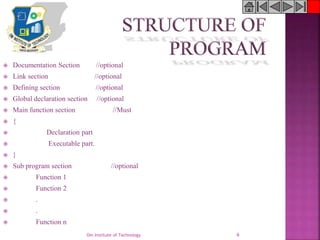
 Documentation Section //optional
 Link section //optional
 Defining section //optional
 Global declaration section //optional
 Main function section //Must
 {
 Declaration part
 Executable part.
 }
 Sub program section //optional
 Function 1
 Function 2
 .
 .
 Function n
Om Institute of Technology 7
 The files that are specified in the include section is called as
header file
 These are precompiled files that has some functions defined in
them
 We can call those functions in our program by supplying
parameters
 Header file is given an extension .h
 C Source file is given an extension .c
Om Institute of Technology 8
 This is the entry point of a program
 When a file is executed, the start point is the main function
 From main function the flow goes as per the programmers
choice.
 There may or may not be other functions written by user in a
program
 Main function is compulsory for any c program
Om Institute of Technology 9
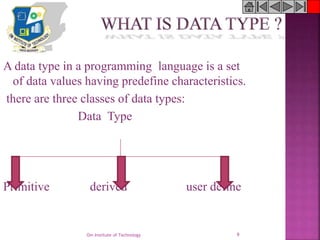
A data type in a programming language is a set
of data values having predefine characteristics.
there are three classes of data types:
Data Type
Primitive derived user define
Om Institute of Technology 10
 Primitive data types
int, float, double, char
 Aggregate data types
Arrays come under this category
Arrays can contain collection of int or float or char or
double data
 User defined data types
Structures and enum fall under this category.
Om Institute of Technology 11
 The ‘C’ language supports following types of
constants:
Numeric constants (5, 15, 3.6, -5.4 etc)
Non-numeric constants
 Character constants (‘B’ , ‘a’ , ‘?’ , ‘5’ , ‘+’ etc)
 String Constants (“Computer”, “XYZ”, “-5.4” etc)
Om Institute of Technology 12
 a Bell
 b Back space
 f Form feed
 n New line
 r Carriage return
 t Horizontal tab
 v vertical tab
 ’ single quote
 ” Double quote
 ? Question Mark
  Backslash
 0 Null
Om Institute of Technology 13
 Variables are the identifiers whose value changes as opposite
to constants.
 As variable is an identifier, all the rules for naming an
identifier applies to variables also.
 Should not be a reserved word like int etc..
 Should start with a letter or an underscore(_)
 Can contain letters, numbers or underscore.
 No other special characters are allowed including space
 Variable names are case sensitive
 A and a are different.
Om Institute of Technology 14
 Arithmetic (+,-,*,/,%)
 Relational (<,>,<=,>=,==,!=)
 Logical (&&,||,!)
 Bitwise (&,|)
 Assignment (=)
 Compound assignment(+=,*=,-=,/=,%=,&=,|=)
 Shift (right shift >>, left shift <<)
Om Institute of Technology 15
 Input
scanf(“%d”,&a);
Gets an integer value from the user and stores it under
the name “a”
 Output
printf(“%d”,a);
Prints the value present in variable a on the screen
Om Institute of Technology 16
 All preprocessor directives begin with #
 Possible actions
Inclusion of other files
Definition of symbolic constants & macros
Conditional compilation of program code
Conditional compilation of preprocessor directives
Om Institute of Technology 17

Computer programming and utilization 2110003

  • 1.
    Subject code: 2110003 OmInstitute of Technology 1
  • 2.
    Om Institute ofTechnology 2
  • 3.
    History of ‘c’ Featuresof ‘c’ Structure of program Header files Main function Data type Constant Variables Operators Input/output C preprocessor Om Institute of Technology 3
  • 4.
    Om Institute ofTechnology 4  C is developed by Dennis Ritchie  C is a structured programming language  C supports functions that enables easy maintainability of code, by breaking large file into smaller modules  Comments in C provides easy readability  C is a powerful language
  • 5.
    Om Institute ofTechnology 5  Important feature of ‘C’ language is it is portable, by portability we mean that the program can be run on any hardware machine.  It supports modular programming.  It supports bit-wise operations.  It is known as structured programming language.
  • 6.
    Om Institute ofTechnology 6  Documentation Section //optional  Link section //optional  Defining section //optional  Global declaration section //optional  Main function section //Must  {  Declaration part  Executable part.  }  Sub program section //optional  Function 1  Function 2  .  .  Function n
  • 7.
    Om Institute ofTechnology 7  The files that are specified in the include section is called as header file  These are precompiled files that has some functions defined in them  We can call those functions in our program by supplying parameters  Header file is given an extension .h  C Source file is given an extension .c
  • 8.
    Om Institute ofTechnology 8  This is the entry point of a program  When a file is executed, the start point is the main function  From main function the flow goes as per the programmers choice.  There may or may not be other functions written by user in a program  Main function is compulsory for any c program
  • 9.
    Om Institute ofTechnology 9 A data type in a programming language is a set of data values having predefine characteristics. there are three classes of data types: Data Type Primitive derived user define
  • 10.
    Om Institute ofTechnology 10  Primitive data types int, float, double, char  Aggregate data types Arrays come under this category Arrays can contain collection of int or float or char or double data  User defined data types Structures and enum fall under this category.
  • 11.
    Om Institute ofTechnology 11  The ‘C’ language supports following types of constants: Numeric constants (5, 15, 3.6, -5.4 etc) Non-numeric constants  Character constants (‘B’ , ‘a’ , ‘?’ , ‘5’ , ‘+’ etc)  String Constants (“Computer”, “XYZ”, “-5.4” etc)
  • 12.
    Om Institute ofTechnology 12  a Bell  b Back space  f Form feed  n New line  r Carriage return  t Horizontal tab  v vertical tab  ’ single quote  ” Double quote  ? Question Mark  Backslash  0 Null
  • 13.
    Om Institute ofTechnology 13  Variables are the identifiers whose value changes as opposite to constants.  As variable is an identifier, all the rules for naming an identifier applies to variables also.  Should not be a reserved word like int etc..  Should start with a letter or an underscore(_)  Can contain letters, numbers or underscore.  No other special characters are allowed including space  Variable names are case sensitive  A and a are different.
  • 14.
    Om Institute ofTechnology 14  Arithmetic (+,-,*,/,%)  Relational (<,>,<=,>=,==,!=)  Logical (&&,||,!)  Bitwise (&,|)  Assignment (=)  Compound assignment(+=,*=,-=,/=,%=,&=,|=)  Shift (right shift >>, left shift <<)
  • 15.
    Om Institute ofTechnology 15  Input scanf(“%d”,&a); Gets an integer value from the user and stores it under the name “a”  Output printf(“%d”,a); Prints the value present in variable a on the screen
  • 16.
    Om Institute ofTechnology 16  All preprocessor directives begin with #  Possible actions Inclusion of other files Definition of symbolic constants & macros Conditional compilation of program code Conditional compilation of preprocessor directives
  • 17.
    Om Institute ofTechnology 17

Editor's Notes

  • #16 Format specifiers %d is the format specifier. This informs to the compiler that the incoming value is an integer value. Other data types can be specified as follows: %c – character %f – float %lf – double %s – character array (string) Printf and scanf are defined under the header file stdio.h