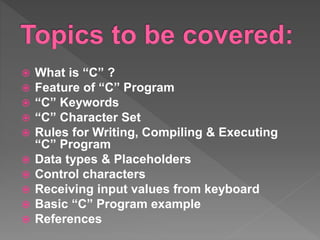
 What is “C” ?
 Feature of “C” Program
 “C” Keywords
 “C” Character Set
 Rules for Writing, Compiling & Executing
“C” Program
 Data types & Placeholders
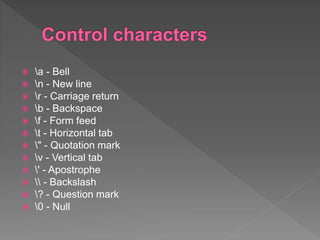
 Control characters
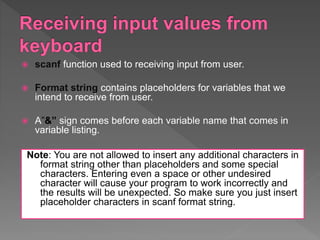
 Receiving input values from keyboard
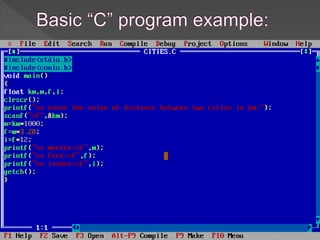
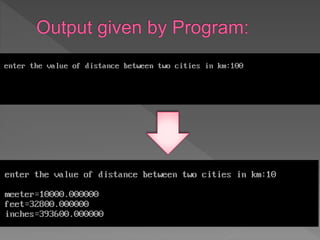
 Basic “C” Program example
 References
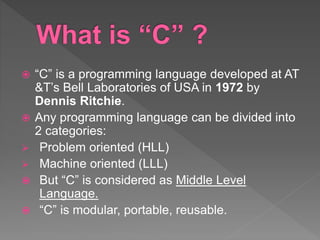
 “C” is a programming language developed at AT
&T’s Bell Laboratories of USA in 1972 by
Dennis Ritchie.
 Any programming language can be divided into
2 categories:
 Problem oriented (HLL)
 Machine oriented (LLL)
 But “C” is considered as Middle Level
Language.
 “C” is modular, portable, reusable.
 General purpose language
 Limited no. of keyword
 Code Re-usability & Ability to customize and
extend
 Portability
 Structured language
 Make it ideal language for system
programming.
 It can also be used for business & scientific
application.
 ANSI established a standard for “C” in 1983.
 The ability of “C” is to manipulate bits, byte &
addresses.
 It is adopted in later 1990.
 It has ability to divide & hide all the
information & instruction.
 Code can be partitioned in “C” using
functions or code block.
 C is a well structured language compare to
other.
 Portability is the ability to port or use the
software written.
 One computer C program can be reused.
 By modification or no modification.
 A programmer can easily create his own
function.
 It can be used repeatedly in different
application.
 “C” program basically collection of function.
 The function are supported by “C” library.
 Function can be added to “C” library
continuously.
 There are only 32 keywords in ”C”.
 27 keywords are given by Ritchie.
 5 is added by ANSI.
 The strength of “C” lies in its in-built function.
 Unix system provides as large number of “C”
function.
 Some function are used in operation.
 Other are for specialized in their application.
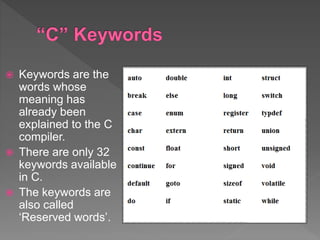
 Keywords are the
words whose
meaning has
already been
explained to the C
compiler.
 There are only 32
keywords available
in C.
 The keywords are
also called
‘Reserved words’.
 A character denotes any alphabet, digit or
special symbol used to represent
information.
 Following are the valid alphabets, numbers
and special symbols allowed in C:
 Alphabets - A, B, ….., Y, Z a, b, ……, y, z
 Digits - 0, 1, 2, 3, 4, 5, 6, 7, 8, 9
 Special symbols - ~ ‘ ! @ # % ^ & * ( ) _ - +
= |  { } [ ] : ; " ' < > , . ? /
 C is case sensitive means variable named "COUNTER" is different from
a variable named "counter".
 All keywords are lowercased.
 Keywords cannot be used for any other purpose (like variable names).
 Every C statement must end with a ”;”. Thus “;” acts as a statement
terminator.
 First character must be an alphabet or underscore, no special symbol
other than an underscore, no commas or blank spaces are allowed with
in a variable, constant or keyword.
 Blank spaces may be inserted between two words to improve the
readability of the statement. However, no blank spaces are allowed
within a variable, constant or keyword.
 Variable must be declared before it is used in the program.
 File should be have the extension .c
 Program need to be compiled before execution.
 Data type defines a set
of values that a variable
can store along with a
set of operations that
can be performed on it.
 Common data types are:
 int - integer
 char - character
 long - long integer
 float - float number
 double - long float
 a - Bell
 n - New line
 r - Carriage return
 b - Backspace
 f - Form feed
 t - Horizontal tab
 " - Quotation mark
 v - Vertical tab
 ' - Apostrophe
  - Backslash
 ? - Question mark
 0 - Null
 scanf function used to receiving input from user.
 Format string contains placeholders for variables that we
intend to receive from user.
 A”&” sign comes before each variable name that comes in
variable listing.
Note: You are not allowed to insert any additional characters in
format string other than placeholders and some special
characters. Entering even a space or other undesired
character will cause your program to work incorrectly and
the results will be unexpected. So make sure you just insert
placeholder characters in scanf format string.
 Kanetkar, P.Y. “Let Us C” Seventh Edition
2007, pp. 34-37, BPB Publications, New
Delhi-1.
 Sharan, B. V. and Jagdeesh, G. “Computer
Fundamentals And programming in C” First
Edition 2004, pp. 07-16 SMT. Sumitra
Handa, SatyaPrakashans, New Delhi.
Introduction to C Programming

Introduction to C Programming

  • 2.
     What is“C” ?  Feature of “C” Program  “C” Keywords  “C” Character Set  Rules for Writing, Compiling & Executing “C” Program  Data types & Placeholders  Control characters  Receiving input values from keyboard  Basic “C” Program example  References
  • 3.
     “C” isa programming language developed at AT &T’s Bell Laboratories of USA in 1972 by Dennis Ritchie.  Any programming language can be divided into 2 categories:  Problem oriented (HLL)  Machine oriented (LLL)  But “C” is considered as Middle Level Language.  “C” is modular, portable, reusable.
  • 4.
     General purposelanguage  Limited no. of keyword  Code Re-usability & Ability to customize and extend  Portability  Structured language
  • 5.
     Make itideal language for system programming.  It can also be used for business & scientific application.  ANSI established a standard for “C” in 1983.  The ability of “C” is to manipulate bits, byte & addresses.  It is adopted in later 1990.
  • 6.
     It hasability to divide & hide all the information & instruction.  Code can be partitioned in “C” using functions or code block.  C is a well structured language compare to other.
  • 7.
     Portability isthe ability to port or use the software written.  One computer C program can be reused.  By modification or no modification.
  • 8.
     A programmercan easily create his own function.  It can be used repeatedly in different application.  “C” program basically collection of function.  The function are supported by “C” library.  Function can be added to “C” library continuously.
  • 9.
     There areonly 32 keywords in ”C”.  27 keywords are given by Ritchie.  5 is added by ANSI.  The strength of “C” lies in its in-built function.  Unix system provides as large number of “C” function.  Some function are used in operation.  Other are for specialized in their application.
  • 10.
     Keywords arethe words whose meaning has already been explained to the C compiler.  There are only 32 keywords available in C.  The keywords are also called ‘Reserved words’.
  • 11.
     A characterdenotes any alphabet, digit or special symbol used to represent information.  Following are the valid alphabets, numbers and special symbols allowed in C:  Alphabets - A, B, ….., Y, Z a, b, ……, y, z  Digits - 0, 1, 2, 3, 4, 5, 6, 7, 8, 9  Special symbols - ~ ‘ ! @ # % ^ & * ( ) _ - + = | { } [ ] : ; " ' < > , . ? /
  • 12.
     C iscase sensitive means variable named "COUNTER" is different from a variable named "counter".  All keywords are lowercased.  Keywords cannot be used for any other purpose (like variable names).  Every C statement must end with a ”;”. Thus “;” acts as a statement terminator.  First character must be an alphabet or underscore, no special symbol other than an underscore, no commas or blank spaces are allowed with in a variable, constant or keyword.  Blank spaces may be inserted between two words to improve the readability of the statement. However, no blank spaces are allowed within a variable, constant or keyword.  Variable must be declared before it is used in the program.  File should be have the extension .c  Program need to be compiled before execution.
  • 13.
     Data typedefines a set of values that a variable can store along with a set of operations that can be performed on it.  Common data types are:  int - integer  char - character  long - long integer  float - float number  double - long float
  • 14.
     a -Bell  n - New line  r - Carriage return  b - Backspace  f - Form feed  t - Horizontal tab  " - Quotation mark  v - Vertical tab  ' - Apostrophe  - Backslash  ? - Question mark  0 - Null
  • 15.
     scanf functionused to receiving input from user.  Format string contains placeholders for variables that we intend to receive from user.  A”&” sign comes before each variable name that comes in variable listing. Note: You are not allowed to insert any additional characters in format string other than placeholders and some special characters. Entering even a space or other undesired character will cause your program to work incorrectly and the results will be unexpected. So make sure you just insert placeholder characters in scanf format string.
  • 18.
     Kanetkar, P.Y.“Let Us C” Seventh Edition 2007, pp. 34-37, BPB Publications, New Delhi-1.  Sharan, B. V. and Jagdeesh, G. “Computer Fundamentals And programming in C” First Edition 2004, pp. 07-16 SMT. Sumitra Handa, SatyaPrakashans, New Delhi.