What is a
Network?
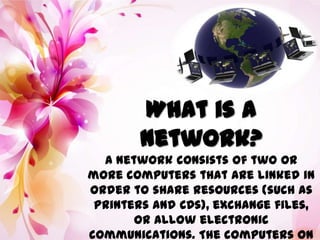
A network consists of two or
more computers that are linked in
order to share resources (such as
printers and CDs), exchange files,
or allow electronic
communications. The computers on
Types of network
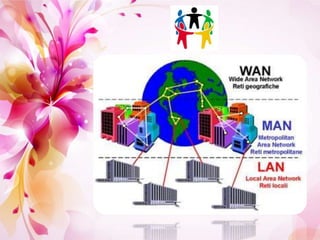
Different types of (private) networks are
distinguished based on their size (in terms
of the number of machines), their data
transfer speed, and their reach. Private
networks are networks that belong to a
single organisation. There are usually said
to be three categories of networks:
•Local Area Network(LAN)
•Wide Area Network(WAN)
.
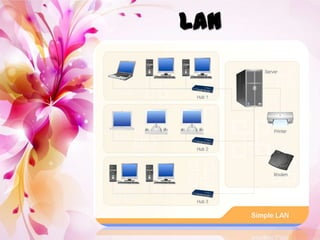
LAN stands for Local Area Network. It’s a group
of computers which all belong to the same
organisation, and which are linked within a
small geographic area using a network, and
often the same technology (the most
widespread being Ethernet). A local area
network is a network in its simplest form. Data
transfer speeds over a local area network can
reach up to 10 Mbps.
A local area network can reach as many as
100, or even 1000, users. By expanding the
definition of a LAN to the services that it
provides, two different operating modes can be
defined: In a “peer-to-peer” network, in which
LAN
WAN
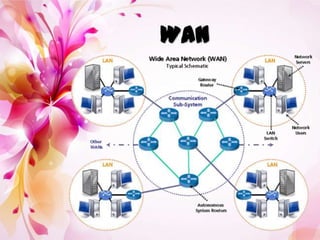
A WAN (Wide Area Network or
extended network) connects
multiple LANs to one another over
great geographic distances. The
speed available on a WAN varies
depending on the cost of the
connections (which increases with
distance) and may be low. WANs
operate using routers, which can
“choose” the most appropriate
path for data to take to reach a
network node. The most well-
WAN
MAN
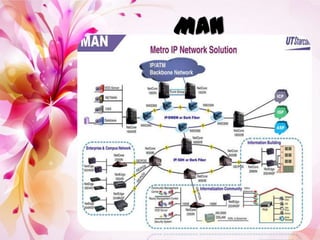
MANs (Metropolitan Area
Networks) connect multiple
geographically nearby LANs to
one another (over an area of up
to a few dozen kilometres) at
high speeds. Thus, a MAN lets two
remote nodes communicate as if
they were part of the same local
area network. A MAN is made
from switches or routers
connected to one another with
MAN
As far as how they work, a LAN, a MAN,
and A WAN all use the same
technology, protocol, etc. There is no
easy way to decide which is a
network is. If you have a company
that has two building 10 feet apart,
and they set up a single network
between them, is it a LAN or a WAN?
You could make good arguments for
either. As Google has different
servers that handle different cities
or different countries, is it one giant
WAN, or a set of smaller MANs? You
could make a good argument for
either. The definition of what is WHAT
is not very clear in the real world.
DONE BY:
SADIA ZAREEN

Computer networks

  • 2.
    What is a Network? Anetwork consists of two or more computers that are linked in order to share resources (such as printers and CDs), exchange files, or allow electronic communications. The computers on
  • 3.
    Types of network Differenttypes of (private) networks are distinguished based on their size (in terms of the number of machines), their data transfer speed, and their reach. Private networks are networks that belong to a single organisation. There are usually said to be three categories of networks: •Local Area Network(LAN) •Wide Area Network(WAN)
  • 5.
    . LAN stands forLocal Area Network. It’s a group of computers which all belong to the same organisation, and which are linked within a small geographic area using a network, and often the same technology (the most widespread being Ethernet). A local area network is a network in its simplest form. Data transfer speeds over a local area network can reach up to 10 Mbps. A local area network can reach as many as 100, or even 1000, users. By expanding the definition of a LAN to the services that it provides, two different operating modes can be defined: In a “peer-to-peer” network, in which
  • 6.
  • 7.
    WAN A WAN (WideArea Network or extended network) connects multiple LANs to one another over great geographic distances. The speed available on a WAN varies depending on the cost of the connections (which increases with distance) and may be low. WANs operate using routers, which can “choose” the most appropriate path for data to take to reach a network node. The most well-
  • 8.
  • 9.
    MAN MANs (Metropolitan Area Networks)connect multiple geographically nearby LANs to one another (over an area of up to a few dozen kilometres) at high speeds. Thus, a MAN lets two remote nodes communicate as if they were part of the same local area network. A MAN is made from switches or routers connected to one another with
  • 10.
  • 11.
    As far ashow they work, a LAN, a MAN, and A WAN all use the same technology, protocol, etc. There is no easy way to decide which is a network is. If you have a company that has two building 10 feet apart, and they set up a single network between them, is it a LAN or a WAN? You could make good arguments for either. As Google has different servers that handle different cities or different countries, is it one giant WAN, or a set of smaller MANs? You could make a good argument for either. The definition of what is WHAT is not very clear in the real world.
  • 12.