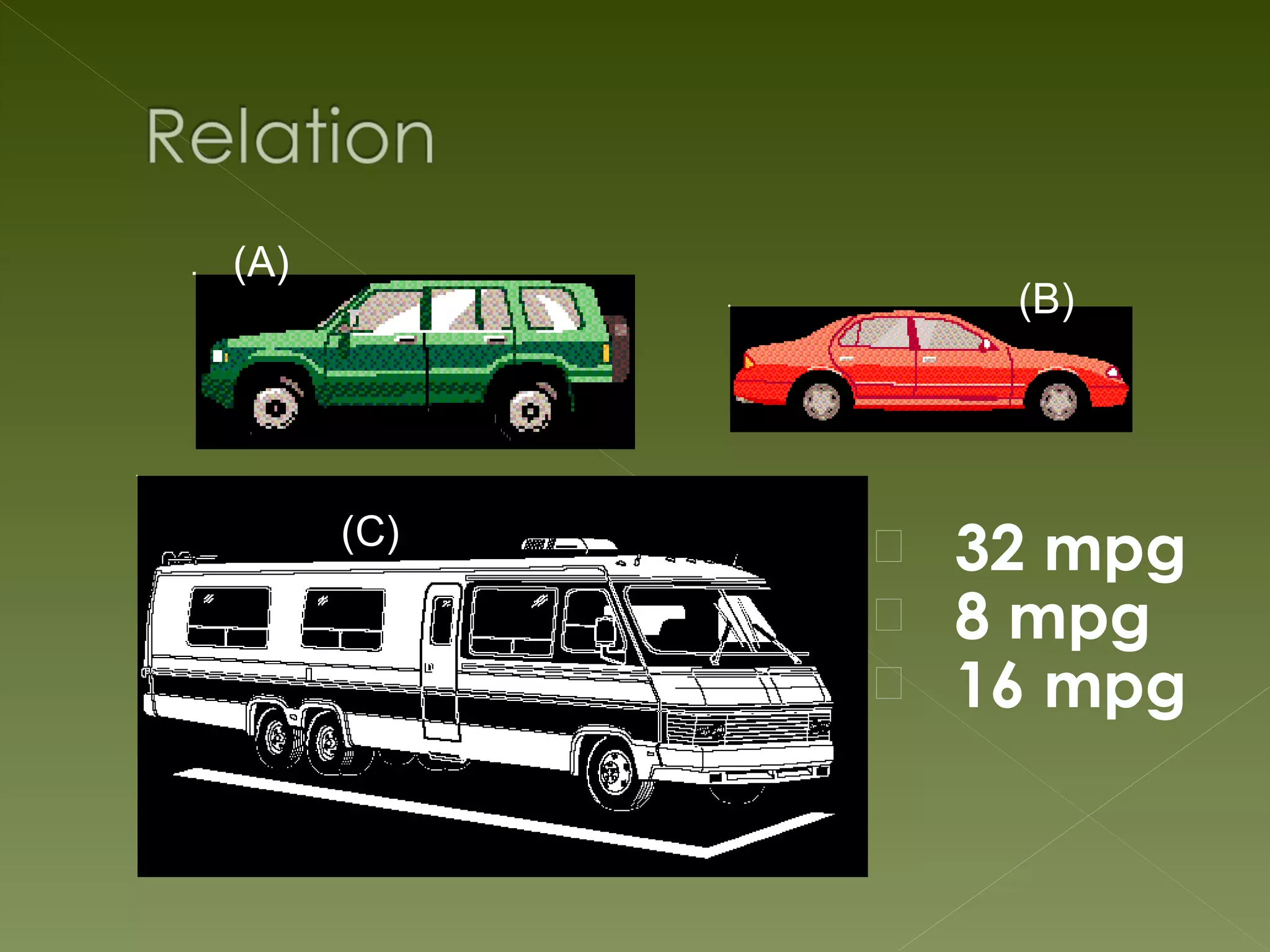
(A)
                 (B)


      (C)   °   32 mpg
            °   8 mpg
            °   16 mpg
 The values that make up the set of
  independent values are the domain
 The values that make up the set of
  dependent values are the range.
 State the domain and range from the 4
  examples of relations given.
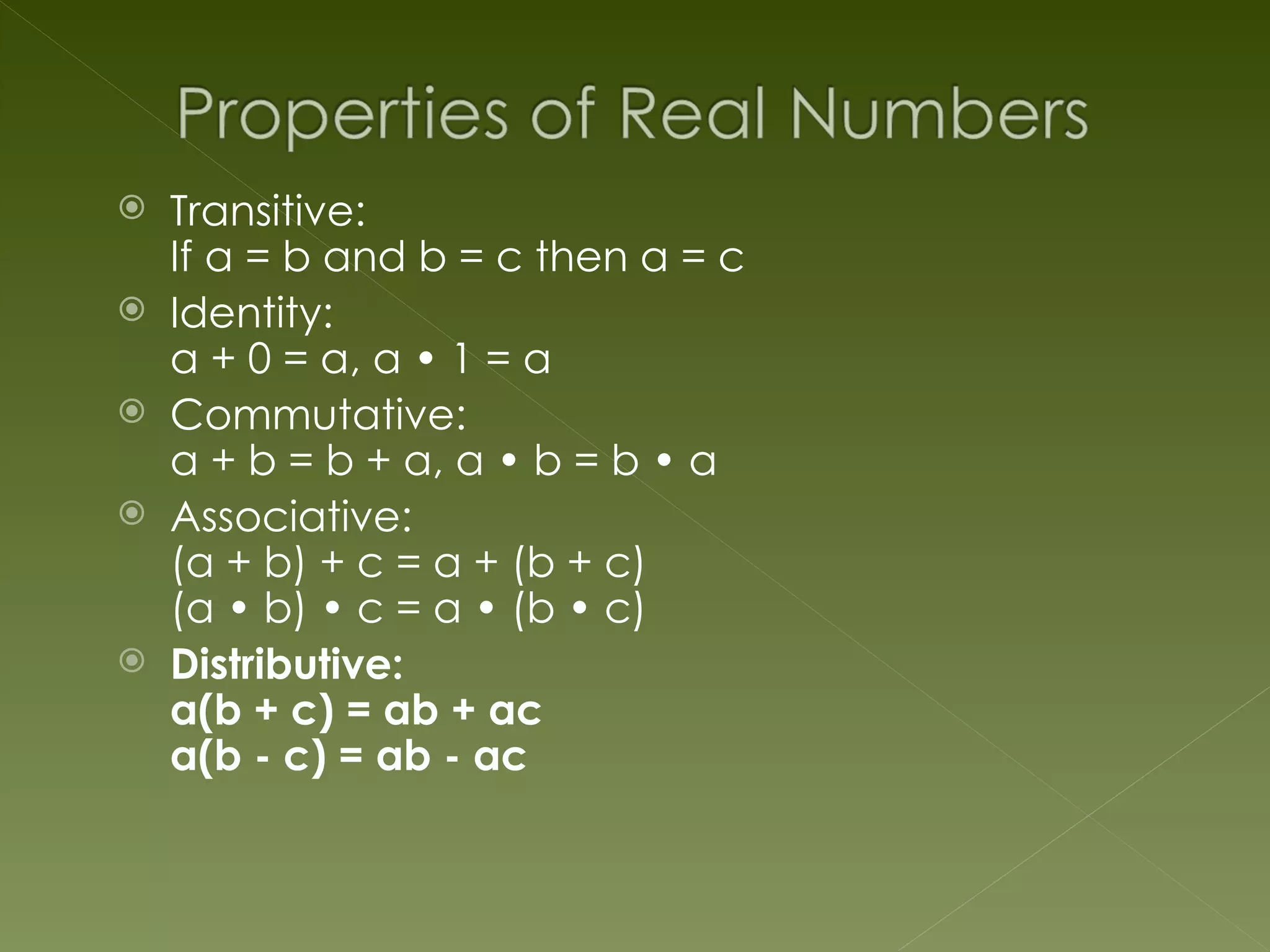
   Transitive:
    If a = b and b = c then a = c
   Identity:
    a + 0 = a, a • 1 = a
   Commutative:
    a + b = b + a, a • b = b • a
   Associative:
    (a + b) + c = a + (b + c)
    (a • b) • c = a • (b • c)
   Distributive:
    a(b + c) = ab + ac
    a(b - c) = ab - ac
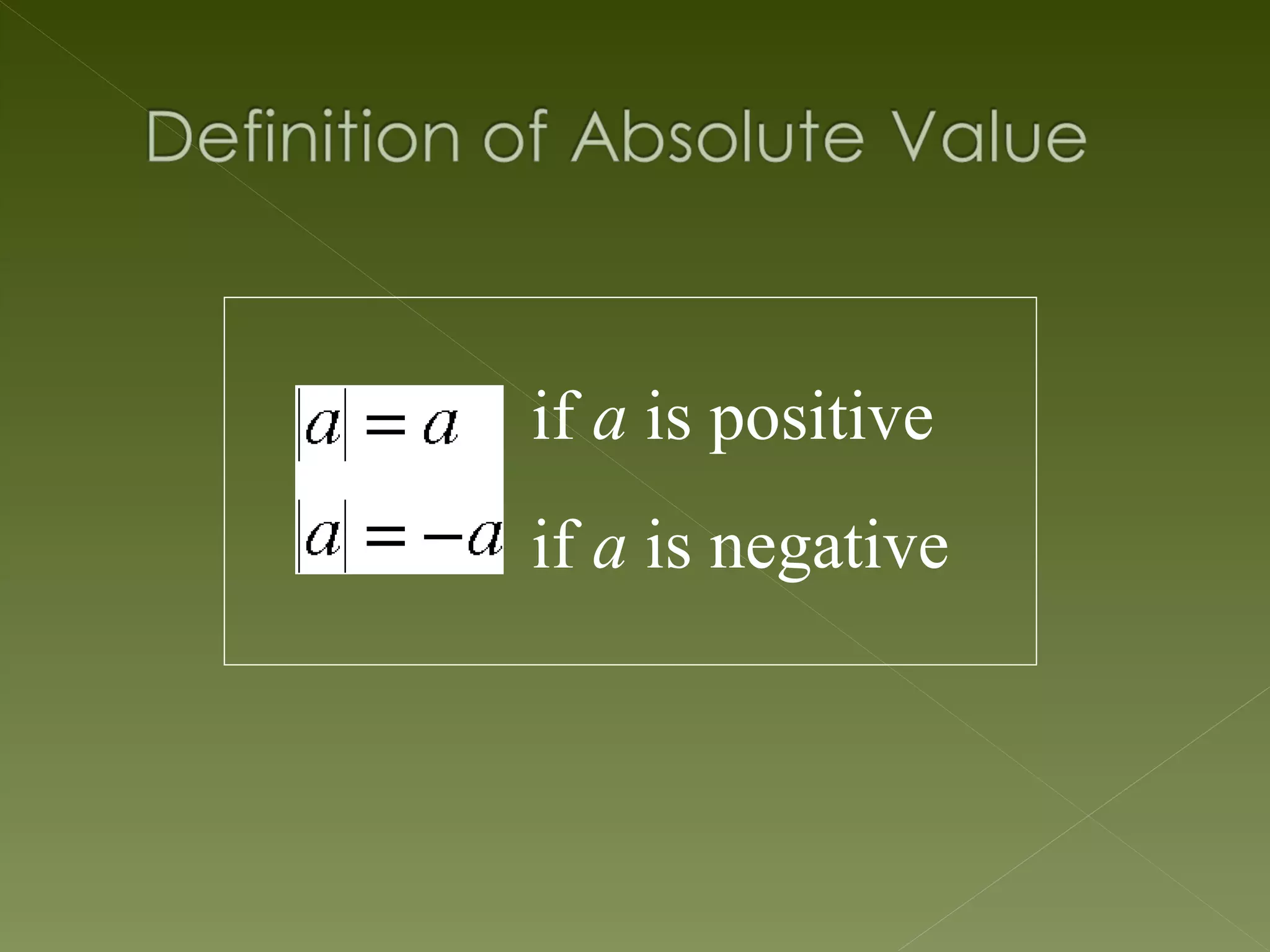
if a is positive
if a is negative
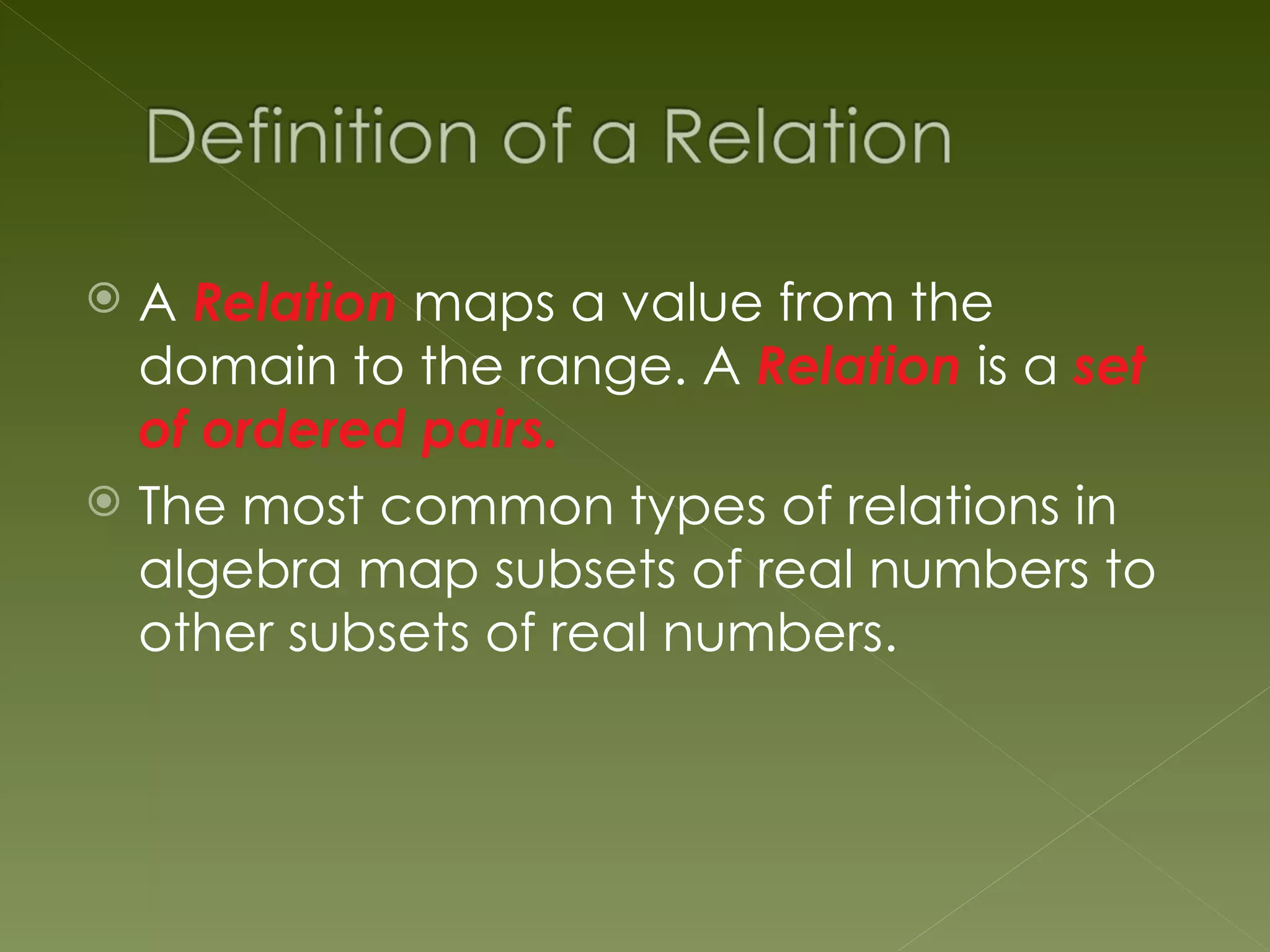
 A Relation maps a value from the
  domain to the range. A Relation is a set
  of ordered pairs.
 The most common types of relations in
  algebra map subsets of real numbers to
  other subsets of real numbers.
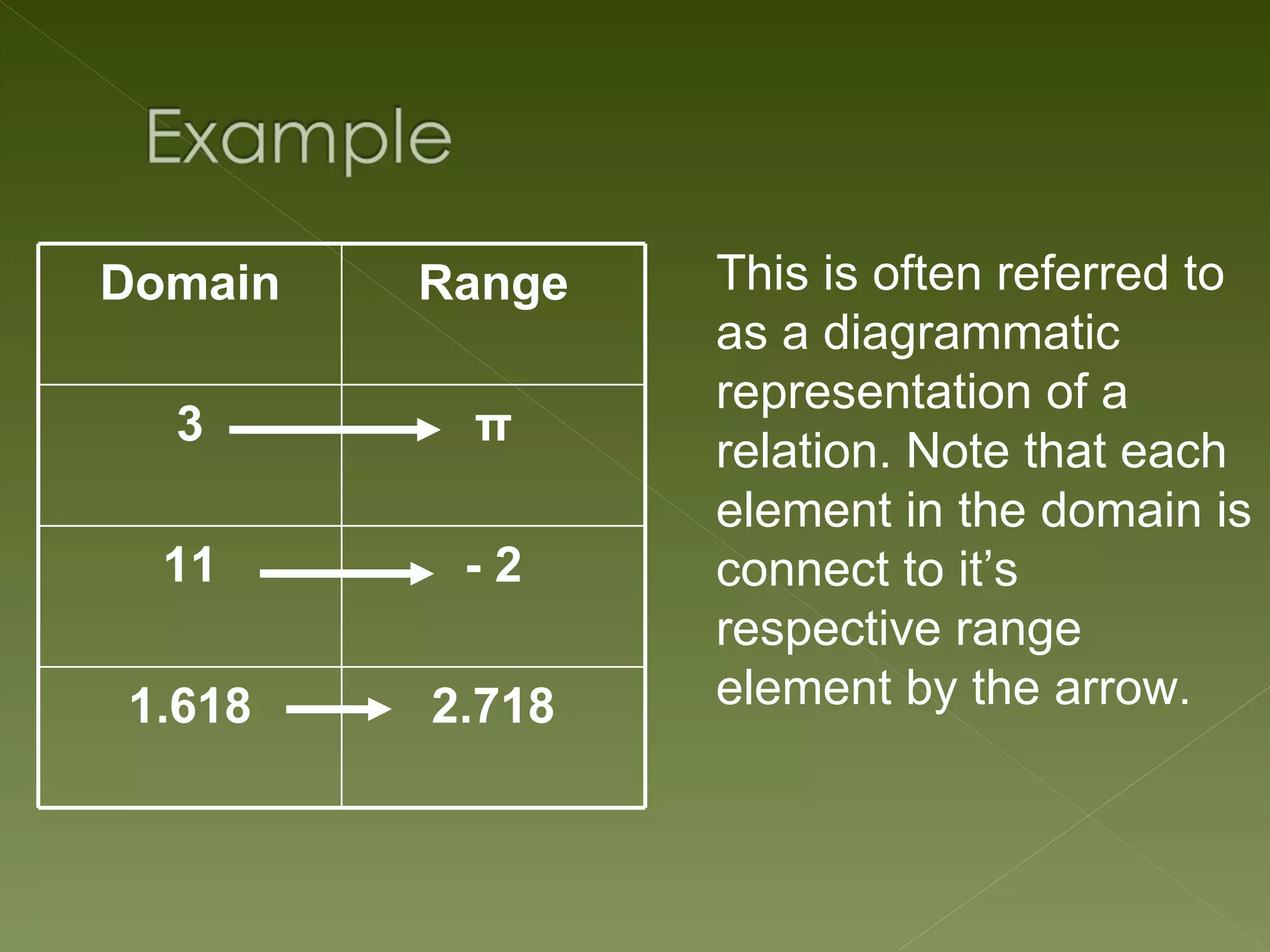
Domain   Range   This is often referred to
                 as a diagrammatic
                 representation of a
  3       π
                 relation. Note that each
                 element in the domain is
  11      -2     connect to it’s
                 respective range
1.618    2.718   element by the arrow.
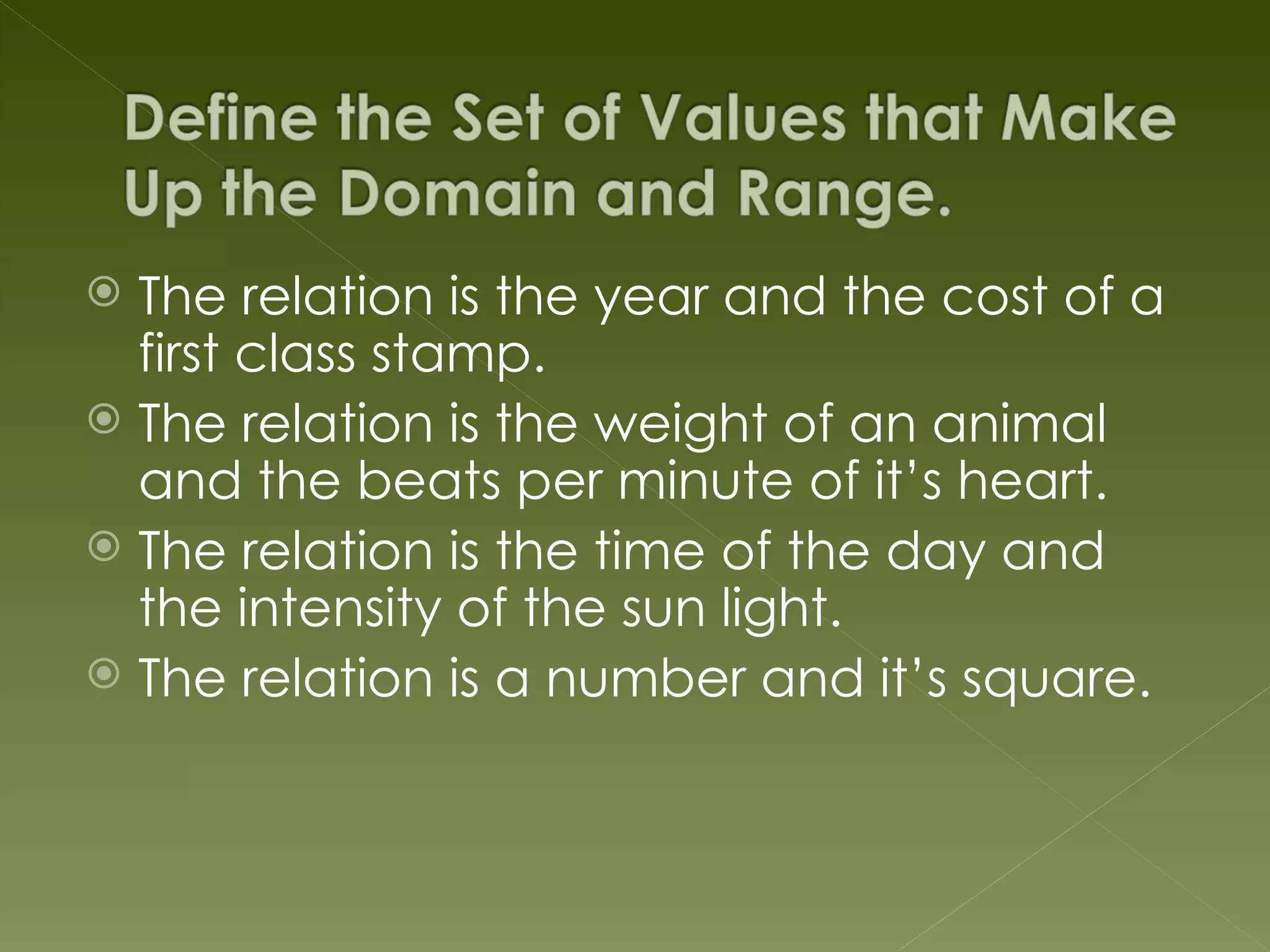
 The relation is the year and the cost of a
  first class stamp.
 The relation is the weight of an animal
  and the beats per minute of it’s heart.
 The relation is the time of the day and
  the intensity of the sun light.
 The relation is a number and it’s square.
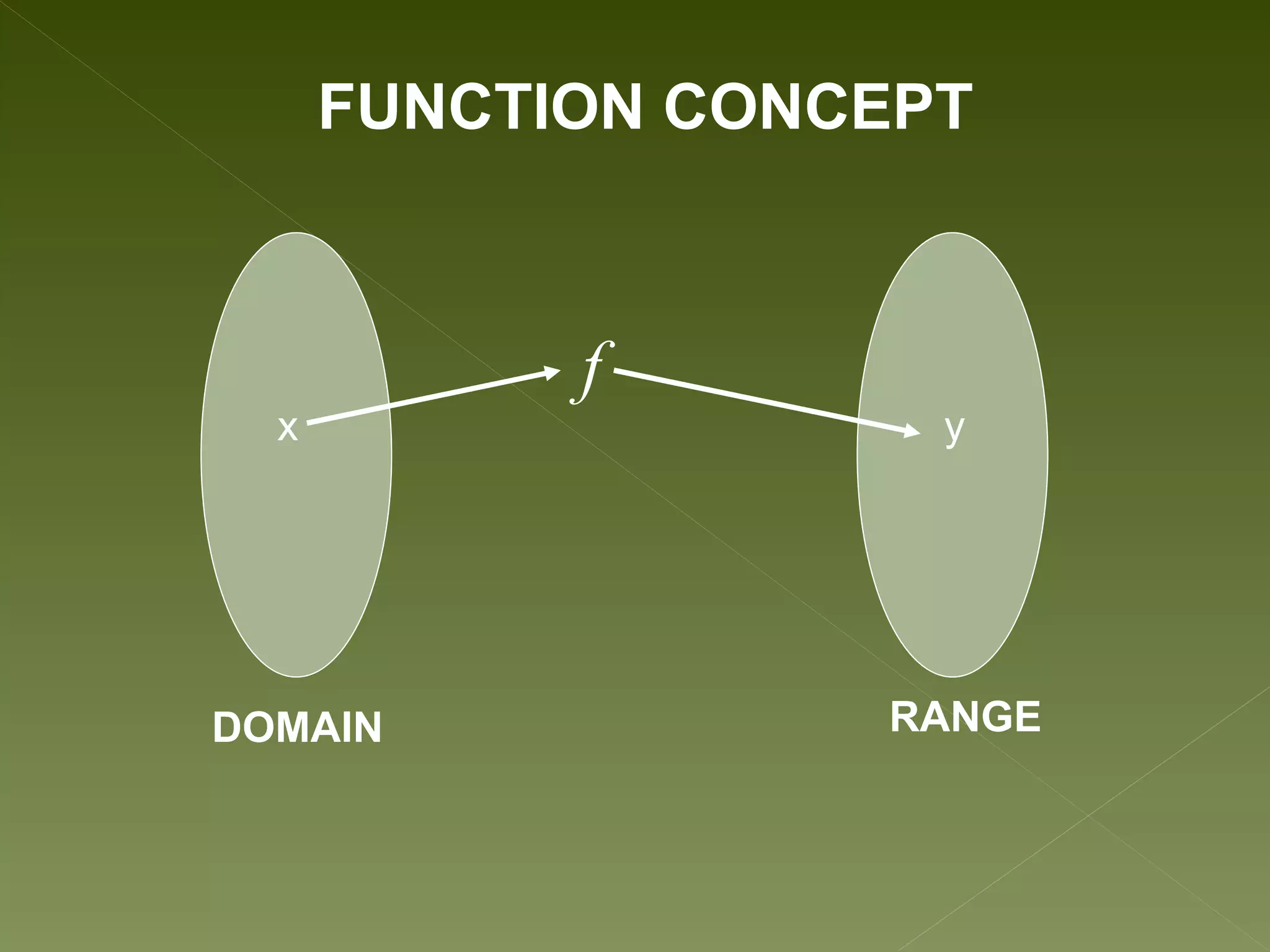
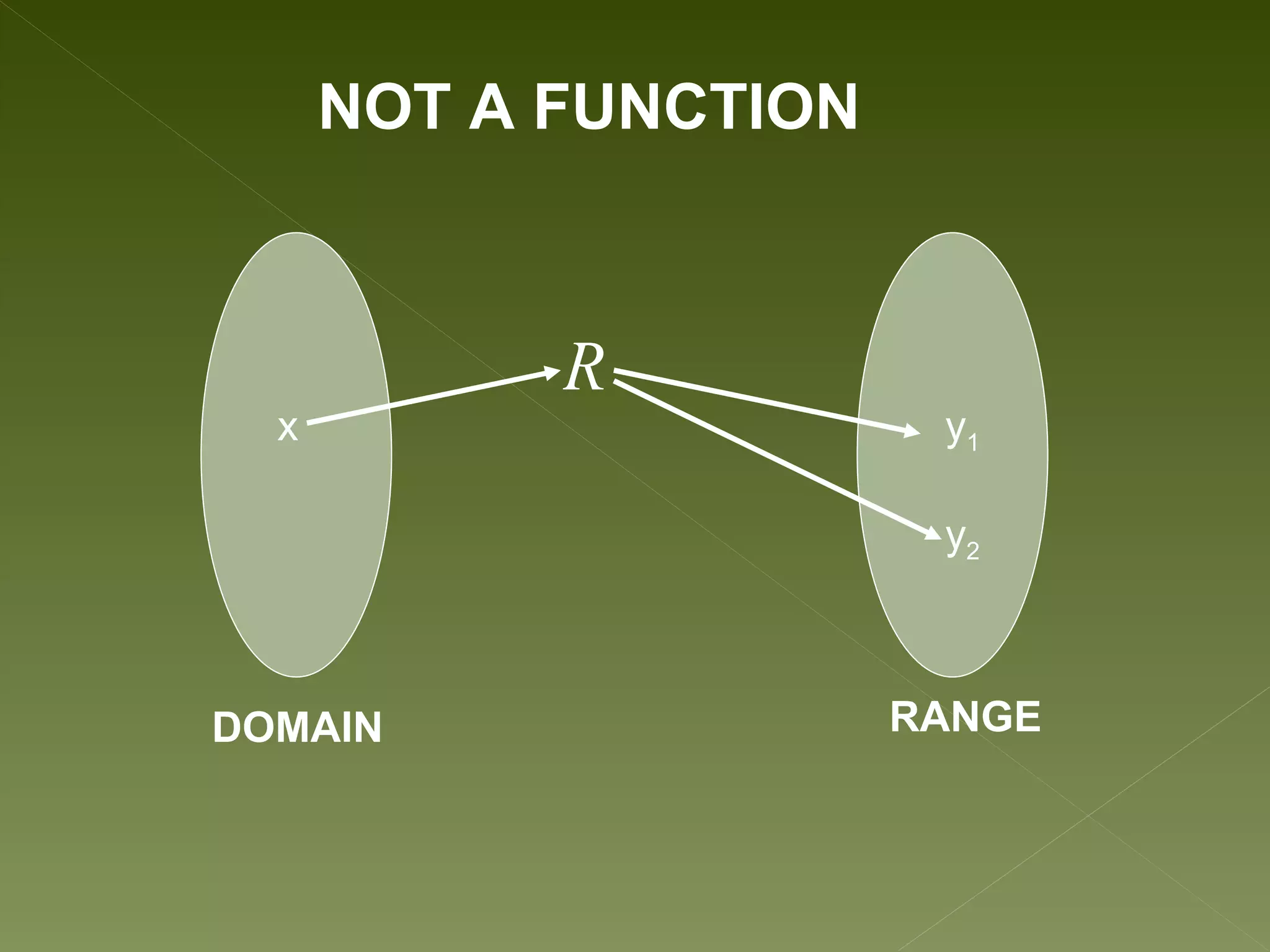
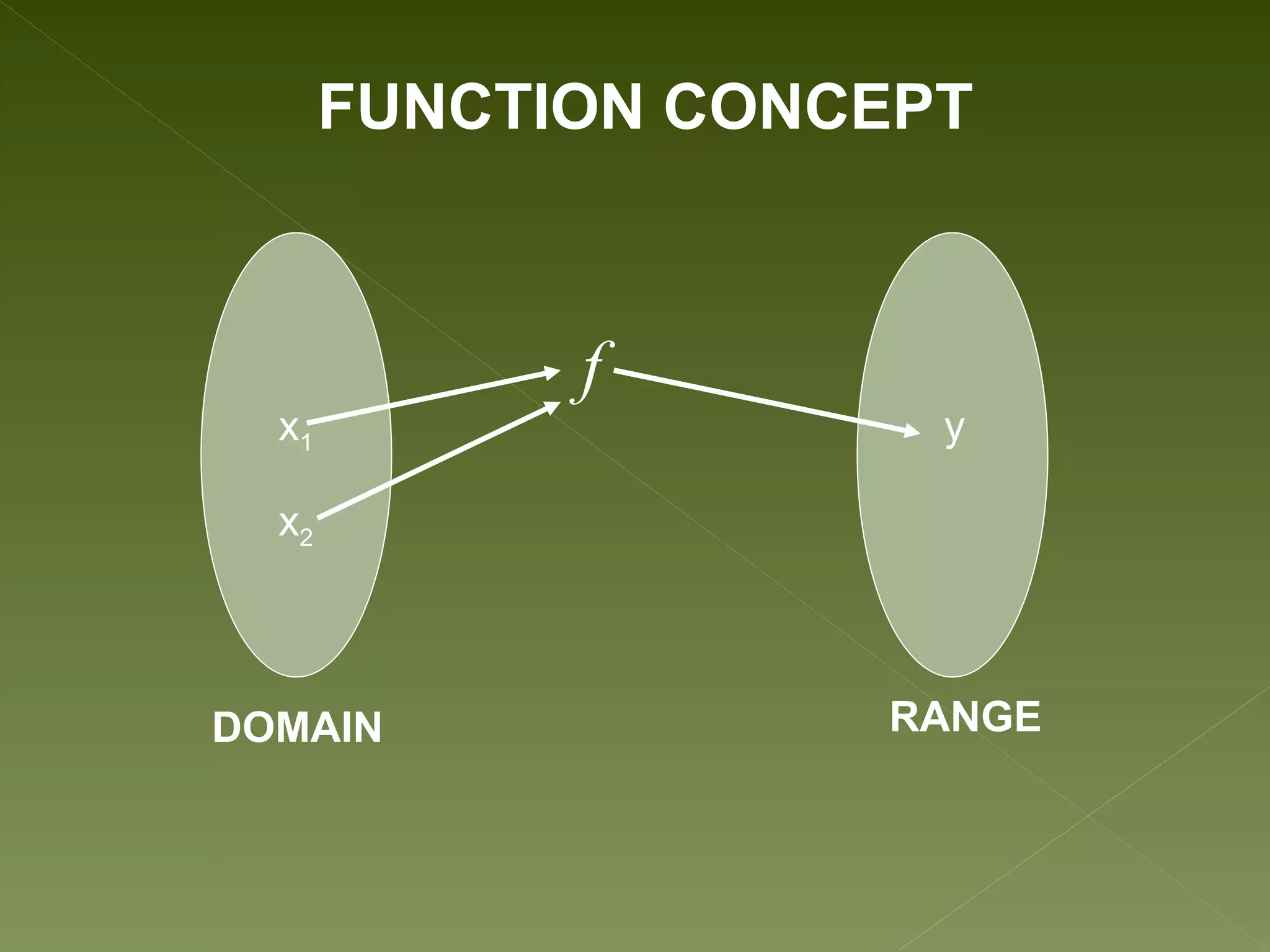
   If a relation has the additional
    characteristic that each element of the
    domain is mapped to one and only one
    element of the range then we call the
    relation a Function.
FUNCTION CONCEPT


            f
  x                  y


DOMAIN             RANGE
NOT A FUNCTION


            R
  x                     y1

                        y2


DOMAIN                 RANGE
FUNCTION CONCEPT


             f
  x1                  y

  x2


DOMAIN              RANGE
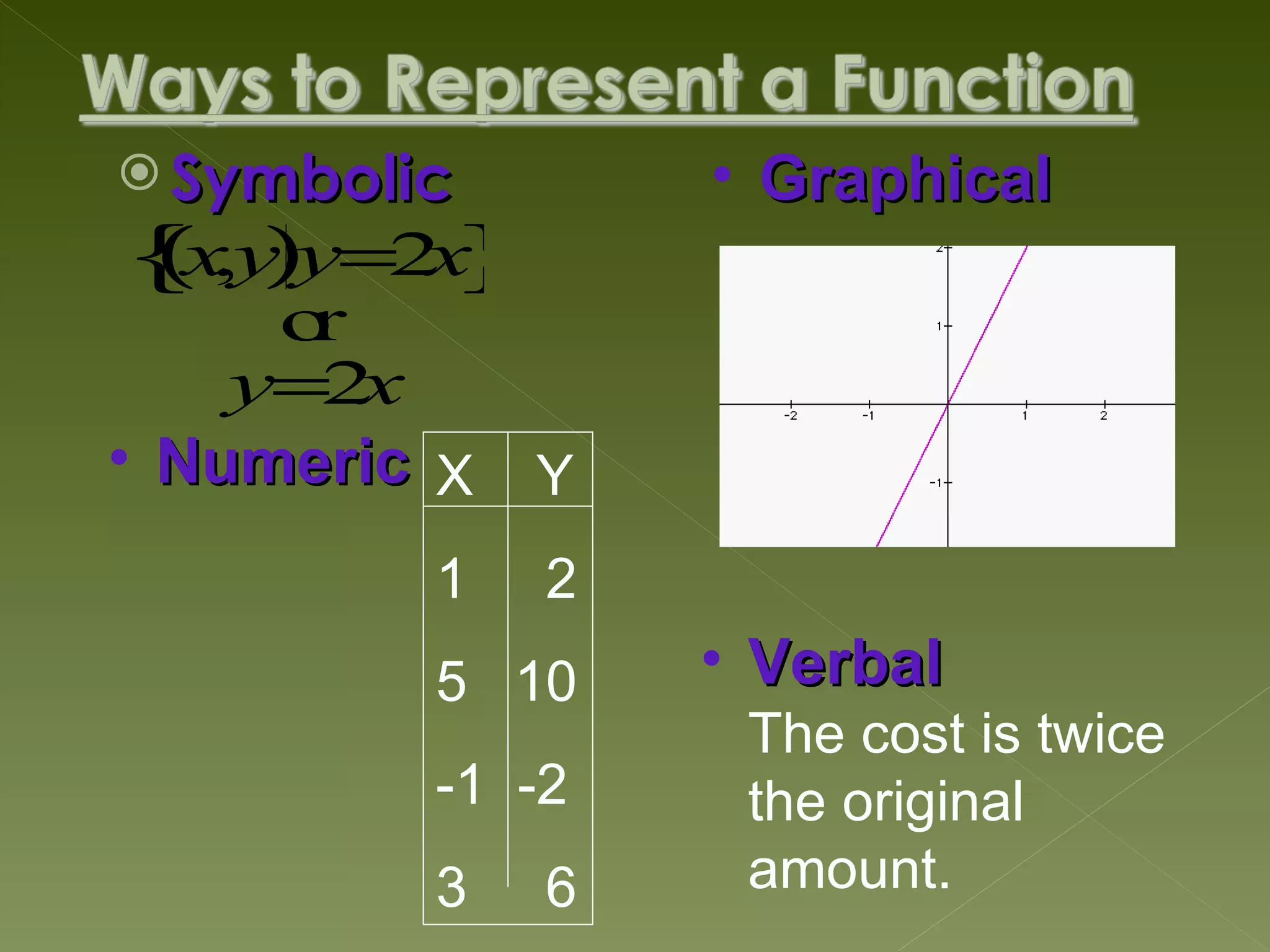
 Symbolic       • Graphical
{x )y=2 }
 ( ,y  x
     or
    y=2 x
• Numeric X Y
         1   2
         5 10    • Verbal
                  The cost is twice
         -1 -2    the original
         3   6    amount.
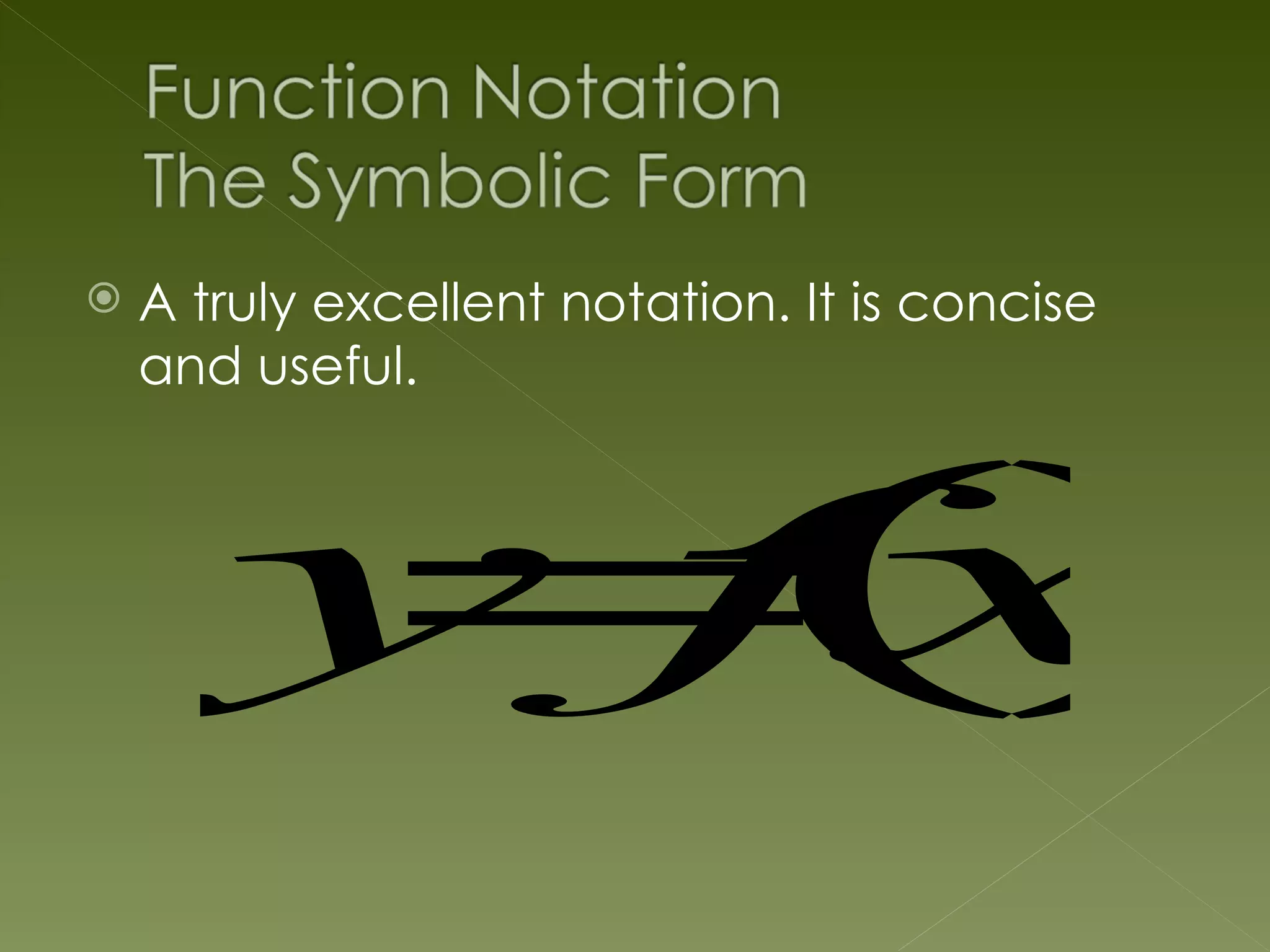
   A truly excellent notation. It is concise
    and useful.


        = ()
       y fx
= ()
     y fx
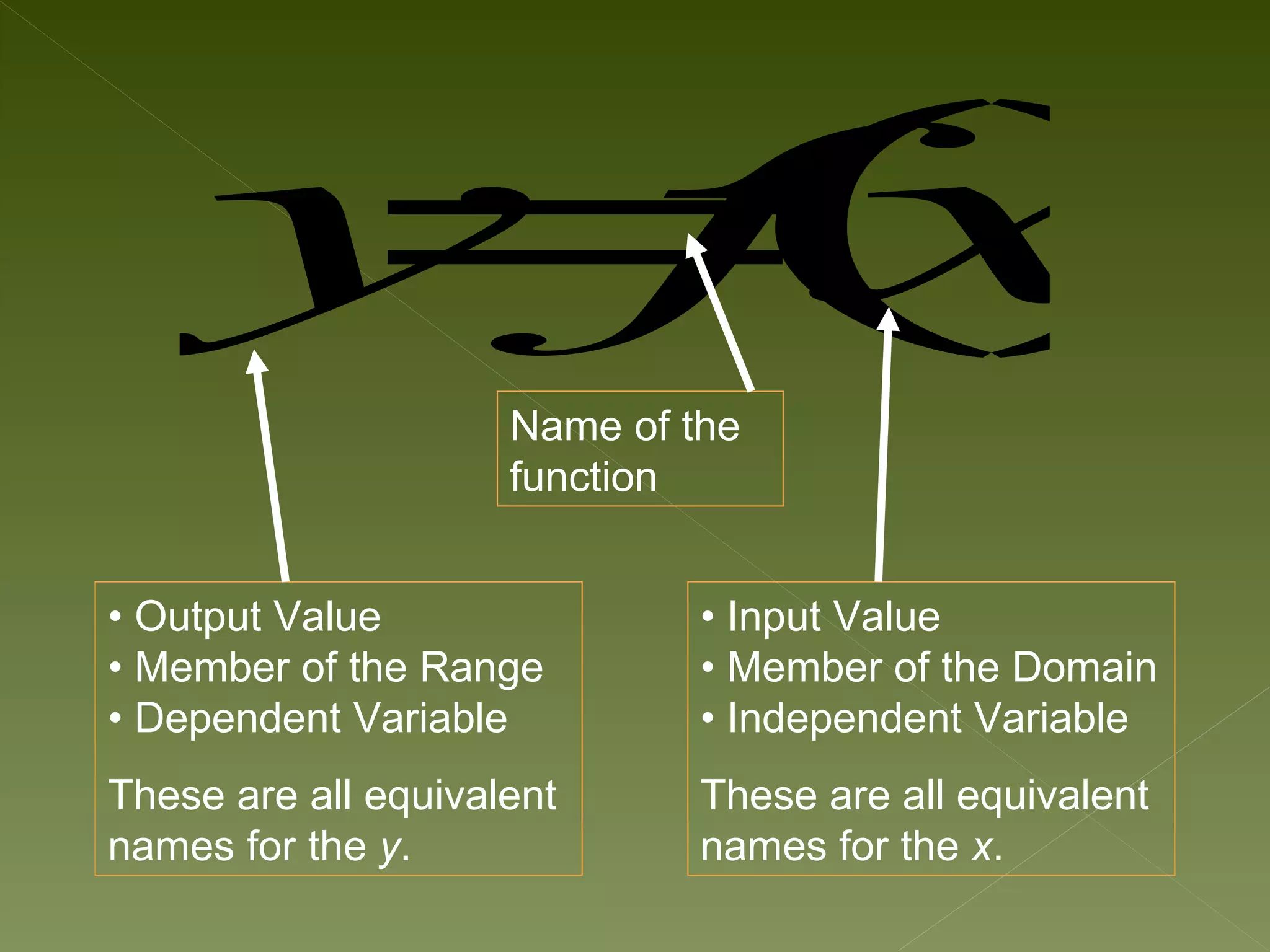
                     Name of the
                     function


• Output Value                • Input Value
• Member of the Range         • Member of the Domain
• Dependent Variable          • Independent Variable
These are all equivalent      These are all equivalent
names for the y.              names for the x.
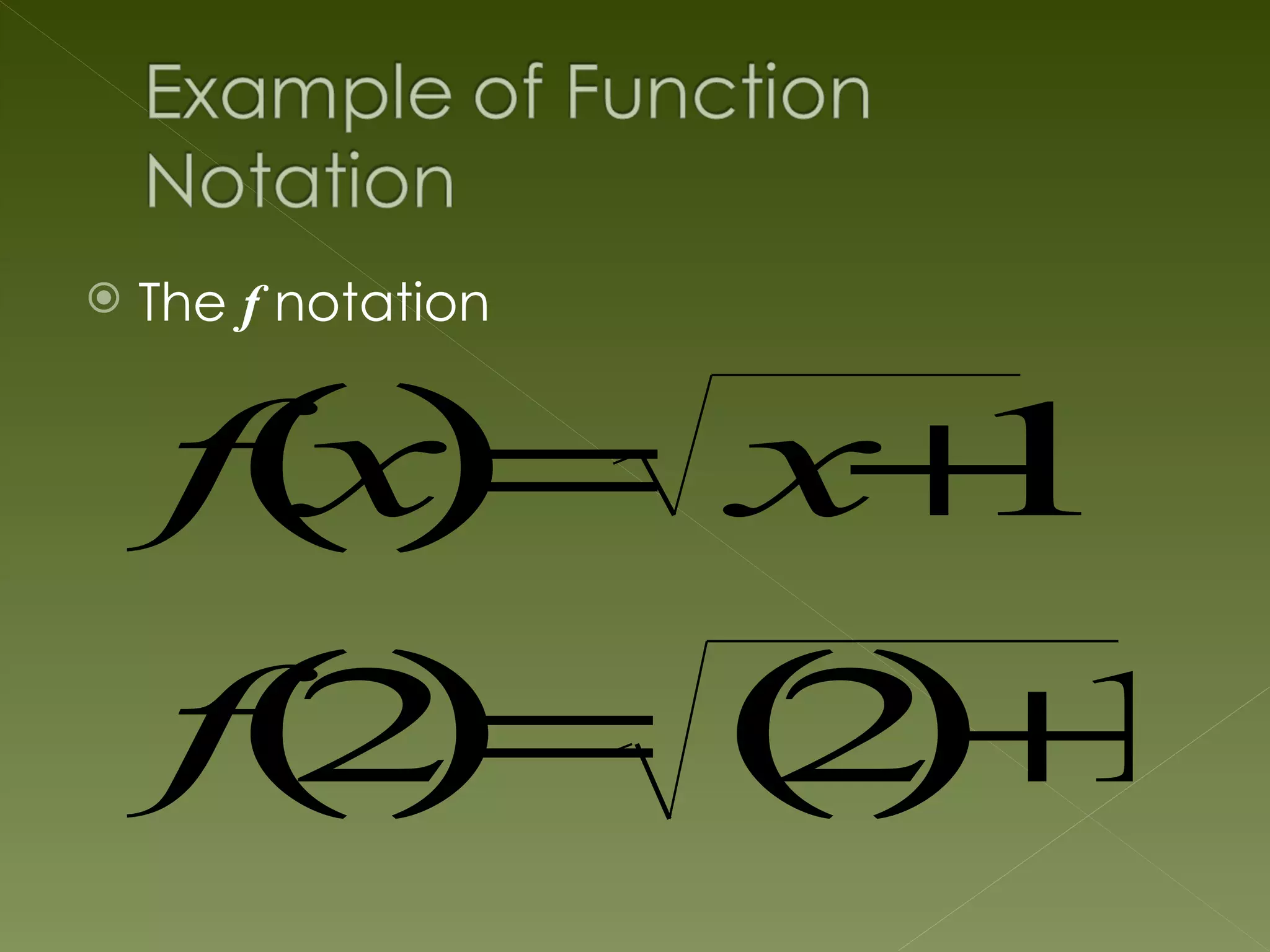
   The f notation


    f( ) x 1
      x= +
    f( ) () 1
     2 = 2+

Functions and graphs

  • 3.
    (A) (B) (C) ° 32 mpg ° 8 mpg ° 16 mpg
  • 4.
     The valuesthat make up the set of independent values are the domain  The values that make up the set of dependent values are the range.  State the domain and range from the 4 examples of relations given.
  • 7.
    Transitive: If a = b and b = c then a = c  Identity: a + 0 = a, a • 1 = a  Commutative: a + b = b + a, a • b = b • a  Associative: (a + b) + c = a + (b + c) (a • b) • c = a • (b • c)  Distributive: a(b + c) = ab + ac a(b - c) = ab - ac
  • 8.
    if a ispositive if a is negative
  • 11.
     A Relationmaps a value from the domain to the range. A Relation is a set of ordered pairs.  The most common types of relations in algebra map subsets of real numbers to other subsets of real numbers.
  • 12.
    Domain Range This is often referred to as a diagrammatic representation of a 3 π relation. Note that each element in the domain is 11 -2 connect to it’s respective range 1.618 2.718 element by the arrow.
  • 13.
     The relationis the year and the cost of a first class stamp.  The relation is the weight of an animal and the beats per minute of it’s heart.  The relation is the time of the day and the intensity of the sun light.  The relation is a number and it’s square.
  • 14.
    If a relation has the additional characteristic that each element of the domain is mapped to one and only one element of the range then we call the relation a Function.
  • 15.
    FUNCTION CONCEPT f x y DOMAIN RANGE
  • 16.
    NOT A FUNCTION R x y1 y2 DOMAIN RANGE
  • 17.
    FUNCTION CONCEPT f x1 y x2 DOMAIN RANGE
  • 18.
     Symbolic • Graphical {x )y=2 } ( ,y x or y=2 x • Numeric X Y 1 2 5 10 • Verbal The cost is twice -1 -2 the original 3 6 amount.
  • 19.
    A truly excellent notation. It is concise and useful. = () y fx
  • 20.
    = () y fx Name of the function • Output Value • Input Value • Member of the Range • Member of the Domain • Dependent Variable • Independent Variable These are all equivalent These are all equivalent names for the y. names for the x.
  • 21.
    The f notation f( ) x 1 x= + f( ) () 1 2 = 2+

Editor's Notes

  • #2 Day 0ne. Cover the concepts: Relation Function Domain and range 4 ways to represent a relation/function Graphical Symbolic Numeric Verbal
  • #3 Define the relationships that are presented. Husband and Wife Father and son Foot length shoe size Number of drinks and BAC
  • #4 Match the miles per gallon to the vehicle Write the definition of RELATION: “ The way one thing is related to another, to reference to or connection with” “ A set of ordered pairs” What is meant by “Ordered pairs” Which is causing which? The miles per gallon causes the vehicle size The vehicle size causes the miles per gallon The “independent” variable causes the “dependent” variable (in most cases)
  • #5 Make up and example of a relation then define the domain and range of the relation
  • #6 Make up and example of a relation then define the domain and range of the relation
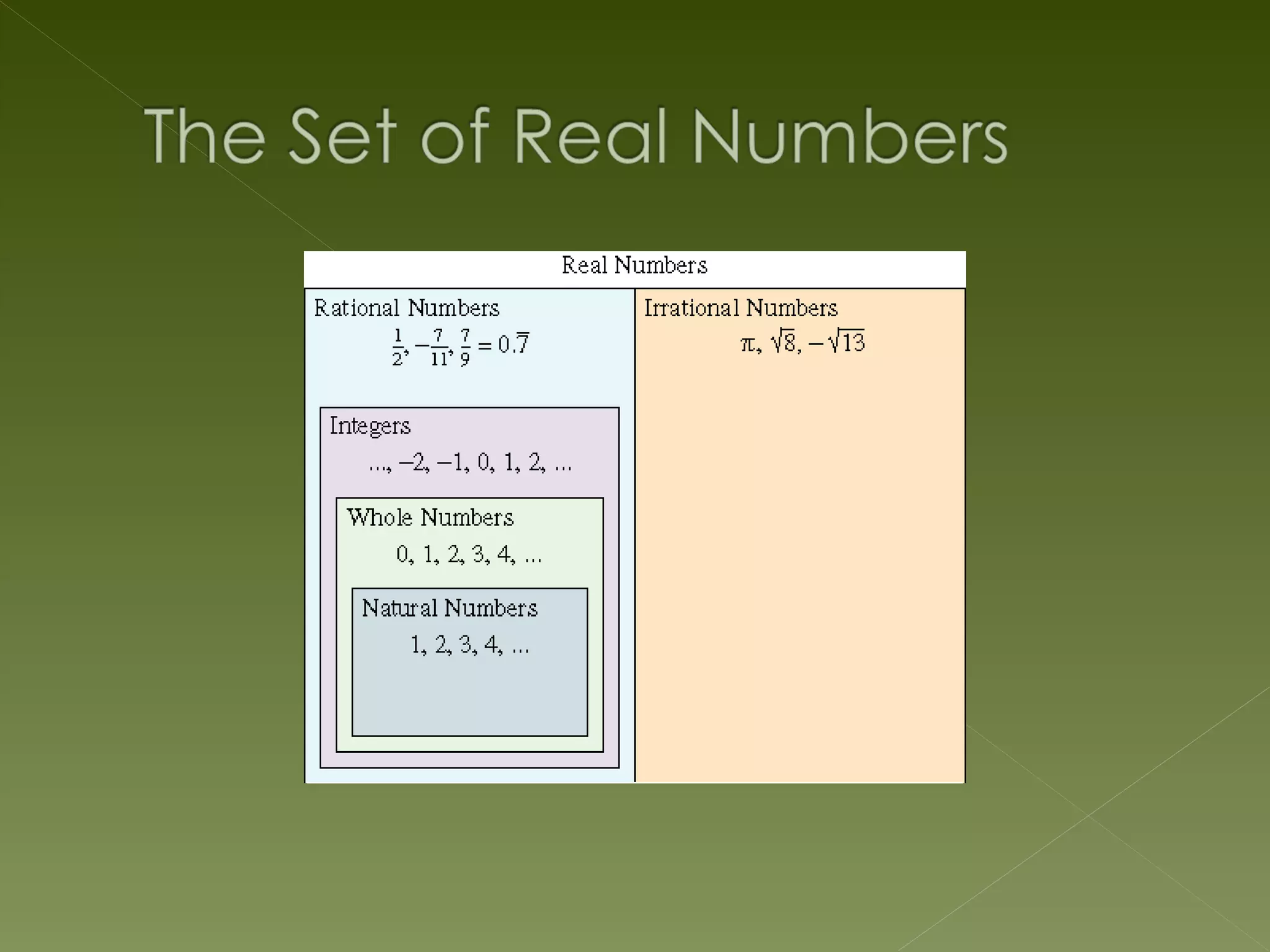
  • #7 In mathematics one topic we are interested in relationships between sets of numbers So, lets take a minute to talk about the sets of numbers that make up the REAL numbers.
  • #8 The properties of the real numbers are a fundamental to all of what we do in algebra. Algebra is in a broad sense the generalization of arithmetic. The properties of the real numbers allow us to do most of the operations we do when simplifying algebraic expressions. Why does the distributive property work?
  • #9 An excellent definition of absolute value is the distance between two points on a number line. In the case where we take the absolute value of a single value, we are finding the distance between that value and 0 on the number line.
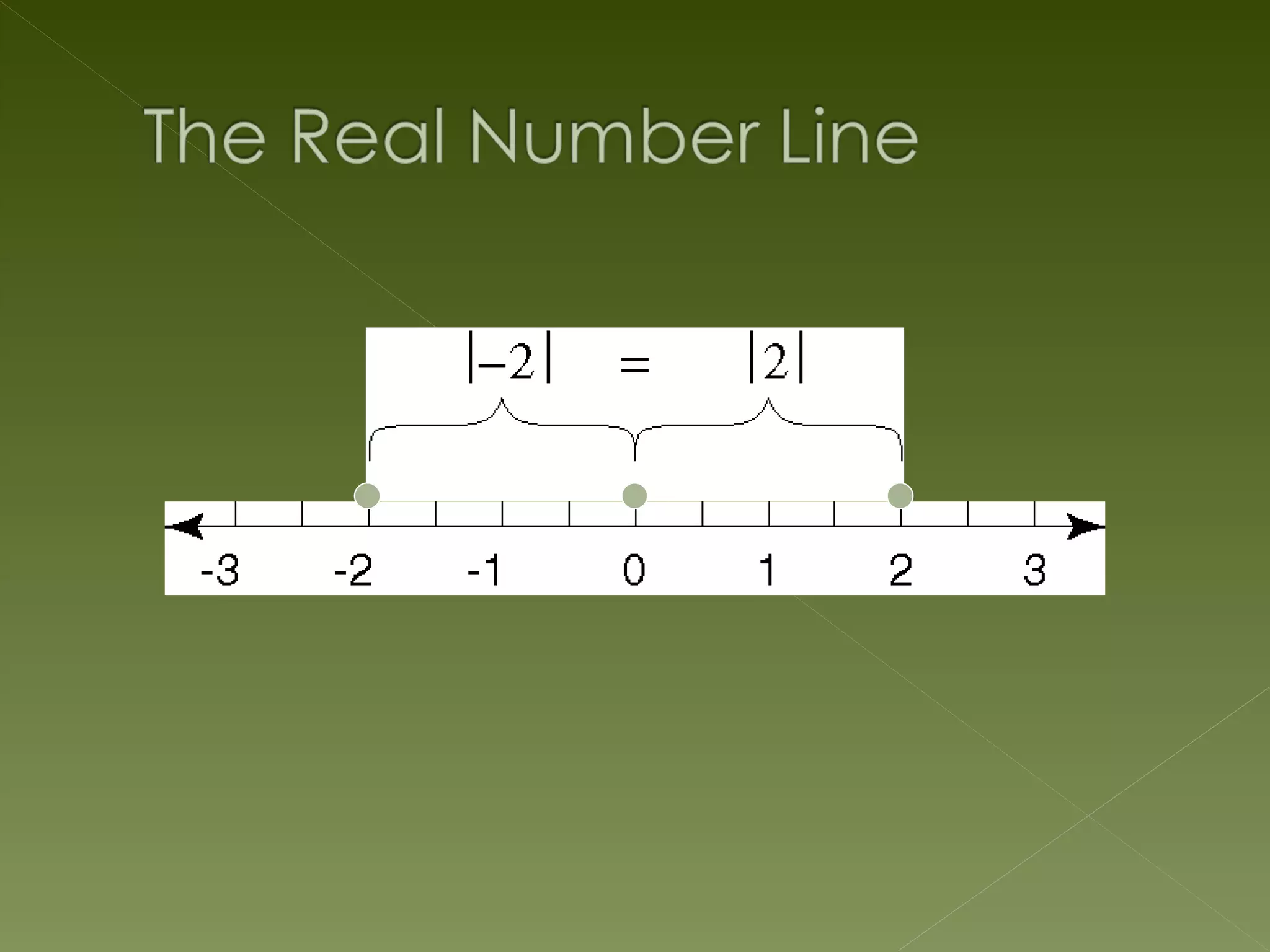
  • #10 Note that the absolute value of -2 is the distance between -2 and 0 on the number line.
  • #11 Make up and example of a relation then define the domain and range of the relation
  • #12 This is the mathematical definition of a relation.
  • #14 This is one place the real world and math don’t mix very well. In most cases the real world works in the set of rational numbers. In fact, we round off most irrationals to rational to be able to work with them. Yet in mathematics, the definition of your domain and range in a sense defines the relation. For two relations to be equivalent they must have the same set of ordered pairs. That is each element in the domain must be matched with the exact same element in the range. For example, the square root of x squared is equivalent to the absolute value of x.
  • #16 A function f is a set of ordered pairs (x,y) where each x-value corresponds to exactly one y-value.
  • #17 A function f is a set of ordered pairs (x,y) where each x-value corresponds to exactly one y-value.
  • #18 A function f is a set of ordered pairs (x,y) where each x-value corresponds to exactly one y-value.
  • #20 The notation can be confusing when topics such as composition of functions or inverse functions are discussed. But, at the fundamental level, the notation is easy to use and understand. The trick is to break it into its pieces and discuss what each piece represents.
  • #21 One of the really big deals is to remember that y is f(x). That means that f(x) and y are interchangeable.
  • #22 Do some examples on the board.