TYPES OF COMPUTER
NETWORKS

Maninder Kaur
professormaninder@gmail.com
What is Network?
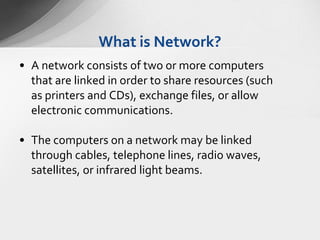
• A network consists of two or more computers
that are linked in order to share resources (such
as printers and CDs), exchange files, or allow
electronic communications.
• The computers on a network may be linked
through cables, telephone lines, radio waves,
satellites, or infrared light beams.
Different Types of Networks
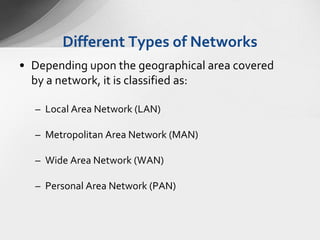
• Depending upon the geographical area covered
by a network, it is classified as:
– Local Area Network (LAN)

– Metropolitan Area Network (MAN)
– Wide Area Network (WAN)

– Personal Area Network (PAN)
Local Area Network (LAN)
• A LAN is a network that is used for communicating among
computer devices, usually within an office building or home.
• LAN’s enable the sharing of resources such as files or
hardware devices that may be needed by multiple users
•
• Is limited in size, typically spanning a few hundred meters,
and no more than a mile
• Is fast, with speeds from 10 Mbps to 10 Gbps

• Requires little wiring, typically a single cable connecting to
each device
• Has lower cost compared to MAN’s or WAN’s
Local Area Network (LAN)
• LAN’s can be either wired or wireless. Twisted pair,
coax or fibre optic cable can be used in wired LAN’s.
• Every LAN uses a protocol – a set of rules that governs
how packets are configured and transmitted.

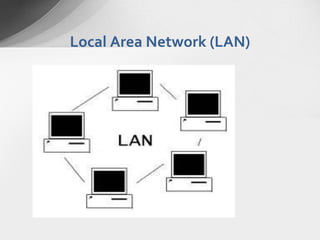
• Nodes in a LAN are linked together with a certain
topology. These topologies include:
– Bus
– Ring
– Star

• LANs are capable of very high transmission rates (100s
Mb/s to G b/s).
Local Area Network (LAN)
Advantages of LAN
• Speed
• Cost
• Security
• E-mail

• Resource Sharing
Disadvantages of LAN
• Expensive To Install

• Requires Administrative Time

• File Server May Fail

• Cables May Break
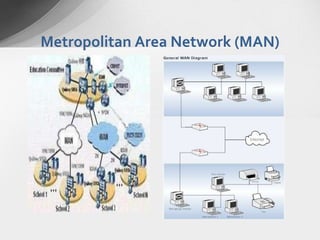
Metropolitan Area Network (MAN)
• A metropolitan area network (MAN) is a large
computer network that usually spans a city or a
large campus.
• A MAN is optimized for a larger geographical
area than a LAN, ranging from several blocks of
buildings to entire cities.

• A MAN might be owned and operated by a
single organization, but it usually will be used
by many individuals and organizations.
Metropolitan Area Network (MAN)
• A MAN often acts as a high speed network to
allow sharing of regional resources.
• A MAN typically covers an area of between 5
and 50 km diameter.
• Examples of MAN: Telephone company
network that provides a high speed DSL to
customers and cable TV network.
Metropolitan Area Network (MAN)
Wide Area Network (WAN)
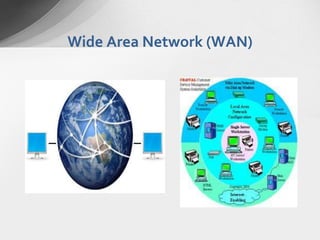
• WAN covers a large geographic area such as
country, continent or even whole of the world.
• A WAN is two or more LANs connected
together. The LANs can be many miles apart.
• To cover great distances, WANs may transmit
data over leased high-speed phone lines or
wireless links such as satellites.
Wide Area Network (WAN)
• Multiple LANs can be connected together
using devices such as bridges, routers, or
gateways, which enable them to share data.
• The world's most popular WAN is the Internet.
Wide Area Network (WAN)
Personal Area Network (PAN)
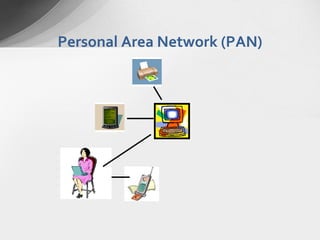
• A PAN is a network that is used for
communicating among computers and computer
devices (including telephones) in close
proximity of around a few meters within a room

• It can be used for communicating between the
devices themselves, or for connecting to a larger
network such as the internet.
• PAN’s can be wired or wireless
Personal Area Network (PAN)
• A personal area network (PAN) is a computer
network used for communication among
computer devices, including telephones and
personal digital assistants, in proximity to an
individual's body.
• The devices may or may not belong to the
person in question. The reach of a PAN is
typically a few meters.
Personal Area Network (PAN)
Types of-networks(1)

Types of-networks(1)

  • 1.
    TYPES OF COMPUTER NETWORKS ManinderKaur professormaninder@gmail.com
  • 2.
    What is Network? •A network consists of two or more computers that are linked in order to share resources (such as printers and CDs), exchange files, or allow electronic communications. • The computers on a network may be linked through cables, telephone lines, radio waves, satellites, or infrared light beams.
  • 3.
    Different Types ofNetworks • Depending upon the geographical area covered by a network, it is classified as: – Local Area Network (LAN) – Metropolitan Area Network (MAN) – Wide Area Network (WAN) – Personal Area Network (PAN)
  • 4.
    Local Area Network(LAN) • A LAN is a network that is used for communicating among computer devices, usually within an office building or home. • LAN’s enable the sharing of resources such as files or hardware devices that may be needed by multiple users • • Is limited in size, typically spanning a few hundred meters, and no more than a mile • Is fast, with speeds from 10 Mbps to 10 Gbps • Requires little wiring, typically a single cable connecting to each device • Has lower cost compared to MAN’s or WAN’s
  • 5.
    Local Area Network(LAN) • LAN’s can be either wired or wireless. Twisted pair, coax or fibre optic cable can be used in wired LAN’s. • Every LAN uses a protocol – a set of rules that governs how packets are configured and transmitted. • Nodes in a LAN are linked together with a certain topology. These topologies include: – Bus – Ring – Star • LANs are capable of very high transmission rates (100s Mb/s to G b/s).
  • 6.
  • 7.
    Advantages of LAN •Speed • Cost • Security • E-mail • Resource Sharing
  • 8.
    Disadvantages of LAN •Expensive To Install • Requires Administrative Time • File Server May Fail • Cables May Break
  • 9.
    Metropolitan Area Network(MAN) • A metropolitan area network (MAN) is a large computer network that usually spans a city or a large campus. • A MAN is optimized for a larger geographical area than a LAN, ranging from several blocks of buildings to entire cities. • A MAN might be owned and operated by a single organization, but it usually will be used by many individuals and organizations.
  • 10.
    Metropolitan Area Network(MAN) • A MAN often acts as a high speed network to allow sharing of regional resources. • A MAN typically covers an area of between 5 and 50 km diameter. • Examples of MAN: Telephone company network that provides a high speed DSL to customers and cable TV network.
  • 11.
  • 12.
    Wide Area Network(WAN) • WAN covers a large geographic area such as country, continent or even whole of the world. • A WAN is two or more LANs connected together. The LANs can be many miles apart. • To cover great distances, WANs may transmit data over leased high-speed phone lines or wireless links such as satellites.
  • 13.
    Wide Area Network(WAN) • Multiple LANs can be connected together using devices such as bridges, routers, or gateways, which enable them to share data. • The world's most popular WAN is the Internet.
  • 14.
  • 15.
    Personal Area Network(PAN) • A PAN is a network that is used for communicating among computers and computer devices (including telephones) in close proximity of around a few meters within a room • It can be used for communicating between the devices themselves, or for connecting to a larger network such as the internet. • PAN’s can be wired or wireless
  • 16.
    Personal Area Network(PAN) • A personal area network (PAN) is a computer network used for communication among computer devices, including telephones and personal digital assistants, in proximity to an individual's body. • The devices may or may not belong to the person in question. The reach of a PAN is typically a few meters.
  • 17.