COMPUTER
NETWORKS
LECTURER SURAJ PANDEY CCT COLLEGE
What is a ComputerNetwork?
A computer network is a system in which multiple computers
are connected to each other to share information and
resources.
Usually, the connections between computers in a network are
made using physical wires or cables
LECTURER SURAJ PANDEY CCT COLLEGE
• Characteristics
1. Share Resources from one computer to another
2. Create files and store them in one computer, access those
files from the other computer(s) connected over the network
3. Connect a printer, scanner or a fax machine to one computer
within the network and let other computers of the network use
the machines available over network.
LECTURER SURAJ PANDEY CCT COLLEGE
• Types of ComputerNetworks
There are different types of computernetworks. Some of the
common ones include.
1. Local Area Network LAN
2. Personal Area Network (PAN)
3. Metropolitan Area Network MAN
4. Wide Area Network WAN
5. Wireless Local Area Network WLAN
LECTURER SURAJ PANDEY CCT COLLEGE
LOCAL AREA NETWORK
(LAN)
A LAN is a network that is used for communicating among
computer devices, usually within an office building or home.
LAN’s enable the sharing of resources such as files or
hardware devices that may be needed by multiple users •
Is limited in size, typically spanning a few hundred meters,
and no more than a mile
Is fast, with speeds from 10 Mbps to 10 Gbps
Requires little wiring, typically a single cable connecting to
each device
 Has lower cost compared to MAN’s or WAN’s
LECTURER SURAJ PANDEY CCT COLLEGE
LAN’s can be either wired or wireless. Twisted pair, coax or
fibre optic cable can be used in wired LAN’s.
Every LAN uses a protocol – a set of rules that governs how
packets are configured and transmitted.
Nodes in a LAN are linked together with a certain topology.
These topologies include: – Bus – Ring – Star
LANs are capable of very high transmission rates (100s Mb/s
to G b/s).
LECTURER SURAJ PANDEY CCT COLLEGE
ADVANTAGES OF LAN
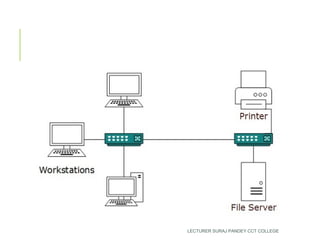
1. Files can be stored on a central computer (the file server)
allowing data to be shared throughout an organisation.
2. Files can be backed up more easily when they are all on a
central fileserver rather than when they are scattered
across a number of independent workstations.
3. Networks also allow security to be established, ensuring
that the network users may only have access to certain
files and applications.
4. Software and resources can be centrally managed.
5. Network versions of software often allow for their speedy
installation on workstations from the file server.
6. Expensive devices such as laser printers or scanners can
be shared.
7. Users can access their files from any workstation
LECTURER SURAJ PANDEY CCT COLLEGE
DISADVANTAGES OF LAN
1. Power - a good LAN is required to be on all the times.
2. Security - each computer and device become another point
of entry for undesirables.
3. Upkeep - when things go wrong or the software gets
updated.
4. Frustration if having a problem setting up.
5. A lot of times a network shares one Internet connection - if all
computers running at once, can reduce speed for each.
6. Area covered is limited.
LECTURER SURAJ PANDEY CCT COLLEGE
PERSONAL AREA NETWORK
 A PAN is a network that is used for communicating among
computers and computer devices (including telephones) in
close proximity of around a few meters within a room
 It can be used for communicating between the devices
themselves, or for connecting to a larger network such as the
internet.
 PAN’s can be wired or wireless
A personal area network (PAN) is a computer network used
for communication among computer devices, including
telephones and personal digital assistants, in proximity to an
individual's body.
The devices may or may not belong to the person in
question. The reach of a PAN is typically a few meters.
LECTURER SURAJ PANDEY CCT COLLEGE
METROPOLITAN AREA
NETWORK (MAN)
A metropolitan area network (MAN) is a large computer
network that usually spans a city or a large campus.
A MAN is optimized for a larger geographical area than a
LAN, ranging from several blocks of buildings to entire cities.
 A MAN might be owned and operated by a single
organization, but it usually will be used by many individuals
and organizations.
A MAN often acts as a high speed network to allow sharing of
regional resources.
A MAN typically covers an area of between 5 and 50 km
diameter.
Examples of MAN: Telephone company network that
provides a high speed DSL to customers and cable TV
network.
LECTURER SURAJ PANDEY CCT COLLEGE
ADVANTAGES OF MAN
MAN can cover a wider area than a LAN. MAN networks are
usually operated at airports, or a combination of several pieces
at a local school.
LECTURER SURAJ PANDEY CCT COLLEGE
DISADVANTAGES OF MANs
The key disadvantage of MANs is the cost of the cutting-edge
technology employed. Also, this equipment generally has to be
installed for the first time, as the copper traditionally used for
the phone network is generally considered to be too slow to be
annexed for this purpose.
The cost is what inhibits the geographical reach of MANs,
which is also another drawback.
LECTURER SURAJ PANDEY CCT COLLEGE
WIDE AREA NETWORK
WAN covers a large geographic area such as country,
continent or even whole of the world.
A WAN is two or more LANs connected together. The LANs
can be many miles apart.
To cover great distances, WANs may transmit data over
leased high-speed phone lines or wireless links such as
satellites.
Multiple LANs can be connected together using devices such
as bridges, routers, or gateways, which enable them to share
data.
 The world's most popular WAN is the Internet.
LECTURER SURAJ PANDEY CCT COLLEGE
CAMPUS AREA NETWORK
•A campus network is a proprietary local area network (LAN) or
set of interconnected LANs serving a corporation, government
agency, university, or similar organization.
•The end users in a campus network may be dispersed more
widely (in a geographical sense) than in a single LAN, but they
are usually not as scattered as they would be in a wide area
network (WAN).
LECTURER SURAJ PANDEY CCT COLLEGE
College and university campus networks interconnect
administrative buildings, residence halls, academic halls,
libraries, student centers, athletic facilities, and other buildings
associated with the institution in a specific town or
neighborhood. Corporate campus networks interconnect
buildings that house key departments and staff members. The
corporate campus network forms the user-facing aspect of the
larger corporate network within a limited geographic area.
LECTURER SURAJ PANDEY CCT COLLEGE

Basic in Computernetwork

  • 1.
  • 2.
    What is aComputerNetwork? A computer network is a system in which multiple computers are connected to each other to share information and resources. Usually, the connections between computers in a network are made using physical wires or cables LECTURER SURAJ PANDEY CCT COLLEGE
  • 3.
    • Characteristics 1. ShareResources from one computer to another 2. Create files and store them in one computer, access those files from the other computer(s) connected over the network 3. Connect a printer, scanner or a fax machine to one computer within the network and let other computers of the network use the machines available over network. LECTURER SURAJ PANDEY CCT COLLEGE
  • 4.
  • 5.
  • 6.
    • Types ofComputerNetworks There are different types of computernetworks. Some of the common ones include. 1. Local Area Network LAN 2. Personal Area Network (PAN) 3. Metropolitan Area Network MAN 4. Wide Area Network WAN 5. Wireless Local Area Network WLAN LECTURER SURAJ PANDEY CCT COLLEGE
  • 7.
    LOCAL AREA NETWORK (LAN) ALAN is a network that is used for communicating among computer devices, usually within an office building or home. LAN’s enable the sharing of resources such as files or hardware devices that may be needed by multiple users • Is limited in size, typically spanning a few hundred meters, and no more than a mile Is fast, with speeds from 10 Mbps to 10 Gbps Requires little wiring, typically a single cable connecting to each device  Has lower cost compared to MAN’s or WAN’s LECTURER SURAJ PANDEY CCT COLLEGE
  • 8.
    LAN’s can beeither wired or wireless. Twisted pair, coax or fibre optic cable can be used in wired LAN’s. Every LAN uses a protocol – a set of rules that governs how packets are configured and transmitted. Nodes in a LAN are linked together with a certain topology. These topologies include: – Bus – Ring – Star LANs are capable of very high transmission rates (100s Mb/s to G b/s). LECTURER SURAJ PANDEY CCT COLLEGE
  • 9.
  • 10.
    ADVANTAGES OF LAN 1.Files can be stored on a central computer (the file server) allowing data to be shared throughout an organisation. 2. Files can be backed up more easily when they are all on a central fileserver rather than when they are scattered across a number of independent workstations. 3. Networks also allow security to be established, ensuring that the network users may only have access to certain files and applications. 4. Software and resources can be centrally managed. 5. Network versions of software often allow for their speedy installation on workstations from the file server. 6. Expensive devices such as laser printers or scanners can be shared. 7. Users can access their files from any workstation LECTURER SURAJ PANDEY CCT COLLEGE
  • 11.
    DISADVANTAGES OF LAN 1.Power - a good LAN is required to be on all the times. 2. Security - each computer and device become another point of entry for undesirables. 3. Upkeep - when things go wrong or the software gets updated. 4. Frustration if having a problem setting up. 5. A lot of times a network shares one Internet connection - if all computers running at once, can reduce speed for each. 6. Area covered is limited. LECTURER SURAJ PANDEY CCT COLLEGE
  • 12.
    PERSONAL AREA NETWORK A PAN is a network that is used for communicating among computers and computer devices (including telephones) in close proximity of around a few meters within a room  It can be used for communicating between the devices themselves, or for connecting to a larger network such as the internet.  PAN’s can be wired or wireless A personal area network (PAN) is a computer network used for communication among computer devices, including telephones and personal digital assistants, in proximity to an individual's body. The devices may or may not belong to the person in question. The reach of a PAN is typically a few meters. LECTURER SURAJ PANDEY CCT COLLEGE
  • 13.
  • 14.
    METROPOLITAN AREA NETWORK (MAN) Ametropolitan area network (MAN) is a large computer network that usually spans a city or a large campus. A MAN is optimized for a larger geographical area than a LAN, ranging from several blocks of buildings to entire cities.  A MAN might be owned and operated by a single organization, but it usually will be used by many individuals and organizations. A MAN often acts as a high speed network to allow sharing of regional resources. A MAN typically covers an area of between 5 and 50 km diameter. Examples of MAN: Telephone company network that provides a high speed DSL to customers and cable TV network. LECTURER SURAJ PANDEY CCT COLLEGE
  • 15.
  • 16.
    ADVANTAGES OF MAN MANcan cover a wider area than a LAN. MAN networks are usually operated at airports, or a combination of several pieces at a local school. LECTURER SURAJ PANDEY CCT COLLEGE
  • 17.
    DISADVANTAGES OF MANs Thekey disadvantage of MANs is the cost of the cutting-edge technology employed. Also, this equipment generally has to be installed for the first time, as the copper traditionally used for the phone network is generally considered to be too slow to be annexed for this purpose. The cost is what inhibits the geographical reach of MANs, which is also another drawback. LECTURER SURAJ PANDEY CCT COLLEGE
  • 18.
    WIDE AREA NETWORK WANcovers a large geographic area such as country, continent or even whole of the world. A WAN is two or more LANs connected together. The LANs can be many miles apart. To cover great distances, WANs may transmit data over leased high-speed phone lines or wireless links such as satellites. Multiple LANs can be connected together using devices such as bridges, routers, or gateways, which enable them to share data.  The world's most popular WAN is the Internet. LECTURER SURAJ PANDEY CCT COLLEGE
  • 19.
  • 20.
    CAMPUS AREA NETWORK •Acampus network is a proprietary local area network (LAN) or set of interconnected LANs serving a corporation, government agency, university, or similar organization. •The end users in a campus network may be dispersed more widely (in a geographical sense) than in a single LAN, but they are usually not as scattered as they would be in a wide area network (WAN). LECTURER SURAJ PANDEY CCT COLLEGE
  • 21.
    College and universitycampus networks interconnect administrative buildings, residence halls, academic halls, libraries, student centers, athletic facilities, and other buildings associated with the institution in a specific town or neighborhood. Corporate campus networks interconnect buildings that house key departments and staff members. The corporate campus network forms the user-facing aspect of the larger corporate network within a limited geographic area. LECTURER SURAJ PANDEY CCT COLLEGE
  • 22.