BASIC CONCEPTS OF NETWORK
INDEX
 Definition & applications of computer network
 Components of computer network
 Network benefits
 Disadvantages of computer network
 Classification by their geographical area
 Network classification by their component role
 Types of servers
DEFINTION & APPLICATIONS
DEFINTION:
A computer network is defined as the interconnection of two or
more computers. It is done to enable the computers to
communicate and share available resources.
APPLICATIONS:
i. Sharing of resources such as printers
ii. Sharing of expensive software's and database
iii. Communication from one computer to another computer
iv. Exchange of data and information among users via
network
v. Sharing of information over geographically wide areas.
COMPONENTS OF COMPUTER NETWORK
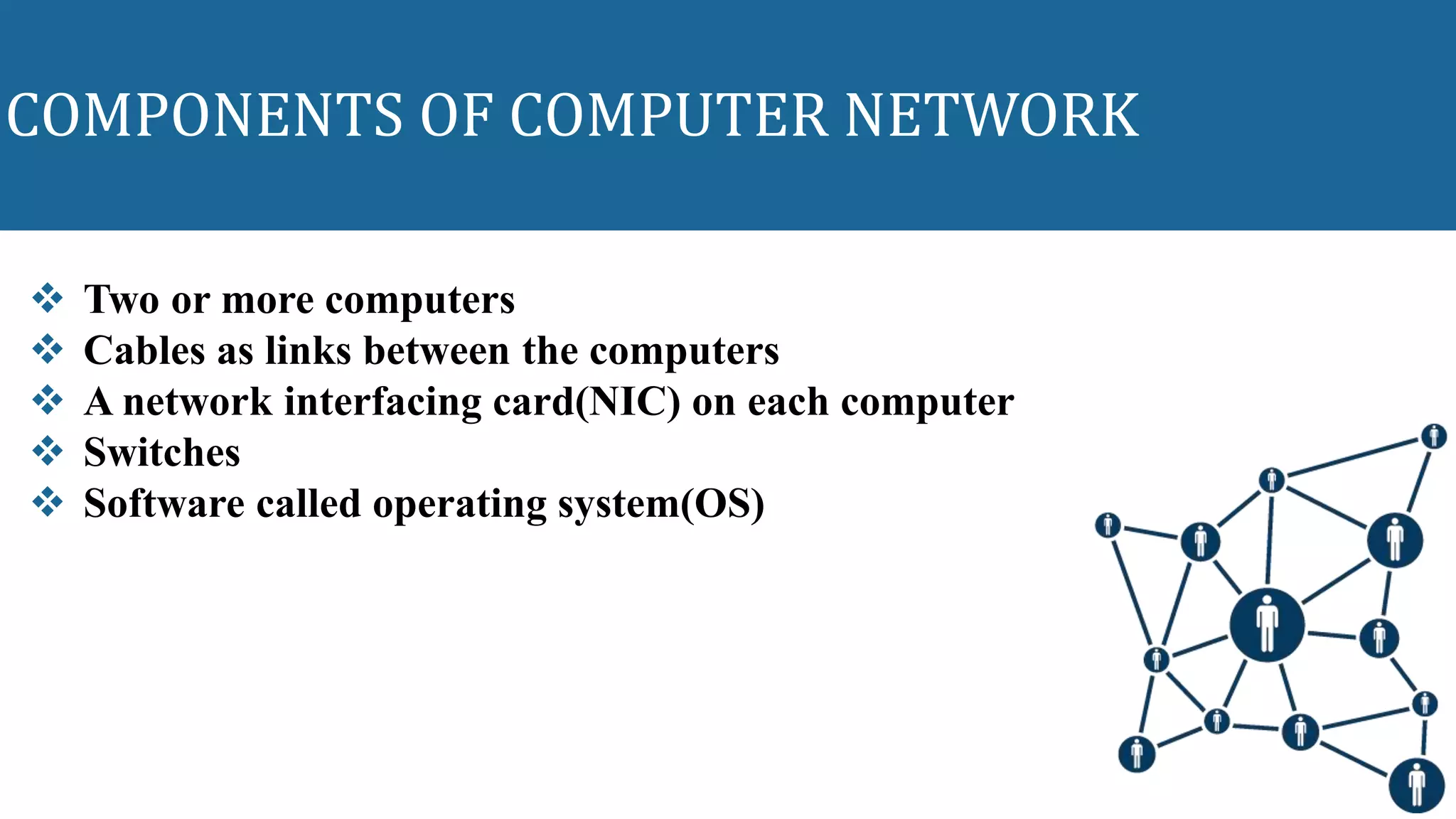
 Two or more computers
 Cables as links between the computers
 A network interfacing card(NIC) on each computer
 Switches
 Software called operating system(OS)
SHARING RESOURCES
Types of resources are:
1. Hardware: A network allows users to share many
hardware devices such as printers , modems, fax
machines, CD ROM, players, etc.
2. Software: sharing software resources reduces the
cost of software installation, saves space on hard
disk.
SOCIAL MEDIA POWER
FACEBOOK TWITTER INSTAGRAM WHAT’S APP
55% 25% 20% 10%
CLASSIFICATION OF AREA
BY
THEIR GEOGRAPHY
LOCAL AREA NETWORK(LAN)
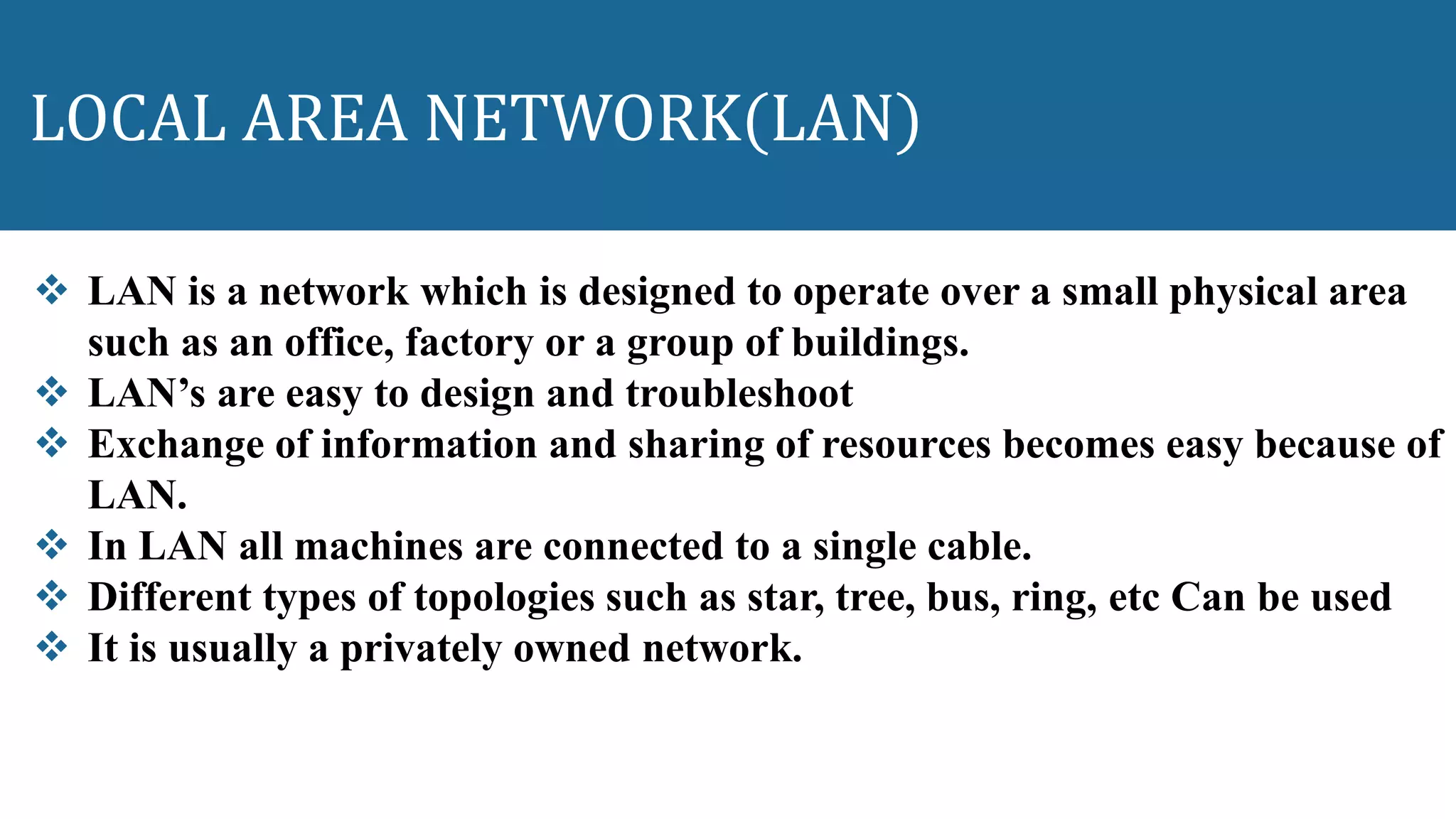
 LAN is a network which is designed to operate over a small physical area
such as an office, factory or a group of buildings.
 LAN’s are easy to design and troubleshoot
 Exchange of information and sharing of resources becomes easy because of
LAN.
 In LAN all machines are connected to a single cable.
 Different types of topologies such as star, tree, bus, ring, etc Can be used
 It is usually a privately owned network.
WIDE AREA NETWORK(WAN)
 When network spans over a large distance or when the computers to
be connected to each other are at widely separated locations a local
area network cannot be used. A wide area network(WAN) is installed.
 The communication between different users of WAN is established
using leased telephone lines, satellite links and similar channels.
 It is cheaper and more efficient to use the phone network for the link.
 Most WAN networks are used to transfer large blocks of data
between its users.
PERSONAL AREA NETWORK(PAN)
 A personal area network is a computer network organized around an
individual person.
 It generally consists of a mobile computer, a cell phone or personal
digital assistant. PAN enables the communication among these
devices.
 It can also be used for communication among personal devices
themselves for connecting to a digital level network and internet.
 The PANs can be constructed using wireless or cables.
METROPOLITAN AREA NETWORK(MAN)
 It is in between LAN & WAN technology that covers the entire city.
 It uses similar technology as LAN.
 It can be a single network such as cable TV network, or a measure of
connecting a number of LAN’s o a large network so that resources can
be shared LAN to LAN as well as device to device.
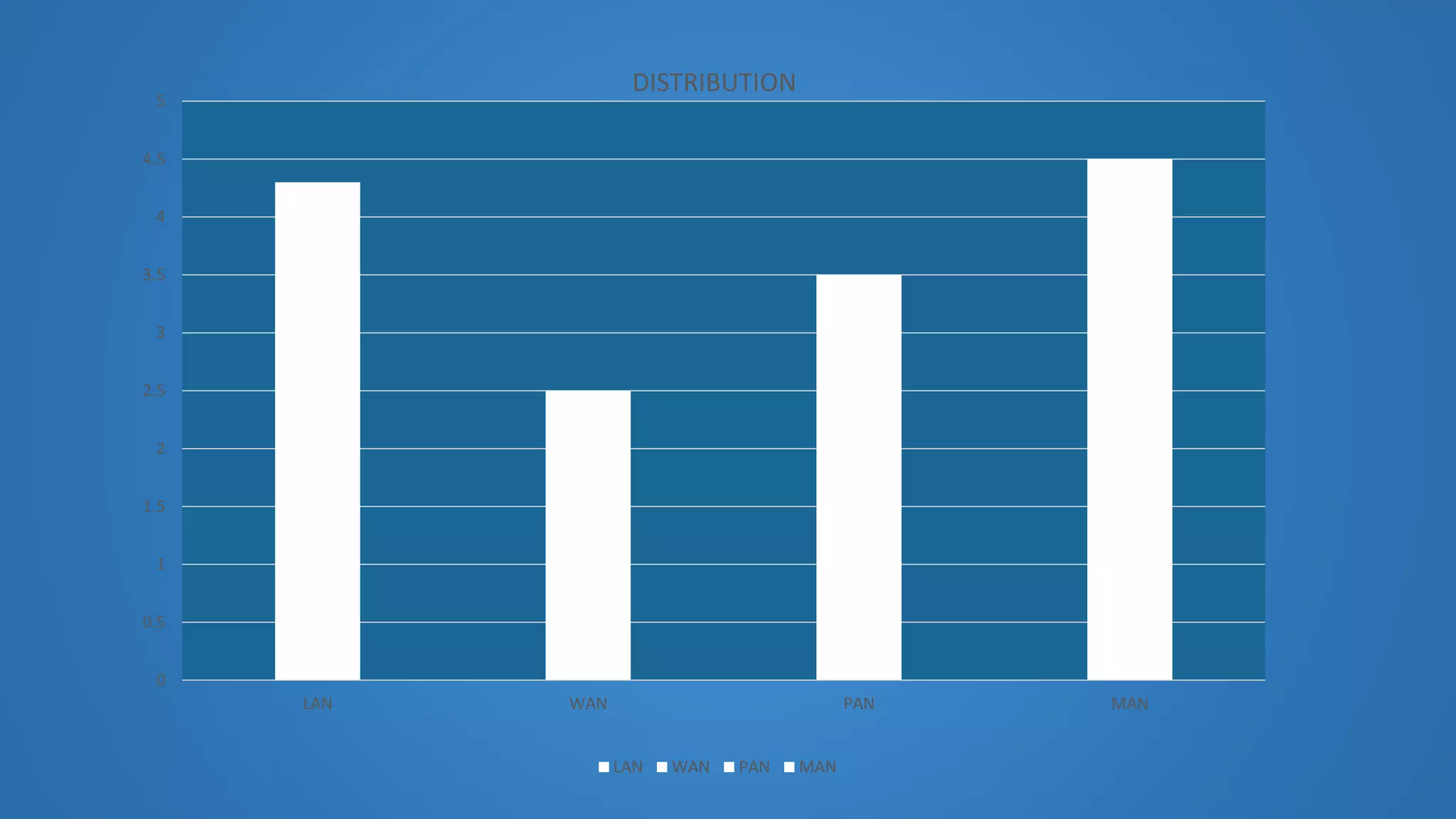
0
0.5
1
1.5
2
2.5
3
3.5
4
4.5
5
LAN WAN PAN MAN
DISTRIBUTION
LAN WAN PAN MAN
GOOD-BYE

PROFESSIONAL SLIDES

  • 1.
  • 2.
    INDEX  Definition &applications of computer network  Components of computer network  Network benefits  Disadvantages of computer network  Classification by their geographical area  Network classification by their component role  Types of servers
  • 3.
    DEFINTION & APPLICATIONS DEFINTION: Acomputer network is defined as the interconnection of two or more computers. It is done to enable the computers to communicate and share available resources. APPLICATIONS: i. Sharing of resources such as printers ii. Sharing of expensive software's and database iii. Communication from one computer to another computer iv. Exchange of data and information among users via network v. Sharing of information over geographically wide areas.
  • 4.
    COMPONENTS OF COMPUTERNETWORK  Two or more computers  Cables as links between the computers  A network interfacing card(NIC) on each computer  Switches  Software called operating system(OS)
  • 5.
    SHARING RESOURCES Types ofresources are: 1. Hardware: A network allows users to share many hardware devices such as printers , modems, fax machines, CD ROM, players, etc. 2. Software: sharing software resources reduces the cost of software installation, saves space on hard disk.
  • 7.
    SOCIAL MEDIA POWER FACEBOOKTWITTER INSTAGRAM WHAT’S APP 55% 25% 20% 10%
  • 8.
  • 9.
    LOCAL AREA NETWORK(LAN) LAN is a network which is designed to operate over a small physical area such as an office, factory or a group of buildings.  LAN’s are easy to design and troubleshoot  Exchange of information and sharing of resources becomes easy because of LAN.  In LAN all machines are connected to a single cable.  Different types of topologies such as star, tree, bus, ring, etc Can be used  It is usually a privately owned network.
  • 10.
    WIDE AREA NETWORK(WAN) When network spans over a large distance or when the computers to be connected to each other are at widely separated locations a local area network cannot be used. A wide area network(WAN) is installed.  The communication between different users of WAN is established using leased telephone lines, satellite links and similar channels.  It is cheaper and more efficient to use the phone network for the link.  Most WAN networks are used to transfer large blocks of data between its users.
  • 11.
    PERSONAL AREA NETWORK(PAN) A personal area network is a computer network organized around an individual person.  It generally consists of a mobile computer, a cell phone or personal digital assistant. PAN enables the communication among these devices.  It can also be used for communication among personal devices themselves for connecting to a digital level network and internet.  The PANs can be constructed using wireless or cables.
  • 12.
    METROPOLITAN AREA NETWORK(MAN) It is in between LAN & WAN technology that covers the entire city.  It uses similar technology as LAN.  It can be a single network such as cable TV network, or a measure of connecting a number of LAN’s o a large network so that resources can be shared LAN to LAN as well as device to device.
  • 13.
    0 0.5 1 1.5 2 2.5 3 3.5 4 4.5 5 LAN WAN PANMAN DISTRIBUTION LAN WAN PAN MAN
  • 14.