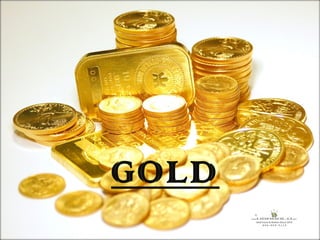
GOLD
THE ELEMENT GOLD
Atomic Number: 79
Atomic Weight: 196.966569
Phase at Room Temperature: Solid
Element Classification: Metal
Period Number: 6    
Group Number: 11 
 From the Sanskrit word Jval and the Anglo-
Saxon word gold. Gold's chemical symbol
comes from the Latin word for
gold, Aurum.
WHY GOLD IS PREFERRED
FOR MAKING JEWELLERY??
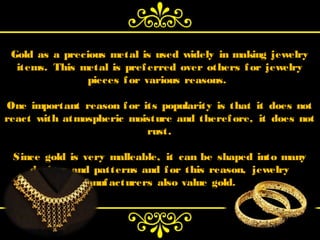
Gold as a precious metal is used widely in making jewelry
  items. This metal is pref erred over others f or jewelry
               pieces f or various reasons.

One important reason f or its popularity is that it does not
react with atmospheric moisture and theref ore, it does not
                           rust.

 Since gold is very malleable, it can be shaped into many
    designs and patterns and f or this reason,   jewelry
              manuf acturers  also value gold.
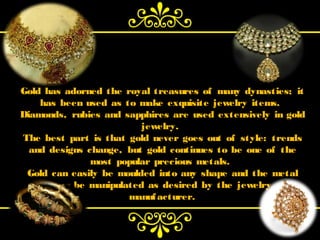
Gold has adorned the royal treasures of many dynasties; it
    has been used as to make exquisite jewelry items.
Diamonds, rubies and sapphires are used extensively in gold
                         jewelry.
The best part is that gold never goes out of style: trends
  and designs change, but gold continues to be one of the
               most popular precious metals.
 Gold can easily be moulded into any shape and the metal
       can be manipulated as desired by the  jewelry
                      manuf acturer.
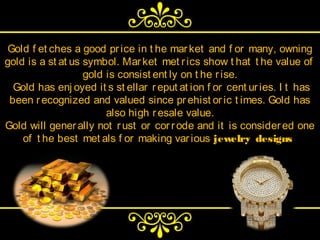
Gold f et ches a good pr ice in t he mar ket and f or many, owning
gold is a st at us symbol. Mar ket met r ics show t hat t he value of
                   gold is consist ent ly on t he r ise.
  Gold has enj oyed it s st ellar r eput at ion f or cent ur ies. I t has
 been r ecognized and valued since pr ehist or ic t imes. Gold has
                        also high r esale value.
Gold will gener ally not r ust or cor r ode and it is consider ed one
    of t he best met als f or making var ious jewelry designs.
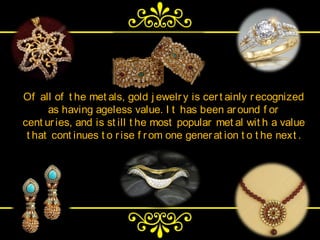
Of all of t he met als, gold j ewelr y is cer t ainly r ecognized
      as having ageless value. I t has been ar ound f or
cent ur ies, and is st ill t he most popular met al wit h a value
 t hat cont inues t o r ise f r om one gener at ion t o t he next .
THANK YOU

Gold

  • 1.
  • 2.
    THE ELEMENT GOLD AtomicNumber: 79 Atomic Weight: 196.966569 Phase at Room Temperature: Solid Element Classification: Metal Period Number: 6     Group Number: 11   From the Sanskrit word Jval and the Anglo- Saxon word gold. Gold's chemical symbol comes from the Latin word for gold, Aurum.
  • 3.
    WHY GOLD ISPREFERRED FOR MAKING JEWELLERY??
  • 4.
    Gold as aprecious metal is used widely in making jewelry items. This metal is pref erred over others f or jewelry pieces f or various reasons. One important reason f or its popularity is that it does not react with atmospheric moisture and theref ore, it does not rust. Since gold is very malleable, it can be shaped into many designs and patterns and f or this reason,   jewelry manuf acturers  also value gold.
  • 5.
    Gold has adornedthe royal treasures of many dynasties; it has been used as to make exquisite jewelry items. Diamonds, rubies and sapphires are used extensively in gold jewelry. The best part is that gold never goes out of style: trends and designs change, but gold continues to be one of the most popular precious metals. Gold can easily be moulded into any shape and the metal can be manipulated as desired by the  jewelry manuf acturer.
  • 6.
    Gold f etches a good pr ice in t he mar ket and f or many, owning gold is a st at us symbol. Mar ket met r ics show t hat t he value of gold is consist ent ly on t he r ise. Gold has enj oyed it s st ellar r eput at ion f or cent ur ies. I t has been r ecognized and valued since pr ehist or ic t imes. Gold has also high r esale value. Gold will gener ally not r ust or cor r ode and it is consider ed one of t he best met als f or making var ious jewelry designs.
  • 7.
    Of all oft he met als, gold j ewelr y is cer t ainly r ecognized as having ageless value. I t has been ar ound f or cent ur ies, and is st ill t he most popular met al wit h a value t hat cont inues t o r ise f r om one gener at ion t o t he next .
  • 8.