Transmission Modes in
Computer Networks
By Nevin & Meghaduth P
BCA20
What Are Transmission Modes In Computer
Networks?
• The Data Transmission mode specifies the direction of information
flow between two communication devices via a communication
channel that includes an optical fiber, wireless channels, copper
wires, and other storage media . It is also known as Data
Communication Mode. The transmission mode is sometimes referred
to as a directional mode because each communication channel is
coupled with a direction provided by the transmission media
• The Physical Layer in the Open System Interconnection (OSI) Layer
Model is dedicated to data transmission in the network. It primarily
determines the direction in which the data must travel to reach the
receiving system or node.
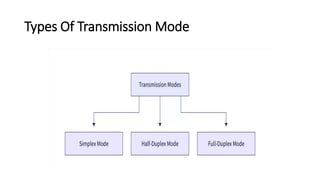
Types Of Transmission Mode
Simplex mode
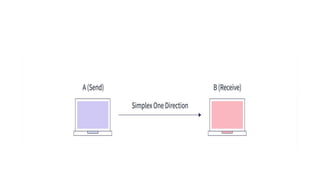
• The Simplex transmission mode is used in computing networks when
there is a single or one-way flow of information from sender to
receiver. In this mode of transmission, communication occurs only in
one direction, i.e., the circuit is configured so that it is either transmit
only or receive only.
• Simplex mode is just like a one-way road in which the traffic travels
only in one direction, which means no vehicle from the opposite
direction is allowed to drive through.
Examples
• A basic example of simplex transmission mode is communication
between a computer and a keyboard. The keyboard can only accept
data from the user, and the monitor can only display data on the
screen.
• The radio station is a simplex channel since it transmits the signal but
never permits listeners to transmit it back
Advantages
• The station can broadcast more data at once when operating
in simplex mode since it can use the complete bandwidth of
the communication channel.
• In a simplex mode of transmission, radio stations can use
the complete bandwidth of the communicating channel to send all
data in one shot with no data loss.
Half duplex mode
• The half duplex mode of transmission is used in computer networks
when there is a way to flow information from sender to receiver but
only one at a time. In this mode, the connected devices can transmit
or receive the data but not simultaneously.
• In half duplex mode, the direction of communication can be reversed
as the radio stations can receive as well as transmit the data.
• The half-duplex mode is used when communication in both directions
is not required at the same time
Examples
• A communication using a Walkie-talkie is an example of a half duplex
mode. When using a walkie-talkie, one party speaks while the other
listens. After a slight pause, the other party speaks while the first
party listens. Speaking at the same time produces a distorted sound
that cannot be understood.
Advantages
• In half duplex mode, error detection is available, and if an error
occurs, the receiver demands that the sender retransmit the data.
• Since this method of transmission allows for two-way communication,
the entire bandwidth of the communication channel is used in
only one direction at a time.
Full duplex
• The Full Duplex mode of transmission is used in computing networks
when there is simultaneous information flow in both directions, from
sender to receiver.
• In this mode of transmission, the channel capacity is shared between
the two devices, and communication occurs in both directions across
a communication link that requires two wires. The Full Duplex mode
features two simplex channels.
• One channel has traffic flowing in one direction, while the other
channel has traffic flowing in the other way. The full duplex mode is
used when communication in both directions is required.
Examples
• A telephone network in which two people communicate over a phone
line on which both can talk and listen at the same time.
• In the messaging app, we can send and receive messages
simultaneously.
Advantages
• The full duplex transmission mode is the fastest because the
transmission happens in both ways.
• Both stations can send and receive data simultaneously.
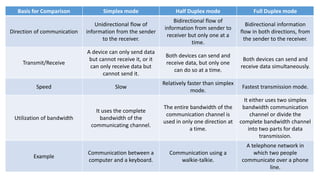
Basis for Comparison Simplex mode Half Duplex mode Full Duplex mode
Direction of communication
Unidirectional flow of
information from the sender
to the receiver.
Bidirectional flow of
information from sender to
receiver but only one at a
time.
Bidirectional information
flow in both directions, from
the sender to the receiver.
Transmit/Receive
A device can only send data
but cannot receive it, or it
can only receive data but
cannot send it.
Both devices can send and
receive data, but only one
can do so at a time.
Both devices can send and
receive data simultaneously.
Speed Slow
Relatively faster than simplex
mode.
Fastest transmission mode.
Utilization of bandwidth
It uses the complete
bandwidth of the
communicating channel.
The entire bandwidth of the
communication channel is
used in only one direction at
a time.
It either uses two simplex
bandwidth communication
channel or divide the
complete bandwidth channel
into two parts for data
transmission.
Example
Communication between a
computer and a keyboard.
Communication using a
walkie-talkie.
A telephone network in
which two people
communicate over a phone
line.

COMPUTER NETWORK - TRANSMISSION MODES.pptx

  • 1.
    Transmission Modes in ComputerNetworks By Nevin & Meghaduth P BCA20
  • 2.
    What Are TransmissionModes In Computer Networks? • The Data Transmission mode specifies the direction of information flow between two communication devices via a communication channel that includes an optical fiber, wireless channels, copper wires, and other storage media . It is also known as Data Communication Mode. The transmission mode is sometimes referred to as a directional mode because each communication channel is coupled with a direction provided by the transmission media • The Physical Layer in the Open System Interconnection (OSI) Layer Model is dedicated to data transmission in the network. It primarily determines the direction in which the data must travel to reach the receiving system or node.
  • 3.
  • 4.
    Simplex mode • TheSimplex transmission mode is used in computing networks when there is a single or one-way flow of information from sender to receiver. In this mode of transmission, communication occurs only in one direction, i.e., the circuit is configured so that it is either transmit only or receive only. • Simplex mode is just like a one-way road in which the traffic travels only in one direction, which means no vehicle from the opposite direction is allowed to drive through.
  • 6.
    Examples • A basicexample of simplex transmission mode is communication between a computer and a keyboard. The keyboard can only accept data from the user, and the monitor can only display data on the screen. • The radio station is a simplex channel since it transmits the signal but never permits listeners to transmit it back
  • 7.
    Advantages • The stationcan broadcast more data at once when operating in simplex mode since it can use the complete bandwidth of the communication channel. • In a simplex mode of transmission, radio stations can use the complete bandwidth of the communicating channel to send all data in one shot with no data loss.
  • 8.
    Half duplex mode •The half duplex mode of transmission is used in computer networks when there is a way to flow information from sender to receiver but only one at a time. In this mode, the connected devices can transmit or receive the data but not simultaneously. • In half duplex mode, the direction of communication can be reversed as the radio stations can receive as well as transmit the data. • The half-duplex mode is used when communication in both directions is not required at the same time
  • 10.
    Examples • A communicationusing a Walkie-talkie is an example of a half duplex mode. When using a walkie-talkie, one party speaks while the other listens. After a slight pause, the other party speaks while the first party listens. Speaking at the same time produces a distorted sound that cannot be understood.
  • 11.
    Advantages • In halfduplex mode, error detection is available, and if an error occurs, the receiver demands that the sender retransmit the data. • Since this method of transmission allows for two-way communication, the entire bandwidth of the communication channel is used in only one direction at a time.
  • 12.
    Full duplex • TheFull Duplex mode of transmission is used in computing networks when there is simultaneous information flow in both directions, from sender to receiver. • In this mode of transmission, the channel capacity is shared between the two devices, and communication occurs in both directions across a communication link that requires two wires. The Full Duplex mode features two simplex channels. • One channel has traffic flowing in one direction, while the other channel has traffic flowing in the other way. The full duplex mode is used when communication in both directions is required.
  • 14.
    Examples • A telephonenetwork in which two people communicate over a phone line on which both can talk and listen at the same time. • In the messaging app, we can send and receive messages simultaneously.
  • 15.
    Advantages • The fullduplex transmission mode is the fastest because the transmission happens in both ways. • Both stations can send and receive data simultaneously.
  • 16.
    Basis for ComparisonSimplex mode Half Duplex mode Full Duplex mode Direction of communication Unidirectional flow of information from the sender to the receiver. Bidirectional flow of information from sender to receiver but only one at a time. Bidirectional information flow in both directions, from the sender to the receiver. Transmit/Receive A device can only send data but cannot receive it, or it can only receive data but cannot send it. Both devices can send and receive data, but only one can do so at a time. Both devices can send and receive data simultaneously. Speed Slow Relatively faster than simplex mode. Fastest transmission mode. Utilization of bandwidth It uses the complete bandwidth of the communicating channel. The entire bandwidth of the communication channel is used in only one direction at a time. It either uses two simplex bandwidth communication channel or divide the complete bandwidth channel into two parts for data transmission. Example Communication between a computer and a keyboard. Communication using a walkie-talkie. A telephone network in which two people communicate over a phone line.