DATA WAREHOUSE
PRESENTED BY:
LAKSHMI.S,
ASSISTANT PROFESSOR,
SRI ADI CHUNCHANAGIRI WOMEN’S
COLLEGE, CUMBUM.
DATA WAREHOUSE:
 The term “Data Warehouse” was first coined by BILL
INMON in 1990.
 According to INMON, a data warehouse is a subject
oriented , integrated , time-variant , and non-volatile
collection of data.
 This data helps analysts to take informed decisions in
an organization.
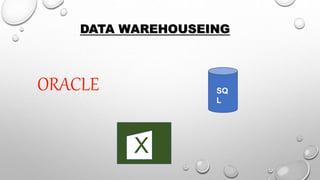
DATA WAREHOUSEING
ORACLE SQ
L
X
 A data warehouse is a database, which is kept
separate from the organizations operational database.
 There is no frequent updating done in a data
warehouse.
 It possesses consolidated historical data, which helps
the organization to analyse its business.
 A data warehouse helps executives to organize ,
understand ,and use their data to take strategic
decisions.
DATA WAREHOUSE FEATURES:
 SUBJECT ORIENTED- A data warehouse is
subject oriented because it provides information
around a subject rather than the organization’s
ongoing operations . These subjects can be product,
customer, suppliers, sales, revenue, ect.
 INTEGRATED-A data warehouse is constructed by
integrating data from heterogeneous sources such
as relational databases, flat files ect .This
integration enhances the effective analysis of data.
 TIME VARIANT- The data collected in a data
warehouse is identified with a particular time
period . The data is a data warehouse provides
information from the historical point of view.
 NON-VOLATILE – Non volatile means the
previous data is not erased when new data is
added to it . A data warehouse is kept separate
from the operational database and therefore
frequent changes in operational database is not
reflected in the data warehouse.
Online analytical Processing (OLAP) :
OLAP is a computer processing that enables a
user to easily and selectively extract and view data from different
points of view. It allows user to analyze database information from
multiple database systems at one time. OLAP data is stored in
multidimensional databases
EXAMPLE:
OLAP (online analytical processing) is a computing
method that enables users to easily and selectively
extract and query data in order to analyze it from different
points of view.
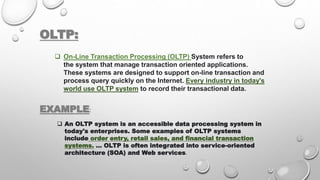
 On-Line Transaction Processing (OLTP) System refers to
the system that manage transaction oriented applications.
These systems are designed to support on-line transaction and
process query quickly on the Internet. Every industry in today's
world use OLTP system to record their transactional data.
OLTP:
EXAMPLE:
 An OLTP system is an accessible data processing system in
today's enterprises. Some examples of OLTP systems
include order entry, retail sales, and financial transaction
systems. ... OLTP is often integrated into service-oriented
architecture (SOA) and Web services.
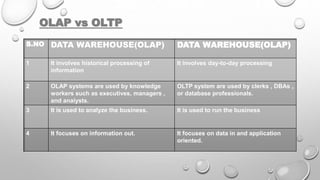
S.NO DATA WAREHOUSE(OLAP) DATA WAREHOUSE(OLAP)
1 It involves historical processing of
information
It involves day-to-day processing
2 OLAP systems are used by knowledge
workers such as executives, managers ,
and anaiysts.
OLTP system are used by clerks , DBAs ,
or database professionals.
3 It is used to analyze the business. It is used to run the business
4 It focuses on information out. It focuses on data in and application
oriented.
OLAP vs OLTP
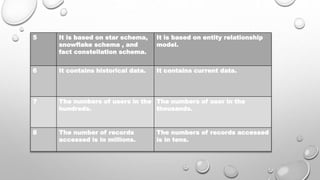
5 It is based on star schema,
snowflake schema , and
fact constellation schema.
It is based on entity relationship
model.
6 It contains historical data. It contains current data.
7 The numbers of users in the
hundreds.
The numbers of user in the
thousands.
8 The number of records
accessed is in millions.
The numbers of records accessed
is in tens.
9 The database size is from
1000GB to 100 TB.
The database size is from
100MB 100 GB.
10 These are highly flexible It provides high
performance.
THE END

Presentation DM.pptx

  • 1.
    DATA WAREHOUSE PRESENTED BY: LAKSHMI.S, ASSISTANTPROFESSOR, SRI ADI CHUNCHANAGIRI WOMEN’S COLLEGE, CUMBUM.
  • 2.
    DATA WAREHOUSE:  Theterm “Data Warehouse” was first coined by BILL INMON in 1990.  According to INMON, a data warehouse is a subject oriented , integrated , time-variant , and non-volatile collection of data.  This data helps analysts to take informed decisions in an organization.
  • 3.
  • 4.
     A datawarehouse is a database, which is kept separate from the organizations operational database.  There is no frequent updating done in a data warehouse.  It possesses consolidated historical data, which helps the organization to analyse its business.  A data warehouse helps executives to organize , understand ,and use their data to take strategic decisions.
  • 6.
    DATA WAREHOUSE FEATURES: SUBJECT ORIENTED- A data warehouse is subject oriented because it provides information around a subject rather than the organization’s ongoing operations . These subjects can be product, customer, suppliers, sales, revenue, ect.  INTEGRATED-A data warehouse is constructed by integrating data from heterogeneous sources such as relational databases, flat files ect .This integration enhances the effective analysis of data.
  • 7.
     TIME VARIANT-The data collected in a data warehouse is identified with a particular time period . The data is a data warehouse provides information from the historical point of view.  NON-VOLATILE – Non volatile means the previous data is not erased when new data is added to it . A data warehouse is kept separate from the operational database and therefore frequent changes in operational database is not reflected in the data warehouse.
  • 8.
    Online analytical Processing(OLAP) : OLAP is a computer processing that enables a user to easily and selectively extract and view data from different points of view. It allows user to analyze database information from multiple database systems at one time. OLAP data is stored in multidimensional databases EXAMPLE: OLAP (online analytical processing) is a computing method that enables users to easily and selectively extract and query data in order to analyze it from different points of view.
  • 10.
     On-Line TransactionProcessing (OLTP) System refers to the system that manage transaction oriented applications. These systems are designed to support on-line transaction and process query quickly on the Internet. Every industry in today's world use OLTP system to record their transactional data. OLTP: EXAMPLE:  An OLTP system is an accessible data processing system in today's enterprises. Some examples of OLTP systems include order entry, retail sales, and financial transaction systems. ... OLTP is often integrated into service-oriented architecture (SOA) and Web services.
  • 11.
    S.NO DATA WAREHOUSE(OLAP)DATA WAREHOUSE(OLAP) 1 It involves historical processing of information It involves day-to-day processing 2 OLAP systems are used by knowledge workers such as executives, managers , and anaiysts. OLTP system are used by clerks , DBAs , or database professionals. 3 It is used to analyze the business. It is used to run the business 4 It focuses on information out. It focuses on data in and application oriented. OLAP vs OLTP
  • 12.
    5 It isbased on star schema, snowflake schema , and fact constellation schema. It is based on entity relationship model. 6 It contains historical data. It contains current data. 7 The numbers of users in the hundreds. The numbers of user in the thousands. 8 The number of records accessed is in millions. The numbers of records accessed is in tens.
  • 13.
    9 The databasesize is from 1000GB to 100 TB. The database size is from 100MB 100 GB. 10 These are highly flexible It provides high performance.
  • 14.