A*STAR
Institute of High Performance Computing
Collaborative Thinking Technologies (CTT) Research
Cluster
Dr. Ilker YENGIN
yengini@ihpc.a-star.edu.sg
About
• 21st-century : learning and workplace
• Importance of Collaborative Learning
• What are Dialog Games
• Research Design: Computer Engineering
Students’ Readiness and Motivations
• Findings and Discussions
Transferable knowledge and skills in the 21st
century
• Collaborative learning scenarios.
• Dialog games as potential collaborative
learning tools
Dialog Games
• Words have a specific action with and
intention or purpose attached.
• A dialog could be constructed like the
format of games
Dialog Games in Education
• Improved reasoning, knowledge
development and conceptual understanding
in a range of contexts.
• Conceptual change in learning.
DEMO
https://youtu.be/5DaPy4IZ-20
Research Design
• Computer Engineering students (n=33)
• A questionnaire including questions
exploring students’ attitudes .
• Intrinsic motivation inventory
Questionnaire
• Students’ usage of digital technologies to
create knowledge in a social collaborative
learning environment.
• Checked for validity and avoid redundancy,
misleading and bias loaded questions.
Intrinsic Motivation Inventory
• Interest/enjoyment,
• Value/usefulness
• Perceived choice
Findings
• Understanding and awareness of the
concept of collaborative learning :
- 97.00 (n=32) percent of the students stated
that have been aware of the concept of
collaborative learning
Technology tools for
collaborative learning
1. Face to face and/or talking directly
(n=30).
2. Talking via telephone or mobile phone
(n=21)
3. Using apps on a mobile phone (n=19)
4. Online forums on the Internet” (n=9)
5. Exchanging messages via e-mail (n=8)
Prefer Dialog Games over the face to
face communication
• 67 percent of the students (n=22) they
would prefer dialog games and similar
digital technologies in collaborative
learning, if available
Dialog Games are easier to use than the
traditional methods of communication
• Strongly agreed : 6 percent (n=2)
• Agreed : 30 percent (n=10).
• Strongly disagreed: 3 percent (n=1)
• Disagree: 33 percent (n=11).
• Neither agree nor disagree: 27 percent (n=9).
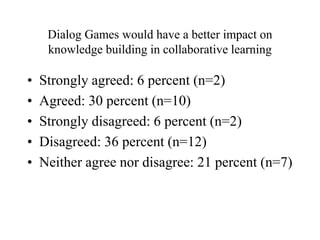
Dialog Games would have a better impact on
knowledge building in collaborative learning
• Strongly agreed: 6 percent (n=2)
• Agreed: 30 percent (n=10)
• Strongly disagreed: 6 percent (n=2)
• Disagreed: 36 percent (n=12)
• Neither agree nor disagree: 21 percent (n=7)
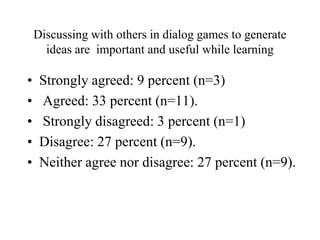
Discussing with others in dialog games to generate
ideas are important and useful while learning
• Strongly agreed: 9 percent (n=3)
• Agreed: 33 percent (n=11).
• Strongly disagreed: 3 percent (n=1)
• Disagree: 27 percent (n=9).
• Neither agree nor disagree: 27 percent (n=9).
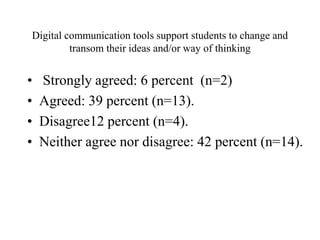
Digital communication tools support students to change and
transom their ideas and/or way of thinking
• Strongly agreed: 6 percent (n=2)
• Agreed: 39 percent (n=13).
• Disagree12 percent (n=4).
• Neither agree nor disagree: 42 percent (n=14).
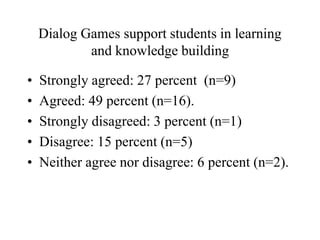
Dialog Games support students in learning
and knowledge building
• Strongly agreed: 27 percent (n=9)
• Agreed: 49 percent (n=16).
• Strongly disagreed: 3 percent (n=1)
• Disagree: 15 percent (n=5)
• Neither agree nor disagree: 6 percent (n=2).
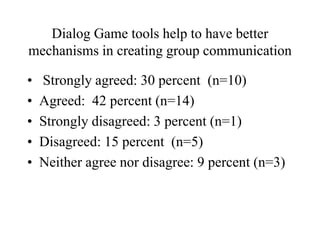
Dialog Game tools help to have better
mechanisms in creating group communication
• Strongly agreed: 30 percent (n=10)
• Agreed: 42 percent (n=14)
• Strongly disagreed: 3 percent (n=1)
• Disagreed: 15 percent (n=5)
• Neither agree nor disagree: 9 percent (n=3)
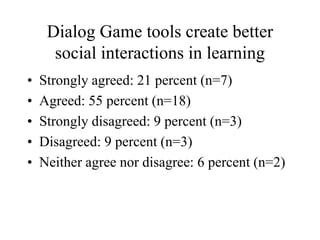
Dialog Game tools create better
social interactions in learning
• Strongly agreed: 21 percent (n=7)
• Agreed: 55 percent (n=18)
• Strongly disagreed: 9 percent (n=3)
• Disagreed: 9 percent (n=3)
• Neither agree nor disagree: 6 percent (n=2)
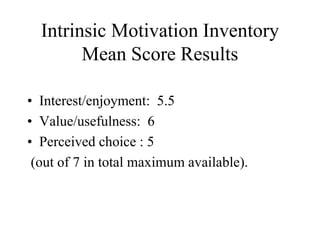
Intrinsic Motivation Inventory
Mean Score Results
• Interest/enjoyment: 5.5
• Value/usefulness: 6
• Perceived choice : 5
(out of 7 in total maximum available).
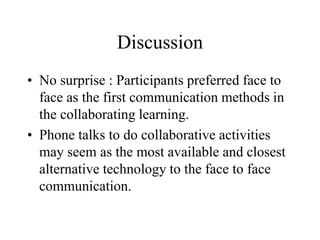
Discussion
• No surprise : Participants preferred face to
face as the first communication methods in
the collaborating learning.
• Phone talks to do collaborative activities
may seem as the most available and closest
alternative technology to the face to face
communication.
Discussion
• Further research need for mobile apps
• Contradictory Results: Face to face over
dialog games ?
• Ease of use has some trouble: better
usability for their products.
Discussion
• Better Benefits and impact of dialog games
on learning compared to traditional learning
methods wasn’t grasped !
Discussion
• Students have positive views and attitudes
of dialog games effects and functions in
their learning.
• Students think that dialog games are helping
their learning.
Discussion
• The results of the intrinsic motivation
survey also support the findings on the
questionnaire findings that show general
positive views and attitudes of students
toward dialog games.
Conclusion
• Students are positively ready to use dialog games
in collaborative learning.
• The majority of students showed a positive
attitude on that dialog games help them to learn
and build knowledge, changing and transforming
their ideas and/or way of thinking with better
mechanisms in creating group communication and
better social interactions in collaborative learning.
Questions
Dr. Ilker YENGIN
yengini@ihpc.a-star.edu.sg

Computer Engineering Students’ Readiness and Motivations for Using Dialog Games in Collaborative Learning

  • 1.
    A*STAR Institute of HighPerformance Computing Collaborative Thinking Technologies (CTT) Research Cluster Dr. Ilker YENGIN yengini@ihpc.a-star.edu.sg
  • 2.
    About • 21st-century :learning and workplace • Importance of Collaborative Learning • What are Dialog Games • Research Design: Computer Engineering Students’ Readiness and Motivations • Findings and Discussions
  • 3.
    Transferable knowledge andskills in the 21st century • Collaborative learning scenarios. • Dialog games as potential collaborative learning tools
  • 4.
    Dialog Games • Wordshave a specific action with and intention or purpose attached. • A dialog could be constructed like the format of games
  • 5.
    Dialog Games inEducation • Improved reasoning, knowledge development and conceptual understanding in a range of contexts. • Conceptual change in learning.
  • 6.
  • 7.
    Research Design • ComputerEngineering students (n=33) • A questionnaire including questions exploring students’ attitudes . • Intrinsic motivation inventory
  • 8.
    Questionnaire • Students’ usageof digital technologies to create knowledge in a social collaborative learning environment. • Checked for validity and avoid redundancy, misleading and bias loaded questions.
  • 9.
    Intrinsic Motivation Inventory •Interest/enjoyment, • Value/usefulness • Perceived choice
  • 10.
    Findings • Understanding andawareness of the concept of collaborative learning : - 97.00 (n=32) percent of the students stated that have been aware of the concept of collaborative learning
  • 11.
    Technology tools for collaborativelearning 1. Face to face and/or talking directly (n=30). 2. Talking via telephone or mobile phone (n=21) 3. Using apps on a mobile phone (n=19) 4. Online forums on the Internet” (n=9) 5. Exchanging messages via e-mail (n=8)
  • 12.
    Prefer Dialog Gamesover the face to face communication • 67 percent of the students (n=22) they would prefer dialog games and similar digital technologies in collaborative learning, if available
  • 13.
    Dialog Games areeasier to use than the traditional methods of communication • Strongly agreed : 6 percent (n=2) • Agreed : 30 percent (n=10). • Strongly disagreed: 3 percent (n=1) • Disagree: 33 percent (n=11). • Neither agree nor disagree: 27 percent (n=9).
  • 14.
    Dialog Games wouldhave a better impact on knowledge building in collaborative learning • Strongly agreed: 6 percent (n=2) • Agreed: 30 percent (n=10) • Strongly disagreed: 6 percent (n=2) • Disagreed: 36 percent (n=12) • Neither agree nor disagree: 21 percent (n=7)
  • 15.
    Discussing with othersin dialog games to generate ideas are important and useful while learning • Strongly agreed: 9 percent (n=3) • Agreed: 33 percent (n=11). • Strongly disagreed: 3 percent (n=1) • Disagree: 27 percent (n=9). • Neither agree nor disagree: 27 percent (n=9).
  • 16.
    Digital communication toolssupport students to change and transom their ideas and/or way of thinking • Strongly agreed: 6 percent (n=2) • Agreed: 39 percent (n=13). • Disagree12 percent (n=4). • Neither agree nor disagree: 42 percent (n=14).
  • 17.
    Dialog Games supportstudents in learning and knowledge building • Strongly agreed: 27 percent (n=9) • Agreed: 49 percent (n=16). • Strongly disagreed: 3 percent (n=1) • Disagree: 15 percent (n=5) • Neither agree nor disagree: 6 percent (n=2).
  • 18.
    Dialog Game toolshelp to have better mechanisms in creating group communication • Strongly agreed: 30 percent (n=10) • Agreed: 42 percent (n=14) • Strongly disagreed: 3 percent (n=1) • Disagreed: 15 percent (n=5) • Neither agree nor disagree: 9 percent (n=3)
  • 19.
    Dialog Game toolscreate better social interactions in learning • Strongly agreed: 21 percent (n=7) • Agreed: 55 percent (n=18) • Strongly disagreed: 9 percent (n=3) • Disagreed: 9 percent (n=3) • Neither agree nor disagree: 6 percent (n=2)
  • 20.
    Intrinsic Motivation Inventory MeanScore Results • Interest/enjoyment: 5.5 • Value/usefulness: 6 • Perceived choice : 5 (out of 7 in total maximum available).
  • 21.
    Discussion • No surprise: Participants preferred face to face as the first communication methods in the collaborating learning. • Phone talks to do collaborative activities may seem as the most available and closest alternative technology to the face to face communication.
  • 22.
    Discussion • Further researchneed for mobile apps • Contradictory Results: Face to face over dialog games ? • Ease of use has some trouble: better usability for their products.
  • 23.
    Discussion • Better Benefitsand impact of dialog games on learning compared to traditional learning methods wasn’t grasped !
  • 24.
    Discussion • Students havepositive views and attitudes of dialog games effects and functions in their learning. • Students think that dialog games are helping their learning.
  • 25.
    Discussion • The resultsof the intrinsic motivation survey also support the findings on the questionnaire findings that show general positive views and attitudes of students toward dialog games.
  • 26.
    Conclusion • Students arepositively ready to use dialog games in collaborative learning. • The majority of students showed a positive attitude on that dialog games help them to learn and build knowledge, changing and transforming their ideas and/or way of thinking with better mechanisms in creating group communication and better social interactions in collaborative learning.
  • 27.

Editor's Notes

  • #4 New challenges and fast changing dynamics of the new global environment have put a great emphasis on building communities that are using and building knowledge in a social setting in order to cope within the modern world Thus, there is a need to invest effort to develop the cognitive skills that enable the societies to effectively achieve tasks in 21st century. Communicating and creating knowledge together in a shared learning setting is one of the core skill set for meeting the demands of 21st-century workplaces. Previous research studies suggested dialog games as potential collaborative learning tools that allow students to construct knowledge and generate ideas in a shared online dialogs.
  • #5 Shortly, dialog games are tools for forming and ordering logical argumentation strategies in interactive dialogs. Dialog games have special designs to help students in well-structured sentence building to allow them to form critical thinking strategies in ongoing argumentative dialogs. Dialog game templates are designed based on speech act theory which direct students to create behavioral dialog patterns such as helping, information-seeking, probing, and instructing.
  • #6 special design of dialog games provides opportunities for teachers to create learning activities for promoting deep reasoning and creativity. Hence, dialog-games are potential candidates for facilitating well-structured interactions for effective collaborative learning.
  • #10 Intrinsic motivation inventory was designed by Deci and Ryan [32] to assess “participants subjective experience related to a target activity”. This inventory is well used in research literature [33-35]. Previous research also showed the strong validity of intrinsic motivation inventory