Level Up! Gamifying the
22 Century Classroom
Dina Moati
@dinamoati
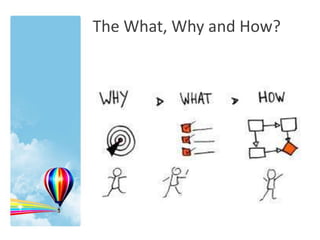
The What, Why and How?
What?
Gamification is the concept of applying game-
design ELEMENTS and thinking to NON-game
applications to make them more fun and
engaging.
(Gamification.org, 2013)
• Storyline / Narrative
• Tracking of progress and mastery
(XP, Badges, score boards, virtual maps )
• Immediate Feedback
• Reinforcers
• Scaffolding
• Increasing Difficulty, Leveling System
• Low Risk of Failure
(makeups and Try agains)
• Choice
Let’s Talk Elements
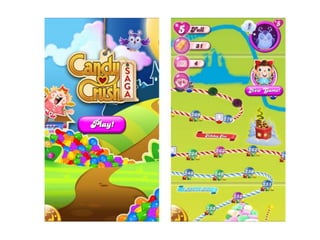
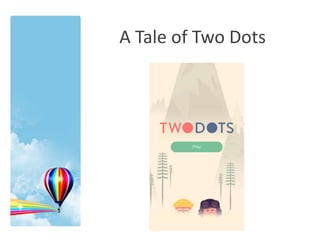
A Tale of Two Dots
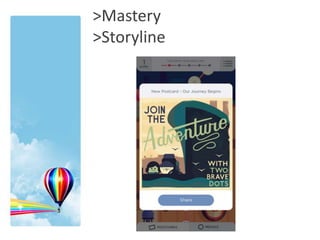
>Mastery
>Storyline
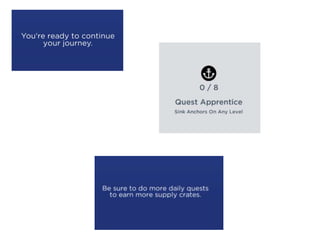
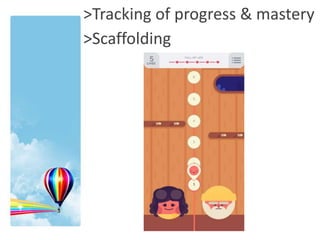
>Tracking of progress & mastery
>Scaffolding
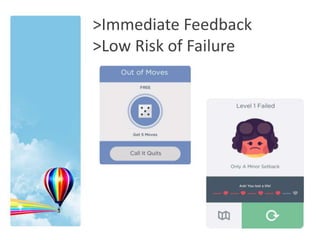
>Immediate Feedback
>Low Risk of Failure
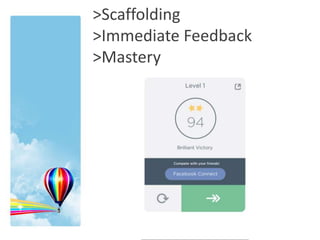
>Scaffolding
>Immediate Feedback
>Mastery
Why?
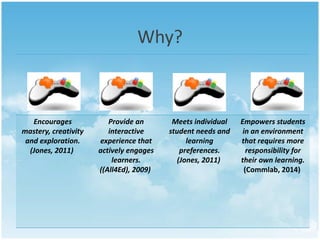
Encourages
mastery, creativity
and exploration.
(Jones, 2011)
Provide an
interactive
experience that
actively engages
learners.
((All4Ed), 2009)
Meets individual
student needs and
learning
preferences.
(Jones, 2011)
Empowers students
in an environment
that requires more
responsibility for
their own learning.
(Commlab, 2014)
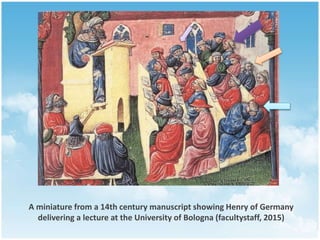
A miniature from a 14th century manuscript showing Henry of Germany
delivering a lecture at the University of Bologna (facultystaff, 2015)
Why?
Brain-based learning
It is more difficult to learn anything
if you are not motivated and
engaged.
Why Gamify?
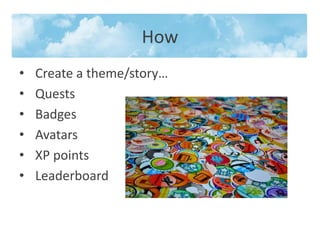
How
• Create a theme/story…
• Quests
• Badges
• Avatars
• XP points
• Leaderboard

Gamification Presentation

Editor's Notes

  • #4 “...the incorporation of game mechanics, dynamics, and frameworks to promote desired behaviors.” Lee & Hammer, 2011 harnesses the motivational power of games and applies it to real-world problems.
  • #5 Gamification/Quest  Based Learning is based on the pedagogy of constructivism where students complete quests progressively to reach the final destination on a map that is reflective of their learning journey. Working with our current student population and needs, it allows the reconstruction of  instructional design to meet the needs of students in a digital world
  • #6 Tim-Student buy-in is important. Give students a voice regarding rewards. Rewards could be attached to the leaderboard
  • #10 (XP, Badges, score boards, virtual maps )
  • #13 “Let's create these communities around the game that do an incredible amount of intellectual work, and when they’re done with the work, they will leave the game and go on to another game that’s more challenging. Can you imagine if we had that   kind of environment in classrooms?”  — "Squire, 2013)
  • #16 Learning will occur as long as the brain is not inhibited from it’s normal processes.