Your Interactive Guide
to the Digital World
Discovering
Computers 2012
Objectives Overview
Differentiate between storage
devices and storage media
Describe the characteristics of an
internal hard disk including
capacity, platters, read/write
heads, cylinders, sectors and
tracks, revolutions per
minute, transfer rate, and access
time
Discuss the purpose of network
attached storage
devices, external and removable
hard disks, and hard disk
controllers
Describe the various types of
flash memory storage
Discovering Computers 2012: Chapter 7
2
See Page 351
for Detailed Objectives
Objectives Overview
Describe cloud storage and
explain its advantages
Describe the characteristics
of optical discs
Differentiate among various
types of optical discs:
CDs, archive discs and
Picture CDs, DVDs, and Blu-
ray Discs
Identify the uses of
tape, magnetic stripe
cards, smart
cards, microfilm and
microfiche, and enterprise
storage
Discovering Computers 2012: Chapter 7
3
See Page 351
for Detailed Objectives
Storage
Storage holds data, instructions, and
information for future use
A storage medium is the physical
material on which a computer keeps
data, instructions, and information
Discovering Computers 2012: Chapter 7
4
Pages 352 - 353
Storage
Discovering Computers 2012: Chapter 7
5
Pages 352 – 353
Figure 7-1
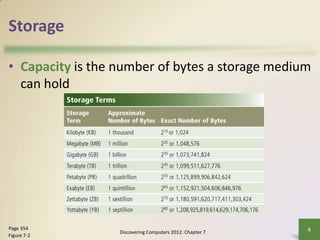
Storage
• Capacity is the number of bytes a storage medium
can hold
Discovering Computers 2012: Chapter 7
6
Page 354
Figure 7-2
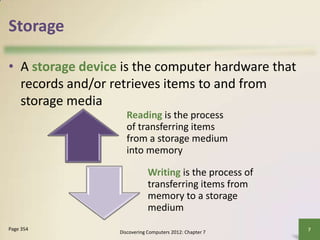
Storage
• A storage device is the computer hardware that
records and/or retrieves items to and from
storage media
Discovering Computers 2012: Chapter 7
7
Page 354
Reading is the process
of transferring items
from a storage medium
into memory
Writing is the process of
transferring items from
memory to a storage
medium
Storage
• Access time measures:
– The amount of time it
takes a storage device to
locate an item on a
storage medium
– The time required to
deliver an item from
memory to the
processor
Discovering Computers 2012: Chapter 7
8
Page 355
Figure 7-4
Hard Disks
• A hard disk contains one or more inflexible, circular platters
that use magnetic particles to store data, instructions, and
information
Discovering Computers 2012: Chapter 7
9
Page 355
Figure 7-5
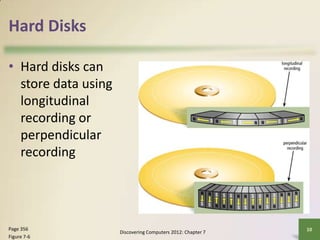
Hard Disks
• Hard disks can
store data using
longitudinal
recording or
perpendicular
recording
Discovering Computers 2012: Chapter 7
10
Page 356
Figure 7-6
Hard Disks
• Characteristics of a hard disk
include:
Discovering Computers 2012: Chapter 7
11
Page 357
Figure 7-8
Capacity Platters
Read/Write
Heads
Cylinders
Sectors and
Tracks
Revolutions
per Minute
Transfer
Rate
Access Time
Hard Disks
• Formatting is the process of dividing the disk into tracks
and sectors so that the operating system can store and
locate data and information on the disk
Discovering Computers 2012: Chapter 7
12
Page 357
Figure 7-7
Hard Disks
Discovering Computers 2012: Chapter 7
13
Page 358
Figure 7-9
Hard Disks
• The hard disk arms
move the read/write
head, which reads items
and writes items in the
drive
– Location often is
referred to by its
cylinder
Discovering Computers 2012: Chapter 7
14
Page 358
Figure 7-10
Hard Disks
• A head crash occurs when a read/write head
touches the surface of a platter
• Always keep a backup of your hard disk
Discovering Computers 2012: Chapter 7
15
Pages 358 – 359
Figure 7-11
Hard Disks
Discovering Computers 2012: Chapter 7
16
Page 359
Figure 7-12
Hard Disks
• RAID (redundant array of independent disks) is a
group of two or more integrated hard disks
• A network attached storage (NAS) device is a
server connected to a network with the sole
purpose of providing storage
Discovering Computers 2012: Chapter 7
17
Page 360
Figure 7-13
Hard Disks
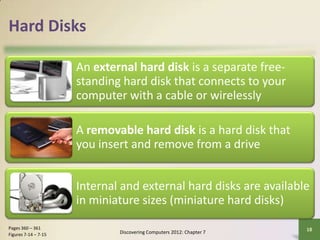
An external hard disk is a separate free-
standing hard disk that connects to your
computer with a cable or wirelessly
A removable hard disk is a hard disk that
you insert and remove from a drive
Internal and external hard disks are available
in miniature sizes (miniature hard disks)
Discovering Computers 2012: Chapter 7
18
Pages 360 – 361
Figures 7-14 – 7-15
Hard Disks
• A disk controller consists of a special-purpose chip and
electronic circuits that control the transfer of
data, instructions, and information from a disk to and
from the system bus and other components of the
computer
Discovering Computers 2012: Chapter 7
19
Pages 361 - 362
SATA EIDE
SCSI SAS
Flash Memory Storage
• Flash memory chips are a type of solid state
media and contain no moving parts
• Solid state drives (SSDs) have several advantages
over magnetic hard disks:
Discovering Computers 2012: Chapter 7
20
Pages 362 - 363
Faster access time Faster transfer rates
Generate less heat and
consume less power
Last longer
Flash Memory Storage
Discovering Computers 2012: Chapter 7
21
Page 363
Figure 7-17
Flash Memory Storage
• A memory card is a removable flash memory
device that you insert and remove from a slot in a
computer, mobile device, or card reader/writer
Discovering Computers 2012: Chapter 7
22
Page 364
CompactFlash
(CF)
Secure Digital
(SD)
Secure Digital
High Capacity
(SDHC)
microSD
microSDHC
xD Picture
Card
Memory Stick
Memory Stick
Micro (M2)
Flash Memory Storage
Discovering Computers 2012: Chapter 7
23
Pages 364 – 365
Figures 7-18 – 7-19
Flash Memory Storage
Discovering Computers 2012: Chapter 7
24
Page 366
Figure 7-20
Flash Memory Storage
• USB flash drives plug into a USB port on a
computer or mobile device
Discovering Computers 2012: Chapter 7
25
Page 367
Figure 7-21
Flash Memory Storage
• An ExpressCard module
is a removable device
that fits in an
ExpressCard slot
• Developed by the
PCMCIA
• Commonly used in
notebook computers
Discovering Computers 2012: Chapter 7
26
Page 367
Figure 7-22
Cloud Storage
• Cloud storage is an Internet service that provides
storage to computer users
Discovering Computers 2012: Chapter 7
27
Page 368
Figure 7-23
Cloud Storage
Discovering Computers 2012: Chapter 7
28
Page 368
Figure 7-24
Cloud Storage
• Users subscribe to cloud storage for a variety of
reasons:
Discovering Computers 2012: Chapter 7
29
Page 369
Access files from any computer
Store large files instantaneously
Allow others to access their files
View time-critical data and images immediately
Store offsite backups
Provide data center functions
Optical Discs
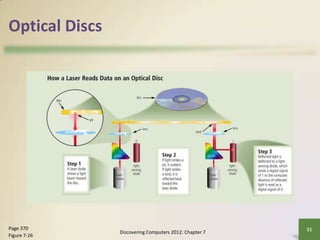
• An optical disc consists of a flat, round, portable
disc made of metal, plastic, and lacquer that is
written and read by a laser
• Typically store software, data, digital
photos, movies, and music
• Read only vs. rewritable
Discovering Computers 2012: Chapter 7
30
Page 370
Figure 7-25
Optical Discs
Discovering Computers 2012: Chapter 7
31
Page 370
Figure 7-26
Optical Discs
• Optical discs commonly
store items in a single
track that spirals from
the center of the disc to
the edge
• Track is divided into
evenly sized sectors
Discovering Computers 2012: Chapter 7
32
Page 371
Figure 7-27
Optical Discs
• Care of optical discs
Discovering Computers 2012: Chapter 7
33
Page 371
Figure 7-28
Optical Discs
A CD-ROM can be read from but not written to
• Read from a CD-ROM drive or CD-ROM player
A CD-R is a multisession optical disc on which
users can write, but not erase
A CD-RW is an erasable multisession disc
• Must have a CD-RW drive
Discovering Computers 2012: Chapter 7
34
Pages 372 – 373
Figure 7-29
Optical Discs
Archive disc
• Stores photos from an
online photo center
• Resolution usually is
7200 pixels per photo
• Cost is determined by
the number of photos
being stored
Picture CD
• Single-session CD-ROM
that stores digital
versions of film
• Typically uses a 1024 x
1536 resolution
• Many photo centers
offer Picture CD
services
Discovering Computers 2012: Chapter 7
35
Page 374
Optical Discs
Discovering Computers 2012: Chapter 7
36
Page 374
Figure 7-31
Optical Discs
A DVD-ROM is a high-capacity optical disc on
which users can read but not write or erase
• Requires a DVD-ROM drive
A Blu-ray Disc-ROM (BD-ROM) has a storage
capacity of 100 GB
DVD-RW, DVD+RW, and DVD+RAM are high-
capacity rewritable DVD formats
Discovering Computers 2012: Chapter 7
37
Pages 375 – 376
Figure 7-29
Other Types of Storage
Discovering Computers 2012: Chapter 7
38
Page 376
Other Types of Storage
• Tape is a magnetically coated ribbon of plastic capable of
storing large amounts of data and information
• A tape drive reads and writes data and information on a
tape
Discovering Computers 2012: Chapter 7
39
Page 376
Figure 7-35
Other Types of Storage
• A magnetic stripe card
contains a magnetic
stripe that stores
information
• A smart card stores
data on a thin
microprocessor
embedded in the card
Discovering Computers 2012: Chapter 7
40
Page 377
Figure 7-36
Other Types of Storage
• Microfilm and microfiche store microscopic
images of documents on a roll or sheet film
Discovering Computers 2012: Chapter 7
41
Page 378
Figure 7-37
Other Types of Storage
Discovering Computers 2012: Chapter 7
42
Page 378
Figure 7-38
Other Types of Storage
• Enterprise storage stores huge volumes of data
and information for large businesses
– Uses special hardware for heavy use, maximum
availability, and maximum efficiency
Discovering Computers 2012: Chapter 7
43
Page 379
Figure 7-39
Putting It All Together
Home user
• 500 GB hard disk
• Cloud storage
• Optical disc drive
• Card reader/writer
• USB flash drive
Small Office/Home Office
user
• 1 TB hard disk
• Cloud storage
• Optical disc drive
• External hard disk for
backup
• USB flash drive
Mobile
• 250 GB hard disk
• Cloud storage
• Optical disc drive
• Card reader/writer
• Portable hard disk for
backup
• USB flash drive
Discovering Computers 2012: Chapter 7
44
Page 380
Figure 7-40
Putting It All Together
Discovering Computers 2012: Chapter 7
45
Page 380
Figure 7-40
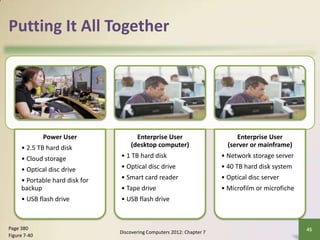
Power User
• 2.5 TB hard disk
• Cloud storage
• Optical disc drive
• Portable hard disk for
backup
• USB flash drive
Enterprise User
(desktop computer)
• 1 TB hard disk
• Optical disc drive
• Smart card reader
• Tape drive
• USB flash drive
Enterprise User
(server or mainframe)
• Network storage server
• 40 TB hard disk system
• Optical disc server
• Microfilm or microfiche
Summary
Various storage media and storage
devices
Internal hard disks, external and
removable hard disks, solid state
drives, memory cards, USB flash
drives, ExpressCard modules, cloud
storage, CDs, DVDs, and Blu-ray
Discs, tape, smart cards, and
microfilm and microfiche
Discovering Computers 2012: Chapter 7
46
Page 381
Your Interactive Guide
to the Digital World
Discovering
Computers 2012
Chapter 7 Complete

Computer Course including necessary Information

  • 1.
    Your Interactive Guide tothe Digital World Discovering Computers 2012
  • 2.
    Objectives Overview Differentiate betweenstorage devices and storage media Describe the characteristics of an internal hard disk including capacity, platters, read/write heads, cylinders, sectors and tracks, revolutions per minute, transfer rate, and access time Discuss the purpose of network attached storage devices, external and removable hard disks, and hard disk controllers Describe the various types of flash memory storage Discovering Computers 2012: Chapter 7 2 See Page 351 for Detailed Objectives
  • 3.
    Objectives Overview Describe cloudstorage and explain its advantages Describe the characteristics of optical discs Differentiate among various types of optical discs: CDs, archive discs and Picture CDs, DVDs, and Blu- ray Discs Identify the uses of tape, magnetic stripe cards, smart cards, microfilm and microfiche, and enterprise storage Discovering Computers 2012: Chapter 7 3 See Page 351 for Detailed Objectives
  • 4.
    Storage Storage holds data,instructions, and information for future use A storage medium is the physical material on which a computer keeps data, instructions, and information Discovering Computers 2012: Chapter 7 4 Pages 352 - 353
  • 5.
    Storage Discovering Computers 2012:Chapter 7 5 Pages 352 – 353 Figure 7-1
  • 6.
    Storage • Capacity isthe number of bytes a storage medium can hold Discovering Computers 2012: Chapter 7 6 Page 354 Figure 7-2
  • 7.
    Storage • A storagedevice is the computer hardware that records and/or retrieves items to and from storage media Discovering Computers 2012: Chapter 7 7 Page 354 Reading is the process of transferring items from a storage medium into memory Writing is the process of transferring items from memory to a storage medium
  • 8.
    Storage • Access timemeasures: – The amount of time it takes a storage device to locate an item on a storage medium – The time required to deliver an item from memory to the processor Discovering Computers 2012: Chapter 7 8 Page 355 Figure 7-4
  • 9.
    Hard Disks • Ahard disk contains one or more inflexible, circular platters that use magnetic particles to store data, instructions, and information Discovering Computers 2012: Chapter 7 9 Page 355 Figure 7-5
  • 10.
    Hard Disks • Harddisks can store data using longitudinal recording or perpendicular recording Discovering Computers 2012: Chapter 7 10 Page 356 Figure 7-6
  • 11.
    Hard Disks • Characteristicsof a hard disk include: Discovering Computers 2012: Chapter 7 11 Page 357 Figure 7-8 Capacity Platters Read/Write Heads Cylinders Sectors and Tracks Revolutions per Minute Transfer Rate Access Time
  • 12.
    Hard Disks • Formattingis the process of dividing the disk into tracks and sectors so that the operating system can store and locate data and information on the disk Discovering Computers 2012: Chapter 7 12 Page 357 Figure 7-7
  • 13.
    Hard Disks Discovering Computers2012: Chapter 7 13 Page 358 Figure 7-9
  • 14.
    Hard Disks • Thehard disk arms move the read/write head, which reads items and writes items in the drive – Location often is referred to by its cylinder Discovering Computers 2012: Chapter 7 14 Page 358 Figure 7-10
  • 15.
    Hard Disks • Ahead crash occurs when a read/write head touches the surface of a platter • Always keep a backup of your hard disk Discovering Computers 2012: Chapter 7 15 Pages 358 – 359 Figure 7-11
  • 16.
    Hard Disks Discovering Computers2012: Chapter 7 16 Page 359 Figure 7-12
  • 17.
    Hard Disks • RAID(redundant array of independent disks) is a group of two or more integrated hard disks • A network attached storage (NAS) device is a server connected to a network with the sole purpose of providing storage Discovering Computers 2012: Chapter 7 17 Page 360 Figure 7-13
  • 18.
    Hard Disks An externalhard disk is a separate free- standing hard disk that connects to your computer with a cable or wirelessly A removable hard disk is a hard disk that you insert and remove from a drive Internal and external hard disks are available in miniature sizes (miniature hard disks) Discovering Computers 2012: Chapter 7 18 Pages 360 – 361 Figures 7-14 – 7-15
  • 19.
    Hard Disks • Adisk controller consists of a special-purpose chip and electronic circuits that control the transfer of data, instructions, and information from a disk to and from the system bus and other components of the computer Discovering Computers 2012: Chapter 7 19 Pages 361 - 362 SATA EIDE SCSI SAS
  • 20.
    Flash Memory Storage •Flash memory chips are a type of solid state media and contain no moving parts • Solid state drives (SSDs) have several advantages over magnetic hard disks: Discovering Computers 2012: Chapter 7 20 Pages 362 - 363 Faster access time Faster transfer rates Generate less heat and consume less power Last longer
  • 21.
    Flash Memory Storage DiscoveringComputers 2012: Chapter 7 21 Page 363 Figure 7-17
  • 22.
    Flash Memory Storage •A memory card is a removable flash memory device that you insert and remove from a slot in a computer, mobile device, or card reader/writer Discovering Computers 2012: Chapter 7 22 Page 364 CompactFlash (CF) Secure Digital (SD) Secure Digital High Capacity (SDHC) microSD microSDHC xD Picture Card Memory Stick Memory Stick Micro (M2)
  • 23.
    Flash Memory Storage DiscoveringComputers 2012: Chapter 7 23 Pages 364 – 365 Figures 7-18 – 7-19
  • 24.
    Flash Memory Storage DiscoveringComputers 2012: Chapter 7 24 Page 366 Figure 7-20
  • 25.
    Flash Memory Storage •USB flash drives plug into a USB port on a computer or mobile device Discovering Computers 2012: Chapter 7 25 Page 367 Figure 7-21
  • 26.
    Flash Memory Storage •An ExpressCard module is a removable device that fits in an ExpressCard slot • Developed by the PCMCIA • Commonly used in notebook computers Discovering Computers 2012: Chapter 7 26 Page 367 Figure 7-22
  • 27.
    Cloud Storage • Cloudstorage is an Internet service that provides storage to computer users Discovering Computers 2012: Chapter 7 27 Page 368 Figure 7-23
  • 28.
    Cloud Storage Discovering Computers2012: Chapter 7 28 Page 368 Figure 7-24
  • 29.
    Cloud Storage • Userssubscribe to cloud storage for a variety of reasons: Discovering Computers 2012: Chapter 7 29 Page 369 Access files from any computer Store large files instantaneously Allow others to access their files View time-critical data and images immediately Store offsite backups Provide data center functions
  • 30.
    Optical Discs • Anoptical disc consists of a flat, round, portable disc made of metal, plastic, and lacquer that is written and read by a laser • Typically store software, data, digital photos, movies, and music • Read only vs. rewritable Discovering Computers 2012: Chapter 7 30 Page 370 Figure 7-25
  • 31.
    Optical Discs Discovering Computers2012: Chapter 7 31 Page 370 Figure 7-26
  • 32.
    Optical Discs • Opticaldiscs commonly store items in a single track that spirals from the center of the disc to the edge • Track is divided into evenly sized sectors Discovering Computers 2012: Chapter 7 32 Page 371 Figure 7-27
  • 33.
    Optical Discs • Careof optical discs Discovering Computers 2012: Chapter 7 33 Page 371 Figure 7-28
  • 34.
    Optical Discs A CD-ROMcan be read from but not written to • Read from a CD-ROM drive or CD-ROM player A CD-R is a multisession optical disc on which users can write, but not erase A CD-RW is an erasable multisession disc • Must have a CD-RW drive Discovering Computers 2012: Chapter 7 34 Pages 372 – 373 Figure 7-29
  • 35.
    Optical Discs Archive disc •Stores photos from an online photo center • Resolution usually is 7200 pixels per photo • Cost is determined by the number of photos being stored Picture CD • Single-session CD-ROM that stores digital versions of film • Typically uses a 1024 x 1536 resolution • Many photo centers offer Picture CD services Discovering Computers 2012: Chapter 7 35 Page 374
  • 36.
    Optical Discs Discovering Computers2012: Chapter 7 36 Page 374 Figure 7-31
  • 37.
    Optical Discs A DVD-ROMis a high-capacity optical disc on which users can read but not write or erase • Requires a DVD-ROM drive A Blu-ray Disc-ROM (BD-ROM) has a storage capacity of 100 GB DVD-RW, DVD+RW, and DVD+RAM are high- capacity rewritable DVD formats Discovering Computers 2012: Chapter 7 37 Pages 375 – 376 Figure 7-29
  • 38.
    Other Types ofStorage Discovering Computers 2012: Chapter 7 38 Page 376
  • 39.
    Other Types ofStorage • Tape is a magnetically coated ribbon of plastic capable of storing large amounts of data and information • A tape drive reads and writes data and information on a tape Discovering Computers 2012: Chapter 7 39 Page 376 Figure 7-35
  • 40.
    Other Types ofStorage • A magnetic stripe card contains a magnetic stripe that stores information • A smart card stores data on a thin microprocessor embedded in the card Discovering Computers 2012: Chapter 7 40 Page 377 Figure 7-36
  • 41.
    Other Types ofStorage • Microfilm and microfiche store microscopic images of documents on a roll or sheet film Discovering Computers 2012: Chapter 7 41 Page 378 Figure 7-37
  • 42.
    Other Types ofStorage Discovering Computers 2012: Chapter 7 42 Page 378 Figure 7-38
  • 43.
    Other Types ofStorage • Enterprise storage stores huge volumes of data and information for large businesses – Uses special hardware for heavy use, maximum availability, and maximum efficiency Discovering Computers 2012: Chapter 7 43 Page 379 Figure 7-39
  • 44.
    Putting It AllTogether Home user • 500 GB hard disk • Cloud storage • Optical disc drive • Card reader/writer • USB flash drive Small Office/Home Office user • 1 TB hard disk • Cloud storage • Optical disc drive • External hard disk for backup • USB flash drive Mobile • 250 GB hard disk • Cloud storage • Optical disc drive • Card reader/writer • Portable hard disk for backup • USB flash drive Discovering Computers 2012: Chapter 7 44 Page 380 Figure 7-40
  • 45.
    Putting It AllTogether Discovering Computers 2012: Chapter 7 45 Page 380 Figure 7-40 Power User • 2.5 TB hard disk • Cloud storage • Optical disc drive • Portable hard disk for backup • USB flash drive Enterprise User (desktop computer) • 1 TB hard disk • Optical disc drive • Smart card reader • Tape drive • USB flash drive Enterprise User (server or mainframe) • Network storage server • 40 TB hard disk system • Optical disc server • Microfilm or microfiche
  • 46.
    Summary Various storage mediaand storage devices Internal hard disks, external and removable hard disks, solid state drives, memory cards, USB flash drives, ExpressCard modules, cloud storage, CDs, DVDs, and Blu-ray Discs, tape, smart cards, and microfilm and microfiche Discovering Computers 2012: Chapter 7 46 Page 381
  • 47.
    Your Interactive Guide tothe Digital World Discovering Computers 2012 Chapter 7 Complete