Presented by :
Bachchhao Kunal B..
M. Pharm 2nd
Semester
Guided by :
Mr. G. B. Patil.
Department of Quality
Assurance
21-Apr-15 1
Contents :
๏ƒผ Introduction
๏ƒผ Definition
๏ƒผ Parameter
๏ƒผ Classic optimization
๏ƒผ Statistical design
๏ƒผ Applied optimization metheod
๏ƒผ Design of experiments
๏ƒผ Types of experimental design
๏ƒผ Advantages and applications
๏ƒผ Conclusion
๏ƒผ References21-Apr-15 2OPTIMIZATION TECHNIQUES
INTRODUCTION
๏ƒผThe term Optimize is defined as โ€œto make perfectโ€.
๏ƒผIt is used in pharmacy relative to formulation and processing
๏ƒผInvolved in formulating drug products in various forms
๏ƒผIt is the process of finding the best way of using the existing
resources while taking in to the account of all the factors that
influences decisions in any experiment
21-Apr-15 3OPTIMIZATION TECHNIQUES
๏ƒผFinal product not only meets the requirements from the bio-
availability but also from the practical mass production criteria
๏ƒผPharmaceutical scientist- to understand theoretical
formulation.
๏ƒผTarget processing parameters โ€“ ranges for each excipients &
processing factors
๏ƒผIn development projects , one generally experiments by a
series of logical steps, carefully controlling the variables &
changing one at a time, until a satisfactory system is obtained
๏ƒผIt is not a screening technique.
Continueโ€ฆ.
21-Apr-15 4OPTIMIZATION TECHNIQUES
๏ƒผ How we can make Formulation perfect ?
๏ƒผ What should be characteristics?
๏ƒผ What should be the conditions?
Questions Should be in mind
21-Apr-15 5OPTIMIZATION TECHNIQUES
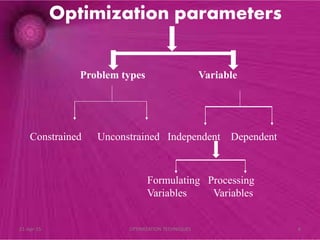
Optimization parameters
Problem types Variable
Constrained Unconstrained Independent Dependent
Formulating Processing
Variables Variables
21-Apr-15 6OPTIMIZATION TECHNIQUES
๏ถ Independent variables or primary variables :
Formulations and process variables directly under control of the
formulator.
These includes ingredients
๏ถ Dependent or secondary variables :
These are the responses of the inprogress material or the
resulting drug delivery system.
It is the result of independent variables .
Optimization Parameters
21-Apr-15 7OPTIMIZATION TECHNIQUES
General optimization
By MRA the relationships are generated from experimental
data , resulting equations are on the basis of optimization.

These equation defines response surface for the system under
investigation
After collection of all the runs and calculated responses
,calculation of regression coefficient is initiated.
Analysis of variance (ANOVA) presents the sum of the squares
used to estimate the factor main effects.
21-Apr-15 8OPTIMIZATION TECHNIQUES
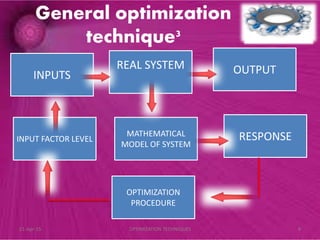
General optimization
technique3
INPUTS
OPTIMIZATION
PROCEDURE
RESPONSEMATHEMATICAL
MODEL OF SYSTEM
INPUT FACTOR LEVEL
OUTPUTREAL SYSTEM
21-Apr-15 9OPTIMIZATION TECHNIQUES
TERMS USED
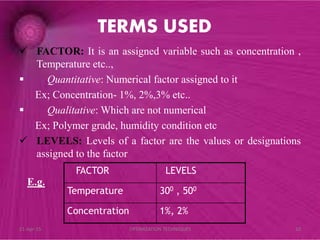
๏ƒผ FACTOR: It is an assigned variable such as concentration ,
Temperature etc..,
๏‚ง Quantitative: Numerical factor assigned to it
Ex; Concentration- 1%, 2%,3% etc..
๏‚ง Qualitative: Which are not numerical
Ex; Polymer grade, humidity condition etc
๏ƒผ LEVELS: Levels of a factor are the values or designations
assigned to the factor
FACTOR LEVELS
Temperature 300 , 500
Concentration 1%, 2%
E.g.
21-Apr-15 10OPTIMIZATION TECHNIQUES
APPLIED OPTIMIZATION
METHODS3
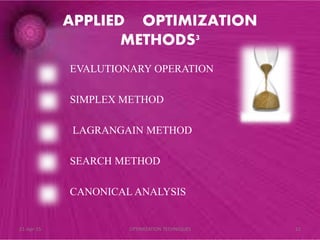
EVALUTIONARY OPERATION
SIMPLEX METHOD
LAGRANGAIN METHOD
SEARCH METHOD
CANONICAL ANALYSIS
21-Apr-15 11OPTIMIZATION TECHNIQUES
Continuedโ€ฆโ€ฆโ€ฆ
Evolutionary Method:
Constant , Repetitive and Care full planning of
production process to move towards better process.
Simplex Method:
It is simplex algorithm i.e. mathematical process which
is adopted for simplex process & generally represented in
geometrical figers.
LAGRANGAIN METHOD:
It is extension of classical method for simplifying the
formulae & equations .the disadvantage of this method is
that it is applicable to for only two variable problems.
21-Apr-15 12OPTIMIZATION TECHNIQUES
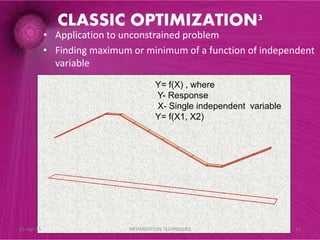
CLASSIC OPTIMIZATION3
โ€ข Application to unconstrained problem
โ€ข Finding maximum or minimum of a function of independent
variable
Y= f(X) , where
Y- Response
X- Single independent variable
Y= f(X1, X2)
21-Apr-15 13OPTIMIZATION TECHNIQUES
Design Of Experiment4
(DOE)
It is a structured, organized method used to determine
relationship between the factor affecting a process and
output of that process.
๏ƒผ Reduce experiment time
๏ƒผ Reduce experimental cost
21-Apr-15 14OPTIMIZATION TECHNIQUES
Phases Of DOE4
Determine the goal
Identifying affecting factors
Selection of Experimental design
Generating a Design Matrix
Conducting an Experiment
Finding the optimum
Results
21-Apr-15 15OPTIMIZATION TECHNIQUES
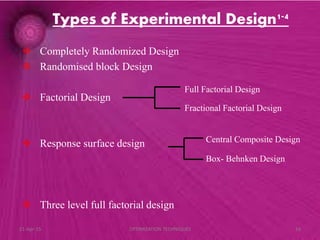
Types of Experimental Design1-4
๏ถ Completely Randomized Design
๏ถ Randomised block Design
๏ถ Factorial Design
๏ถ Response surface design
๏ถ Three level full factorial design
Full Factorial Design
Fractional Factorial Design
Central Composite Design
Box- Behnken Design
21-Apr-15 16OPTIMIZATION TECHNIQUES
Factorial Design
๏ถ For evaluation of multiple factors simultaneously.
๏ถ 23 means 2 is level while 3 is factor
๏ถ Factorial Design is divided into two types-
- Full Factorial Design
- Fractional factorial design
21-Apr-15 17OPTIMIZATION TECHNIQUES
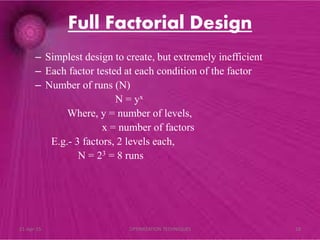
Full Factorial Design
โ€“ Simplest design to create, but extremely inefficient
โ€“ Each factor tested at each condition of the factor
โ€“ Number of runs (N)
N = yx
Where, y = number of levels,
x = number of factors
E.g.- 3 factors, 2 levels each,
N = 23 = 8 runs
21-Apr-15 18OPTIMIZATION TECHNIQUES
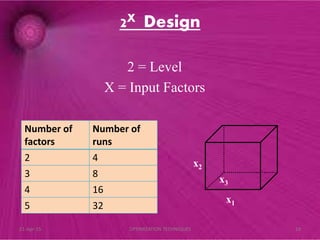
2X Design
2 = Level
X = Input Factors
x2
Number of
factors
Number of
runs
2 4
3 8
4 16
5 32
x1
x3
21-Apr-15 19OPTIMIZATION TECHNIQUES
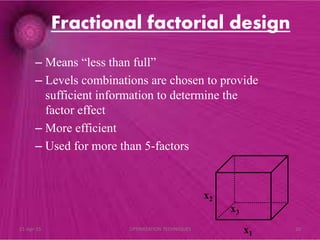
Fractional factorial design
โ€“ Means โ€œless than fullโ€
โ€“ Levels combinations are chosen to provide
sufficient information to determine the
factor effect
โ€“ More efficient
โ€“ Used for more than 5-factors
x1
x2
x3
21-Apr-15 20OPTIMIZATION TECHNIQUES
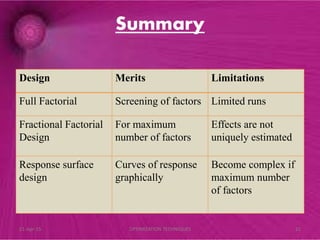
Summary
Design Merits Limitations
Full Factorial Screening of factors Limited runs
Fractional Factorial
Design
For maximum
number of factors
Effects are not
uniquely estimated
Response surface
design
Curves of response
graphically
Become complex if
maximum number
of factors
21-Apr-15 21OPTIMIZATION TECHNIQUES
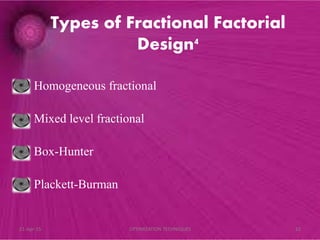
Types of Fractional Factorial
Design4
โ€ข Homogeneous fractional
โ€ข Mixed level fractional
โ€ข Box-Hunter
โ€ข Plackett-Burman
21-Apr-15 22OPTIMIZATION TECHNIQUES
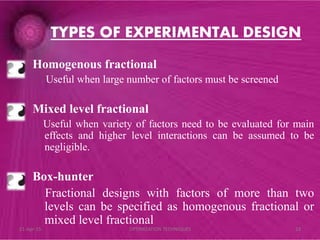
Homogenous fractional
Useful when large number of factors must be screened
Mixed level fractional
Useful when variety of factors need to be evaluated for main
effects and higher level interactions can be assumed to be
negligible.
Box-hunter
Fractional designs with factors of more than two
levels can be specified as homogenous fractional or
mixed level fractional
TYPES OF EXPERIMENTAL DESIGN
21-Apr-15 23OPTIMIZATION TECHNIQUES
Plackett-Burman
๏ฑ It is a popular class of screening design.
๏ฑ These designs are very efficient screening designs when only
the main effects are of interest.
๏ฑ These are useful for detecting large main effects economically
,assuming all interactions are negligible when compared with
important main effects
๏ฑ Used to investigate n-1 variables in n experiments proposing
experimental designs for more than seven factors and
especially for n*4 experiments.
TYPES OF EXPERIMENTAL DESIGN
21-Apr-15 24OPTIMIZATION TECHNIQUES
๏ฑ Two most common designs generally used in this response
surface modelling are
๏‚ง Central composite designs
๏‚ง Box-Behnken designs
๏ƒ˜ Box-Wilson central composite Design
๏‚ง This type contains an embedded factorial or fractional
factorial design with centre points that is augemented with the
group of โ€˜star pointsโ€™.
๏‚ง These always contains twice as many star points as there are
factors in the design
Continuedโ€ฆโ€ฆโ€ฆ
21-Apr-15 25OPTIMIZATION TECHNIQUES
๏ฑ The star points represent new extreme value (low & high) for
each factor in the design
๏ฑ To picture central composite design, it must imagined that
there are several factors that can vary between low and high
values.
๏ฑ Central composite designs are of three types
๏ฑ Circumscribed(CCC) designs-Cube points at the corners of
the unit cube ,star points along the axes at or outside the cube
and centre point at origin
๏ฑ Inscribed (CCI) designs-Star points take the value of +1 & -1
and cube points lie in the interior of the cube
๏ฑ Faced(CCI) โ€“star points on the faces of the cube.
Continuedโ€ฆโ€ฆโ€ฆ
21-Apr-15 26OPTIMIZATION TECHNIQUES
Box-Behnken design
๏ฑThey do not contain embedded factorial or fractional
factorial design.
๏ฑBox-Behnken designs use just three levels of each
factor.
๏ฑThese designs for three factors with circled point
appearing at the origin and possibly repeated for
several runs.
21-Apr-15 27OPTIMIZATION TECHNIQUES
Software's for Optimization
โ€ข Design Expert 7.1.3
โ€ข SYSTAT Sigma Stat 3.11
โ€ข CYTEL East 3.1
โ€ข Minitab
โ€ข Matrex
โ€ข Omega
โ€ข Compact
21-Apr-15 28OPTIMIZATION TECHNIQUES
Advantages
๏ถ Helps to determine important variables
๏ถ Helps to measures interactions.
๏ถ Allows extrapolations of the data and search for the
best possible product .
๏ถ Allows plotting of graphs to depict how variables
are related.
21-Apr-15 29OPTIMIZATION TECHNIQUES
Application1,5
๏ถ Formulation development
๏ถ Dissolution testing
๏ถ Tablet coating
๏ถ Capsule preparation
21-Apr-15 30OPTIMIZATION TECHNIQUES
Conclusion
Immense potential in development of pharmaceutical product and
processes
Less involvement of men, material, machine and money.
Improvement in formulation characteristics.
21-Apr-15 31OPTIMIZATION TECHNIQUES
REFERENCE
๏‚ง Modern pharmaceutics- vol 121
๏‚ง Textbook of industrial pharmacy by sobha rani
R.Hiremath.
๏‚ง Pharmaceutical statistics
๏‚ง Pharmaceutical characteristics โ€“ Practical and
clinical applications
๏‚ง www.google.com
21-Apr-15 32OPTIMIZATION TECHNIQUES
REFERENCES
1) Bolton S, BonC.Pharmacutical statistics practical & clinical
application, 5th ed. New York London ;informa healthcare
publishing ; 2010.p. (223- 39,424-51).
2) Jain NK,Pharmaceutical Product Development, New Delhi ;
CBS Publisher ; 2010. p. 295-340.
3) Schwartz JB,Connere RE,Schnaar RL,In: Banker GS & Rodes
CJ , editor . Modern Pharmaceutics, 4thed. informa healthcare
publishing ; 2010.p. 727-728.
4)Hirmanth RR,Vanjaka KI , Textbook of Industry Pharmacy
;Drug Delivery System and Cosmetics and Herbal Drug
Technology ; 2009.p.148-68.
5) Lewis GH, Mathieu DG, Pharmaceutical experimental design;
Dekker series publishing;Vol-92; 2008. p. 237-240.
21-Apr-15 33OPTIMIZATION TECHNIQUES
21-Apr-15 34OPTIMIZATION TECHNIQUES

Optimization techniques

  • 1.
    Presented by : BachchhaoKunal B.. M. Pharm 2nd Semester Guided by : Mr. G. B. Patil. Department of Quality Assurance 21-Apr-15 1
  • 2.
    Contents : ๏ƒผ Introduction ๏ƒผDefinition ๏ƒผ Parameter ๏ƒผ Classic optimization ๏ƒผ Statistical design ๏ƒผ Applied optimization metheod ๏ƒผ Design of experiments ๏ƒผ Types of experimental design ๏ƒผ Advantages and applications ๏ƒผ Conclusion ๏ƒผ References21-Apr-15 2OPTIMIZATION TECHNIQUES
  • 3.
    INTRODUCTION ๏ƒผThe term Optimizeis defined as โ€œto make perfectโ€. ๏ƒผIt is used in pharmacy relative to formulation and processing ๏ƒผInvolved in formulating drug products in various forms ๏ƒผIt is the process of finding the best way of using the existing resources while taking in to the account of all the factors that influences decisions in any experiment 21-Apr-15 3OPTIMIZATION TECHNIQUES
  • 4.
    ๏ƒผFinal product notonly meets the requirements from the bio- availability but also from the practical mass production criteria ๏ƒผPharmaceutical scientist- to understand theoretical formulation. ๏ƒผTarget processing parameters โ€“ ranges for each excipients & processing factors ๏ƒผIn development projects , one generally experiments by a series of logical steps, carefully controlling the variables & changing one at a time, until a satisfactory system is obtained ๏ƒผIt is not a screening technique. Continueโ€ฆ. 21-Apr-15 4OPTIMIZATION TECHNIQUES
  • 5.
    ๏ƒผ How wecan make Formulation perfect ? ๏ƒผ What should be characteristics? ๏ƒผ What should be the conditions? Questions Should be in mind 21-Apr-15 5OPTIMIZATION TECHNIQUES
  • 6.
    Optimization parameters Problem typesVariable Constrained Unconstrained Independent Dependent Formulating Processing Variables Variables 21-Apr-15 6OPTIMIZATION TECHNIQUES
  • 7.
    ๏ถ Independent variablesor primary variables : Formulations and process variables directly under control of the formulator. These includes ingredients ๏ถ Dependent or secondary variables : These are the responses of the inprogress material or the resulting drug delivery system. It is the result of independent variables . Optimization Parameters 21-Apr-15 7OPTIMIZATION TECHNIQUES
  • 8.
    General optimization By MRAthe relationships are generated from experimental data , resulting equations are on the basis of optimization. These equation defines response surface for the system under investigation After collection of all the runs and calculated responses ,calculation of regression coefficient is initiated. Analysis of variance (ANOVA) presents the sum of the squares used to estimate the factor main effects. 21-Apr-15 8OPTIMIZATION TECHNIQUES
  • 9.
    General optimization technique3 INPUTS OPTIMIZATION PROCEDURE RESPONSEMATHEMATICAL MODEL OFSYSTEM INPUT FACTOR LEVEL OUTPUTREAL SYSTEM 21-Apr-15 9OPTIMIZATION TECHNIQUES
  • 10.
    TERMS USED ๏ƒผ FACTOR:It is an assigned variable such as concentration , Temperature etc.., ๏‚ง Quantitative: Numerical factor assigned to it Ex; Concentration- 1%, 2%,3% etc.. ๏‚ง Qualitative: Which are not numerical Ex; Polymer grade, humidity condition etc ๏ƒผ LEVELS: Levels of a factor are the values or designations assigned to the factor FACTOR LEVELS Temperature 300 , 500 Concentration 1%, 2% E.g. 21-Apr-15 10OPTIMIZATION TECHNIQUES
  • 11.
    APPLIED OPTIMIZATION METHODS3 EVALUTIONARY OPERATION SIMPLEXMETHOD LAGRANGAIN METHOD SEARCH METHOD CANONICAL ANALYSIS 21-Apr-15 11OPTIMIZATION TECHNIQUES
  • 12.
    Continuedโ€ฆโ€ฆโ€ฆ Evolutionary Method: Constant ,Repetitive and Care full planning of production process to move towards better process. Simplex Method: It is simplex algorithm i.e. mathematical process which is adopted for simplex process & generally represented in geometrical figers. LAGRANGAIN METHOD: It is extension of classical method for simplifying the formulae & equations .the disadvantage of this method is that it is applicable to for only two variable problems. 21-Apr-15 12OPTIMIZATION TECHNIQUES
  • 13.
    CLASSIC OPTIMIZATION3 โ€ข Applicationto unconstrained problem โ€ข Finding maximum or minimum of a function of independent variable Y= f(X) , where Y- Response X- Single independent variable Y= f(X1, X2) 21-Apr-15 13OPTIMIZATION TECHNIQUES
  • 14.
    Design Of Experiment4 (DOE) Itis a structured, organized method used to determine relationship between the factor affecting a process and output of that process. ๏ƒผ Reduce experiment time ๏ƒผ Reduce experimental cost 21-Apr-15 14OPTIMIZATION TECHNIQUES
  • 15.
    Phases Of DOE4 Determinethe goal Identifying affecting factors Selection of Experimental design Generating a Design Matrix Conducting an Experiment Finding the optimum Results 21-Apr-15 15OPTIMIZATION TECHNIQUES
  • 16.
    Types of ExperimentalDesign1-4 ๏ถ Completely Randomized Design ๏ถ Randomised block Design ๏ถ Factorial Design ๏ถ Response surface design ๏ถ Three level full factorial design Full Factorial Design Fractional Factorial Design Central Composite Design Box- Behnken Design 21-Apr-15 16OPTIMIZATION TECHNIQUES
  • 17.
    Factorial Design ๏ถ Forevaluation of multiple factors simultaneously. ๏ถ 23 means 2 is level while 3 is factor ๏ถ Factorial Design is divided into two types- - Full Factorial Design - Fractional factorial design 21-Apr-15 17OPTIMIZATION TECHNIQUES
  • 18.
    Full Factorial Design โ€“Simplest design to create, but extremely inefficient โ€“ Each factor tested at each condition of the factor โ€“ Number of runs (N) N = yx Where, y = number of levels, x = number of factors E.g.- 3 factors, 2 levels each, N = 23 = 8 runs 21-Apr-15 18OPTIMIZATION TECHNIQUES
  • 19.
    2X Design 2 =Level X = Input Factors x2 Number of factors Number of runs 2 4 3 8 4 16 5 32 x1 x3 21-Apr-15 19OPTIMIZATION TECHNIQUES
  • 20.
    Fractional factorial design โ€“Means โ€œless than fullโ€ โ€“ Levels combinations are chosen to provide sufficient information to determine the factor effect โ€“ More efficient โ€“ Used for more than 5-factors x1 x2 x3 21-Apr-15 20OPTIMIZATION TECHNIQUES
  • 21.
    Summary Design Merits Limitations FullFactorial Screening of factors Limited runs Fractional Factorial Design For maximum number of factors Effects are not uniquely estimated Response surface design Curves of response graphically Become complex if maximum number of factors 21-Apr-15 21OPTIMIZATION TECHNIQUES
  • 22.
    Types of FractionalFactorial Design4 โ€ข Homogeneous fractional โ€ข Mixed level fractional โ€ข Box-Hunter โ€ข Plackett-Burman 21-Apr-15 22OPTIMIZATION TECHNIQUES
  • 23.
    Homogenous fractional Useful whenlarge number of factors must be screened Mixed level fractional Useful when variety of factors need to be evaluated for main effects and higher level interactions can be assumed to be negligible. Box-hunter Fractional designs with factors of more than two levels can be specified as homogenous fractional or mixed level fractional TYPES OF EXPERIMENTAL DESIGN 21-Apr-15 23OPTIMIZATION TECHNIQUES
  • 24.
    Plackett-Burman ๏ฑ It isa popular class of screening design. ๏ฑ These designs are very efficient screening designs when only the main effects are of interest. ๏ฑ These are useful for detecting large main effects economically ,assuming all interactions are negligible when compared with important main effects ๏ฑ Used to investigate n-1 variables in n experiments proposing experimental designs for more than seven factors and especially for n*4 experiments. TYPES OF EXPERIMENTAL DESIGN 21-Apr-15 24OPTIMIZATION TECHNIQUES
  • 25.
    ๏ฑ Two mostcommon designs generally used in this response surface modelling are ๏‚ง Central composite designs ๏‚ง Box-Behnken designs ๏ƒ˜ Box-Wilson central composite Design ๏‚ง This type contains an embedded factorial or fractional factorial design with centre points that is augemented with the group of โ€˜star pointsโ€™. ๏‚ง These always contains twice as many star points as there are factors in the design Continuedโ€ฆโ€ฆโ€ฆ 21-Apr-15 25OPTIMIZATION TECHNIQUES
  • 26.
    ๏ฑ The starpoints represent new extreme value (low & high) for each factor in the design ๏ฑ To picture central composite design, it must imagined that there are several factors that can vary between low and high values. ๏ฑ Central composite designs are of three types ๏ฑ Circumscribed(CCC) designs-Cube points at the corners of the unit cube ,star points along the axes at or outside the cube and centre point at origin ๏ฑ Inscribed (CCI) designs-Star points take the value of +1 & -1 and cube points lie in the interior of the cube ๏ฑ Faced(CCI) โ€“star points on the faces of the cube. Continuedโ€ฆโ€ฆโ€ฆ 21-Apr-15 26OPTIMIZATION TECHNIQUES
  • 27.
    Box-Behnken design ๏ฑThey donot contain embedded factorial or fractional factorial design. ๏ฑBox-Behnken designs use just three levels of each factor. ๏ฑThese designs for three factors with circled point appearing at the origin and possibly repeated for several runs. 21-Apr-15 27OPTIMIZATION TECHNIQUES
  • 28.
    Software's for Optimization โ€ขDesign Expert 7.1.3 โ€ข SYSTAT Sigma Stat 3.11 โ€ข CYTEL East 3.1 โ€ข Minitab โ€ข Matrex โ€ข Omega โ€ข Compact 21-Apr-15 28OPTIMIZATION TECHNIQUES
  • 29.
    Advantages ๏ถ Helps todetermine important variables ๏ถ Helps to measures interactions. ๏ถ Allows extrapolations of the data and search for the best possible product . ๏ถ Allows plotting of graphs to depict how variables are related. 21-Apr-15 29OPTIMIZATION TECHNIQUES
  • 30.
    Application1,5 ๏ถ Formulation development ๏ถDissolution testing ๏ถ Tablet coating ๏ถ Capsule preparation 21-Apr-15 30OPTIMIZATION TECHNIQUES
  • 31.
    Conclusion Immense potential indevelopment of pharmaceutical product and processes Less involvement of men, material, machine and money. Improvement in formulation characteristics. 21-Apr-15 31OPTIMIZATION TECHNIQUES
  • 32.
    REFERENCE ๏‚ง Modern pharmaceutics-vol 121 ๏‚ง Textbook of industrial pharmacy by sobha rani R.Hiremath. ๏‚ง Pharmaceutical statistics ๏‚ง Pharmaceutical characteristics โ€“ Practical and clinical applications ๏‚ง www.google.com 21-Apr-15 32OPTIMIZATION TECHNIQUES
  • 33.
    REFERENCES 1) Bolton S,BonC.Pharmacutical statistics practical & clinical application, 5th ed. New York London ;informa healthcare publishing ; 2010.p. (223- 39,424-51). 2) Jain NK,Pharmaceutical Product Development, New Delhi ; CBS Publisher ; 2010. p. 295-340. 3) Schwartz JB,Connere RE,Schnaar RL,In: Banker GS & Rodes CJ , editor . Modern Pharmaceutics, 4thed. informa healthcare publishing ; 2010.p. 727-728. 4)Hirmanth RR,Vanjaka KI , Textbook of Industry Pharmacy ;Drug Delivery System and Cosmetics and Herbal Drug Technology ; 2009.p.148-68. 5) Lewis GH, Mathieu DG, Pharmaceutical experimental design; Dekker series publishing;Vol-92; 2008. p. 237-240. 21-Apr-15 33OPTIMIZATION TECHNIQUES
  • 34.