‘Lend me
your ears’
Shakespeare & the English
language
Chris Lima
April 2013
Overview
 Myths about Shakespeare’s language
 Everyday Shakespeare
 Implications of language teaching and
learning
 Questions
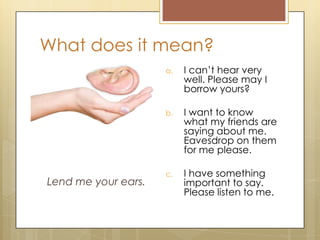
What does it mean?
Lend me your ears.
a. I can’t hear very
well. Please may I
borrow yours?
b. I want to know
what my friends are
saying about me.
Eavesdrop on them
for me please.
c. I have something
important to say.
Please listen to me.
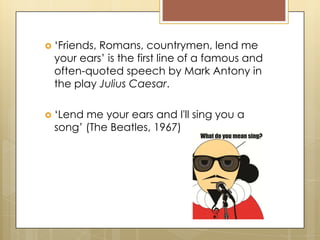
 ‘Friends, Romans, countrymen, lend me
your ears’ is the first line of a famous and
often-quoted speech by Mark Antony in
the play Julius Caesar.
 ‘Lend me your ears and I'll sing you a
song’ (The Beatles, 1967)
How difficult is Shakespeare’s language?
a. Very difficult
b. Quite difficult
c. Quite easy
d. Very easy
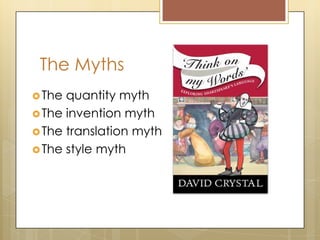
The Myths
The quantity myth
The invention myth
The translation myth
The style myth
The quantity myth
 End of 16th
century: 150,000
 21st century: 600,00
 Fluent speaker:
50,000
 Shakespeare’s
vocabulary: 20,000
‘It is not as much the
number of words we
have as what we do
with those words that
makes the difference
between an ordinary
and a brilliant use of
language.’ (p.3)
The invention myth
 First recorded user in
the OED
 2,200 words first
recorded in
Shakespeare
 1,700 plausible
Shakespearean
inventions
 About half of them
stayed in the
language
 anthropophagy,
assassination,
insultment, outswear
 ear, eye, lip, mouth,
scandal, word
 uncomfortable,
uncompassionate,
uneducated,
unaware, undo (314)
The translation myth
 10% of Shakespeare's grammar is likely to
cause a comprehension problem
 95% of Shakespeare’s vocabulary are
words we know and use every day
 only 5% of all different words in all
Shakespeare’s plays will give you a hard
time
The style myth
 Vocabulary, sentence length, structure,
word-order, sounds, interaction between
speakers
 Characters' styles: groups or individuals
 Genres: tragedies, comedies, history plays
 Early and later plays
 Language choices between alternatives
in particular lines
The big question
If quantity, unusual
words and ‘style’ are
not the major
problems, why do so
many people find it
difficult to
understand
Shakespeare?
‘A distinction has to
be drawn, first of all
between difficulty
of language, and
difficulty of
thought.’ (p.11)
Lend him your ears
 ‘To be or not to be,
that is the question’.
 ‘Tomorrow, and
tomorrow, and
tomorrow.’
 Simple language
can sometimes
express a complex
though.
 ‘a lily-livered, action-
taking, whoreson,
glass-gazing, super-
serviceable, finical
rogue’
 Complex language
can sometimes
express a simple
thought.
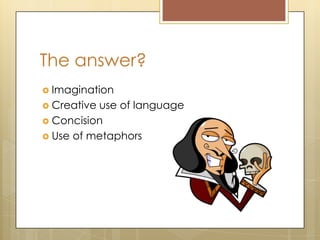
The answer?
 Imagination
 Creative use of language
 Concision
 Use of metaphors
The Merchant of Venice
The Tempest
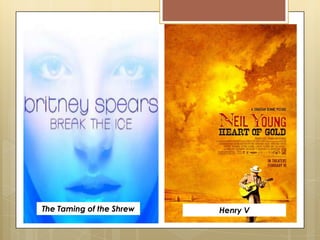
The Taming of the Shrew Henry V
The Tempest
Hamlet
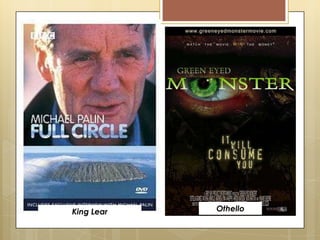
King Lear Othello
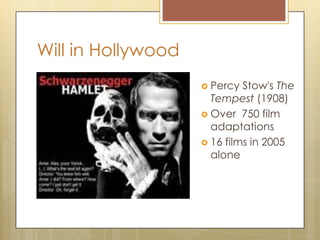
Will in Hollywood
 Percy Stow's The
Tempest (1908)
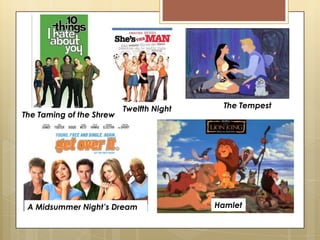
 Over 750 film
adaptations
 16 films in 2005
alone
The Taming of the Shrew
Twelfth Night
Hamlet
The Tempest
A Midsummer Night’s Dream
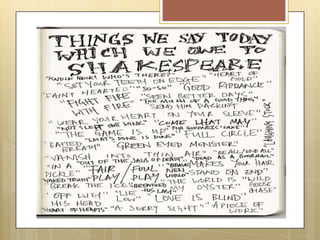
Everywhere!
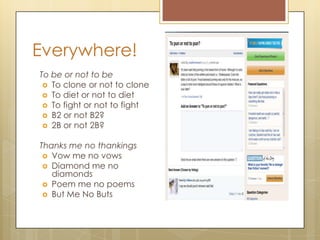
To be or not to be
 To clone or not to clone
 To diet or not to diet
 To fight or not to fight
 B2 or not B2?
 2B or not 2B?
Thanks me no thankings
 Vow me no vows
 Diamond me no
diamonds
 Poem me no poems
 But Me No Buts
What does it mean for us?
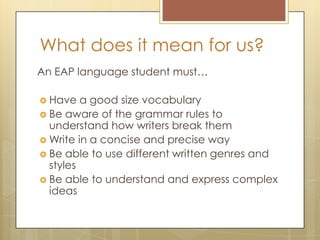
An EAP language student must…
 Have a good size vocabulary
 Be aware of the grammar rules to
understand how writers break them
 Write in a concise and precise way
 Be able to use different written genres and
styles
 Be able to understand and express complex
ideas
‘A study of [Shakespeare’s] linguistic
techniques, in such areas as functional shift,
affixation, idiomatic allusiveness and
collocation, can add to our awareness of the
language’s expressive potential and increase
our confidence as users. At the same time, of
course, the more we study Shakespeare from
a linguistic point of view, the more we will
increase our understanding and enjoyment
of the plays as literature and theatre.’
(Crystal, 2003)
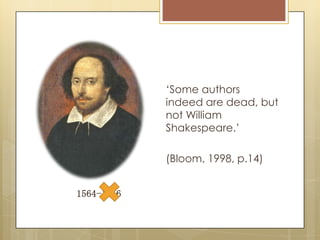
1564-1616
‘Some authors
indeed are dead, but
not William
Shakespeare.’
(Bloom, 1998, p.14)
Bibliography
Braunmuller, A. R., and Michael Hattaway, eds., The Cambridge Companion to English Renaissance Drama (Cambridge:
Cambridge University Press, 2003)
Briggs, Julia, This Stage-Play World: Texts and Contexts, 1580-1625 (Oxford: Oxford Paperbacks, 1997)
Bloom, Harold, Shakespeare. The Invention of the Human. (New York, NY: Riverhead Books, 1998)
Chernaik, Warren, The Cambridge Introduction to Shakespeare’s History Plays. (Cambridge: Cambridge University Press,
2007)
Crystal, Ben, Shakespeare on Toast: Getting a Taste for the Bard (London: Icon Books, 2009)
Crystal, David, and Ben Crystal, Shakespeare’s Words: A Glossary and Language Companion
(London: Penguin, 2004)
Crystal, David, Think of My Words: Exploring Shakespeare’s Language (Cambridge:
Cambridge University Press, 2008)
Grazia, Margreta de, and Stanley Wells, eds., The Cambridge Companion to Shakespeare (Cambridge: Cambridge
University Press, 2001)
Greenblatt, Stephen, Renaissance Self-fashioning: From More to Shakespeare (Chicago,Il: University of Chicago Press,
2005)
Greenblatt, Stephen, Will In The World: How Shakespeare Became Shakespeare (London: Pimlico, 2005)
Hattaway, Michael, ed., The Cambridge Companion to Shakespeare’s History Plays (Cambridge: Cambridge University
Press, 2002)
Jackson, Russell, ed., The Cambridge Companion to Shakespeare on Film (Cambridge: Cambridge University Press, 2007)
Leggatt, Alexander, ed., The Cambridge Companion to Shakespearean Comedy (Cambridge University Press, 2001)
Shaughnessy, Robert, ed., The Cambridge Companion to Shakespeare and Popular Culture (Cambridge: Cambridge
University Press, 2007)
Wells, Stanley, ed., The Cambridge Companion to Shakespeare Studies (Cambridge University Press, 1986)
Wells, Stanley, and Sarah Stanton, eds., The Cambridge Companion to Shakespeare on Stage (Cambridge: Cambridge
University Press, 2002)
Thank you
cl203@leicester.ac.uk

Lend me your ears’

  • 1.
    ‘Lend me your ears’ Shakespeare& the English language Chris Lima April 2013
  • 2.
    Overview  Myths aboutShakespeare’s language  Everyday Shakespeare  Implications of language teaching and learning  Questions
  • 3.
    What does itmean? Lend me your ears. a. I can’t hear very well. Please may I borrow yours? b. I want to know what my friends are saying about me. Eavesdrop on them for me please. c. I have something important to say. Please listen to me.
  • 4.
     ‘Friends, Romans,countrymen, lend me your ears’ is the first line of a famous and often-quoted speech by Mark Antony in the play Julius Caesar.  ‘Lend me your ears and I'll sing you a song’ (The Beatles, 1967)
  • 5.
    How difficult isShakespeare’s language? a. Very difficult b. Quite difficult c. Quite easy d. Very easy
  • 6.
    The Myths The quantitymyth The invention myth The translation myth The style myth
  • 7.
    The quantity myth End of 16th century: 150,000  21st century: 600,00  Fluent speaker: 50,000  Shakespeare’s vocabulary: 20,000 ‘It is not as much the number of words we have as what we do with those words that makes the difference between an ordinary and a brilliant use of language.’ (p.3)
  • 8.
    The invention myth First recorded user in the OED  2,200 words first recorded in Shakespeare  1,700 plausible Shakespearean inventions  About half of them stayed in the language  anthropophagy, assassination, insultment, outswear  ear, eye, lip, mouth, scandal, word  uncomfortable, uncompassionate, uneducated, unaware, undo (314)
  • 9.
    The translation myth 10% of Shakespeare's grammar is likely to cause a comprehension problem  95% of Shakespeare’s vocabulary are words we know and use every day  only 5% of all different words in all Shakespeare’s plays will give you a hard time
  • 10.
    The style myth Vocabulary, sentence length, structure, word-order, sounds, interaction between speakers  Characters' styles: groups or individuals  Genres: tragedies, comedies, history plays  Early and later plays  Language choices between alternatives in particular lines
  • 11.
    The big question Ifquantity, unusual words and ‘style’ are not the major problems, why do so many people find it difficult to understand Shakespeare? ‘A distinction has to be drawn, first of all between difficulty of language, and difficulty of thought.’ (p.11)
  • 12.
    Lend him yourears  ‘To be or not to be, that is the question’.  ‘Tomorrow, and tomorrow, and tomorrow.’  Simple language can sometimes express a complex though.  ‘a lily-livered, action- taking, whoreson, glass-gazing, super- serviceable, finical rogue’  Complex language can sometimes express a simple thought.
  • 13.
    The answer?  Imagination Creative use of language  Concision  Use of metaphors
  • 14.
    The Merchant ofVenice The Tempest
  • 15.
    The Taming ofthe Shrew Henry V
  • 16.
  • 17.
  • 18.
    Will in Hollywood Percy Stow's The Tempest (1908)  Over 750 film adaptations  16 films in 2005 alone
  • 19.
    The Taming ofthe Shrew Twelfth Night Hamlet The Tempest A Midsummer Night’s Dream
  • 20.
    Everywhere! To be ornot to be  To clone or not to clone  To diet or not to diet  To fight or not to fight  B2 or not B2?  2B or not 2B? Thanks me no thankings  Vow me no vows  Diamond me no diamonds  Poem me no poems  But Me No Buts
  • 22.
    What does itmean for us? An EAP language student must…  Have a good size vocabulary  Be aware of the grammar rules to understand how writers break them  Write in a concise and precise way  Be able to use different written genres and styles  Be able to understand and express complex ideas
  • 23.
    ‘A study of[Shakespeare’s] linguistic techniques, in such areas as functional shift, affixation, idiomatic allusiveness and collocation, can add to our awareness of the language’s expressive potential and increase our confidence as users. At the same time, of course, the more we study Shakespeare from a linguistic point of view, the more we will increase our understanding and enjoyment of the plays as literature and theatre.’ (Crystal, 2003)
  • 26.
    1564-1616 ‘Some authors indeed aredead, but not William Shakespeare.’ (Bloom, 1998, p.14)
  • 28.
    Bibliography Braunmuller, A. R.,and Michael Hattaway, eds., The Cambridge Companion to English Renaissance Drama (Cambridge: Cambridge University Press, 2003) Briggs, Julia, This Stage-Play World: Texts and Contexts, 1580-1625 (Oxford: Oxford Paperbacks, 1997) Bloom, Harold, Shakespeare. The Invention of the Human. (New York, NY: Riverhead Books, 1998) Chernaik, Warren, The Cambridge Introduction to Shakespeare’s History Plays. (Cambridge: Cambridge University Press, 2007) Crystal, Ben, Shakespeare on Toast: Getting a Taste for the Bard (London: Icon Books, 2009) Crystal, David, and Ben Crystal, Shakespeare’s Words: A Glossary and Language Companion (London: Penguin, 2004) Crystal, David, Think of My Words: Exploring Shakespeare’s Language (Cambridge: Cambridge University Press, 2008) Grazia, Margreta de, and Stanley Wells, eds., The Cambridge Companion to Shakespeare (Cambridge: Cambridge University Press, 2001) Greenblatt, Stephen, Renaissance Self-fashioning: From More to Shakespeare (Chicago,Il: University of Chicago Press, 2005) Greenblatt, Stephen, Will In The World: How Shakespeare Became Shakespeare (London: Pimlico, 2005) Hattaway, Michael, ed., The Cambridge Companion to Shakespeare’s History Plays (Cambridge: Cambridge University Press, 2002) Jackson, Russell, ed., The Cambridge Companion to Shakespeare on Film (Cambridge: Cambridge University Press, 2007) Leggatt, Alexander, ed., The Cambridge Companion to Shakespearean Comedy (Cambridge University Press, 2001) Shaughnessy, Robert, ed., The Cambridge Companion to Shakespeare and Popular Culture (Cambridge: Cambridge University Press, 2007) Wells, Stanley, ed., The Cambridge Companion to Shakespeare Studies (Cambridge University Press, 1986) Wells, Stanley, and Sarah Stanton, eds., The Cambridge Companion to Shakespeare on Stage (Cambridge: Cambridge University Press, 2002)
  • 29.

Editor's Notes

  • #9 No other writer has come anywhere near!
  • #17 There is nothing either good or bad, but only thinking makes it so.
  • #21 RJ
  • #23 A poet must master the rules of English grammar before he attempts to bend or break them.’ (Robert Graves)