Online Algorithms
• Classic model of algorithms
– We get to see the entire input, then compute some
function of it
– In this context, “offline algorithm”
• Online Algorithms
– We get to see the input one piece at a time, and need
to make irrevocable decisions along the way
– Similar to the data stream model
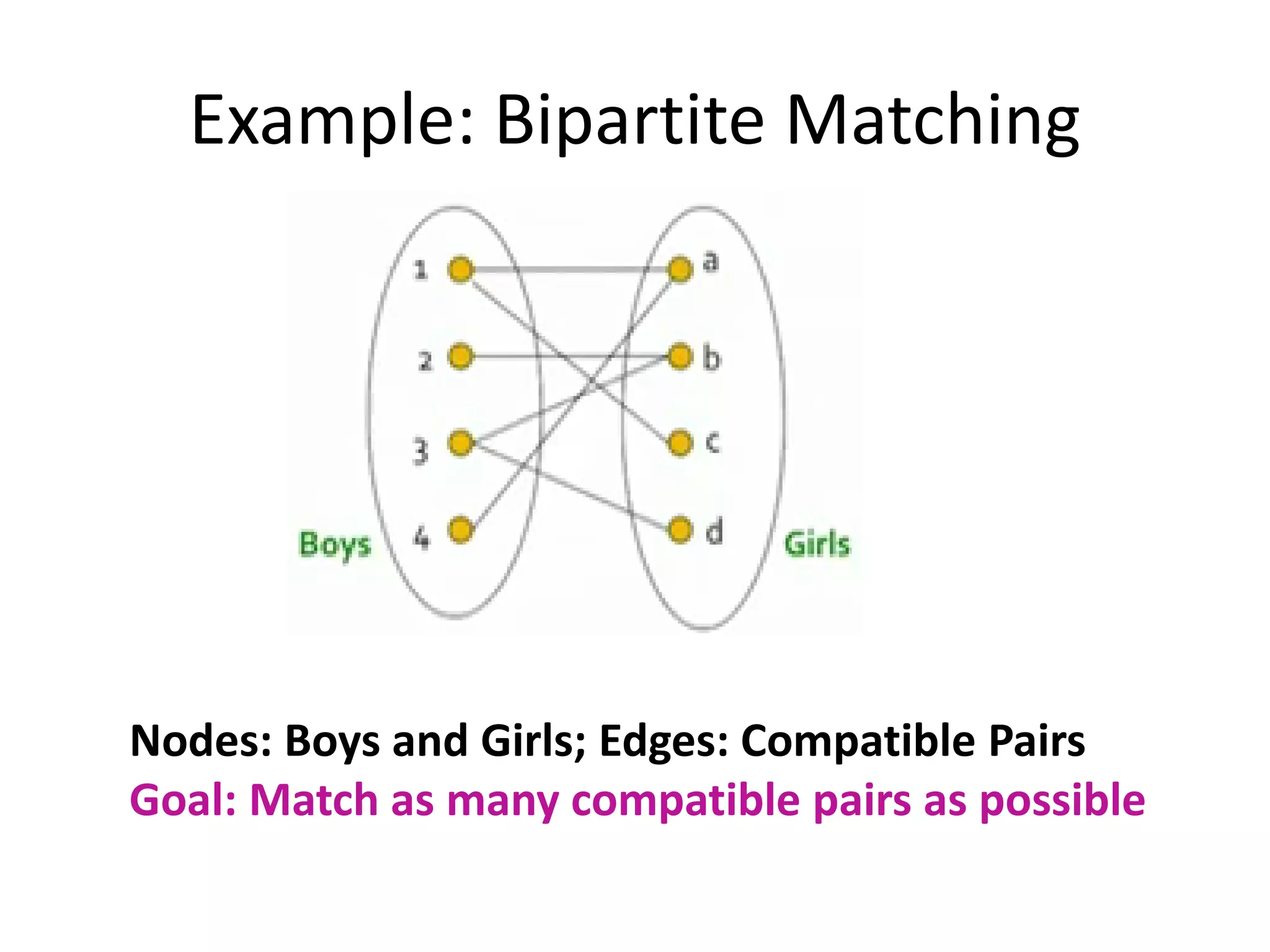
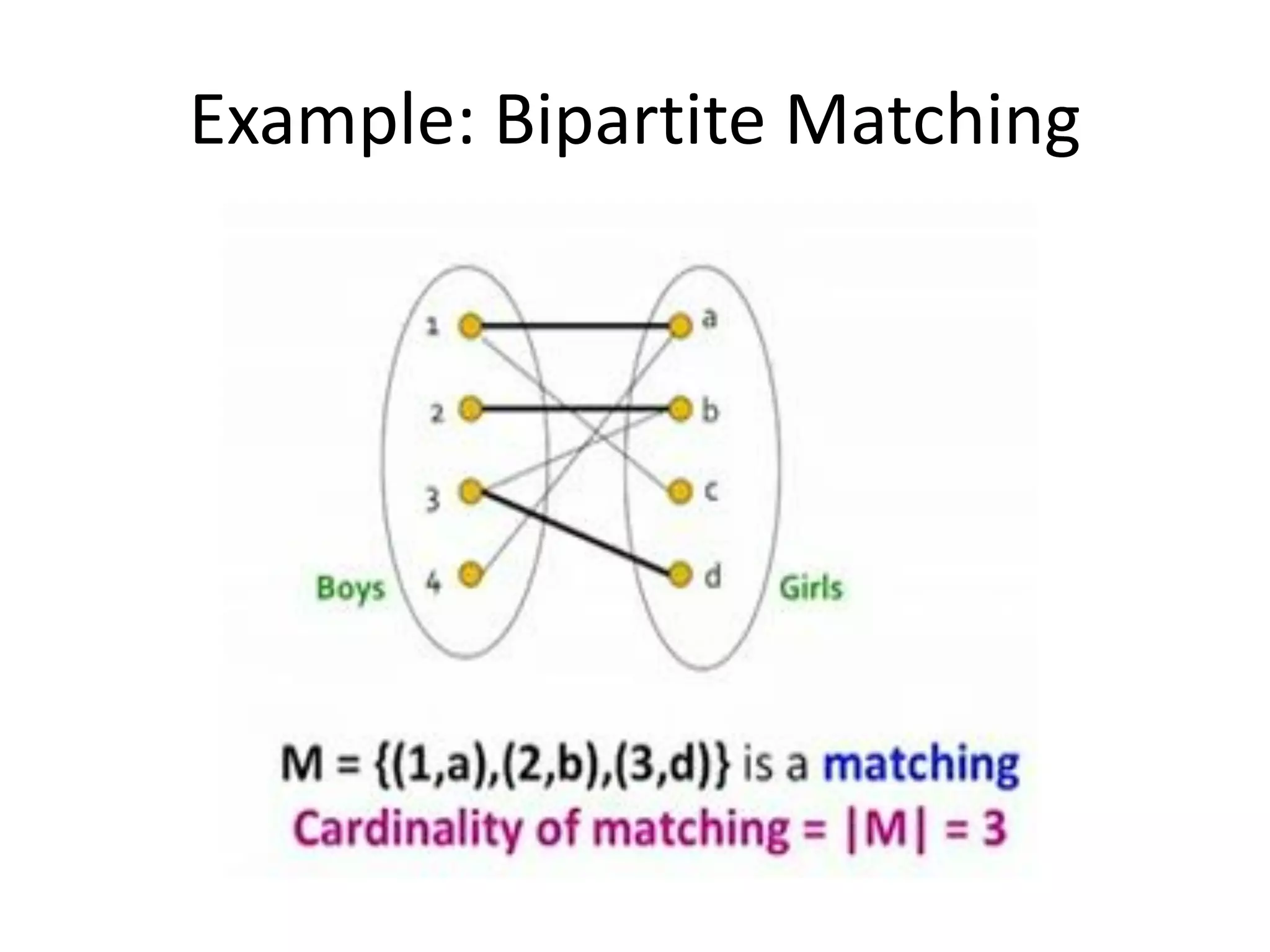
Example: Bipartite Matching
Nodes: Boys and Girls; Edges: Compatible Pairs
Goal: Match as many compatible pairs as possible
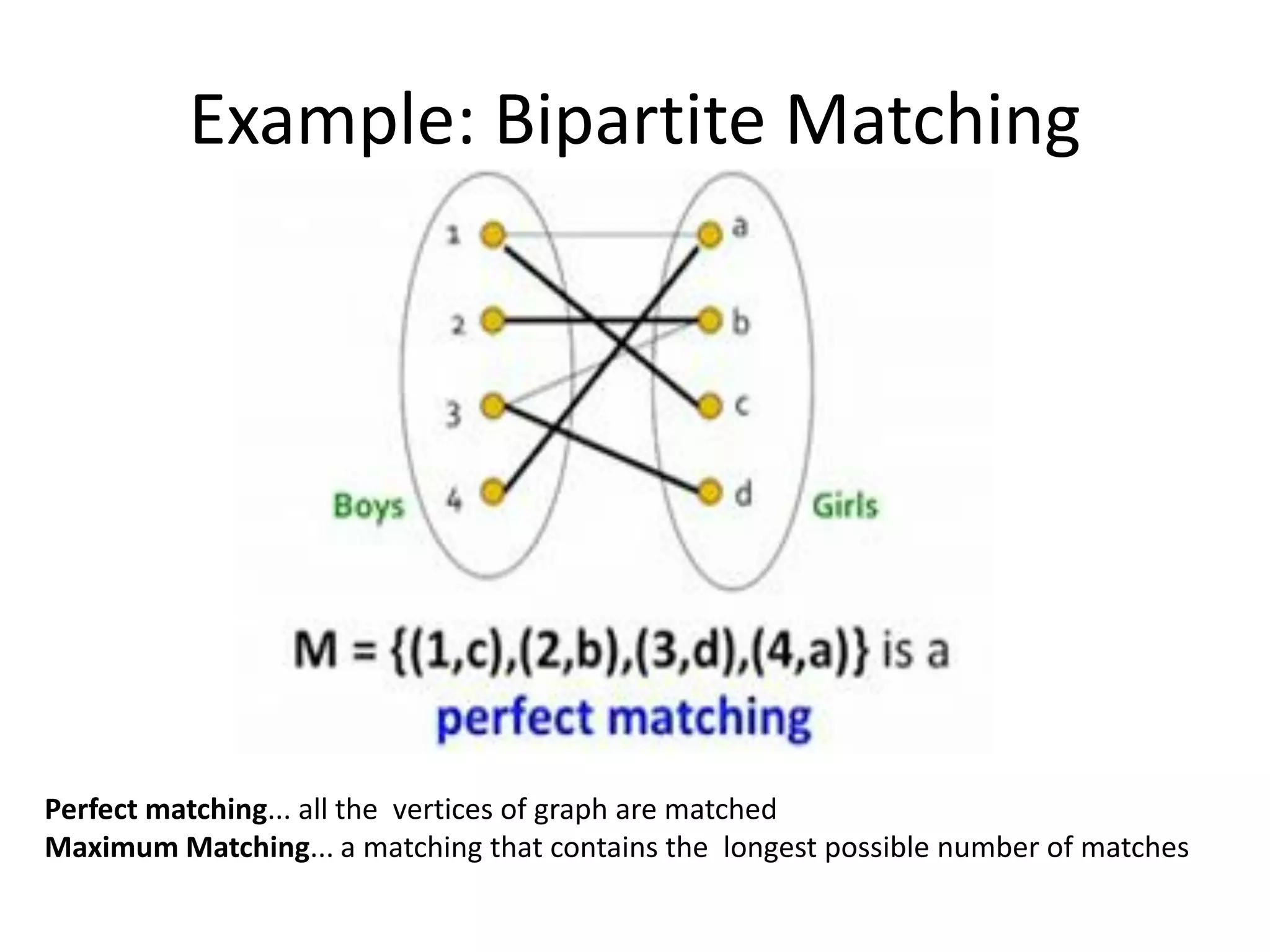
Example: Bipartite Matching
Perfect matching... all the vertices of graph are matched
Maximum Matching... a matching that contains the longest possible number of matches
Matching Algorithm
• Problem: Find a maximum matching for a
given bipartite graph
– A perfect one if it exists
• There is a polynomial – time offline algorithm
based on augmenting path (Hopcroft & Karp
1973)
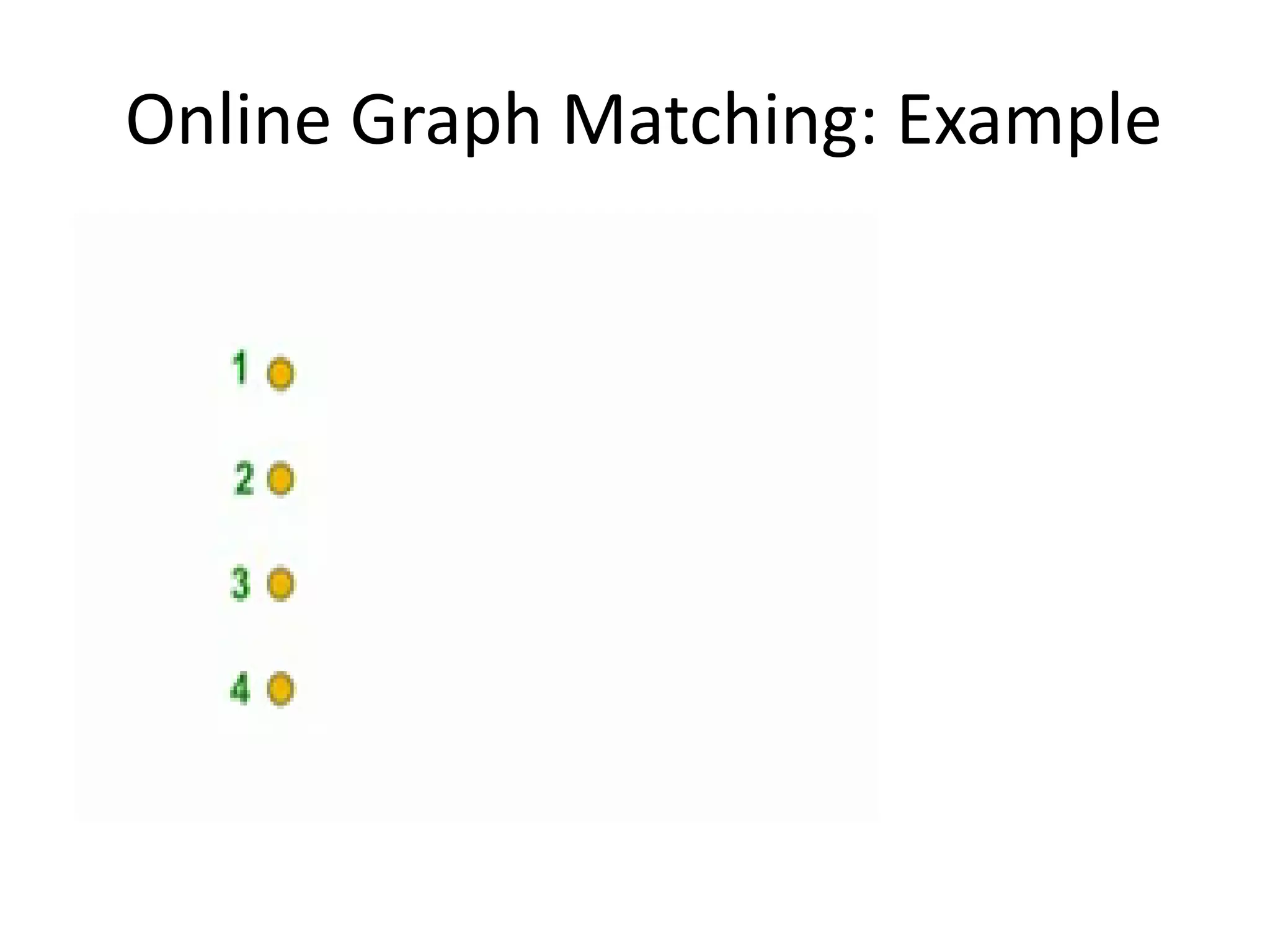
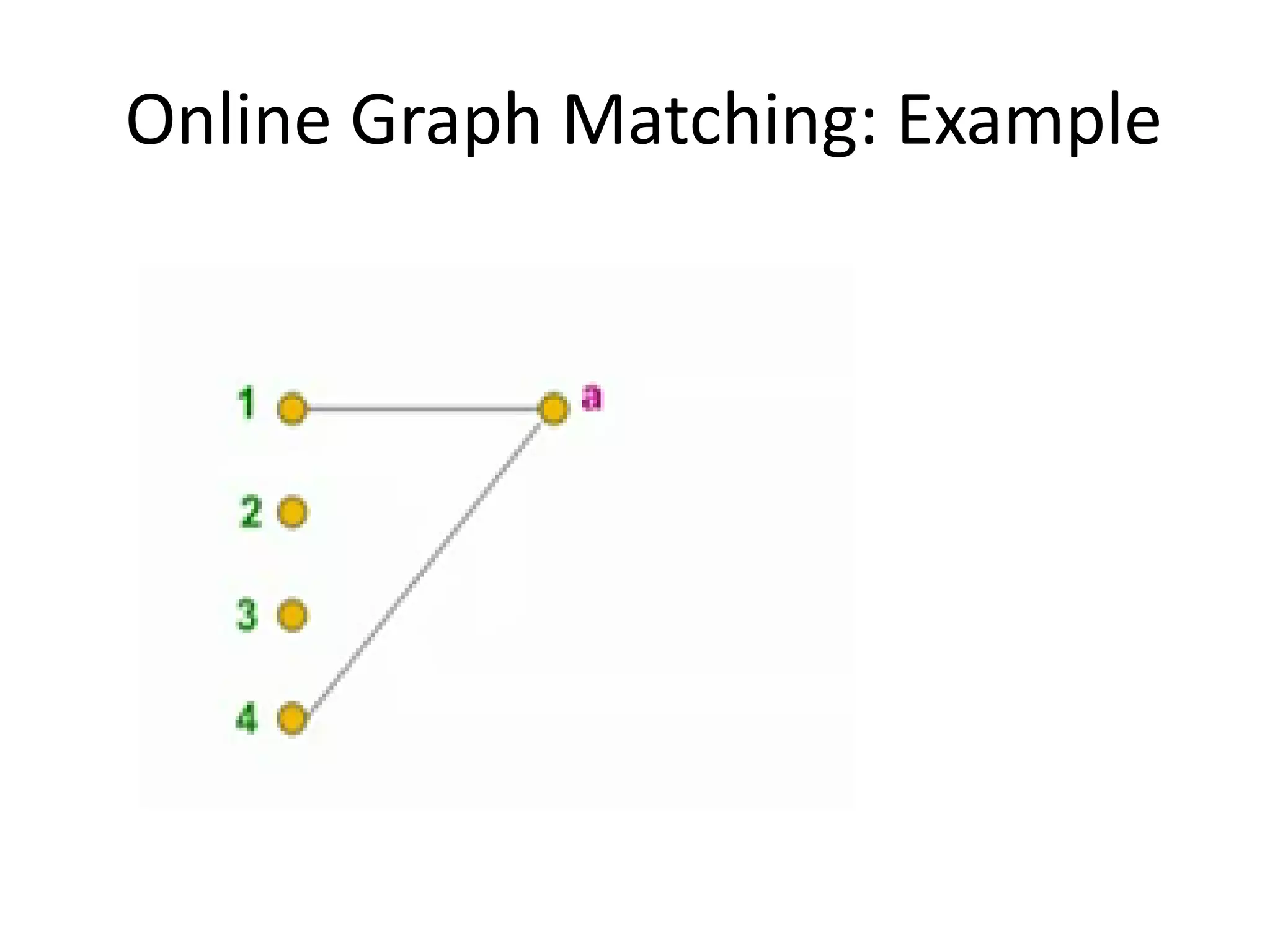
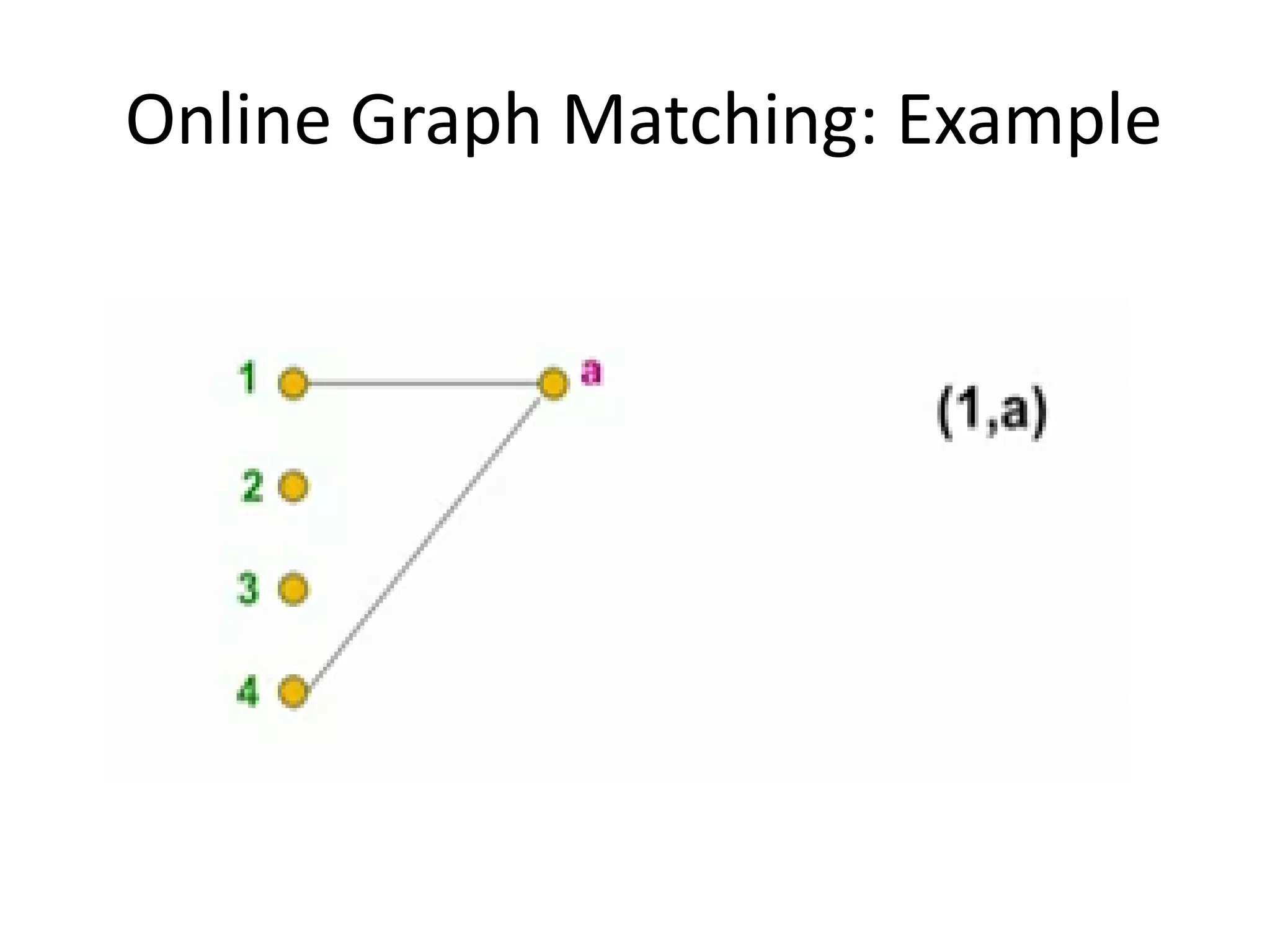
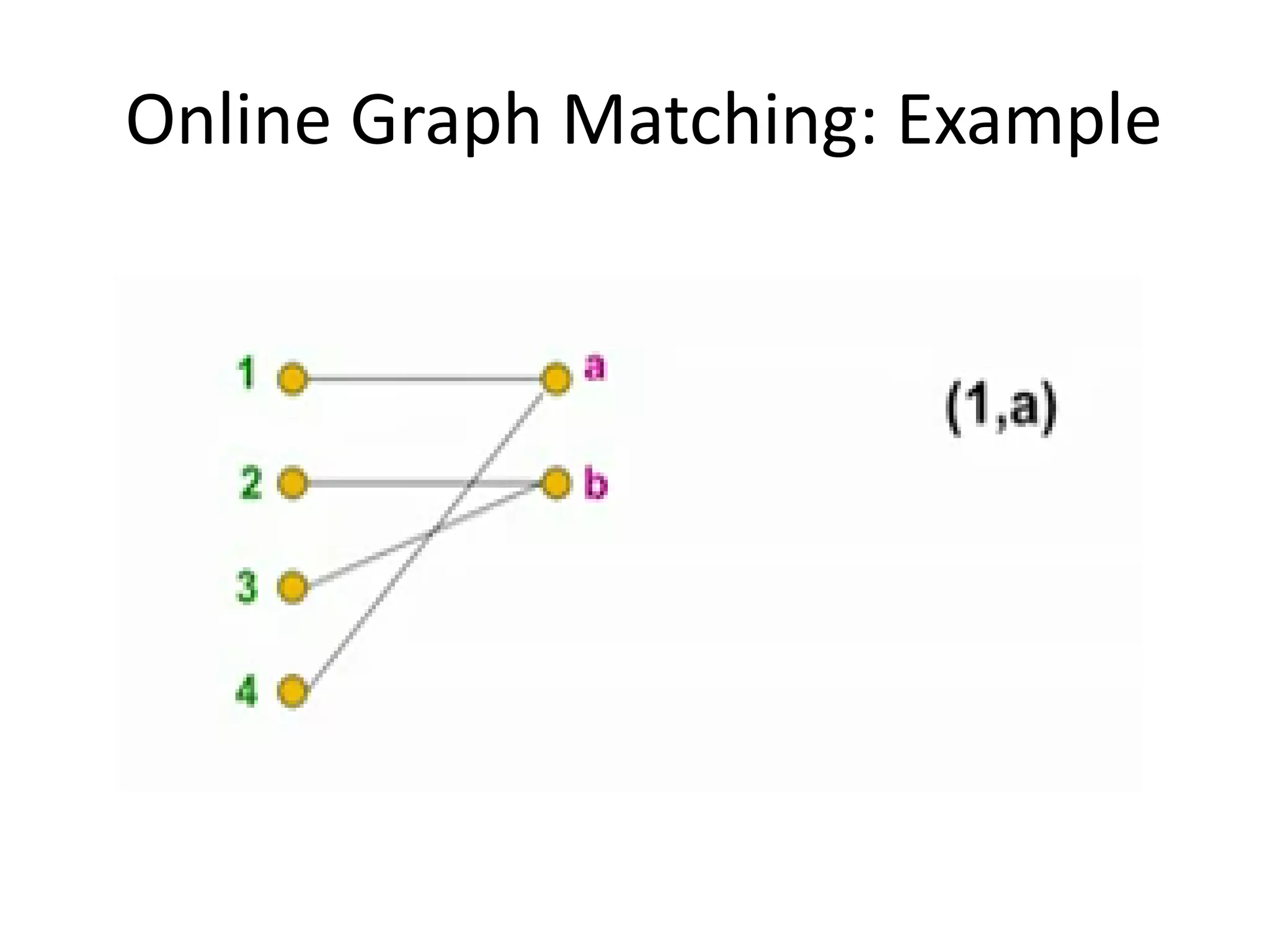
Online Graph Matching Problem
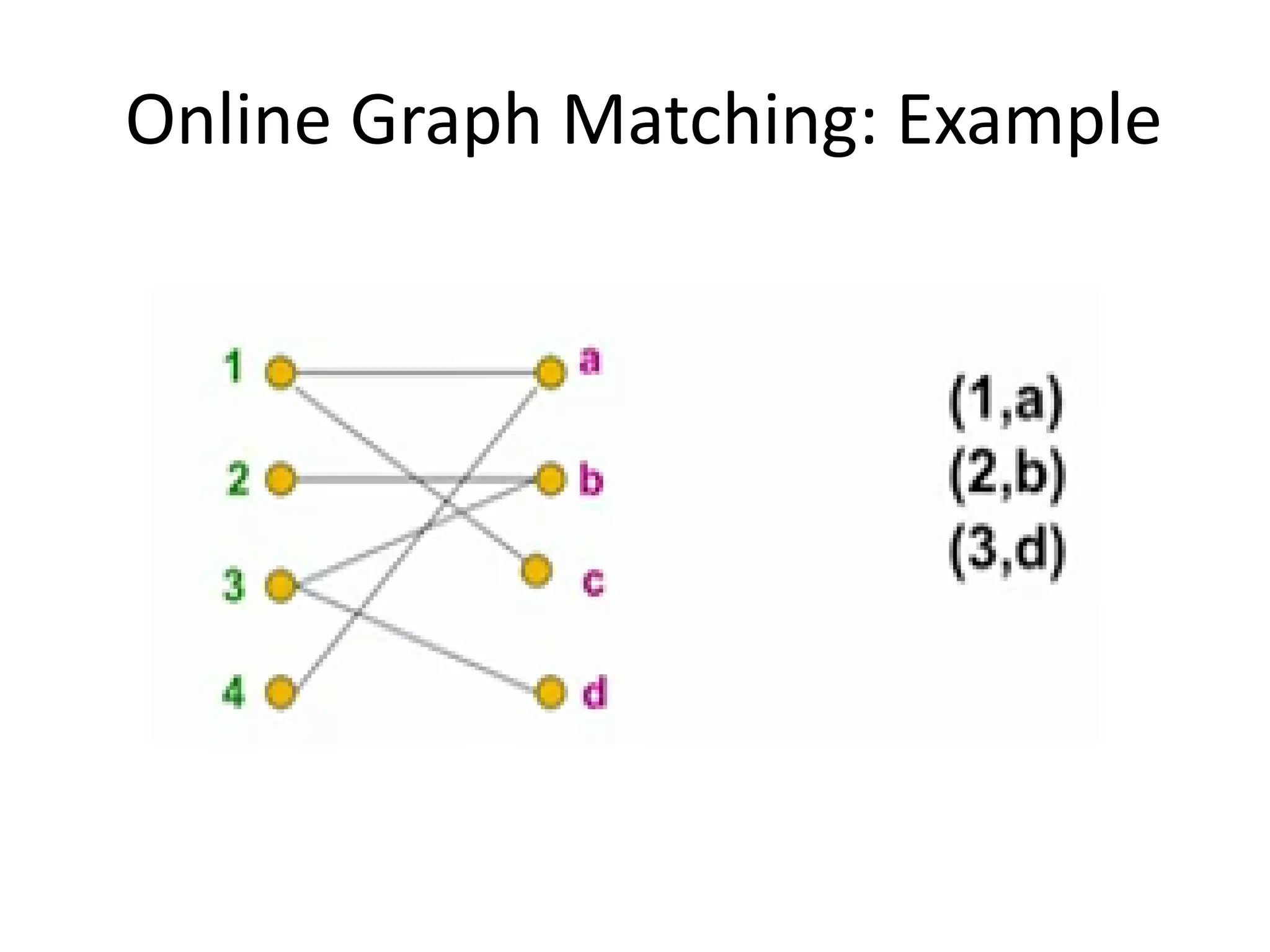
• Initially, we are given the sets boys and girls
• In each round, one girl’s choice are revealed
– That is, girl’s edges are revealed
• At that time, we have to decide either:
– Pair the girl with a boy
– Do not pair the girl with any boy
• Example of application:
Assigning tasks to servers
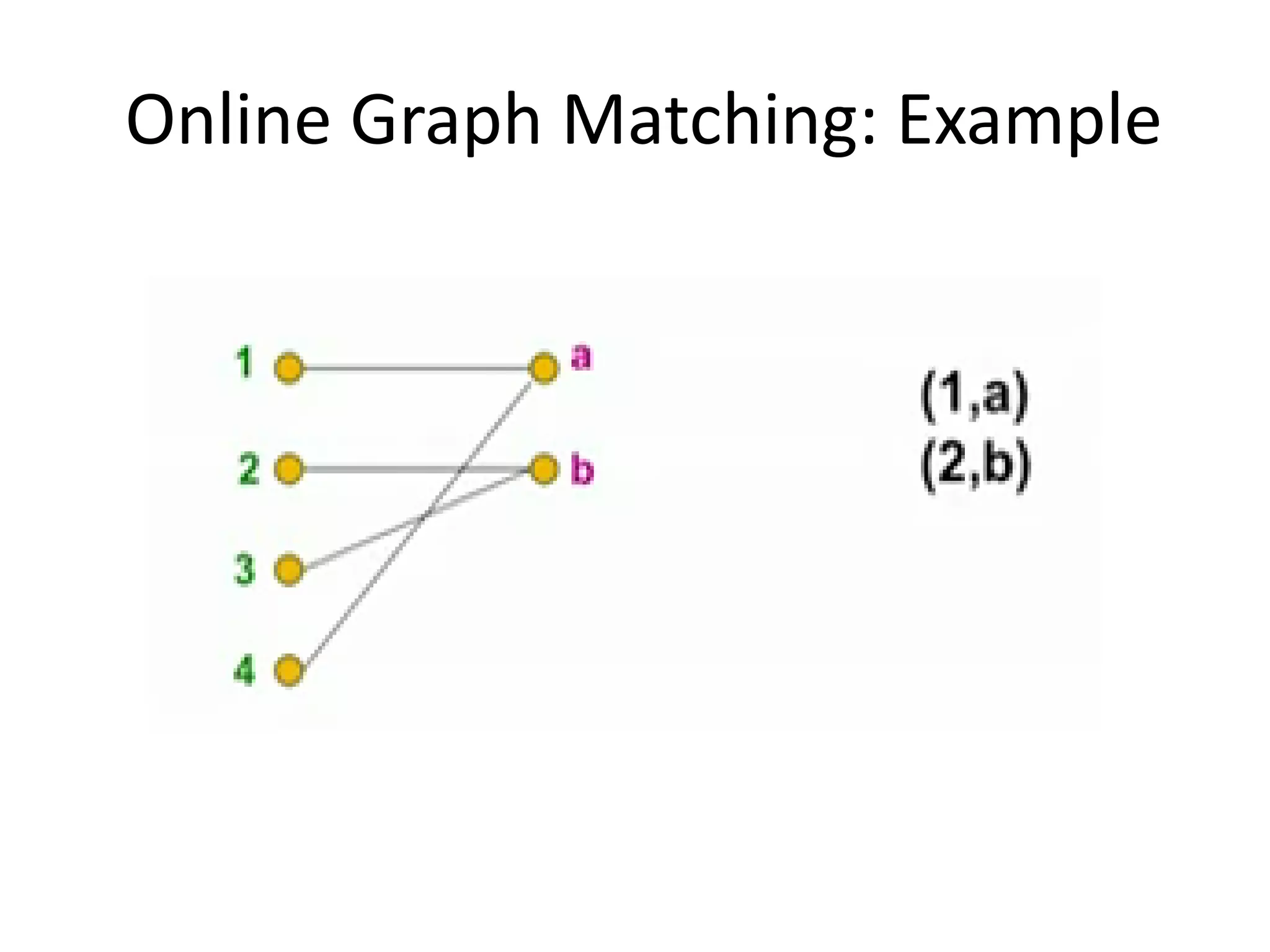
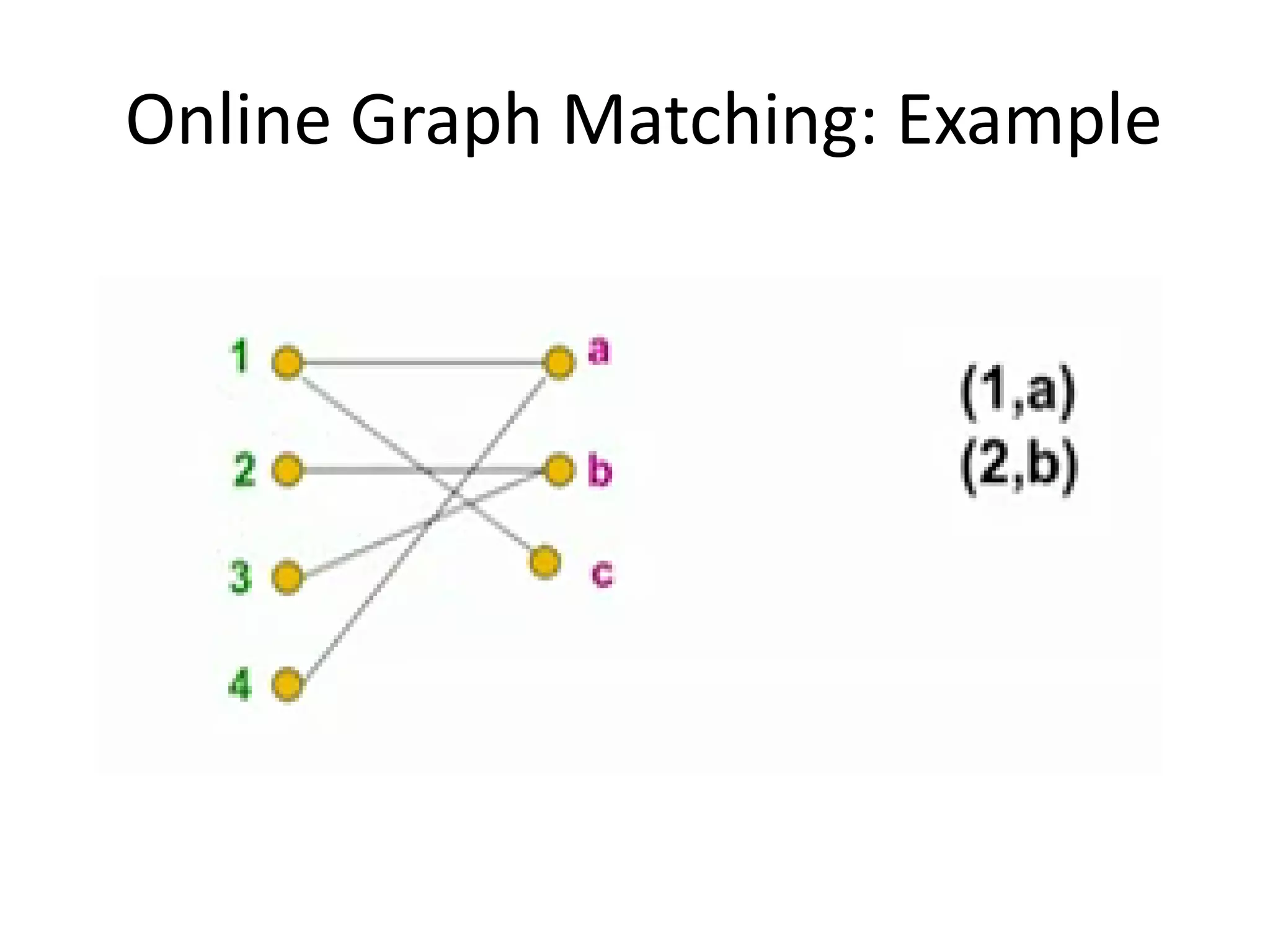
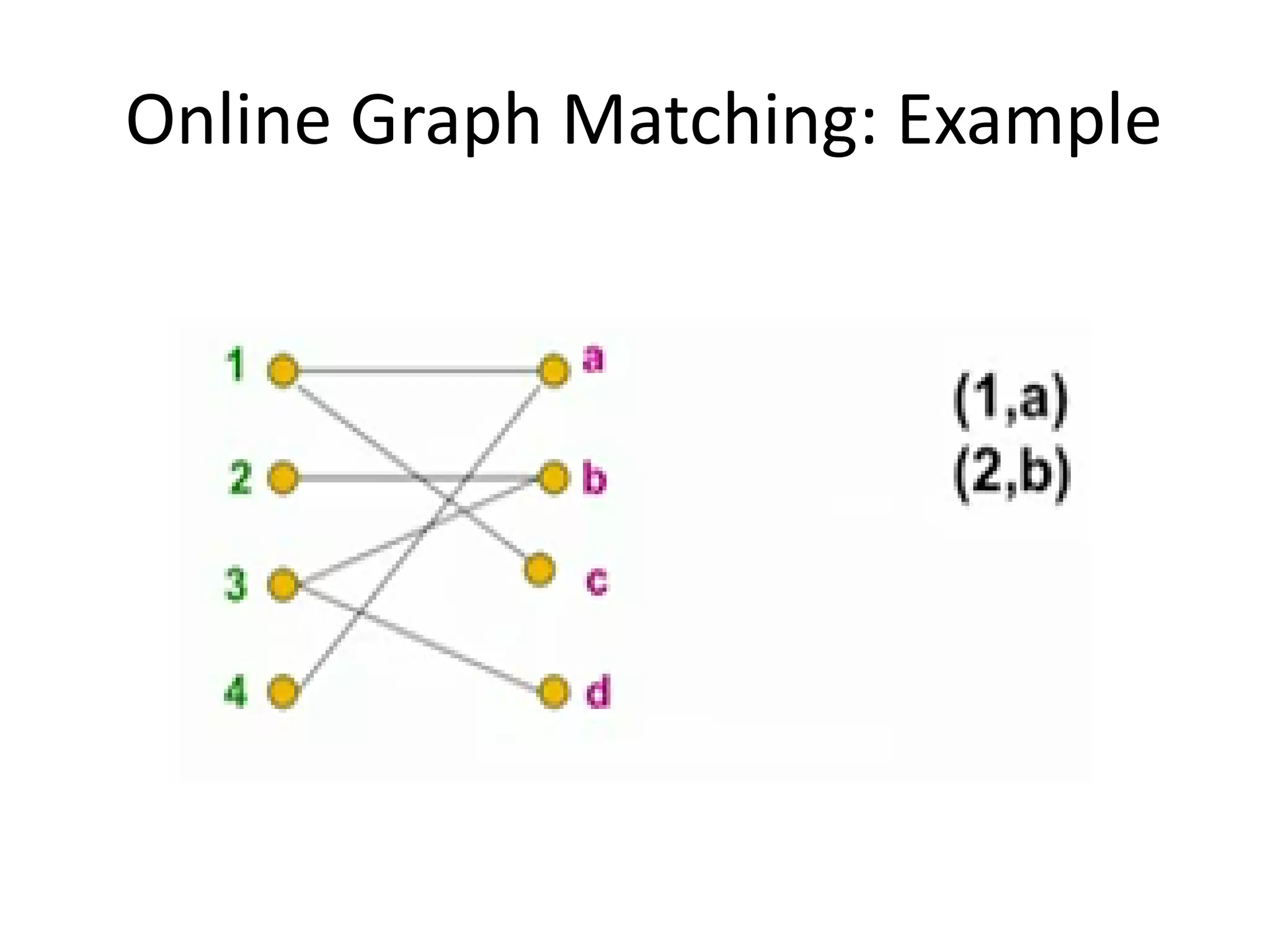
Online Graph Matching: Example
Greedy Algorithm
• Greedy algorithm for the online graph
matching problem:
– Pair the new girl with any eligible boy
• If there is none, do not pair girl
• How good is the algorithm?
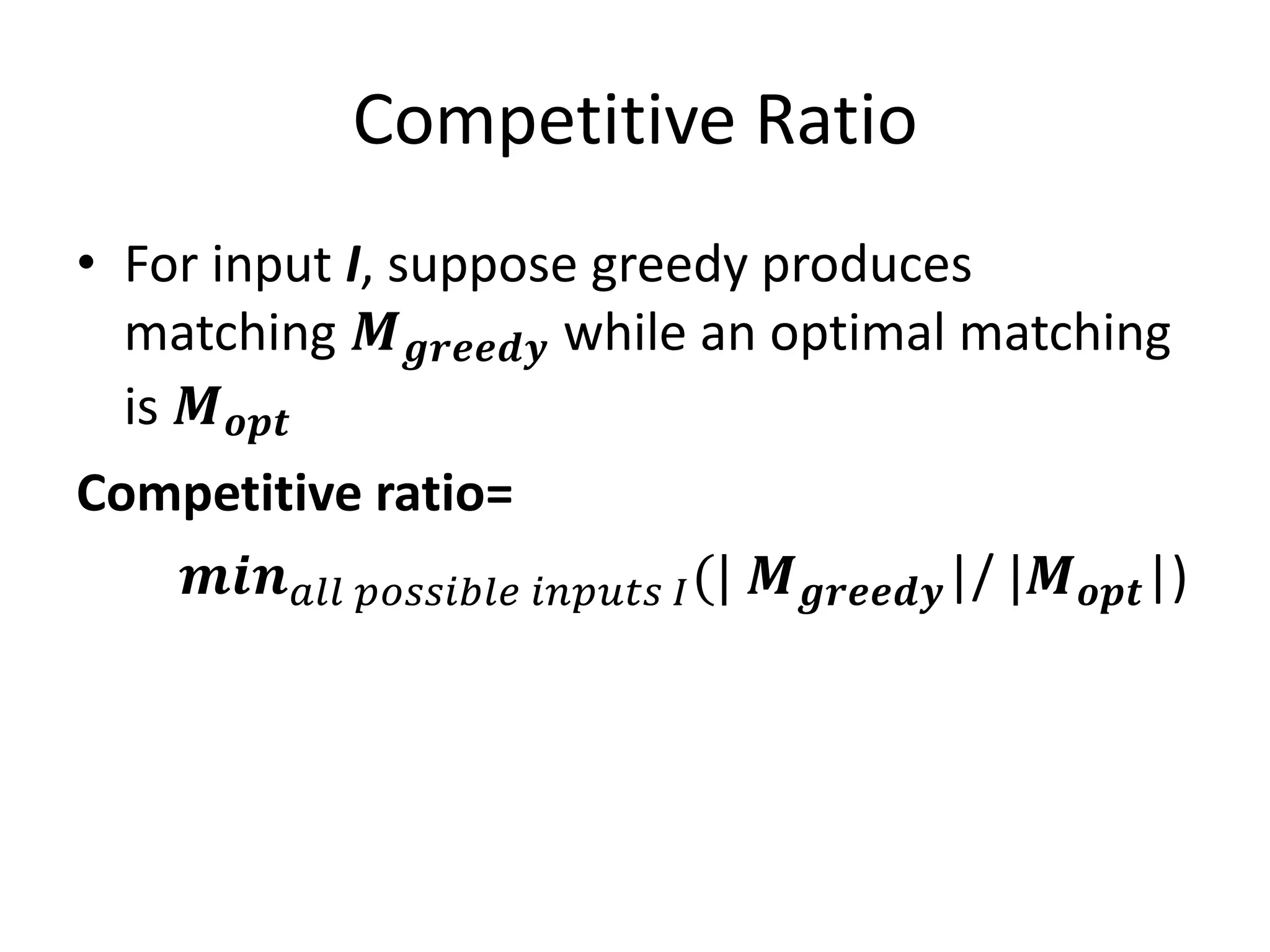
Competitive Ratio
• For input I, suppose greedy produces
matching 𝑴 𝒈𝒓𝒆𝒆𝒅𝒚 while an optimal matching
is 𝑴 𝒐𝒑𝒕
Competitive ratio=
𝒎𝒊𝒏 𝑎𝑙𝑙 𝑝𝑜𝑠𝑠𝑖𝑏𝑙𝑒 𝑖𝑛𝑝𝑢𝑡𝑠 𝐼(| 𝑴 𝒈𝒓𝒆𝒆𝒅𝒚|/ |𝑴 𝒐𝒑𝒕|)
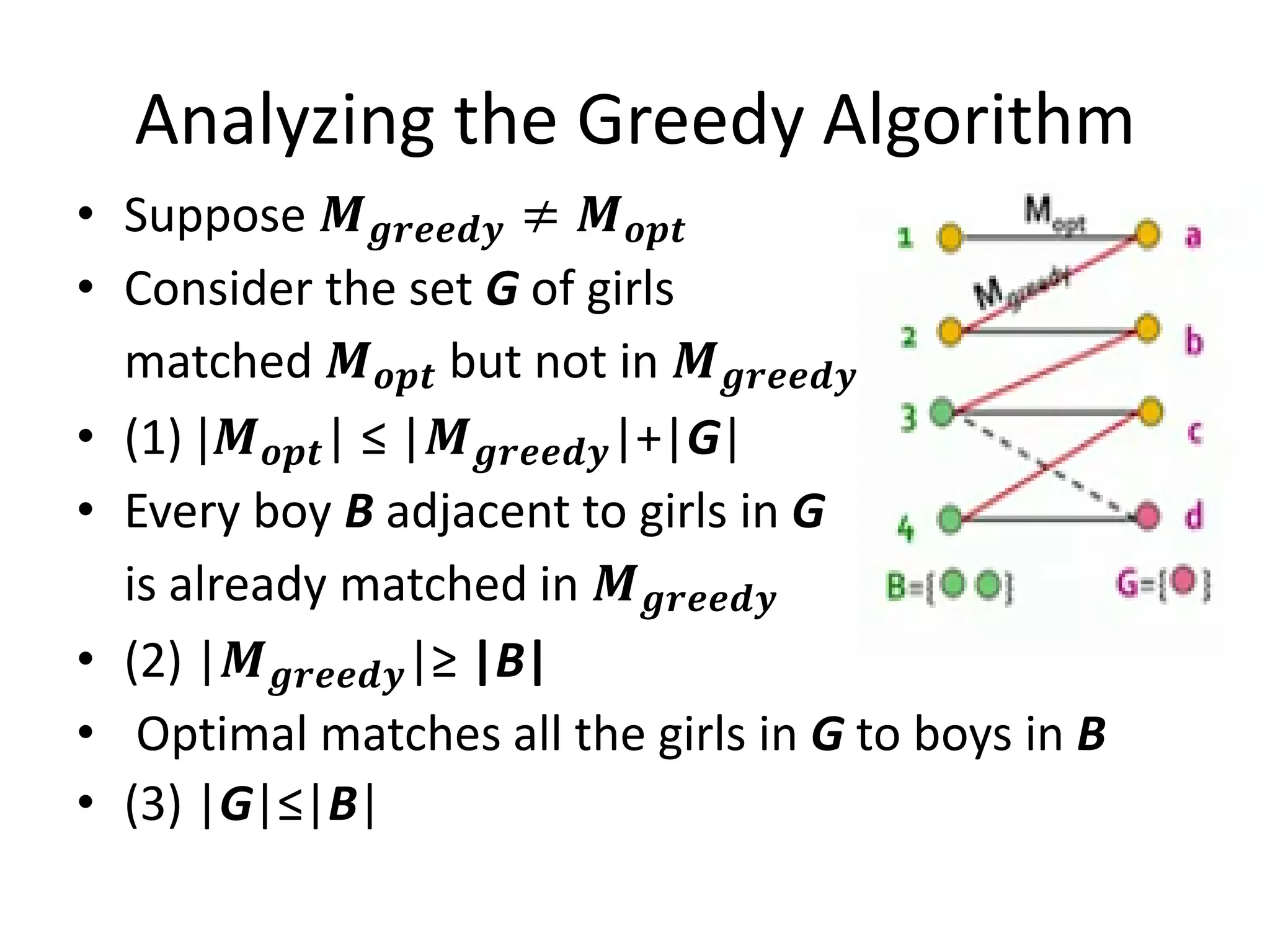
Analyzing the Greedy Algorithm
• Suppose 𝑴 𝒈𝒓𝒆𝒆𝒅𝒚 ≠ 𝑴 𝒐𝒑𝒕
• Consider the set G of girls
matched 𝑴 𝒐𝒑𝒕 but not in 𝑴 𝒈𝒓𝒆𝒆𝒅𝒚
• (1) |𝑴 𝒐𝒑𝒕| ≤ |𝑴 𝒈𝒓𝒆𝒆𝒅𝒚|+|G|
• Every boy B adjacent to girls in G
is already matched in 𝑴 𝒈𝒓𝒆𝒆𝒅𝒚
• (2) |𝑴 𝒈𝒓𝒆𝒆𝒅𝒚|≥ |B|
• Optimal matches all the girls in G to boys in B
• (3) |G|≤|B|
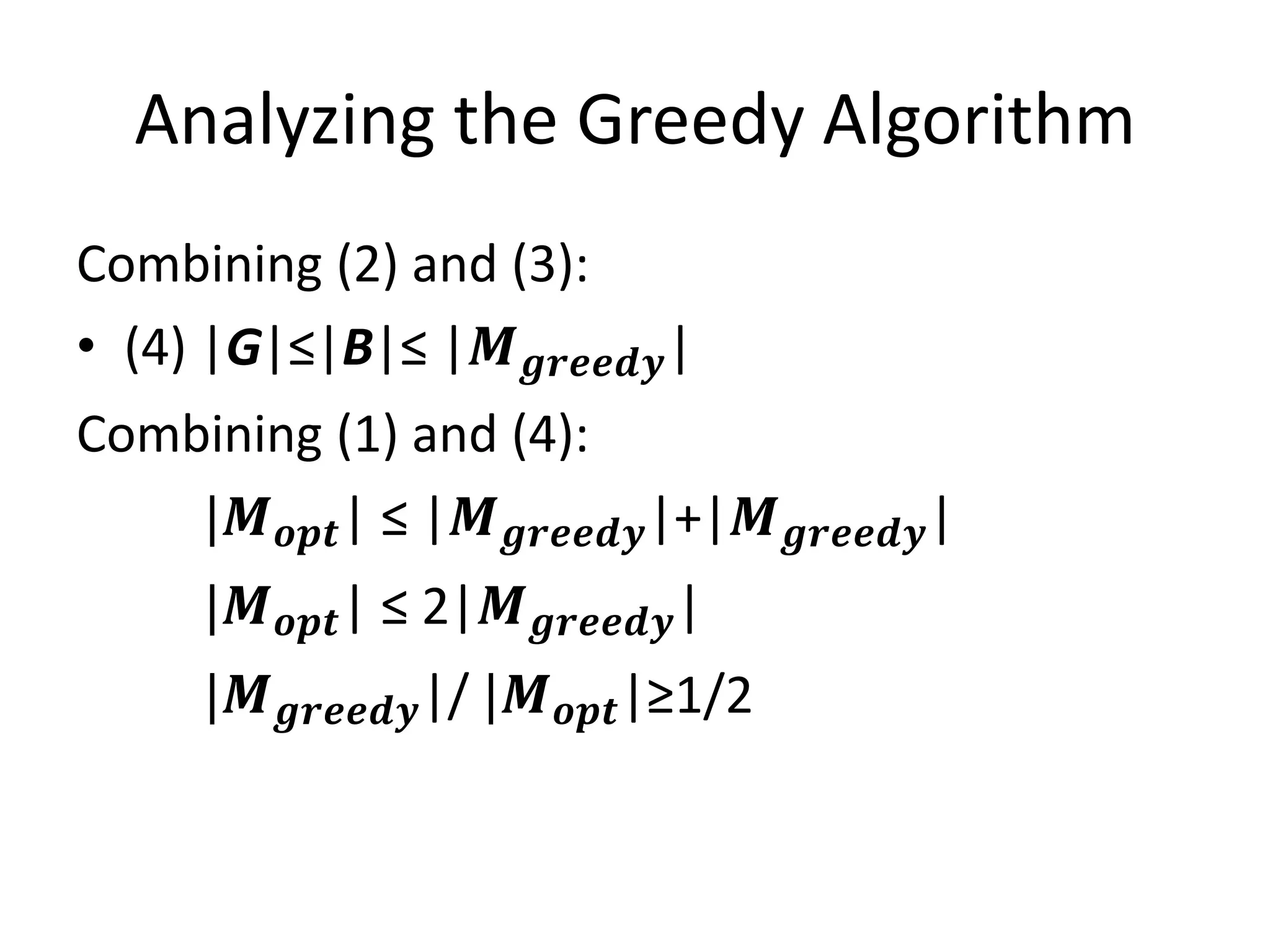
Analyzing the Greedy Algorithm
Combining (2) and (3):
• (4) |G|≤|B|≤ |𝑴 𝒈𝒓𝒆𝒆𝒅𝒚|
Combining (1) and (4):
|𝑴 𝒐𝒑𝒕| ≤ |𝑴 𝒈𝒓𝒆𝒆𝒅𝒚|+|𝑴 𝒈𝒓𝒆𝒆𝒅𝒚|
|𝑴 𝒐𝒑𝒕| ≤ 2|𝑴 𝒈𝒓𝒆𝒆𝒅𝒚|
|𝑴 𝒈𝒓𝒆𝒆𝒅𝒚|/ |𝑴 𝒐𝒑𝒕|≥1/2
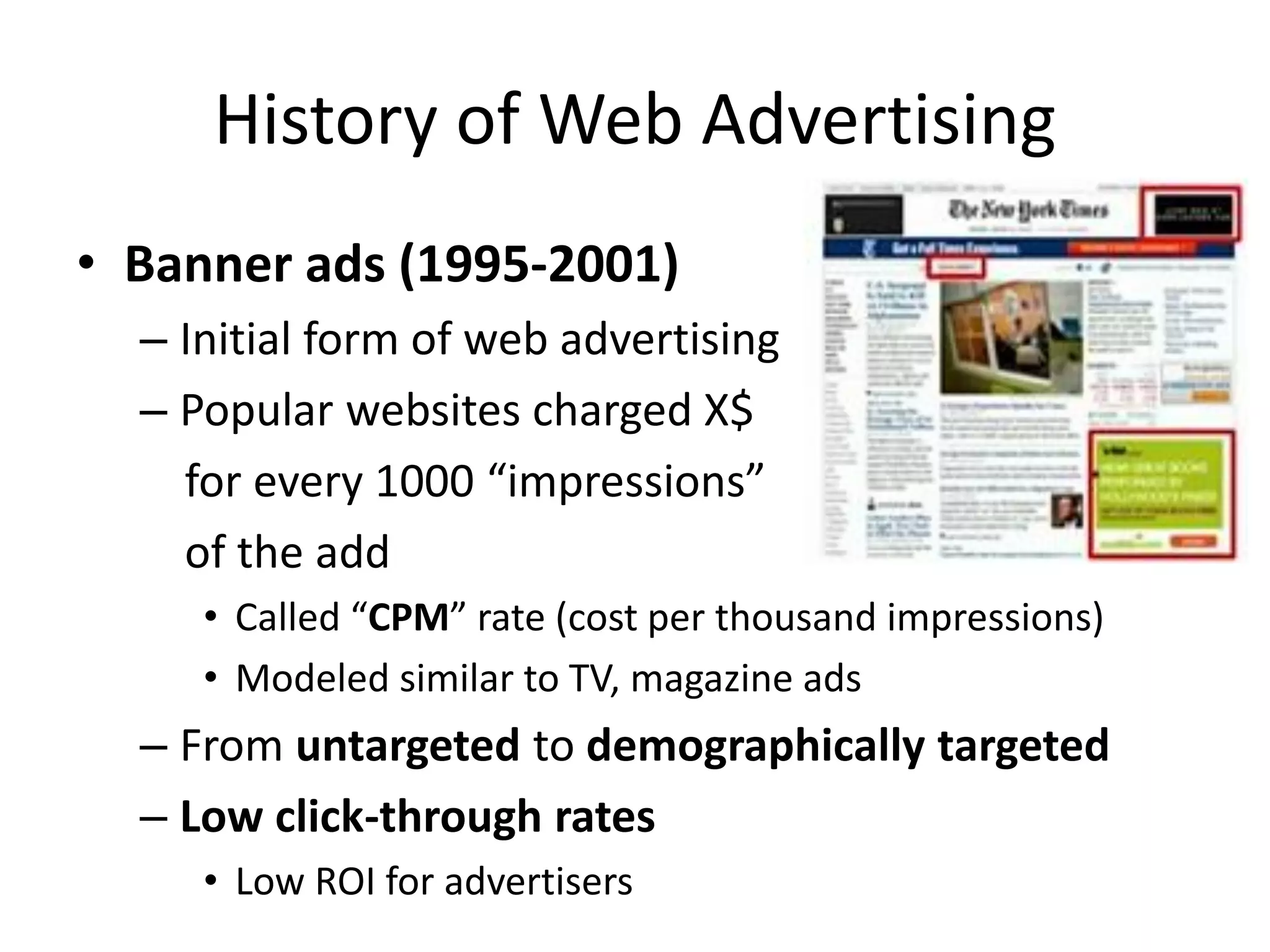
History of Web Advertising
• Banner ads (1995-2001)
– Initial form of web advertising
– Popular websites charged X$
for every 1000 “impressions”
of the add
• Called “CPM” rate (cost per thousand impressions)
• Modeled similar to TV, magazine ads
– From untargeted to demographically targeted
– Low click-through rates
• Low ROI for advertisers
Performance-based Advertising
• Introduced by Overture around 2000
– Advertisers bid on search keywords
– When someone searches for that keyword, the
highest bidder’s ad is shown
– Advertiser is charged only if the ad is clicked on
• Similar model adopted by Google with some
changes around 2002
– Called Adwords
Algorithmic Challenges
• Performance – based advertising works
– Multi-billion-dollar industry
• What ads to show for a given query?
– The AdWords Problem Mining of Massive Datasets
• If I am an advertiser, which search terms should I
bid on and how much should I bid?
– (It’s not our focus)
AdWords Problem
• A stream of queries arrives at the search
engine: 𝑞1, 𝑞2, …
• Several advertisers bid on each query
• When query 𝑞𝑖 arrives, search engine must
pick a subset of advertisers whose ads are
shown
• Goal: Maximize search engine’s revenues
• Clearly we need an online algorithm!
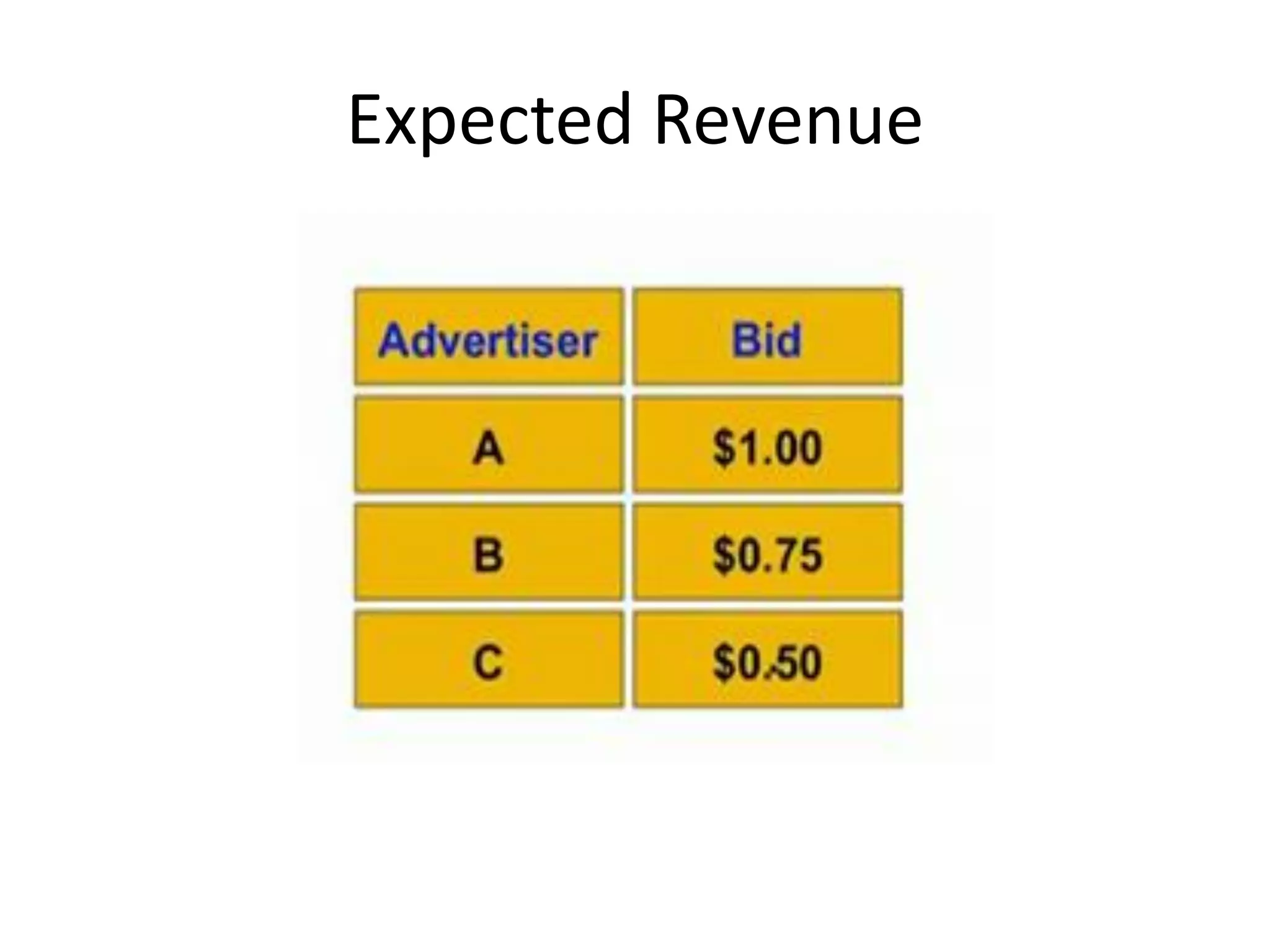
Expected Revenue
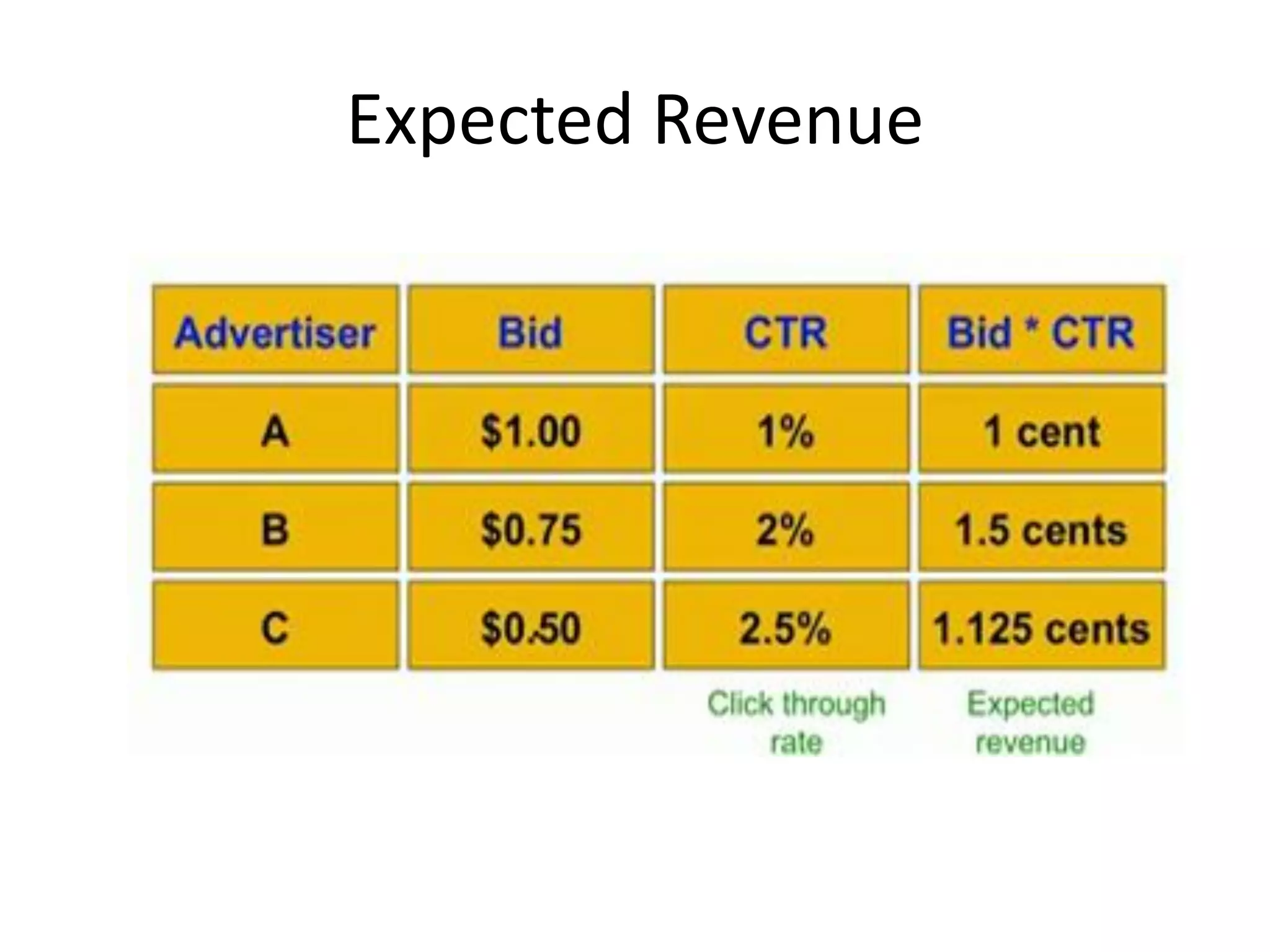
Expected Revenue
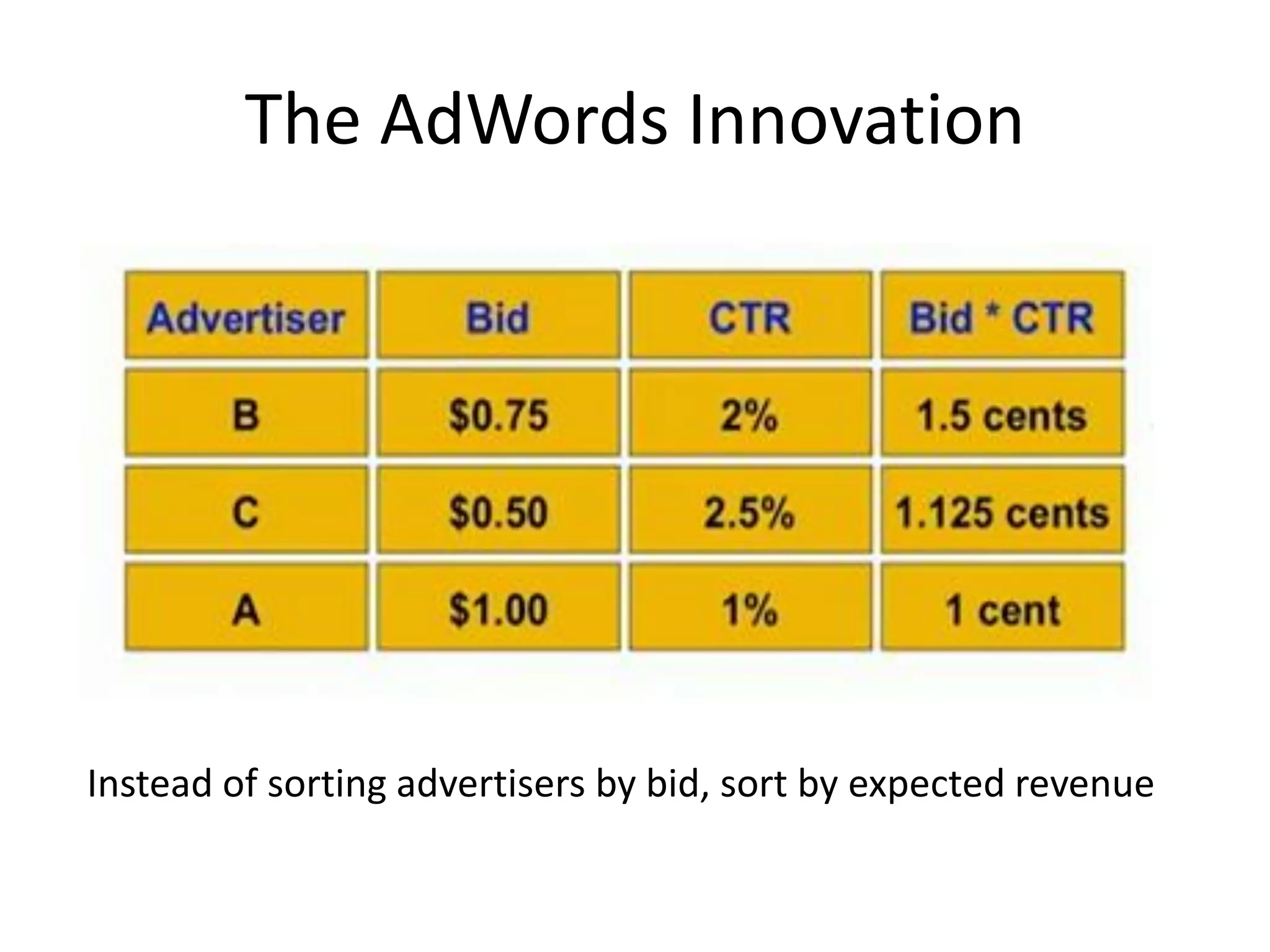
The AdWords Innovation
Instead of sorting advertisers by bid, sort by expected revenue
Limitations of Simple Algorithm
• CTR of an ad is unknown
• Advertisers have limited budgets and bid on
multiple ads.
Future Work
• Estimation of CTR
• Algorithm to solve limited budgets problem
(Balance Algorithm)
Recall…
• Greedy algorithm for the online graph
matching problem
• Competitive Ratio
• History of Web Advertising
• Performance-based Advertising
• The AdWords Innovation
• Click Through Rate (CTR)
• Expected Revenue
AdWords Problem
Given:
• A set of bids by advertiser for search queries
• A click-through rate for each advertiser query
pair
• A budget for each advertiser
• A limit on the number of ads to be displayed
with each search query
Adwords Problem
Respond to each search query with a set of
advertisers such that:
• The size of set is no larger than the limit on
the number of ads per query
• Each advertiser has bid on search query
• Each advertiser has enough budget left to pay
for the ad if it is clicked upon
Dealing with Limited Budget
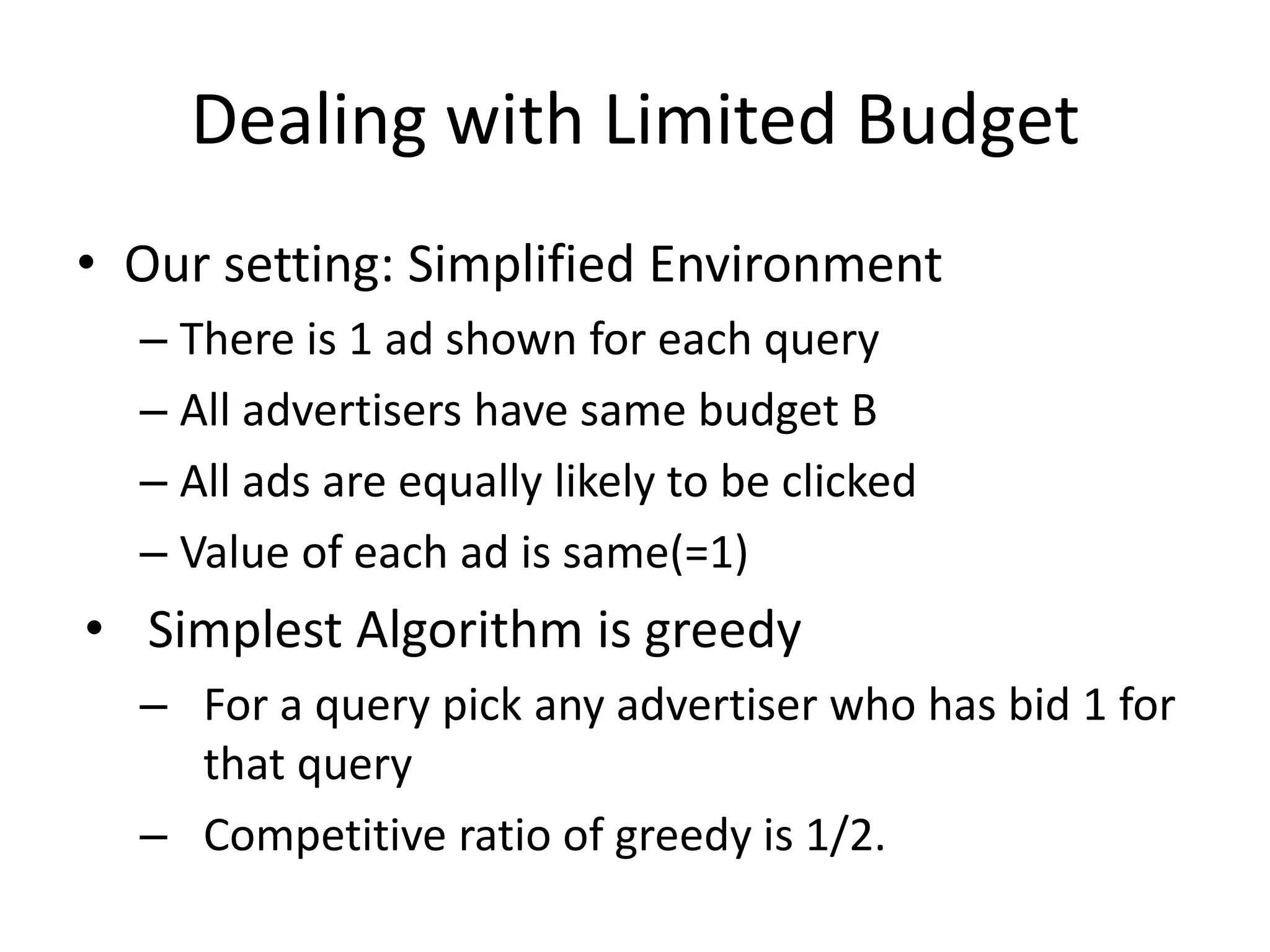
• Our setting: Simplified Environment
– There is 1 ad shown for each query
– All advertisers have same budget B
– All ads are equally likely to be clicked
– Value of each ad is same(=1)
• Simplest Algorithm is greedy
– For a query pick any advertiser who has bid 1 for
that query
– Competitive ratio of greedy is 1/2.
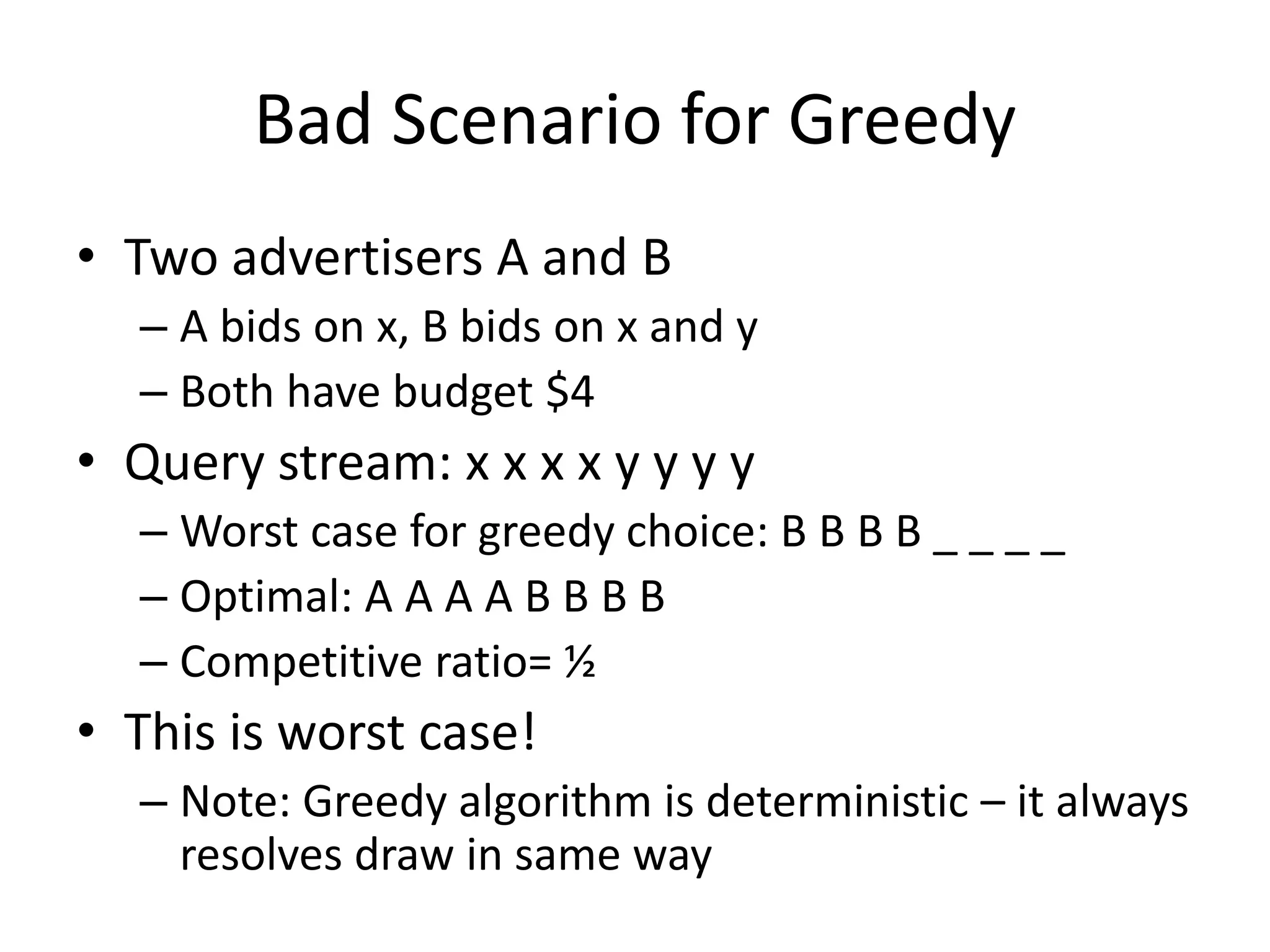
Bad Scenario for Greedy
• Two advertisers A and B
– A bids on x, B bids on x and y
– Both have budget $4
• Query stream: x x x x y y y y
– Worst case for greedy choice: B B B B _ _ _ _
– Optimal: A A A A B B B B
– Competitive ratio= ½
• This is worst case!
– Note: Greedy algorithm is deterministic – it always
resolves draw in same way
BALANCE Algorithm [MSVV]
• For each query, pick the advertiser with the
largest unspent budget
• Break ties arbitrarily ( but in deterministic way)
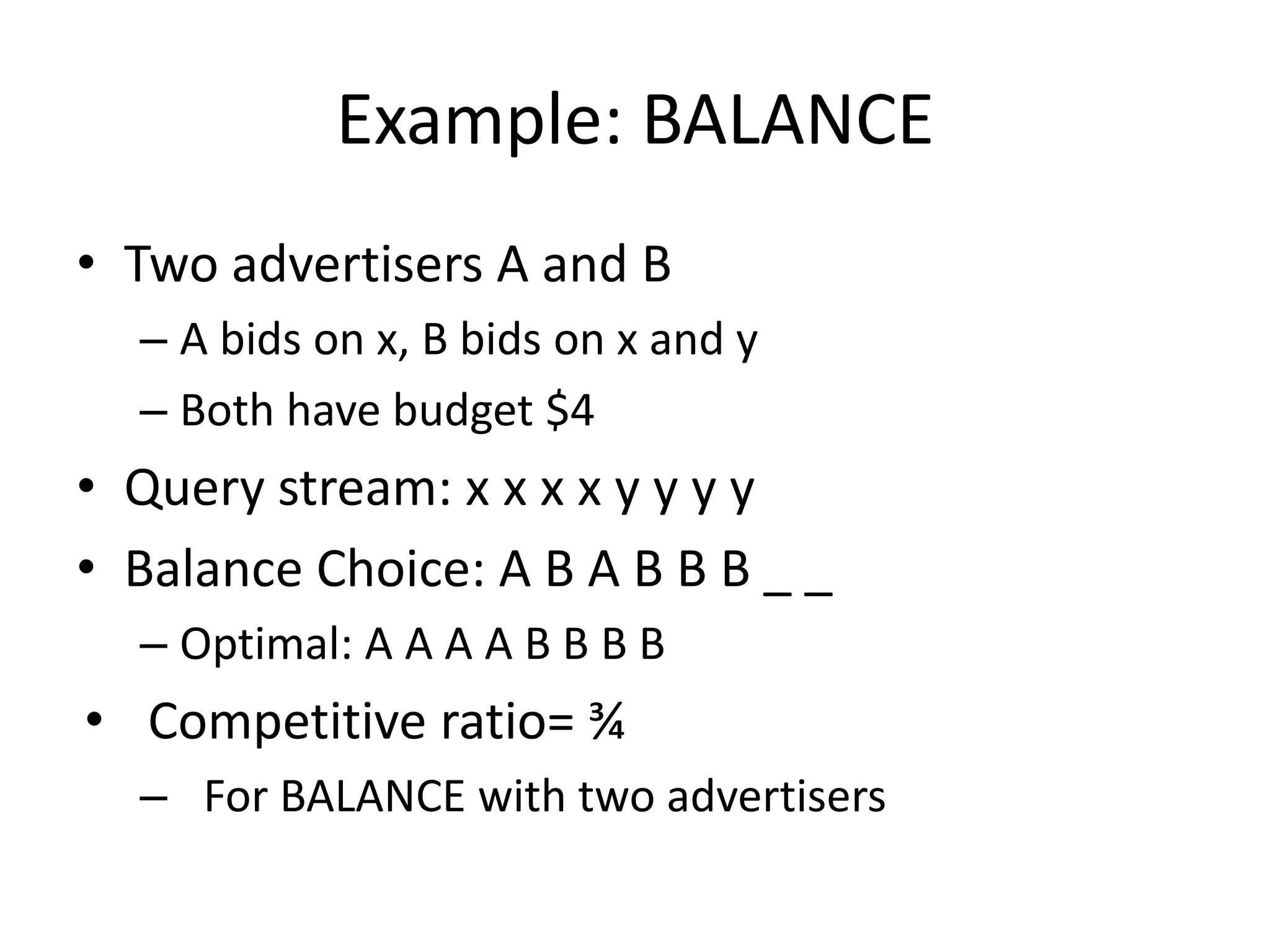
Example: BALANCE
• Two advertisers A and B
– A bids on x, B bids on x and y
– Both have budget $4
• Query stream: x x x x y y y y
• Balance Choice: A B A B B B _ _
– Optimal: A A A A B B B B
• Competitive ratio= ¾
– For BALANCE with two advertisers
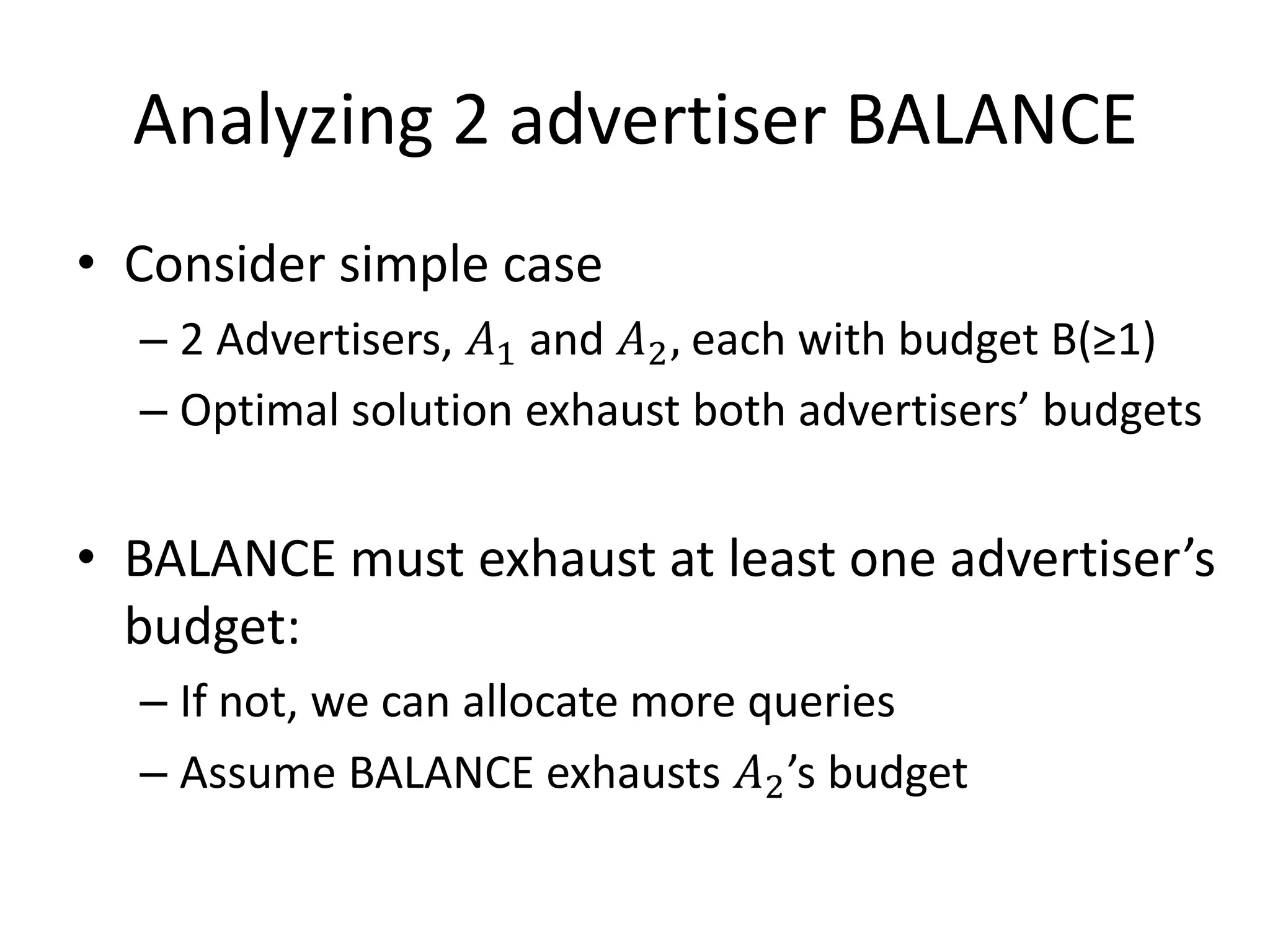
Analyzing 2 advertiser BALANCE
• Consider simple case
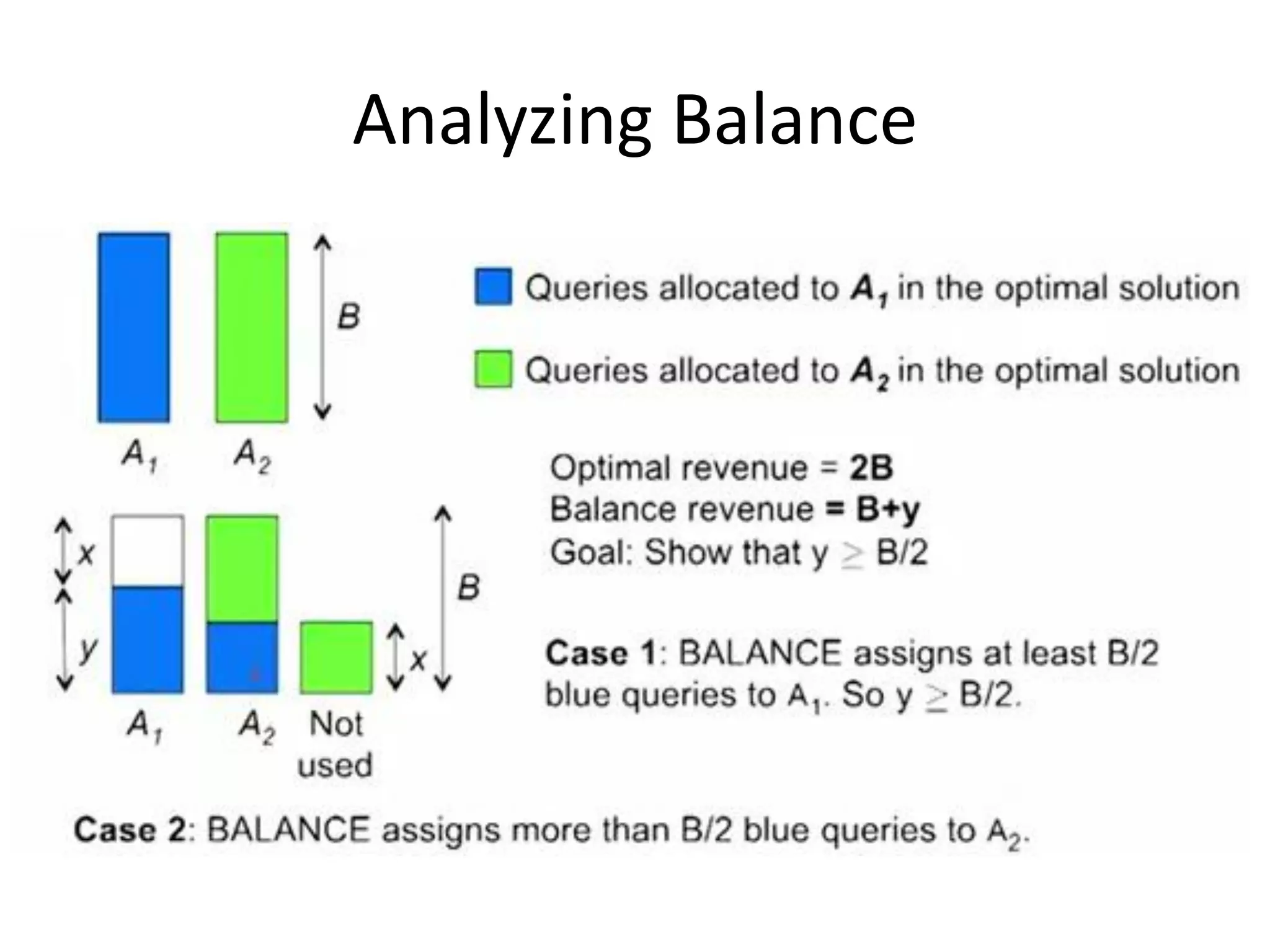
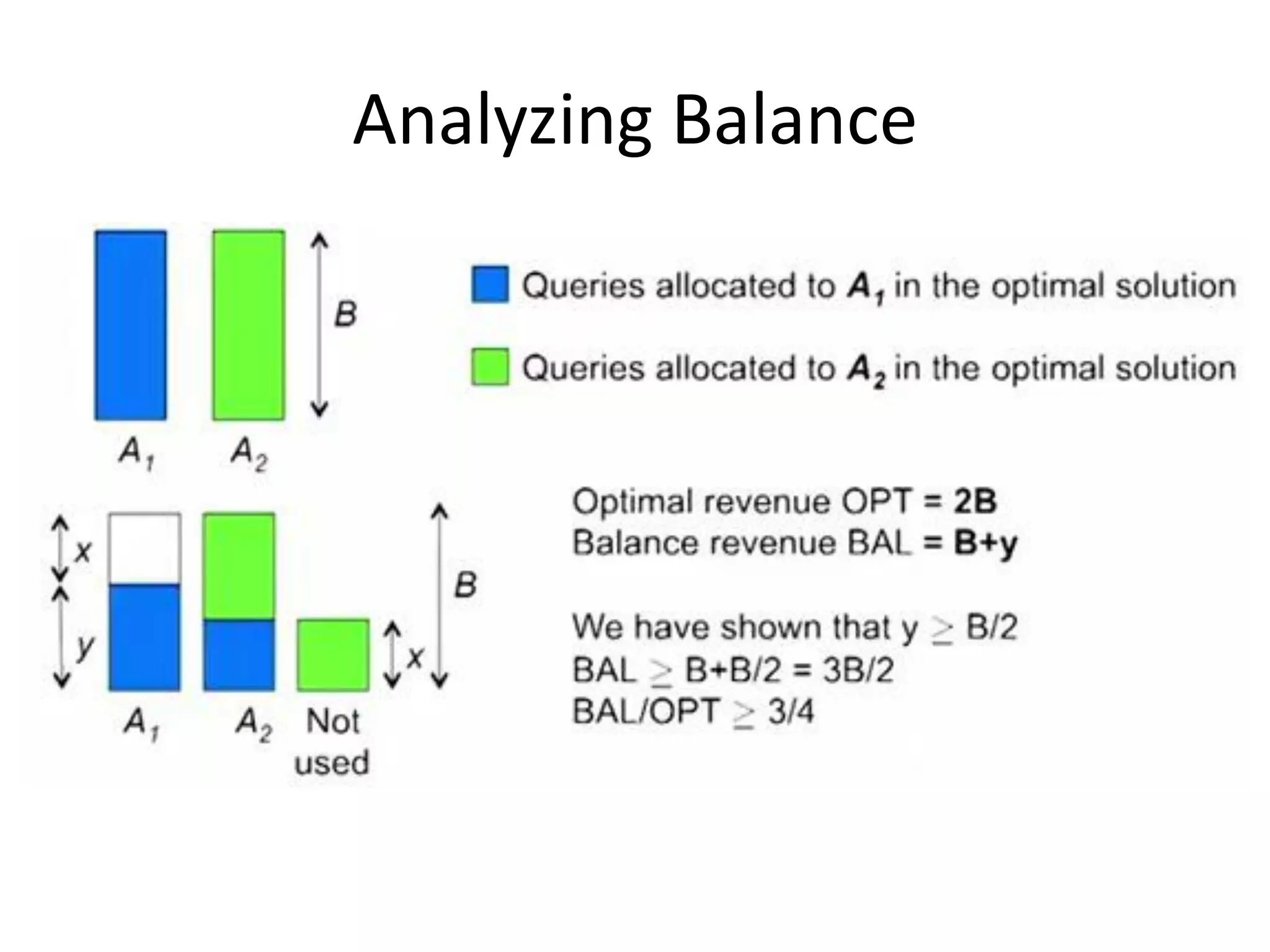
– 2 Advertisers, 𝐴1 and 𝐴2, each with budget B(≥1)
– Optimal solution exhaust both advertisers’ budgets
• BALANCE must exhaust at least one advertiser’s
budget:
– If not, we can allocate more queries
– Assume BALANCE exhausts 𝐴2’s budget
Analyzing Balance
Analyzing Balance
BALANCE: General Result
• In the general case, worst case competitive
ratio of BALANCE is 1-1/e = approx. 0.63
– Interestingly, no online algorithm has a better
competitive ratio!
• Let’s see the worst case example that gives
this ratio
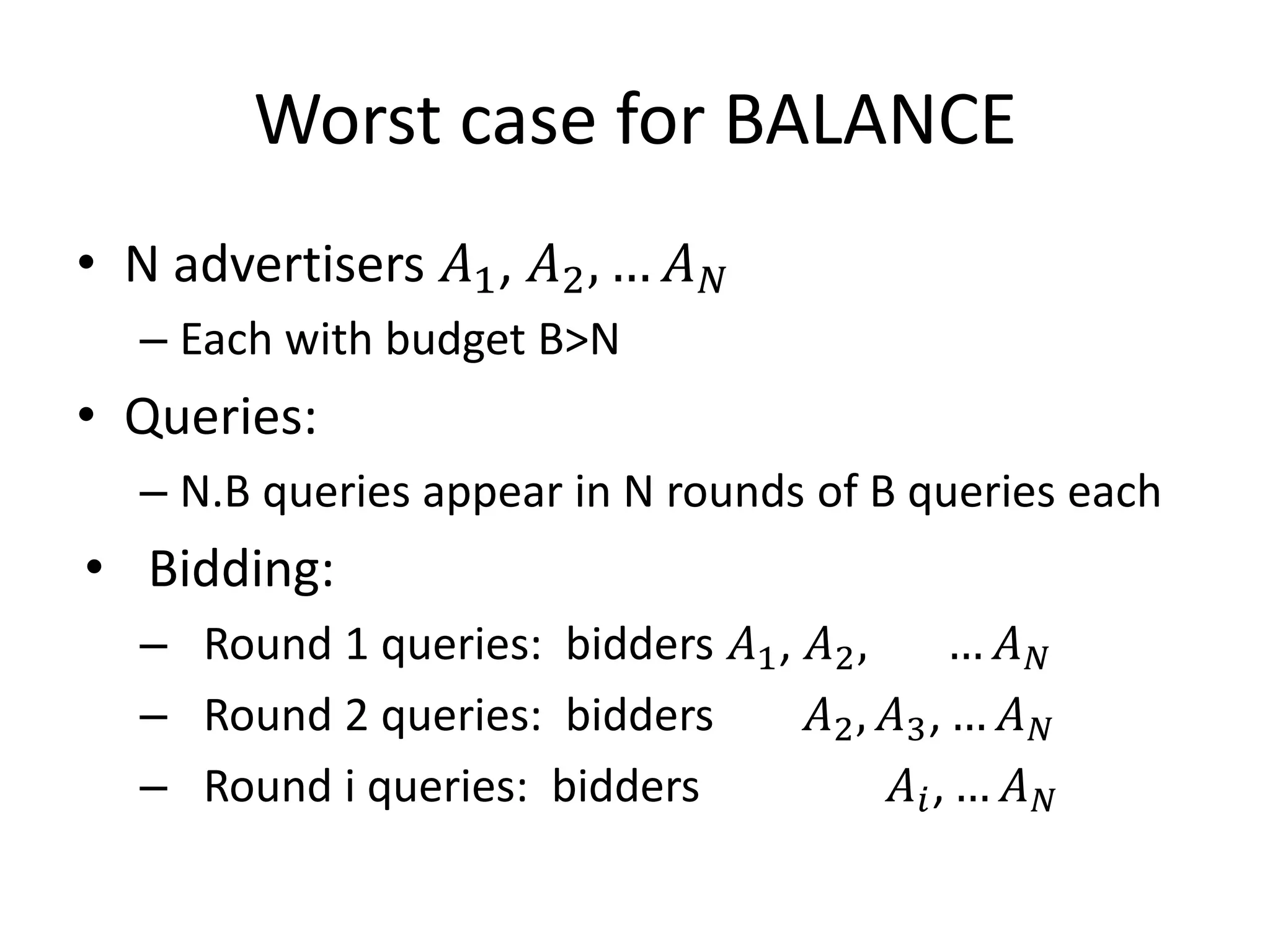
Worst case for BALANCE
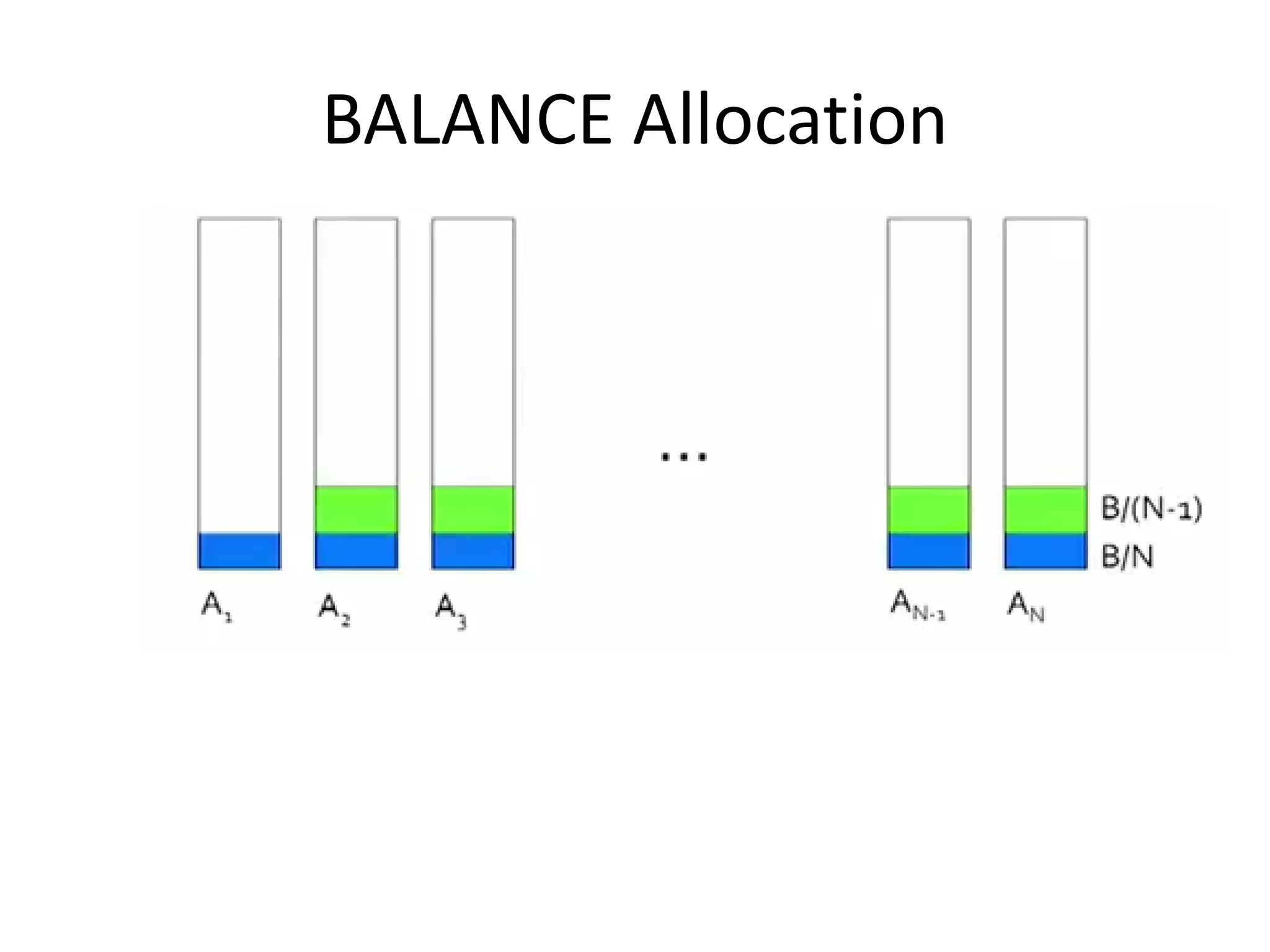
• N advertisers 𝐴1, 𝐴2, … 𝐴 𝑁
– Each with budget B>N
• Queries:
– N.B queries appear in N rounds of B queries each
• Bidding:
– Round 1 queries: bidders 𝐴1, 𝐴2, … 𝐴 𝑁
– Round 2 queries: bidders 𝐴2, 𝐴3, … 𝐴 𝑁
– Round i queries: bidders 𝐴𝑖, … 𝐴 𝑁
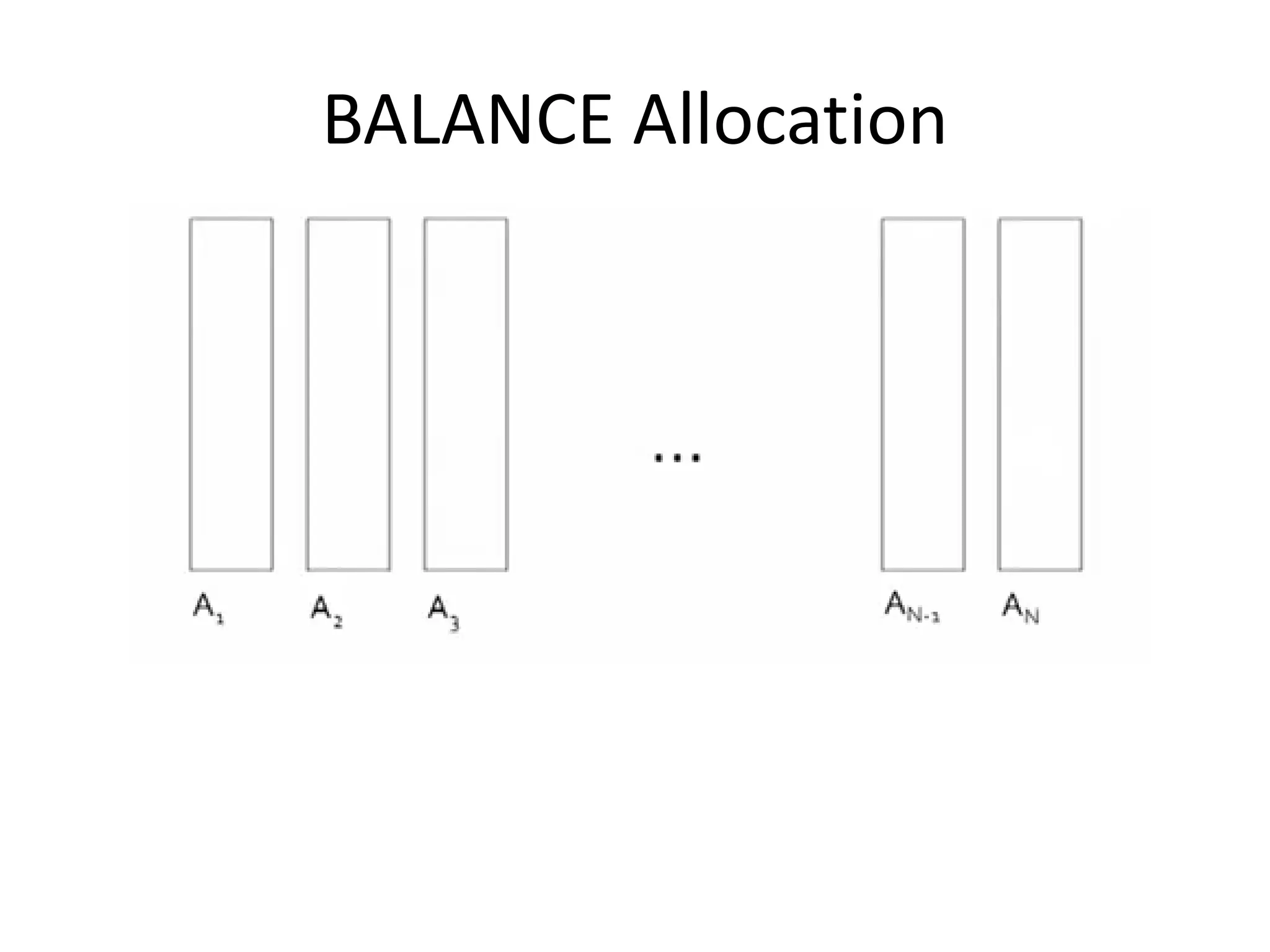
BALANCE Allocation
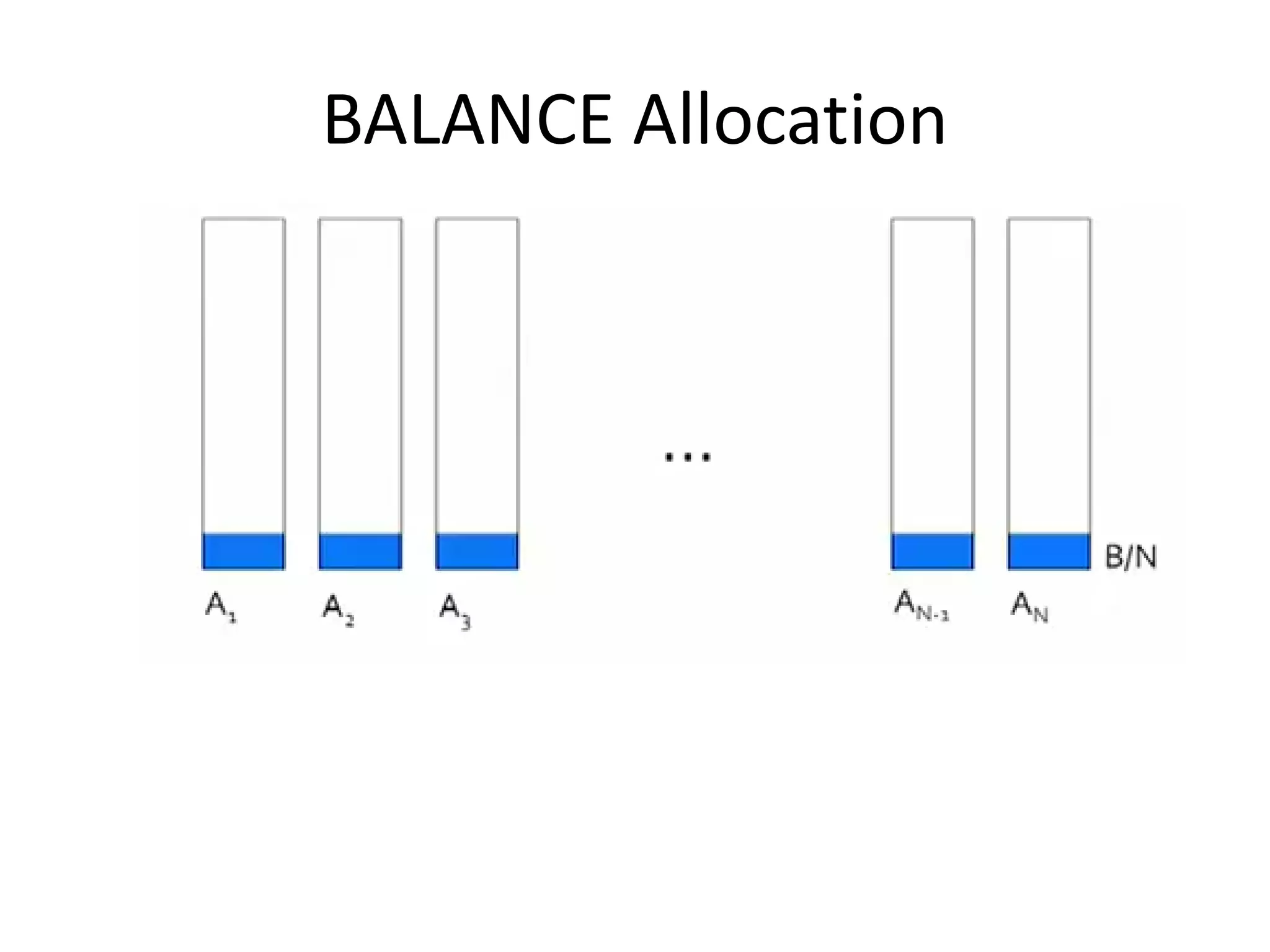
BALANCE Allocation
BALANCE Allocation
BALANCE Allocation
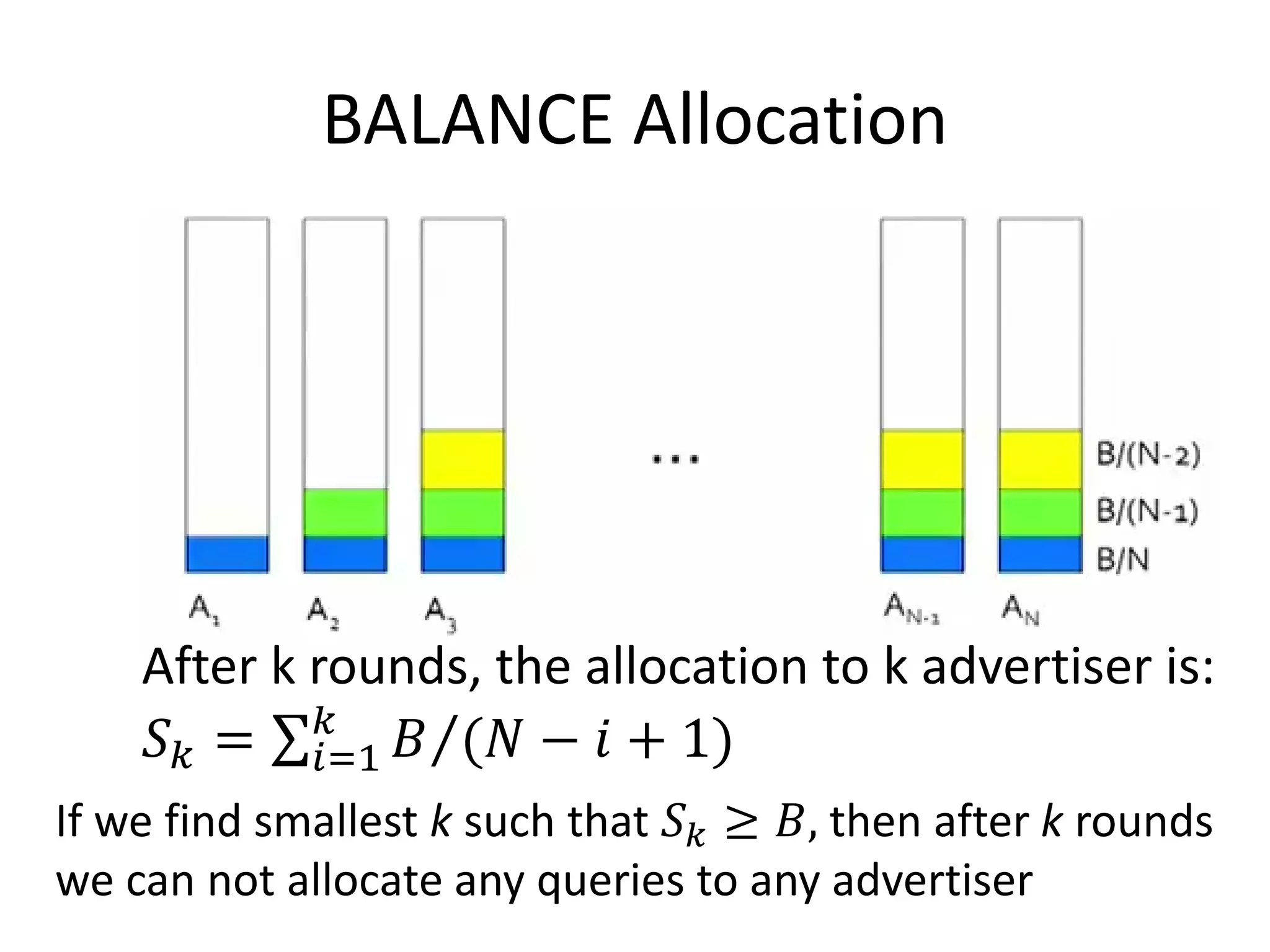
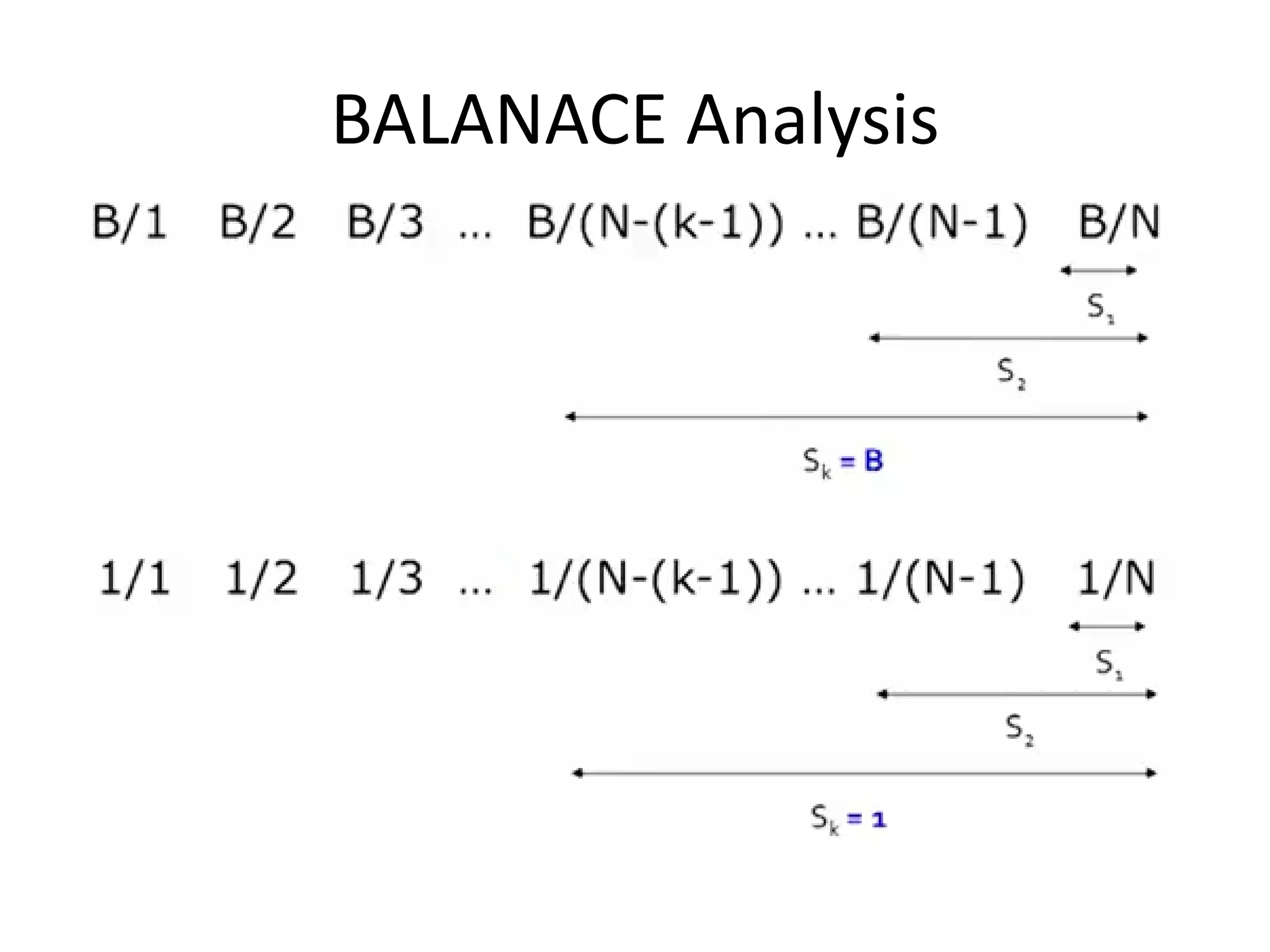
After k rounds, the allocation to k advertiser is:
𝑆 𝑘 = 𝐵 (𝑁 − 𝑖 + 1)𝑘
𝑖=1
If we find smallest k such that 𝑆 𝑘 ≥ 𝐵, then after k rounds
we can not allocate any queries to any advertiser
BALANACE Analysis
BALANACE Analysis
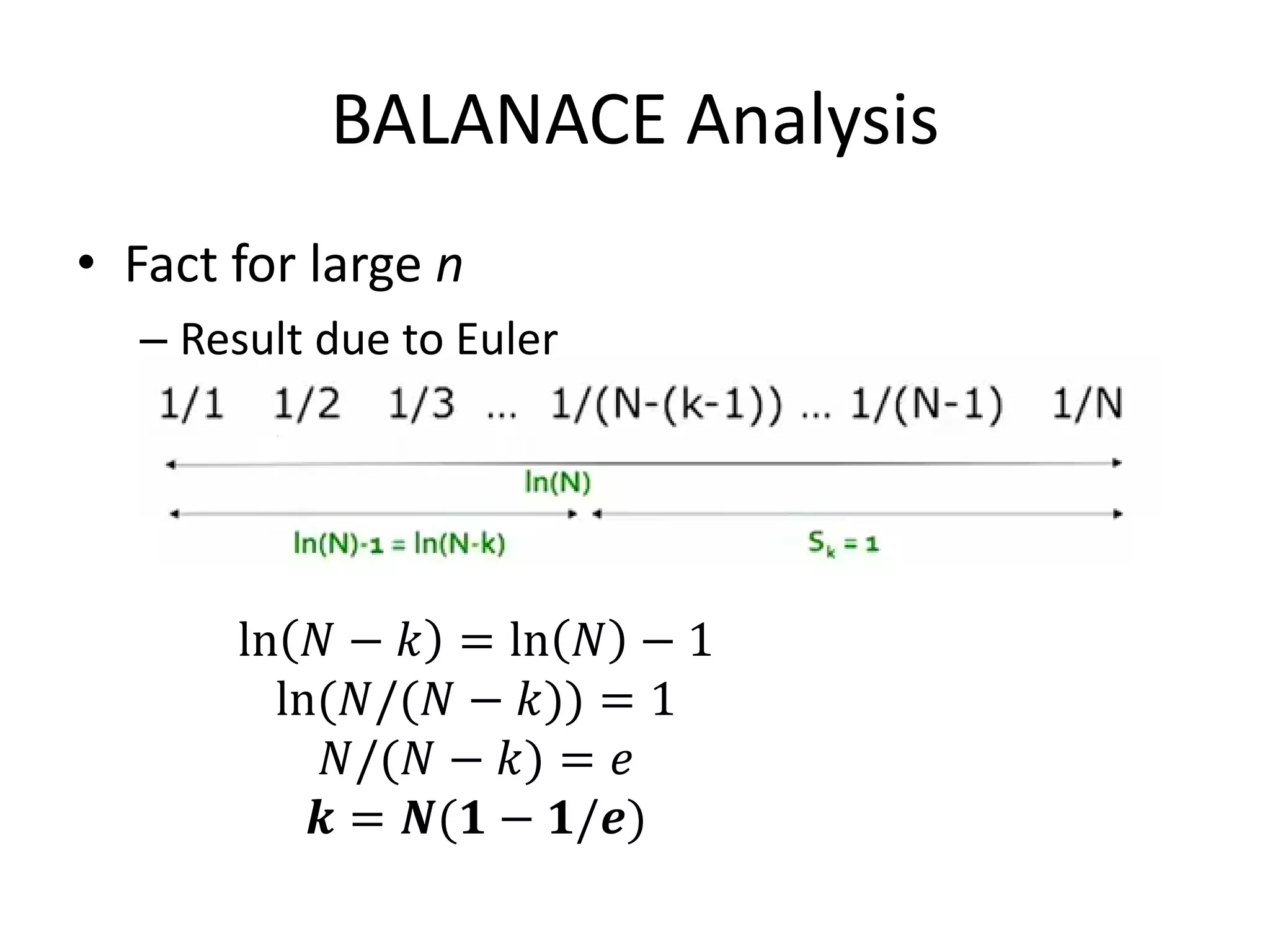
• Fact for large n
– Result due to Euler
ln 𝑁 − 𝑘 = ln 𝑁 − 1
ln(𝑁/(𝑁 − 𝑘)) = 1
𝑁/(𝑁 − 𝑘) = 𝑒
𝒌 = 𝑵(𝟏 − 𝟏/𝒆)
BALANACE Analysis
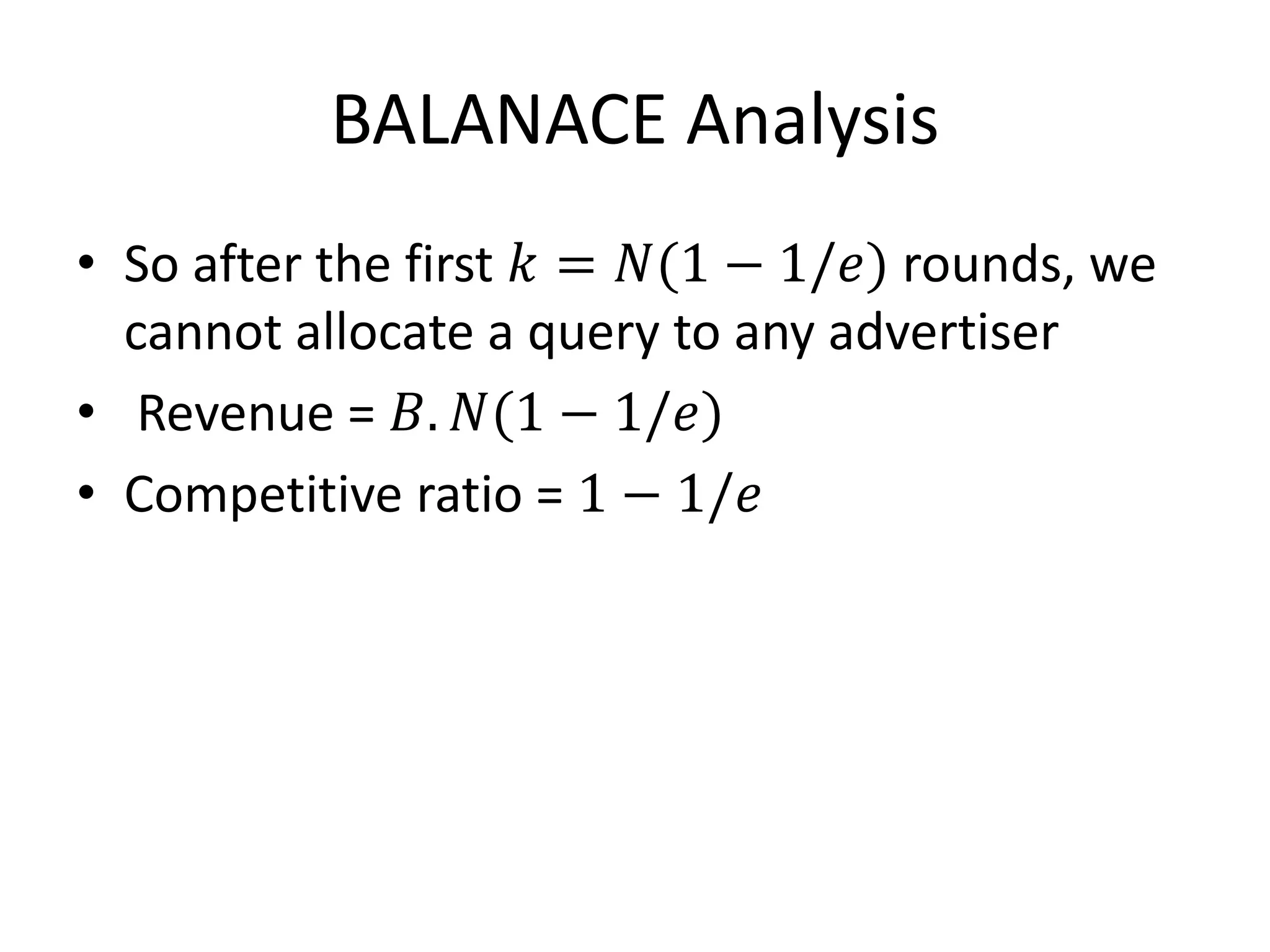
• So after the first 𝑘 = 𝑁(1 − 1/𝑒) rounds, we
cannot allocate a query to any advertiser
• Revenue = 𝐵. 𝑁(1 − 1/𝑒)
• Competitive ratio = 1 − 1/𝑒
General Version of the Problem
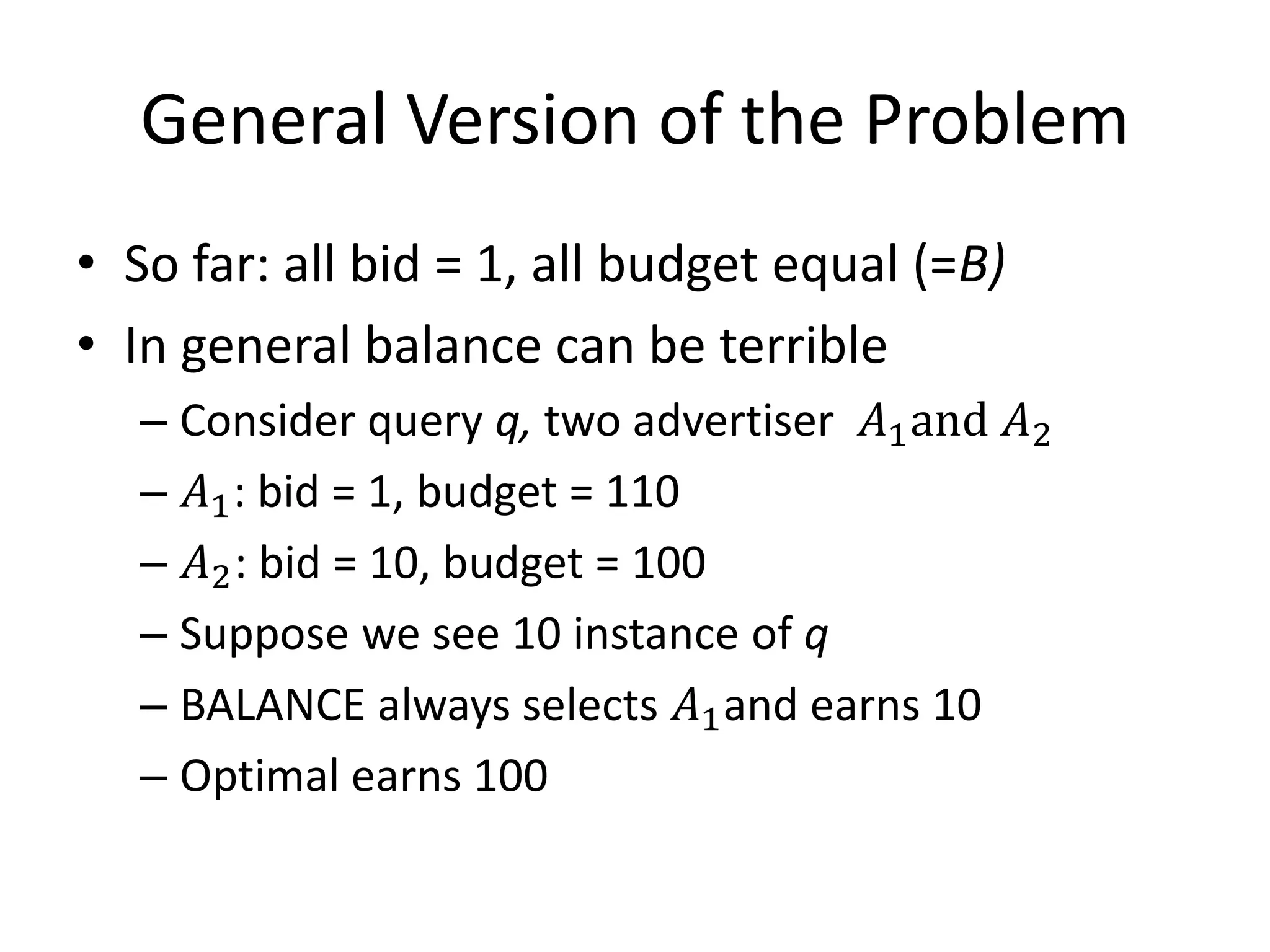
• So far: all bid = 1, all budget equal (=B)
• In general balance can be terrible
– Consider query q, two advertiser 𝐴1and 𝐴2
– 𝐴1: bid = 1, budget = 110
– 𝐴2: bid = 10, budget = 100
– Suppose we see 10 instance of q
– BALANCE always selects 𝐴1and earns 10
– Optimal earns 100
Generalized BALANCE
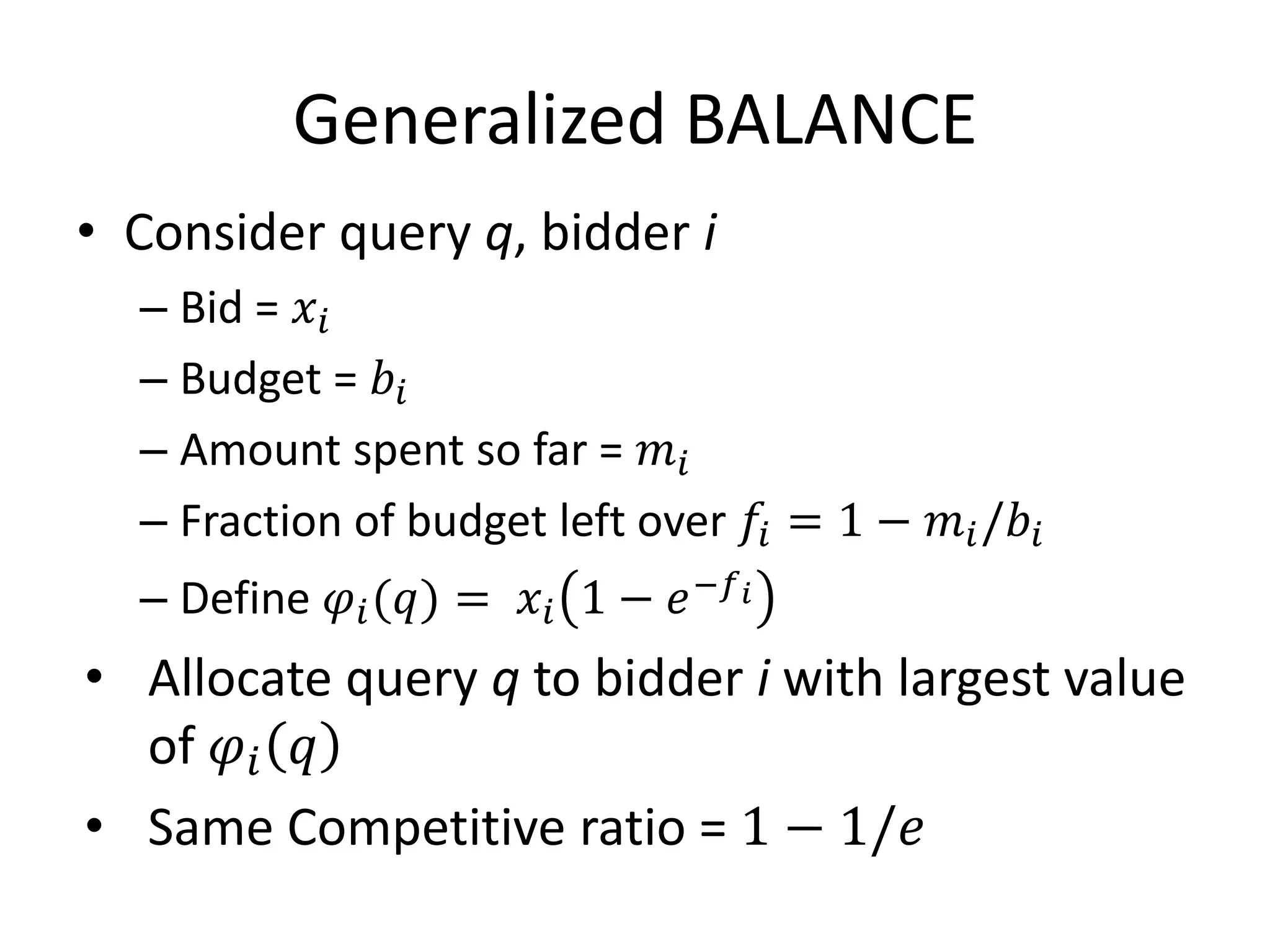
• Consider query q, bidder i
– Bid = 𝑥𝑖
– Budget = 𝑏𝑖
– Amount spent so far = 𝑚𝑖
– Fraction of budget left over 𝑓𝑖 = 1 − 𝑚𝑖/𝑏𝑖
– Define 𝜑𝑖(𝑞) = 𝑥𝑖 1 − 𝑒−𝑓 𝑖
• Allocate query q to bidder i with largest value
of 𝜑𝑖 𝑞
• Same Competitive ratio = 1 − 1/𝑒
Conclusion
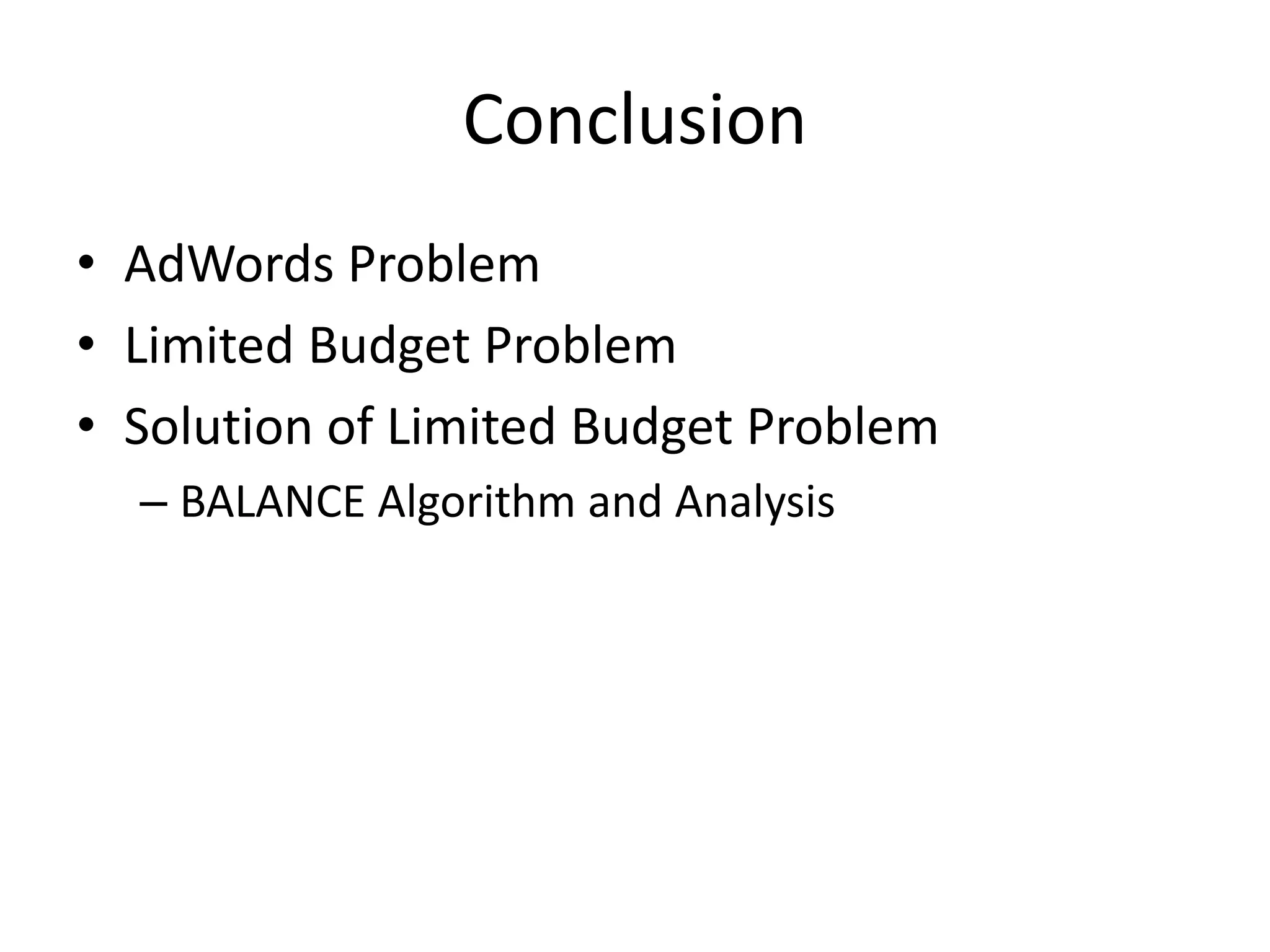
• AdWords Problem
• Limited Budget Problem
• Solution of Limited Budget Problem
– BALANCE Algorithm and Analysis
Future Work
• Estimation of CTR
– Data Mining and Machine Learning techniques
References
• [1] Mehta A, Saberi A, Vazirani U, Vazirani V.
Adwords and generalized online
matching. J ACM (JACM) 2007;54(5):22.
• [2] Reiss C, Wilkes J, Hellerstein JL. Google cluster-
usage traces: formatþ schema.
Google Inc., White Paper; 2011.
• [3] Legrain A, Fortin M-A, Lahrichi N, Rousseau L-
M. Online stochastic optimization of radiotherapy
patient scheduling. In: Health care management
science;
2014. p. 1–14
References
• [4] Coy P. The secret to google's success.
〈http://www.bloomberg.com/bw/stories/ 2006-03-05/
the-secret-to-googles-success〉;
5 March 2006 [accessed16.02.15].
• [5] Google, 2014. 2014 financial tables.
〈https://investor.google.com/financial/tables.html〉
[accessed 16.02.2015].
• [6] Antoine Legrain , Patrick Jaillet A stochastic
algorithm for online bipartite resource allocation
problems.
Computers & Operations Research 75 (2016) 28–37,
Thank you

Computational advertising bipartite graph matching

  • 2.
    Online Algorithms • Classicmodel of algorithms – We get to see the entire input, then compute some function of it – In this context, “offline algorithm” • Online Algorithms – We get to see the input one piece at a time, and need to make irrevocable decisions along the way – Similar to the data stream model
  • 3.
    Example: Bipartite Matching Nodes:Boys and Girls; Edges: Compatible Pairs Goal: Match as many compatible pairs as possible
  • 4.
  • 5.
    Example: Bipartite Matching Perfectmatching... all the vertices of graph are matched Maximum Matching... a matching that contains the longest possible number of matches
  • 6.
    Matching Algorithm • Problem:Find a maximum matching for a given bipartite graph – A perfect one if it exists • There is a polynomial – time offline algorithm based on augmenting path (Hopcroft & Karp 1973)
  • 7.
    Online Graph MatchingProblem • Initially, we are given the sets boys and girls • In each round, one girl’s choice are revealed – That is, girl’s edges are revealed • At that time, we have to decide either: – Pair the girl with a boy – Do not pair the girl with any boy • Example of application: Assigning tasks to servers
  • 8.
  • 9.
  • 10.
  • 11.
  • 12.
  • 13.
  • 14.
  • 15.
  • 16.
    Greedy Algorithm • Greedyalgorithm for the online graph matching problem: – Pair the new girl with any eligible boy • If there is none, do not pair girl • How good is the algorithm?
  • 17.
    Competitive Ratio • Forinput I, suppose greedy produces matching 𝑴 𝒈𝒓𝒆𝒆𝒅𝒚 while an optimal matching is 𝑴 𝒐𝒑𝒕 Competitive ratio= 𝒎𝒊𝒏 𝑎𝑙𝑙 𝑝𝑜𝑠𝑠𝑖𝑏𝑙𝑒 𝑖𝑛𝑝𝑢𝑡𝑠 𝐼(| 𝑴 𝒈𝒓𝒆𝒆𝒅𝒚|/ |𝑴 𝒐𝒑𝒕|)
  • 18.
    Analyzing the GreedyAlgorithm • Suppose 𝑴 𝒈𝒓𝒆𝒆𝒅𝒚 ≠ 𝑴 𝒐𝒑𝒕 • Consider the set G of girls matched 𝑴 𝒐𝒑𝒕 but not in 𝑴 𝒈𝒓𝒆𝒆𝒅𝒚 • (1) |𝑴 𝒐𝒑𝒕| ≤ |𝑴 𝒈𝒓𝒆𝒆𝒅𝒚|+|G| • Every boy B adjacent to girls in G is already matched in 𝑴 𝒈𝒓𝒆𝒆𝒅𝒚 • (2) |𝑴 𝒈𝒓𝒆𝒆𝒅𝒚|≥ |B| • Optimal matches all the girls in G to boys in B • (3) |G|≤|B|
  • 19.
    Analyzing the GreedyAlgorithm Combining (2) and (3): • (4) |G|≤|B|≤ |𝑴 𝒈𝒓𝒆𝒆𝒅𝒚| Combining (1) and (4): |𝑴 𝒐𝒑𝒕| ≤ |𝑴 𝒈𝒓𝒆𝒆𝒅𝒚|+|𝑴 𝒈𝒓𝒆𝒆𝒅𝒚| |𝑴 𝒐𝒑𝒕| ≤ 2|𝑴 𝒈𝒓𝒆𝒆𝒅𝒚| |𝑴 𝒈𝒓𝒆𝒆𝒅𝒚|/ |𝑴 𝒐𝒑𝒕|≥1/2
  • 20.
    History of WebAdvertising • Banner ads (1995-2001) – Initial form of web advertising – Popular websites charged X$ for every 1000 “impressions” of the add • Called “CPM” rate (cost per thousand impressions) • Modeled similar to TV, magazine ads – From untargeted to demographically targeted – Low click-through rates • Low ROI for advertisers
  • 21.
    Performance-based Advertising • Introducedby Overture around 2000 – Advertisers bid on search keywords – When someone searches for that keyword, the highest bidder’s ad is shown – Advertiser is charged only if the ad is clicked on • Similar model adopted by Google with some changes around 2002 – Called Adwords
  • 22.
    Algorithmic Challenges • Performance– based advertising works – Multi-billion-dollar industry • What ads to show for a given query? – The AdWords Problem Mining of Massive Datasets • If I am an advertiser, which search terms should I bid on and how much should I bid? – (It’s not our focus)
  • 23.
    AdWords Problem • Astream of queries arrives at the search engine: 𝑞1, 𝑞2, … • Several advertisers bid on each query • When query 𝑞𝑖 arrives, search engine must pick a subset of advertisers whose ads are shown • Goal: Maximize search engine’s revenues • Clearly we need an online algorithm!
  • 24.
  • 25.
  • 26.
    The AdWords Innovation Insteadof sorting advertisers by bid, sort by expected revenue
  • 27.
    Limitations of SimpleAlgorithm • CTR of an ad is unknown • Advertisers have limited budgets and bid on multiple ads.
  • 28.
    Future Work • Estimationof CTR • Algorithm to solve limited budgets problem (Balance Algorithm)
  • 29.
    Recall… • Greedy algorithmfor the online graph matching problem • Competitive Ratio • History of Web Advertising • Performance-based Advertising • The AdWords Innovation • Click Through Rate (CTR) • Expected Revenue
  • 30.
    AdWords Problem Given: • Aset of bids by advertiser for search queries • A click-through rate for each advertiser query pair • A budget for each advertiser • A limit on the number of ads to be displayed with each search query
  • 31.
    Adwords Problem Respond toeach search query with a set of advertisers such that: • The size of set is no larger than the limit on the number of ads per query • Each advertiser has bid on search query • Each advertiser has enough budget left to pay for the ad if it is clicked upon
  • 32.
    Dealing with LimitedBudget • Our setting: Simplified Environment – There is 1 ad shown for each query – All advertisers have same budget B – All ads are equally likely to be clicked – Value of each ad is same(=1) • Simplest Algorithm is greedy – For a query pick any advertiser who has bid 1 for that query – Competitive ratio of greedy is 1/2.
  • 33.
    Bad Scenario forGreedy • Two advertisers A and B – A bids on x, B bids on x and y – Both have budget $4 • Query stream: x x x x y y y y – Worst case for greedy choice: B B B B _ _ _ _ – Optimal: A A A A B B B B – Competitive ratio= ½ • This is worst case! – Note: Greedy algorithm is deterministic – it always resolves draw in same way
  • 34.
    BALANCE Algorithm [MSVV] •For each query, pick the advertiser with the largest unspent budget • Break ties arbitrarily ( but in deterministic way)
  • 35.
    Example: BALANCE • Twoadvertisers A and B – A bids on x, B bids on x and y – Both have budget $4 • Query stream: x x x x y y y y • Balance Choice: A B A B B B _ _ – Optimal: A A A A B B B B • Competitive ratio= ¾ – For BALANCE with two advertisers
  • 36.
    Analyzing 2 advertiserBALANCE • Consider simple case – 2 Advertisers, 𝐴1 and 𝐴2, each with budget B(≥1) – Optimal solution exhaust both advertisers’ budgets • BALANCE must exhaust at least one advertiser’s budget: – If not, we can allocate more queries – Assume BALANCE exhausts 𝐴2’s budget
  • 37.
  • 38.
  • 39.
    BALANCE: General Result •In the general case, worst case competitive ratio of BALANCE is 1-1/e = approx. 0.63 – Interestingly, no online algorithm has a better competitive ratio! • Let’s see the worst case example that gives this ratio
  • 40.
    Worst case forBALANCE • N advertisers 𝐴1, 𝐴2, … 𝐴 𝑁 – Each with budget B>N • Queries: – N.B queries appear in N rounds of B queries each • Bidding: – Round 1 queries: bidders 𝐴1, 𝐴2, … 𝐴 𝑁 – Round 2 queries: bidders 𝐴2, 𝐴3, … 𝐴 𝑁 – Round i queries: bidders 𝐴𝑖, … 𝐴 𝑁
  • 41.
  • 42.
  • 43.
  • 44.
    BALANCE Allocation After krounds, the allocation to k advertiser is: 𝑆 𝑘 = 𝐵 (𝑁 − 𝑖 + 1)𝑘 𝑖=1 If we find smallest k such that 𝑆 𝑘 ≥ 𝐵, then after k rounds we can not allocate any queries to any advertiser
  • 45.
  • 46.
    BALANACE Analysis • Factfor large n – Result due to Euler ln 𝑁 − 𝑘 = ln 𝑁 − 1 ln(𝑁/(𝑁 − 𝑘)) = 1 𝑁/(𝑁 − 𝑘) = 𝑒 𝒌 = 𝑵(𝟏 − 𝟏/𝒆)
  • 47.
    BALANACE Analysis • Soafter the first 𝑘 = 𝑁(1 − 1/𝑒) rounds, we cannot allocate a query to any advertiser • Revenue = 𝐵. 𝑁(1 − 1/𝑒) • Competitive ratio = 1 − 1/𝑒
  • 48.
    General Version ofthe Problem • So far: all bid = 1, all budget equal (=B) • In general balance can be terrible – Consider query q, two advertiser 𝐴1and 𝐴2 – 𝐴1: bid = 1, budget = 110 – 𝐴2: bid = 10, budget = 100 – Suppose we see 10 instance of q – BALANCE always selects 𝐴1and earns 10 – Optimal earns 100
  • 49.
    Generalized BALANCE • Considerquery q, bidder i – Bid = 𝑥𝑖 – Budget = 𝑏𝑖 – Amount spent so far = 𝑚𝑖 – Fraction of budget left over 𝑓𝑖 = 1 − 𝑚𝑖/𝑏𝑖 – Define 𝜑𝑖(𝑞) = 𝑥𝑖 1 − 𝑒−𝑓 𝑖 • Allocate query q to bidder i with largest value of 𝜑𝑖 𝑞 • Same Competitive ratio = 1 − 1/𝑒
  • 50.
    Conclusion • AdWords Problem •Limited Budget Problem • Solution of Limited Budget Problem – BALANCE Algorithm and Analysis
  • 51.
    Future Work • Estimationof CTR – Data Mining and Machine Learning techniques
  • 52.
    References • [1] MehtaA, Saberi A, Vazirani U, Vazirani V. Adwords and generalized online matching. J ACM (JACM) 2007;54(5):22. • [2] Reiss C, Wilkes J, Hellerstein JL. Google cluster- usage traces: formatþ schema. Google Inc., White Paper; 2011. • [3] Legrain A, Fortin M-A, Lahrichi N, Rousseau L- M. Online stochastic optimization of radiotherapy patient scheduling. In: Health care management science; 2014. p. 1–14
  • 53.
    References • [4] CoyP. The secret to google's success. 〈http://www.bloomberg.com/bw/stories/ 2006-03-05/ the-secret-to-googles-success〉; 5 March 2006 [accessed16.02.15]. • [5] Google, 2014. 2014 financial tables. 〈https://investor.google.com/financial/tables.html〉 [accessed 16.02.2015]. • [6] Antoine Legrain , Patrick Jaillet A stochastic algorithm for online bipartite resource allocation problems. Computers & Operations Research 75 (2016) 28–37,
  • 54.