www.infosectrain.com | sales@infosectrain.com 01
About Security+ SY0-601
CompTIA Security+ is a worldwide certification that verifies the
fundamental skills required to execute basic security activities and
build a career in information security. CompTIA Security+ SY0-601 is
the latest version of the Security+ certification. The very first security
certification that IT professionals can obtain is CompTIA Security+,
and it is the best entry-level certification. The main reason why
CompTIA’s Security+(Plus) certification is such an excellent
entry-level certification is It provides the fundamental information
that each cybersecurity professional must have. Its areas are based
on a straightforward premise: a major emphasis on practical skills.
After passing the certification you can show that you are prepared
to deal with a real-world scenario and It also provides a platform for
intermediate-level cybersecurity positions.
www.infosectrain.com | sales@infosectrain.com 02
The latest version of
Security+ SY0-601 have 5 Domains:
Domain 1.0: Attacks, Threats, and Vulnerabilities (24%)
Domain 2.0: Architecture and Design (21%)
Domain 3.0: Implementation (25%)
Domain 4.0: Operations and Incident Response (16%)
Domain 5.0: Governance, Risk, and Compliance (14%)
In this blog, we discuss the first domain Attacks, Threats,
and Vulnerabilities.
www.infosectrain.com | sales@infosectrain.com 03
Attacks, Threats, and
Vulnerabilities
D O M A I N 1
The first domain of CompTIA Security+ (plus), SY0-601 addresses a
fundamental requirement of every data security expert: the ability
to detect and comprehend various threats, attack methods, and
vulnerabilities that might be exploited. The weightage of this
domain is 24%. In this domain, we learn about:
1. Social Engineering Techniques and Type
2. Malware Based Attack
3. Threat Actors, Vectors, and Threat Intelligence
4. Explain Penetration Testing Techniques
5. Explain Security Concerns with Type of Vulnerability
www.infosectrain.com | sales@infosectrain.com 04
Social Engineering Techniques
and Type
01
In this lesson, we will learn all about social engineering and its
techniques. We discuss various principles of social engineering like:
• Familiarity
• Social Proof
• Authority and Intimidation
• Scarcity and Urgency
• Impersonation and trust
We also cover Impersonation and Trust: It is a common technique of
social engineering. Trying to pretend to be someone else is known
as impersonation. After that we learn different types of social
engineering:
• Phishing
• Smishing
• Vishing
• Spear Phishing
• Dumpster Diving
• Shoulder Surfing
• Tailgating
• Whaling
www.infosectrain.com | sales@infosectrain.com 05
Malware-Based Attack
02
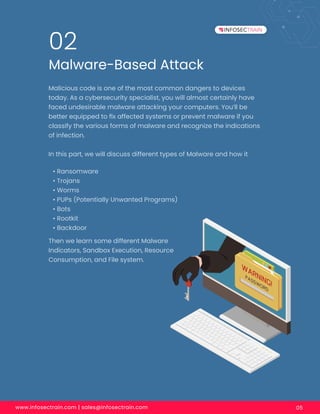
Malicious code is one of the most common dangers to devices
today. As a cybersecurity specialist, you will almost certainly have
faced undesirable malware attacking your computers. You’ll be
better equipped to fix affected systems or prevent malware if you
classify the various forms of malware and recognize the indications
of infection.
In this part, we will discuss different types of Malware and how it
Then we learn some different Malware
Indicators, Sandbox Execution, Resource
Consumption, and File system.
• Ransomware
• Trojans
• Worms
• PUPs (Potentially Unwanted Programs)
• Bots
• Rootkit
• Backdoor
www.infosectrain.com | sales@infosectrain.com 06
Threat Actors, Vectors, and
Threat Intelligence:
03
You should be able to describe defensive and attack tactics in order
to conduct a successful security analysis. Your primary
responsibility will most likely be protecting assets, but in order to do
so, you’ll need to be able to describe threat actors’ strategies,
techniques, and processes. You should also be able to discover
trusted sources of threat intelligence and research as the threat
landscape evolves.
In this lesson we will learn
1. Threat Actor and Vectors: In this part, we will discuss types of threat actors: Insider
Threat Actors, Hackers, Script Kiddies, Hacker Team, State Actors, Advanced
Persistent Threats, and Criminal Syndicates. We also cover Attributes of Threat
Actors. Inside this, we discuss Internal/External, Intent/Motivation, Level of
Sophistication/Capability, Resources/Funding.
Also, we understand Attack Vectors and how attack vectors help threat
actors to gain access to a protected system. Inside Attack vector, we also learn
Direct access, Removable media, Email, Remote and wireless, Social chain, and
Cloud.
2. Threat Intelligence: In this part we explain threat intelligence, work of threat
intelligence, we learn, Threat Intelligence Source and Research Source In Threat
Intelligence Source we discuss Open-source intelligence (OSINT), Closed/
proprietary, Vulnerability databases, Public/private information sharing centers,
Dark web, Indicators of compromise, and Threat maps.In Research Source we
discuss:
1. Threat Actors and Vectors.
2. Threat Intelligence.
• Vendor websites
• Vulnerability feeds
• Conferences
• Academic journals
• Request for Comments (RFC)
• Local industry groups
• Social media
• Threat feeds
• Adversary tactics, techniques,
and procedures (TTP)
www.infosectrain.com | sales@infosectrain.com 07
Explain Penetration Testing
Techniques
04
Penetration testing is a form of evaluation that uses well-known
strategies and procedures to try to break into a system.
In this part we understand Penetration Testing, inside this, we
discuss:
• Known environment
• Unknown environment
• Partially known environment
• Rules of engagement
• Lateral movement
We understand Passive and active reconnaissance:
We also cover Exercise Types. In this part, we learn about some
Teams. What is the work of these teams: Red-team, Blue-team,
White-team, Purple-team.
• Drones
• War flying
• War driving
• Footprinting
• OSINT
• Privilege escalation
• Persistence
• Cleanup
• Bug bounty
• Pivoting
www.infosectrain.com | sales@infosectrain.com 08
Explain Security Concerns with
Type of Vulnerability
05
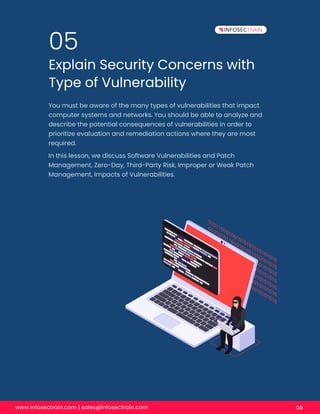
You must be aware of the many types of vulnerabilities that impact
computer systems and networks. You should be able to analyze and
describe the potential consequences of vulnerabilities in order to
prioritize evaluation and remediation actions where they are most
required.
In this lesson, we discuss Software Vulnerabilities and Patch
Management, Zero-Day, Third-Party Risk, Improper or Weak Patch
Management, Impacts of Vulnerabilities.
www.infosectrain.com | sales@infosectrain.com

CompTIA Security+ SY0-601 Domain 1

  • 2.
    www.infosectrain.com | sales@infosectrain.com01 About Security+ SY0-601 CompTIA Security+ is a worldwide certification that verifies the fundamental skills required to execute basic security activities and build a career in information security. CompTIA Security+ SY0-601 is the latest version of the Security+ certification. The very first security certification that IT professionals can obtain is CompTIA Security+, and it is the best entry-level certification. The main reason why CompTIA’s Security+(Plus) certification is such an excellent entry-level certification is It provides the fundamental information that each cybersecurity professional must have. Its areas are based on a straightforward premise: a major emphasis on practical skills. After passing the certification you can show that you are prepared to deal with a real-world scenario and It also provides a platform for intermediate-level cybersecurity positions.
  • 3.
    www.infosectrain.com | sales@infosectrain.com02 The latest version of Security+ SY0-601 have 5 Domains: Domain 1.0: Attacks, Threats, and Vulnerabilities (24%) Domain 2.0: Architecture and Design (21%) Domain 3.0: Implementation (25%) Domain 4.0: Operations and Incident Response (16%) Domain 5.0: Governance, Risk, and Compliance (14%) In this blog, we discuss the first domain Attacks, Threats, and Vulnerabilities.
  • 4.
    www.infosectrain.com | sales@infosectrain.com03 Attacks, Threats, and Vulnerabilities D O M A I N 1 The first domain of CompTIA Security+ (plus), SY0-601 addresses a fundamental requirement of every data security expert: the ability to detect and comprehend various threats, attack methods, and vulnerabilities that might be exploited. The weightage of this domain is 24%. In this domain, we learn about: 1. Social Engineering Techniques and Type 2. Malware Based Attack 3. Threat Actors, Vectors, and Threat Intelligence 4. Explain Penetration Testing Techniques 5. Explain Security Concerns with Type of Vulnerability
  • 5.
    www.infosectrain.com | sales@infosectrain.com04 Social Engineering Techniques and Type 01 In this lesson, we will learn all about social engineering and its techniques. We discuss various principles of social engineering like: • Familiarity • Social Proof • Authority and Intimidation • Scarcity and Urgency • Impersonation and trust We also cover Impersonation and Trust: It is a common technique of social engineering. Trying to pretend to be someone else is known as impersonation. After that we learn different types of social engineering: • Phishing • Smishing • Vishing • Spear Phishing • Dumpster Diving • Shoulder Surfing • Tailgating • Whaling
  • 6.
    www.infosectrain.com | sales@infosectrain.com05 Malware-Based Attack 02 Malicious code is one of the most common dangers to devices today. As a cybersecurity specialist, you will almost certainly have faced undesirable malware attacking your computers. You’ll be better equipped to fix affected systems or prevent malware if you classify the various forms of malware and recognize the indications of infection. In this part, we will discuss different types of Malware and how it Then we learn some different Malware Indicators, Sandbox Execution, Resource Consumption, and File system. • Ransomware • Trojans • Worms • PUPs (Potentially Unwanted Programs) • Bots • Rootkit • Backdoor
  • 7.
    www.infosectrain.com | sales@infosectrain.com06 Threat Actors, Vectors, and Threat Intelligence: 03 You should be able to describe defensive and attack tactics in order to conduct a successful security analysis. Your primary responsibility will most likely be protecting assets, but in order to do so, you’ll need to be able to describe threat actors’ strategies, techniques, and processes. You should also be able to discover trusted sources of threat intelligence and research as the threat landscape evolves. In this lesson we will learn 1. Threat Actor and Vectors: In this part, we will discuss types of threat actors: Insider Threat Actors, Hackers, Script Kiddies, Hacker Team, State Actors, Advanced Persistent Threats, and Criminal Syndicates. We also cover Attributes of Threat Actors. Inside this, we discuss Internal/External, Intent/Motivation, Level of Sophistication/Capability, Resources/Funding. Also, we understand Attack Vectors and how attack vectors help threat actors to gain access to a protected system. Inside Attack vector, we also learn Direct access, Removable media, Email, Remote and wireless, Social chain, and Cloud. 2. Threat Intelligence: In this part we explain threat intelligence, work of threat intelligence, we learn, Threat Intelligence Source and Research Source In Threat Intelligence Source we discuss Open-source intelligence (OSINT), Closed/ proprietary, Vulnerability databases, Public/private information sharing centers, Dark web, Indicators of compromise, and Threat maps.In Research Source we discuss: 1. Threat Actors and Vectors. 2. Threat Intelligence. • Vendor websites • Vulnerability feeds • Conferences • Academic journals • Request for Comments (RFC) • Local industry groups • Social media • Threat feeds • Adversary tactics, techniques, and procedures (TTP)
  • 8.
    www.infosectrain.com | sales@infosectrain.com07 Explain Penetration Testing Techniques 04 Penetration testing is a form of evaluation that uses well-known strategies and procedures to try to break into a system. In this part we understand Penetration Testing, inside this, we discuss: • Known environment • Unknown environment • Partially known environment • Rules of engagement • Lateral movement We understand Passive and active reconnaissance: We also cover Exercise Types. In this part, we learn about some Teams. What is the work of these teams: Red-team, Blue-team, White-team, Purple-team. • Drones • War flying • War driving • Footprinting • OSINT • Privilege escalation • Persistence • Cleanup • Bug bounty • Pivoting
  • 9.
    www.infosectrain.com | sales@infosectrain.com08 Explain Security Concerns with Type of Vulnerability 05 You must be aware of the many types of vulnerabilities that impact computer systems and networks. You should be able to analyze and describe the potential consequences of vulnerabilities in order to prioritize evaluation and remediation actions where they are most required. In this lesson, we discuss Software Vulnerabilities and Patch Management, Zero-Day, Third-Party Risk, Improper or Weak Patch Management, Impacts of Vulnerabilities.
  • 10.