


By
Ahmed Abdel Hamid
Mohamed Alwy
Outlines
• What’s Information Security ?
• General Paths of Security.
• How to Start your Information Security Path.
• Roles in information Security.
• Information Security Market Need .
• Opportunities in Middle East.
• Roadmap to Information Security.
• Hints in your Roadmap
• First Step why CompTIA Security + is the Main Gate.
• Q & A
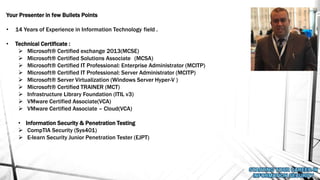
Your Presenter in few Bullets Points
• 14 Years of Experience in Information Technology field .
• Technical Certificate :
 Microsoft® Certified exchange 2013(MCSE)
 Microsoft® Certified Solutions Associate (MCSA)
 Microsoft® Certified IT Professional: Enterprise Administrator (MCITP)
 Microsoft® Certified IT Professional: Server Administrator (MCITP)
 Microsoft® Server Virtualization (Windows Server Hyper-V )
 Microsoft® Certified TRAINER (MCT)
 Infrastructure Library Foundation (ITIL v3)
 VMware Certified Associate(VCA)
 VMware Certified Associate – Cloud(VCA)
• Information Security & Penetration Testing
 CompTIA Security (Sys401)
 E-learn Security Junior Penetration Tester (EJPT)
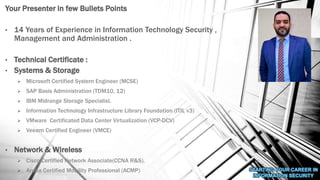
Your Presenter in few Bullets Points
• 14 Years of Experience in Information Technology Security ,
Management and Administration .
• Technical Certificate :
• Systems & Storage
 Microsoft Certified System Engineer (MCSE)
 SAP Basis Administration (TDM10, 12)
 IBM Midrange Storage Specialist.
 Information Technology Infrastructure Library Foundation (ITIL v3)
 VMware Certificated Data Center Virtualization (VCP-DCV)
 Veeam Certified Engineer (VMCE)
• Network & Wireless
 Cisco Certified Network Associate(CCNA R&S).
 Aruba Certified Mobility Professional (ACMP)
• Information Security & Penetration Testing
 CompTIA Security (Sys401)
 E-learn Security Junior Penetration Tester (EJPT)
 E-learn Security Certified Professional Penetration Tester(eCCPT)
 Certified Information Systems Security Professional (CISSP- In progress)
 Fortinet Network Security Expert 1, 2, 4, (NSE 1, 2, 4)
 Ruby Development
 Linux Kali , Arch , Black Arch .
• Academic Certificate
 BSc of Computer Science
 Master of Business Administration.
Current Positon : Senior information Security Consultant .
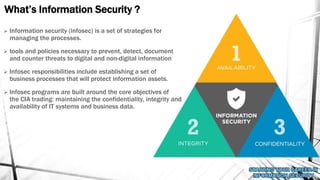
What’s Information Security ?
 Information security (infosec) is a set of strategies for
managing the processes.
 tools and policies necessary to prevent, detect, document
and counter threats to digital and non-digital information
 Infosec responsibilities include establishing a set of
business processes that will protect information assets.
 Infosec programs are built around the core objectives of
the CIA trading: maintaining the confidentiality, integrity and
availability of IT systems and business data.
 Is there a difference between cyber security and
information security?
• Information Security (also known as InfoSec) guarantees that the data,
including both physical and digital is safeguarded from unauthorized use,
access, disruption, inspection, modification, destruction or recording. In
case a business is beginning to generate a security program, Information
Security is where they should start; since, it is the data security foundation.
• Cyber security guarantees that the computers, data, and network of the
organization is defended from the unauthorized digital attack, access or
damage by the mean of implementing several processes, practices, and
technologies. This security is to prevent the data, network, and reputation
of the company against the attack.
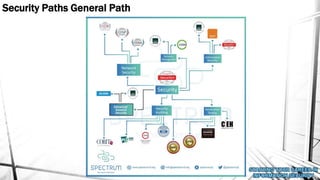
Security Paths General Path
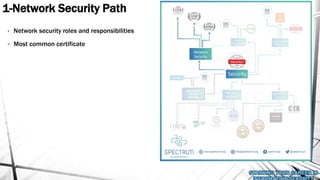
1-Network Security Path
• Network security roles and responsibilities
• Most common certificate
Network security roles and responsibilities
• Guarantee network security best practices are executed through
auditing: router, change control, switch, firewall configurations, and
monitoring.
• Coordinate and oversee log analysis for company managed
services offerings to ensure customer policy and security
requirements are met
• Maintain network security devices to enable pro-active defense of
networks within a managed service SOC environment, providing
protective monitoring to multiple commercial customers
• efficient on-boarding and understanding of varying customer log
sources into SIEM environments
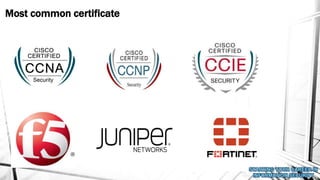
Most common certificate
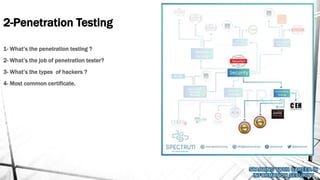
2-Penetration Testing
1- What’s the penetration testing ?
2- What’s the job of penetration tester?
3- What’s the types of hackers ?
4- Most common certificate.
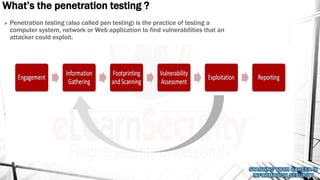
What’s the penetration testing ?
 Penetration testing (also called pen testing) is the practice of testing a
computer system, network or Web application to find vulnerabilities that an
attacker could exploit.
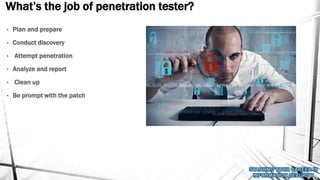
What’s the job of penetration tester?
• Plan and prepare
• Conduct discovery
• Attempt penetration
• Analyze and report
• Clean up
• Be prompt with the patch
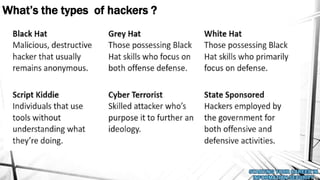
What’s the types of hackers ?
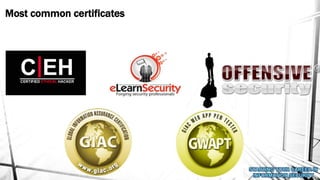
Most common certificates
How to Start your Information Security Path.
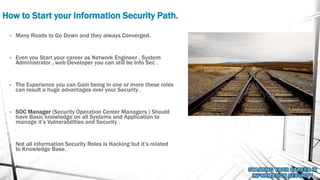
• Many Roads to Go Down and they always Converged.
• Even you Start your career as Network Engineer , System
Administrator , web Developer you can still be Info Sec .
• The Experience you can Gain being in one or more these roles
can result a huge advantages over your Security .
• SOC Manager (Security Operation Center Managers ) Should
have Basic knowledge on all Systems and Application to
manage it’s Vulnerabilities and Security .
• Not all information Security Roles is Hacking but it’s related
to Knowledge Base.
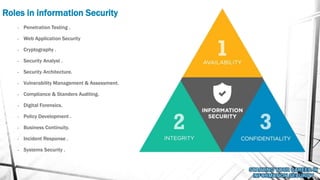
Roles in information Security
- Penetration Testing .
- Web Application Security
- Cryptography .
- Security Analyst .
- Security Architecture.
- Vulnerability Management & Assessment.
- Compliance & Standers Auditing.
- Digital Forensics.
- Policy Development .
- Business Continuity.
- Incident Response .
- Systems Security .
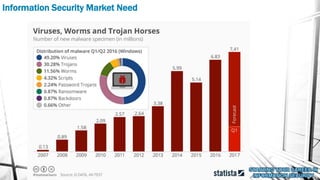
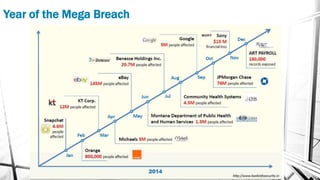
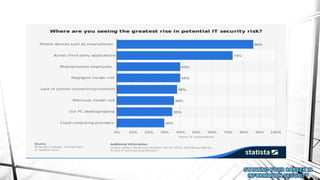
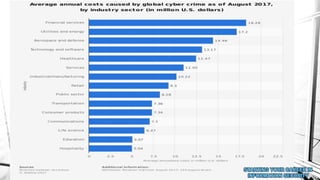
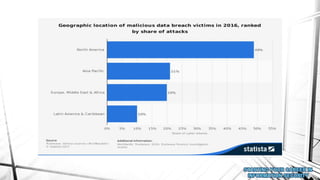
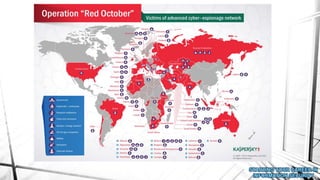
Information Security Market Need
Year of the Mega Breach
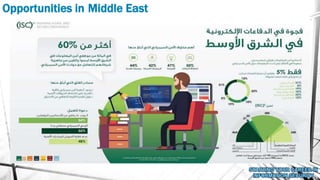
Opportunities in Middle East
Opportunities in Saudi Arabia
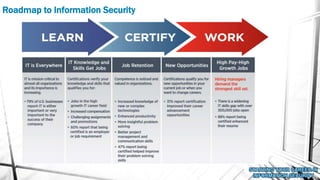
Roadmap to Information Security
Hints in your Roadmap
• Choose a Roadmap Plan with Certificates .
• Learn To Hack And Then Learn To Automate using Programming
Language
• Try Your Hand At Security Research .
• Participate In Team Activities Like Capture The Flag Information
Security.
• Pay attention to information security news web sites.
• Don’t break into anything without permission.
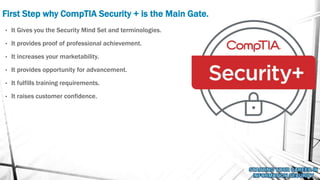
First Step why CompTIA Security + is the Main Gate.
• It Gives you the Security Mind Set and terminologies.
• It provides proof of professional achievement.
• It increases your marketability.
• It provides opportunity for advancement.
• It fulfills training requirements.
• It raises customer confidence.
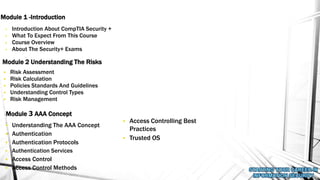
• Introduction About CompTIA Security +
• What To Expect From This Course
• Course Overview
• About The Security+ Exams
Module 1 -Introduction
Module 2 Understanding The Risks
• Risk Assessment
• Risk Calculation
• Policies Standards And Guidelines
• Understanding Control Types
• Risk Management
Module 3 AAA Concept
• Understanding The AAA Concept
• Authentication
• Authentication Protocols
• Authentication Services
• Access Control
• Access Control Methods
• Access Controlling Best
Practices
• Trusted OS
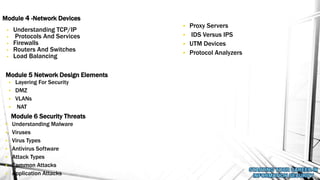
• Understanding TCP/IP
• Protocols And Services
• Firewalls
• Routers And Switches
• Load Balancing
Module 4 -Network Devices
Module 5 Network Design Elements
• Layering For Security
• DMZ
• VLANs
• NAT
Module 6 Security Threats
• Understanding Malware
• Viruses
• Virus Types
• Antivirus Software
• Attack Types
• Common Attacks
• Application Attacks
• Proxy Servers
• IDS Versus IPS
• UTM Devices
• Protocol Analyzers
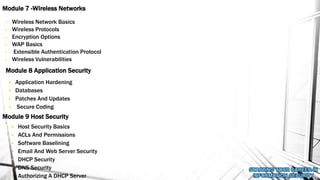
• Wireless Network Basics
• Wireless Protocols
• Encryption Options
• WAP Basics
• Extensible Authentication Protocol
• Wireless Vulnerabilities
Module 7 -Wireless Networks
Module 8 Application Security
• Application Hardening
• Databases
• Patches And Updates
• Secure Coding
Module 9 Host Security
• Host Security Basics
• ACLs And Permissions
• Software Baselining
• Email And Web Server Security
• DHCP Security
• DNS Security
• Authorizing A DHCP Server
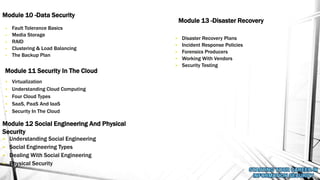
• Fault Tolerance Basics
• Media Storage
• RAID
• Clustering & Load Balancing
• The Backup Plan
Module 10 -Data Security
Module 11 Security In The Cloud
• Understanding Social Engineering
• Social Engineering Types
• Dealing With Social Engineering
• Physical Security
Module 12 Social Engineering And Physical
Security
• Virtualization
• Understanding Cloud Computing
• Four Cloud Types
• SaaS, PaaS And IaaS
• Security In The Cloud
Module 13 -Disaster Recovery
• Disaster Recovery Plans
• Incident Response Policies
• Forensics Producers
• Working With Vendors
• Security Testing
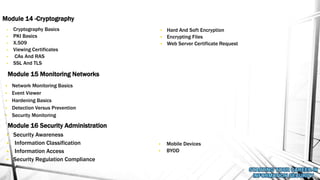
• Cryptography Basics
• PKI Basics
• X.509
• Viewing Certificates
• CAs And RAS
• SSL And TLS
Module 14 -Cryptography
Module 15 Monitoring Networks
• Security Awareness
• Information Classification
• Information Access
• Security Regulation Compliance
Module 16 Security Administration
• Network Monitoring Basics
• Event Viewer
• Hardening Basics
• Detection Versus Prevention
• Security Monitoring
• Hard And Soft Encryption
• Encrypting Files
• Web Server Certificate Request
• Mobile Devices
• BYOD
Starting your Career in Information Security

Starting your Career in Information Security

  • 1.
  • 2.
    Outlines • What’s InformationSecurity ? • General Paths of Security. • How to Start your Information Security Path. • Roles in information Security. • Information Security Market Need . • Opportunities in Middle East. • Roadmap to Information Security. • Hints in your Roadmap • First Step why CompTIA Security + is the Main Gate. • Q & A
  • 3.
    Your Presenter infew Bullets Points • 14 Years of Experience in Information Technology field . • Technical Certificate :  Microsoft® Certified exchange 2013(MCSE)  Microsoft® Certified Solutions Associate (MCSA)  Microsoft® Certified IT Professional: Enterprise Administrator (MCITP)  Microsoft® Certified IT Professional: Server Administrator (MCITP)  Microsoft® Server Virtualization (Windows Server Hyper-V )  Microsoft® Certified TRAINER (MCT)  Infrastructure Library Foundation (ITIL v3)  VMware Certified Associate(VCA)  VMware Certified Associate – Cloud(VCA) • Information Security & Penetration Testing  CompTIA Security (Sys401)  E-learn Security Junior Penetration Tester (EJPT)
  • 4.
    Your Presenter infew Bullets Points • 14 Years of Experience in Information Technology Security , Management and Administration . • Technical Certificate : • Systems & Storage  Microsoft Certified System Engineer (MCSE)  SAP Basis Administration (TDM10, 12)  IBM Midrange Storage Specialist.  Information Technology Infrastructure Library Foundation (ITIL v3)  VMware Certificated Data Center Virtualization (VCP-DCV)  Veeam Certified Engineer (VMCE) • Network & Wireless  Cisco Certified Network Associate(CCNA R&S).  Aruba Certified Mobility Professional (ACMP)
  • 5.
    • Information Security& Penetration Testing  CompTIA Security (Sys401)  E-learn Security Junior Penetration Tester (EJPT)  E-learn Security Certified Professional Penetration Tester(eCCPT)  Certified Information Systems Security Professional (CISSP- In progress)  Fortinet Network Security Expert 1, 2, 4, (NSE 1, 2, 4)  Ruby Development  Linux Kali , Arch , Black Arch . • Academic Certificate  BSc of Computer Science  Master of Business Administration. Current Positon : Senior information Security Consultant .
  • 6.
    What’s Information Security?  Information security (infosec) is a set of strategies for managing the processes.  tools and policies necessary to prevent, detect, document and counter threats to digital and non-digital information  Infosec responsibilities include establishing a set of business processes that will protect information assets.  Infosec programs are built around the core objectives of the CIA trading: maintaining the confidentiality, integrity and availability of IT systems and business data.
  • 7.
     Is therea difference between cyber security and information security? • Information Security (also known as InfoSec) guarantees that the data, including both physical and digital is safeguarded from unauthorized use, access, disruption, inspection, modification, destruction or recording. In case a business is beginning to generate a security program, Information Security is where they should start; since, it is the data security foundation. • Cyber security guarantees that the computers, data, and network of the organization is defended from the unauthorized digital attack, access or damage by the mean of implementing several processes, practices, and technologies. This security is to prevent the data, network, and reputation of the company against the attack.
  • 8.
  • 9.
    1-Network Security Path •Network security roles and responsibilities • Most common certificate
  • 10.
    Network security rolesand responsibilities • Guarantee network security best practices are executed through auditing: router, change control, switch, firewall configurations, and monitoring. • Coordinate and oversee log analysis for company managed services offerings to ensure customer policy and security requirements are met • Maintain network security devices to enable pro-active defense of networks within a managed service SOC environment, providing protective monitoring to multiple commercial customers • efficient on-boarding and understanding of varying customer log sources into SIEM environments
  • 11.
  • 12.
    2-Penetration Testing 1- What’sthe penetration testing ? 2- What’s the job of penetration tester? 3- What’s the types of hackers ? 4- Most common certificate.
  • 13.
    What’s the penetrationtesting ?  Penetration testing (also called pen testing) is the practice of testing a computer system, network or Web application to find vulnerabilities that an attacker could exploit.
  • 14.
    What’s the jobof penetration tester? • Plan and prepare • Conduct discovery • Attempt penetration • Analyze and report • Clean up • Be prompt with the patch
  • 15.
    What’s the typesof hackers ?
  • 16.
  • 17.
    How to Startyour Information Security Path. • Many Roads to Go Down and they always Converged. • Even you Start your career as Network Engineer , System Administrator , web Developer you can still be Info Sec . • The Experience you can Gain being in one or more these roles can result a huge advantages over your Security . • SOC Manager (Security Operation Center Managers ) Should have Basic knowledge on all Systems and Application to manage it’s Vulnerabilities and Security . • Not all information Security Roles is Hacking but it’s related to Knowledge Base.
  • 18.
    Roles in informationSecurity - Penetration Testing . - Web Application Security - Cryptography . - Security Analyst . - Security Architecture. - Vulnerability Management & Assessment. - Compliance & Standers Auditing. - Digital Forensics. - Policy Development . - Business Continuity. - Incident Response . - Systems Security .
  • 20.
  • 21.
    Year of theMega Breach
  • 26.
  • 27.
  • 28.
  • 29.
    Hints in yourRoadmap • Choose a Roadmap Plan with Certificates . • Learn To Hack And Then Learn To Automate using Programming Language • Try Your Hand At Security Research . • Participate In Team Activities Like Capture The Flag Information Security. • Pay attention to information security news web sites. • Don’t break into anything without permission.
  • 30.
    First Step whyCompTIA Security + is the Main Gate. • It Gives you the Security Mind Set and terminologies. • It provides proof of professional achievement. • It increases your marketability. • It provides opportunity for advancement. • It fulfills training requirements. • It raises customer confidence.
  • 32.
    • Introduction AboutCompTIA Security + • What To Expect From This Course • Course Overview • About The Security+ Exams Module 1 -Introduction Module 2 Understanding The Risks • Risk Assessment • Risk Calculation • Policies Standards And Guidelines • Understanding Control Types • Risk Management Module 3 AAA Concept • Understanding The AAA Concept • Authentication • Authentication Protocols • Authentication Services • Access Control • Access Control Methods • Access Controlling Best Practices • Trusted OS
  • 33.
    • Understanding TCP/IP •Protocols And Services • Firewalls • Routers And Switches • Load Balancing Module 4 -Network Devices Module 5 Network Design Elements • Layering For Security • DMZ • VLANs • NAT Module 6 Security Threats • Understanding Malware • Viruses • Virus Types • Antivirus Software • Attack Types • Common Attacks • Application Attacks • Proxy Servers • IDS Versus IPS • UTM Devices • Protocol Analyzers
  • 34.
    • Wireless NetworkBasics • Wireless Protocols • Encryption Options • WAP Basics • Extensible Authentication Protocol • Wireless Vulnerabilities Module 7 -Wireless Networks Module 8 Application Security • Application Hardening • Databases • Patches And Updates • Secure Coding Module 9 Host Security • Host Security Basics • ACLs And Permissions • Software Baselining • Email And Web Server Security • DHCP Security • DNS Security • Authorizing A DHCP Server
  • 35.
    • Fault ToleranceBasics • Media Storage • RAID • Clustering & Load Balancing • The Backup Plan Module 10 -Data Security Module 11 Security In The Cloud • Understanding Social Engineering • Social Engineering Types • Dealing With Social Engineering • Physical Security Module 12 Social Engineering And Physical Security • Virtualization • Understanding Cloud Computing • Four Cloud Types • SaaS, PaaS And IaaS • Security In The Cloud Module 13 -Disaster Recovery • Disaster Recovery Plans • Incident Response Policies • Forensics Producers • Working With Vendors • Security Testing
  • 36.
    • Cryptography Basics •PKI Basics • X.509 • Viewing Certificates • CAs And RAS • SSL And TLS Module 14 -Cryptography Module 15 Monitoring Networks • Security Awareness • Information Classification • Information Access • Security Regulation Compliance Module 16 Security Administration • Network Monitoring Basics • Event Viewer • Hardening Basics • Detection Versus Prevention • Security Monitoring • Hard And Soft Encryption • Encrypting Files • Web Server Certificate Request • Mobile Devices • BYOD

Editor's Notes

  • #33 How presentation will benefit audience: Adult learners are more interested in a subject if they know how or why it is important to them. Presenter’s level of expertise in the subject: Briefly state your credentials in this area, or explain why participants should listen to you.
  • #34 How presentation will benefit audience: Adult learners are more interested in a subject if they know how or why it is important to them. Presenter’s level of expertise in the subject: Briefly state your credentials in this area, or explain why participants should listen to you.
  • #35 How presentation will benefit audience: Adult learners are more interested in a subject if they know how or why it is important to them. Presenter’s level of expertise in the subject: Briefly state your credentials in this area, or explain why participants should listen to you.
  • #36 How presentation will benefit audience: Adult learners are more interested in a subject if they know how or why it is important to them. Presenter’s level of expertise in the subject: Briefly state your credentials in this area, or explain why participants should listen to you.
  • #37 How presentation will benefit audience: Adult learners are more interested in a subject if they know how or why it is important to them. Presenter’s level of expertise in the subject: Briefly state your credentials in this area, or explain why participants should listen to you.