COMPRESSIBLE FLOWS
C.A.Ruwanpathirana
Eng/16/025
1
INCOMPRESSIBLE FLOWS
• Flow in which the material density is constant within a fluid parcel an
infinitesimal volume that moves with the flow velocity.
• Also known as Isochoric flow.
• Purely incompressible flows are never exist.
• Fluid flows which has less density changes can be assumed as
incompressible flows.
2
COMPRESSIBLE FLOWS
• The density of fluid does not remain constant during the process of
flow.
• Density of the fluid changes from point to point in compressible flow.
• All real fluids are compressible fluid flows.
3
COMPRESSIBLE FLOWS
• Ex: -The flight of projectiles and aero planes moving at high altitude
with high velocity
-Flow of gases through nozzles and orifices
-Flow of gases in compressors
4
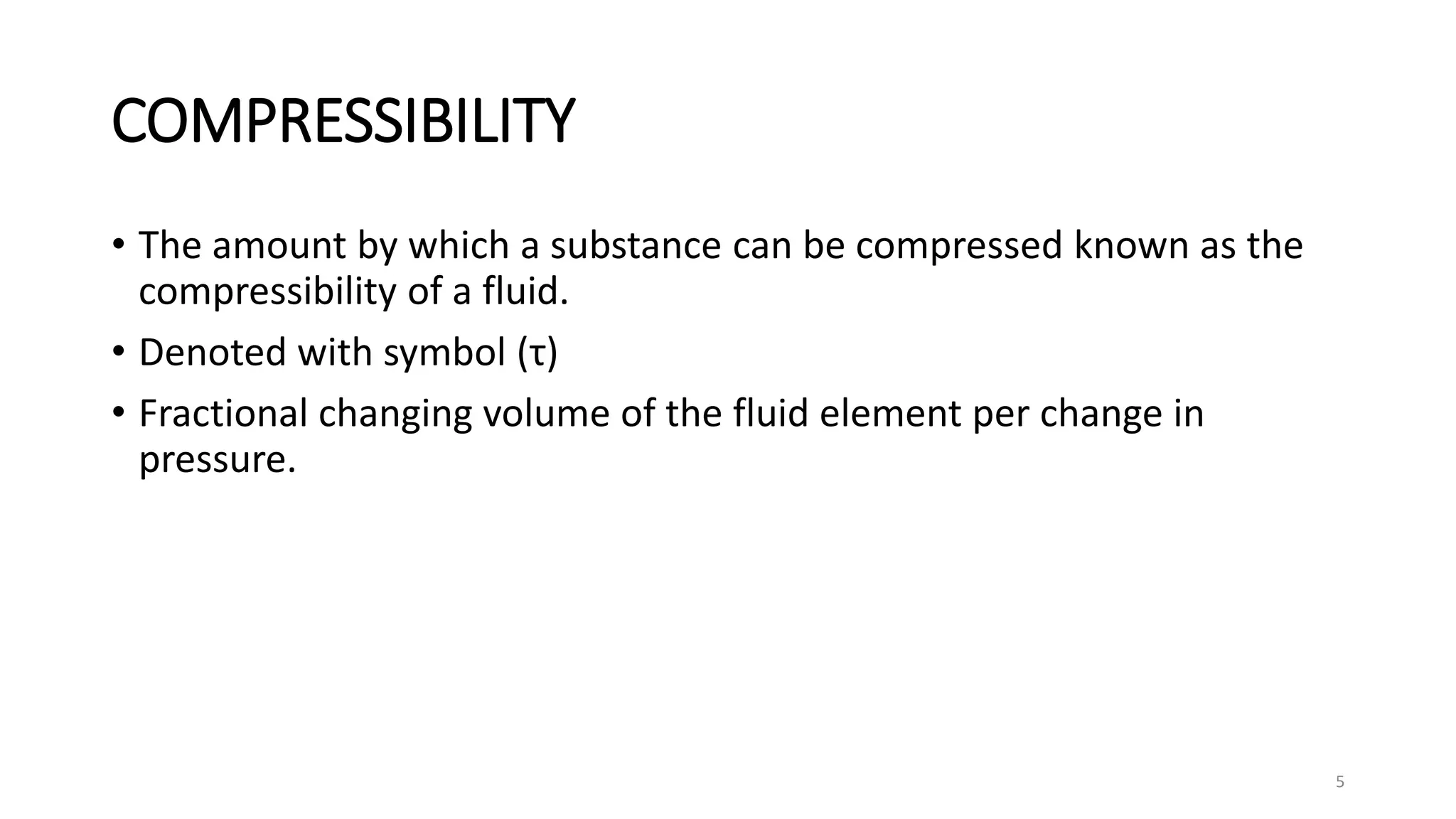
COMPRESSIBILITY
• The amount by which a substance can be compressed known as the
compressibility of a fluid.
• Denoted with symbol (τ)
• Fractional changing volume of the fluid element per change in
pressure.
5
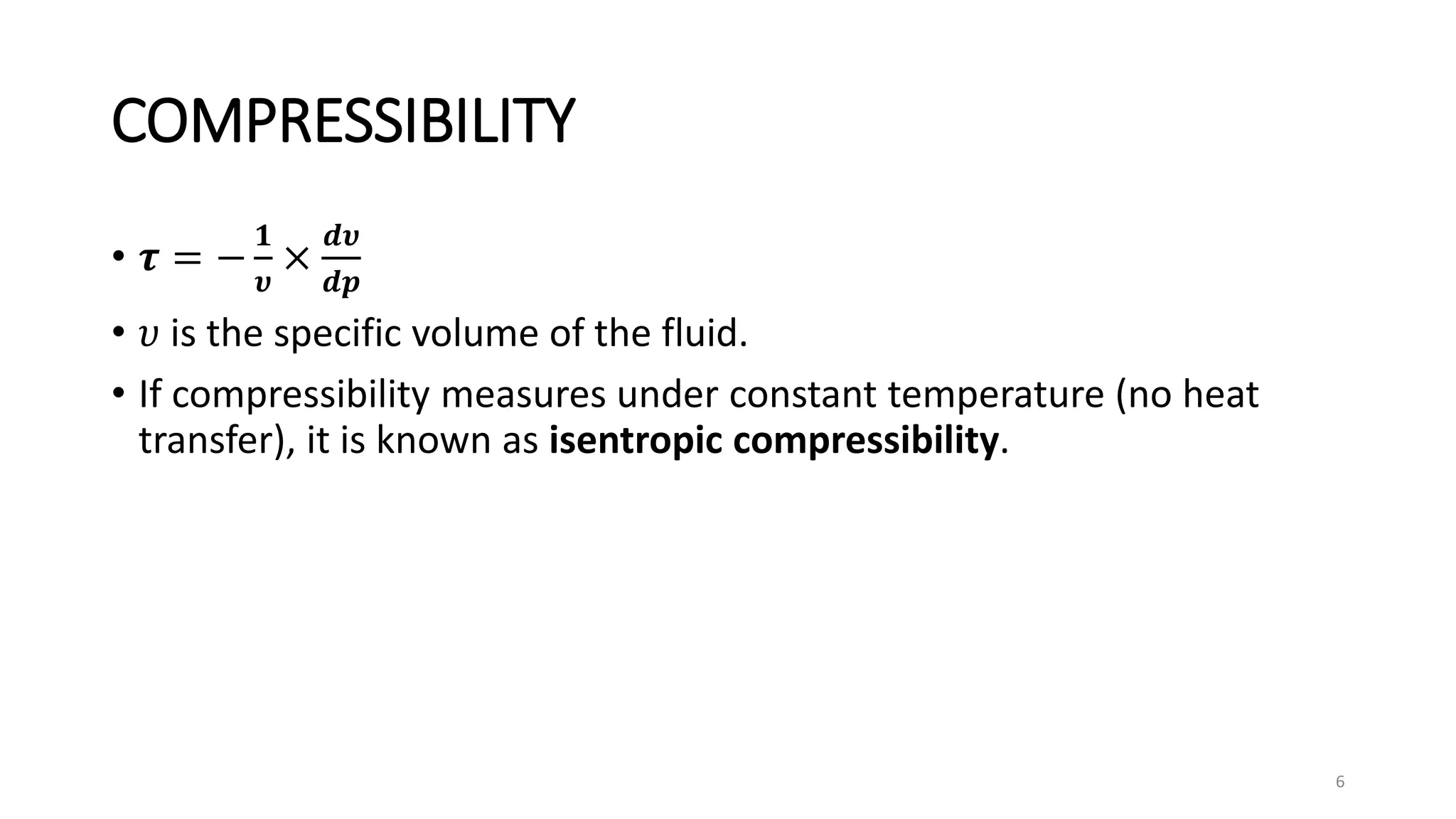
COMPRESSIBILITY
• 𝝉 = −
𝟏
𝝊
×
𝒅𝝊
𝒅𝒑
• 𝜐 is the specific volume of the fluid.
• If compressibility measures under constant temperature (no heat
transfer), it is known as isentropic compressibility.
6
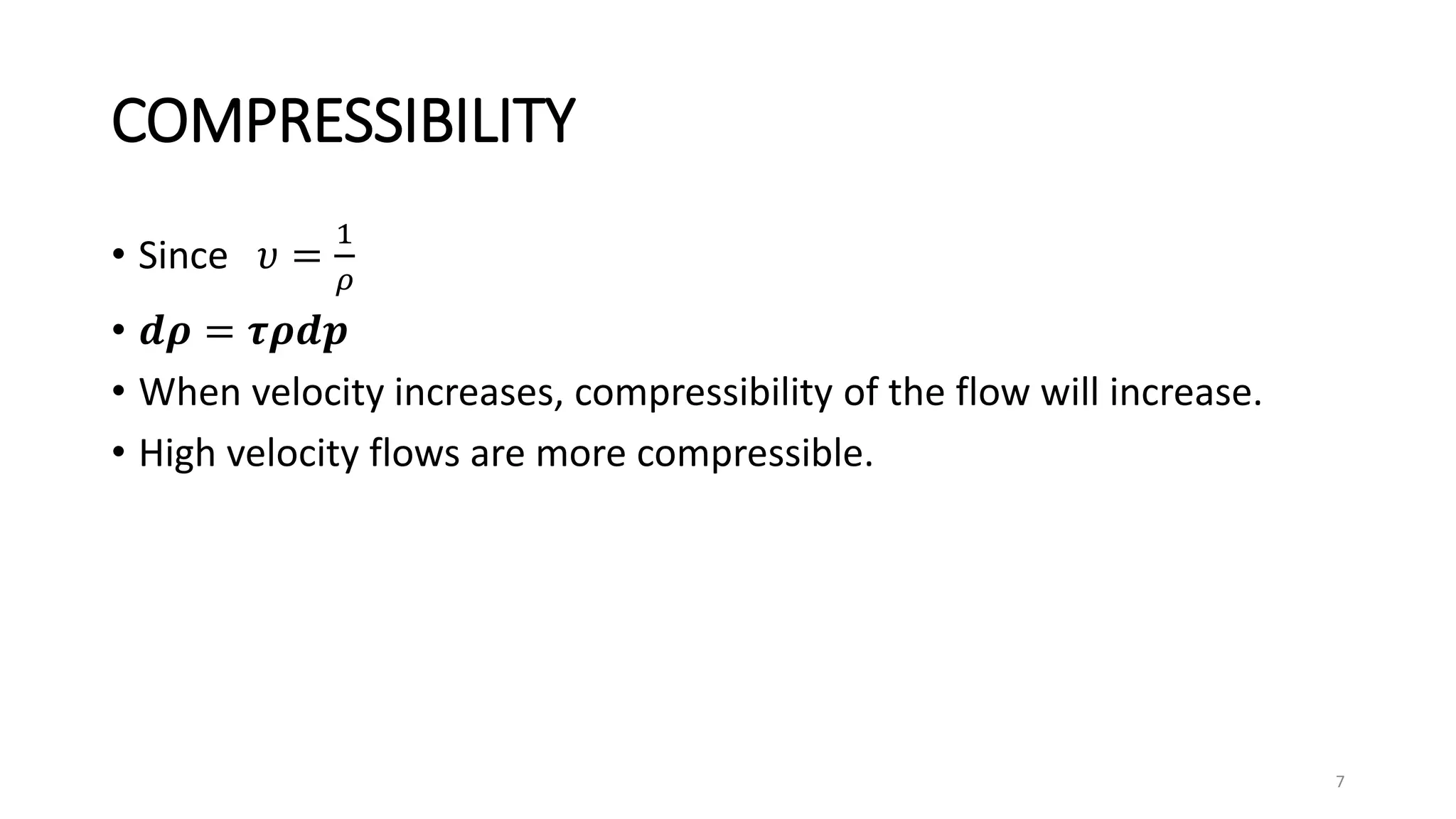
COMPRESSIBILITY
• Since 𝜐 =
1
𝜌
• 𝒅𝝆 = 𝝉𝝆𝒅𝒑
• When velocity increases, compressibility of the flow will increase.
• High velocity flows are more compressible.
7
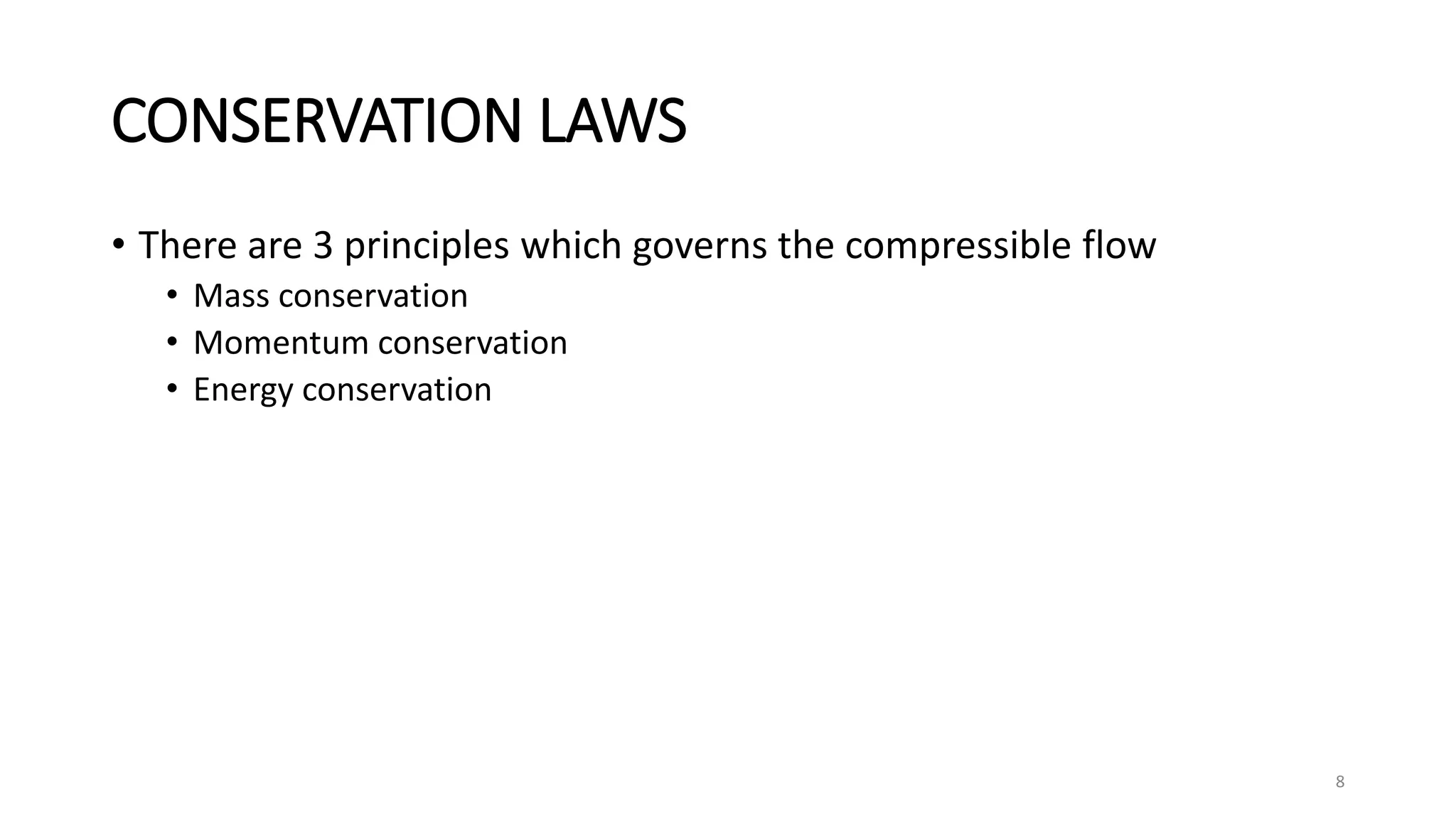
CONSERVATION LAWS
• There are 3 principles which governs the compressible flow
• Mass conservation
• Momentum conservation
• Energy conservation
8
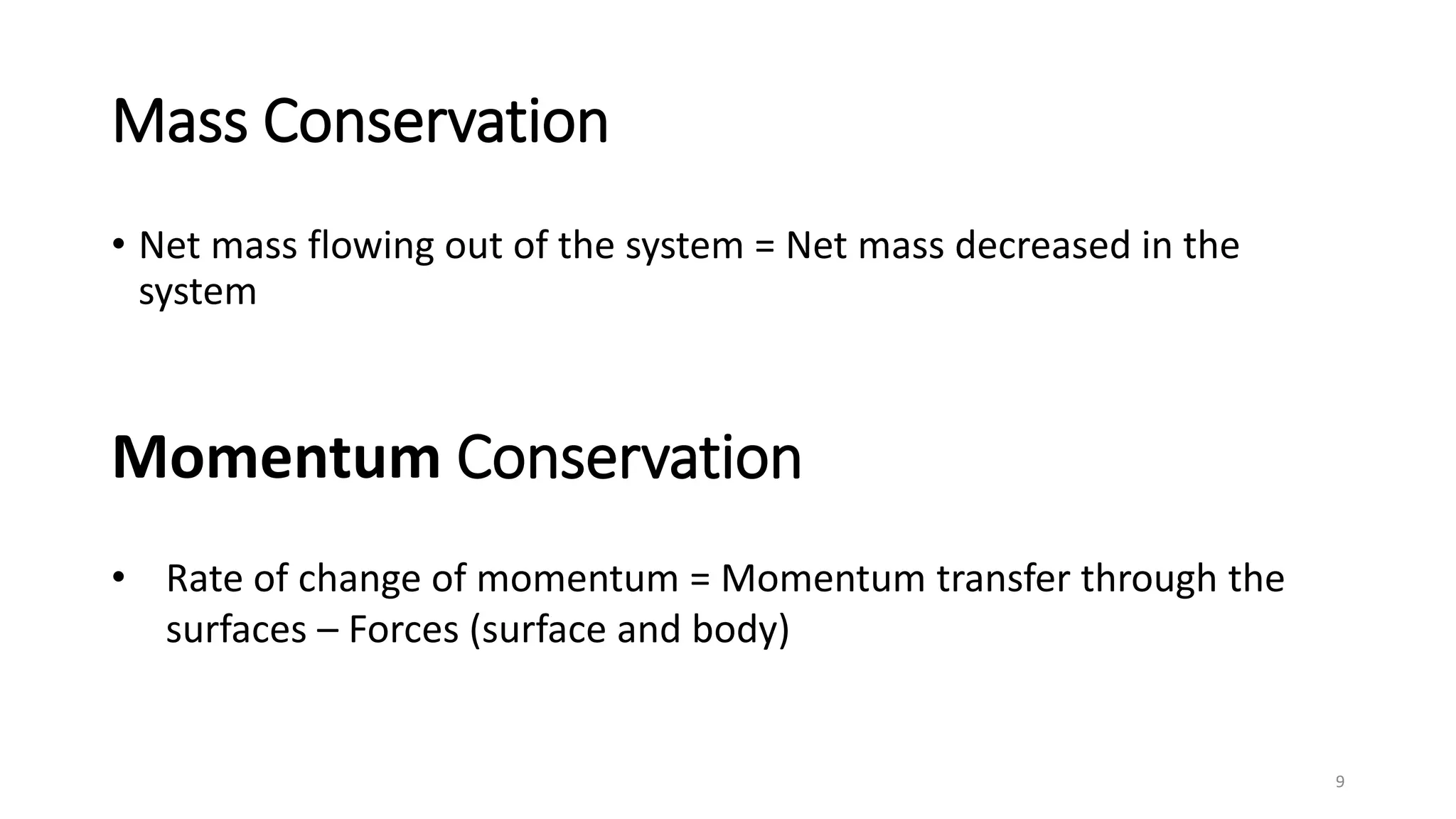
Mass Conservation
• Net mass flowing out of the system = Net mass decreased in the
system
9
Momentum Conservation
• Rate of change of momentum = Momentum transfer through the
surfaces – Forces (surface and body)
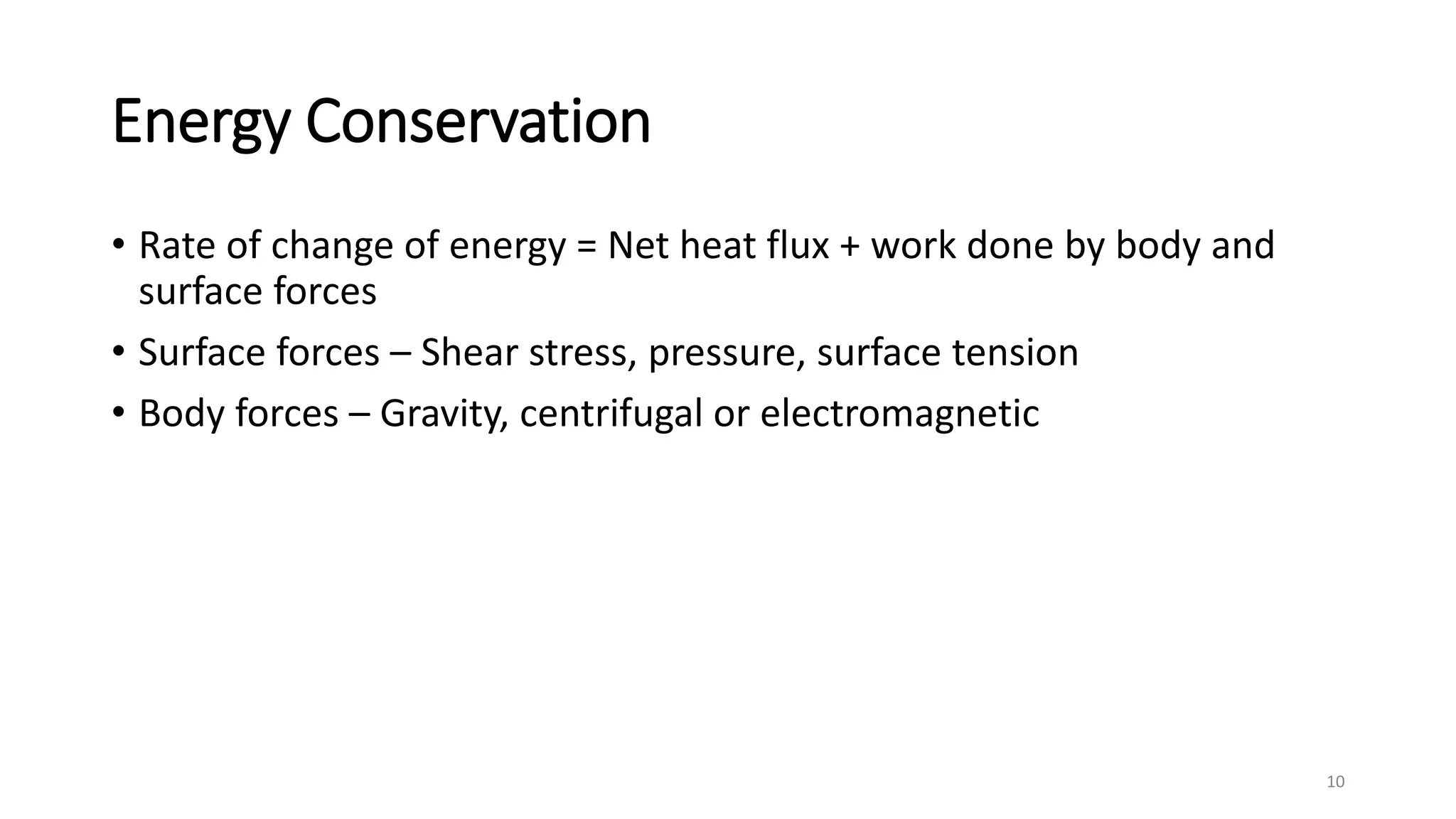
Energy Conservation
• Rate of change of energy = Net heat flux + work done by body and
surface forces
• Surface forces – Shear stress, pressure, surface tension
• Body forces – Gravity, centrifugal or electromagnetic
10
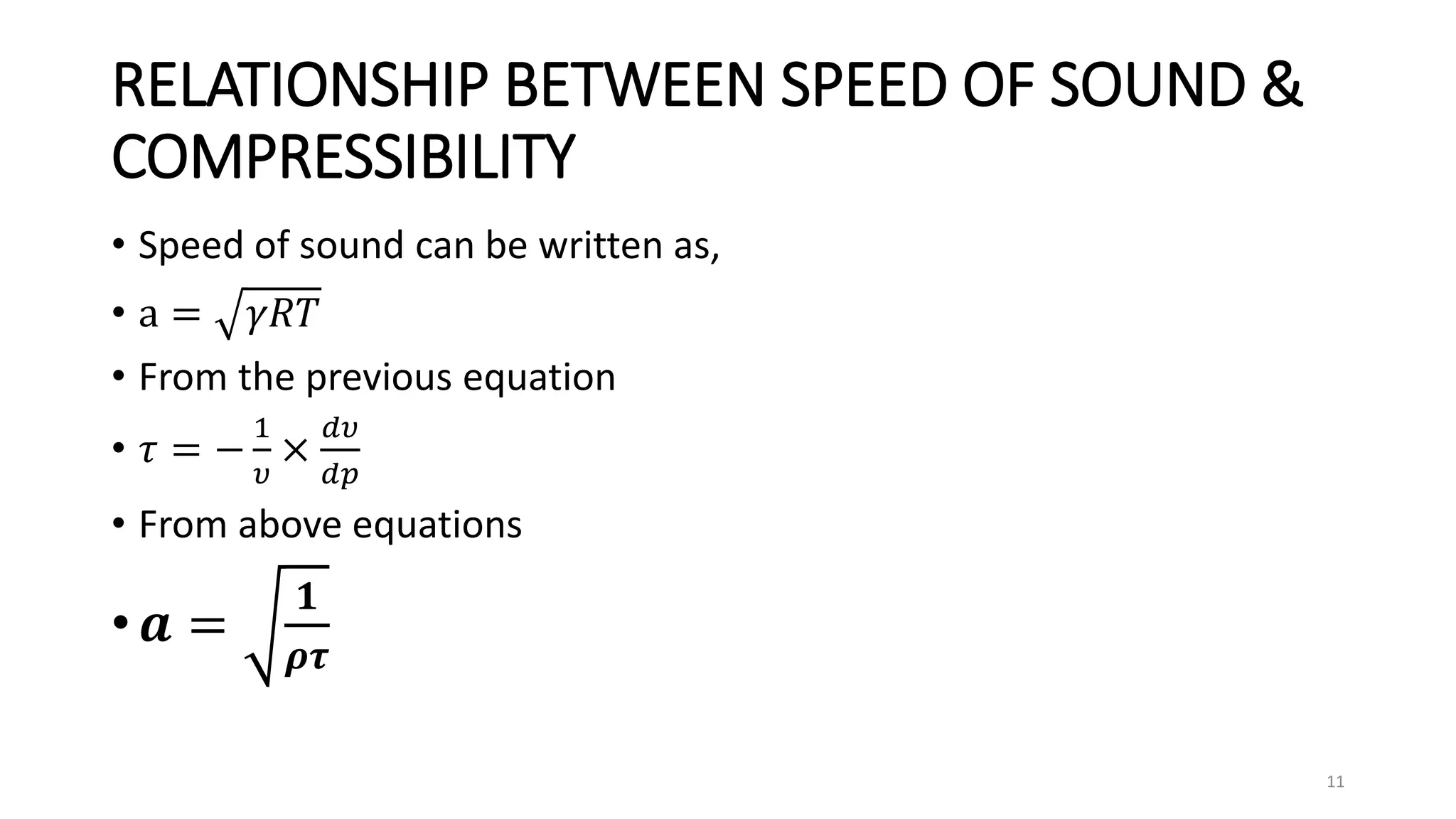
RELATIONSHIP BETWEEN SPEED OF SOUND &
COMPRESSIBILITY
• Speed of sound can be written as,
• a = 𝛾𝑅𝑇
• From the previous equation
• 𝜏 = −
1
𝜐
×
𝑑𝜐
𝑑𝑝
• From above equations
• 𝒂 =
𝟏
𝝆𝝉
11
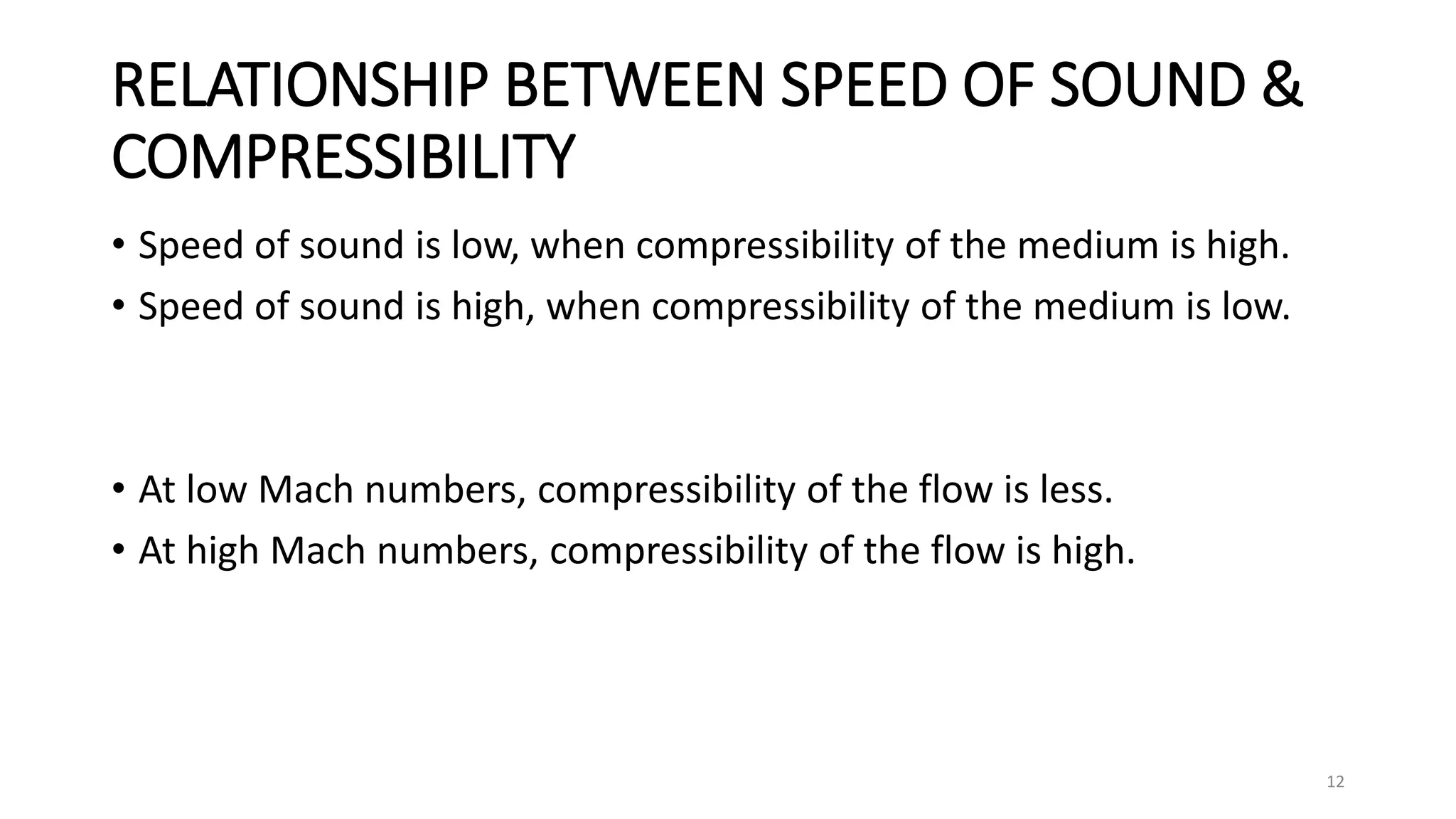
RELATIONSHIP BETWEEN SPEED OF SOUND &
COMPRESSIBILITY
• Speed of sound is low, when compressibility of the medium is high.
• Speed of sound is high, when compressibility of the medium is low.
• At low Mach numbers, compressibility of the flow is less.
• At high Mach numbers, compressibility of the flow is high.
12
RELATIONSHIP BETWEEN SPEED OF SOUND &
COMPRESSIBILITY
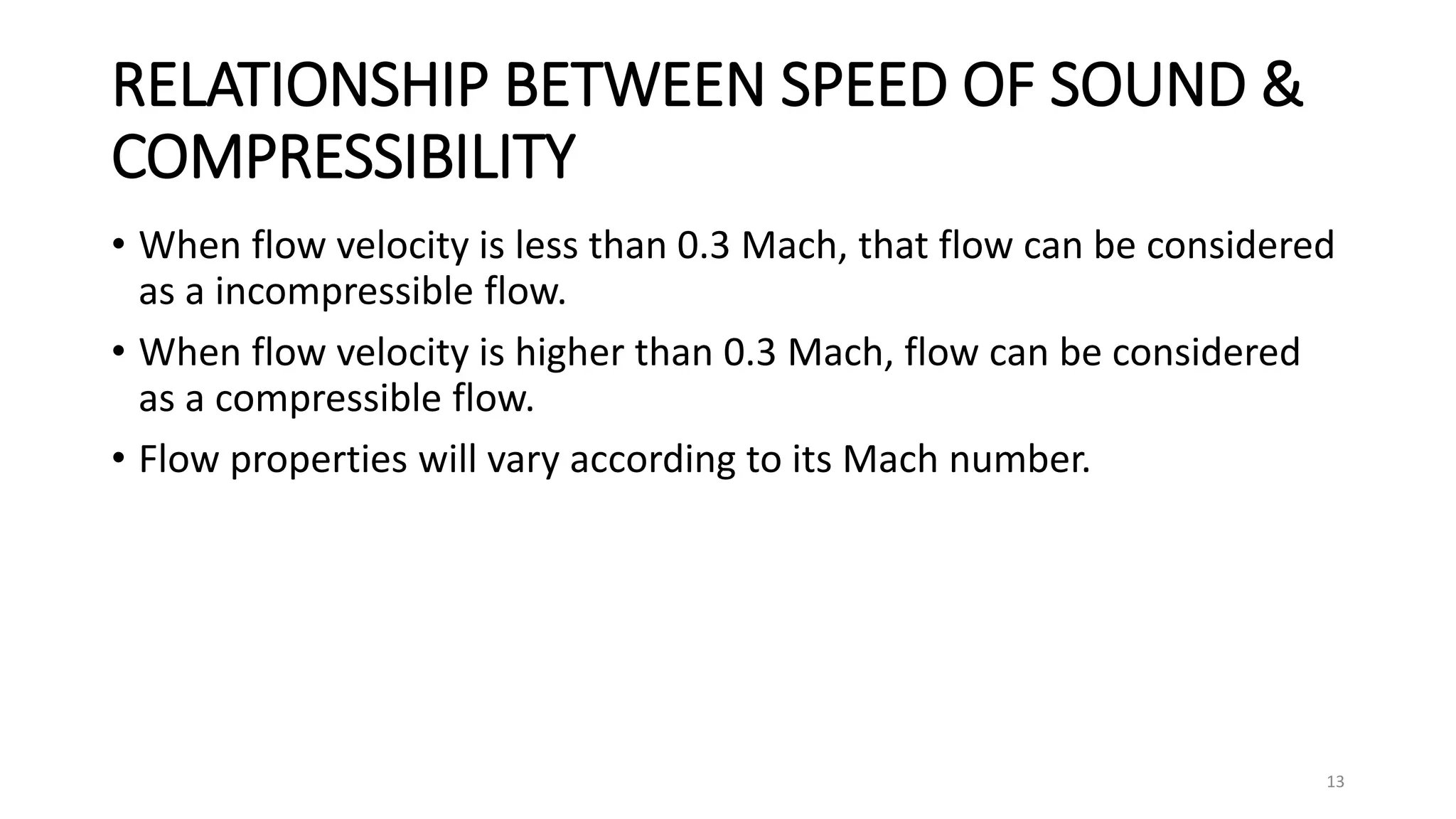
• When flow velocity is less than 0.3 Mach, that flow can be considered
as a incompressible flow.
• When flow velocity is higher than 0.3 Mach, flow can be considered
as a compressible flow.
• Flow properties will vary according to its Mach number.
13
RELATIONSHIP BETWEEN SPEED OF SOUND &
COMPRESSIBILITY
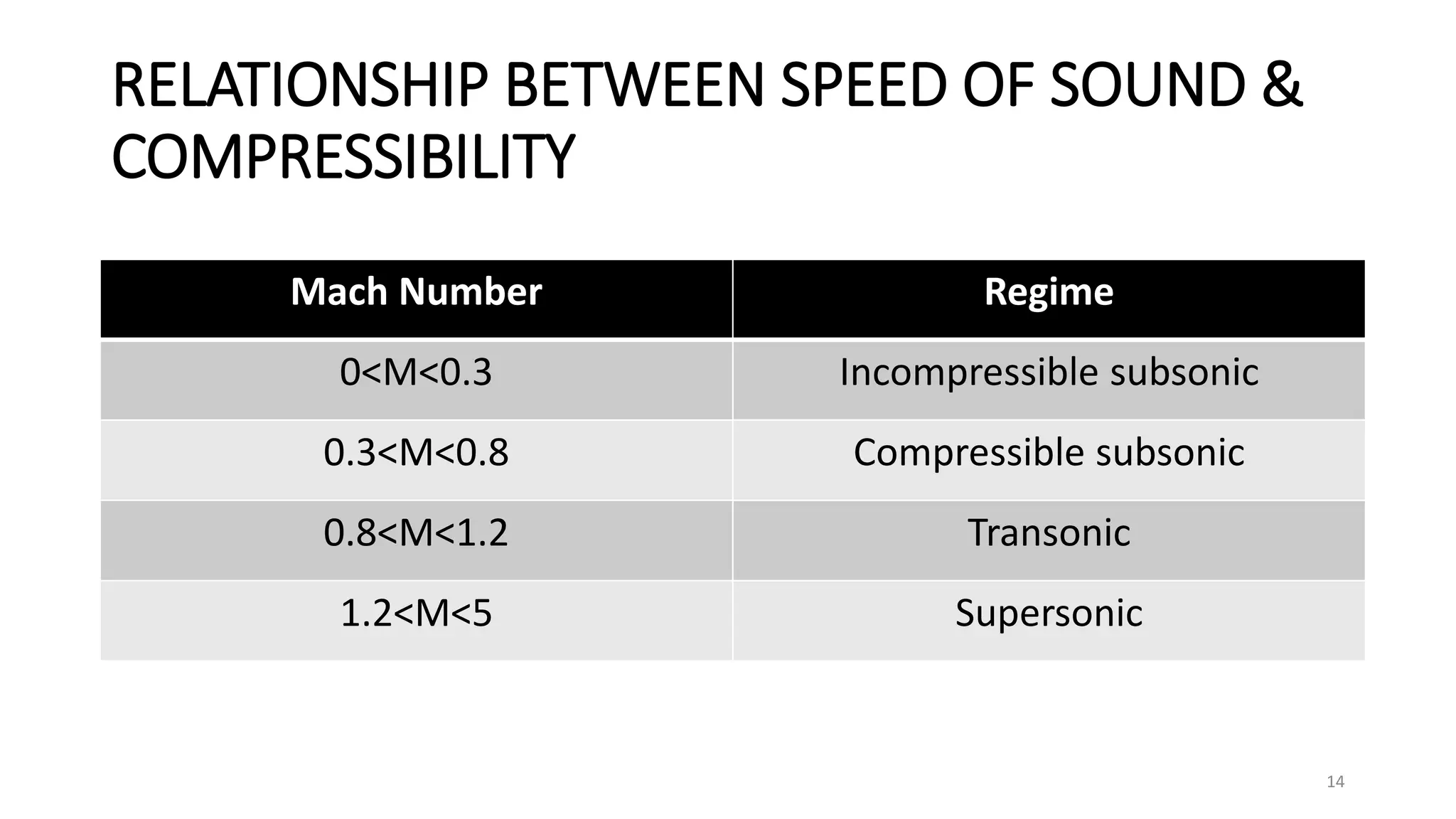
Mach Number Regime
0<M<0.3 Incompressible subsonic
0.3<M<0.8 Compressible subsonic
0.8<M<1.2 Transonic
1.2<M<5 Supersonic
14
QUESTIONS
????
15
THANK YOU
16

Compressible flows

  • 1.
  • 2.
    INCOMPRESSIBLE FLOWS • Flowin which the material density is constant within a fluid parcel an infinitesimal volume that moves with the flow velocity. • Also known as Isochoric flow. • Purely incompressible flows are never exist. • Fluid flows which has less density changes can be assumed as incompressible flows. 2
  • 3.
    COMPRESSIBLE FLOWS • Thedensity of fluid does not remain constant during the process of flow. • Density of the fluid changes from point to point in compressible flow. • All real fluids are compressible fluid flows. 3
  • 4.
    COMPRESSIBLE FLOWS • Ex:-The flight of projectiles and aero planes moving at high altitude with high velocity -Flow of gases through nozzles and orifices -Flow of gases in compressors 4
  • 5.
    COMPRESSIBILITY • The amountby which a substance can be compressed known as the compressibility of a fluid. • Denoted with symbol (τ) • Fractional changing volume of the fluid element per change in pressure. 5
  • 6.
    COMPRESSIBILITY • 𝝉 =− 𝟏 𝝊 × 𝒅𝝊 𝒅𝒑 • 𝜐 is the specific volume of the fluid. • If compressibility measures under constant temperature (no heat transfer), it is known as isentropic compressibility. 6
  • 7.
    COMPRESSIBILITY • Since 𝜐= 1 𝜌 • 𝒅𝝆 = 𝝉𝝆𝒅𝒑 • When velocity increases, compressibility of the flow will increase. • High velocity flows are more compressible. 7
  • 8.
    CONSERVATION LAWS • Thereare 3 principles which governs the compressible flow • Mass conservation • Momentum conservation • Energy conservation 8
  • 9.
    Mass Conservation • Netmass flowing out of the system = Net mass decreased in the system 9 Momentum Conservation • Rate of change of momentum = Momentum transfer through the surfaces – Forces (surface and body)
  • 10.
    Energy Conservation • Rateof change of energy = Net heat flux + work done by body and surface forces • Surface forces – Shear stress, pressure, surface tension • Body forces – Gravity, centrifugal or electromagnetic 10
  • 11.
    RELATIONSHIP BETWEEN SPEEDOF SOUND & COMPRESSIBILITY • Speed of sound can be written as, • a = 𝛾𝑅𝑇 • From the previous equation • 𝜏 = − 1 𝜐 × 𝑑𝜐 𝑑𝑝 • From above equations • 𝒂 = 𝟏 𝝆𝝉 11
  • 12.
    RELATIONSHIP BETWEEN SPEEDOF SOUND & COMPRESSIBILITY • Speed of sound is low, when compressibility of the medium is high. • Speed of sound is high, when compressibility of the medium is low. • At low Mach numbers, compressibility of the flow is less. • At high Mach numbers, compressibility of the flow is high. 12
  • 13.
    RELATIONSHIP BETWEEN SPEEDOF SOUND & COMPRESSIBILITY • When flow velocity is less than 0.3 Mach, that flow can be considered as a incompressible flow. • When flow velocity is higher than 0.3 Mach, flow can be considered as a compressible flow. • Flow properties will vary according to its Mach number. 13
  • 14.
    RELATIONSHIP BETWEEN SPEEDOF SOUND & COMPRESSIBILITY Mach Number Regime 0<M<0.3 Incompressible subsonic 0.3<M<0.8 Compressible subsonic 0.8<M<1.2 Transonic 1.2<M<5 Supersonic 14
  • 15.
  • 16.

Editor's Notes

  • #8 When velocity increases, pressure changes will increase, due to that density changes will increase