SUBJECT:- BUSINESS MATHEMATICS
TOPIC :- INTEREST
ACROPOLIS INSTITUTE OF MANAGEMENT STUDIES
& RESEARCH
SUBMITTED BY :- 1) ANANYA MANGAL
2) PALAK TRIVEDI
3) PRAYUSHI JAIN
4) AMRUTA BEDARKAR
5) CHAYA GUPTA
SUBMITTED TO :- Prof. LALIT DUBEY
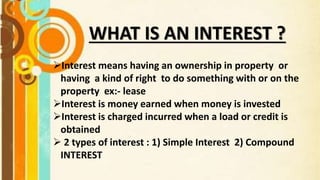
WHAT IS AN INTEREST ?
Interest means having an ownership in property or
having a kind of right to do something with or on the
property ex:- lease
Interest is money earned when money is invested
Interest is charged incurred when a load or credit is
obtained
 2 types of interest : 1) Simple Interest 2) Compound
INTEREST
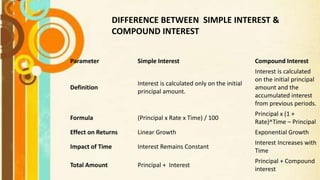
DIFFERENCE BETWEEN SIMPLE INTEREST &
COMPOUND INTEREST
Parameter Simple Interest Compound Interest
Definition
Interest is calculated only on the initial
principal amount.
Interest is calculated
on the initial principal
amount and the
accumulated interest
from previous periods.
Formula (Principal x Rate x Time) / 100
Principal x (1 +
Rate)^Time – Principal
Effect on Returns Linear Growth Exponential Growth
Impact of Time Interest Remains Constant
Interest Increases with
Time
Total Amount Principal + Interest
Principal + Compound
interest
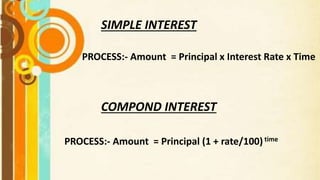
SIMPLE INTEREST
PROCESS:- Amount = Principal x Interest Rate x Time
COMPOND INTEREST
PROCESS:- Amount = Principal (1 + rate/100)time
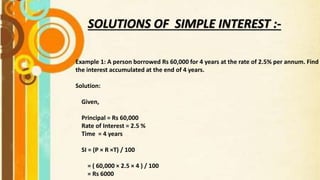
SOLUTIONS OF SIMPLE INTEREST :-
Example 1: A person borrowed Rs 60,000 for 4 years at the rate of 2.5% per annum. Find
the interest accumulated at the end of 4 years.
Solution:
Given,
Principal = Rs 60,000
Rate of Interest = 2.5 %
Time = 4 years
SI = (P × R ×T) / 100
= ( 60,000 × 2.5 × 4 ) / 100
= Rs 6000
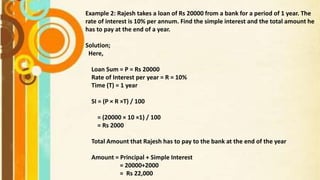
Example 2: Rajesh takes a loan of Rs 20000 from a bank for a period of 1 year. The
rate of interest is 10% per annum. Find the simple interest and the total amount he
has to pay at the end of a year.
Solution;
Here,
Loan Sum = P = Rs 20000
Rate of Interest per year = R = 10%
Time (T) = 1 year
SI = (P × R ×T) / 100
= (20000 × 10 ×1) / 100
= Rs 2000
Total Amount that Rajesh has to pay to the bank at the end of the year
Amount = Principal + Simple Interest
= 20000+2000
= Rs 22,000
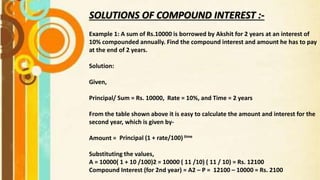
SOLUTIONS OF COMPOUND INTEREST :-
Example 1: A sum of Rs.10000 is borrowed by Akshit for 2 years at an interest of
10% compounded annually. Find the compound interest and amount he has to pay
at the end of 2 years.
Solution:
Given,
Principal/ Sum = Rs. 10000, Rate = 10%, and Time = 2 years
From the table shown above it is easy to calculate the amount and interest for the
second year, which is given by-
Amount =
Substituting the values,
A = 10000( 1 + 10 /100)2 = 10000 ( 11 /10) ( 11 / 10) = Rs. 12100
Compound Interest (for 2nd year) = A2 – P = 12100 – 10000 = Rs. 2100
Principal (1 + rate/100) time
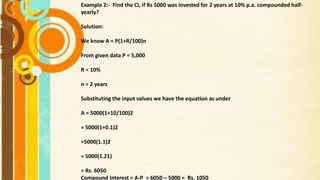
Example 2:- Find the CI, if Rs 5000 was invested for 2 years at 10% p.a. compounded half-
yearly?
Solution:
We know A = P(1+R/100)n
From given data P = 5,000
R = 10%
n = 2 years
Substituting the input values we have the equation as under
A = 5000(1+10/100)2
= 5000(1+0.1)2
=5000(1.1)2
= 5000(1.21)
= Rs. 6050
Compound Interest = A-P = 6050 – 5000 = Rs. 1050
PPT PRESENTATION OF MATHS.pptx

PPT PRESENTATION OF MATHS.pptx

  • 1.
    SUBJECT:- BUSINESS MATHEMATICS TOPIC:- INTEREST ACROPOLIS INSTITUTE OF MANAGEMENT STUDIES & RESEARCH SUBMITTED BY :- 1) ANANYA MANGAL 2) PALAK TRIVEDI 3) PRAYUSHI JAIN 4) AMRUTA BEDARKAR 5) CHAYA GUPTA SUBMITTED TO :- Prof. LALIT DUBEY
  • 2.
    WHAT IS ANINTEREST ? Interest means having an ownership in property or having a kind of right to do something with or on the property ex:- lease Interest is money earned when money is invested Interest is charged incurred when a load or credit is obtained  2 types of interest : 1) Simple Interest 2) Compound INTEREST
  • 3.
    DIFFERENCE BETWEEN SIMPLEINTEREST & COMPOUND INTEREST Parameter Simple Interest Compound Interest Definition Interest is calculated only on the initial principal amount. Interest is calculated on the initial principal amount and the accumulated interest from previous periods. Formula (Principal x Rate x Time) / 100 Principal x (1 + Rate)^Time – Principal Effect on Returns Linear Growth Exponential Growth Impact of Time Interest Remains Constant Interest Increases with Time Total Amount Principal + Interest Principal + Compound interest
  • 4.
    SIMPLE INTEREST PROCESS:- Amount= Principal x Interest Rate x Time COMPOND INTEREST PROCESS:- Amount = Principal (1 + rate/100)time
  • 5.
    SOLUTIONS OF SIMPLEINTEREST :- Example 1: A person borrowed Rs 60,000 for 4 years at the rate of 2.5% per annum. Find the interest accumulated at the end of 4 years. Solution: Given, Principal = Rs 60,000 Rate of Interest = 2.5 % Time = 4 years SI = (P × R ×T) / 100 = ( 60,000 × 2.5 × 4 ) / 100 = Rs 6000
  • 6.
    Example 2: Rajeshtakes a loan of Rs 20000 from a bank for a period of 1 year. The rate of interest is 10% per annum. Find the simple interest and the total amount he has to pay at the end of a year. Solution; Here, Loan Sum = P = Rs 20000 Rate of Interest per year = R = 10% Time (T) = 1 year SI = (P × R ×T) / 100 = (20000 × 10 ×1) / 100 = Rs 2000 Total Amount that Rajesh has to pay to the bank at the end of the year Amount = Principal + Simple Interest = 20000+2000 = Rs 22,000
  • 7.
    SOLUTIONS OF COMPOUNDINTEREST :- Example 1: A sum of Rs.10000 is borrowed by Akshit for 2 years at an interest of 10% compounded annually. Find the compound interest and amount he has to pay at the end of 2 years. Solution: Given, Principal/ Sum = Rs. 10000, Rate = 10%, and Time = 2 years From the table shown above it is easy to calculate the amount and interest for the second year, which is given by- Amount = Substituting the values, A = 10000( 1 + 10 /100)2 = 10000 ( 11 /10) ( 11 / 10) = Rs. 12100 Compound Interest (for 2nd year) = A2 – P = 12100 – 10000 = Rs. 2100 Principal (1 + rate/100) time
  • 8.
    Example 2:- Findthe CI, if Rs 5000 was invested for 2 years at 10% p.a. compounded half- yearly? Solution: We know A = P(1+R/100)n From given data P = 5,000 R = 10% n = 2 years Substituting the input values we have the equation as under A = 5000(1+10/100)2 = 5000(1+0.1)2 =5000(1.1)2 = 5000(1.21) = Rs. 6050 Compound Interest = A-P = 6050 – 5000 = Rs. 1050