Components of a Computer
System
UNIT-I
Learning Objectives
• By the end of this session all of you will;
– define the terms hardware, software, input
device, storage device and output device;
– describe the purpose of input devices, storage
devices and output devices;
Hardware
Hardware are the physical components of a computer
– eg. the input devices, output devices, primary
storage (memory) and secondary storage (backing
store), Central Processing Unit etc. Note that input
and output devices are collectively known as
peripherals.
External Hardware Internal Hardware
Monitor Hard drive
Printer CPU
Keyboard Fan
Mouse Motherboard
Microphone Sound card
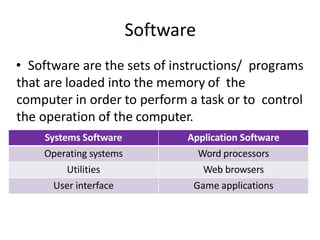
Software
• Software are the sets of instructions/ programs
that are loaded into the memory of the
computer in order to perform a task or to control
the operation of the computer.
Systems Software Application Software
Operating systems Word processors
Utilities Web browsers
User interface Game applications
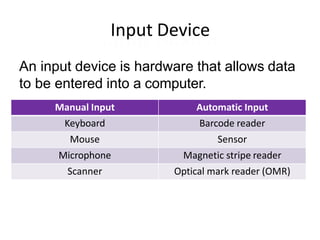
Input Device
An input device is hardware that allows data
to be entered into a computer.
Manual Input Automatic Input
Keyboard Barcode reader
Mouse Sensor
Microphone Magnetic stripe reader
Scanner Optical mark reader (OMR)
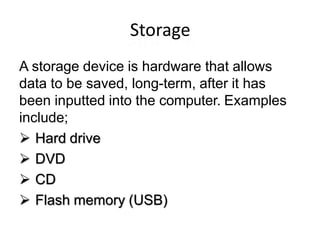
Storage
A storage device is hardware that allows
data to be saved, long-term, after it has
been inputted into the computer. Examples
include;
 Hard drive
 DVD
 CD
 Flash memory (USB)
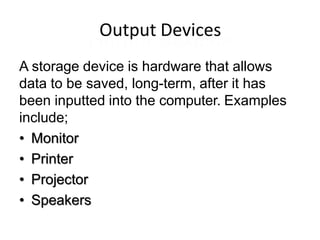
Output Devices
A storage device is hardware that allows
data to be saved, long-term, after it has
been inputted into the computer. Examples
include;
• Monitor
• Printer
• Projector
• Speakers
Task 1
• Under this session you will need
to complete the definitions task.
• You should include at least 2 sentences for
each device type by your own, including at
least 5 examples.
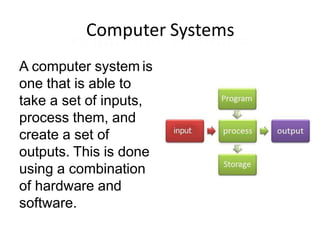
Computer Systems
A computer system is
one that is able to
take a set of inputs,
process them, and
create a set of
outputs. This is done
using a combination
of hardware and
software.
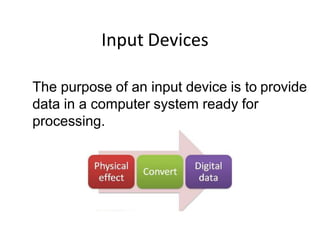
Input Devices
The purpose of an input device is to provide
data in a computer system ready for
processing.
Storage Devices
The purpose of a storage device to store data and
software for later use. The storage device will make
some use of physical effect to represent the data.
• CD, DVD, Blu-Ray – a laser burns dark pits onto the medium.
Each pit is a binary digit.
• Hard drives and magnetic tape use magnetic domains to
represent data.
• Flash drive use electric charge to store the data
A primary storage device is the main computer storage
device, and a secondary device is one where you can
also store files, but is not the main storage you use.
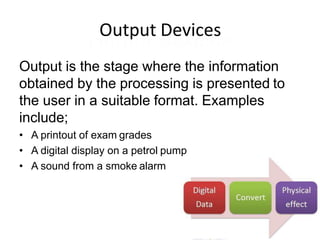
Output Devices
Output is the stage where the information
obtained by the processing is presented to
the user in a suitable format. Examples
include;
• A printout of exam grades
• A digital display on a petrol pump
• A sound from a smoke alarm
Task 2
• You will need to download and complete
the Input, Storage and Output devices
worksheet.
• You will need to think of some extra
examples by yourself.
Task 3
• Using your smart phone, or a digital camera
you will need to find 5 different examples of
input and output devices around the College.
• Use your imagination and think of examples
other than ones found in a computer room.
• For each image you will need to explain
where it is found in the College, and what is
its purpose .
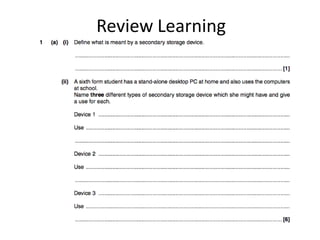
Review Learning

Componentsofacomputersystem

  • 1.
    Components of aComputer System UNIT-I
  • 2.
    Learning Objectives • Bythe end of this session all of you will; – define the terms hardware, software, input device, storage device and output device; – describe the purpose of input devices, storage devices and output devices;
  • 3.
    Hardware Hardware are thephysical components of a computer – eg. the input devices, output devices, primary storage (memory) and secondary storage (backing store), Central Processing Unit etc. Note that input and output devices are collectively known as peripherals. External Hardware Internal Hardware Monitor Hard drive Printer CPU Keyboard Fan Mouse Motherboard Microphone Sound card
  • 4.
    Software • Software arethe sets of instructions/ programs that are loaded into the memory of the computer in order to perform a task or to control the operation of the computer. Systems Software Application Software Operating systems Word processors Utilities Web browsers User interface Game applications
  • 5.
    Input Device An inputdevice is hardware that allows data to be entered into a computer. Manual Input Automatic Input Keyboard Barcode reader Mouse Sensor Microphone Magnetic stripe reader Scanner Optical mark reader (OMR)
  • 6.
    Storage A storage deviceis hardware that allows data to be saved, long-term, after it has been inputted into the computer. Examples include;  Hard drive  DVD  CD  Flash memory (USB)
  • 7.
    Output Devices A storagedevice is hardware that allows data to be saved, long-term, after it has been inputted into the computer. Examples include; • Monitor • Printer • Projector • Speakers
  • 8.
    Task 1 • Underthis session you will need to complete the definitions task. • You should include at least 2 sentences for each device type by your own, including at least 5 examples.
  • 9.
    Computer Systems A computersystem is one that is able to take a set of inputs, process them, and create a set of outputs. This is done using a combination of hardware and software.
  • 10.
    Input Devices The purposeof an input device is to provide data in a computer system ready for processing.
  • 11.
    Storage Devices The purposeof a storage device to store data and software for later use. The storage device will make some use of physical effect to represent the data. • CD, DVD, Blu-Ray – a laser burns dark pits onto the medium. Each pit is a binary digit. • Hard drives and magnetic tape use magnetic domains to represent data. • Flash drive use electric charge to store the data A primary storage device is the main computer storage device, and a secondary device is one where you can also store files, but is not the main storage you use.
  • 12.
    Output Devices Output isthe stage where the information obtained by the processing is presented to the user in a suitable format. Examples include; • A printout of exam grades • A digital display on a petrol pump • A sound from a smoke alarm
  • 13.
    Task 2 • Youwill need to download and complete the Input, Storage and Output devices worksheet. • You will need to think of some extra examples by yourself.
  • 14.
    Task 3 • Usingyour smart phone, or a digital camera you will need to find 5 different examples of input and output devices around the College. • Use your imagination and think of examples other than ones found in a computer room. • For each image you will need to explain where it is found in the College, and what is its purpose .
  • 15.