VISVESVARAYA TECHNOLOGICAL UNIVERSITY
Jnana Sangama, Belagavi, Karnataka
Bachelor of Engineering Technical
Seminar
On
INDUSTRY 4.0
By
VIJAYKUMAR V CHAVAN
(USN:-2BU20ME438)
Under the Guidanceof
Prof.Srinath Ghodke
Dept. of ME
S. G. Balekundri Institute of Technology,
Belagavi-10
INDUSTRY 4.0
(SMART FACTORY)
Content Layout
• Industrialization
• Introduction
• Literature survey
• Methodology
• Recent trends in the area
• Future Scope
• Applications
• Advantages & Disadvantages
• Conclusion
• Bibliography
INDUSTRIALIZATION
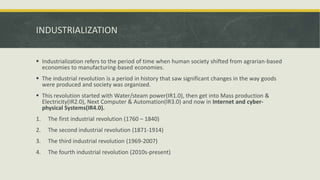
 Industrialization refers to the period of time when human society shifted from agrarian-based
economies to manufacturing-based economies.
 The industrial revolution is a period in history that saw significant changes in the way goods
were produced and society was organized.
 This revolution started with Water/steam power(IR1.0), then get into Mass production &
Electricity(IR2.0), Next Computer & Automation(IR3.0) and now in Internet and cyber-
physical Systems(IR4.0).
1. The first industrial revolution (1760 – 1840)
2. The second industrial revolution (1871-1914)
3. The third industrial revolution (1969-2007)
4. The fourth industrial revolution (2010s-present)
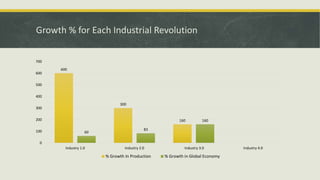
Growth % for Each Industrial Revolution
600
300
160
60
83
160
0
100
200
300
400
500
600
700
Industry 1.0 Industry 2.0 Industry 3.0 Industry 4.0
% Growth In Production % Growth in Global Economy
INTRODUCTION
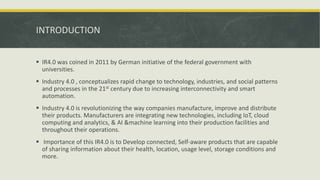
 IR4.0 was coined in 2011 by German initiative of the federal government with
universities.
 Industry 4.0 , conceptualizes rapid change to technology, industries, and social patterns
and processes in the 21st century due to increasing interconnectivity and smart
automation.
 Industry 4.0 is revolutionizing the way companies manufacture, improve and distribute
their products. Manufacturers are integrating new technologies, including IoT, cloud
computing and analytics, & AI &machine learning into their production facilities and
throughout their operations.
 Importance of this IR4.0 is to Develop connected, Self-aware products that are capable
of sharing information about their health, location, usage level, storage conditions and
more.
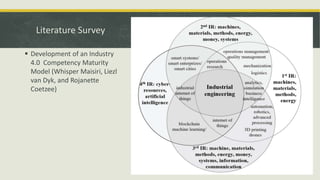
Literature Survey
 Development of an Industry
4.0 Competency Maturity
Model (Whisper Maisiri, Liezl
van Dyk, and Rojanette
Coetzee)
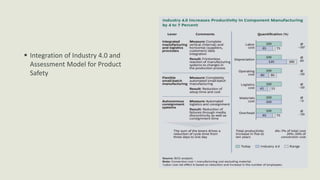
 Integration of Industry 4.0 and
Assessment Model for Product
Safety
Methodology
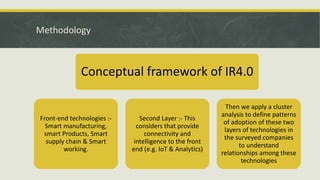
Conceptual framework of IR4.0
Front-end technologies :-
Smart manufacturing,
smart Products, Smart
supply chain & Smart
working.
Second Layer :- This
considers that provide
connectivity and
intelligence to the front
end (e.g. IoT & Analytics)
Then we apply a cluster
analysis to define patterns
of adoption of these two
layers of technologies in
the surveyed companies
to understand
relationships among these
technologies
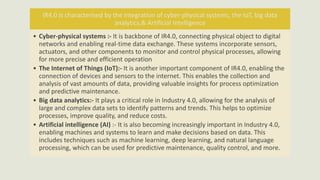
IR4.0 is characterised by the integration of cyber-physical systems, the IoT, big data
analytics,& Artificial Intelligence
• Cyber-physical systems :- It is backbone of IR4.0, connecting physical object to digital
networks and enabling real-time data exchange. These systems incorporate sensors,
actuators, and other components to monitor and control physical processes, allowing
for more precise and efficient operation
• The Internet of Things (IoT):- It is another important component of IR4.0, enabling the
connection of devices and sensors to the internet. This enables the collection and
analysis of vast amounts of data, providing valuable insights for process optimization
and predictive maintenance.
• Big data analytics:- It plays a critical role in Industry 4.0, allowing for the analysis of
large and complex data sets to identify patterns and trends. This helps to optimize
processes, improve quality, and reduce costs.
• Artificial intelligence (AI) :- It is also becoming increasingly important in Industry 4.0,
enabling machines and systems to learn and make decisions based on data. This
includes techniques such as machine learning, deep learning, and natural language
processing, which can be used for predictive maintenance, quality control, and more.
Recent Trends
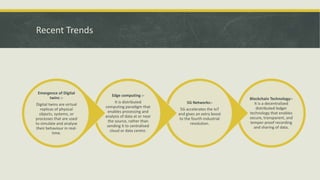
Blockchain Technology:-
It is a decentralized
distributed ledger
technology that enables
secure, transparent, and
temper-proof recording
and sharing of data.
5G Networks:-
5G accelerates the IoT
and gives an extra boost
to the fourth industrial
revolution.
Edge computing :-
It is distributed
computing paradigm that
enables processing and
analysis of data at or near
the source, rather than
sending it to centralised
cloud or data centre.
Emergence of Digital
twins :-
Digital twins are virtual
replicas of physical
objects, systems, or
processes that are used
to simulate and analyse
their behaviour in real-
time.
Future Scope
 Here are 2 key areas where industry 4.0 is expected to have significant impact
1. Sustainable Manufacturing :- It enables the creation of smart factories that use
interconnected sensors & machines to optimize production processes.
2. Smart Cities :- IR4.0 technologies can also play a key role in building smarter, more
sustainable cities.
 According to a report by McKinsey & Company, the global economic impact of Industry
4.0 could reach $3.7 trillion to $5.8 trillion per year by 2025.
 Industry 5.0 concept that builds upon IR4.0 and seeks to incorporate benefits of human
touch and creativity into the manufacturing process. It aims to combine the advantage of
automation and advanced technology with the unique abilities of humans to drive
innovation and enhance customer experiences.
Applications
Smart factories: Industry 4.0 enables the creation of smart factories that use interconnected sensors, devices,
and machines to optimize production processes, reduce downtime, and increase efficiency.
Predictive maintenance: Industry 4.0 technologies can be used to predict maintenance needs and detect
potential equipment failures before they occur. This can reduce downtime and maintenance costs.
Supply chain optimization: Industry 4.0 can enable end-to-end supply chain optimization, from raw materials
to final delivery. Real-time data and analytics can help optimize inventory management, reduce waste, and
improve delivery times.
Quality control: Industry 4.0 technologies can be used to monitor and control product quality in real-time,
leading to improved consistency, fewer defects, and greater customer satisfaction.
Remote monitoring: Industry 4.0 can enable remote monitoring of equipment and processes, allowing
operators to detect and resolve issues from anywhere. This can reduce travel costs, increase safety, and
improve efficiency.
Advantages
• Improved Data Analytics: Industry 4.0 technologies can provide more comprehensive and accurate data,
enabling better decision-making and business intelligence.
• Increased Sustainability: Industry 4.0 technologies can enable more sustainable production processes,
reducing waste and energy consumption.
• Increased Efficiency: Industry 4.0 technologies can increase efficiency by optimizing production processes,
reducing downtime, and improving supply chain management.
• Cost Reduction: Industry 4.0 technologies can reduce costs through predictive maintenance, supply chain
optimization, and process automation.
• Flexibility and Customization: Industry 4.0 technologies can enable manufacturers to quickly adapt to
changes in demand and offer customized products to meet specific customer needs.
Disadvantages
• High Implementation Costs: The adoption of Industry 4.0 technologies can require significant
investment in hardware, software, and training, which may be a barrier for smaller companies.
• Security Risks: As more devices and systems become connected, the risk of cyber attacks and
data breaches increases.
• Job Displacement: Automation and robotics can lead to job displacement and a shift in required
job skills, potentially causing social and economic challenges.
• Technological Complexity: The complexity of Industry 4.0 technologies can require specialized
expertise and resources, making it challenging for some organizations to implement.
• Data Privacy Concerns: The collection and use of large amounts of data raises concerns about
data privacy and ownership, and can lead to legal and ethical challenges.
• Dependence on Technology: The reliance on technology in Industry 4.0 can lead to operational
disruptions if there are system failures or technical difficulties.
Conclusion
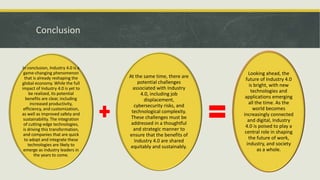
In conclusion, Industry 4.0 is a
game-changing phenomenon
that is already reshaping the
global economy. While the full
impact of Industry 4.0 is yet to
be realized, its potential
benefits are clear, including
increased productivity,
efficiency, and customization,
as well as improved safety and
sustainability. The integration
of cutting-edge technologies,
is driving this transformation,
and companies that are quick
to adopt and integrate these
technologies are likely to
emerge as industry leaders in
the years to come.
At the same time, there are
potential challenges
associated with Industry
4.0, including job
displacement,
cybersecurity risks, and
technological complexity.
These challenges must be
addressed in a thoughtful
and strategic manner to
ensure that the benefits of
Industry 4.0 are shared
equitably and sustainably.
Looking ahead, the
future of Industry 4.0
is bright, with new
technologies and
applications emerging
all the time. As the
world becomes
increasingly connected
and digital, Industry
4.0 is poised to play a
central role in shaping
the future of work,
industry, and society
as a whole.
Bibliography
[1] Based on “Development of an Industry 4.0 Competency Maturity Model” by Whisper Maisiri and Liezl van
Dyk which appeared in the Proceedings of 2020 IFEES World Engineering Education Forum - Global Engineering
Deans Council (WEEF-GEDC), virtual conference, 16 - 19 November 2020. © 2020 IEEE
[2] C. H. Li1 and H. K. Lau2 “Integration of Industry 4.0 and Assessment Model for Product Safety “ By School of
Science and Technology, The Open University of Hong Kong, Hong Kong, China
[3] Petr Novak´∗, Petr Douda∗, Petr Kadera∗, Jiˇr´ı Vyskocil ˇ∗
∗ Czech Institute of Informatics, Robotics and Cybernetics, Czech Technical University in Prague,
Prague, Czech Republic. “PyMES: Distributed Manufacturing Execution System for Flexible Industry 4.0 Cyber-
PhysicalProduction Systems”
[4] Sibukele Gumboa,*, Hossana Twinomurinzia, Kelvin Bwalyaa, Samuel Fosso Wambab “Skills provisioning for
the Fourth Industrial Revolution: A Bibliometric Analysis”
[5] M P Metri, Executive Committee Member, IEILC, Belagavi “INDUSTRY 4.0 TECHNOLOGIES”
THANK YOU….

INDUSTRY 4.0 which covers IOT, AI, Augmented reality

  • 1.
    VISVESVARAYA TECHNOLOGICAL UNIVERSITY JnanaSangama, Belagavi, Karnataka Bachelor of Engineering Technical Seminar On INDUSTRY 4.0 By VIJAYKUMAR V CHAVAN (USN:-2BU20ME438) Under the Guidanceof Prof.Srinath Ghodke Dept. of ME S. G. Balekundri Institute of Technology, Belagavi-10
  • 2.
  • 3.
    Content Layout • Industrialization •Introduction • Literature survey • Methodology • Recent trends in the area • Future Scope • Applications • Advantages & Disadvantages • Conclusion • Bibliography
  • 4.
    INDUSTRIALIZATION  Industrialization refersto the period of time when human society shifted from agrarian-based economies to manufacturing-based economies.  The industrial revolution is a period in history that saw significant changes in the way goods were produced and society was organized.  This revolution started with Water/steam power(IR1.0), then get into Mass production & Electricity(IR2.0), Next Computer & Automation(IR3.0) and now in Internet and cyber- physical Systems(IR4.0). 1. The first industrial revolution (1760 – 1840) 2. The second industrial revolution (1871-1914) 3. The third industrial revolution (1969-2007) 4. The fourth industrial revolution (2010s-present)
  • 5.
    Growth % forEach Industrial Revolution 600 300 160 60 83 160 0 100 200 300 400 500 600 700 Industry 1.0 Industry 2.0 Industry 3.0 Industry 4.0 % Growth In Production % Growth in Global Economy
  • 6.
    INTRODUCTION  IR4.0 wascoined in 2011 by German initiative of the federal government with universities.  Industry 4.0 , conceptualizes rapid change to technology, industries, and social patterns and processes in the 21st century due to increasing interconnectivity and smart automation.  Industry 4.0 is revolutionizing the way companies manufacture, improve and distribute their products. Manufacturers are integrating new technologies, including IoT, cloud computing and analytics, & AI &machine learning into their production facilities and throughout their operations.  Importance of this IR4.0 is to Develop connected, Self-aware products that are capable of sharing information about their health, location, usage level, storage conditions and more.
  • 7.
    Literature Survey  Developmentof an Industry 4.0 Competency Maturity Model (Whisper Maisiri, Liezl van Dyk, and Rojanette Coetzee)
  • 8.
     Integration ofIndustry 4.0 and Assessment Model for Product Safety
  • 9.
    Methodology Conceptual framework ofIR4.0 Front-end technologies :- Smart manufacturing, smart Products, Smart supply chain & Smart working. Second Layer :- This considers that provide connectivity and intelligence to the front end (e.g. IoT & Analytics) Then we apply a cluster analysis to define patterns of adoption of these two layers of technologies in the surveyed companies to understand relationships among these technologies
  • 10.
    IR4.0 is characterisedby the integration of cyber-physical systems, the IoT, big data analytics,& Artificial Intelligence • Cyber-physical systems :- It is backbone of IR4.0, connecting physical object to digital networks and enabling real-time data exchange. These systems incorporate sensors, actuators, and other components to monitor and control physical processes, allowing for more precise and efficient operation • The Internet of Things (IoT):- It is another important component of IR4.0, enabling the connection of devices and sensors to the internet. This enables the collection and analysis of vast amounts of data, providing valuable insights for process optimization and predictive maintenance. • Big data analytics:- It plays a critical role in Industry 4.0, allowing for the analysis of large and complex data sets to identify patterns and trends. This helps to optimize processes, improve quality, and reduce costs. • Artificial intelligence (AI) :- It is also becoming increasingly important in Industry 4.0, enabling machines and systems to learn and make decisions based on data. This includes techniques such as machine learning, deep learning, and natural language processing, which can be used for predictive maintenance, quality control, and more.
  • 11.
    Recent Trends Blockchain Technology:- Itis a decentralized distributed ledger technology that enables secure, transparent, and temper-proof recording and sharing of data. 5G Networks:- 5G accelerates the IoT and gives an extra boost to the fourth industrial revolution. Edge computing :- It is distributed computing paradigm that enables processing and analysis of data at or near the source, rather than sending it to centralised cloud or data centre. Emergence of Digital twins :- Digital twins are virtual replicas of physical objects, systems, or processes that are used to simulate and analyse their behaviour in real- time.
  • 12.
    Future Scope  Hereare 2 key areas where industry 4.0 is expected to have significant impact 1. Sustainable Manufacturing :- It enables the creation of smart factories that use interconnected sensors & machines to optimize production processes. 2. Smart Cities :- IR4.0 technologies can also play a key role in building smarter, more sustainable cities.  According to a report by McKinsey & Company, the global economic impact of Industry 4.0 could reach $3.7 trillion to $5.8 trillion per year by 2025.  Industry 5.0 concept that builds upon IR4.0 and seeks to incorporate benefits of human touch and creativity into the manufacturing process. It aims to combine the advantage of automation and advanced technology with the unique abilities of humans to drive innovation and enhance customer experiences.
  • 14.
    Applications Smart factories: Industry4.0 enables the creation of smart factories that use interconnected sensors, devices, and machines to optimize production processes, reduce downtime, and increase efficiency. Predictive maintenance: Industry 4.0 technologies can be used to predict maintenance needs and detect potential equipment failures before they occur. This can reduce downtime and maintenance costs. Supply chain optimization: Industry 4.0 can enable end-to-end supply chain optimization, from raw materials to final delivery. Real-time data and analytics can help optimize inventory management, reduce waste, and improve delivery times. Quality control: Industry 4.0 technologies can be used to monitor and control product quality in real-time, leading to improved consistency, fewer defects, and greater customer satisfaction. Remote monitoring: Industry 4.0 can enable remote monitoring of equipment and processes, allowing operators to detect and resolve issues from anywhere. This can reduce travel costs, increase safety, and improve efficiency.
  • 15.
    Advantages • Improved DataAnalytics: Industry 4.0 technologies can provide more comprehensive and accurate data, enabling better decision-making and business intelligence. • Increased Sustainability: Industry 4.0 technologies can enable more sustainable production processes, reducing waste and energy consumption. • Increased Efficiency: Industry 4.0 technologies can increase efficiency by optimizing production processes, reducing downtime, and improving supply chain management. • Cost Reduction: Industry 4.0 technologies can reduce costs through predictive maintenance, supply chain optimization, and process automation. • Flexibility and Customization: Industry 4.0 technologies can enable manufacturers to quickly adapt to changes in demand and offer customized products to meet specific customer needs.
  • 16.
    Disadvantages • High ImplementationCosts: The adoption of Industry 4.0 technologies can require significant investment in hardware, software, and training, which may be a barrier for smaller companies. • Security Risks: As more devices and systems become connected, the risk of cyber attacks and data breaches increases. • Job Displacement: Automation and robotics can lead to job displacement and a shift in required job skills, potentially causing social and economic challenges. • Technological Complexity: The complexity of Industry 4.0 technologies can require specialized expertise and resources, making it challenging for some organizations to implement. • Data Privacy Concerns: The collection and use of large amounts of data raises concerns about data privacy and ownership, and can lead to legal and ethical challenges. • Dependence on Technology: The reliance on technology in Industry 4.0 can lead to operational disruptions if there are system failures or technical difficulties.
  • 17.
    Conclusion In conclusion, Industry4.0 is a game-changing phenomenon that is already reshaping the global economy. While the full impact of Industry 4.0 is yet to be realized, its potential benefits are clear, including increased productivity, efficiency, and customization, as well as improved safety and sustainability. The integration of cutting-edge technologies, is driving this transformation, and companies that are quick to adopt and integrate these technologies are likely to emerge as industry leaders in the years to come. At the same time, there are potential challenges associated with Industry 4.0, including job displacement, cybersecurity risks, and technological complexity. These challenges must be addressed in a thoughtful and strategic manner to ensure that the benefits of Industry 4.0 are shared equitably and sustainably. Looking ahead, the future of Industry 4.0 is bright, with new technologies and applications emerging all the time. As the world becomes increasingly connected and digital, Industry 4.0 is poised to play a central role in shaping the future of work, industry, and society as a whole.
  • 18.
    Bibliography [1] Based on“Development of an Industry 4.0 Competency Maturity Model” by Whisper Maisiri and Liezl van Dyk which appeared in the Proceedings of 2020 IFEES World Engineering Education Forum - Global Engineering Deans Council (WEEF-GEDC), virtual conference, 16 - 19 November 2020. © 2020 IEEE [2] C. H. Li1 and H. K. Lau2 “Integration of Industry 4.0 and Assessment Model for Product Safety “ By School of Science and Technology, The Open University of Hong Kong, Hong Kong, China [3] Petr Novak´∗, Petr Douda∗, Petr Kadera∗, Jiˇr´ı Vyskocil ˇ∗ ∗ Czech Institute of Informatics, Robotics and Cybernetics, Czech Technical University in Prague, Prague, Czech Republic. “PyMES: Distributed Manufacturing Execution System for Flexible Industry 4.0 Cyber- PhysicalProduction Systems” [4] Sibukele Gumboa,*, Hossana Twinomurinzia, Kelvin Bwalyaa, Samuel Fosso Wambab “Skills provisioning for the Fourth Industrial Revolution: A Bibliometric Analysis” [5] M P Metri, Executive Committee Member, IEILC, Belagavi “INDUSTRY 4.0 TECHNOLOGIES”
  • 19.