Components of a
Successful Collaboration
Prevention Institute and
East Bay Asian Local Development Corporation
Practical Playbook National Meeting
May 23, 2016
Leslie Mikkelsen, MPH
Managing Director
Katie Miller, MPH
Associate Program Manager
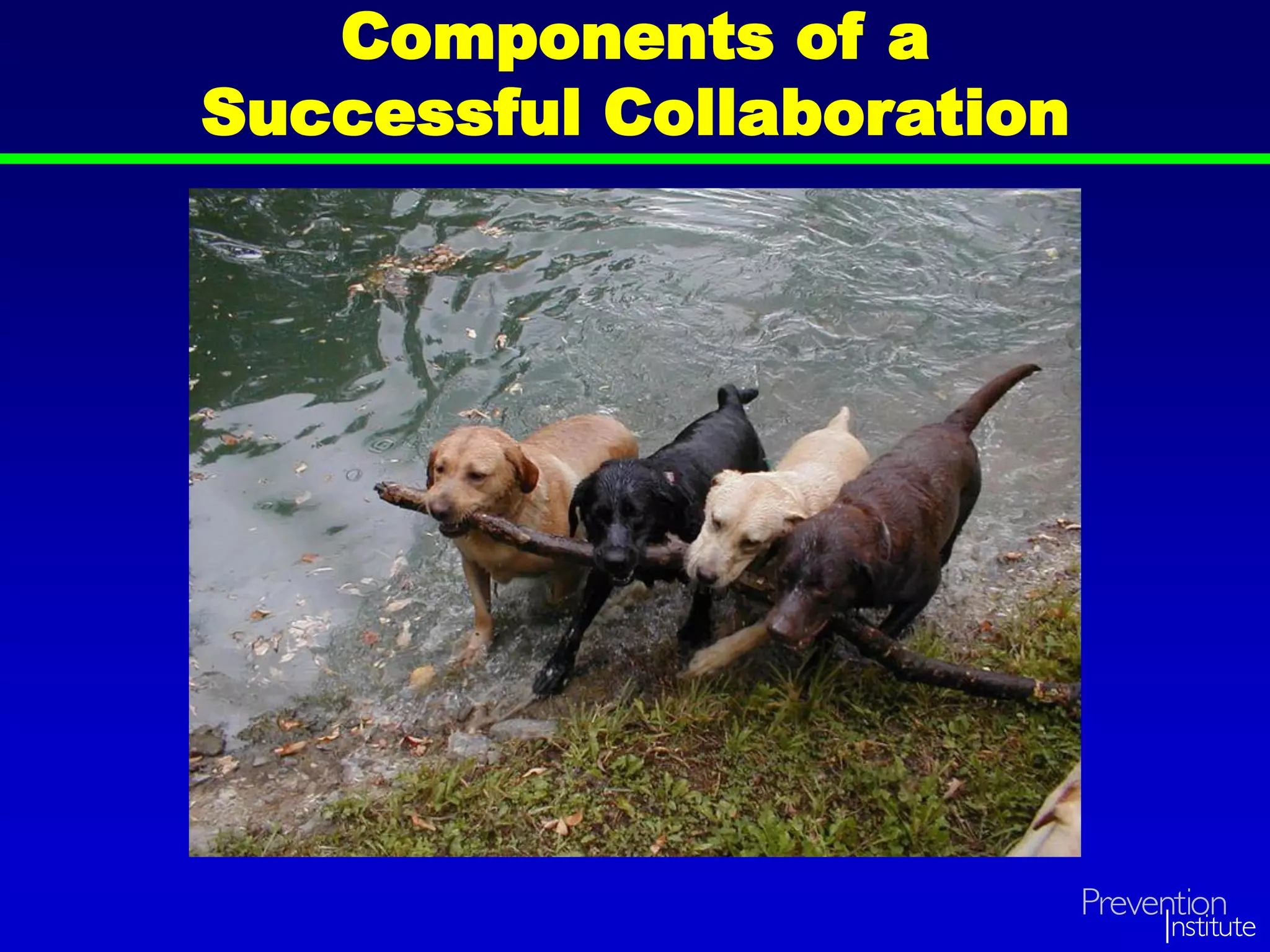
Components of a
Successful Collaboration
he determinants of health are
beyond the capacity of any one
practitioner or discipline to
manage… We must collaborate to
survive, as disciplines and as
professionals attempting to help
our communities and each other.
–Mitchel and Crittenden,
Washington Public Health Fall 2000
“T
”
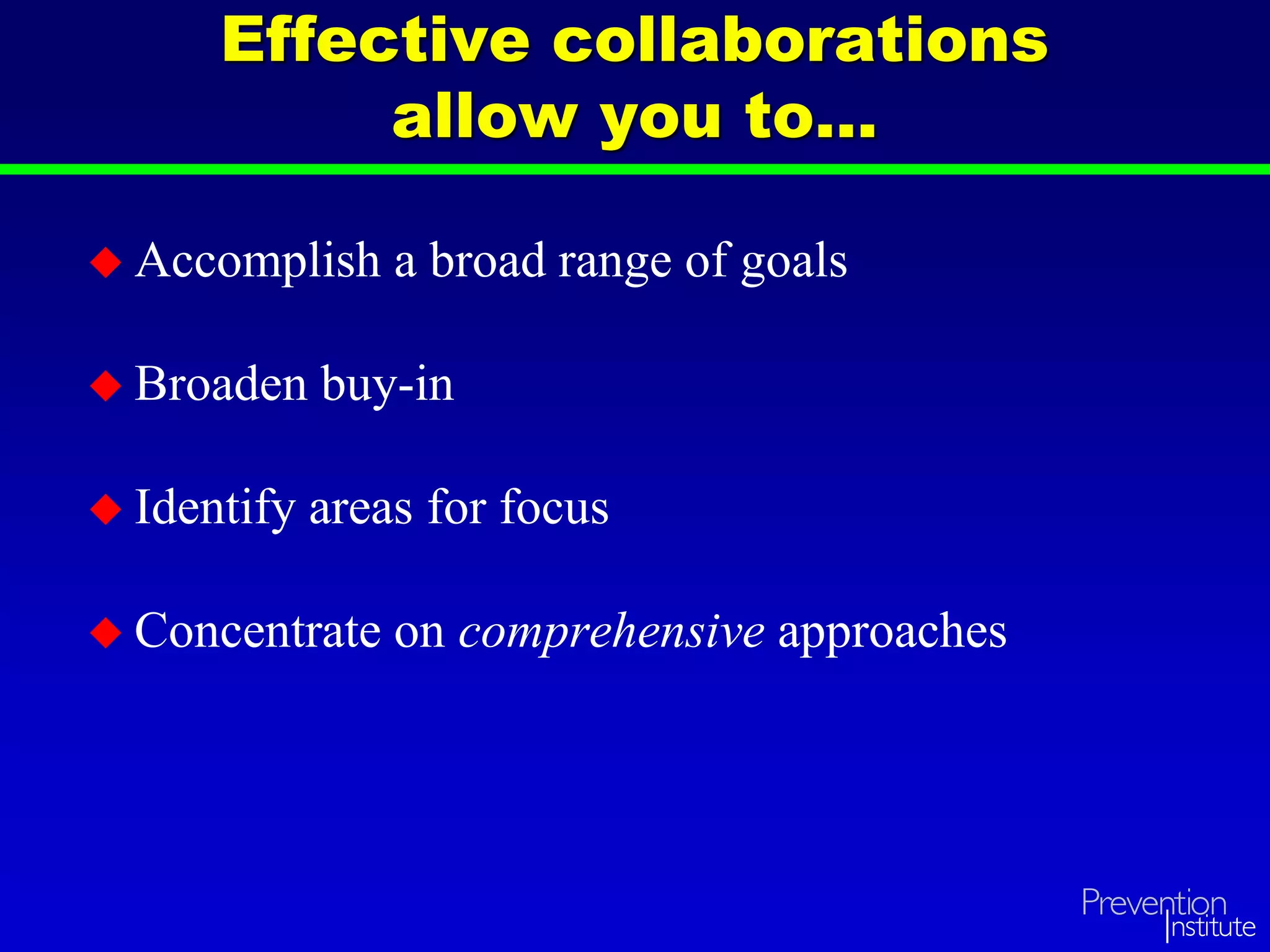
Effective collaborations
allow you to…
 Accomplish a broad range of goals
 Broaden buy-in
 Identify areas for focus
 Concentrate on comprehensive approaches
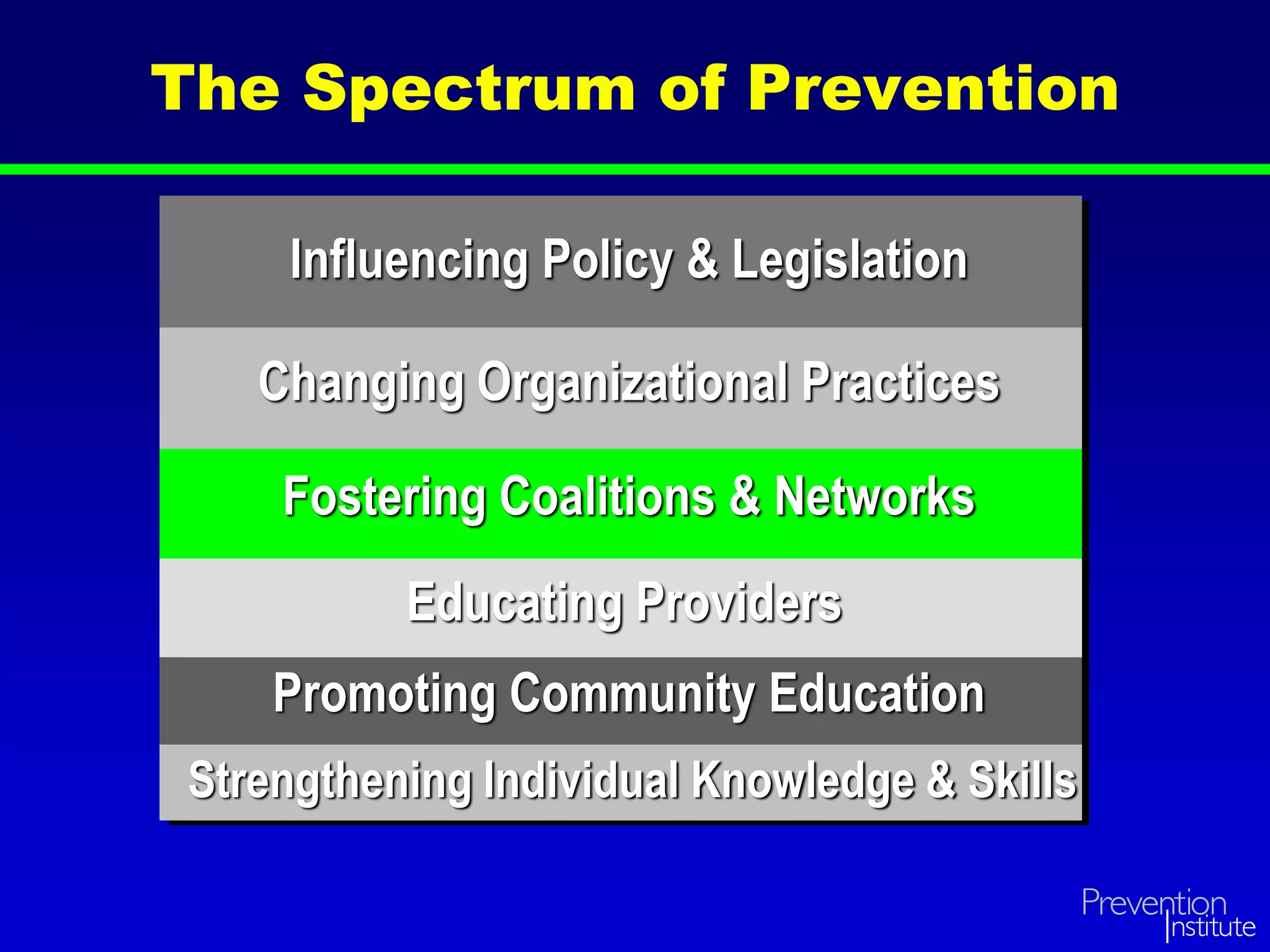
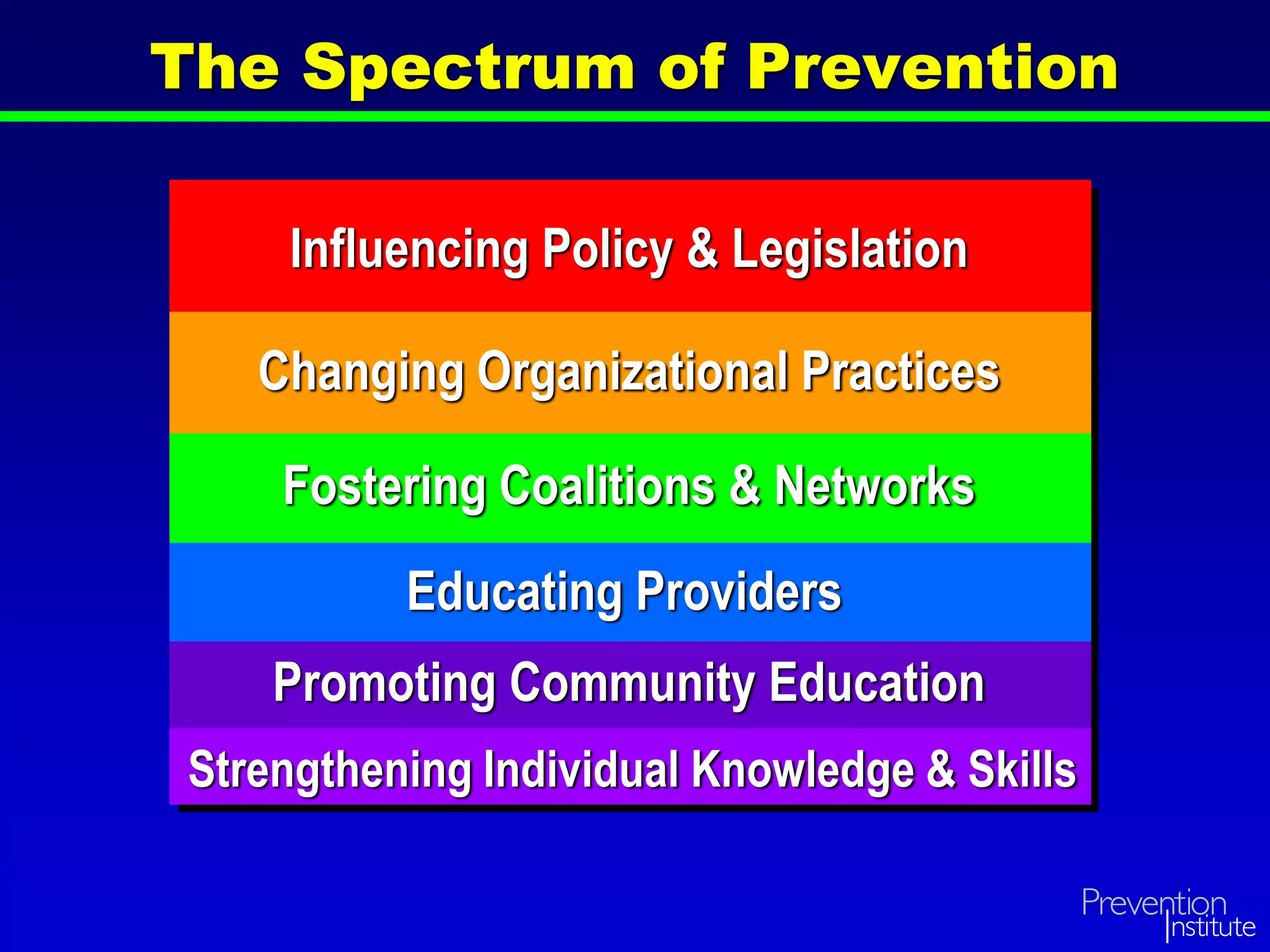
The Spectrum of Prevention
Influencing Policy & Legislation
Changing Organizational Practices
Fostering Coalitions & Networks
Educating Providers
Promoting Community Education
Strengthening Individual Knowledge & Skills
Components of a
Successful Collaboration
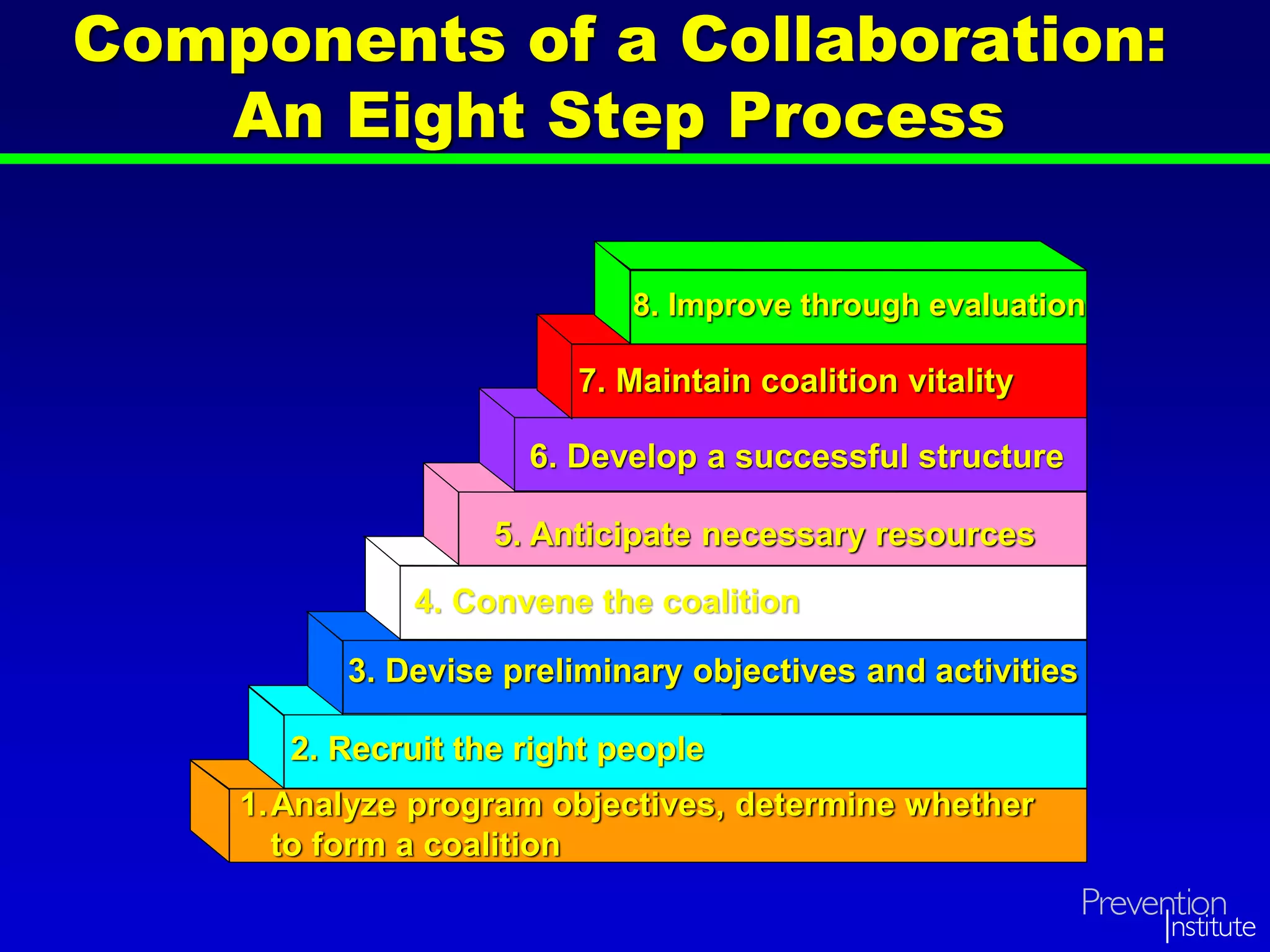
Components of a Collaboration:
An Eight Step Process
1.Analyze program objectives, determine whether
to form a coalition
2. Recruit the right people
3. Devise preliminary objectives and activities
4. Convene the coalition
5. Anticipate necessary resources
6. Develop a successful structure
7. Maintain coalition vitality
8. Improve through evaluation
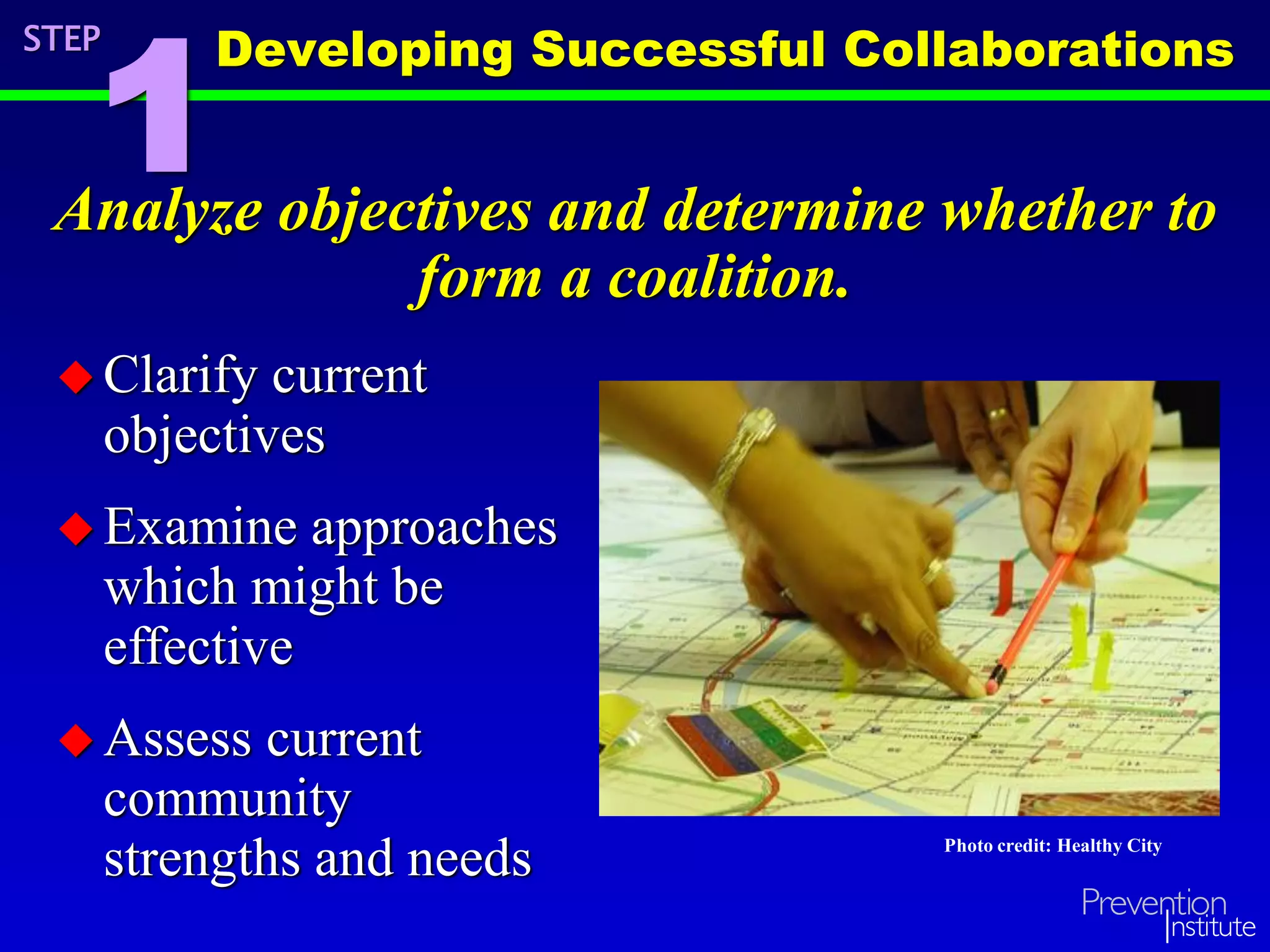
Analyze objectives and determine whether to
form a coalition.
Developing Successful Collaborations
1
Photo credit: Healthy City
STEP
 Clarify current
objectives
 Examine approaches
which might be
effective
 Assess current
community
strengths and needs
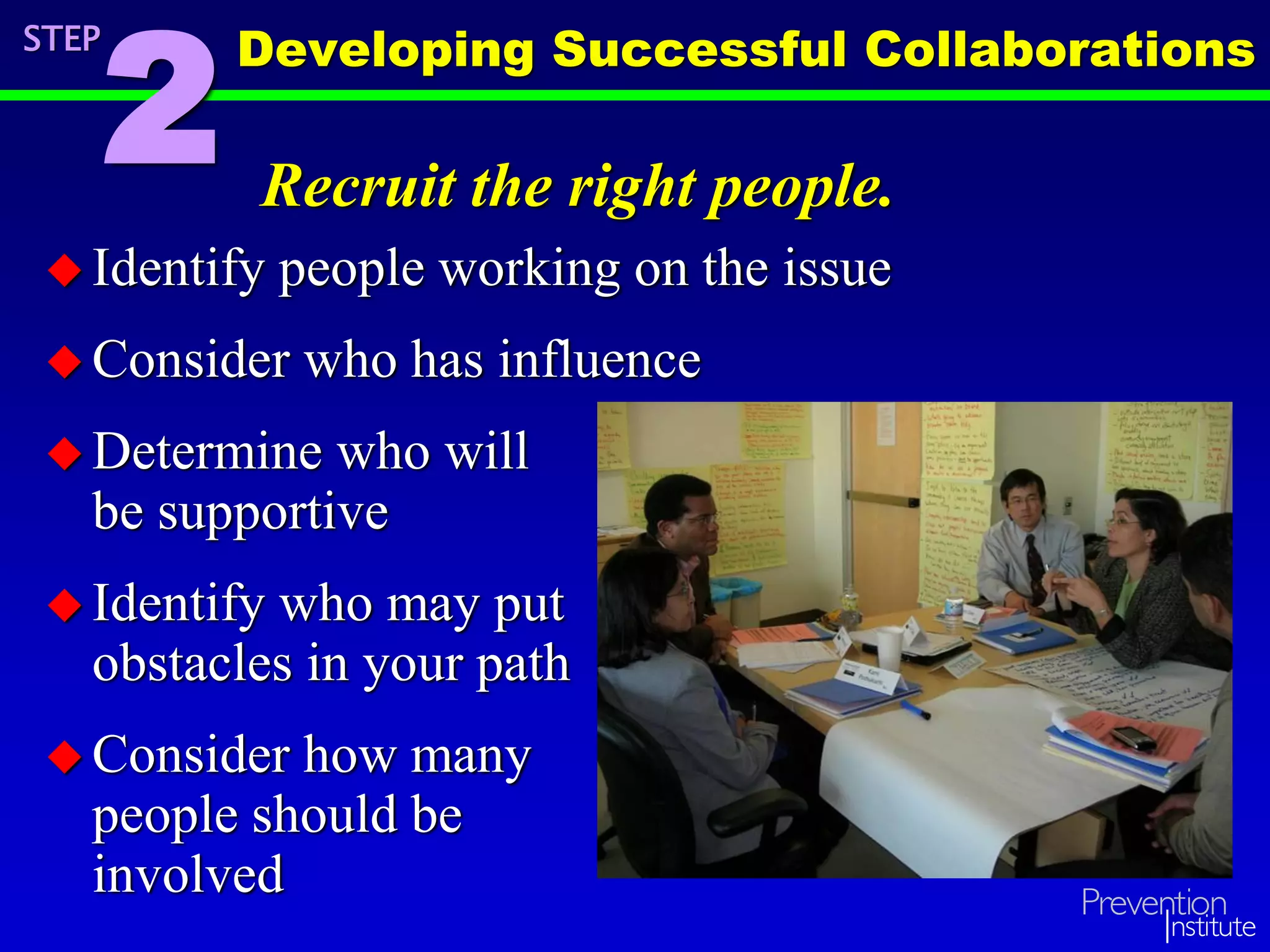
Recruit the right people.
 Identify people working on the issue
 Consider who has influence
 Determine who will
be supportive
 Identify who may put
obstacles in your path
 Consider how many
people should be
involved
STEP
2
Developing Successful Collaborations
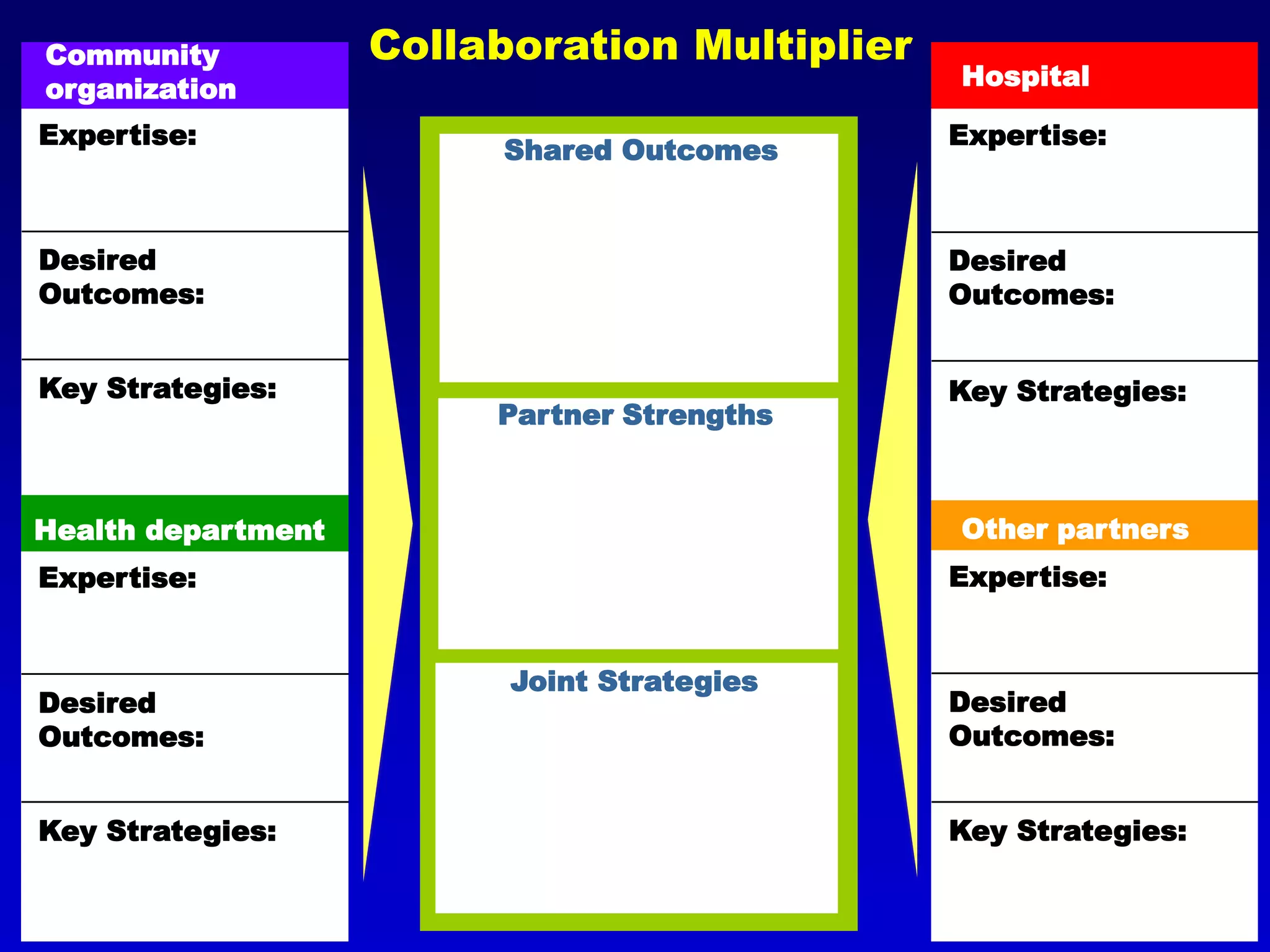
Other partners
Expertise:
Desired
Outcomes:
Key Strategies:
Hospital
Expertise:
Desired
Outcomes:
Key Strategies:
Community
organization
Expertise:
Desired
Outcomes:
Key Strategies:
Health department
Expertise:
Desired
Outcomes:
Key Strategies:
Shared Outcomes
Partner Strengths
Joint Strategies
Collaboration Multiplier
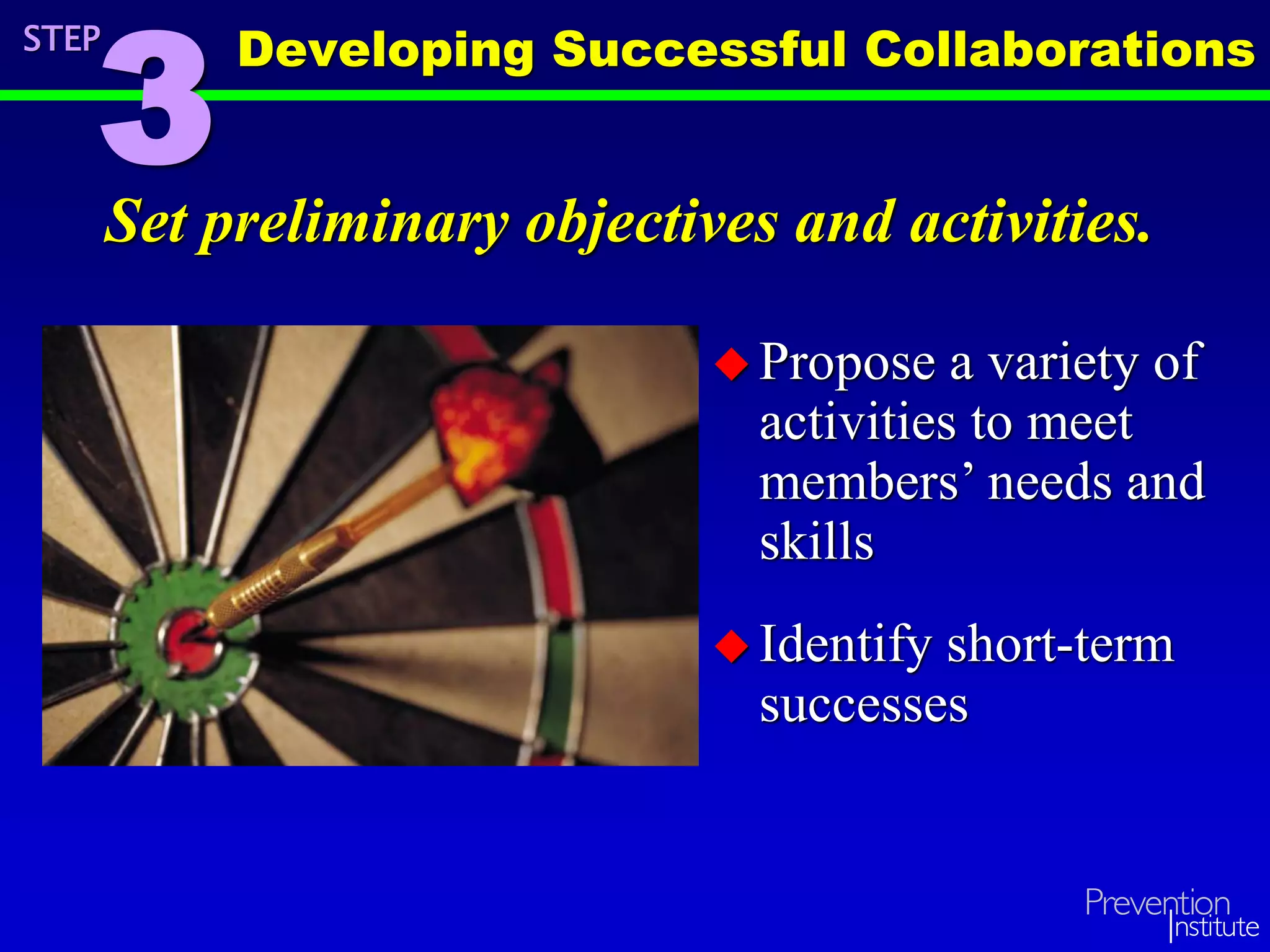
Set preliminary objectives and activities.
 Propose a variety of
activities to meet
members’ needs and
skills
 Identify short-term
successes
STEP
3
Developing Successful Collaborations
Influencing Policy & Legislation
Changing Organizational Practices
Fostering Coalitions & Networks
Educating Providers
Promoting Community Education
The Spectrum of Prevention
Strengthening Individual Knowledge & Skills
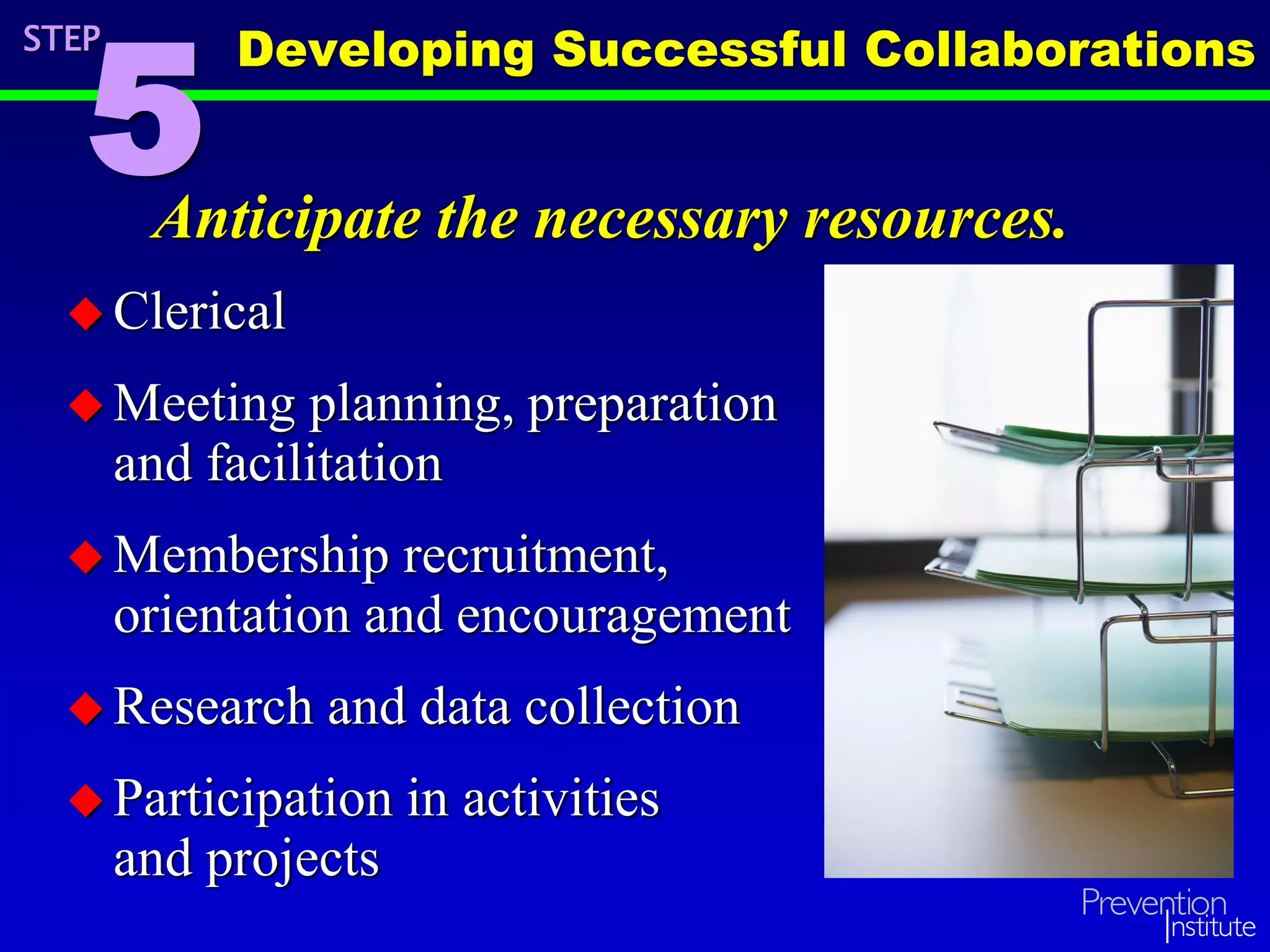
Anticipate the necessary resources.
 Clerical
 Meeting planning, preparation
and facilitation
 Membership recruitment,
orientation and encouragement
 Research and data collection
 Participation in activities
and projects
STEP
5
Developing Successful Collaborations
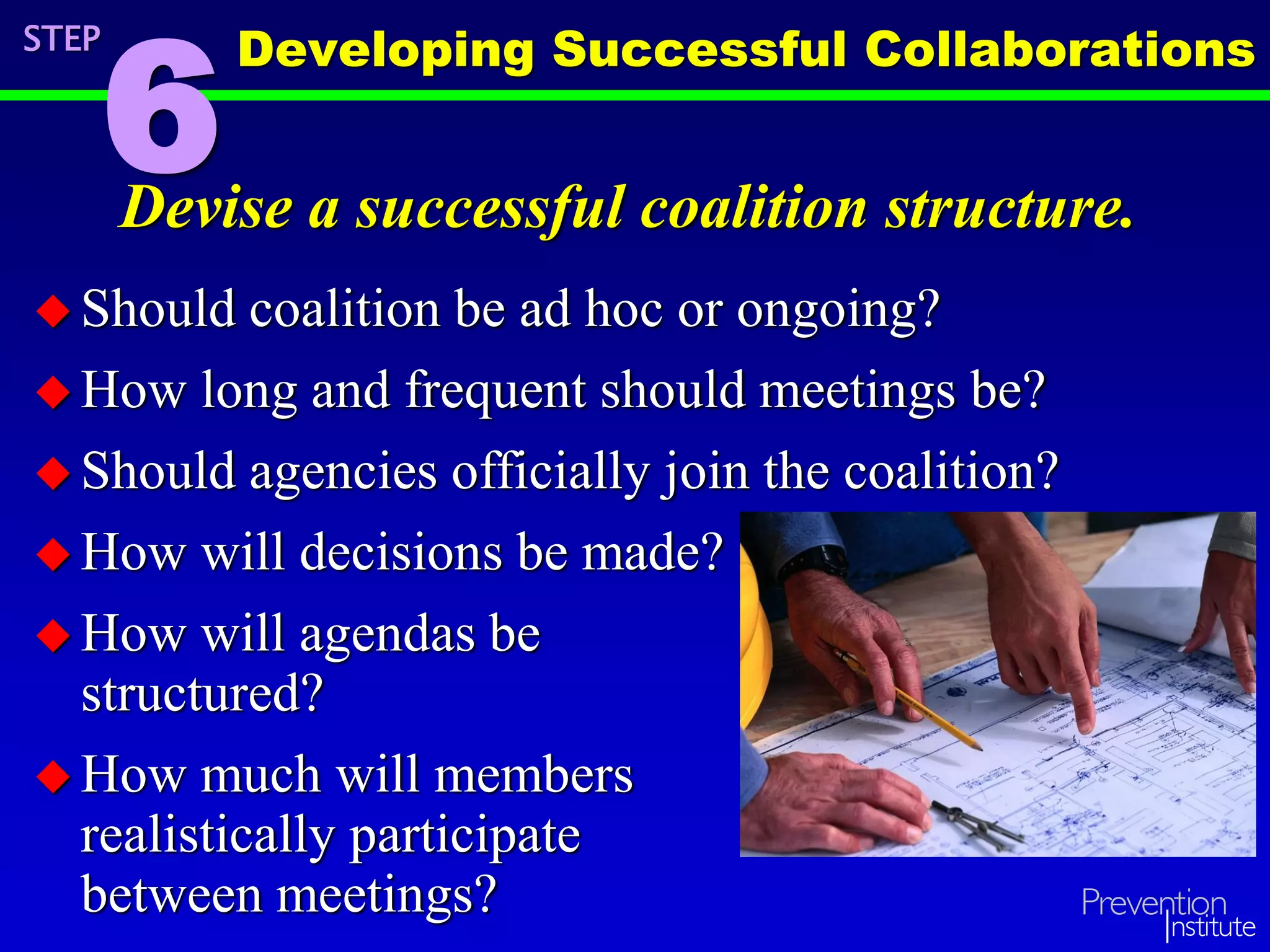
Devise a successful coalition structure.
 Should coalition be ad hoc or ongoing?
 How long and frequent should meetings be?
 Should agencies officially join the coalition?
 How will decisions be made?
 How will agendas be
structured?
 How much will members
realistically participate
between meetings?
STEP
6
Developing Successful Collaborations
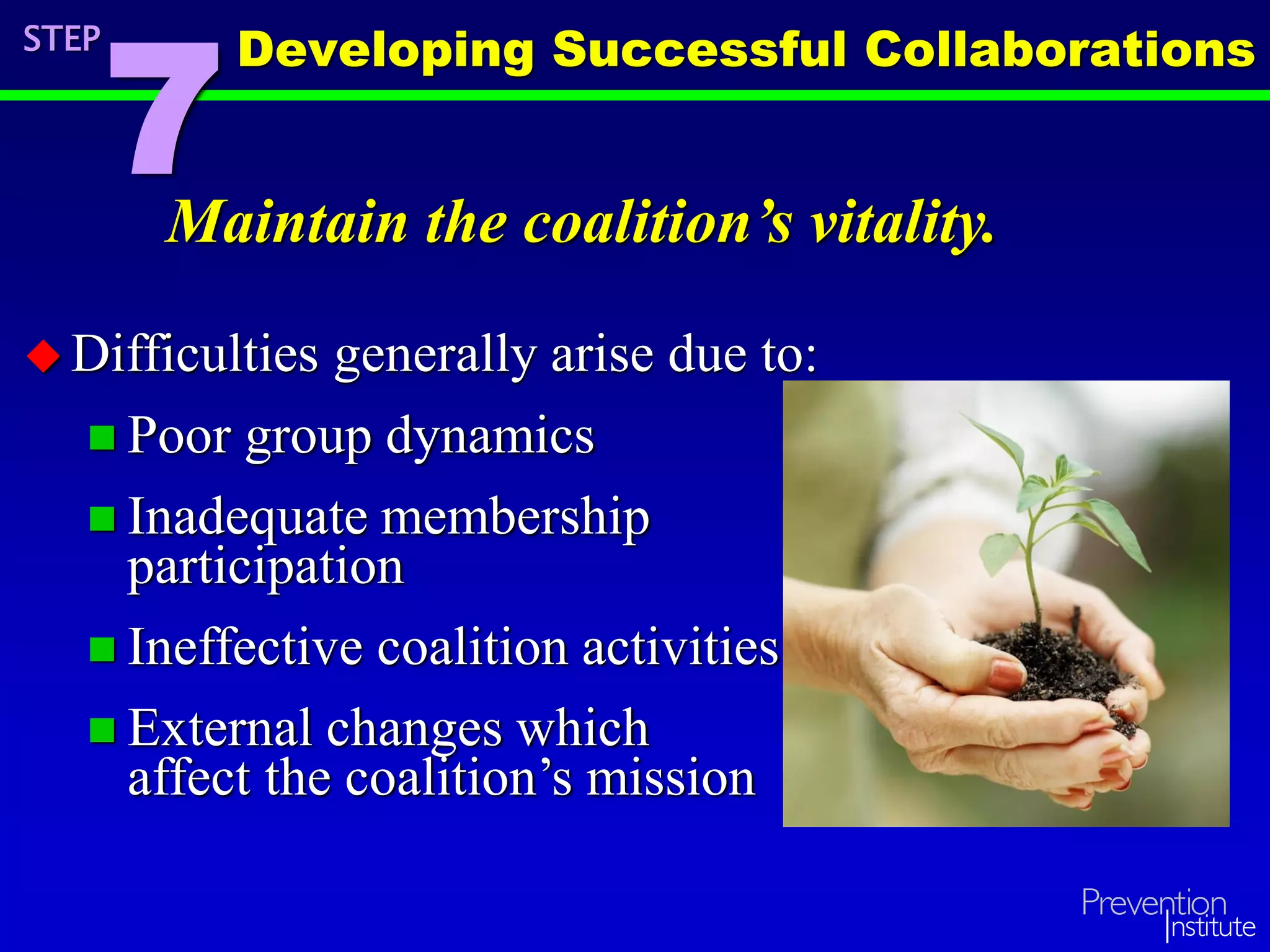
Maintain the coalition’s vitality.
 Difficulties generally arise due to:
 Poor group dynamics
 Inadequate membership
participation
 Ineffective coalition activities
 External changes which
affect the coalition’s mission
STEP
7
Developing Successful Collaborations
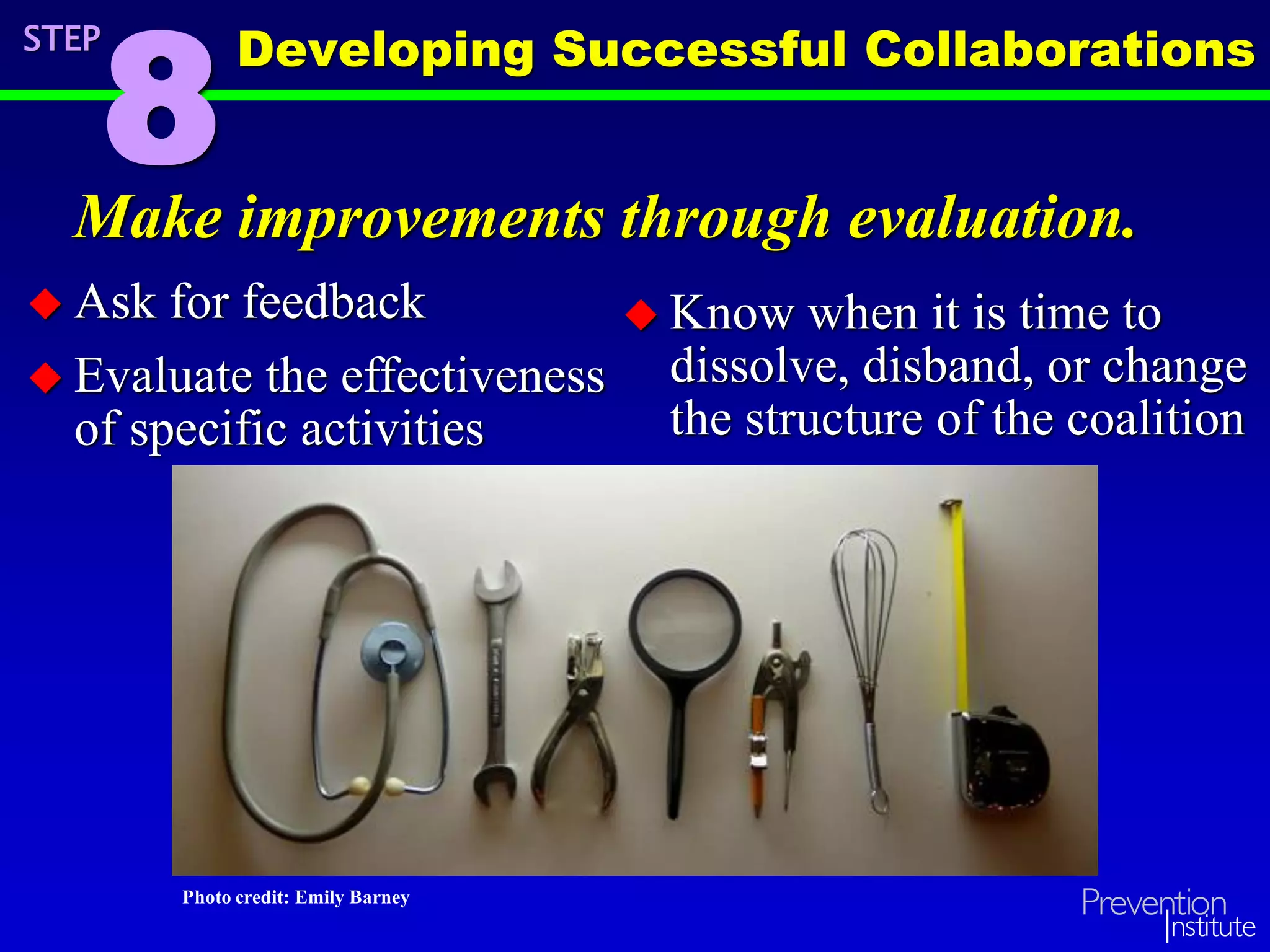
Make improvements through evaluation.
 Ask for feedback
 Evaluate the effectiveness
of specific activities
STEP
8
 Know when it is time to
dissolve, disband, or change
the structure of the coalition
Photo credit: Emily Barney
Developing Successful Collaborations
www.preventioninstitute.org
221 Oak Street
Oakland, CA 94607
Sign up for our media alerts:
www.preventioninstitute.org/alerts
Leslie Mikkelsen, MPH
leslie@preventioninstitute.org
Katie Miller, MPH
katie@preventioninstitute.org
Charise Fong, JD
Chief Operating Officer
cafong@ebaldc.org
Romi Hall, MPH
Healthy Neighborhoods Manager
rhall@ebaldc.org
www.ebaldc.org
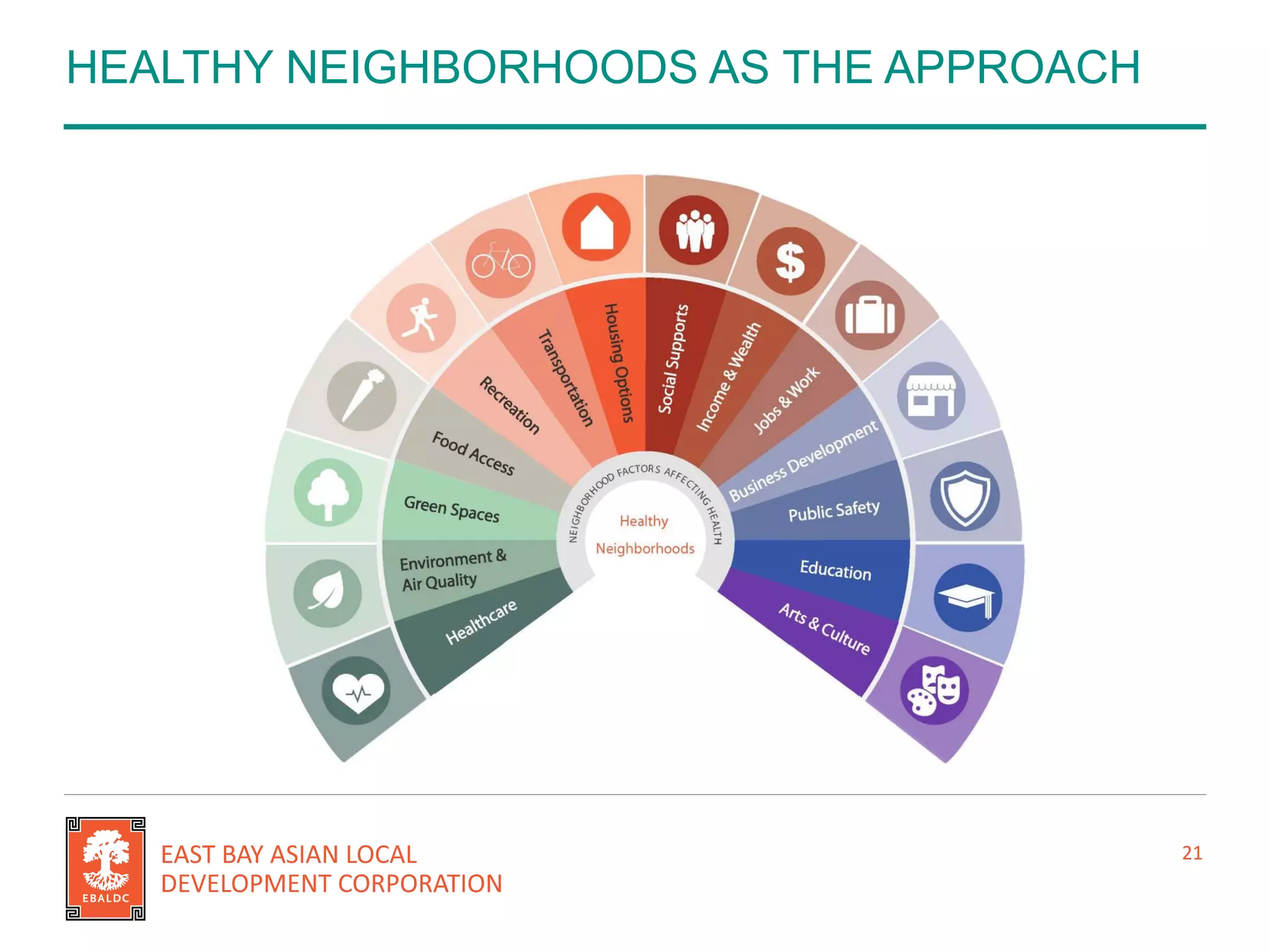
HEALTHY NEIGHBORHOODS AS THE APPROACH
21
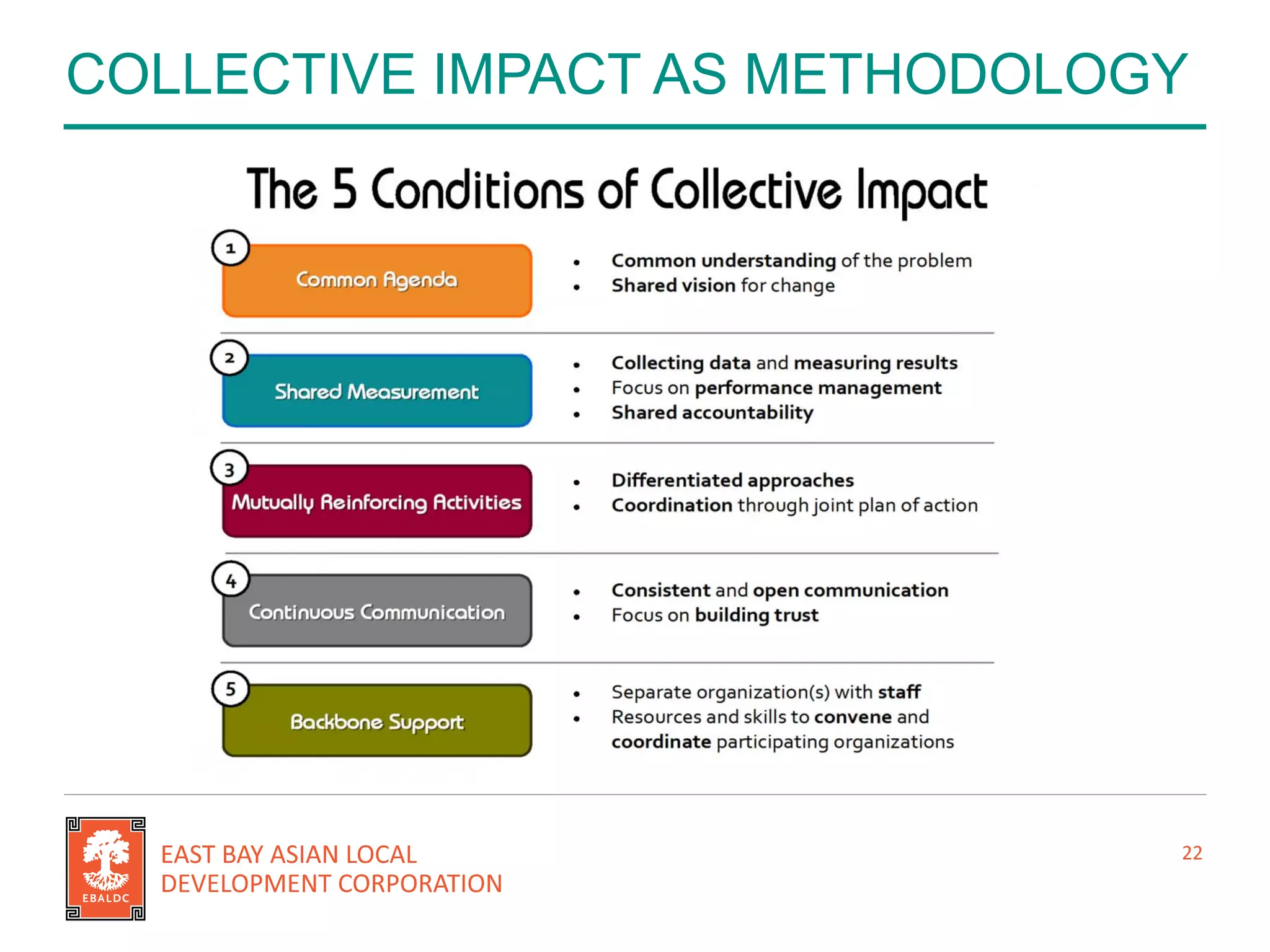
COLLECTIVE IMPACT AS METHODOLOGY
22
Placeholder Presentation Title 23
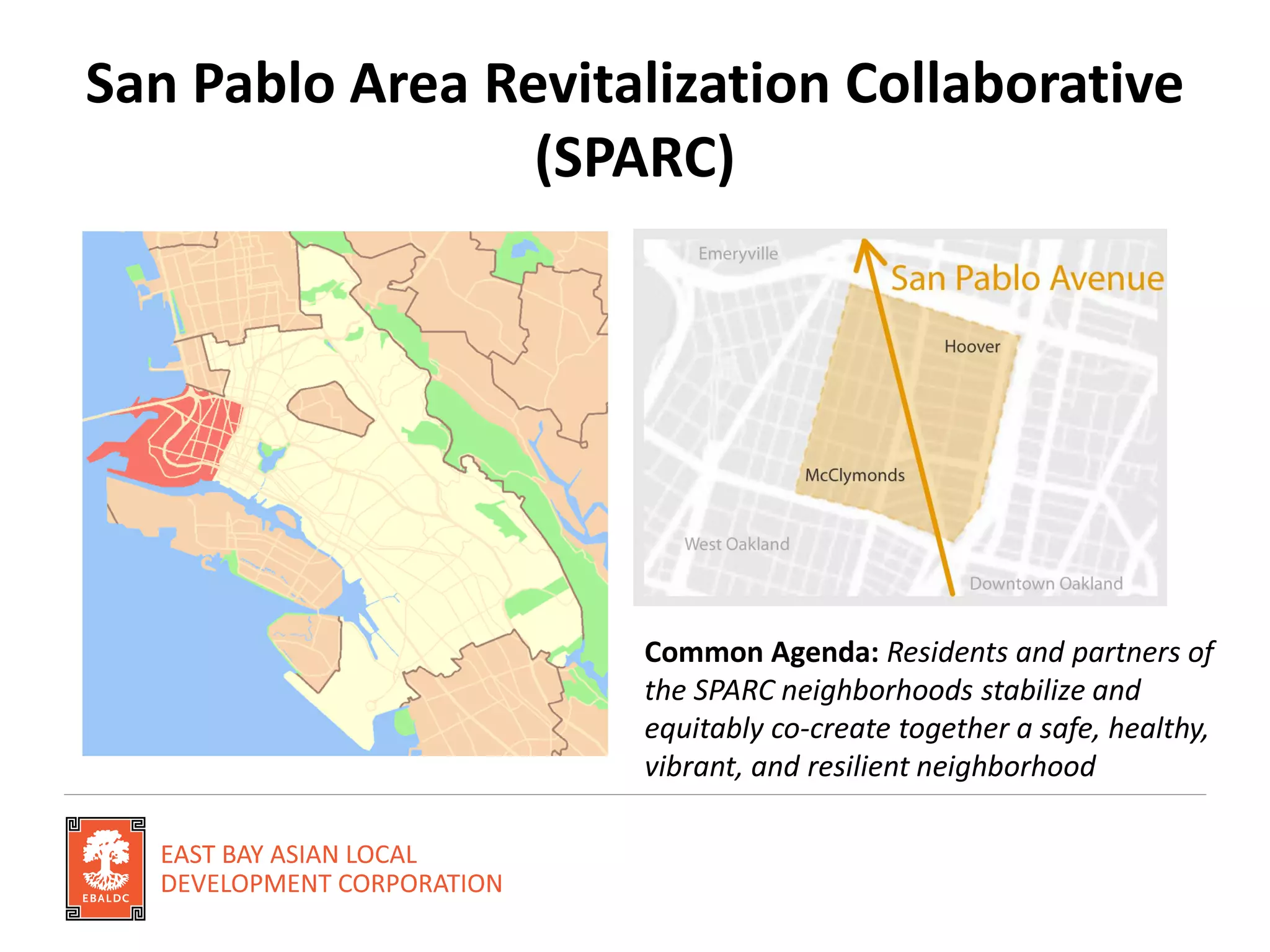
San Pablo Area Revitalization Collaborative
(SPARC)
Common Agenda: Residents and partners of
the SPARC neighborhoods stabilize and
equitably co-create together a safe, healthy,
vibrant, and resilient neighborhood
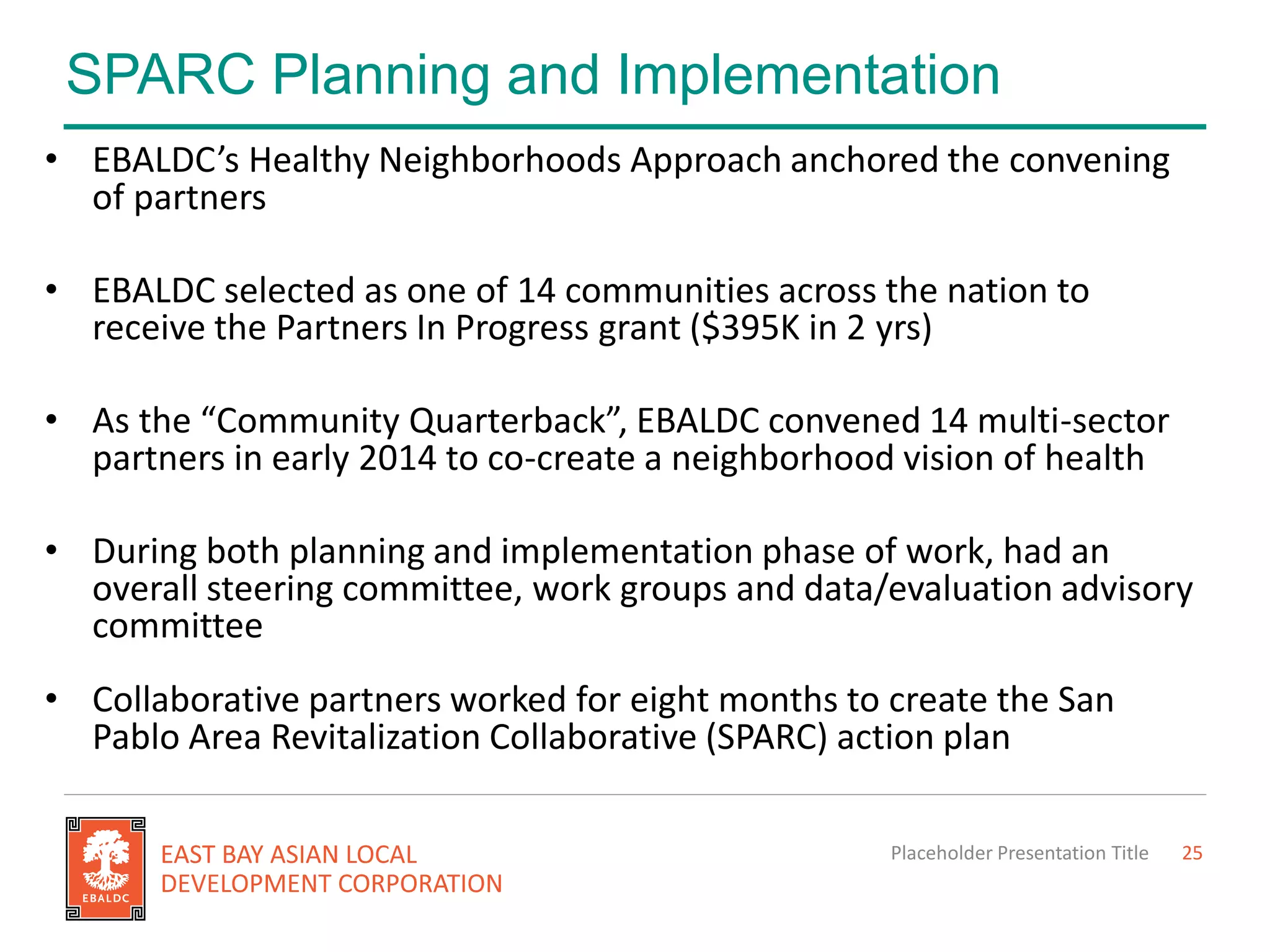
SPARC Planning and Implementation
Placeholder Presentation Title 25
• EBALDC’s Healthy Neighborhoods Approach anchored the convening
of partners
• EBALDC selected as one of 14 communities across the nation to
receive the Partners In Progress grant ($395K in 2 yrs)
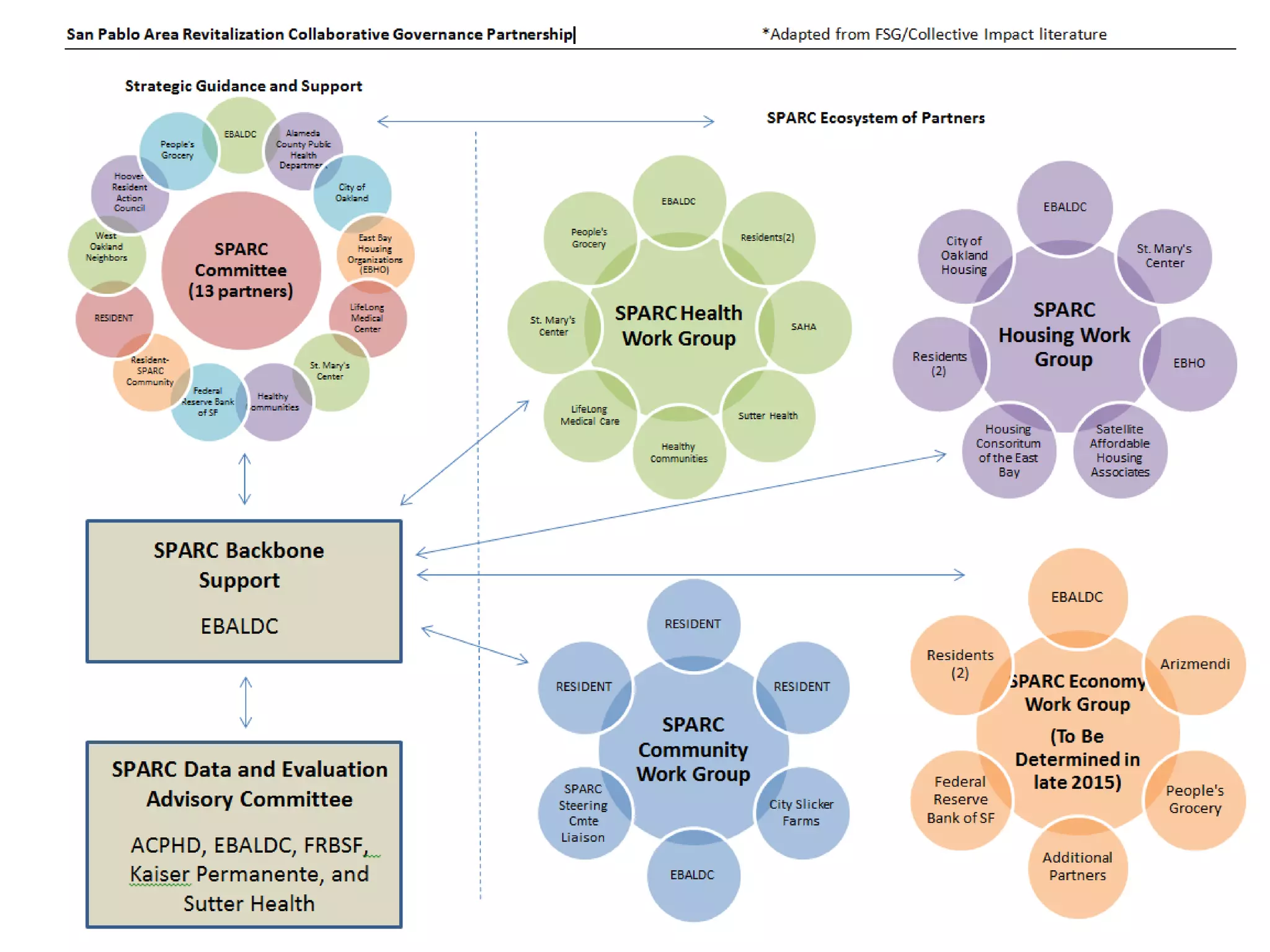
• As the “Community Quarterback”, EBALDC convened 14 multi-sector
partners in early 2014 to co-create a neighborhood vision of health
• During both planning and implementation phase of work, had an
overall steering committee, work groups and data/evaluation advisory
committee
• Collaborative partners worked for eight months to create the San
Pablo Area Revitalization Collaborative (SPARC) action plan
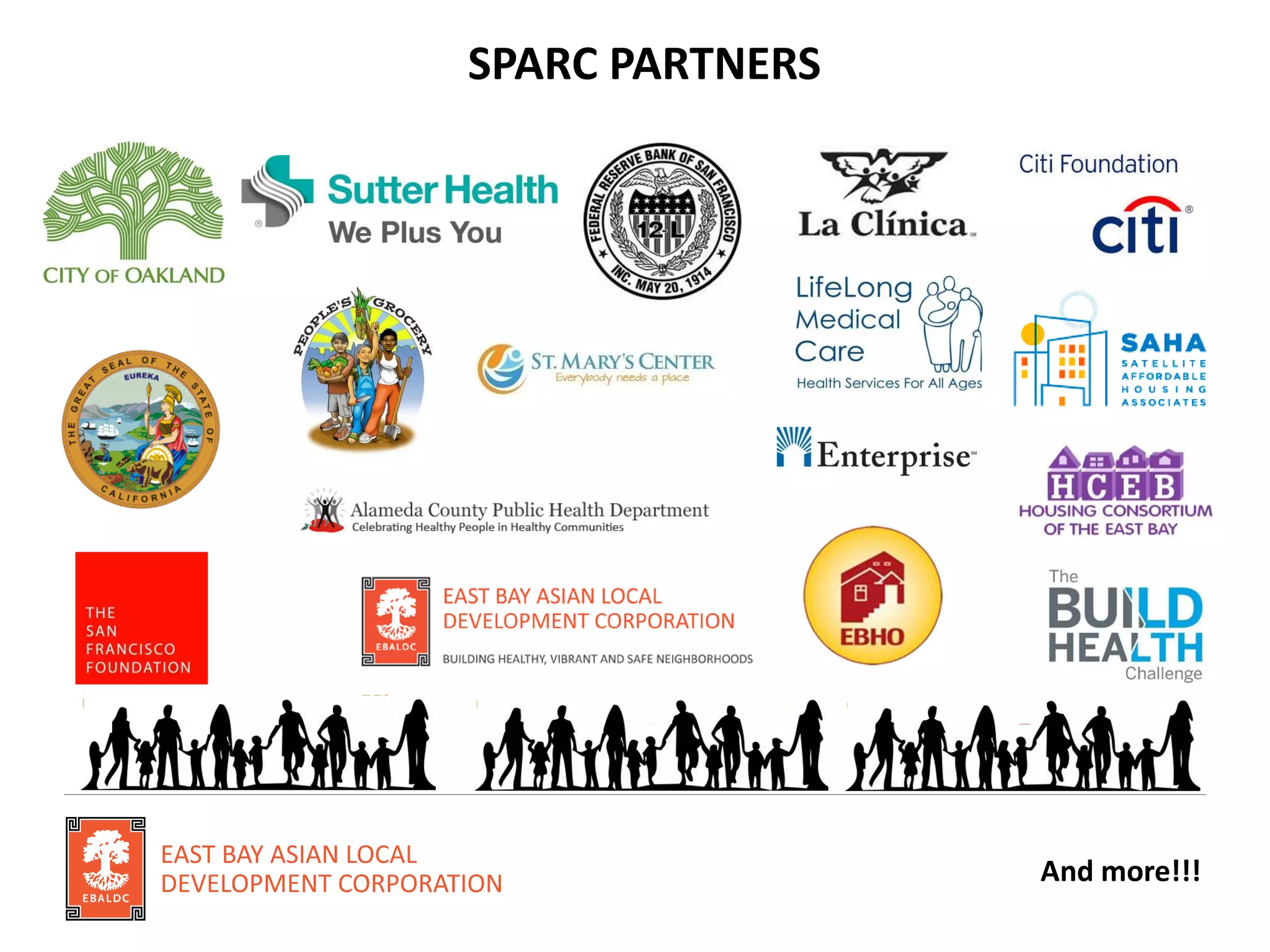
SPARC PARTNERS
And more!!!
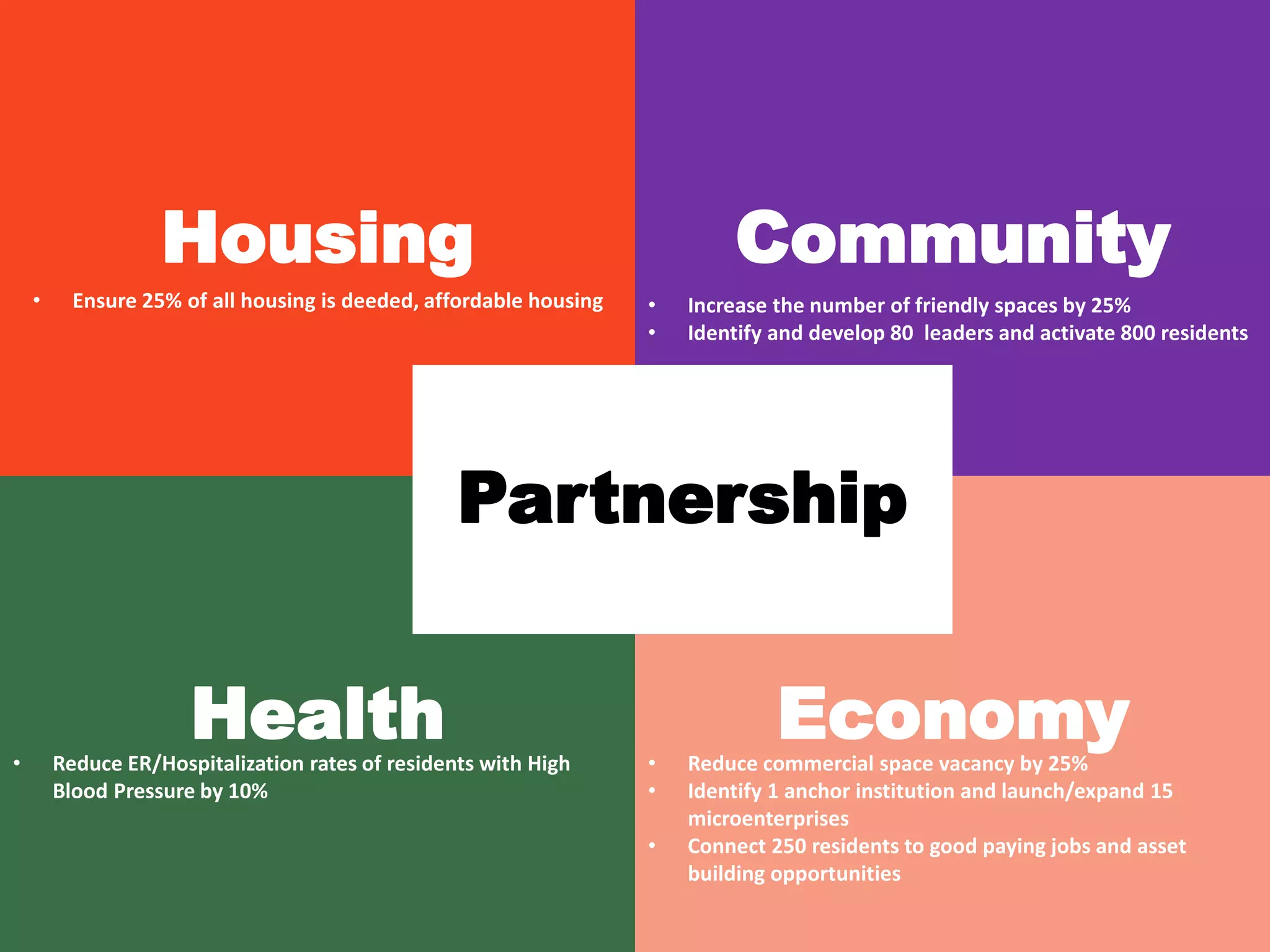
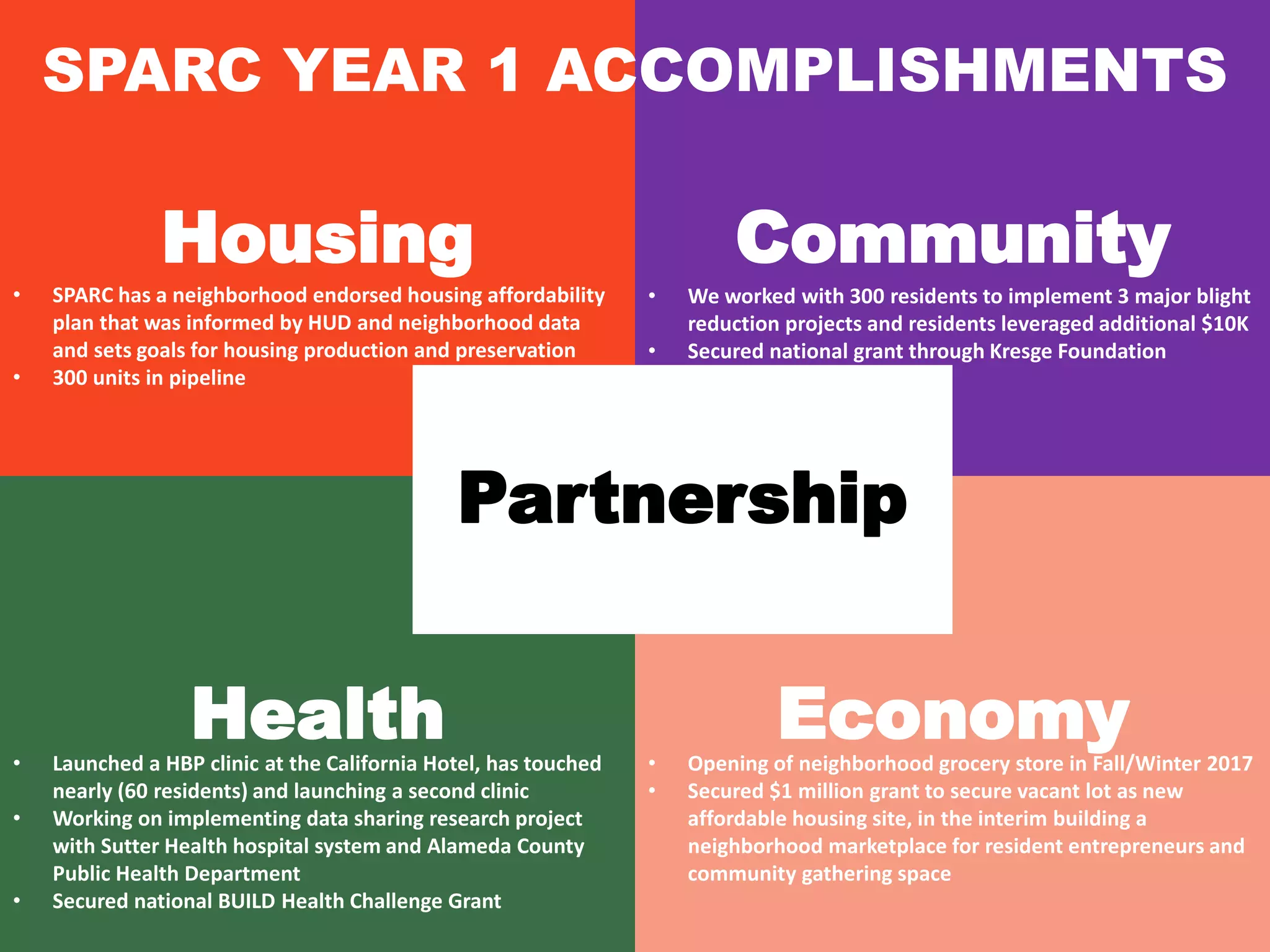
Housing Community
EconomyHealth
Partnership
• Ensure 25% of all housing is deeded, affordable housing • Increase the number of friendly spaces by 25%
• Identify and develop 80 leaders and activate 800 residents
• Reduce ER/Hospitalization rates of residents with High
Blood Pressure by 10%
• Reduce commercial space vacancy by 25%
• Identify 1 anchor institution and launch/expand 15
microenterprises
• Connect 250 residents to good paying jobs and asset
building opportunities
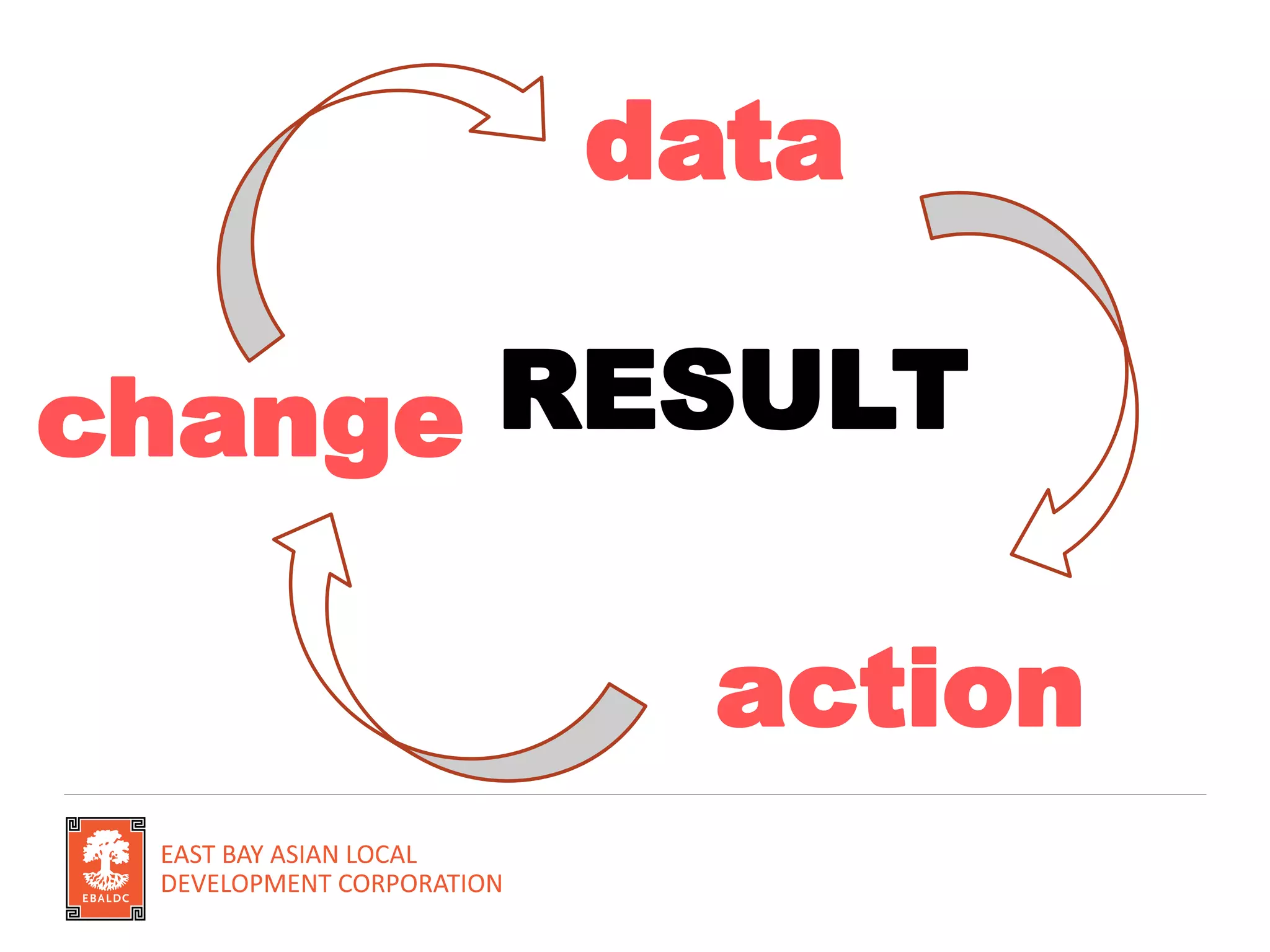
data
action
change RESULT
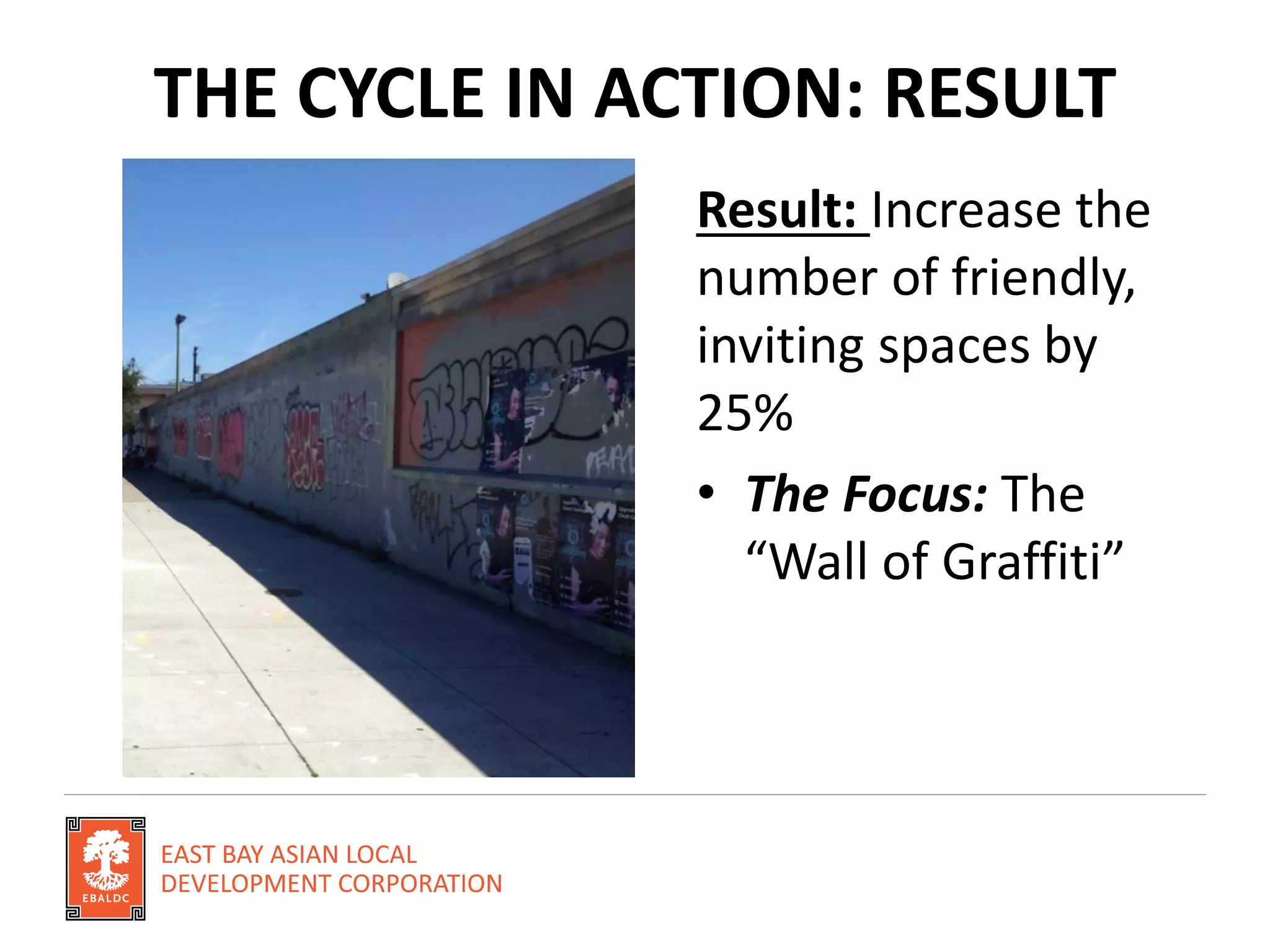
THE CYCLE IN ACTION: RESULT
Result: Increase the
number of friendly,
inviting spaces by
25%
• The Focus: The
“Wall of Graffiti”
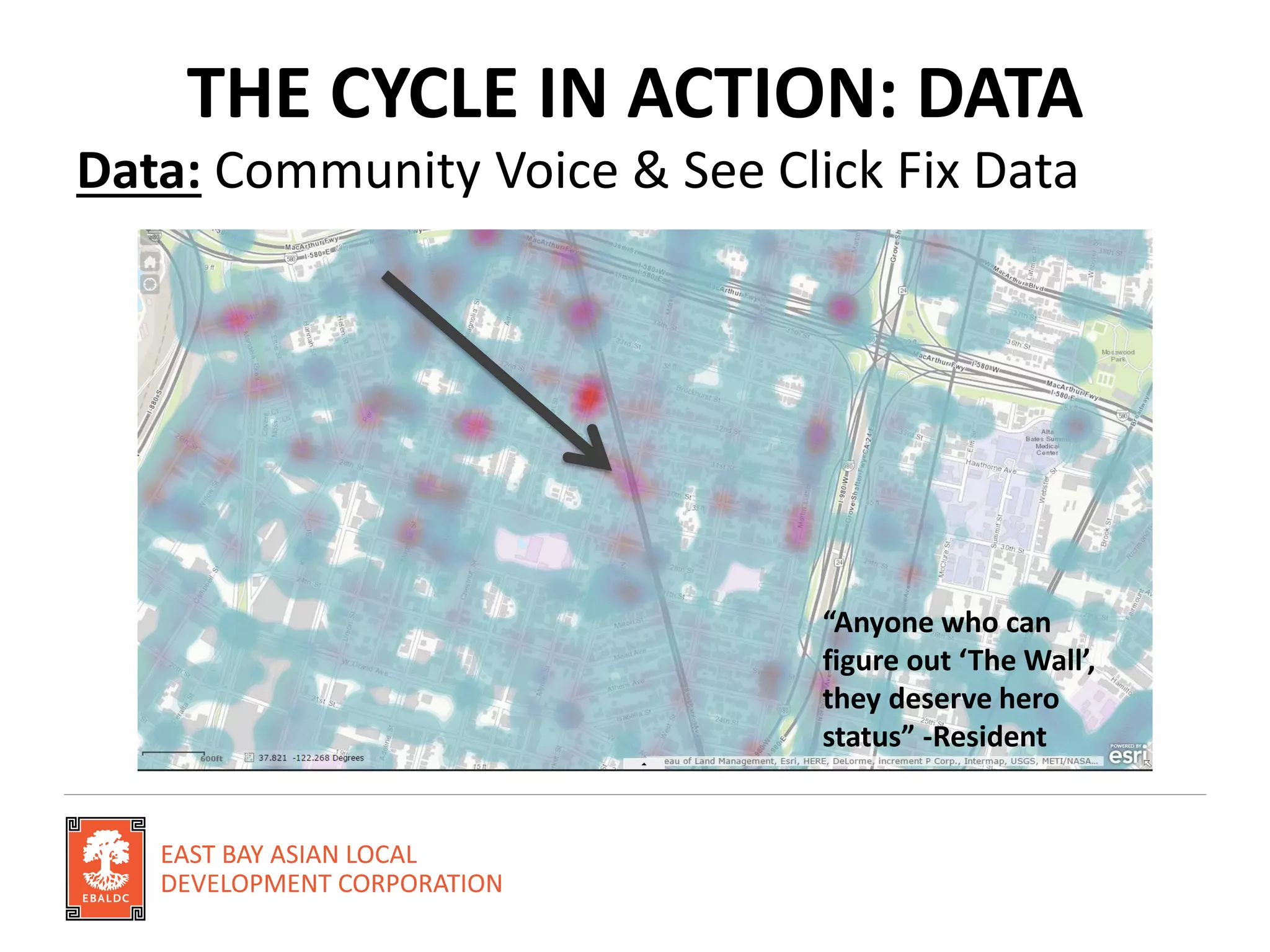
THE CYCLE IN ACTION: DATA
Data: Community Voice & See Click Fix Data
“Anyone who can
figure out ‘The Wall’,
they deserve hero
status” -Resident
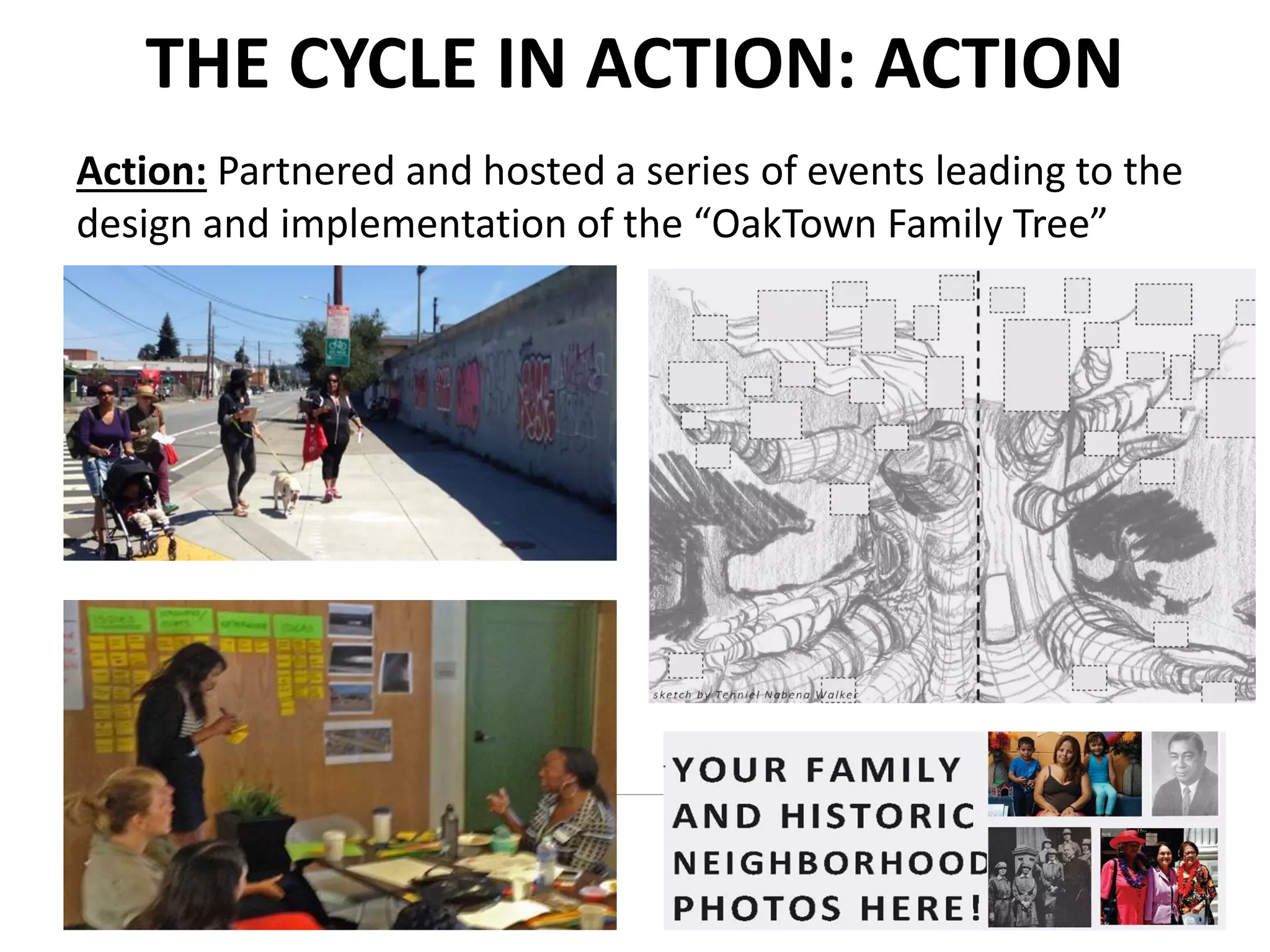
THE CYCLE IN ACTION: ACTION
Action: Partnered and hosted a series of events leading to the
design and implementation of the “OakTown Family Tree”
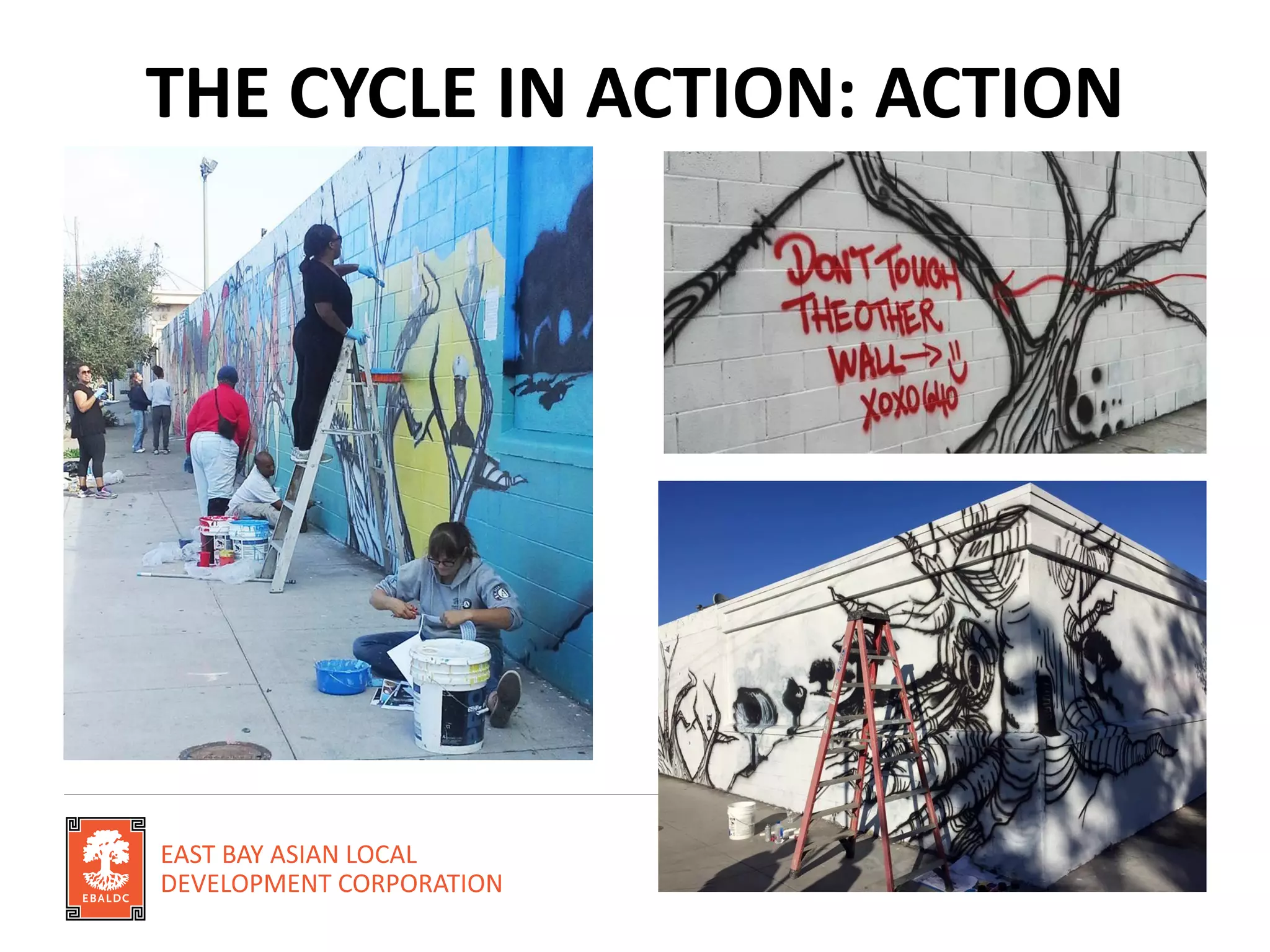
THE CYCLE IN ACTION: ACTION
THE CYCLE IN ACTION: CHANGE
Change:
– No “tagging on the wall” for five months!!
– Resident ownership- one more friendly space
– Close 250 residents participated in the process
– Working on next iteration of the project- a community designed
mural
Housing Community
EconomyHealth
Partnership
• SPARC has a neighborhood endorsed housing affordability
plan that was informed by HUD and neighborhood data
and sets goals for housing production and preservation
• 300 units in pipeline
• We worked with 300 residents to implement 3 major blight
reduction projects and residents leveraged additional $10K
• Secured national grant through Kresge Foundation
• Launched a HBP clinic at the California Hotel, has touched
nearly (60 residents) and launching a second clinic
• Working on implementing data sharing research project
with Sutter Health hospital system and Alameda County
Public Health Department
• Secured national BUILD Health Challenge Grant
• Opening of neighborhood grocery store in Fall/Winter 2017
• Secured $1 million grant to secure vacant lot as new
affordable housing site, in the interim building a
neighborhood marketplace for resident entrepreneurs and
community gathering space
SPARC YEAR 1 ACCOMPLISHMENTS
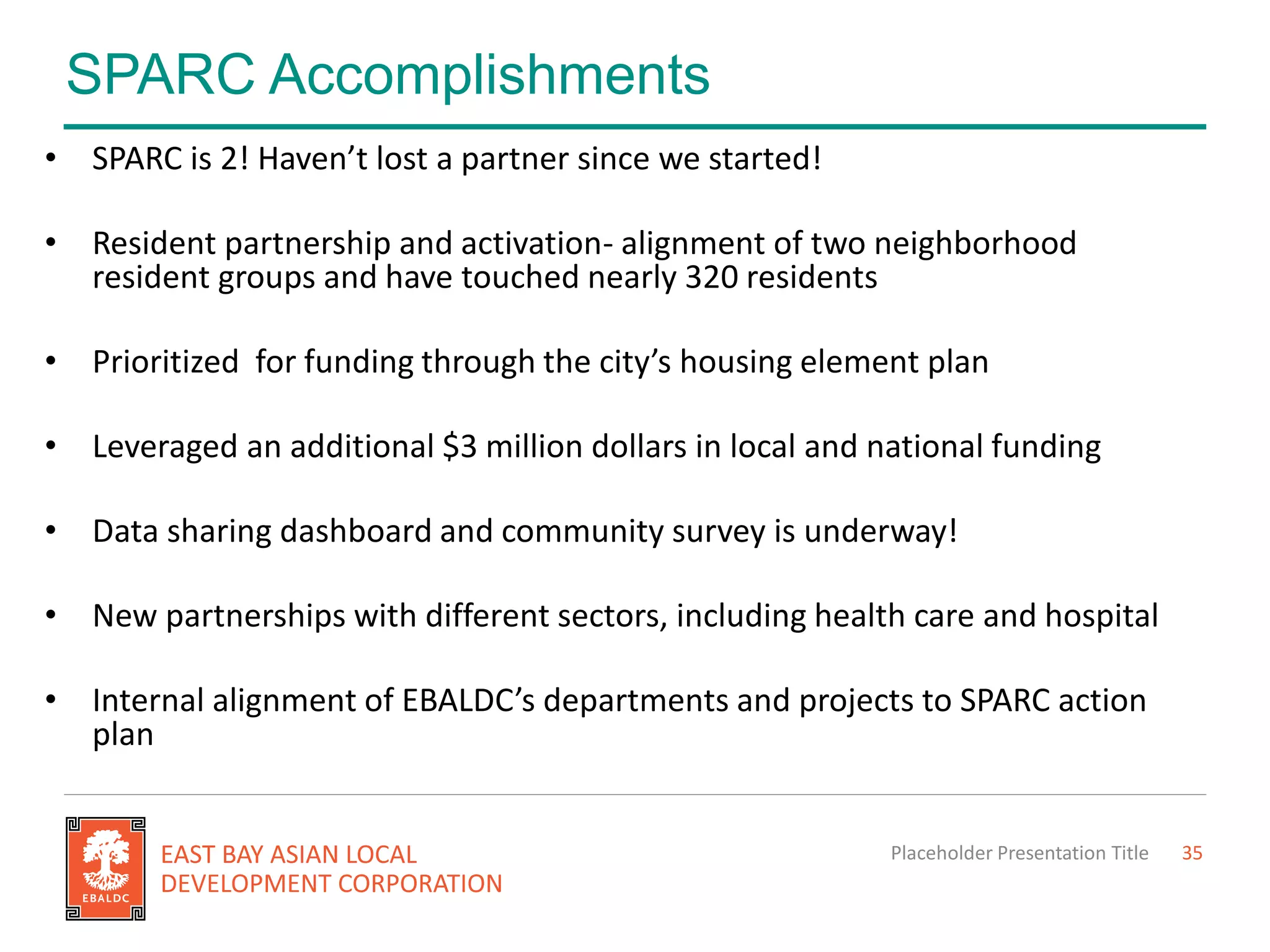
SPARC Accomplishments
Placeholder Presentation Title 35
• SPARC is 2! Haven’t lost a partner since we started!
• Resident partnership and activation- alignment of two neighborhood
resident groups and have touched nearly 320 residents
• Prioritized for funding through the city’s housing element plan
• Leveraged an additional $3 million dollars in local and national funding
• Data sharing dashboard and community survey is underway!
• New partnerships with different sectors, including health care and hospital
• Internal alignment of EBALDC’s departments and projects to SPARC action
plan
1. Each roundtable should break into two groups. With your roundtable sub-
group, please briefly introduce yourselves and discuss the following:
• Who you are and what sector you work in
• What brought you to this session
• If you participate in a collaboration or coalition, what is an issue your
collaboration is facing?
2. Pick one collaboration issue identified and discuss as a group. Identify one
actionable step to take within three months.
3. Think about what questions you’d like to ask EBALDC and PI based on the
presentation, the talk show, and/or the roundtable discussions.
Contact Information
Charise Fong, JD
Chief Operating Officer
cafong@ebaldc.org
Romi Hall, MPH
Healthy Neighborhoods Manager
rhall@ebaldc.org
Leslie Mikkelsen, MPH
Managing Director
leslie@preventioninstitute.org
Katie Miller, MPH
Associate Program Manager
katie@preventioninstitute.org

Components of a Successful Collaboration

  • 1.
    Components of a SuccessfulCollaboration Prevention Institute and East Bay Asian Local Development Corporation
  • 2.
    Practical Playbook NationalMeeting May 23, 2016 Leslie Mikkelsen, MPH Managing Director Katie Miller, MPH Associate Program Manager Components of a Successful Collaboration
  • 3.
    he determinants ofhealth are beyond the capacity of any one practitioner or discipline to manage… We must collaborate to survive, as disciplines and as professionals attempting to help our communities and each other. –Mitchel and Crittenden, Washington Public Health Fall 2000 “T ”
  • 4.
    Effective collaborations allow youto…  Accomplish a broad range of goals  Broaden buy-in  Identify areas for focus  Concentrate on comprehensive approaches
  • 5.
    The Spectrum ofPrevention Influencing Policy & Legislation Changing Organizational Practices Fostering Coalitions & Networks Educating Providers Promoting Community Education Strengthening Individual Knowledge & Skills
  • 6.
  • 7.
    Components of aCollaboration: An Eight Step Process 1.Analyze program objectives, determine whether to form a coalition 2. Recruit the right people 3. Devise preliminary objectives and activities 4. Convene the coalition 5. Anticipate necessary resources 6. Develop a successful structure 7. Maintain coalition vitality 8. Improve through evaluation
  • 8.
    Analyze objectives anddetermine whether to form a coalition. Developing Successful Collaborations 1 Photo credit: Healthy City STEP  Clarify current objectives  Examine approaches which might be effective  Assess current community strengths and needs
  • 9.
    Recruit the rightpeople.  Identify people working on the issue  Consider who has influence  Determine who will be supportive  Identify who may put obstacles in your path  Consider how many people should be involved STEP 2 Developing Successful Collaborations
  • 10.
    Other partners Expertise: Desired Outcomes: Key Strategies: Hospital Expertise: Desired Outcomes: KeyStrategies: Community organization Expertise: Desired Outcomes: Key Strategies: Health department Expertise: Desired Outcomes: Key Strategies: Shared Outcomes Partner Strengths Joint Strategies Collaboration Multiplier
  • 11.
    Set preliminary objectivesand activities.  Propose a variety of activities to meet members’ needs and skills  Identify short-term successes STEP 3 Developing Successful Collaborations
  • 13.
    Influencing Policy &Legislation Changing Organizational Practices Fostering Coalitions & Networks Educating Providers Promoting Community Education The Spectrum of Prevention Strengthening Individual Knowledge & Skills
  • 14.
    Anticipate the necessaryresources.  Clerical  Meeting planning, preparation and facilitation  Membership recruitment, orientation and encouragement  Research and data collection  Participation in activities and projects STEP 5 Developing Successful Collaborations
  • 15.
    Devise a successfulcoalition structure.  Should coalition be ad hoc or ongoing?  How long and frequent should meetings be?  Should agencies officially join the coalition?  How will decisions be made?  How will agendas be structured?  How much will members realistically participate between meetings? STEP 6 Developing Successful Collaborations
  • 16.
    Maintain the coalition’svitality.  Difficulties generally arise due to:  Poor group dynamics  Inadequate membership participation  Ineffective coalition activities  External changes which affect the coalition’s mission STEP 7 Developing Successful Collaborations
  • 17.
    Make improvements throughevaluation.  Ask for feedback  Evaluate the effectiveness of specific activities STEP 8  Know when it is time to dissolve, disband, or change the structure of the coalition Photo credit: Emily Barney Developing Successful Collaborations
  • 18.
    www.preventioninstitute.org 221 Oak Street Oakland,CA 94607 Sign up for our media alerts: www.preventioninstitute.org/alerts Leslie Mikkelsen, MPH leslie@preventioninstitute.org Katie Miller, MPH katie@preventioninstitute.org
  • 19.
    Charise Fong, JD ChiefOperating Officer cafong@ebaldc.org Romi Hall, MPH Healthy Neighborhoods Manager rhall@ebaldc.org www.ebaldc.org
  • 21.
    HEALTHY NEIGHBORHOODS ASTHE APPROACH 21
  • 22.
    COLLECTIVE IMPACT ASMETHODOLOGY 22
  • 23.
  • 24.
    San Pablo AreaRevitalization Collaborative (SPARC) Common Agenda: Residents and partners of the SPARC neighborhoods stabilize and equitably co-create together a safe, healthy, vibrant, and resilient neighborhood
  • 25.
    SPARC Planning andImplementation Placeholder Presentation Title 25 • EBALDC’s Healthy Neighborhoods Approach anchored the convening of partners • EBALDC selected as one of 14 communities across the nation to receive the Partners In Progress grant ($395K in 2 yrs) • As the “Community Quarterback”, EBALDC convened 14 multi-sector partners in early 2014 to co-create a neighborhood vision of health • During both planning and implementation phase of work, had an overall steering committee, work groups and data/evaluation advisory committee • Collaborative partners worked for eight months to create the San Pablo Area Revitalization Collaborative (SPARC) action plan
  • 26.
  • 27.
    Housing Community EconomyHealth Partnership • Ensure25% of all housing is deeded, affordable housing • Increase the number of friendly spaces by 25% • Identify and develop 80 leaders and activate 800 residents • Reduce ER/Hospitalization rates of residents with High Blood Pressure by 10% • Reduce commercial space vacancy by 25% • Identify 1 anchor institution and launch/expand 15 microenterprises • Connect 250 residents to good paying jobs and asset building opportunities
  • 28.
  • 29.
    THE CYCLE INACTION: RESULT Result: Increase the number of friendly, inviting spaces by 25% • The Focus: The “Wall of Graffiti”
  • 30.
    THE CYCLE INACTION: DATA Data: Community Voice & See Click Fix Data “Anyone who can figure out ‘The Wall’, they deserve hero status” -Resident
  • 31.
    THE CYCLE INACTION: ACTION Action: Partnered and hosted a series of events leading to the design and implementation of the “OakTown Family Tree”
  • 32.
    THE CYCLE INACTION: ACTION
  • 33.
    THE CYCLE INACTION: CHANGE Change: – No “tagging on the wall” for five months!! – Resident ownership- one more friendly space – Close 250 residents participated in the process – Working on next iteration of the project- a community designed mural
  • 34.
    Housing Community EconomyHealth Partnership • SPARChas a neighborhood endorsed housing affordability plan that was informed by HUD and neighborhood data and sets goals for housing production and preservation • 300 units in pipeline • We worked with 300 residents to implement 3 major blight reduction projects and residents leveraged additional $10K • Secured national grant through Kresge Foundation • Launched a HBP clinic at the California Hotel, has touched nearly (60 residents) and launching a second clinic • Working on implementing data sharing research project with Sutter Health hospital system and Alameda County Public Health Department • Secured national BUILD Health Challenge Grant • Opening of neighborhood grocery store in Fall/Winter 2017 • Secured $1 million grant to secure vacant lot as new affordable housing site, in the interim building a neighborhood marketplace for resident entrepreneurs and community gathering space SPARC YEAR 1 ACCOMPLISHMENTS
  • 35.
    SPARC Accomplishments Placeholder PresentationTitle 35 • SPARC is 2! Haven’t lost a partner since we started! • Resident partnership and activation- alignment of two neighborhood resident groups and have touched nearly 320 residents • Prioritized for funding through the city’s housing element plan • Leveraged an additional $3 million dollars in local and national funding • Data sharing dashboard and community survey is underway! • New partnerships with different sectors, including health care and hospital • Internal alignment of EBALDC’s departments and projects to SPARC action plan
  • 36.
    1. Each roundtableshould break into two groups. With your roundtable sub- group, please briefly introduce yourselves and discuss the following: • Who you are and what sector you work in • What brought you to this session • If you participate in a collaboration or coalition, what is an issue your collaboration is facing? 2. Pick one collaboration issue identified and discuss as a group. Identify one actionable step to take within three months. 3. Think about what questions you’d like to ask EBALDC and PI based on the presentation, the talk show, and/or the roundtable discussions.
  • 37.
    Contact Information Charise Fong,JD Chief Operating Officer cafong@ebaldc.org Romi Hall, MPH Healthy Neighborhoods Manager rhall@ebaldc.org Leslie Mikkelsen, MPH Managing Director leslie@preventioninstitute.org Katie Miller, MPH Associate Program Manager katie@preventioninstitute.org